JKSCI
Similarity Measure based on Utilization of Rating Distributions for Data Sparsity Problem in Collaborative Filtering
1)
Soojung Lee*
*Professor, Dept. of Computer Education, Gyeongin National University of Education, Anyang, Korea
[Abstract]
Memory-based collaborative filtering is one of the representative types of the recommender system, but it suffers from the inherent problem of data sparsity. Although many works have been devoted to solving this problem, there is still a request for more systematic approaches to the problem. This study exploits distribution of user ratings given to items for computing similarity. All user ratings are utilized in the proposed method, compared to previous ones which use ratings for only common items between users. Moreover, for similarity computation, it takes a global view of ratings for items by reflecting other users’ ratings for that item. Performance is evaluated through experiments and compared to that of other relevant methods. The results reveal that the proposed demonstrates superior performance in prediction and rank accuracies. This improvement in prediction accuracy is as high as 2.6 times more than that achieved by the state-of-the-art method over the traditional similarity measures.
▸Key words: Collaborative Filtering, Recommender System, Similarity Measure, Data Sparsity
[요 약]
메모리 기반의 협력 필터링은 추천 시스템의 대표적인 타입이지만 데이터 희소성이라는 본질적 인 문제를 갖고 있다 . 이 문제를 해결하기 위해 많은 연구 업적들이 이루어졌으나, 보다 체계적인 접근 방법은 여전히 요구된다. 본 연구는 사용자 간의 유사도를 산출하기 위하여 항목들에 대한 사용자 평가치 분포를 활용한다 . 따라서 제안 방법은 사용자의 모든 평가치를 이용하므로, 공통 항목에 대한 평가치만을 이용하는 기존 방법들과 대비된다 . 더욱이, 각 항목에 대한 다른 사용자 들의 평가치들을 유사도 계산에 반영함으로써 항목 평가치의 광역적인 관점을 취한다. 제안 방법 의 성능은 실험을 통하여 평가하였고 , 연관된 다른 방법들과 비교하였다. 그 결과, 제안 방법은 예측과 순위 정확도 측면에서 우수한 성능을 보였다 . 이러한 예측 정확도의 향상은 전통적인 유 사도 척도에 비해 최근의 방법으로 달성한 것보다 최고 2.6배 더 높다.
▸주제어: 협력 필터링, 추천 시스템, 유사도 척도, 데이터 희소성
∙First Author: Soojung Lee, Corresponding Author: Soojung Lee
*Soojung Lee ([email protected]), Dept. of Computer Education, Gyeongin National University of Education
∙Received: 2020. 10. 26, Revised: 2020. 12. 10, Accepted: 2020. 12. 10.
Copyright ⓒ 2020 The Korea Society of Computer and Information http://www.ksci.re.kr pISSN:1598-849X | eISSN:2383-9945
I. Introduction
Recommender systems have become essential in e-commerce areas these days. They assist customers to acquire useful information efficiently in time. Several types of recommender systems have been developed in literature[1]. Representative ones include content-based, collaborative, and hybrid filtering, but later demographic filtering, social network-based, knowledge-based, and trust-based filtering also draw attention of many researchers. In [2], the authors discuss five main hotspots, issues, and solutions of current recommendation system research.
Content-based filtering analyzes the user or item profiles to extract features that people might like for recommendation. Accordingly, it has shortcomings of reliance on the amount of profiles which is usually hard to obtain in reality. On the contrary, collaborative filtering (CF) is based on users’ interactions with the system such as explicit and implicit feedbacks. These feedbacks data are readily available in most current systems, thus giving more advantages to CF [1][2].
The principle of CF systems is that they analyze user feedbacks on items, find other users with similar responses, and recommend those items which other similar users called the nearest neighbors show preferences for. This methodology obviously creates two main issues: feedback data sparsity and scalability problems. These issues are related to the reliability and complexity of similarity measures [1][3].
Various similarity measures have been developed in literature. Major traditional measures include Pearson correlation, the cosine similarity, and the mean squared differences, while variants of those such as constrained Pearson correlation, Spearman rank, and the adjusted cosine are also designed [3].
All of these, however, heavily rely on the number of items co-rated by two users for computing similarity between the two users. Hence, if the user feedback data, mainly implemented as user ratings,
are sparse, the resulting similarity can not be reliable, thus producing poor recommendation.
Another issue of the scalability problem occurs due to the enormous number of users in the system which requires extensive time for similarity computation. As the number of users are usually much more than the number of items in most recommender systems, the scalability problem can be reduced by having similarity between items rather than between users and recommending items similar to those which the current user prefers in the past. This is called item-based CF systems [1][3].
This paper focuses on CF systems and addresses the data sparsity problem. Instead of utilizing the user ratings for only common items as in previous measures, the proposed method considers the distribution of ratings in computing similarity between users. Thus, all of the user ratings are taken into account. Moreover, it reflects the other users’ ratings for each item onto similarity computation to have a global view of ratings with respect to the item. The proposed method is experimented for performance evaluation to demonstrate superior results especially in prediction accuracy.
The remaining of the paper is organized as follows: Section 2 describes existing CF strategies for the data sparsity problem. The proposed method is presented in Section 3, followed by experimental results in Section 4. Section 5 concludes this paper.
II. Related Works
The approaches to the data sparsity problem in
CF systems for similarity computation can be
categorized into Jaccard index-based and rating
distribution-based. Jaccard index [4] is
representative, belonging to the first category. It is
defined as the ratio of the co-rated items among all
the items rated by the two users. This index is
usually incorporated into previous similarity measures to define a new measure. The work in [5]
incorporated Jaccard into the mean squared differences and reported to have better recommendation results. Sun et al. integrated Triangle [6] and Jaccard similarities to successfully improve the prediction errors [7]. Mu et al.
proposed an improved Common Pearson Correlation Coefficient measure and further combined it with global similarity Hellinger Distance [8] and Jaccard similarity [9]. In [10], Jaccard similarity is improved and integrated into the mean squared differences. They emphasized their proposed relevant Jaccard similarity performed more accurately and effectively than other traditional ones.
The rating distribution-based approaches utilize probability density distribution of ratings to calculate similarity. The benefit of this approach is that it uses all rating data as opposed to Jaccard index-based ones. In [11], Bhattacharyya coefficient (BC) is used to introduce a new similarity measure.
Kullback–Leibler(KL)-divergence is another distribution-based index measuring differences between two sequences. The difference between BC and KL-divergence is described in the study of [12].
Also, this study designed an item similarity measure based on the KL-divergence, which is used as a weight to correct the output of an adjusted Proximity–Significance–Singularity model [13]. Deng et al. also presented an item similarity measure based on the KL-divergence which identifies the relation between items based on the probability density distribution of ratings [14]. BC is further utilized in [12] such that it is incorporated into an existing nonlinear similarity computation model to recommend items with higher prediction accuracy. Meanwhile, Wang et al. proposed a more generalized concept of divergence named α -divergence for developing a new item similarity measure to address the sparsity problem and reduce the dependence on co-rated cases [15].
III. Proposed Methodology
1. Basic Idea
In order to take care of the issue of ratings data sparsity and obtain reliable similarities, we make use of the distribution of user ratings for similarity computation. The advantage of our strategy is:
First, it no more relies on common item ratings as in conventional similarity measures; Second, it utilizes all ratings provided by a user.
Assume that three users u, v, and w give a rating 4, 5, and 2 to an item x, respectively. Then it can be said that users u and v are more generous in giving ratings than user w, thus regarded more similar to each other, when confined to this item.
We utilize this point of rating behavior in our method. That is, the degree of generosity of users is reflected on the similarity formula.
2. Formulation of the Algorithm
Users have different opinions on movies and movies may have different range of ratings accordingly. There are some movies for which most users show high preference, thus producing small variations between user ratings, while the opposite cases also occur. Thus, each user rating for an item should be translated with respect to all the ratings given to the same item. Therefore, we make use of normalized user ratings and their distribution for each user. The detailed procedure follows.
1. Calculate the average (m x ) and standard deviation (σ x ) of the ratings given to each item x.
2. For a rating of user u for item x (r u,x ), convert it into z value (z u,x ) using
... (1) 3. Obtain the rating distribution of user u. That
is, let N u,z be the number of z rating values of user u and N u the total number of ratings of user u. Then the probability of normalized rating value z by user u is given as
...(2)
Once the distribution is obtained as above, we compute similarity between users based on their distributions. KL divergence is one of the well-known metrics that measures difference between two sequences from the perspective of probability distributions [16]. We use this metric for computing similarity. Specifically, we first adjust p u,z to make this value non-zero as suggested by [16] as follows.
...(3) where Z is the number of all possible z values. We use z values to include one decimal point and compute KL divergence between two users u and v as below, where ±4 are taken as a maximum and minimum possible values of z.
log
...(4) KL divergence is asymmetric as seen in the formula above. Hence, in order to have similarity symmetric, we finally compute similarity between the two users as follows.
...(5)
3. Example
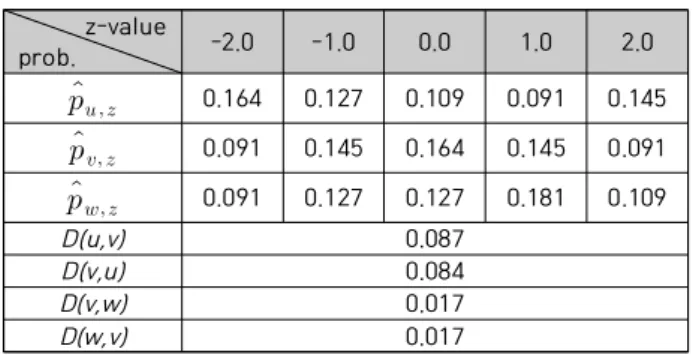
In this section, we give an illustration of the proposed similarity computation. Let us use an integer value of z within the range from –2 to 2 for simplicity. Assume that z distributions of three users u, v, and w are as presented in Table 1. The non-zero z values and KL-divergences can be computed as in Table 2 using Eq. (3) and (4). From this, similarity between two users is computed as
sim(u, v) = 1/(1+(0.087+0.084)/2) = 0.9212 sim(v, w) = 1/(1+(0.017+0.017)/2) = 0.9837
z-value
prob. -2.0 -1.0 0.0 1.0 2.0
0.4 0.2 0.1 0 0.3
0 0.3 0.4 0.3 0
0 0.2 0.2 0.5 0.1
Table 1. z distributions of user ratings
z-value
prob. -2.0 -1.0 0.0 1.0 2.0
0.164 0.127 0.109 0.091 0.145
0.091 0.145 0.164 0.145 0.091
0.091 0.127 0.127 0.181 0.109
D(u,v)
0.087
D(v,u)
0.084
D(v,w)
0.017
D(w,v)