Data envelopment analyses on evaluating efficiencies of satellite communication and broadcasting R&D outcomes in
Korea
Jaekyoung AhnP*P, Do-seob AhnP**P, and Bon-Jun KuP**P
ABSTRACT
Traditionally R&D evaluation has been performed by experts who can understand the contents of the study area very well. Recently extensive application of quantitative evaluation methods have been attempted for introducing the administrative management system that poses greater importance on records and results. More objective reviews on the R&D outcomes are called for gaining public supports.
In this paper a bibliometrical analysis is to be performed to evaluate satellite communication and broadcasting public R&D outcomes for last 7 years. Data envelopment analysis method is selected for evaluating the efficiencies of multiple outputs (papers, patents, royalties, technology transfers) where multiple inputs (number of researchers and R&D expenses) are given. R&D outcomes from 22 research institutes are being compared and satellite communication and broadcasting R&D efforts turn out to be highly efficient.
TKey WordsT
:
TData Envelopment Analysis, bibliometrical analysis, Satellite Communication and Broadcasting R&D
TT1T. Introduction
Over a decade there have been lots of efforts made by ETRI in the satellite communication and broadcasting R&Ds. Their research focuses on the development of satellite communications system for communications, ocean and meteorological satellite, development of satellite and terrestrial convergence technology for internet service on high-speed mobile vehicles, development of global navigation satellite system ground station and search and rescue beacon technologies, development of 21GHz band satellite broadcasting transmission technology, development of satellite IMT-2000+ technology, development of KOMPSAT satellite MCE system and etc. It is not too much to say that ETRI R&D outcomes represent for whole nation’s capabilities in those areas. By now it would be very well-timed to review their research outcomes and to examine their efficiencies in objective and quantitative
manner.
Traditionally R&D evaluation has been performed by experts who can understand the contents of the study area very well. Recently extensive application of quantitative evaluation methods have been attempted for introducing the administrative management system that poses greater importance on records and results. [4]
More objective reviews on the R&D outcomes are called for gaining public supports.
In this paper a bibliometrical analysis is to be performed to evaluate satellite communication and broadcasting public R&D outcomes for last 7 years. Bibliometrics is a set of methods used to measure the outcomes versus R&D expenditure in terms of citations and patents and so on. For example citation indices of a particular author, growth rate of a special area in academic journals, response time to get published are to be quantified easily via bibliometrics. [5]
By 2007, there were three research councils which are planning, supporting and assessing
* 서울산업대학교 산업정보시스템공학과 ([email protected]), ** 한국전자통신연구원 광역무선전송연구팀 논문번호 : K3-2-10 , 접수일자 : 2008년 12 월 19일, 최종게재논문통보일자 : 2008 년 12 월 26일
T
※
T 본 연구는 정보통신연구진흥원의 IT핵심원천기술개발사업의 일환으로 수행되었습니다. [2008-F-010-01, IMT-Advanced 위성접속기술 개발]governmental R&D institutes (In 2008, public council is merged into fundamental council, thereafter, the three councils are restructured into two councils.) They are comprised of fundamental, public and industrial science and technology areas. From 2000, each council announce annual assessment reports on the member institutes outcomes such as papers published, patents acquired, royalties and so on.
In this paper, satellite communication and broadcasting R&D outcomes are to be evaluated across the 22 governmental research institutes from the three research councils. Data envelopment analysis method is selected for evaluating the efficiencies of multiple outputs (papers, patents, royalties, technology transfers) where multiple inputs (number of researchers and R&D expenses) are given.
2. DEA methodology
Let’s assume that Decision Making Unit (DMU) converts multiple inputs into multiple outputs and refer to any entity that is to be evaluated. DEA (Data Envelopment Analysis) measures the efficiency of any DMU by obtaining the maximum ratio of weighted outputs to weighted inputs subject to the condition that the similar ratios for every DMU be less than or equal to unity. [1]
In a mathematical form,
Subject to
Here the yBrjB, xBijB are the known outputs and inputs of the jP
th
P DMU and the uBrB, vBiB ≥ 0 are variable weights to be determined by the solution of this problem. The indicated maximization then accords this DMU the most favorable weighting that the constraints allow.
Since DEA in its present form was first introduced in 1978, researchers in a number of fields have quickly recognized that it is an excellent and easily methodology for modeling operational processes for performance evaluations. [3] This has been accompanied by other developments. For instance, Choi[2] made an attempt to determine adequacy indices based on the DEA evaluation for basic science programs (General Research Grants, Creative Research Initiatives, Research Infrastructure Development, and Centers of Excellence) that have been granted by Korea Science and Engineering Foundation.
3. Data Collection
Probably data collection constitutes the most important and time consuming process in the data envelopment analysis. Two inputs, that are, number of researchers and R&D expenditures are recognized while four outputs (papers, patents, royalties, technology transfers) are identified. The annual reports issued by each three councils are different from each other, and even different from each year, too. Six common(not always, but most of the cases) input and output factors listed above are selected for efficiency evaluation. The annual reports have been available after 2000, and there are 7 years data points, thereof.
Among the 6 factors, patent and paper factors need more consideration for the analysis. Delving into the patents, there are domestic patents and international patents, and moreover there is an application for a patent or an acquisition of a patent. The papers published in SCI listed journals normally attract more preferences to the ones in non-SCI listed journals. To accommodate these situations, Choi[2] performed an AHP analysis to find out reasonable weights to derive a single value of patent factor as well as a single value of paper factor. The weights derived are as follows;
Patent Score = 0.06*No. of Domestic application + 0.26*No. of Domestic acquisition + 0.12*No. of Int’l application + 0.56*No. of Int’l acquisition
Paper Score = 0.8*No. of SCI listed +0.2*No.
of non-SCI listed
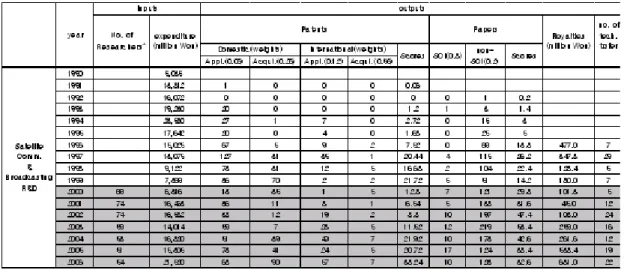
The R&D outcomes of ETRI on satellite communication and broadcasting are summarized in Table 1.
While 7 DMUs (Decision Making Units) are assigned to ETRI’s satellite communication and broadcasting R&D (shaded area in Table 1), there are 31 DMUs for fundamental councils, 18 DMUs for public councils, and 25 DMUs for industrial councils due to the limited data availability.
4. Analysis
There will be 5 evaluation categories to compare R&D efficiencies among all the DMUs.
Firstly, comparisons within the satellite communication and broadcasting (SatComm&Broad) R&Ds under the various combinations of the output factors are made. The results are shown in Table 2.
As shown Table 2, R&D outcomes in ‘01 turns out to be least efficient across all the output combinations while the outcomes in ‘00, ‘03, and
‘06 are most efficient along the whole output combinations.
Table 2: Comparison within SatComm&Broad R&D
Output combinations
Avg.
efficiency
Inefficient DMUs (Index)*
All factors 0.9384 ‘01(.57) Patent, paper 0.8895 ‘01(.50), ‘02(.74)
‘05(.99)
Patent, royalty 0.8782 ‘01(.50), ‘02(.74)
‘04(.91) Paper,
tech. transfer 0.9213 ’01(.57), ‘04(.88) Patent, paper,
royalty 0.8915 ‘01(.50), ‘02(.74)
(* 1.00 means most efficient while 0.00 means least efficient)
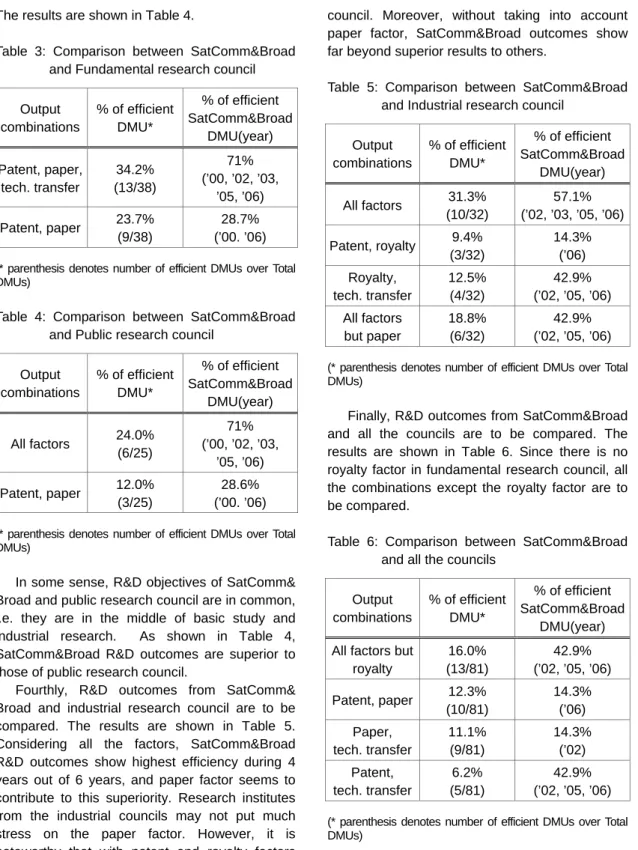
Secondly, R&D outcomes from SatComm&Broad and fundamental research council are to be compared. Due to the very limited data availability, only two output combinations are considered. The results are shown in Table 3.
Note that research institutes in fundamental councils tend to put more stress on papers and patents, however, SatComm&Broad efficiencies under the patent and paper output combinations are placed above the average performance.
Thirdly, R&D outcomes from SatComm&Broad and public research council are to be evaluated.
Table 1: R&D outcomes of ETRI on satellite communication and broadcasting
(No. of researchers are to be added up to 10% more reflecting additional administrative manpower)
The results are shown in Table 4.
Table 3: Comparison between SatComm&Broad and Fundamental research council
Output combinations
% of efficient DMU*
% of efficient SatComm&Broad
DMU(year) Patent, paper,
tech. transfer
34.2%
(13/38)
71%
(’00, ’02, ’03,
’05, ’06) Patent, paper 23.7%
(9/38)
28.7%
(’00. ’06)
(* parenthesis denotes number of efficient DMUs over Total DMUs)
Table 4: Comparison between SatComm&Broad and Public research council
Output combinations
% of efficient DMU*
% of efficient SatComm&Broad
DMU(year)
All factors 24.0%
(6/25)
71%
(’00, ’02, ’03,
’05, ’06) Patent, paper 12.0%
(3/25)
28.6%
(’00. ’06)
(* parenthesis denotes number of efficient DMUs over Total DMUs)
In some sense, R&D objectives of SatComm&
Broad and public research council are in common, i.e. they are in the middle of basic study and industrial research. As shown in Table 4, SatComm&Broad R&D outcomes are superior to those of public research council.
Fourthly, R&D outcomes from SatComm&
Broad and industrial research council are to be compared. The results are shown in Table 5.
Considering all the factors, SatComm&Broad R&D outcomes show highest efficiency during 4 years out of 6 years, and paper factor seems to contribute to this superiority. Research institutes from the industrial councils may not put much stress on the paper factor. However, it is noteworthy that with patent and royalty factors only, SatComm&Broad R&D activities in 2006 gain most efficiency compared to other industrial
council. Moreover, without taking into account paper factor, SatComm&Broad outcomes show far beyond superior results to others.
Table 5: Comparison between SatComm&Broad and Industrial research council
Output combinations
% of efficient DMU*
% of efficient SatComm&Broad
DMU(year) All factors 31.3%
(10/32)
57.1%
(’02, ’03, ’05, ’06) Patent, royalty 9.4%
(3/32)
14.3%
(’06) Royalty,
tech. transfer
12.5%
(4/32)
42.9%
(’02, ’05, ’06) All factors
but paper
18.8%
(6/32)
42.9%
(’02, ’05, ’06)
(* parenthesis denotes number of efficient DMUs over Total DMUs)
Finally, R&D outcomes from SatComm&Broad and all the councils are to be compared. The results are shown in Table 6. Since there is no royalty factor in fundamental research council, all the combinations except the royalty factor are to be compared.
Table 6: Comparison between SatComm&Broad and all the councils
Output combinations
% of efficient DMU*
% of efficient SatComm&Broad
DMU(year) All factors but
royalty
16.0%
(13/81)
42.9%
(’02, ’05, ’06) Patent, paper 12.3%
(10/81)
14.3%
(’06) Paper,
tech. transfer
11.1%
(9/81)
14.3%
(’02) Patent,
tech. transfer
6.2%
(5/81)
42.9%
(’02, ’05, ’06)
(* parenthesis denotes number of efficient DMUs over Total DMUs)
With all the factors except royalty, SatComm&
Broad R&D gains three most efficient
DMUs(’02, ’05, and ’06) among 81 DMUs while 7 DMUs from fundamental council, 1 DMU from public council, and 2 DMUs from industrial council are turned out to be most efficient. This result is quite encouraging to SatComm&Broad area. Even with the paper factor considered, one DMU from SatComm&Broad R&D are selected as one of the most efficient DMUs. Taking into account patent and technology transfer factors, DMUs from the industrial council are getting into higher efficient groups, while three DMUs (’02, ’05, ’06) from SatComm&Broad R&D attain highest efficiency.
5. Results
Comparisons within SatComm&Broad R&Ds under the various combinations of the output factors show that the outcomes in 2000, 2003, 2006 are most efficient along the whole output combinations. When comparing R&D outcomes from SatComm&Broad and fundamental research council, SatComm&Broad efficiencies under the patent and paper output combinations are placed above the average performance. Considering R&D objectives of SatComm&Broad and public research council are in common, higher efficiency of SatComm&Broad R&D activities deserves to be praised. It is also noteworthy that with patent and royalty factors only, SatComm&Broad R&D activities in 2006 gain most efficiency compared to other industrial council. Finally, with all the factors except royalty, SatComm&Broad R&D gains three most efficient DMUs(’02, ’05, and ’06) among 81 DMUs while 7 DMUs from fundamental council, 1 DMU from public council, and 2 DMUs from industrial council are selected as most efficient. These results are quite encouraging to SatComm&Broad R&D arena.
Reference
[1] A. Charnes, W. Cooper, and E. Rhodes,
“Measuring the efficiency of decision making units,” European Journal of Operational Research Vol. 2, 1978, pp429-444
[2] H. Choi, “Determination of adequacy indices based on performance analysis for basic
research programs,” KOSEF, 2007
[3] W. Cooper, L. Seiford, and J. Zhu, “Data envelopment analysis, History, Models and Interpretations,” Kluwer Academic Publishers, 2004
[4] D. Hicks, P. Knoll, et al., “Quantitative methods of research evaluation used by the U.S.
federal government,” NISTEP study material No. 86, 2002
[5] N. Sarafoglou and K. Haynes, “University productivity in Sweden: A demonstration and explanatory analysis for economics and business programs,” The annals of regional science, Vol. 30, 1996, pp285-304
U저 자 안 재 경(Jaekyoung Ahn) 정회원
1985년 2월: 서울대학교 산업공학과 졸업 1987년 2월: 서울대학교 산업공학과 석사 1991년 8월: The Univ. of
Iowa 산업공학 박사 1991년 10월~현재 서울산업
대학교 산업정보시 스템공학과 교수
<관심분야> 정보통신기술평가, 기술경제성분석, 위성통신응용
안 도 섭(Do-seob Ahn) 정회원
1988년 2월: 경북대학교 전자공학사 1990년 2월: 경북대학교
전자공학석사 1990년 2월~현재 한국전자
통신연구원 팀장 (책임연구원)
<관심분야> 위성통신, 성층권통신(HAPS)
구 본 준(Bon-Jun Ku) 정회원 1995년 2월: 경북대학교
전자공학사 1999년 2월: 경북대학교
전자공학석사 1999년 3월~현재 한국전자
통신연구원 선임연구원
<관 심 분 야 > 고 고 도 통 신 , 디 지 털 빔 형 성 , 위 성 통 신