Relevance between oral health life practices and oral discomforts in elderly school participants in W urban-rural complex city
Eun-Mi Choi
1, Hae-Kyung Hong
1, Young-Nam Kim
2, Min-Jin Cho
3, Dae-il Kim
4*1Professor, Dept. of Dental Hygiene, Kyungdong University
2Professor, Dept. of Dental Hygiene, Kyungbok University
3Professor, Dept. of Dental Hygiene, Daewon University
4Professor, Dept. of Architectural Design, Kyungdong University
도농복합도시 W시 노인대학생의 구강건강생활 실천도와 구강불편감과의 관련성
최은미
1, 홍해경
1, 김영남
2, 조민진
3, 김대일
4*1경동대학교 치위생학과 교수, 2경복대학교 치위생과 교수
3대원대학교 치위생과 겸임교수, 4경동대학교 건축디자인학과 교수
Abstract This study aims to analyze the relevance between oral health practices and oral discomforts of the elderly in an urban-rural area by surveying the elderly in welfare centers for the Elderly-continued oral health care program. The result shows that the elderly brush their teeth under regular oral care, and practice oral health life by scaling for the prevention of periodontal disease. Most of the elderly who drink alcohol have experienced implant care and tend to quit drinking after the treatment, and seemed to get their oral discomfort relieved. However, no relevance is found between implant experiences and social discomfort. Furthermore, the elderly who had bad breath expressed pronunciation, taste, pain and chewing discomfort, and social discomfort (P>.05). The educational level of the elderly did not have an impact on oral discomfort, but smoking, chewing and bad breath discomfort seemed to be related to social discomfort(P>.05). Therefore, since oral discomfort of the elderly causes social discomfort which decreases their quality of living, we recommend oral health departments of local governments to help the elderly maintain happy lives by continuing to study the practical use of reducing oral discomfort.
Key Words : Oral Health, Elderly People, Chewing Discomfort, Implant, Social Discomfort
요 약 본 연구는 도농복합지역 복지센터 노인들을 대상으로 구강불편감과 구강건강생활 실천도와의 관련성을 분석한 결과 계속구강건강생활습관이 있는 대상자는 정기구강검진과 스켈링, 식사 후와 잠자기 전에 칫솔질을 하는 것으로 나타났다. 임플란트 치료를 받은 경우 음주와 관련이 있었으며, 치료 후에는 절주를 하게 되고, 저작이나 식사 불편감이 낮아지는 것으로 나타났다. 반면 구취발생은 사회적 불편감과 관련이 있었으며, 발음불편감은 미각이나, 동통, 저작불 편을 호소하는 것으로 나타났다(
P
>.05). 노인들의 구강불편감은 교육수준과는 차이가 없었으나, 흡연, 저작불편감, 구 취불편감 등이 사회적 불편감과 관련이 있었다(P
>.05). 결과적으로 노인들의 구강불편감은 사회적불편감을 발생시켜 삶의 질을 저하시키기 때문에 계속구강건강관리를 실시하여 노년기의 삶을 행복하게 유지할 수 있도록 지역사회 구강 보건 팀이 공동으로 노력해야 할 것으로 사료되었다.주제어 : 구강건강, 노인, 저작불편감, 임플란트, 사회적불편감
*Corresponding Author : Dae-il Kim([email protected])
Received April 4, 2019 Revised May 8, 2019
Accepted June 20, 2019 Published June 28, 2019
1. Introduction
According to the report on "Future Population Estimation" from the Korea National Statistical Office, the elderly population over age 65 increased 11% in 2011, 14% in 2018, and it will reach 20% in 2025 which means to enter an aging society (2016 National Statistical Office).
With the growth of the elderly population, the desires for education and economic activity for the elderly as well as the requirement to welfare policies of local and national governments has also increased.
Elderly people spend their time with other elderly people of similar ages by regularly visiting senior schools, welfare centers, and senior community centers. Dr. Hyo Seob Han[1]
established the Haneol elderly school, the first Korean elderly school, and developed the elderly schools by promoting education and social participation, and by improving awareness of the elderly. The classes for elderly people at the senior welfare center, an affiliated organization of the Korean Senior Citizens Association, offer various programs for entertainment and leisure time. Recently, health care programs supervised by public health centers teaching geriatric and chronic disease managements are the most active programs at senior welfare facilities or senior community centers. The elderly welfare act, which was promulgated as law no. 3453 on June 5th, 1981, was an act to take necessary measures to maintain the health of the mind and body of the elderly and to stabilize their lives. The law was revised to law in 1993, which prescribes health promotion and the right use of leisure for senior citizens[2]. The majority of elderly people in the urban-rural area spend their leisure time at senior community centers or welfare centers and access cultural activities by participating in health care, yoga, or singing classes supervised by local governments.
The elderly school participants of the senior
welfare center in W city usually participate in festivals or events provided by local communities, volunteer work supervised by cities or provinces, lifelong education programs of universities in neighborhoods, or health care classes and medical service activities during the day.
Oral health is closely related to whole-body health for the elderly. Especially, since the mouth is the first stage of the digestive tract, oral health is highly connected to whole-body health according to the tooth retention rate. In terms of Oral Health Policy for the Elderly of South Korea[3], efforts has been made to extend tooth life by maintaining the number of natural teeth up to 20 by 2020, to resolve discomforts when the elderly chew food by reducing complaint rate of chewing discomfort to 45%, and to enhance oral health of the elderly by increasing the regular oral examination rate to 30%. Since the oral health condition, socio-economic characteristics and chewing function of the elderly people are related to the awareness of oral health[4], and most elderly only receive dental care when oral symptoms appear, oral health behavior needs to be improved by developing regular oral examinations and oral care education programs as well as institutional support[5]. Prevention and management of oral diseases are important, given that lifestyle-related diseases also affect oral health depending on the degree of care[6].
The elderly in South Korea were provided relatively fewer opportunities to take professional personal oral care such as oral health education or preventive treatments in comparison with their interest in oral health.
Therefore, they have to live with chronic oral
discomforts. Most of the elderly have a strong
desire to live healthy lives. However, considering
that the poor oral health of the elderly has been
induced by family, local community
organizations, and the government, refusing to
accept the elderly's health care problem as an
issue is problematic. Research in Korea also
shows that tooth loss of the elderly influences their oral health and quality of life[7]. It says that the fewer number of teeth remaining, the lower the quality of life[4]. In terms of the oral conditions of the South Korean elderly in 2015, the average numbers of remaining teeth was 17.5, the ratio of patients without natural teeth was 9.2%, the ratio of patients in need of denture was 22.7%, which indicates poor oral conditions compared to national economic growth rate[8].
Due to the biological characteristics of the elderly, which cause decreased myocardial function, reduced salivation, and decreased oral health care ability, they suffer from chewing discomfort, taste discomfort, bad breath, and dry mouth. In this oral condition, if a person wears dentures or has few remaining teeth, lives in an edentulous state without dentures, these ultimately cause several oral discomforts.
Therefore, the oral discomfort of elderly people work as vital factors to aggravate qualify of life, since they usually accompany daily discomfort as well as social discomfort[9]. As a result, the oral health of the elderly is the most significant factor to maintain health and improve quality of life.
Thus, identifying the influence of oral discomfort by researching oral health life practices which show oral health conditions and habits of the elderly is meaningful. In this context, this study aims to develop a program which helps to enhance oral health of the elderly in local community by identifying the relevance among the following factors: what causes oral discomfort of the elderly school participants in local communities where they are enter an aging society; and how important oral health life practices are in reducing oral discomforts.
2. Research subjects and methods 2.1 Research subjects and tools
This study surveyed 127 participants, 28 male participants (23.1%), 93 female participants (76.9%), of senior welfare centers and elderly schools in M county, Wonju-si, from September to October of 2017. Among them, we used 121 responses as a resource, except for 6 reponses which did not respond or gave insufficient responses. We chose subjects from participants of Elderly Continued Oral Health Care of university by using G*Power 3.1.9.2 program and applying odds ratio(OR) to 2.0. For this study, we produced samples with the power of the test (1- β)=.95, significant level ⍺=.05, effect size=0.3 (KDU IRB no.1041455-2017-06-HR-002-01).
2.2 Research method and data analysis For the analysis of this research, we used SPSS software program(SPSS 20.0, SPSS Inc., Chicago, USA). We used t-test for analyzing regular oral examinations, one-way ANOVA for oral health care practices and oral discomforts, and Scheffe multiple range test for post-analysis. The reliability of the statistics was Cronbach ⍺
.646.3. Results
3.1 Regular oral examination and oral care life practices
Among subjects who take regular
examinations, the most meaningful difference
appeared in brushing after meals and brushing
before sleep( P >.05). In terms of the gender
difference, female respondents showed the
biggest differences in brushing after meals,
brushing to prevent periodontal disease, scaling
to prevent periodontal disease, and plaque
removal and scaling to prevent periodontal
disease( P >.05).
Classification F p-value t df p-value (both)
Mean
Difference Std. Error OR(95% CI)
Low High
Brushing after Meals 40.749 .000 -3.072 92.717 .003 -.152 .049 -.250 -.054
Brushing before Sleep 6.222 .014 -1.242 117.683 .217 -.082 .066 -.214 .049
Oral Hygiene care devices
experience 2.035 .156 -.983 119 .327 -.090 .092 -.272 .091
Knowledge of Interdental
Cleanliness .027 .870 1.763 105.733 .081 .440 .250 -.055 .935
Knowledge of Tongue
Cleanliness 1.681 .197 1.284 119 .202 .327 .255 -.177 .832
Preventing periodontal
disease and Gums .387 .535 1.866 119 .064 .390 .209 -.024 .803
Scaling and periodontal
disease .024 .876 4.969 106.812 .000 1.096 .220 .658 1.533
Prevention and Scaling 2.174 .143 2.974 119 .004 .583 .196 .195 .971
Bacterial membranes and Calculus cause periodontal disease
.002 .963 2.922 110.528 .004 .603 .206 .194 1.011
Table 1. Regular examination and oral health care practices
Classification F p-value t df p-value
(both)
Mean
Difference Std. Error
OR(95% CI)
Low High
Drinking alcohol experience 23.269 .000 2.715 118.941 .008 .130 .048 .035 .225
Smoking experience 1.562 .214 .613 119 .541 .032 .052 -.071 .134
After meals TBI 7.883 .006 -1.524 103.492 .131 -.080 .052 -.184 .024
Before sleep TBI .551 .459 .376 119 .707 .028 .073 -.118 .173
Oral Hygiene care devices
experience .154 .696 -2.986 119 .003 -.282 .095 -.469 -.095
Continue to Program 10.106 .002 -1.657 98.648 .101 -.102 .061 -.224 .020
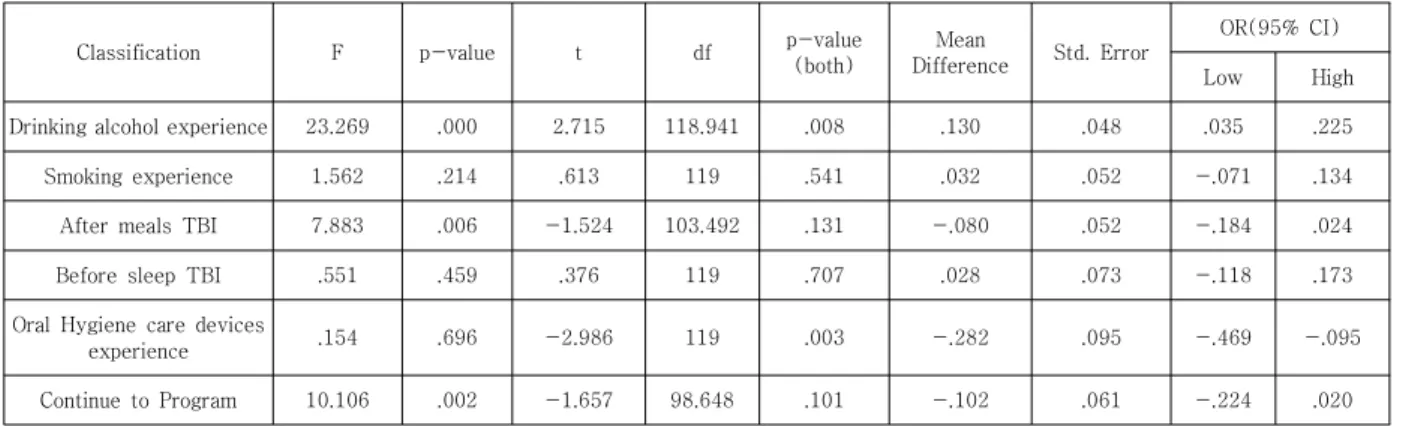
Table 2. Oral health life practices according to implant experience
3.2 Oral health life practices according to implant experience
In respect to implant experience, the responses of drinking habits, brushing after meals, and intention to be involved in the Continued Oral Health program showed statistically meaningful differences( P >.05). In terms of the gender difference, subjects who experienced implants did not show differences between brushing after meals and intention to involve in Continued oral health program, whereas a meaningful gender difference is shown in oral health life practices in case of temperance for implant care and intention to involve in Continue oral health program( P >.05).
3.3 Oral discomfort according to implant experience
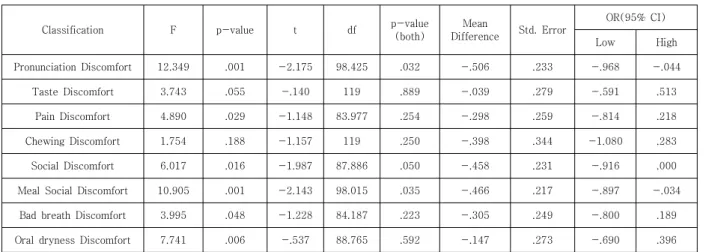
Oral discomforts according to implant experience shows meaningful differences in pronunciation discomfort, pain discomfort, meal discomfort, bad breath, dry mouth, and social discomfort( P >.05). However, there are no significant differences shown in taste discomfort or chewing discomfort according to implant experience. Also, pronunciation discomfort, meal discomfort, and social discomfort show meaningful difference according to implant experience and gender difference( P >.05).
Classification F p-value t df p-value (both)
Mean
Difference Std. Error
OR(95% CI)
Low High
Taste Discomfort 5.580 .021 -2.113 39.885 .041 -.679 .321 -1.329 -.029
Pain Discomfort 3.556 .064 -.718 64 .476 -.220 .306 -.831 .392
Social Discomfort 5.676 .020 -2.725 38.463 .010 -.516 .189 -.899 -.133
Oral dryness Discomfort .384 .538 -3.168 64 .002 -1.196 .378 -1.950 -.442
Oral Hygiene care devices
experience 5.050 .028 -1.160 53.190 .251 -.143 .124 -.391 .105
Knowledge of interdental
cleanliness .007 .933 1.217 64 .228 .396 .326 -.254 1.046
Knowledge of tongue
cleanliness 3.990 .050 1.341 43.687 .187 .480 .358 -.242 1.202
Table 4. Oral discomfort according to bad breath
Classification F p-value t df p-value
(both)
Mean
Difference Std. Error
OR(95% CI)
Low High
Pronunciation Discomfort 12.349 .001 -2.175 98.425 .032 -.506 .233 -.968 -.044
Taste Discomfort 3.743 .055 -.140 119 .889 -.039 .279 -.591 .513
Pain Discomfort 4.890 .029 -1.148 83.977 .254 -.298 .259 -.814 .218
Chewing Discomfort 1.754 .188 -1.157 119 .250 -.398 .344 -1.080 .283
Social Discomfort 6.017 .016 -1.987 87.886 .050 -.458 .231 -.916 .000
Meal Social Discomfort 10.905 .001 -2.143 98.015 .035 -.466 .217 -.897 -.034
Bad breath Discomfort 3.995 .048 -1.228 84.187 .223 -.305 .249 -.800 .189
Oral dryness Discomfort 7.741 .006 -.537 88.765 .592 -.147 .273 -.690 .396
Table 3. Oral discomfort according to implant experience
3.4 Oral discomfort according to bad breath Oral discomforts according to the experience of bad breath show meaningful differences in taste discomfort, social discomfort, oral hygiene care devices experience, and knowledge of tongue cleanliness ( P >.05).
3.5 Oral discomforts according to meal discomfort
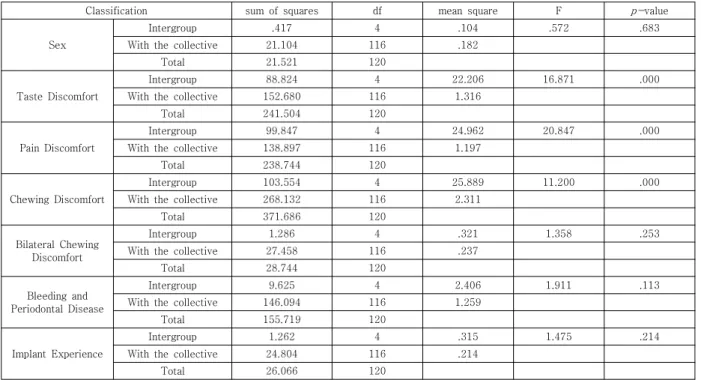
Oral discomforts according to meal discomfort show significant differences in taste discomfort, pain discomfort, and chewing discomfort( P >.05), there is no differences in oral discomforts according to gender, bilateral chewing, bleeding and periodontal disease.
3.6 Trigger factors of social discomfort In terms of trigger factors for social discomfort, it is found that educational level, implant experience, and chewing discomfort do not have strong relevance, whereas smoking, chewing discomfort, meal discomfort, bad breath, taste discomfort, pain discomfort, and social discomfort have meaningful relevances( P >.05).
Furthermore, oral discomforts from
pronunciation discomfort, taste discomfort, pain
discomfort, and chewing discomfort show
meaningful differences( P >.05).
Classification sum of squares df mean square F p-value
Sex
Intergroup .417 4 .104 .572 .683
With the collective 21.104 116 .182
Total 21.521 120
Taste Discomfort
Intergroup 88.824 4 22.206 16.871 .000
With the collective 152.680 116 1.316
Total 241.504 120
Pain Discomfort
Intergroup 99.847 4 24.962 20.847 .000
With the collective 138.897 116 1.197
Total 238.744 120
Chewing Discomfort
Intergroup 103.554 4 25.889 11.200 .000
With the collective 268.132 116 2.311
Total 371.686 120
Bilateral Chewing Discomfort
Intergroup 1.286 4 .321 1.358 .253
With the collective 27.458 116 .237
Total 28.744 120
Bleeding and Periodontal Disease
Intergroup 9.625 4 2.406 1.911 .113
With the collective 146.094 116 1.259
Total 155.719 120
Implant Experience
Intergroup 1.262 4 .315 1.475 .214
With the collective 24.804 116 .214
Total 26.066 120
Table 5. Oral discomforts according to meal discomfort
Classification sum of squares df mean square F p-value
Education
Intergroup 24.413 4 6.103 2.229 .070
With the collective 317.669 116 2.739
Total 342.083 120
Smoking
Intergroup .881 4 .220 3.431 .011
With the collective 7.449 116 .064
Total 8.331 120
Chewing Discomfort
Intergroup 75.762 4 18.940 7.425 .000
With the collective 295.924 116 2.551
Total 371.686 120
Meal Discomfort
Intergroup 97.112 4 24.278 29.317 .000
With the collective 96.061 116 .828
Total 193.174 120
Bad breath Discomfort
Intergroup 103.044 4 25.761 25.572 .000
With the collective 116.857 116 1.007
Total 219.901 120
Implant Experience
Intergroup 1.241 4 .310 1.450 .222
With the collective 24.825 116 .214
Total 26.066 120
Taste Discomfort
Intergroup 83.618 4 20.905 15.359 .000
With the collective 157.886 116 1.361
Total 241.504 120
Pain Discomfort
Intergroup 93.703 4 23.426 18.735 .000
With the collective 145.041 116 1.250
Total 238.744 120
Bilateral Chewing Discomfort
Intergroup .793 4 .198 .822 .513
With the collective 27.951 116 .241
Total 28.744 120
Table 6. Trigger factors of social discomfort
4. Discussion
Most of the elderly people living in an urban-rural area work for family farms during farming season. During non-farming season, they spend their leisure times participating in various programs run by local society. Such an environment helps the elderly people to maintain regular living patterns as well as to keep physically and mentally healthy life. Particularly, oral health and whole-body health of the old age are closely related to quality of life. The elderly people in an urban-rural area usually visit health center or health clinic for their health care.
It needs to approach with whole-body health perspective, since oral health, like the health of other organs, is influenced by physical, mental, and social impact[10]. The social support system also gives major impact to health behaviors or health levels of the elderly[11].
In this research, we found that elderly people who receive oral examinations regularly are highly aware of oral health; they brush after meals and before sleep( P >.05). and brush after meals or do scaling to prevent periodontal disease. Especially, given that the elderly people who take regular oral examinations have prevented periodontal disease by dental plaque and calculus removal, the elderly in an urban-rural area form proper oral health care practices( P >.05).
The oral health of the elderly is highly relevant to whole-body health[12]. Especially, since tooth decay or periodontal disease are classified as chronic disease such as high blood pressure or diabetes, whole-body health and oral diseases need to be related when the elderly are diagnosed or suggested health care management.
As we analyze oral care life practices of patients who have received implant care for recovering missing teeth from tooth loss, obvious gender difference is shown in temperance and continuous care. Most of the patients who experienced implant care have drinking habits
and begin temperance only after implant care.
Moreover, the people with implant care experience have brushing habits after meals and intend to keep participating in the Continue to Oral Health Program by life cycle( P >.05). It is considered that the difficulty of recovery of perfect function of missing teeth equal to that of natural teeth by implant care and the maintenance after the implant care becomes the motivation to recognize the importance and necessity of continuous dental and oral health care.
Oral discomforts, depending on inplant care experience, show differences in pronunciation discomfort, pain discomfort, meal discomfort, bad breath discomfort, oral dryness discomfort, social discomfort; female patients show bigger differences than male patients( P >.05). As a research evaluating chewing ability of patients after implant surgery indicates that the masticatory forces of those patients is improved[13], the result of this study also discovered that patients show improved chewing ability but reduced meal discomfort after implant surgery. However, given that implant experience does not trigger social discomfort, implant care is considered as a symbol of economic prosperity, since prosthesis is only afforded to the elderly with economic ability.
The result of comparative research on oral discomforts, which included taste discomfort, knowledge of tongue cleanliness, social discomfort, and whether to use oral care products or not, shows meaningful difference( P >.05). Bad breath is an unpleasant smell that occurs both in healthy and unhealthy persons depending on their physical and mental status. Among several causes of bad breath, there is senile bad breath[14].
As our comparative research by gender on the
incidence of bad breath of the elderly people,
female elders show meaningful differences in
pronunciation discomfort, meal discomfort, and
social discomfort( P >.05); oral discomfort
according to pronunciation discomfort causes
taste discomfort, pain discomfort, and chewing discomfort( P >.05).
The oral discomforts accompanied with aging of the elderly rapidly increases. Oral pain caused by missing teeth, dry mouth, prosthesis, and periodontal disease leads to meal discomfort and chewing discomfort, which worsen oral discomforts. Also, oral pain causes social discomfort and makes daily life inconvenient, and finally decreases quality of life. Thus, Kim[15] insists that the elderly with oral tooth decay or dentures have increased chewing or pronunciation discomforts, while subjective oral health level of the elderly with periodontal disease appears to be low, which generally affects the quality of life of the elderly people.
The trigger factors of oral discomforts of the elderly relate to smoking, chewing discomfort, meal discomfort, bad breath discomfort, and social discomfort, but show no relevance to educational level( P >.05). According to the analysis of the relevance between drinking habits and bad breath by N. Suzuki et. al. [16], bad breath is more likely to occur when a person has periodontal disease or a drinking habit. Also, since most of the elderly have low oral hygiene management ability, the occurrence of periodontal disease is increased. As the more the people smoke, the worse the oral condition, as well as increased tooth loss and denture prosthesis ratio [15]. Particularly, the possibility of bad breath becomes greater because of the physiological reason to oral dryness and life habits of the elderly.
Even though oral diseases can be prevented or treated easily by everyday oral care, most of the elderly often let the disease go untreated or unprevented, considering that their poor oral condition is a natural phenomenon of old age.
Especially, the elderly in urban-rural area are left untreated even when proper treatments are required because of the lack of time due to their farming responsibilities, losing self-confidence
because of old age, feeling anxiety from life expectancy, and economic hardship. Therefore, to solve oral discomforts of the elderly, oral care of those people need to be promoted by regular oral examinations identifying and analyzing the degree of recognition of examination by dentists and personal oral care methods on the remaining teeth and prosthetic treatment. Also, as we consider the particularity of the urban-rural complex city, common efforts of neighboring universities, public health centers, and oral health workers of rural public health centers are necessary under cooperation of local dentists in order to provide oral health promotion services to local senior citizens. Therefore, to enhance the oral health and quality of life of the local elderly, effective projects such as the Continue to Oral Health Program need to be operated continuously with multilateral reflections.
5. Conclusion
This study aims to provide basic data in order to operate Continued oral health program targeting elderly people in a certain area.
Following are the result from analyzing the relevance between oral discomfort and oral health practices of 127 participants of senior welfare centers.
1. Most of the elderly who take regular oral examinations brush after meals as well as before sleep( P >.05). They brush after meals in order to prevent periodontal disease and to do scaling for plaque and dental calculus removals ( P >.05).
2. Most of the elderly who experienced
implant have drinking habits, brush after
meals, and do temperance for implant
care. Also, people who received implant
care are more likely to participate in the
Continue to Oral Health Program ( P >.05).
3. Most of the elderly who underwent implant surgery show decreased chewing discomfort or meal discomfort( P >.05), however, there is no relevance between implant experience and social discomfort.
4. Bad breath influences pronunciation discomfort, meal discomfort, and social discomfort ( P >.05), while oral discomforts depending on pronunciation discomfort cause taste discomfort, pain discomfort, and chewing discomfort( P >.05).
5. Oral discomforts and educational levels of the elderly do not show any relevance.
However, smoking, chewing discomfort, meal discomfort, bad breath and social discomfort show meaningful differences( P >.05).
As a result, to improve oral health and quality of life of the elderly in an urban-rural area, joint efforts of local societies are necessary to enhance oral health practices and to make senior oral health plans and oral health programs by identifying the trigger factors of oral discomforts which include pronunciation discomfort, chewing discomfort, meal discomfort, bad breath, and social discomfort. It is important to continue oral health care
REFERENCES
[1] Y. J. Baek. (2016). A Study on the Life History of the Senior Education by Dr. Hyo Seob Han of Haneol.
Ph.D. thesis of Kyungsung University Graduate Schoo, Busan.
[2] Koran Law No. 16403. Law of the Elderly Welfare Act.
http://www.law.go.kr/LSW/main.html
[3] Korea Dental Association Health Policy Institute (2016). Korean Dental Medical Yearbook Oral Health Policy and Business, 177-180.
[4] M. H. Kim, K. W. Kim & K. S. Lee. (2014). Association between oral health and oral health-related quality of life among the elderly. J Dent Hyg Sci, 14(4), 488-494.
http://doi.org/10.17135/jdhs.2014.14.4.488
[5] C. S. Park & I. J. Kim. (2016). Oral health behavior according to perceived oral symptoms in the elderly.
J Korean Soc Dent Hyg, 16(6), 955-68.
https://doi.org/10.13065/jksdh.2016.16.06.955
[6] J. H. Park, H. K Lee, K. S. Lee & E. J. Jang. (2010).
Influence of lifestyle-related diseases on the oral health of the rural elderly in Korea. J Agr Med Commun Health, 35(3), 249-259.
DOI : 10.5393/JAMCH.2010.35.3.249.
[7] J. H. Park, S. H. Jeong, G. R. Lee & K. B. Song. (2008).
The impact of tooth loss on oral health related quality of life among the elderly in Seongju. J Korean Accad Oral Health, 32, 63-74.
[8] National Statistical Office. (2011-2015). Year general manager of the National Health Statistics survey.
[9] B. H. Lee. (2019). A Convergence study on the mediating effects of dental health determinants on relationship between health practice behaviors and health-related quality of life of the elderly. Journal of the Korea Convergence Society, 10(2), 49-56.
https://doi.org/10.15207/JKCS.2019.10.2.049
[10] J. H. Park, H. K. Lee, K. S. Lee & E. J. Jang. (2010).
Influence of lifestyle-related diseases on the oral health of the rural elderly in Korea. J Agr Med Commun Health, 35(3), 249-259.
DOI : 10.5393/JAMCH.2010.35.3.249.
[11] E. S. Jung. (2017). Research on health and oral health status of elderly living alone compared to elderly living with their families - based on the data (2014) from the 6th two-year Korea national health and nutrition examination survey. J Korean Soc Dent Hyg, 17(1), 99-110.
https://doi.org/10.13065/jksdh.
[12] E. S. Choi, J. Y. Lyu, L. L. Patton & H. Y. Kim. (2017).
Association between Systemic Health Conditions and Self-Reported Oral Health in Korean Elderly. J Dent Hyg Sci., 17(1), 56-64.
https://doi.org/10.17135/jdhs.2017.17.1.56
[13] S. M. Kang, S. S. Lee, H. K. Kwon & B. I. Kim. (2015).
Short-term improvement of masticatory function after implant restoration. J Periodontal Implant Sci. 45(6), 205–209.
DOI : 10.5051/jpis.2015.45.6.205.
[14] Y. S. Kim. (2014). The Korean Academy of Halitosis Control. Oral Malodor Management. Seoul: Komoonsa.
[15] Y. N. Kim. (2012). Factors influencing the oral health related quality of life of korean aged population.
focused on the PRECEDE Model. Ph.D. thesis of Hanyang University Graduate School, Seoul.
[16] N. Suzuki et al. (2009). The relationship between alcohol consumption and oral malodour.
International Dental Journal, 59(1), 31-34.
https://doi.org/10.1922/IDJ_1984Suzuki04
최 은 미(Eun-Mi Choi) [정회원]
․ 08, 2007: Yonsei University Graduate School Ph.D. (Doctor of Dentistry)
․ 09, 2012 ~ : Professor Department Of Dental Hygiene Kyungdong University
․ Interests : Dental Hygiene, Dentistry, Convergence
․ E-Mail : [email protected]
홍 해 경(Hae-Kyung Hong) [정회원]
․ 02, 2018: Dankook University Graduate School (Ph.D. degree completion)
․ 03, 2013 ~ : Professor Department Of Dental Hygiene Kyungdong University
․ Interests : Dental Hygiene, Public Health, Convergence
․ E-Mail : [email protected]
김 영 남(Young-Nam Kim) [정회원]
․ 08, 2012: Hanyang University Graduate School Ph.D.(Doctor of Philosophy)
․ 03, 1997 ~ : Professor Department Of Dental Hygiene Kyungbok University
․ Interests : Dental Hygiene, Public Health, Convergence
․ E-Mail : [email protected]
조 민 진(Min-Jin Cho) [정회원]
․ 02, 2018: Wonkwang University Graduate School (Ph.D. degree completion)
․ 03, 2018 ~ : Professor Department Of Dental Hygiene Daewon University
․ Interests : Dental Hygiene, Public Health, Convergence
․ E-Mail : [email protected]
김 대 일(Dae-il Kim) [정회원]
․ 09, 1985: Barch. Cand Architectural Design Catholic University At Washington D.C
․ 03, 1998 ~ : Professor Department Of Architectural Design Kyungdong University
․ Interests : Design, Architecture, Health
․ E-Mail : [email protected]