서론
I.
연구방법 .
Ⅱ
연구대상 1.
연구도구 2.
표 어머니 아동 정서적 가용성의 하위차원별 조작적 정의와 점수범위
< 1> -
연구절차 및 분석 3.
결과 및 해석 .
Ⅲ
취업모와 보육시설에 다니는 개월 아동의 정서적가용성
1. 24-48
표 어머니 아동 정서적 가용성 차원의 점수범위와 평균 및 표준편차
< 2> -
취업모 관련변인에 따른 어머니 아동의 정서적 가용성
2. -
+
+
표
< 4> 가정의 경제적 수준에 따른 어머니 아동 정서적 가용성에 관한 평균과 표준편차 및 차이검증-
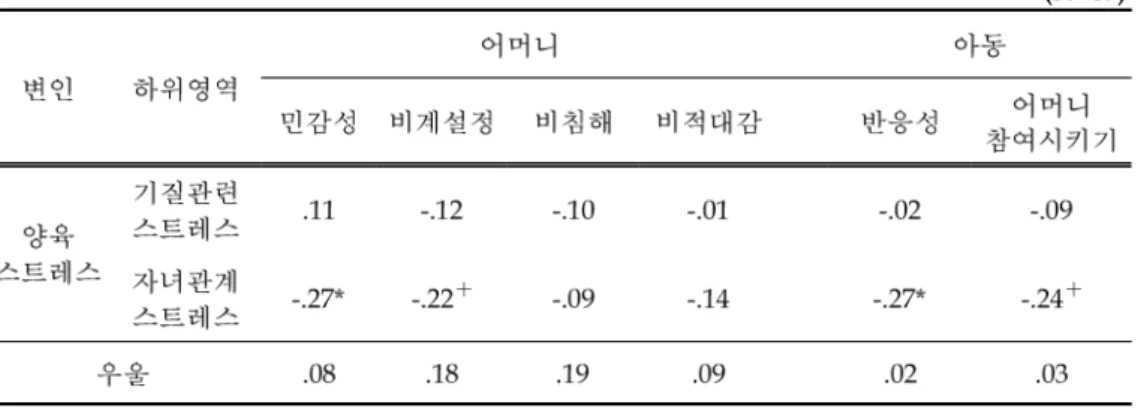
표 취업모의 심리적 변인과 어머니 아동 정서적 가용성간의 상관관계
< 5> -
아동 관련변인에 따른 어머니 아동의 정서적 가용성
3. -
표
< 6> 아동의 양육환경관련 변인에 따른 어머니 아동 정서적 가용성에 관한 평균과 표준편차 및 차이검증-
+
취업모 아동의 정서적 가용성에 대한 관련 변인들의 설명력 4. -
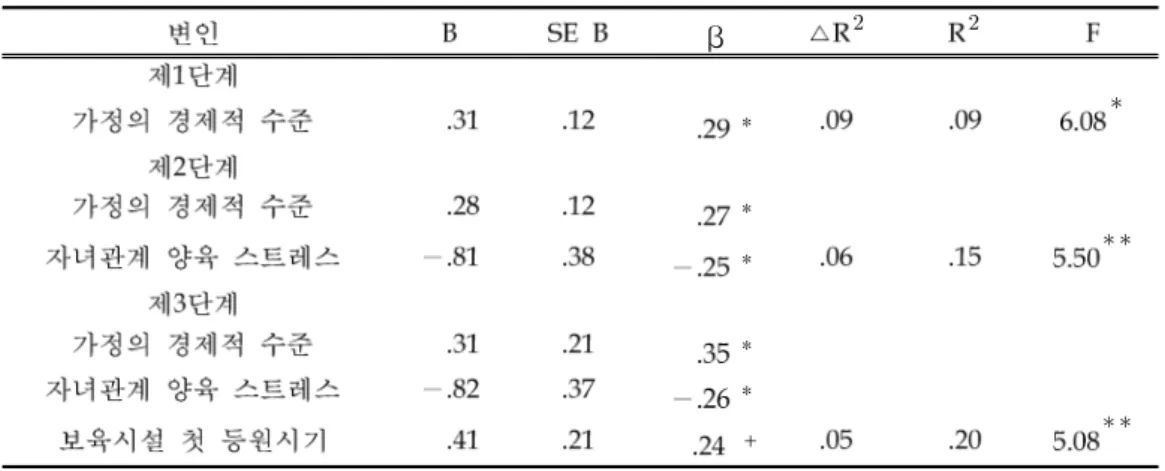
표 어머니의 민감성에 대한 관련변인의 위계적 회귀분석
< 7>
β
*
*
*
*
*
+
+
* * *
β
β β
*
*
*
*
+
* * *
β
β β
논의 및 결론 .
Ⅳ
취업모와 보육시설에 다니는 개월 아동의 정서적 가용성
1. 24~48
취업모 관련변인에 따른 어머니 아동의 정서적 가용성
2. -
아동 관련변인에 따른 어머니 아동의 정서적 가용성
3. -
취업모 아동의 정서적 가용성에 대한 관련변인들의 설명력 4. -
참 고 문 헌
boys and 34 girls) in child care centers and to examine the relationship between the mother-child emotional availability and the related variables of working mothers and their children.
Emotional Availability Scales (EA, 3rd edition) developed by Biringen, Z., Robinson, J., & and Emde, R.N. (1998) was used. Mother's work-family conflict, maternal parenting stress, and maternal depression, temperament of child, personal background were measured.
The results of this study were as follows:
The level of mother-child emotional availability was above in the middle level. There were significant differences in the mother-child emotional availability by maternal educational level and family income level, and significant negative correlation between maternal parenting stress and mother-child emotional availability. There was significant difference in the mother-child emotional availability by the starting point of child care experience. Mother-child emotional availability were significantly explained by family income level, maternal parenting stress, and the starting point of child care experience.
Key words: emotional availability
투고 수정원고접수 최종게재결정
2010. 04. 22. : 2010. 06. 07. : 2010. 06. 11.