식물병연구 Res. Plant Dis. 20(2) : 129-131(2014)
http://dx.doi.org/10.5423/RPD.2014.20.2.129 Note Open Access
Research in Plant Disease
The Korean Society of Plant Pathology pISSN 1598-2262, eISSN 2233-9191
First Report of Postharvest Gray Mold Rot on Carrot Caused by Botrytis cinerea in Korea
Md. Aktaruzzaman, Joon-Young Kim, Sheng-Jun Xu and Byung-Sup Kim*
Department of Plant Science, Gangneung-Wonju National University, Gangneung 210-702, Korea
In February 2014, gray mold rotting symptoms were observed in carrots in cold storage at Gangneung, Gangwon province, Korea. The typical symptom of gray mold rot showed abundant blackish gray mycelia and conidia was observed on the infected root. The pathogen was isolated from infected root and cultured on PDA for further fungal morphological observation and confirming its pathogenicity according to Koch’s postulates.
Results of morphological data, pathogenicity test and rDNA internal transcribed spacer (ITS 1 and 4) sequence showed that the postharvest gray mold rot of carrot was caused by Botyrtis cinerea. This is the first report of postharvest gray mold rot on carrot in Korea.
Keywords : Botrytis cinerea, Carrot, Pathogenicity, Postharvest gray mold rot
Carrots (Daucus carota var. sativa DC.) are biannual crop un- der the Apiaceae (Umbelliferae) family. The edible portion is the storage taproot, which contains high levels of carbohydrates (sugars) and b-carotene (pre-vitamin A). In 2011, carrot was grown in Korea on 2,849 ha of land to yield a total of 93,694 Mt with productivity of 32.88 t ha-1 (Anonymous, 2012).
Botrytis cinerea (teleomorph Botryotinia fuckeliana) also known as gray mold fungus is a ubiquitous filamentous fungal pathogen and may cause enormous damage both during plant growth and postharvest (Jarvis, 1977). The pathogen is a necro- troph, inducing host cell death resulting in serious damage to plant tissues culminating in rot of the plant or the harvested product (Govrin and Levine, 2000; Staats et al., 2005). Botrytis spp. are often considered a cool weather pathogen with best growth, sporulation, spore release, germination, and estab- lishment of infection occurring at an optimum of 18 to 23ºC.
However, it is also active at low temperatures and can cause considerable loss of plant material maintained at 0 to 10ºC. This fungus has been reported on the leaves and petioles of carrots infected at field condition in Korea (Park et al., 2011) and post- harvest carrot disease in the USA (Davis and Raid, 2002) but not reported in Korea as a postharvest carrot disease.
Isolation of the fungi and pathogenicity test. In Febru- ary 2014, rotting symptoms were observed in carrots in cold
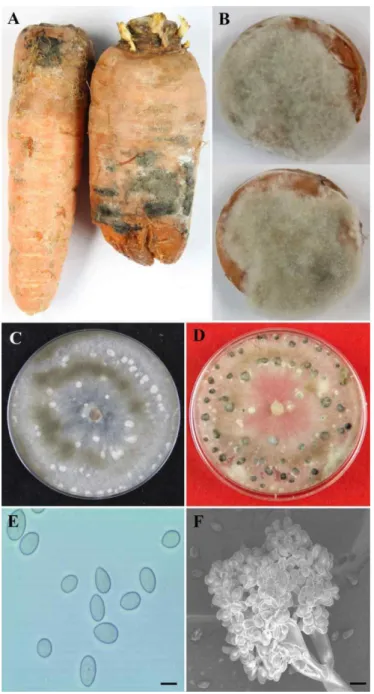
storage at Gangneung, Gangwon province, Korea (Fig. 1A).
The symptoms observed were abundant blackish gray mycelia and conidia on the infected root. For pathogen isolation, small pieces from infected root were sterilized by immersion in 0.1%
sodium hypochlorite (NaOCl) for 1 min, rinsed with sterile dis- tilled water three times and cultivated on potato dextrose agar (PDA, Difco, USA) and incubated at 20 ± 2°C for 7 days.
To determine the pathogenicity of the fungus, 10 ml conidial suspension (2 × 10⁴ spores per ml) was sprayed onto carrot sliced roots in plastic box lined with moist filter papers. The control was sprayed with sterile distilled water served as con- trols. The plastic box with sliced roots was incubated at 20 ± 2ºC under laboratory condition. After 5 days, blackish gray mycelia were developed on sliced roots. The fungal pathogen was re- isolated from the disease lesions of the inoculated roots and the re-isolated pathogen exhibited the same morphological characteristics as those of the original isolates (Fig. 1B). Thus, the fungal pathogen fulfilled the criteria stipulated by the Koch’s postulates and was identified as the causal agent of the post- harvest gray mold rot of carrot.
DNA extraction, polymerase chain reaction (PCR) amplifica- tion, and sequence analysis. For DNA extraction, the mycelia isolated from diseased lesion were grown in 250 ml flasks con- taining 100 ml potato dextrose broth, which were incubated for 4 days at 20°C on a rotary shaker at 125 rpm. Mycelia were har- vested by vacuum filtration through Whatman No. 1 filter paper and then lyophilized for 24 h before grinding them to a fine
*Corresponding author Tel : +82-33-640-2353 Fax: +82-33-640-2909 E-mail: [email protected]
Received April 28, 2014 Revised June 20, 2014 Accepted June 21, 2014
Research in Plant Disease Vol. 20 No. 2
130
powder. Next, 100 mg of the ground powder was transferred to a 1.5 ml Eppendorf tube and DNA was extracted by using the CTAB extraction method (Moller et al., 1992).
To confirm identity of the causal fungus, the complete ITS rDNA of the representative fungal pathogen was amplified and sequenced using by universal primers for internal tran- scribed spacer (ITS) 1 (5’-TCCGTAGGTGAACCTGCGG-3’) and ITS 4 (5’-TCCTCCGCTTATTGATATGC-3’) (White et al.,1990).
The amplification was performed in a 25 ml reaction mixture containing 0.5 ml of each primer, 0.5 ml of Taq DNA polymerase (Bioneer, Korea), 0.5 ml of each dNTP, 2.5 ml of 10× PCR reaction buffer, 18.5 ml of distilled water, and 2.0 ml of template DNA. The reaction was performed in Mastercycler Gradient (Eppendorf, Germany) under the following conditions: pre-denaturation at 94°C for 5 min, followed by 35 cycles of denaturation at 94°C for 35 s, annealing at 52°C for 55 s, and elongation at 72°C for 1 min and then post elongation at 72°C for 10 min.
The obtained nucleotide sequences were searched through BLASTn at the GenBank database (http://www.ncbi.nlm.nih.
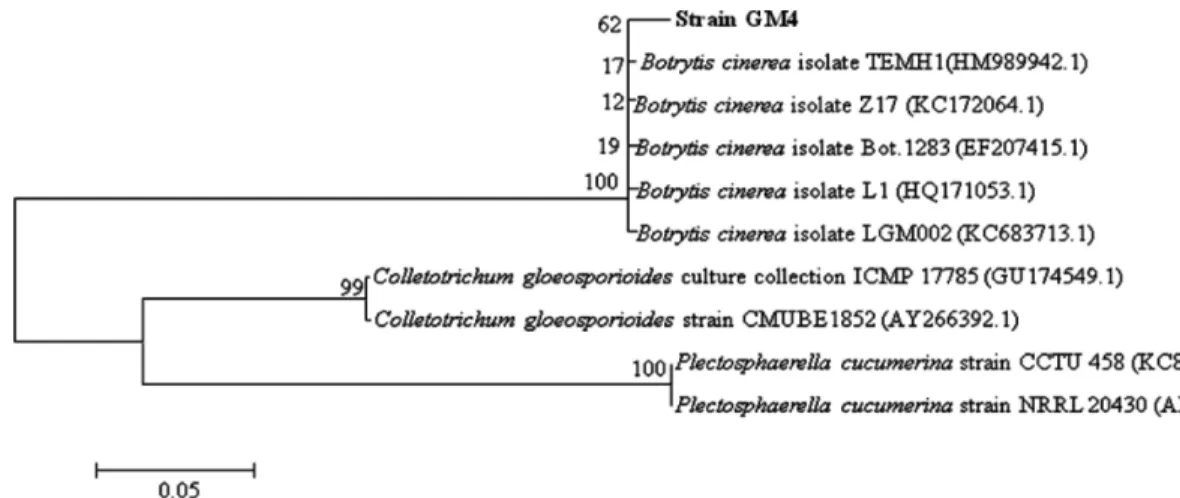
gov/BLAST/). Phylogenetic analysis of B. cinerea was performed by using the MEGA5 program with the neighbor-joining method (Tamura et al., 2011). Sequence data were deposited in GenBank (accession number KJ685806).
Identification and characterization of Botrytis cinerea.
Total 6 fungal strains were obtained from the gray mold rot of storing carrots, and strain GM4 among 6 strains was examined for identification. Strain GM4 was identified as B. cinerea by analyzing the morphological characteristics of the isolated fun- gus and by performing rDNA sequencing analysis. The fungus produced gray to dark colonies with dark mycelium and pro- duced abundant conidia on potato dextrose agar at 20 ± 2ºC for 7 days (Fig. 1C ). The conidia were one-celled, ellipsoid or ovoid in shape, dark brown, and 6.3~11.8 × 5.2~8.0 mm in size (Fig. 1E).
Conidiophores solitary, cylindrical, terminally branched, 15 to 28 mm wide, grayish to olivaceous gray, and smooth (Fig. 1F).
After 3 weeks, the fungus formed several black sclerotia as sur- vival structures near the PDA plate edge of petri dish (Fig. 1D).
The morphological characteristics of the identified species are summarized in Table 1. The ITS sequence was compared to the GenBank database sequences by using the NCBI BLAST search tool (Fig. 2). The sequences identified based on ITS of rRNA gene alignment were 100% similar to those of several B. cinerea species (accession nos. HM989942.1, KC172064.1, EF207415.1, HQ171053.1, and KC683713.1). Thus, B. cinerea was identified as the causal agent of gray mold rot on carrot during storage in Fig. 1. Gray mold rot on carrot caused by Botrytis cinerea. A: Disease
infected carrot root showing blackish gray mycelia and conidia, B: In pathogenicity test, produced similar symptoms on carrot sliced by artificial inoculation, C and D: One and three-wk-old colony showing black sclerotia growing on potato dextrose agar (PDA) medium, E:
Conidia under light microscope, F: Conidiophore and conidia by SEM.
Scale bar: E = 20 mm and F = 50 mm.
Table 1. Comparison of morphological characteristics of gray mold fungus isolated from carrot
Characteristics Present isolate Botrytis cinereaa
Colony color greyish brown greyish brown
Conidia shape ellipsoidal or ovoid ellipsoidal or ovoid size (mm) 6.3-11.8 × 5.2-8.0 6.0-18.0 × 4.0-11.0
color dark brown pale brown
Conidiophore size (mm) 15-28 16-32
Sclerotia shape flat or irregular flat or irregular
color black black
aDescribed by Ellis and Waller (1974).
Research in Plant Disease Vol. 20 No. 2 131
Korea. To our knowledge, this is the first report of postharvest gray mold rot on carrot in Korea.
References
Anonymous. 2012. Food, Agriculture, Forestry and Fisheries Statistical Year Book 2012. Korean Ministry for Food, Agriculture, Forestry and Fisheries. 115 pp.
Davis, R. M. and Raid, R. N. 2002. Compendium of Umbelliferous crop diseases. American Phytopathological Society. USA. 75 pp.
Ellis, M. B. and Waller, J. M. 1974. Sclerotinia fuckeliana (conidial state: Botrytis cinerea). CMI descriptions of Pathogenic Fungi and Bacteria, No. 431. Commonwealth Mycological Institute, Kew, Surrey, England.
Govrin, E. and Levine, A. 2000. The hypersensitive response facilitates plant infection by the necrotrophic pathogen Botrytis cinerea.
Current Biol.10: 751-757.
Jarvis, W. R. 1977. Botryotinia and Botrytis species - Taxonomy, physi- ology and pathogenicity. A guide to the literature, Monograph no. 15, Canada Department of Agriculture, Ottawa, 195 pp.
Moller, E. M., Bahnweg, G., Sandermann, H. and Geiger H. H. 1992.
A simple and efficient protocol for isolation of high molecular weight DNA from filamentous fungi, fruit bodies, and infected plant tissues. Nucleic Acids Res. 20: 6115-6116.
Park, K. H., Ryu, K. Y., Yun, H. J., Yun, J. C., Kim, B. S., Jeong, K. S., Kwon, Y. S. and Cha, B. 2011. Gray Mold on Carrot Caused by Botrytis cinerea in Korea. Res. Plant Dis. 17: 364-368.
Staats, M., van Baarlen, P. and van Kan, J. A. L. 2005. Molecular phy- logeny of the plant pathogenic genus Botrytis and the evolu- tion of host specificity. Mol. Biol. Evol. 22: 333-346.
Tamura, K., Peterson, D., Peterson, N., Stecher, G., Nei, M. and Kumar, S. 2011. MEGA5: Molecular evolutionary genetics analysis using maximum likelihood, evolutionary distance, and maximum parsimony methods. Mol. Biol. Evol. 28: 2731-2739.
White, T. J., Bruns, T., Lee, S. and Taylor, J. W. 1990. Amplification and direct sequencing of fungal ribosomal RNA genes for phyloge- netics. In: PCR protocols: A guide to methods and applications, eds. by M. A. Innis, D. H. Gelfand, J. J. Sninsky, and T. J. White, pp.
315-322. Academic Press Inc., New York, USA.
Fig. 2. Neighbor-joining phylogenetic tree of Botrytis cinerea strain GM4 and related species identified from GenBank based on internal tran- scribed spacer gene sequences. Numbers at the nodes indicate bootstrap values from a test of 1000 replications. The scale bar indicates the number of nucleotide substitutions.