• 검색 결과가 없습니다.

Comparative Performance Analysis of Robot-based Automated Construction System Using a Real Scale Test Project

N/A
N/A
Protected

Academic year: 2021

Share "Comparative Performance Analysis of Robot-based Automated Construction System Using a Real Scale Test Project"

Copied!
11
0
0

로드 중.... (전체 텍스트 보기)

전체 글

(1)

pISSN 1598-2033 eISSN 2233-5706

J. Korea Inst. Build. Const., Vol. 15, No. 3

http://dx.doi.org/10.5345/JKIBC.2015.15.3.339 www.jkibc.org

Comparative Performance Analysis of Robot-based Automated Construction System Using a Real Scale Test Project

Lee, Ung-Kyun

*

Dept. of Architectural Engineering, Catholic Kwandong University, Gangneung-si, Gangwon-do 210-701, Korea

Abstract


A large-scale research project to develop a robot-based automated building construction system for steel structures was successfully conducted in South Korea. This paper discusses the results of the real-scale test and the key lessons gained from the testing process. The system was assessed in terms of system productivity, construction cost, quality control, and safety improvements. While the productivity of the automated system showed an improvement of about 9.5%, the construction cost was about six times higher than that of the conventional method. The field test also indicated that the automated system requires more on-site quality control measures. However, because the system can eliminate the causes of various safety accidents, safety levels might be expected to be improved significantly. It is expected that this paper will provide knowledge and insight for developing new systems, and the results of the real-scale test might be useful for other researchers and similar research projects in the future.

Keywords : automated construction system, productivity analysis, quality control, safety improvement

1. Introduction

Compared to other industries, the construction industry is highly dependent on human labor. For construction activities, human laborers need to learn the related skills and spend a significant amount of time to become a skilled laborer. A high dependency on human labor is considered to be a common cause of health and safety problems or lowered productivity in the industry. Automated construction methods have been considered as a possible way forward to decrease the dependency on skilled laborers[1] and to improve jobsite conditions so as to ensure safety and increase the productivity

Received: January 16, 2015

Revision received: February 2, 2015 Accepted: February 6, 2015

* Corresponding author: Lee, Ung-Kyun

[Tel: +82-33-649-7548, E-mail: [email protected]]

ⓒ2015 The Korea Institute of Building Construction, All rights reserved.

of repetitive processes similar to other in- dustries[2].

Various efforts have been made to reduce the de- pendency on skilled laborers and to improve jobsite conditions. Fully automated construction systems supported by robots have been considered for this purpose. The unique feature of these systems is that they involve a factory, which is a structure with automated devices for construction that can protect laborers and building structures from envi- ronmental conditions such as inclement weather. In the factory, the building materials are delivered by an automatic mechanism and are set up by a robot.

The main assumption is that the repetitive floor

plan of high-rise buildings can be built in a manner

that is similar to the repetitive fabrication processes

used in a car manufacturing factory. This system

can also be managed more efficiently than the tra-

ditional construction method, because all the con-

struction procedures are monitored in the main

(2)

control room. Previous studies[3,4,5,6] have shown how such a system can be successfully applied to the jobsite, but nowadays, it is not widely used in the construction industry and most research and development (R&D) projects have stopped.

There are some reasons for this discontinuity.

The purpose of developing those systems was to de- crease the construction cost and improve the jobsite conditions, but the investment costs for general contractors were extremely high, and no govern- ment funding was available; as such, R&D projects could not be supported despite the advantages.

According to the analysis of the results for the pre- vious system, the high costs stem from the material costs of the construction factory (CF) and related mechanics, which are much higher than expected.

The weight of the CF including the robots and cranes was about 2000 tons, which is greater than the weight of all the steel materials of new buildings. In contrast to the materials employed in the industrial manufacturing process, these ex- pensive materials cannot be reused because for safety reasons the massive structure cannot be dis- assembled from the top floor of high-rise build- ings[7].

Recently, a new type of automated construction system was developed in Korea based on the key lessons gained from previous research projects[8].

It has a light-massive (CF), which can be reused, and it is designed as economically as possible. After five years, the research project on a robot-based automated building construction system for steel structures and a real-scale test project were suc- cessfully completed. The purpose of this paper is to introduce the automated construction system and to discuss the real-scale test results, as well as to as- sess the current status of R&D of the system in the light of those results. The system will be assessed in terms of system productivity, construction cost, quality control, and safety improvements.

2. Robot-based construction (RCA) system

2.1 Overview of research project

The South Korean government has sponsored a research project to overcome the current problems that reduce the productivity and efficiency of the construction industry. In Korea, the skilled labor population is ageing, and young people tend to avoid learning certain skills because of the diffi- culty of construction work. In addition, with the rise in Korea’s economic status, there is an in- creased social awareness of health, safety, and en- vironmental problems. As a step toward realizing Korea’s aspiration of becoming a developed nation, the public has begun to place a strong emphasis on human rights. Many believe that the development of a new automated construction system will solve the currently prevalent problems, while ensuring that human rights requirements are fulfilled by the con- struction industry.

The R&D consortium involved in the project was formed by three cooperative research institutes from various fields, including a general contractor with a global presence in the construction industry, a research institution for robotics and precision machinery established by the government, and top-ranked colleges in South Korea. Each coopera- tive research institution involved 15 research in- stitutions that were brought together according to the specific technologies required. For example, there is a structural engineering company for de- signing a CF, a mechanical engineering company for designing a rail for the robot inside the CF and the robot and supporting devices, and a graphic de- sign company for designing the monitoring system.

The total research funds amounted to USD

20,239,259, of which the government contribution

was USD 14,371,904 and the total matching con-

tribution from the private sector was USD

(3)

5,867,356. The research project was carried out from December 2006 to October 2011.

2.2 Introduction to robot-based construction automation (RCA) system

In the conventional construction method, all op- erations involved in steel erection and fabrication are carried out by human laborers. In the lifting phase, field workers must identify the correct ma- terials to be lifted, and then signal to a crane operator. The construction manager supervises and controls these operations to avoid errors such as in- correct selection of material to be lifted. Once the material arrives at the planned location, iron- workers connect the material. For example, two workers must climb up to the top of each column, pull a girder to the column edge at the same time, and perform the first bolting. During this task, there is the risk that the girder can hit the workers, or that they can fall down from the top of the column. In addition, this operation must be synchronized on both sides; otherwise, the con- nection will fail. After the girder connects to the columns, all structural materials including the col- umns and girders should be plumbed, and then the final connection is made. The purpose of developing the RCA system is to improve the efficiency of the workflow.

The RCA system consists of three sub-tech- nologies: (1) an intelligent tower crane based on automatic identification devices, (2) a new column–

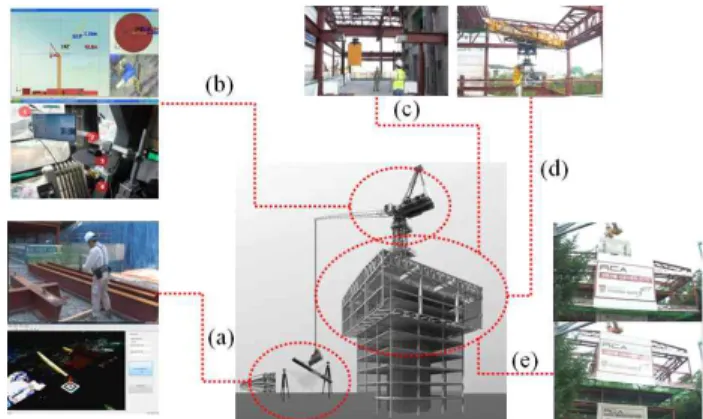
girder connection design for automated con- struction, and (3) a bolting robot for a steel con- nection and supporting mechanics. Figure 1 shows the configurations and interrelationships that con- stitute the system, as well as images of the pilot project.

The intelligent tower crane was first suggested by Lee et al.[9]. Using augmented reality (AR) and ra- dio frequency identification (RFID) technology, the

required material is identified in the stockyard, which is shown in Figure 1a. This information is instantly sent to the tower crane operator in the main control center. In the scheduling and design process, the path for the movement of the material is planned, and the lifting path is tracked and cor- rected using laser technology to prevent the lifted material from moving out of the planned path, as shown in Figure. 1b.

Figure 1. . Robot-based automated construction system for high-rise buildings: (a) material recognition system using AR and RFID, (b) tower crane navigation system, (c) self-supported

steel joint (DFA), (d) bolting robot on CF, and (e) climbing CF

Once the material reaches the planned work site, it is assembled by a specially designed connection, called design for automation (DFA)[10], as shown in the picture on the left in Figure 1c. Because the current design does not apply to the new automated construction system, a new type of connection de- sign is needed for the automated construction method. According to Kim and Cho[11], two special changes were made to the joint to distinguish this method from the conventional method of girder installation. One change is to the shape, and the second is to the installation process.

After the material is placed in position, the bolt-

ing robot[12] moves to that location, as shown in

the picture on the right in Figure 1c. Because of the

supporting rail in the CF, the robot is able to move

(4)

1. (a) conventional method 2. (b) DFA technology

without any interference. The purpose of the CF is not only to protect the laborers and the robot from the external environment, but also to continue building regardless of weather conditions. The CF is fixed to the concrete core structure of the build- ing and climbs to the next level using a hydraulic device, as shown in Figure 1e.

Table 1 summarizes three noticeable differences between the conventional method and the RCA system. In the preparation phase, steel materials for the building structure are identified automatically. In the conventional method currently in use, the field workers must find materials to be lifted manually, and communicate with the operator of the tower crane to move them to the target location. In the RCA system, this sequence of tasks is performed automatically. The identification device based on AR and RFID technologies finds the mate- rials and sends the material information to the crane operator and the construction control room, where all construction activities are monitored.

sequences Work Conventional method RCA system

Material Preparation

and Lifting

Workers should confirm materials to

set and signal to the crane operator

using a walkie-talkie.

Managers supervise and control the

process.

The automatic identification device sends the material information to the crane operator and

the construction control room. Using

these data, the location to be built is

confirmed.

Fabrication of girder or

beam

Positioned by laborers on aerial

position

Positioned by specially designed connection without aerial work of

laborers Bolting Laborers work in

elevated positions. Bolted by robot Plumbing,

welding, finishing and work

Done by laborers Table 1. Differences in construction performance

Second, the aerial work involved in connecting the girder to the column is eliminated. As shown in Figure 2, in the conventional method, the iron- workers have to assemble the materials manually, which creates an unsafe environment. To enhance safety as well as to improve the accuracy of the connection it was redesigned for automated con- struction, which is called DFA. In this condition, the aerial work does not need to be performed by the workers.

Figure 2. Comparison of fabrication method [12]

The third difference is in the bolting. In the con- ventional method, the ironworkers must prepare heavy machinery, including a torch wrench, a reamer to ream the hole, bolts, nuts, and washers, and electric torch wrench. The workers only rely on safety ropes for this job, which means they are al- ways at risk for accidents. In the RCA system, all of these tasks are performed by a robot. The robot receives the information about these tasks from the control center, and can freely move to the target location in the CF on the rails installed for the robot.

3. Case study

The RCA was applied to a real-scale test project.

The construction field for the test bed was located

at Korea University, South Korea. The test-bed

(5)

building consisted of a steel structure with seven floors and a reinforced concrete core, and its area was 3,300 ㎡. The conventional method was adapted to the first to third floors, and the RCA system was adapted to the fourth to seventh floors for a com- parative study of the two methods.

3.1 Productivity analysis

The productivity was measured using a simu- lation method. Although this case project was fin- ished successfully, it was unable to represent all of the results obtained by the RCA system because the RCA system was developed for use in high-rise buildings of 40 stories or more. For this reason, an additional analysis was necessary to show a com- parison of the results of each method. From the case study, the research team was able to gather the construction time data for each task when the conventional method and the RCA system were applied.

A simulation model was developed using the Web CYCLic Operation Network (CYCLONE), which was originally developed by Halpin[13]. The CYCLONE methodology has been used in many applications to measure construction productivity[14]. In this study, two simulation models, originally designed by Lee [15], were suggested. Figures 3 and 4 show the steel fabrication process using the conventional method and the RCA system, respectively. The models were simplified to compare the effects of the DFA and the robot. The effect of the intelligent tower crane was not considered because the case building is not a high-rise building, and we could not get significant data. Thus, in this simulation model, the fabrication procedure for connecting the girder to the column was considered because all other construction processes for the two methods were identical.

As shown in Figs 3 and 4, the RCA system em- ployed two additional mechanics: DFA and a bolting

robot. In the conventional method, the tower crane cannot leave the location of fabrication because the crane needs to support the girder during bolting by the ironworkers. However, in the RCA system, the crane does not need to stay in place because the DFA can support the girder by itself, and the bolting is performed by the robot.

Figure 3. Simulation model for conventional method

Figure 4. Simulation model for RCA system

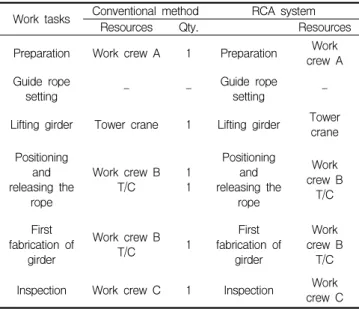
Table 2. Resource input data for simulation Work tasks Conventional method RCA system

Resources Qty. Resources

Preparation Work crew A 1 Preparation Work crew A Guide rope

setting - - Guide rope

setting -

Lifting girder Tower crane 1 Lifting girder Tower crane Positioning

releasing the and rope

Work crew B

T/C 1

1

Positioning releasing the and

rope

crew B Work T/C First

fabrication of girder

Work crew B

T/C 1 First

fabrication of girder

Work crew B

T/C Inspection Work crew C 1 Inspection Work

crew C

(6)

The resource input data are listed in Table 2. In the conventional method, crew A, consisting of three simple workers, is needed for the preparation work, which involves attaching the plates, bolts, and nuts for fabrication. The first positioning of the girder to the columns should be carried out by hu- man laborers called work crew B, consisting of two simple workers, and the tower crane should stay on until the first fabrication is successfully finished. In the RCA system, all bolts and nuts for the fab- rication are inside the robot, and the plate is cov- ered by DFA. The difference is that the guide rope for DFA should be set for the assembly by crew D, consisting of one simple worker, before lifting.

Because the positioning is carried out by DFA, the tower crane does not need to stay in place for the aerial work. The bolting procedures used in the two methods are different. In the conventional method, bolting is performed by ironworkers (referred to as work crew B), but the RCA system eliminates the involvement of ironworkers. Work crew E, one sim- ple worker, controls and supervises the DFA. In contrast, the inspection procedure and plumbing procedure for work crew C (inspector) are identical.

The construction time for each activity was re- corded on site. The working time of each node in the simulation model was measured using a stopwatch. In this study, a triangular distribution was assumed on the basis of previous stud- ies[16,17], even though according to Abou Rizk et al[18], it is appropriate for the construction simu- lation input data to follow a beta distribution.

However, as a triangular distribution is not sig- nificantly affected by the number of samples in the data[17], the triangular distribution was used in this study for the input data.

The simulation analysis results are listed in Table 3 A simulation was performed using CYCLONE in which the cycle number was 30 times based on cen- tral limit theorem. As listed in Table 3, 30 simu-

lation cycles required 4.46 h, and the productivity per time unit was 6.73 cycle/h in the conventional method. In the RCA system, the productivity per time unit was 7.06 cycles/h. The simulation analy- sis concluded that the RCA system is able to im- prove the construction productivity by about 9.5%

compared to the conventional system for the girder fabrication process.

Table 3. Results of simulated productivity

Methods Conventional RCA system

Total simulation time (h) 4.46 4.25

Cycle no. 30 30

Productivity (cycles/h) 6.73 7.06

Comparison (%) - 9.5

3.2 Cost comparison

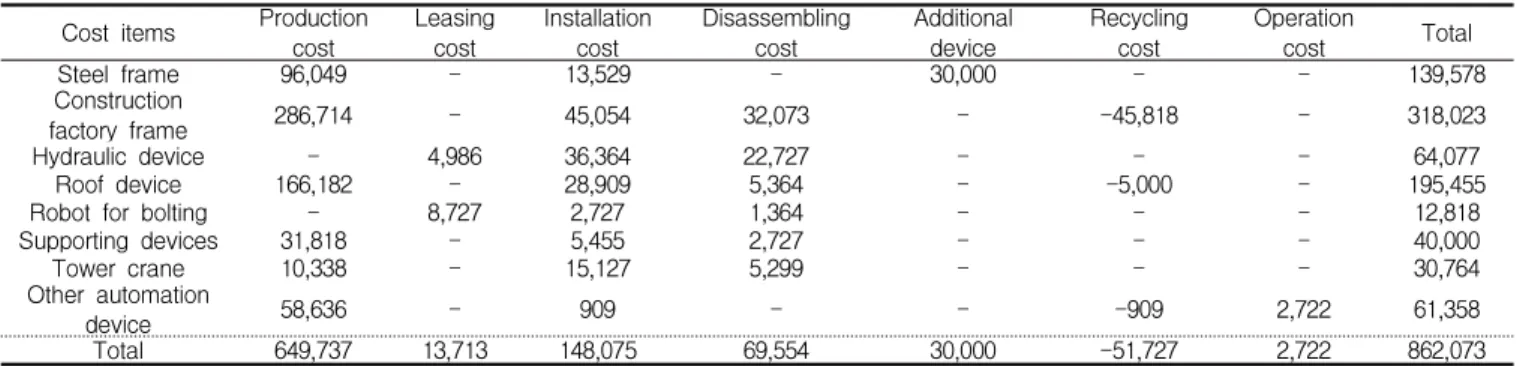
The real construction cost was obtained from a case study; the costs of finishing work are ex- cluded, and only the cost of constructing the steel structural system is considered. The conventional construction cost was calculated on the basis of cost estimation using the Standard Quantities per Unit of Korea[19], which is widely used for steel struc- ture construction. The cost of the RCA system was measured on the basis of the cost breakdown struc- ture of the RCA system[2] related to the cost items of the developed technologies. The main cost items were classified as the steel materials, the CF, the intelligent tower crane, and the bolting robot. These cost items are the major components for fabricating and erecting steel structures. Each cost is specified and itemized by production, leasing, installation, disassembling, recycling, and operation cost, which includes the expense of labor, materials, and equipment in the application of the presented sys- tem[20].

The detailed cost of each item is tabulated in

Tables 4 and 5[20]. The total cost of the RCA sys-

(7)

Cost items Production

cost Leasing

cost Installation

cost Disassembling

cost Additional

device Recycling

cost Operation

cost Total

Steel frame 96,049 - 13,529 - 30,000 - - 139,578

Construction

factory frame 286,714 - 45,054 32,073 - -45,818 - 318,023

Hydraulic device - 4,986 36,364 22,727 - - - 64,077

Roof device 166,182 - 28,909 5,364 - -5,000 - 195,455

Robot for bolting - 8,727 2,727 1,364 - - - 12,818

Supporting devices 31,818 - 5,455 2,727 - - - 40,000

Tower crane 10,338 - 15,127 5,299 - - - 30,764

Other automation

device 58,636 - 909 - - -909 2,722 61,358

Total 649,737 13,713 148,075 69,554 30,000 -51,727 2,722 862,073

Table 5. Construction cost for RCA system (fourth–seventh floors, USD)

tem and of the conventional method are USD 862,073 and USD 103,219, respectively. The con- ventional cost per floor was calculated at USD 34,406 per floor, which was derived by applying the conventional method from the first to the third floor. The cost of the RCA system is USD 215,518 per floor, in which the total cost of the proposed construction method is divided by the number of the applied floors. That is, the construction cost of the RCA system was about six times higher than the cost of the conventional method.

Table 4. Construction cost of conventional method (first–third floors, USD)

C o s t items

Production cost

Installation cost

Disassembling

cost Total

S t e e l

frame 68,570 11,576 - 80,146

Tower

crane 7,753 11,345 3,974 23,072

Total 76,323 22,921 3,974 103,219

The results obtained from the case study indicate that the RCA system is too expensive to apply in the field under current conditions. However, if the technologies mature and their use becomes more widespread, it is expected that the cost of the RCA system will decrease. Because the RCA system was developed for high-rise buildings of more than 40 stories, the proportion of the leasing cost for the robot and crane is lower for buildings with 40 sto-

ries or more. Furthermore, the proportion of cost in relation to the CF is decreased because the steel frame of the current analysis is only for a sev- en-story building, whereas the requirements for high-rise buildings are much greater. In this case study, the cost ratio in relation to the CF (Construction factory frame, Hydraulic device, Roof device, and Robot for bolting) was 69.4%, which is abnormally high. If its application is to be expanded to the construction of high-rise buildings, the ratio must be decreased.

3.3 Quality control

Significant changes were made in the area of

quality control. The RCA system requires more ac-

curate alignment between the holes on the girder

and the bracket of the column because the robot is

not able to ream the holes between a column and

a girder. According to Special Specifications for

Steel Construction[21], the tolerance between two

holes should be within 2.0mm for the conventional

method. This means that the ironworker can fit the

holes by the reamer and put the blot in the hole

without any interruption if the tolerance is within

2.0mm. However, because the robot cannot ream in

the same way as an ironworker, the RCA system

requires a more accurate level of quality control for

the tolerance to be within 1.5mm. Specifically, the

quality controls for the next five items, which are

required as inspection items for the high-tension

(8)

bolt connection, as stated in the Specifications for Steel Construction[21], need more consideration compared to the conventional method. Table 6 lists the specific items.

On the other hand, the RCA system can ensure the connection of high-tension bolts by itself.

According to an interview with a field engineer, the following conditions are required for the connection work: the bolting connection should be performed by an ironworker with a torque wrench, a sample test is necessary, and all spots must be visually in- spected to determine if the bolts have been set to the maximum torque specified by the Specifications for Steel Construction[21]. However, the test is dif- ficult and time consuming, and only an experienced worker is able to guarantee a successful visual inspection. Nevertheless, the bolting robot of the RCA system has the ability to ensure the maximum torque by itself. If the torque of the connection area does not reach the required torque, the robot does not move to the next task, and records all torques measured at the specified locations. This feature allows for simplified quality control of high-tension bolt connections compared to the conventional method.

Special specifications Construction methods

Class I Class II Conventional

method R C A

system

High-tension bolt

Misalignment of the center of the hole

P PP

Misalignment of

the hole spacing P PP

Discrepancies in

two holes P PP

Gap of

high-tension bolt

joints P PP

Spacing between the hole and corner

P PP

Legend: P general check, PP needs more consideration Table 6. Comparison results for quality control

3.4 Safety improvement

Every construction accident has a cause[22].

Since Heinrich[23] first proposed the causal man- agement theory, called the domino theory, many researchers have studied the causal model of an ac- cident so that construction accidents can be prevented. The key concept of the causal model is that an accident could be avoided if one of the causes is eliminated from the domino effect. Lee[24]

showed that the domino effect can be stopped if an appropriate action or device is applied at each stage.

Table 7 lists the eight root causes of construction accidents[25] and the expected results when the RCA system is used in a construction project. First, the causes related to human behaviors such as “lack of proper training,” “deficient enforcement of safe- ty,” “not using provided safety equipment,” and

“poor attitude regarding safety” will be eliminated because human workers are not required for the fabrication process when the RCA system is used.

Second, the causes related to unsafe site conditions such as “lack of safety equipment” and “isolated freak accident” can also be resolved. The RCA sys- tem provides a safer work environment because the site is surrounded by the CF, which can isolate the jobsite from exterior conditions such as bad weather. In addition, the CF can prevent falling ac- cidents because the workplace is covered by the CF’s walls, floor, and roof. Finally, because the RCA system changes the work sequences and method, the possibility of on-site accidents due to

“unsafe methods or sequencing” will not be eliminated.

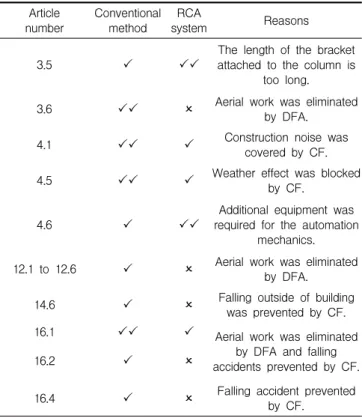
Similarly, in the Standard Safety Specifications

for Steel Construction[26], there are 15 items re-

lated to steel fabrication during building

construction. To determine the target safety im-

provements in this study, the relevant articles and

issues from this manual were studied and ex-

tracted; these are listed in Table 8.

(9)

Root causes of construction

accidents Effect of the system on root causes Lack of proper

training

Because there are no human laborers involved in fabrication work, the unexpected behavior of workers can be

prevented.

Deficient enforcement of

safety

Because one of the purposes of the RCA system is to protect the human laborer from construction accidents, the

system is enforced by itself.

Lack of safety

equipment When the RCA system is applied, this cause no longer has an effect.

Unsafe methods or sequencing

With the aerial work eliminated, the construction sequences and methods

were changed by this system.

Unsafe site

conditions Site was protected by the CF.

Not using provided safety equipment

When the RCA system is applied, additional safety equipment need not be

provided.

Poor attitude toward

safety Because there are no human resources involved in fabrication work, the attitude

is no longer important.

Isolated freak accident

All construction activities were conducted in the CF, and there is no such reason

for at least the structural work.

Table 7. Expected effects of safety improvements by RCA system

Article

number Conventional

method RCA

system Reasons

3.5 P PP The length of the bracket

attached to the column is too long.

3.6 PP O Aerial work was eliminated

by DFA.

4.1 PP P Construction noise was

covered by CF.

4.5 PP P Weather effect was blocked

by CF.

4.6 P PP Additional equipment was

required for the automation mechanics.

12.1 to 12.6 P O Aerial work was eliminated by DFA.

14.6 P O Falling outside of building

was prevented by CF.

16.1 PP P Aerial work was eliminated

by DFA and falling accidents prevented by CF.

16.2 P O

16.4 P O Falling accident prevented

by CF.

Legend: P: relevant; PP: strongly relevant, O: not relevant Table 8. Expectation of safety improvements and considerations

Article 3.6 is on safety planning when iron- workers are working on a column. With the RCA system, a plan is no longer required to be formulated. Similarly, chapter 12 (Articles 12.1 to 12.6), which is about the beam connection proce- dure performed by an ironworker, need not be con- sidered either. Article 4.1 is on the prevention of noise from the construction site, and Article 4.5 in- dicates the safety specifications for bad weather. All of these can be resolved by the CF. With the CF and DFA technologies, Articles 14.6, 16.1, 16.2, and 16.4, which are on the preparation of safety equip- ment for the prevention of falling accidents, can al- so be disregarded.

On the other hand, Article 3.5 is on the steel de- sign, a potential hazard that may give rise to dan- gerous situations. For example, the RCA system has a long bracket for the DFA and robot, which may hit the workers or existing structures while it is be- ing lifted. In addition, because the RCA system consists of many new mechanics, including the CF with supporting devices, a robot, and an intelligent tower crane, other unexpected situations related to safety problems may arise. This fact needs to be considered before the RCA system is used for com- mercial purposes; moreover, more safety controls may be required.

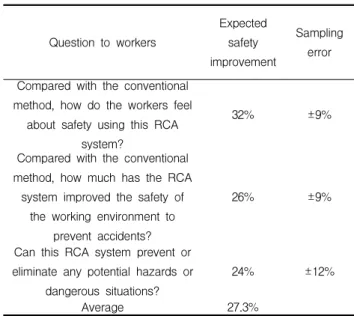
The improvements to safety were also assessed by means of a questionnaire survey. A Likert nine-point scale survey was designed and administered to the field engineers of this pilot project and the con- struction expert group after the field test. The ques- tions were on how the RCA system can affect the safety compared to the conventional method. In total, 28 respondents participated on the case project site.

Table 9 lists the questions and results, which have a

95% confidence level. Compared with the conventional

method, the laborers felt that the construction site is

on average about 27.3% safer when the RCA system

is used. Moreover, they expected the potential haz-

(10)

ards or dangerous situations to decrease by at least 12% to 36% with the use of the RCA system.

Table 9. Results of survey on safety improvements created by RCA system

Question to workers

Expected safety improvement

Sampling error Compared with the conventional

method, how do the workers feel about safety using this RCA

system?

32% ±9%

Compared with the conventional method, how much has the RCA

system improved the safety of the working environment to

prevent accidents?

26% ±9%

Can this RCA system prevent or eliminate any potential hazards or

dangerous situations?

24% ±12%

Average 27.3%

4. Summary and conclusions

A fully automated construction system was fund- ed by the South Korean government and developed for the steel structures of high-rise buildings to cope with the expected crises in the foreseeable future. Through a real-scale field test, the per- formance of the RCA system was verified, and it was determined to be applicable to high-rise build- ing construction. Multidisciplinary experts, from construction engineering to robotic specialists, joined and cooperated in this research project, and significant research funds were invested.

In this article, the case study of the RCA system was introduced and discussed in terms of con- struction project management. On the basis of a comparative study between the conventional method and the RCA system, the productivity, construction cost, quality control features, and safety were analyzed. The results indicated that the RCA sys- tem can improve the productivity of steel fabrication

work and the on-site safety control, and thus pro- vide better quality high-tension bolts connections.

However, the construction cost of the RCA system is too high, and the system gave rise to new con- cerns regarding quality and safety control. For the robot, more accurate quality control measures were required, and the altered construction environment may lead to a new type of accident. Before commer- cial use, further studies on cost savings should be completed.

Various engineering experts participated in this research project, and the differences in academic backgrounds led to conflicts among researchers. For instance, a problem involving a decision-making dilemma proved to be a valuable new experience for a stiff formulary expert. To integrate the separate developments into one system, the time schedule must be strictly managed, and because the R&D consortium is not a single organization, communi- cation between its members should be thought out and planned.

Acknowledgement

The author would like to express his special thanks to Dr. David Jeong.

References

1. Lee JB. Construction automation and robotics: today and tomorrow. Review of Architecture and Building Science. 2007 Jun;51(6):25-7.

2. Kim TH, Lee UK, Yoo WS, An SH, Cho HH, Lee YH, Doh NJ.

Benefit/cost analysis of a robot-based construction automation system. Proceeding of 10th International Conference on Control, Automation and systems; 2010 Oct 27-30; Gyeonggi-do, Korea.

Seoul (Korea): Institute of Control, Robotics, and Systems; 2010.

p. 616-21.

3. Tanijiri H, Ishiguro B, Arai T, Yoshitake R, Kato M, Morishima

Y, Takasaki N. Development of automated weather-unaffected

building construction system. Automation in Construction. 1997

(11)

Jun;6(3):215-27.

4. Yamazaki Y, Maeda J. The SMART system: an integrated appli- cation of automation and information technology in production process. Computers in Industry. 1998 Feb;35(1):87-99.

5. Ikeda Y, Harada T. The automated building construction system for high-rise steel structure buildings. Proceeding of the Council on Tall Buildings and Urban Habitat (CTBUH); 2004 Oct 10-13;

Seoul, South Korea. Seoul(Korea): Council on Tall Buildings and Urban Habitat; 2004. p. 707-13.

6. Wakisaka T, Furuya N, Inoue Y, Shiokawam T. Automated con- struction system for high-rise reinforced concrete buildings.

Automation in Construction. 2000 May;9(3):229-50.

7. Kang TK, Nam C, Lee UK, Doh NL, Park GT. Development of robotic crane-based automatic construction system for steel structures of high-rise buildings. Proceedings of the 28th International Symposium of Automation and Robotics in Construction; 2011 Jun 29–Jul 2; Seoul, Korea. (Korea):

International Symposium of Automation and Robotics in Construction; 2011. p. 670-1

8. Park GT, et al. Robot based construction automation system, Final report. Seoul: Research center for construction automation (South Korea); 2011 Oct. 527p. Report No.:06-UACTP-D01.

9. Lee G, Kim HH, Lee CJ, Ham SI, Yun SH, Cho HH, Kim BK, Kim GT, Kim K. A laser-technology-based lifting-path tracking system for a robotic tower crane. Automation in Construction.

2009 Nov; 18(7):865-74.

10. Jin IG, Shin YS, Cho HH, Kang KI. Development of component design process for automated construction system. Korean jour- nal of construction engineering and management. 2009 Jul;10(4):76-86.

11. Kim DI, Cho HH. Safety and productivity analysis on alternative steel column-girder joint for automated construction.

Proceeding of 10th International Conference on Control, Automation and systems; 2010 Oct 27-30; Gyeonggi-do, Korea.

Seoul (Korea): Institute of Control, Robotics, and Systems; 2010.

p. 2338-41.

12. Chu BS, Jung KM, Ko KH, Hong DH. Mechanism and analysis of a robotic bolting device for steel beam assembly. Proceeding of 10th International Conference on Control, Automation and systems; 2010 Oct 27-30; Gyeonggi-do, Korea. Seoul (Korea):

Institute of Control, Robotics, and Systems; 2010. p. 2351-56.

13. Halpin DW, Riggs LS. Planning and analysis of construction operations. New York: Wiley; 1992.

14. Han SW. Productivity analysis comparison of different types of earthmoving operations by means of various productivity

measurements. Journal of Asian Architecture and Building Engineering. 2010; 9(1):185-92.

15. Lee UK. Development of decision support model for scheduling construction automation system. Korean National Science and Foundation. Research report (D00314): 2011. Seoul, Korea.

16. Cho KM. Integrated schedule and cost management model for repetitive construction process of high-rise building [Ph.D. dis- sertation]. [Seoul(Korea)]: University of Seoul; 2009. 207 p.

17. Hong TH, Cho KM, Hyun CT, Han SW. Simulation-based sched- ule estimation model for ACS-based core wall construction of high-rise building. Journal of Construction Engineering and Management. 2011 Jun;137(6):393-402.

18. AbouRizk, S, Halpin, D, Wilson, J. Fitting beta distributions based on sample data. Journal of Construction Engineering and Management. 1994 Jun;120(2):288-305.

19. Korea Institute of Construction Technology. (2010). Standard quantities per unit of construction projects in Korea, Seoul, Korea.

20. Lee UK, Yoo WS, An SH, Doh N, Cho HH, Jun CH, Kim TH, Lee YH. Performance assessment model for robot-based auto- mated construction systems. Journal of the Korea Institute of Building Construction. 2013 Aug;13(4):416-23.

21. Seoul Metropolitan City. Special specifications for steel construction. Seoul Metropolitan City Press, Seoul, Korea. 2008.

22. Lee UK. An advanced safety control system for building con- struction based on wireless sensor networks [Ph.D. dissertation].

[Seoul(Korea)]: Korea University; 2008. 129 p.

23. Heinrich H. Industrial Accident Prevention: a Scientific Approach. 3rd ed. New York: McGraw-Hill; 1950.

24. Lee UK, Kim JH, Cho HH, Kang KI. Development of a mobile safety monitoring system for construction sites. Automation in Construction. 2009 May;18(3):258-64.

25. Toole TM. Construction site safety roles. Journal of Construction Engineering and Management. 2002 Jun;128(3):203-10.

26. Korea Occupational Safety and Health Agency. Standard Safety

Specifications for Steel Construction, Seoul, Korea. 2009.

수치

Figure 1. . Robot-based automated construction system for high-rise buildings: (a) material recognition system using AR and RFID, (b) tower crane navigation system, (c) self-supported
Figure 2. Comparison of fabrication method [12]
Table 2. Resource input data for simulation Work tasks Conventional method RCA system
Table 3. Results of simulated productivity
+5

참조

관련 문서

– A fixed lump-sum price based on the quantities provided by the owner for the major components of the project. – Most infrastructure projects and

– Organizational support for safety education (e.g. orientation, training, workshops, etc.) for all level of project members – Regular safety meetings and daily toolbox

Resource Based Construction Rate Work Based. Construction

™ Embedded commands: database commands are embedded in a general-purpose programming language.. ™ Library of database functions: available to the host language for

It is built as the automated fruit warehouse management system based on the wireless sensor network in the fruit warehouse through the RFID/USN can use

제주도 기후변화 특성 분석집.. 1) ASOS: Automated Synoptic Observing System 2) AWS: Automatic

KEY WORDS: Electric propulsion system 전기추진시스템; Energy Management System 에너지 관리시스템; Load Control System 부하제어시스템; Load analysis 부하분석... 이산화탄소

❑ What peer review does best is improve the quality of published papers by motivating authors to submit good quality work – and helping to improve that work through the