• 검색 결과가 없습니다.

A Case of Balsalazide-Induced Limited Form of Granulomatosis with Polyangiitis with Bronchiolitis Obliterans Organizing Pneumonia-like Variant in Ulcerative Colitis

N/A
N/A
Protected

Academic year: 2021

Share "A Case of Balsalazide-Induced Limited Form of Granulomatosis with Polyangiitis with Bronchiolitis Obliterans Organizing Pneumonia-like Variant in Ulcerative Colitis"

Copied!
5
0
0

로드 중.... (전체 텍스트 보기)

전체 글

(1)

Tuberc Respir Dis 2012;72:323-327

CopyrightⒸ2012. The Korean Academy of Tuberculosis and Respiratory Diseases. All rights reserved.

A Case of Balsalazide-Induced Limited Form of Granulomatosis with Polyangiitis with Bronchiolitis Obliterans Organizing Pneumonia-like Variant in Ulcerative Colitis

Shin Myung Kang, M.D.

1

, Young Rock Jang, M.D.

1

, Hyun-Hwa Yoon, M.D.

1

, Suji Kim, M.D.

1

, Eun Young Kim, M.D.

2

, Seung Yeon Ha, M.D.

3

, Jeong-Woong Park, M.D.

1

Departments of

1

Pulmonary and Critical Care Medicine,

2

Radiology, and

3

Pathology, Gachon University Gil Hospital, Incheon, Korea

5-Aminosalicylate agents are the main therapeutic agents for ulcerative colitis. Balsalazide is a prodrug of 5-aminosalicylate and has fewer side effects than the other 5-aminosalicylate agents. Pulmonary complications resembling granulomatosis with polyangiitis in ulcerative colitis are extremely rare. Here, we report a patient with ulcerative colitis on balsalazide presenting respiratory symptoms and multiple pulmonary nodules from a chest radiography that was pathologically diagnosed with a limited form of granulomatosis with polyangiitis with bronchiolitis obliterans organizing pneumonia-like variant. To our knowledge, this is the first report of a balsalazide-induced limited form of granulomatosis with polyangiitis with bronchiolitis obliterans organizing pneumonia-like variant.

Key Words: Balsalazide; Wegener Granulomatosis; Colitis, Ulcerative

Address for correspondence: Jeong-Woong Park, M.D.

Department of Pulmonary and Critical Care Medicine, Gachon University Gil Hospital, 1198, Guwol-dong, Namdong-gu, Incheon 405-760, Korea

Phone: 82-32-460-8416, Fax: 82-32-469-4320 E-mail: [email protected]

Received: Jan. 9, 2012 Revised: Jan. 12, 2012 Accepted: Jan. 27, 2012

Introduction

Balsalazide is a non-sulfa-based 5-aminosalicylate (5-ASA) prodrug used for the treatment of ulcerative col- itis (UC)

1,2

. To reduce the adverse effects caused by a sulfapyridine moiety of sulfasalazine, balsalazide was developed to liberate 5-ASA by colonic bacteria from an inert carrier molecule instead of the sulfapyridine moiety. Due to clinical efficacy, good tolerability, and fewer side effects of balsalazide, balsalazide is now widely used as the first choice for the treatment of UC

1,2

.

Sulfasalzine or mesalazine could induce pulmonary toxicities, such as eosinophilic and interstitial pneumo-

nitis, bronchiolitis obliterans organizing pneumonia (BOOP), and eosinophilic pleural effusion, but their oc- currence is rare

3-7

. Pulmonary complications resembling granulomatosis with polyangiitis (GPA) in UC are ex- tremely rare

8-12

. Here, we report a patient with UC on balsalazide presenting respiratory symptoms and multi- ple pulmonary nodules on chest radiography and patho- logically diagnosed with a limited form of GPA with BOOP-like variant. To our knowledge, this is the first report of a balsalazide-induced limited form of GPA with BOOP-like variant.

Case Report

A 31-year-old female patient was referred to our hos-

pital for further evaluation of multiple nodular lesions

observed on chest radiography and chest computed to-

mography (CT) scans. She complained of left-side chest

pain on inspiration and dry cough over the previous

two weeks. The physical examination was noncontri-

butory except for inspiratory crackles on the left lower

(2)

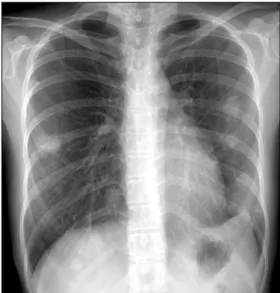
Figure 1. Chest radiography shows multiple nodular opacities of varying size in both lungs.

Figure 2. (A) Initial chest computed tomography (CT) image shows multiple nodular infiltrates located predominantly in the periphery of both lower lobes and a small amount of pleural effusion in the left hemithorax. (B) Three months after the discontinuation of balsalazide, a chest CT shows marked improvements or complete resolution of nodular infiltrates in both lungs and disappearance of the left pleural effusion.

lung fields. Seven months before the visit, she had re- ceived a diagnosis of UC at a general hospital. Balsala- zide (Colazal

TM

; Chong Kun Dang, Seoul, Korea; 2.25 g, orally, three times a day) was started from the diag- nosis and used regularly until the visit of our hospital.

She was also treated with mesalazine enemas (2 g/30 mL, twice daily) for 4 weeks after the diagnosis.

Chest radiography showed multiple nodular opacities of varying size in both lungs (Figure 1). Chest CT scan revealed multiple focal consolidative lesions located predominantly in the periphery of both lower lobes, and a small amount of left pleural effusion (Figure 2A).

Laboratory tests revealed normal values of complete blood cell count, electrolytes, chemistry profile, and ar- terial blood gas analysis. Erythrocyte sedimentation rate (30 mm/hr) and C-reactive protein concentration (3.30 mg/dL; reference range, ≤0.5 mg/dL) were slightly increased. Tests for serum rheumatoid factor and fluo- rescent antinuclear antibodies were negative. Antineu- trophil cytoplasmic antibodies (ANCA) against protei- nase 3 (cANCA) or myeloperoxidase (pANCA) tests were negative. There is no abnormal finding in urine analysis. Pulmonary function tests showed a mild re- strictive pattern: forced vital capacity (FVC) of 1.89 L (69% of predicted value), forced expiratory volume in the first second (FEV

1

) of 2.14 L (62% of predicted val- ue), and FEV

1

/FVC of 88%.

Bronchoscopy with bronchoalveolar lavage (BAL) was performed to evaluate nodular infiltrative lesions and rule out infection or malignancy. There is no endo- bronchial lesion on bronchoscopy. BAL fluid recovered from the lingular segment of the left upper lobe showed prominent lymphocytosis (40% of lymphocytes, 55% of macrophages, and 5% of neutrophils). No malignant cells were observed in BAL cytological analysis. BAL cultures for viruses, bacteria and fungi were negative.

For confirmative diagnosis of the pulmonary lesions, video-assisted thoracoscopic surgery was performed.

Surgical specimens obtained from the left lower lobe re-

vealed extensive necrosis with intraluminal organization

that resembled BOOP (Figure 3A). Distinct multinu-

(3)

Figure 3. (A) Extensive ne- crosis with plugs of fibro- blasts and fibrin within the alveolar space and alveolar duct look like BOOP (H&E stain, ×100). (B) High mag- nification shows a small granuloma with multinucle- ated giant cells (H&E stain,

×200). BOOP: bronchioli- tis obliterans organizing pneumonia.

cleated giant cells were observed within the intraalve- olar fibrosis (Figure 3B). Necrotizing vasculitis was also observed. These pathologic findings are consistent with GPA with BOOP-like variant. The patient had no abnor- malities in nasopharyngoscopic examination. Therefore, we could conclude that the patient had a limited form of GPA with BOOP-like variant.

Predominant BAL lymphocytosis (lymphocyte≥25%) is likely to be caused by interstitial lung disease asso- ciated with granuloma formation such as sarcoidosis or hypersensitivity pneumonitis

13

. Drug toxicity, cellular nonspecific interstitial pneumonia, lymphoid interstitial pneumonia, or lymphoproliferative disorders also cause predominant BAL lymhocytosis

13

. Because infectious or malignant conditions were excluded and there were no clinical manifestations suggesting the above-mentioned interstitial lung diseases, balsalazide toxicity is highly suspected for the development of a limited form of GPA with BOOP-like variant in this patient. To assess the possible relationship, we decided to follow up on the patient without balsalazide treatment. Three weeks after the discontinuation of balsalazide, the nodular in- filtrative lesions decreased in size and the amount of pleural effusion was reduced on chest radiography.

Thereafter, we used 20 mg of prednisolone for one week with the expectation of rapid resolution of symp- toms and radiographic abnormalities. A chest CT ob- tained three months after the discontinuation of balsala-

zide displayed marked improvements or the complete disappearance of nodular infiltrative lesions and left pleural effusion (Figure 2B). Finally, we concluded that the patient had a balsalazide-induced limited form of GPA with BOOP-like variant.

Discussion

Balsalazide is a prodrug of 5-ASA which is linked via a diazo-bond to 4-aminoenzoyl-β-alanine, an inert and biologically inactive carrier molecule

1,2

. After being or- ally administered, colonic bacteria split balsalazide into 5-ASA and 4-aminoenzoyl-β-alanine. Thus, balsalazide is active in the colon with minimal systemic absorption.

Mesalazine, on the other hand, is absorbed into the ter- minal ileum and/or colon. Clinically, balsalazide has gained popularity for use in the treatment of UC due to equivalent efficacy and fewer side effects to com- parable medications.

Pulmonary manifestations of UC are rare. Bronchiec- tasis, inflammatory tracheal stenosis, panbronchiolitis, chronic bronchitis, and BOOP have been reported as pulmonary manifestations of UC

8

. Sulfasalzine or mesa- lazine could induce pulmonary toxicities including inter- stitial pneumonitis, eosinophilic pneumonia, BOOP, and eosinophilic pleural effusion

3-8

.

Pulmonary complications resembling GPA in UC are

extremely rare. We could find only 7 cases reported

8-12

.

(4)

Of these cases, 5 were associated with 5-ASA agents at the time of lung presentations

8-12

, but 2 cases were man- ifested in the absence of 5-ASA agents

8,12

. There is no report of balsalazide-associated GPA as a pulmonary complication during the treatment of UC up to now.

Among the seven cases, 4 cases were identified as a limited form of GPA

8,9,12

. Yano et al.

9

reported a case of a limited form of GPA with BOOP-like variant similar to ours. But this case was associated with mesalazine.

The interval from diagnosis of UC to pulmonary com- plications resembling GPA varies widely from 9 months to 25 years in previous cases

8-12

. In our case, 7 months elapsed from the diagnosis of UC to the development of a limited form of GPA with BOOP-like variant, which is the shortest time interval ever recorded. Thus, devel- opment of GPA should be considered at any time in the course of UC, especially on 5-ASA agents.

In this case, tests for ANCA were negative. The ma- jority of patients with UC (50∼80%) showed pANCA- positive. Up to 90% of patients with active GPA are ANCA positive, of whom the majority are cANCA positive. All the previous cases of pulmonary complica- tions resembling GPA in UC were ANCA-positive

8-12

. A small portion of ANCA-negative GPAs was reported in individuals with GPA symptoms limited to the ears, nose, throat, and lungs

14

.

Most cases of GPA in UC were treated with gluco- corticoids

10

. But the clinical responses to therapeutic in- terventions were diverse. One case showed a relapse of lung disease after adding prednisolone without dis- continuation of mesalazine, thus mesalazine should have to be stopped

9

. One case showed clinical and ra- diographic improvements with only the discontinuation of sulfasalazine

11

, but another one showed radiographic improvements without any treatment or discontinuation of mesalazine

10

. Our case showed marked improve- ments with the discontinuation of balsalazide and a one-week course of prednisolone.

Drug lymphocyte stimulation test for balsalazide may be helpful to support the causal relationship between balsalazide use and the development of GPA. But we did not perform it. A drug lymphocyte stimulation test

was performed in two cases to show the association of drugs and GPA in patients with UC

9,10

. Since respiratory symptoms and radiographic abnormalities were mark- edly improved after the discontinuation of balsalazide under the high suspicion of balsalazide as the cause of them, we considered this case a balsalazide-induced limited form of GPA with BOOP-like variant.

Here, we described a patient with UC on balsalazide presenting respiratory symptoms and multiple pulmo- nary nodules from a chest radiography and pathologi- cally diagnosed with a limited form of GPA with BOOP- like variant. To our knowledge, this is the first report of a limited form of GPA with BOOP-like variant in- duced by balsalazide. A limited form of GPA with BOOP-like variant should be considered in the differ- ential diagnosis as a pulmonary complication in patients with UC on balsalazide.

References

1. Wiggins JB, Rajapakse R. Balsalazide: a novel 5-amino- salicylate prodrug for the treatment of active ulcerative colitis. Expert Opin Drug Metab Toxicol 2009;5:1279- 84.

2. Tursi A. Balsalazide in treating colonic diseases. Expert Opin Drug Metab Toxicol 2009;5:1555-63.

3. Muzzi A, Ciani F, Bianchini D, Festini G, Volpe C.

Adverse pulmonary effects of mesalamine. Chest 1995;

108:1181.

4. Park JE, Hwangbo Y, Chang R, Chang YW, Jang JY, Kim BH, et al. Mesalazine-induced eosinophilic pneu- monia in a patient with Crohn's disease. Korean J Gastroenterol 2009;53:116-20.

5. Tanigawa K, Sugiyama K, Matsuyama H, Nakao H, Kohno K, Komuro Y, et al. Mesalazine-induced eosino- philic pneumonia. Respiration 1999;66:69-72.

6. Bitton A, Peppercorn MA, Hanrahan JP, Upton MP.

Mesalamine-induced lung toxicity. Am J Gastroenterol 1996;91:1039-40.

7. Foster RA, Zander DS, Mergo PJ, Valentine JF. Mesala- mine-related lung disease: clinical, radiographic, and pathologic manifestations. Inflamm Bowel Dis 2003;9:

308-15.

8. Camus P, Piard F, Ashcroft T, Gal AA, Colby TV. The

lung in inflammatory bowel disease. Medicine (Baltim-

ore) 1993;72:151-83.

(5)

9. Yano S, Kobayashi K, Kato K, Nishimura K. A limited form of Wegener's granulomatosis with bronchiolitis obliterans organizing pneumonitis-like variant in an ul- cerative colitis patient. Intern Med 2002;41:1013-5.

10. Kasuga A, Mandai Y, Katsuno T, Sato T, Yamaguchi T, Yokosuka O. Pulmonary complications resembling Wegener's granulomatosis in ulcerative colitis with ele- vated proteinase-3 anti-neutrophil cytoplasmic anti- body. Intern Med 2008;47:1211-4.

11. Salerno SM, Ormseth EJ, Roth BJ, Meyer CA, Christensen ED, Dillard TA. Sulfasalazine pulmonary toxicity in ulcerative colitis mimicking clinical features

of Wegener's granulomatosis. Chest 1996;110:556-9.

12. Stebbing J, Askin F, Fishman E, Stone J. Pulmonary manifestations of ulcerative colitis mimicking Wegen- er's granulomatosis. J Rheumatol 1999;26:1617-21.

13. Meyer KC, Raghu G. Bronchoalveolar lavage for the evaluation of interstitial lung disease: is it clinically use- ful? Eur Respir J 2011;38:761-9.

14. Khan A, Lawson CA, Quinn MA, Isdale AH, Green MJ.

Successful treatment of ANCA-negative Wegener's granulomatosis with rituximab. Int J Rheumatol 2010;

2010:846063.

수치

Figure  1.  Chest  radiography  shows  multiple  nodular  opacities  of  varying  size  in  both  lungs.
Figure 3. (A) Extensive ne- ne-crosis  with  plugs  of   fibro-blasts  and  fibrin  within  the  alveolar space and alveolar  duct  look  like  BOOP  (H&E  stain, ×100)

참조

관련 문서