24
and Safety
Available online at http://www.foodhygiene.or.kr
국내 신선 채소류의 미생물 오염 특성
홍채규·서영호*·최채만·황인숙·김무상 서울시보건환경연구원
Microbial Quality of Fresh Vegetables and Fruits in Seoul, Korea
Chae-kyu Hong, Young-ho Seo*, Chae-man Choi, In-suk Hwang, and Moo-sang Kim Seoul Metropolitan Government Research institute of Public Health and Environment
(Received January 6, 2012/Revised February 13, 2012/Accepted February 20, 2012)
ABSTRACT - A total of 187 samples of leafy vegetables and fruits were acquired at traditional markets and department stores in Seoul, Korea. Samples were tested for microorganism distributions and for the presence of patho- genic bacteria. The aerobic mesophilic counts ranged between 2.5 and 9.4 log CFU/g, with the highest count recorded from the dropwort. Counts of psychrotrophic microorganisms were as high as those of the mesophilic microorgan- isms. Total coliform populations between 1.0 and 7.8 log CFU/g were found in 90.9% of the samples. Microbiological counts for fruits were very low. Escherichia coli was isolated in 24 (12.8%) samples. Staphylococcus aureus and Clostridium perfringens contamination were found in 15 (8.0%) and 20 (10.7%) samples. Salmonella species and Listeria monocytogenes were detected in 2.7 and 0.5% of samples, respectively. Among the total 187 samples, 8 sam- ples were contaminated by more than two pathogens. E. coli O157:H7 was not detected in any of the samples. The microbial contamination levels determined in the present study may be used as the primary data to execute microbial risk assessment of fresh vegetables and fruits.
Key words : Vegetables, microorganism, foodborne pathogen, safety
서 론
유해 미생물에 의한 식중독발생은 생활 수준이 높은 선 진국에서도 계속 증가하고 있다. 이로 인하여 인간의 건 강이 위협받고 있으며, 경제적 손실도 막대하게 발생하고 있다1). 우리나라의 식중독 발생 통계에 따르면 급식과 외 식의 생활화로 인해 5년 전보다 발생건수가 2.5배 증가하 였고, 환자수는 20% 증가하였다2). 그리고 건강에 대한 관 심의 증가로 여러 종류의 야채를 생식하면서 이와 관련된 식중독 사고가 다수 발생하고 있다. 일반적으로 신선 채 소류는 가열하지 않고 신선한 상태로 섭취하기 때문에 병 원성 미생물에 오염되어 있을 경우 식품 안전성에 위협이 될 수 있다. 특히 채소의 생산과정에서 오염된 토양에 의 해 Salmonella spp. 또는 Listeria monocytogenes 등의 식 중독 원인균에 오염될 가능성이 있으므로 생산단계에 있 어서 퇴비나 가축의 분변에 의해 오염되지 않도록 특히
주의를 기울여야 한다3). 또한 가축의 분변을 이용하지 않 더라도 야생동물, 곤충, 환경 등에 의한 오염의 가능성4) 등 야채의 생산에서부터 가정이나 식당에 도달하기까지 오 염의 변수가 있다. 미국 FDA에서는 The guide to Minimize Microbial Food Safety Hazards for Fresh Fruits and Vegetables 지침서5)를 통하여 채소 성장 및 수확시기에는 가축의 접근을 금지하고 수확농업용수, 냉장 공정 등 수확 에서 제품생산에 이르기까지 미생물의 오염을 줄이기 위해 GAPs 및 GMPs에 따르도록 지시하고 있다. 이에 본 연구 는 우리나라 신선 채소류의 최소 유통 시점에서의 미생물 오염 특성을 조사하였다. 우리나라 식품공전에서는 가공식 품의 특성에 따라 Salmonella spp., Staphylococcus aureus, Vibrio parahaemolyticus. Clostridium perfringens, Listeria monocytogenes, Escherichia coli O157:H7, Campylobacter jejuni, Bacillus cereus, Yersinia enterocolitica 등 식중독균 이 검출되어서는 아니된다6) 라고 명시되어 있으며, 근래에 는 신선편의식품에 대하여 정량적인 기준이 설정되어 있 다. 신선 채소류 중 한국인에 있어 일일 평균 섭취량이 많 은 상추, 깻잎 등은 대부분 익히지 않고 직접 섭취하고 있 으므로 이러한 채소류의 미생물에 대해서도 보다 체계적
*Correspondence to: Young Ho Seo, Seoul Metropolitan Govern- ment Research Institute of Public Health and Environment Tel: 82-2-3401-6292, Fax: 82-2-3401-6742
E-mail: [email protected]
인 분석이 요구된다고 할 수 있다.
본 연구는 서울지역 채소의 경매장소인 가락도매시장 및 유통업체에서 유통되는 채소 및 과일 187건을 채취하여 실험에 이용하였다. 채소류 및 과일류의 기본적인 오염도 를 알아보기 위해 총호기성균, 호냉성균, 총대장균군수, 대 장균을 측정하였으며, 식중독균으로써 Salmonella spp., Staphylococcus aureus, Clostridium perfringens, Listeria monocytogenes, Escherichia coli O157:H7의 오염도를 측 정함으로써 채소류에 의해 발생할 수 있는 식중독에 대한 인식을 높이고, 식중독균 검출자료를 축적하여 향후 미생 물 위해평가(microbial risk assessment, MRA)의 기초자료 로 활용하고자 한다.
재료 및 방법
재료
본 실험에 사용된 신선 채소류는 2011년 3월부터 10월 까지 서울지역 가락 농수산물 도매시장에서 수거된 140종 과 대형 유통업체에서 수거된 47건을 실험재료로 사용하 였다. 분석된 신선 채소류는 상추, 깻잎, 시금치, 치커리, 미나리 그리고 과일류(사과, 토마토, 포도, 귤)였다. 각각의 시료는 수거 후 신속 운반하였고 실험실에 도착 후 즉시 실험을 실시하였다.
일반미생물
서울지역에 있는 채소 및 과일류 187건을 수거하여 중 온균, 호냉성균, 총대장균군에 대하여 식품공전에 수록되 어 있는 방법을 이용하여 실험을 실시하였다6). 시료 25 g 을 채취하여 멸균 인산완충액(1 g/L peptone 및 8.5 g/L NaCl 첨가) 225 mL에 넣어 stomacher (Stomacher Lab Blender 400; Seward, NY, USA)로 30초간 균질화시켜 시험용액으 로 하고, 시험용액을 멸균 인산완충액으로 단계별로 희석 하여 접종용 배지에 3회 이상 접종한 후 일정시간 배양하 여 생성된 집락수를 계산하고 그 평균 집락수에 희석배수 에 곱하여 중온균수, 호냉성균수, 그리고 총대장균군수를 각각 산출하였다. 중온균수과 호냉성균수은 Plate Count agar (PCA, Difco, Detroit, MI, USA)에 도말하여 각각 37oC 에서 48시간, 21oC에서 72시간 배양한 후 집락을 계수하 였고, 총대장균군수는 deoxycholate agar (Difco) 배지를 이 용하여 37oC에서 18시간 배양한 후 전형적인 암적색 집락 을 계수하였다.
Escherichia coli 및 E. coli O157:H7
시험용액 1 mL를 EC broth (Difco)에 가하여 35oC에서 24시간 증균 배양하였다. 배양액을 Eosine Methylene Blue Agar (EMB, Difco)에 접종하여 35oC, 24시간 배양하고,
녹색의 금속성 광택이 확인된 집락은 Tryptic Soy Agar (TSA, Difco)에 접종하여 35oC, 24시간 배양한 후 성상을 확인하였다. API 20E kit (Biomerieux, Marcy I'Etoile, France)를 이용하여 E. coli로 확인 동정된 균은 O157 항 혈청을 사용하여 혈청형을 결정하고, O157이 확인되면 H7 혈청형시험을 진행하였다6).
Salmonella spp.
Salmonella spp.는 시험용액 1 mL를 peptone water에 가 하여 1분간 stomaching 한 후 37oC에서 16-20시간 증균 배 양하였다. 2차 증균 배양은 Rappaport-Vassiliadis (RV, Difco) Broth 10 mL에 1차 증균액 0.1 mL를 접종하여 42oC 에서 24시간 배양하였다. 분리배양은 xylose lysine desoxycholate (XLD, BD, NJ, USA) Agar에 접종한 후, 37oC에서 24시간 배양한 후 검은색의 의심집락을 triple sugar iron agar slant (TSI, BD)에서 35oC에서 24시간 배 양하여 성상을 확인하였다. 최종 동정은 API 20E kit (Biomerieux)로 확인하였다6).
Staphylococcus aureus
S. aureus는 시험용액 1 mL를 0.85% NaCl 용액에 1:10 의 비율로 혼합하고 이를 순차적으로 희석하여 Baird-Parker agar (BPA, Difco)에 도말한 후 37oC, 48시간 배양하였다.
투명한 환이 있는 검은색 의심집락을 다시 brain-heart infusion agar (BHI, Difco) 배지에서 37oC, 48시간 배양한 후, Coagulase test를 실시하여 양성임을 확인하고, API Staph kit (Biomerieux)를 이용하여 최종 동정하였다6-7).
Listeria monocytogenes
L. monocytogenes는 검체 25 g을 225 mL의 Listeria enrichment broth (Difco)에 가하여 1분간 stomaching 한 후 30oC에서 24시간 증균배양하였다. 2차 증균배양은 Fraser Listeria Broth (Difco) 10 mL에 1차 증균배양액 0.1 ml를 접종하여 30oC에서 24시간 배양하였다. 분리배양은 증균 액을 PALCAM Agar (Difco)에 접종하여 30oC에서 48시간 배양하고, 검은색의 집락이 의심되는 시료를 그람염색 후 그람양성 간균 및 beta-용혈을 확인한 후 API Listeria kit (Biomerieux)를 이용하여 최종 확인하였다6).
Clostridium perfringens
C. perfringens는 혐기성상태를 유지하면서 cooked-meat 배지에서 30oC, 24시간동안 증균 배양을 하였다. 분리배양 은 perfringens selective supplement를 함유한 tryotose sulfite cycloserine agar (TSC, BD)에 접종한 후, 혐기상태 로 유지하면서 37oC, 24시간 배양하였다. 검은색의 의심되 는 집락을 API 20A (Biomerieux)를 이용하여 확인하였다6).
결과 및 고찰
신선 채소 및 과일류의 총호기성균, 호냉성균, 총대장균군 서울시내 가락 농수산물시장과 대형마트에서 수거한 채 소 및 과일류 187건을 수거하여 중온균, 호냉성균, 총대장 균군을 검사하였다. 미나리에서 중온균이 3.6-9.4 log CFU/
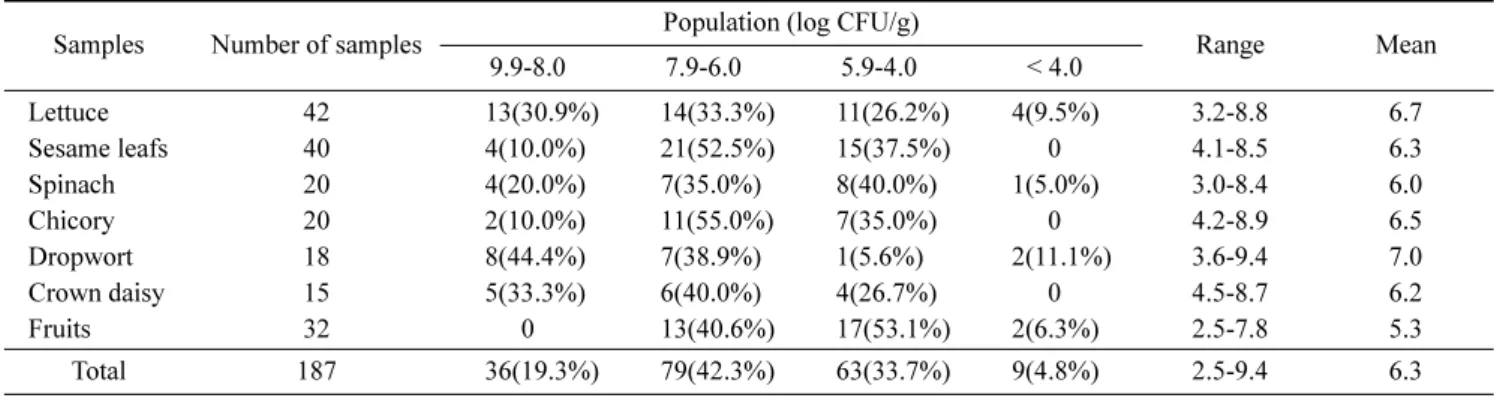
g로 가장 높게 나왔으며, 과일류에서 가장 낮았다. 중온균 은 Table 1과 같이 범위가 매우 광범위하게 검출되었으며 (2.5-9.4 log CFU/g), 구체적으로 시료별로 보면 상추에서 3.2-8.8 log CFU/g, 깻잎에서 4.1-8.5 log CFU/g, 시금치에서 3.0-8.4 log CFU/g, 치커리에서 4.2-8.9 log CFU/g, 쑥갓에서 4.5-8.7 log CFU/g 이었다. 중온균수가 6 log CFU/g 이상 인 시료는 모두 115건(61.5%)으로 나타났으며, 이 중 가장 균수가 높은 시료군은 미나리였으며 44.4%가 8.0-9.9 log CFU/g 범위에 속하는 것으로 나타났다. 채소류는 초기에 병원균이나 부패균이 매우 적은 양으로 존재하더라도 적 당한 온도와 수분 및 영양분이 제공되는 환경 중에서 급 격히 증식할 수 있는 가능성이 높으며, 생산 및 유통과정 에서 유해 미생물을 제거하거나 감소시킬 수 있는 특별한 과정이 없다8).
일반적으로 채소류에서 발견되는 미생물은 대부분 21oC 에서도 잘 자라는 호냉성균이다. 본 연구에서도 중온균과 호냉성균은 유사하게 검출되었다(Table 1-2). 호냉성균은 대부분 낮은 온도에서 매우 느리게 자라므로 소비자들이
섭취 후 감염을 일으키는 경우는 매우 드물다. Garg 등9) 은 제조 과정 중에 중온균과 호냉성균이 유사한 수준으로 검출된다고 보고하였으며, 저온에서 저장하는 동안 대부분 호냉성균이 검출된다는 보고도 있다10). 그러나 중온균도 매 우 적은 수준이지만 낮은 온도에서도 지속적으로 증가하 고 있다고 보고되었다11). Ragaert 등12)의 연구에서는 대부 분의 신선식품들이 7-8 log CFU/g 이상일 때 상품가치가 크게 하락하고, 소비자 기호도에서도 크게 떨어지지만, 세 균수가 이 수치를 넘어선다고 해서 반드시 변질되었다고 할 수는 없다고 보고하였다.
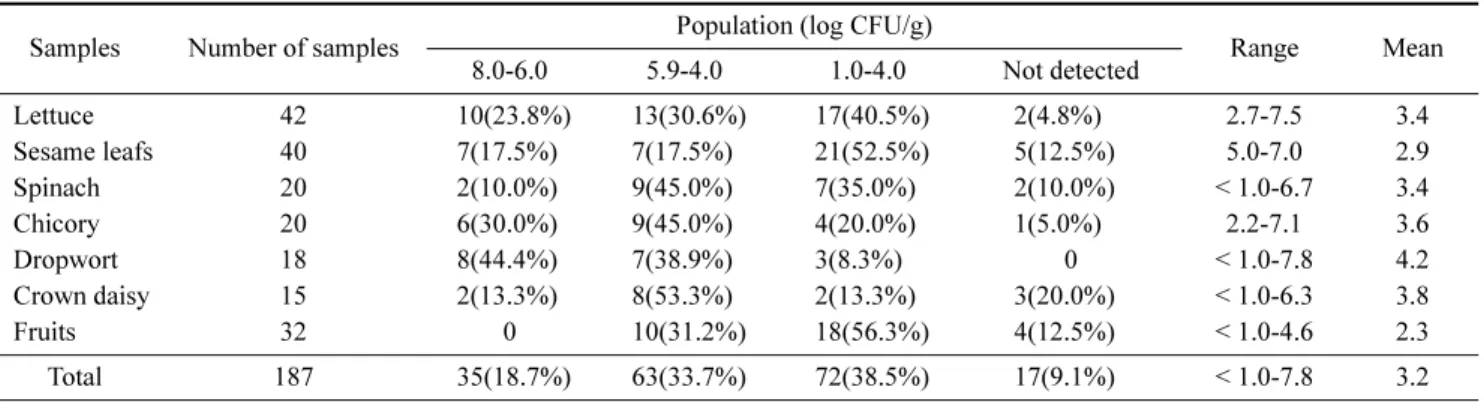
총대장균군은 Table 3에서와 같이 전체시료 187건 중 170건에서 검출되어 시료의 90.9%의 검출률을 나타내었 다. 그리고 평균 균수는 5.8 log CFU/g 이었고 범위는 < 1.0- 7.8 log CFU/g로 나타났다. 상추에서는 40건(95.2%)이 검 출되었으며, 평균함량은 3.4 log CFU/g 이었다. 미나리에서 는 모든 시료에서 총대장균군이 검출되었으며, 평균함량도 4.2 log CFU/g 로 가장 높게 나타났다. 과일류와 깻잎에서 는 평균함량 3.0 log CFU/g 이하로 비교적 적은 양으로 검 출되었다. 채소 및 과일류의 총대장균군과 관련된 다른 연 구를 살펴보면 Pingulkar 등13)의 연구에서는 검사한 신선 채소의 97%에서 대장균군이 검출되었다고 보고하였다. 또 한 Garg 등14)은 상추, 시금치, 양배추, 절단당근 등에서 3- 5 log CFU/g의 분변성 대장균군이 검출되었다고 보고하였 다. 채소류 섭취와 관련된 식중독 발생사고 역학조사에서
Table 1. Populations of the aerobic mesophilic on fresh vegetables and fruits Samples Number of samples Population (log CFU/g)
Range Mean
9.9-8.0 7.9-6.0 5.9-4.0 < 4.0
Lettuce 42 13(30.9%) 14(33.3%) 11(26.2%) 4(9.5%) 3.2-8.8 6.7
Sesame leafs 40 4(10.0%) 21(52.5%) 15(37.5%) 0 4.1-8.5 6.3
Spinach 20 4(20.0%) 7(35.0%) 8(40.0%) 1(5.0%) 3.0-8.4 6.0
Chicory 20 2(10.0%) 11(55.0%) 7(35.0%) 0 4.2-8.9 6.5
Dropwort 18 8(44.4%) 7(38.9%) 1(5.6%) 2(11.1%) 3.6-9.4 7.0
Crown daisy 15 5(33.3%) 6(40.0%) 4(26.7%) 0 4.5-8.7 6.2
Fruits 32 0 13(40.6%) 17(53.1%) 2(6.3%) 2.5-7.8 5.3
Total 187 36(19.3%) 79(42.3%) 63(33.7%) 9(4.8%) 2.5-9.4 6.3
Table 2. Populations of the psychrotrophic microorganisms on fresh vegetables and fruits
Samples Number of samples Population (log CFU/g)
Range Mean
9.9-8.0 7.9-6.0 5.9-4.0 < 4.0
Lettuce 42 7(16.7%) 14(33.3%) 15(35.7%) 6(14.3%) 2.8-8.7 6.2
Sesame leafs 40 3(7.5%) 20(50.0%) 13(32.5%) 4(10.0%) 3.3-8.4 6.2
Spinach 20 2(10.0%) 5(25.0%) 10(50.0%) 3(15.0%) 2.8-8.2 5.6
Chicory 20 2(10.0%) 9(45.0%) 9(45.0%) 0 4.0-8.5 6.0
Dropwort 18 6(33.3%) 5(27.8%) 5(27.8%) 2(11.1%) 3.4-8.9 6.7
Crown daisy 15 2(13.3%) 7(46.7%) 4(26.7%) 2(13.3%) 3.6-8.4 6.0
Fruits 32 0 10(31.3%) 16(50.0%) 6(18.8%) 2.3-7.2 4.4
Total 187 22(11.8%) 70(37.4%) 72(38.5%) 23(12.3%) 2.3-8.9 5.8
대부분의 사고 원인은 이러한 분변세균과 연관되어 있는 것으로 나타났다. 이러한 관점에서 총대장균군은 식품위생 지표의 하나로서 이용될 수 있으리라 생각된다.
대장균 및 식중독균
신선 채소 및 과일류 187건에 대해 E. coli와 식중독균 인 S. aureus, E. coli O157:H7, Salmonella spp., L. mono- cytogenes 및 C. perfringens 를 검출한 결과는 Table 4와 같다. E. coli는 전체시료에서 24건(12.8%)이 분리되었고, 상추에서 19.1%, 미나리에서 16.7%, 깻잎에서 15.0%, 쑥 갓에서 13.3%, 시금치 및 치커리에서 10.0%, 과일류에서 3.1%로 검출되었다. 국내에서 Jung 등15)은 비가열 섭취 채 소류에서 E. coli가 18.5% 검출되었다고 보고했으며, Seo 등16)은 신선편의식품에서 5.8%의 검출율을 보였다고 보고 하였다. 본 연구에서 상추, 깻잎 등 우리가 일상적으로 생 식하는 채소류에서 E. coli가 검출되었기에 위생상태가 좋 지 않은 것으로 판단되어진다. 그러므로 수확 전후 및 유 통단계에 있는 신선 채소들의 미생물적 안전성 확보를 위 한 연구가 필요한 것으로 여겨진다.
S. aureus 는 상추에서 6건(14.3%), 미나리에서 3건 (16.7%), 깻잎과 치커리에서 각각 2건, 쑥갓 및 과일류에서 각각 1건 등 모두 15건(8.0%)에서 검출되어, 일부 농산물
이 오염된 것을 확인할 수 있었다. S. aureus는 하나 이상 의 독소를 형성해서 식중독을 일으키는 독소형 식중독으 로서, 상대적으로 많은 균주들이 항생제에 내성을 가지는 경우가 많다17). Beuchat 등17)은 신선채소의 17.7-24.0%에서 S. aureus가 검출되었다고 보고하면서 이 균이 식품 취급 자의 손에서 유래되었다고 발표하였다. 또한 Jung 등18)은 한국에서 생산된 상추 중 37%에서 S. aureus가 검출되었 다고 보고하였다.
Salmonella spp. 는 187건 중에 5건(미나리 2건, 상추 1 건, 시금치 1건, 과일류 1건)에서 검출되었다. Salmonella spp. 균의 검출사례는 국외 연구결과에서 매우 다양하게 나 타났는데 미네소타와 위스콘신주19), 영국20), 미국 남부21), 스 페인22) 등에서 이루어진 연구에서 각각 0, 0.2, 3.3, 1.3%
의 Salmonella가 검출되었다. 지금까지 한국에서 신선편의 식품 섭취 후에 Salmonella증을 일으킨 사례는 아직 없다.
하지만 2009년 5월 미국 FDA에서 새싹채소인 알팔파가 Salmonella 감염과 연관되어 있을 가능성을 제시하며, 섭 취하지 않을 것을 경고하기도 하였다23).
C. perfringens는 신선채소 187건 중 20건(10.7%)에서 검 출되었으며, 구체적으로 살펴보면 쑥갓에서만 검출되지 않 았으며, 상추에서 5건(11.9%), 시금치와 미나리에서 4건, 깻잎에서 3건, 치커리와 과일에서 2건이 검출되어 대부분 Table 3. Populations of the total coliforms on fresh vegetables and fruits
Samples Number of samples Population (log CFU/g)
Range Mean
8.0-6.0 5.9-4.0 1.0-4.0 Not detected
Lettuce 42 10(23.8%) 13(30.6%) 17(40.5%) 2(4.8%) 2.7-7.5 3.4
Sesame leafs 40 7(17.5%) 7(17.5%) 21(52.5%) 5(12.5%) 5.0-7.0 2.9
Spinach 20 2(10.0%) 9(45.0%) 7(35.0%) 2(10.0%) < 1.0-6.7 3.4
Chicory 20 6(30.0%) 9(45.0%) 4(20.0%) 1(5.0%) 2.2-7.1 3.6
Dropwort 18 8(44.4%) 7(38.9%) 3(8.3%) 0 < 1.0-7.8 4.2
Crown daisy 15 2(13.3%) 8(53.3%) 2(13.3%) 3(20.0%) < 1.0-6.3 3.8
Fruits 32 0 10(31.2%) 18(56.3%) 4(12.5%) < 1.0-4.6 2.3
Total 187 35(18.7%) 63(33.7%) 72(38.5%) 17(9.1%) < 1.0-7.8 3.2
Table 4. Incidence of Staphylococcus aureus, Escherichia. coli, Salmonella spp., Listeria monocytogenes and Clostridium perfringens in fresh vegetables and fruits
Samples Number of samples
Number of samples positive for:
E. coli S. aureus Salmo-nella spp. L. mono- cytogenes Cl. per- fringens
Lettuce 42 8(19.1%) 6(14.3%) 1(2.4%) ND 5(11.9%)
Sesame leafs 40 6(15.0%) 2(5.0%) ND ND 3(7.5%)
Spinach 20 2(10.0%) NDa 1(5.0%) ND 4(20.0%)
Chicory 20 2(10.0%) 2(10.0%) ND ND 2(10.0%)
Dropwort 18 3(16.7%) 3(16.7%) 2(11.1%) ND 4(22.2%)
Crown daisy 15 2(13.3%) 1(6.7%) ND ND ND
Fruits 32 1(3.1%) 1(3.1%) 1(3.1%) 1(3.1%) 2(6.3%)
Total 187 24(12.8%) 15(8.0%) 5(2.7%) 1(0.5%) 20(10.7%)
aND : not detectable in 25 g
의 신선채소에 C. perfringens가 오염되어 있음을 알 수 있 었다. C. perfringens는 환경 중에 넓게 퍼져 있으며, 사람 에서도 장내 세균총에서 자주 발견된다24). 신선편의식품에 서 C. perfringens는 저온저장 중에 부주의한 생산물의 처 리로 인해 자주 검출되고 있다고 보고되고 있다24). 또한 Aguilera 등25)의 연구에 의하면 아르헨티나에서 생산된 pepper, paprika, thyme, sage, rosemary 등의 향신료 식물 에서 115건 중 14건(12.2%)이 C. perfringens 양성으로 나 타났다.
L. monocytogenes는 187건의 시료 중 과일류(토마토)에 서 단 1건 검출되었다. L. monocytogenes에 대한 다른 연 구결과를 살펴보면 미국 남부지방19)과 북아일랜드26)에서는 L. monocytogenes가 단 1건도 검출되지 않았다. 반대로 미 국동부와 멕시코 지역에서 신선채소 중 양배추에서 3건의 L. monocytogenes가 검출되었으며21), 노르웨이에서도 신선 채소 중 0.3%에서 검출되었다고 보고하였다27). 또한 Sagoo 등20)의 연구에서도 3,849건의 신선채소 중 90건(2.3%)에 서 검출되었으며, 그 중 1건의 시료에서는 2 log CFU/g 이 상의 농도로 L. monocytogenes가 검출되었다. 그리고 E.
coli O157:H7는 187건의 시료 중 1건도 검출되지 않았다.
국내에서 재배되어 유통 중인 신선 채소류 187건에서 식중독 세균과 대장균이 중복해서 검출된 경우는 8건(4.3%) 이었으며, 이는 소비자가 섭취 후에 언제든지 식중독이 발 생할 우려가 높다는 것을 나타내고 있다. 구체적으로 살 펴보면 S. aureus 와 E. coli가 동시에 검출된 것이 5건 이 었으며, C. perfringens와 Salmonella와 E.coli가 동시에 검 출된 것이 각각 2건, 1건이었다. 본 논문의 연구결과는 다 른 가이드라인28)과 비교할 수 있으며, 이를 바탕으로 규격 기준 설정이나 미생물 위해성평가에 이용될 수 있으리라 여겨진다. 또한 향후 유통단계에 있는 신선 채소 및 과일 류의 미생물 오염수준을 지속적으로 모니터링 해 나가면 서 이를 제어할 수 있는 방법에 대한 연구가 필요할 것으 로 여겨진다.
요 약
본 연구에서는 2011년 3월에서 11월 사이에 서울지역에 서 유통된 신선 채소류 187건을 대상으로 일반미생물과 식중독균 오염실태를 조사하였다. 중온균은 2.5-9.4 log CFU/
g의 범위로 검출되었으며, 세균수가 6 log CFU/g 이상인 시료는 모두 115건(61.5%)으로 나타났고, 가장 균수가 높 은 시료군은 미나리였다. 호냉성균은 중온균과 유사한 패 턴으로 검출되었으며 범위는 2.3-8.9 log CFU/g로 나타났 다. 총대장균군은 시료의 90.9%에서 검출되었으며, 평균함 량은 3.2 log CFU/g 이었다. 대장균은 24건(12.8%)에서 검 출되었으며, 상추, 미나리, 쑥갓에서 각각 19.1, 16.7, 13.3%
검출되었다. C. perfringens는 20건(10.7%), S. aureus는 15 건(8.0%)이 검출되었으며, Salmonella spp.는 5건(2.7%)이 검출되었다. L. monocytogenes는 과일류(토마토)에서 1건이 검출되었으며, E. coli O157:H7은 검출되지 않았다. 식중 독 세균과 대장균이 중복해서 검출된 경우는 8건(4.3%)이 었다.
참고문헌
1. Abadias, M., Usall, J., Anguera, M., Solsona, C. and Vinas, I.:
Microbiological quality of fresh, minimally-processed fruit and vegetables and sprouts from retail establishments. Int. J.
Food Microbiol., 123, 121-129 (2008).
2. 식품의약품안전청. 식중독 발생현황통계. Available from:
http://e-stat.kfda.go.kr/ Accessed Nov. 10, (2011).
3. Soriano, J.M., Rico, H., Molto, J.C. and Manes, J.: Incidence of microbial flora in lettuce, meat and Spanich potato omelette from restaurants. Food Microbiol. 18, 159-163 (2001).
4. Brackett, H., Oguz, U. and Karci, K.: Incidence, contributing factors and control of bacterial pathogens in produce. Posthar- vest Biol. Technol., 15, 305-310 (1999).
5. Food and Drug Administration: The Guide to Minimize Microbial Food Safety Hazards for Fresh Fruits and Vegeta- bles (1999).
6. Korea Food and Drug Administration: Korean Food Stan- dard code, Korea (2010).
7. Bennett, R.W. and Lancette, G.A.: Staphylococcus aureus. In:
Bacteriological Analytical Mannual, 8th. Revision A (2011).
8. Mukherjee, A., Spec, D., Jones, A.T., Buesing, K.M. and Diez-Gonzalez, F.: Longitudinal microbiological survey of fresh produce grown by farmers in the upper Midwest. J.
Food Prot., 69, 1928-1936 (2006).
9. Garg, N., Churey, J.J. and Sittstoesser, D.F.: Effect of condi- tions on the microflora of fresh-cut vegetables. J. Food Prot., 53, 701-703 (1990).
10. Nguyen-The, C. and Carlin, F.: The microbiology of mini- mally processed fresh fruits and vegetables. Crit. Rev. Food Sci., 34, 371-401 (1994).
11. Vescovo, M., Torriano, S., Orsi, C., Macchiarolo, F. and Sco- Table 5. Sample Numbers of overlapped isolation in fresh vegeta-
bles and fruits
Samples S. aureus + E. coli
Cl. perfringens + E. coli
Salmonella spp. + E. coli
Lettuce 2 1 0
Sesame leafs 0 0 0
Spinach 1 0 0
Chicory 0 1 1
Dropwort 0 0 0
Crown daisy 2 0 0
Fruits 0 0 0
Total 5 2 1
lari, G.: Application of antimicrobial-producing lactic acid bacteria to control pathogens in ready-to-use vegetables. J.
Appl. Bacteriol., 81, 113-119 (1996).
12. Ragaert, P., Devlieghere, F. and Debevere, J.: Role of microbi- ological and physiological spoilage mechanisms during stor- age of minimally processed vegetables. Postharvest Biol.
Technol., 44, 185-194 (2007).
13. Pingulkar, K., Kamat, A, and Bongirwar, D.: Microbiologi- cal quality of fresh leafy vegetables, salad components and ready-to-eat salads. Int. J. Food Sci. Nutr., 52, 15-23 (2001).
14. Garg, N., Churey, J.J. and Sittstoesser, D.F.: Effect of condi- tions on the microflora of fresh-cut vegetables. J. Food Prot., 53, 701-703 (1990).
15. Beuchat, L.R.: Pathogenic microorganisms associated with fresh produce. J. Food Prot., 59, 204-216 (1996).
16. Jung, S.H., Hur, M.J., Ju, J.H., Kim, K.A., Oh, S.S., Go, J.M., Kim, Y.H. and Im, J.S.: Microbiological evaluation of raw vegetables. J. FD Hyg. Safety, 21, 250-257 (2006).
17. Seo, Y.H., Jang, J.H. and Moon, K.D.: Microbial evaluation of minimally processed vegetables and sprouts produced in Seoul, Korea. Food Sci. Biotechnol., 19, 1283-1288 (2010).
18. Jung, H.J., Cho, J.I., Park, S.H., Ha, S.D., Lee, K.H., Kim, C.H., Song, H.S., Chung, D.H., Kim, M.G., Kim, K.Y. and Kim, K.S.: Genotypic and phenotypic characteristics of Sta- phylococcus aureus isolates from lettuces and raw milk.
Korean J. Food Sci. Technol., 37, 134-141 (2005).
19. Mukherjee, A., Spec, D., Jones, A.T., Buesing, K.M. and Diez-Gonzalez, F.: Longitudinal microbiological survey of fresh produce grown by farmers in the upper Midwest. J.
Food Prot., 69, 1928-1936 (2006).
20. Sagoo, S.K., Little, C.L., Ward, L. and Mitchell, R.T.: Micro-
biological study of ready-to-eat salad vegetables from retail establishments uncovers a national outbreak of salmonello- sis. J. Food Prot., 66, 403-409 (2003).
21. Johnston, L.M., Jaykus, L., Moll, D., Martinez, M.C., Anciso, J., Mora, B. and Moe, C.L.: A field study on the microbiolog- ical quality of fresh produce. J. Food Prot., 68, 1840-1847 (2005).
22. Abadias, M., Usall, J., Anguera, M., Solsona, C. and Vinas, I.: Microbiological quality of fresh, minimally processed fruit and vegetables and sprouts from retail establishments.
Int. J. Food Microbiol., 123, 121-129 (2008).
23. Food and Drug Administration: Alfalfa sprouts outbreak, Available from:http://www.fda.gov/Food/FoodSafety/Product- Specific, Accessed Oct. 11 (2011).
24. Novak, J.S. and Juneja V.K.: Clostridium perfringens : hazards in new generation foods. Innov. Food Sci. Emerg., 3, 127-132 (2002).
25. Aguilera M.O., Stagnitta P.V., Micalizzi B. and Guzman A.M.
S.: Prevalence and characterization of Clostridium perfringens from spices in Argentina. Anaerobe 11, 327-334 (2005).
26. McMahon M.A.S. and Wilson I.G.: The occurrence of enteric pathogegens and Aeromonas species in organic vege- tables. Int. J. Food Microbiol., 70, 155-162 (2001).
27. Robertson, L.J., Johannessen, G.S., Gjerde, B.K. and Lon- carevic, S.: Microbiological analysis of seed sprouts in Nor- way. Int. J. Food Microbiol., 75, 119-126 (2002).
28. PHLS (Public Health Laboratory Service): Guidelines for the microbiological quality of some ready-to-eat foods sam- pled at the point of sale. Communicable Disease and Public Health (CDPH) 3, 163-167 (2000).