A Study on the Production and Clinical Evaluation of Natural Lip Balm Using Chamaecyparis Obtusa and
Lithospermum Erythrorhizon
Lee Sunkyoung
Dept. of Beauty Art, Seokyeong University
Abstract
As there is a growing interest in natural ingredients, they are actively being studied to improve damaged skin However, the lip cosmetics are still being inadequately studied on the exposure of lips to several stimuli and easy flow of chemical on the lips into the body . This study was conducted to make a clinical evaluation on the real effect of lip balm on lips, by extracting oil from Chamaecyparis obtusa and Lithospermum erythrorhizon that are known to play a positive role on skin. The following three natural lip balms were produced:
lip balm made with Chamaecyparis obtusa(LBWCO), lip balm made with both Chamaecyparis obtusa and Lithospermum erythrorhizon(LBWCOLE), lip balm made without Chamaecyparis obtusa or Lithospermum erythrorhizon(LBWICOLE). The quality of LBWCO or LBWCOLE was evaluated to be higher than that of LBWICOLE. LBWCO and LBWCOLE had the highest satisfaction and purchase intention, respectively. As stated above, Chamaecyparis obtusa and Lithospermum erythrorhizon could be the ingredients of lip balm, and they were effective in improving damaged lips. Consequently, this study will provide opportunities to explore excellent ingredients to be used in natural lip balm. Also, studying lip cosmetics using only the natural ingredients will provide opportunities to expand positive images of ingredients for producing lip cosmetics.
Key words : chamaecyparis obtusa, clinical evaluation, Lithospermum erythrorhizon, natural ingredients, natural lip balm
Ⅰ. Introduction
As all lip cosmetics including a protective cream for lip, lip balm are easily flowing into the
Corresponding author: Lee Sunkyoung, Tel. +82-70-8699-7307, Fax. +82-2-542-1297 E-mail: [email protected]
This research is a part of doctor’s thesis.
body through thin lip skin and mouth, we need to pay attention to safe components and ingredients. The lips can be easily damaged by external stimuli and “the change in various images can be created by the type, direction and
size of lips” (Ha & Cho, 2008, p. 172). The lip damage has a aesthetically bad influence on lip skin, which there are growing demands for cosmetic treatment. But studies on lip cosmetics are still inadequately conducted, compared to several studies on the improvement of damaged general skin from natural ingredients (Han, 2011;
Misun Kwon, 2012), which it is necessary to develop safe materials for improving the damaged lip skin and do research on them.
In the precedent study (Sunkyoung Lee & Lee, 2013) on the production of lip balm from plants known to have the antibacterial, moisturizing, antiinflammatory and protective effects on human body, Chamaecyparis obtusa known to have the most excellent effect and touch feelings compared to other plants is also known to have an effect on atopy, which it is used for daily necessities or interior decoration. Chamaecyparis obtusa is “Cupressaceae native to Japan called an old pine tree, which it has been mainly widespread in southern area since the introduction into Korea in 1904” (H. Oh, 2009, p. 11). In the result of Saetbyeol Lee’s (2013) study of studies on the possibility of Chamaecyparis obtusa as the ingredients of cosmetics, the components of Chamaecyparis obtusa had an effect on antioxidant activities, skin whitening and wrinkles. In the result of K.
Lim’s (2007) and Cha’s (2012) study, the components of Chamaecyparis obtusa had an effect on the reduction of atopy skin pruritus and xeroderma, and the easing of skin roughness by increased water.
“The outbreak of various dermatitis caused by the recent environment deterioration and pollution produced consumers' emotional and actual culture of wellbeing and welldying in food, clothing, and shelter” (Y. Cho, 2007, p.
2), and there was a growing interest in natural cosmetics and ingredients. On the other hand,
according to articles of Hankook Ilbo (MiJin Kwon, 2013), the concentration of heavy metal in lipstick and lip gloss of 32 products sold in the US showed that cadmium, chrome and lead was detected in 15, 22 and 24 products, respectively. The pigments for lip cosmetics are mainly synthetic pigments, but synthetic pigments cause cancer, which it is urgent to develop and use natural ingredients which are relatively safe for human body.
“The natural pigments have been safely absorbed as a part of natural food materials through many generations, which their stability has been verified” (K. Heo, 2012, p. 2). The Lithospermum erythrorhizon has been used as a representative natural pigment for various foods as well as the production of alcohol.
The Lithospermum erythrorhizon has prescribed its roots for cleaning or protecting blood, yellow blood, preventing measles as an antidote, hemoptysis, melena, and constipation in Chinese medicine and folk remedies from old times, and used in eczema, burn, and frostbite treatments through the grinding of its roots for external application, as well as in the food field like the production of alcohol (T. Lee, 2003).
Chamaecyparis obtusa and Lithospermum erythrorhizon, known as playing a positive role in skin, are the same as Figure 1 and Figure 2, respectively. This study is intended to produce and clinically evaluate natural lip balms through ingredients of Chamaecyparis obtusa and Lithospermum erythrorhizon. And it aims to provide basic data on the use of natural ingredients for lips exposed to many stimuli by checking out the real effects of ingredients of Chamaecyparis obtusa on lips and the possibilities as lip cosmetics containing natural pigments through the production and evaluation of 3 lip balms, LBWCO, LBWCOLE and LBWICOLE for relative evaluation.
Figure 1. Chamaecyparis Obtusa - An illustrated guide to tree, p.34
Figure 2. Lithospermum Erythrorhizon
- A study on hair dye using extracts of the Lithospermum erythrorhizon, p.20
Ⅱ. Research Method
1. Research Subject and Data Collection
Research subjects were 400 women, who do not use lip balms, in their 20s to 50s living in Seoul and Gyeonggi-do. They were selected by a random sample.
The period of data collection was from April 15 to May 18, 2013. The components of 3 lip balms were notified to selected clinical evaluators. The 3 lip balms were used for total 15 days after the date of the distribution of them within the period of data collection.
LBWCO, LBWICOLE, and LBWCOLE were used for the first 5 days, for 5 days since, and for final 5 days during the clinical period of 15days,
respectively. The instructions on use date and method were made out and distributed to help them check daily. Each lip balm was used more tan 5 times a day to write relative differences in each lip balm on the clinical questionnaire. The collected 368 copies except uncollected or non-responded 32 copies of 400 clinical questionnaires after clinical trials for 15 days were used for data analysis.
2. Measurement Scale
The survey consists of 94 questions, which is made up of 7 questions to inquire into the general characteristics of those surveyed. And 29 questions - which consist of 23 questions, 4 questions and 2 questions on the usability,
satisfaction and purchase intention of lip balms, respectively - are applied every each lip balm to be made up of 87 questions. The questions were based on Hyojeung Kim’s (2004), G. Kim’s (2007), Choi’s (2008), Park’s (2009), Jeung’s (2010), S. Oh’s (2011), Hyunyoung Lee’s (2011), Y. Heo’s (2011), K. Kim’s (2012), S. KIm’s (2012), Y. KIm’s (2012), Hayan Kim’s (2013), Cha’s (2012) and Hong’s (2012) studies. This researcher complemented and restructured each question through consultation with 5 experts for the test of this study in response to precedent studies.
3. Research Method
1) Production of Lip Balm
(1) Materials
The Chamaecyparis obtusa and Lithospermum erythrorhizon were used as main materials, and other materials were used to maintain and construct the dosage form of lip balm. The impurities in Chamaecyparis obtusa and Lithospermum erythrorhizon, which bought in a herbal shop, were removed to more maximize extraction efficiency of Chamaecyparis obtusa and Lithospermum erythrorhizon. And then Chamaecyparis obtusa and Lithospermum erythrorhizon were crushed by a blender in dry condition after drying at 70oC in dry oven to reduce them to powder that consists of particles less than 1㎎.
Vegetable materials such as Bees wax, Canola oil and rosemary essential oil were used as other materials. The waxes such as carnauba wax, Bees wax and Candelilla wax were used to keep the dosage form of lip balm (Seo, No, &
Kim, 2011), and Bees wax was used in this
study. It contains natural components, which are extracted from a honeycomb. It is used as an auxiliary material for the production of soap. The edible Canola oil of relatively excellent thermal denaturation and thermal stability was used as a solvent, which consists of a lip balm and extracts Chamaecyparis obtusa and Lithospermum erythrorhizon through the mixture with Bees wax. The small amounts of rosemary essential oil were added for the mild fragrance of lip balm. The glycerine used as a moisturizer played a role in smoothing down lip balms. All natural materials were used for the production of lip balm. The kinds of adding materials were minimized to explore the efficacy of main ingredients.
(2) Extraction of Main Ingredients
The extraction of plant in this study differs from the extraction of necessary ingredients from alcohols such as methanol or ethanol in C.
Lee’s (2012) and Yang’s (2012) studies. The emulsifier has not been added in the process of production since the extraction of oil containing ingredients after soaking ingredients in oil. To use main ingredients of powder form, they soaked in Canola oil according to the kind of each lip balm. The contents were as follows.
Firstly, for the production of LBWCO, after putting Chamaecyparis obtusa powder particles of 100g on a glass container and adding them to edible Canola oil of 900g, the mixture was cultured for 72 hours while agitating at 150rpm into a medium of 60oC. Only oil components were collected after straining culture fluid in stainless steel screen of gradations less than 500㎛ to separate oil and solid.
Secondly, for the production of LBWCOLE, Chamaecyparis obtusa powder of 100g and
Lithospermum erythrorhizon powder of 100g less than 1㎎ crushed by a blender was put on a glass container to add Canola oil of 900g. This was equal to the method of extraction for the production of lip balm from Chamaecyparis obtusa, collecting oil containing components of Lithospermum erythrorhizon and Chamaecyparis obtusa.
Thirdly, for the production of LBWICOLE, Canola oil itself, which does not include both Lithospermum erythrorhizon powder and Chamaecyparis obtusa powder, was used.
(3) Production Procedure
Each components of LBWCO and LBWCOLE were extracted to mix Canola oil and Bees wax containing fat-soluble components of ingredients at the rate of 7:3. Each components of LBWICOLE were extracted to mix Canola oil itself and Bees wax itself at the rate of 7:3.
For the production of each lip balm, oil of 700g, Bees wax of 300g and natural glycerine of 1g were mixed to stir for 30 minutes at about 70oC. The rosemary essential oil used for fragrance was used after putting liquid produced by the final addition of 100㎍ per 1kg on a thermostable container to coagulate it naturally.
The heating temperature in the process of production and extraction was kept within 70oC to preserve the efficacy of each components.
For the production of LBWCO, LBWCOLE and LBWICOLE, the rate of Bees oil, glycerine, and rosemary essential oil was equally applied every each lip balm, producing 3 natural lip balms -LBWCO containing fat-soluble components, LBWCOLE containing fat-soluble components, and LBWICOLE produced by Canola oil.
2) Safety Test on Lip Balm
The skin patch test was conducted to identify the stimulus of LBWCO, LBWCOLE and LBWICOLE to human body. Total 30 women in their 20s, who did not participate in the clinical evaluation testing, were selected by random sample. They were classified into 10 persons by each lip balm to conduct a skin patch test from noon on April 10 to noon on April 12, 2013. The lip balms were applied to the inside of arm to conduct a closed patch test on the spot for 48 hours. The patch was removed to identify the stimulus of lip balms to skin after 1 hour.
For skin stimulus evaluation, the symptoms by skin stimulus were classified into 5 classes (-:
non-reaction, ±: doubtful reaction, +: weak reaction․slight erythema, ++: strong reaction․
erythema․papule․edema, +++: very strong reactio n․erythema․papule․blister) according to D. Lim’s (2011) research method. The patch was removed to identify the stimulus of lip balms to skin after 1 hour. The identification in 1 hour after the removal of patch showed that all subjects, who tested LBWCO, LBWCOLE and LBWICOLE, were (-: non-reaction). The undiscovered skin disorder could confirm the safety of all LBWCO, LBWCOLE and LBWICOLE.
3) Statistical Processing and Data Analysis
The SPSS (Statistical Package for Social Science) v. 17.0 was used for data analysis through the process of data coding and data cleaning.
The conducted analyses were as follows.
First, to explore general characteristics of those surveyed, the frequency analysis was conducted.
Second, to verify the validity of measurement scale, the factor analysis was conducted, and to inquire into the reliability of measurement scale,
a Cronbach's α coefficient was calculated.
Third, to examine detailed items of the usability, satisfaction and purchase intention by type of each lip balm, the descriptive statistics analysis was conducted.
Fourth, to identify the usability, satisfaction, and purchase intention of lip balms and differences according to each type, the one way ANOVA was conducted, and for post-hoc, the Duncan test was conducted.
Ⅲ. Research Result and Review
1. General Characteristics of Those Surveyed
Analysis showed that for age, 20s and 30s-40s were 198 persons (53.8%) and 170 persons (46.2%), respectively. For occupation, student was the highest by 206 persons (56.0%), followed by employee by 52 persons (14.1%), housewife by 35 persons (9.5%), sales․
service by 27 persons (7.3%) and public official․
professional by 18 persons (4.9%).
For monthly average cosmetics expenditure, less than 50,000 won, 50,000-100,000 won and more than 100,000 won were 174 persons (47.3%), 143 persons (38.9%) and 51 persons (13.9%), respectively. For purchase cycle of lip balm, 1 time every 3 months, 1 time every 3-6 months, 1 time every 6-9 months and 1 time a year were 99 persons (26.9%), 93 persons (25.3%) and 66 persons (17.9%) and 66 persons (17.9%), respectively.
For the cause of lip damage, dry weather was the highest by 141 persons (38.3%), followed by life habit by 137 persons (37.2%), health problem like nutrition deficiency by 44 persons (12.0%) and stress by 31 persons (8.4%). For use experience of cosmetics containing natural
pigments, yes and no were 171 persons (46.5%) and 197 persons (53.5%), respectively.
For the kind of using lip balm, general lip balm was the highest by 201 persons (54.6%), followed by naturalism lip balm by 101 persons (27.4%) and lip balm for sensitive skin by 18 persons (4.9%), and no by 48 persons (13.0%).
2. Reliability and Validity Test on Measurement Scale
To verify the validity of questions in this study and use common factors as variables, the factor analysis was conducted. The factor analysis was to identify directly unobserved factors based on a series of observed variables, which was aimed at simplifying the contents of questions by binding lots of variables with few factors. The binding of such each question with few factors could figure out if each question measured the same concept or had validity at once.
This study conducted the principle components with factor sampling to extract only factors of more than specified eigen value. The Varimex rotation was conducted in connection with the factor rotation. The eigen value - which indicates that each factor can explain whole dispersion - was based on more than 1. The factor analysis was based on the eigen value of more than 1 and the factor loading value of more than ±0.40 to draw factors through the Varimex rotation of orthogonal rotations. To verify the reliability if questions measured by a multiple-item scale are homogeneous, a Cronbach's α coefficient showing the internal consistency between questions was calculated.
Generally, there is no set standard for the scale of reliability, Cronbach's α value. But if the Cronbach's α value is more than 0.60 and 0.50, it is viewed as reliability and no serious problem
in analyzing data, respectively.
1) Validity and Reliability Test on Usability of Lip Balms
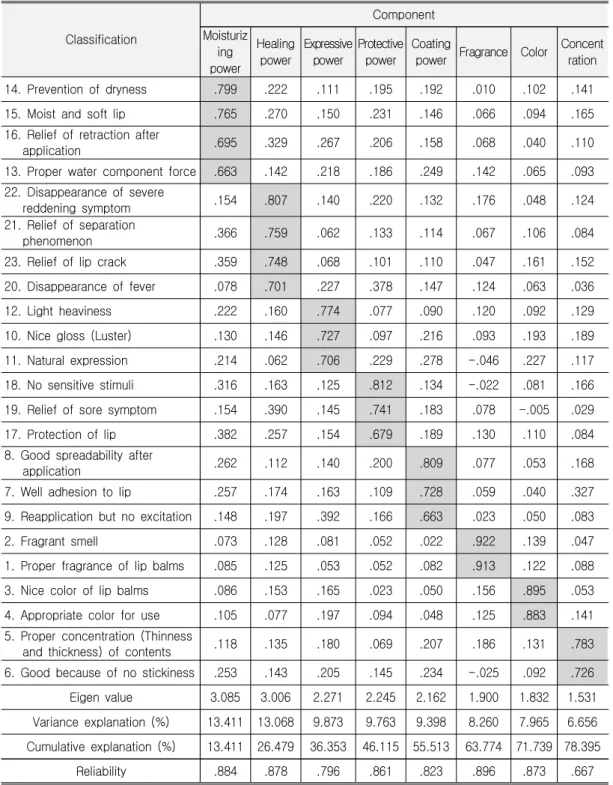
The results of factor analysis on 23 questions about the usability of lip balms were shown below Table 1. Analysis showed that 8 factors were drawn, and based on the central concept of questions forming each factor, factor names were granted.
Factor 1 (13.411%) included the contents of water component force, dryness prevention, moistness and softness, retraction relief, which was named ‘moisturizing power.’ Its eigenvalue and reliability were 3.085 and 0.084, respectively. Factor 2 (13.068%) included the improvement of cracking, reddening symptoms and separation phenomenon, which was named
‘healing power.’ Its eigenvalue and reliability were 3.006 and 0.878, respectively. Factor 3 (9.873%) included the glossy and natural expressiveness, which was named ‘expressive power.’ Its eigenvalue and reliability were 2.271 and 0.796, respectively. Factor 4 (9.763%) included the relief of sensitive stimuli and sore symptoms, which was named ‘protective power.’
Its eigenvalue and reliability were 2.245 and 0.861, respectively. Factor 5 (9.398%) included the contents of spreadability and adhesion, which was named ‘coating power.’ Its eigenvalue and reliability were 2.162 and 0.823, respectively. Factor 6 (8.260%) included the contents of proper fragrance and the positive feeling of fragrance, which was named
‘fragrance.’ Its eigenvalue and reliability were 1.900 and 0.896, respectively. Factor 7 (7.965%) included the contents of if the use of color is proper, which was named ‘color.’ Its eigenvalue and reliability were 1.832 and 0.873,
respectively. Factor 8 (6.656%) included the contents of stickiness, thinness and stiffness, which named it ‘concentration.’ Its eigenvalue and reliability were 1.531 and 0.667, respectively. The loading value of 8 factors was more than ±0.4, which the extracted factors had validity. The reliability of all questions was more than 0.6, a reliable level.
2) Validity and Reliability Test on Satisfaction of Lip Balms
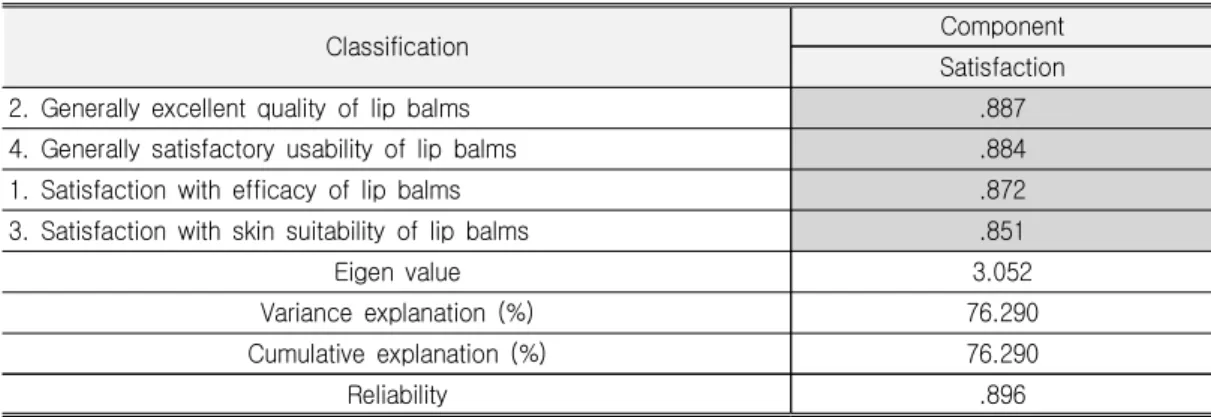
The results of factor analysis on 4 questions about the satisfaction of lip balms were shown below Table 2. Analysis showed that 1 factor was drawn. Factor 1 (76.290%) consisted of questions on the satisfaction with skin suitability, general usability, and efficacy, which was named
‘satisfaction.’ The loading value of 1 factor was more than ±0.4, which the extracted factor had validity. The reliability of all questions was more than 0.6, a reliable level.
3) Validity and Reliability Test on Purchase Intention of Lip Balms
The results of factor analysis on 4 questions about the purchase intention of lip balms were shown below Table 3. Analysis showed that 1 factor was drawn. Factor 1 (89.505%) consisted of questions on recommendation and purchase intention, which was named ‘purchase intention.’
The loading value of 1 factor was more than
±0.4, which the extracted factor had validity.
The reliability of all questions was more than 0.6, a reliable level.
Table 1. Validity and Reliability Test on Usability of Lip Balms
Classification
Component Moisturiz
ing power
Healing power
Expressive power
Protective power
Coating
power Fragrance Color Concent ration
14. Prevention of dryness .799 .222 .111 .195 .192 .010 .102 .141
15. Moist and soft lip .765 .270 .150 .231 .146 .066 .094 .165
16. Relief of retraction after
application .695 .329 .267 .206 .158 .068 .040 .110
13. Proper water component force .663 .142 .218 .186 .249 .142 .065 .093 22. Disappearance of severe
reddening symptom .154 .807 .140 .220 .132 .176 .048 .124
21. Relief of separation
phenomenon .366 .759 .062 .133 .114 .067 .106 .084
23. Relief of lip crack .359 .748 .068 .101 .110 .047 .161 .152
20. Disappearance of fever .078 .701 .227 .378 .147 .124 .063 .036
12. Light heaviness .222 .160 .774 .077 .090 .120 .092 .129
10. Nice gloss (Luster) .130 .146 .727 .097 .216 .093 .193 .189
11. Natural expression .214 .062 .706 .229 .278 -.046 .227 .117
18. No sensitive stimuli .316 .163 .125 .812 .134 -.022 .081 .166
19. Relief of sore symptom .154 .390 .145 .741 .183 .078 -.005 .029
17. Protection of lip .382 .257 .154 .679 .189 .130 .110 .084
8. Good spreadability after
application .262 .112 .140 .200 .809 .077 .053 .168
7. Well adhesion to lip .257 .174 .163 .109 .728 .059 .040 .327
9. Reapplication but no excitation .148 .197 .392 .166 .663 .023 .050 .083
2. Fragrant smell .073 .128 .081 .052 .022 .922 .139 .047
1. Proper fragrance of lip balms .085 .125 .053 .052 .082 .913 .122 .088
3. Nice color of lip balms .086 .153 .165 .023 .050 .156 .895 .053
4. Appropriate color for use .105 .077 .197 .094 .048 .125 .883 .141
5. Proper concentration (Thinness
and thickness) of contents .118 .135 .180 .069 .207 .186 .131 .783
6. Good because of no stickiness .253 .143 .205 .145 .234 -.025 .092 .726
Eigen value 3.085 3.006 2.271 2.245 2.162 1.900 1.832 1.531
Variance explanation (%) 13.411 13.068 9.873 9.763 9.398 8.260 7.965 6.656 Cumulative explanation (%) 13.411 26.479 36.353 46.115 55.513 63.774 71.739 78.395
Reliability .884 .878 .796 .861 .823 .896 .873 .667
Table 2. Validity and Reliability Test on Satisfaction of Lip Balms
Classification Component
Satisfaction
2. Generally excellent quality of lip balms .887
4. Generally satisfactory usability of lip balms .884
1. Satisfaction with efficacy of lip balms .872
3. Satisfaction with skin suitability of lip balms .851
Eigen value 3.052
Variance explanation (%) 76.290
Cumulative explanation (%) 76.290
Reliability .896
Table 3. Validity and Reliability Test on Purchase Intention of Lip Balms
Classification Component
Purchase intention 1. Purchase intention for release of LBWCO if it is released .946 2. Recommendation intention of LBWCO to people around .946
Eigen value 1.790
Variance explanation(%) 89.505
Cumulative explanation(%) 89.505
Reliability .882
3. Usability, Satisfaction and Purchase Intention Evaluation of Lip Balms
1) Evaluation by Type of Lip Balm
The following were the results that natural lip balms were divided into LBWCO, LBWICOLE, and LBWCOLE by each type after the clinical application of them for 15 days to carry out a survey of usability, satisfaction and purchase intention.
(1) Evaluation of LBWCO
For usability, ‘protective power’ (M=3.96) was the highest, followed by ‘moisturizing power’
(M=3.86), ‘coating power’ (M=3.74),
‘concentration’ (M=3.65), ‘expressive power’
(M=3.56), ‘healing power’ (M=3.49), ‘color’
(M=3.35) and ‘fragrance’ (M=2.56). The general usability of LBWCO was 3.58 points on average (Table 4). The satisfaction and purchase intention of LBWCO were 3.75 points and 3.44 points on average, respectively (Table 5).
(2) Evaluation of LBWICOLE
For usability, ‘protective power’ (M=3.59) was the highest, followed by ‘coating power’
(M=3.58), ‘moisturizing power’ (M=3.55),
‘concentration’ (M=3.48), ‘expressive power’
(M=3.41), ‘healing power’ (M=3.27), ‘color’
(M=3.21) and ‘fragrance’ (M=2.82). The general usability of LBWICOLE was 3.39 points on average (Table 4). The satisfaction and purchase
intention of LBWICOLE were 3.38 points and 3.00 points on average, respectively (Table 5).
(3) Evaluation of LBWCOLE
For usability, ‘color’ (M=3.75) was the highest, followed by ‘moisturizing power’ (M=3.73),
‘protective power’ (M=3.72), ‘expressive power’
(M=3.65), ‘coating power’ (M=3.64),
‘concentration’ (M=3.64), ‘healing power’
(M=3.41), and ‘fragrance’ (M=3.05). The general usability of LBWCOLE was 3.59 points on average (Table 4). The satisfaction and purchase intention of LBWCOLE were 3.72 points and 3.58 points on average, respectively (Table 5).
2) Difference in Evaluation by Type of Lip Balm
(1) Usability of Lip Balms
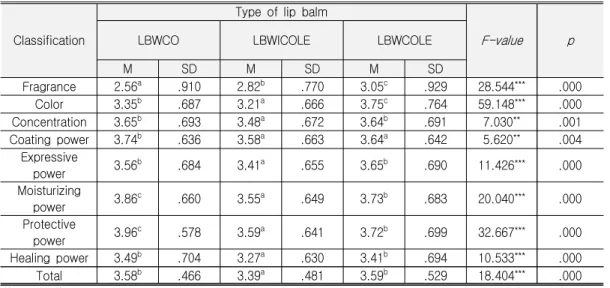
The results of analysis on the difference in usability by the type of lip balm were shown below Table 4. Analysis showed that there was a statistically significant difference between general usability of lip balm, and fragrance, color, concentration, coating power, expressive power, moisturizing power, protective power and healing power by sub-factor (p<.01).
For general usability of lip balms, LBWCOLE (M=3.59) and LBWCO (M=3.58) were relatively better than LBWICOLE (M=3.39).
By each sub-factor, for ‘fragrance’, LBWCOLE (M=3.05) was the highest, followed by LBWICOLE (M=2.82) and LBWCO (M=2.56), which the fragrance of LBWCOLE was the most highly evaluated. For ‘color’, LBWCOLE (M=3.75) was the highest, followed by LBWCO (M=3.35) and LBWICOLE (M=3.21), which the color of LBWCOLE was the most highly evaluated.
For ‘concentration’, LBWCO (M=3.65) was the
highest, followed by LBWCOLE (M=3.64) and LBWICOLE (M=3.48), which the concentration of LBWCO was the most highly evaluated. For
‘coating power’, LBWCO (M=3.74) was the highest, followed by LBWCOLE (M=3.64) and LBWICOLE (M=3.58), which the coating power of LBWCO the most highly evaluated.
For ‘expressive power’, LBWCOLE (M=3.65) was the highest, followed by LBWCO (M=3.56) and LBWICOLE (M=3.41), which the expressive power of LBWCOLE was the most highly evaluated. For ‘moisturizing power’, LBWCO (M=3.86) was the highest, followed by LBWCOLE (M=3.73) and LBWICOLE (M=3.55), which the moisturizing power of LBWCO was the most highly evaluated.
For ‘protective power’, LBWCO (M=3.96) was the highest, followed by LBWCOLE (M=3.72) and LBWICOLE (M=3.59), which the protective power of LBWCO was the most highly evaluated. For
‘healing power’, LBWCO (M=3.49) was the highest, followed by LBWCOLE (M=3.41) and LBWICOLE (M=3.27), which the healing power of LBWCO was the most highly evaluated.
In other words, taken as a whole, the usability of LBWCO or LBWCOLE was evaluated higher than that of LBWICOLE. As the production of essential oil from Chamaecyparis obtusa by a skin toner could show antibacterial activities (Jung, 2011), and confirm the hair-protective effect of essential oil from Chamaecyparis obtusa used for the pretreatment of hair perm and dyeing and the addition of solvents to hair (Ha, 2012), when lip balms from components of Chamaecyparis obtusa was produced to apply it to lips, they had a positive effect on skin.
Consequently, the components of Chamaecyparis obtusa extracted from oil could have the nature of ingredients.
In most of items including the general
usability, LBWCO and LBWCOLE were highly evaluated, but the ranking was only partially changed. For ‘fragrance’, LBWCO had a
Table 4. Difference in Usability Evaluation by Type of Lip Balm
Classification
Type of lip balm
F-value p
LBWCO LBWICOLE LBWCOLE
M SD M SD M SD
Fragrance 2.56a .910 2.82b .770 3.05c .929 28.544*** .000
Color 3.35b .687 3.21a .666 3.75c .764 59.148*** .000
Concentration 3.65b .693 3.48a .672 3.64b .691 7.030** .001
Coating power 3.74b .636 3.58a .663 3.64a .642 5.620** .004
Expressive
power 3.56b .684 3.41a .655 3.65b .690 11.426*** .000
Moisturizing
power 3.86c .660 3.55a .649 3.73b .683 20.040*** .000
Protective
power 3.96c .578 3.59a .641 3.72b .699 32.667*** .000
Healing power 3.49b .704 3.27a .630 3.41b .694 10.533*** .000
Total 3.58b .466 3.39a .481 3.59b .529 18.404*** .000
**p<.01, ***p<.001 Duncan : a<b<c
stronger fragrance than LBWCOLE due to a volatile component of Chamaecyparis obtusa, phytoncide, which fragrance of LBWCO dissolved only Chamaecyparis obtusa grew stronger than that of LBWCOLE dissolved Lithospermum erythrorhizon and Chamaecyparis obtusa. In the feeling of ‘color’, LBWCOLE was evaluated higher than colorless LBWICOLE, requiring tone function as well as protective function. The feeling of ‘color’ had an effect on ‘expressive power.’ In the evaluation of visible factors, colored lip balms were evaluated higher than colorless lip balms.
The dissolution of Chamaecyparis obtusa with Lithospermum erythrorhizon and only Chamaecyparis obtusa in the same amount of oil could affect concentration after the production of lip balms, which LBWCO was evaluated higher than relatively hard LBWICOLE
and relatively soft LBWCOLE. The concentration had an effect on adhering power, which LBWCO was highly evaluated in coating power. And it
had an effect on protective power, moisturizing power and healing power.
The result that LBWCO and LBWCOLE were highly evaluated in protective power, moisturizing power and healing power is similar to Cha's (2012) study that children's atopy symptom was improved by the use of toner containing essential oil from Chamaecyparis obtusa, and S. Cho's (2012) study that Chamaecyparis obtusa leaf extracts were applied to relieve atopic dermatitis.
In the process of producing lip balms, Lithospermum erythrorhizon was additionally added to only LBWCOLE using the same amount of Chamaecyparis obtusa, which a positive component, Chamaecyparis obtusa was less dissolved in LBWCOLE. Consequently, it is estimated to affect the evaluation of protective power, moisturizing power and healing power.
However, it is experimentally impossible to confirm
which component of Chamaecyparis obtusa and Lithospermum erythrorhizon have a relatively positive effect on lip management and improvement. In the light of fragrance of phytoncide in 2 lip balms dissolved Chamaecyparis obtusa in oil, it is estimated phytoncide known as a very good component for human body, which is comprised of 200 compounds such as phenolics, terpenoid, alkaloid, phenylpropane, acetogenin, and steroid(Kang, 2010, pp. 1-2) is dissolved in LBWCO and LBWCOLE to have discrimination from LBWICOLE.
Consequently, the usability of LBWCO and LBWCOLE was higher than that of LBWICOLE.
(2) Satisfaction of Lip Balms
The results of analysis on the difference in satisfaction by the type of lip balm were shown below Table 5. Analysis showed that there was a statistically significant difference in satisfaction of lip balms (p<.001). For satisfaction of lip balms, LBWCO (M=3.75) was the highest, followed by LBWCOLE (M=3.72) and LBWICOLE (M=3.38), which satisfaction of LBWCO was the most highly evaluated.
(3) Purchase Intention of Lip Balms
For purchase intention of lip balms, LBWCOLE (M=3.58) was the highest, followed by LBWCO
Table 5. Difference in Satisfaction and Purchase Intention Evaluation by Type of Lip Balm
Classification
Type of lip balm
F-value p
LBWCO LBWICOLE LBWCOLE
M SD M SD M SD
Satisfaction 3.75b .637 3.38a .585 3.72b .664 39.450*** .000
Purchase
intention 3.44b .859 3.00a .723 3.58c .728 56.131*** .000
***p<.001 Duncan : a<b<c (M=3.44) and LBWICOLE (M=3.00), which purchase intention of LBWCOLE was the most highly evaluated.
For the satisfaction and purchase intention evaluation of lip balms, although LBWCO was highly evaluated in the main role of lip balms,
‘moisturizing power’, ‘protective power’ and
‘healing power’, which there was a significant value in satisfaction, LBWCOLE was highly evaluated in purchase intention. By these results, consumers have selected an additional function of given color with universal functions of lip balms. Their selection differs from general opinions that their purchase intention after the use of natural cosmetics will be mainly influenced by the efficacy of lip balms. The clinical evaluators' purchase intention of lip balms in this study is reflected by the efficacy of lip balms and the function of tone at the same time.
The evaluation of satisfaction and purchase intention are influenced by the usability evaluation, which the high evaluation of protective power, moisturizing and healing power - the functions of LBWCO - has an effect on satisfaction, and the expressive power or color of LBWCOLE are reflected in purchase intention.
Consequently, these results can be put forward as basic data for sales marketing strategies of lip balms given the function of natural color beyond the limit of protective cream, as well as
used as data for analysis on consumption patterns of exploring, purchasing, using, evaluating and selling various lip balms and lip cosmetics in J. Lee and Kim's (1999) study (as cited in K.
Cho & Lee, 2005).
Ⅳ. Conclusion and Suggestion
In this study, fat-soluble components of each material were selectively extracted from Chamaecyparis obtusa and Lithospermum erythrorhizon known as having the positive effects on skin to produce natural lip balms for the management of lips exposed to several stimuli. The usability, purchase intention and satisfaction of produced natural lip balms were evaluated through clinical trials. The results obtained by clinical trials and evaluation in this study were summarized as follows:
First, for the clinical evaluation by each type of lip balm, LBWCO and LBWICOLE close to colorlessness or of light color were the most highly evaluated in ‘protective power’, while LBWCOLE of natural color in Lithospermum erythrorhizon was the most highly evaluated in
‘color.’
Second, for the usability evaluation of lip balms, LBWCOLE and LBWCO were the most highly evaluated in ‘fragrance’, ‘color’ and
‘expressive power’, and ‘concentration’, ‘coating power’, ‘moisturizing power’, ‘protective power’
and ‘healing power’, respectively, which the usability of LBWCO or LBWCOLE was evaluated higher than that of LBWICOLE.
Third, LBWCO and LBWCOLE were the most highly evaluated in the satisfaction and purchase intention of lip balms, respectively.
As stated above, Chamaecyparis obtusa and Lithospermum erythrorhizon had the possibility as
ingredients of lip balm. It proved that Chamaecyparis obtusa had the positive effects on lips, which it was effective in improving the damaged lips. LBWCOLE, which added natural pigments from Lithospermum erythrorhizon to components of Chamaecyparis obtusa to examine the possibilities of natural color cosmetics, had the effects on the improvement of damaged lips as well as satisfaction of color.
In internal factors as the cause of damaged lips and characteristics of lip exposed to various stimuli in life environment, it is hard to recover demaged lips completely, but effective cosmetics protect lips and provide nourishment.
Consequently, Chamaecyparis obtusa is appropriate for vegetable ingredients that help the improvement of damaged lips.
This study can be use as an opportunity to approach the development of broader lip cosmetics by providing opportunities to develop and utilize excellent ingredients of precise natural lip balm, and putting forward the methods of producing safer lip balms excluded chemical addition. It is expected that the study of lip cosmetics from only natural ingredients contributes to enlarge the positive image of lip cosmetics ingredients, and expand a lip balm cosmetics market. However, the limit of this study was the in-depth research and development of only Chamaecyparis obtusa of various materials known as having an effect on the improvement of damaged skin. And the development as various dosage forms was also restrictive.
The follow-up studies need to do research on the development of lip cosmetics from various natural ingredients and components suggested the possibility of skin improvement effect, as well as various and in-depth researches on the construction of the market of safe and effective
ingredients into the field of cosmetics applicable to lips and other parts.
References
Cha, Y. (2012). The effects of Chamaecyparis obtusa extracts on the skin change in a child's atopy (Unpublished master's thesis).
Seokyeong University, Seoul, Korea.
Cho, K., & Lee, K. (2005). A study on the basic skin makeup products consuming patterns of female college students lived in metropolitan area of Seoul. Journal of Fashion Business, 9(2), 40-56.
Cho, S. (2012). Anti-oxidative, Anti-inflammatory And immunomodulatory effects of Chamaecyparis obtusa leaves (Unpublished doctoral dissertation). Konkuk University, Seoul, Korea.
Cho, Y. (2007). A study on the purchasing conditions of natural-dyed clothing product 1 : Focusing on the holding conditions and wearing images. Journal of Fashion Business, 11(4), 1-14.
Choi, Y. (2008). Degree of satisfaction with low-priced cosmetics based on consumer shopping value (Unpublished master's thesis).
Gousin University, Busan, Korea.
Ha, J. (2012). The effect of Chamaecyparis obtusa essence oil on permanent wave and dye procedure (Unpublished doctoral dissertation). Wonkwang University, Inksan, Korea.
Ha, S., & Cho, K. (2008), The visual optical illusion effect study of lip make-up. Journal of Fashion Business, 12(1), 164-172.
Han, J. (2011). The anti-inflammatory and antioxidative effects of Ficus carica L. stem extract (Unpublished master's thesis). Chung
ang University, Seoul, Korea.
Heo, K. (2012). Production and utilization of natural food colorant of shikonin from Lithospermum erythrorhizon Sieb. et Zucc (Unpublished doctoral dissertation). Mokpo National University, Muan, Korea.
Heo, Y. (2011). A comparative study of recognition and satisfaction for fermentation cosmetic and cosmeceuticals (Unpublished master's thesis). Konkuk University, Seoul, Korea.
Hong, S. (2012). The effects of Opuntia ficus-indica var. saboten extract on the skin condition (Unpublished master's thesis).
Seokyeong University, Seoul, Korea.
Jeung, E. (2010). A comparative study on consumer preference and performances of blemish balm tested on bio skin plate (Unpublished master's thesis). Konkuk University, Seoul, Korea.
Jung, J. (2011). Antibacterial effect with essential oil from Hinoki cypress on skin microbiota (Unpublished master's thesis).
Kwangju Women's University, Kwangju, Korea.
Kang, S. (2010). Effect of Chamaecyparis obtusa tree phytoncide on Candida albicans (Unpublished doctoral dissertation). Kyunghee University, Seoul, Korea.
Kim, G. (2007). A study on the Consumption pattern and Satisfaction of natural containing the Generation from 20's to 50's (Unpublished master's thesis). Chungang University, Seoul, Korea.
Kim, H. 〔Hayan〕. (2013). A comparative study of recognition and satisfaction for high-tech cosmetics and natural cosmetics (Unpublished master's thesis). Konkuk University, Seoul, Korea.
Kim, H. 〔Hyojeung〕. (2004). A study on the development of color makeup cosmetics made
from natural dyes (Unpublished doctoral dissertation). Keimyung University, Daegu, Korea.
Kim, K. (2012). Customer awareness and marketing strategy of the cosmetics for infants (Unpublished master's thesis). Sungsin Women's University, Seoul, Korea.
Kim, S. (2012). A study on the development and clinical application of natural hair essences based on oriental medicine raw materials (Unpublished doctoral dissertation). Seokyeong University, Seoul, Korea.
Kim, Y. (2012). Consumers' satisfaction level with the cosmetics after purchase according to perceived risk and information source utilization viewed by the type of distribution channel (Unpublished doctoral dissertation).
Kyunghee University, Seoul, Korea.
Kwon, M.〔Misun〕. (2012). The study of essential oil from the Rutaceae for the treatment of acne skin (Unpublished master's thesis). Konkuk University, Seoul, Korea.
Kwon, M. 〔Mijin〕. (2013, June 21). Warning of Heavy Metal in Lipstick. Hankook Ilbo.
Retrieved from http://www.newshankooki.com Lee, C. (2012). Antioxidative activity of
Chamaecyparis obtusa leaf extract and stability of a cream containing the extract (Unpublished master's thesis). Seoul National University of Science and Technology, Seoul, Korea.
Lee, T. (2003). 대한식물도감(하) 2003 [An illustrated guide to Korean flora 2003]. Seoul:
Hangmunsa.
Lee, H.〔Hounjung〕. (2008). A study on hair dye using extracts of the Lithospermum erythrorhizon (Unpublished master's thesis).
Hannam University, Seoul, Korea.
Lee, H.〔Hyunyoung〕. (2011). A study on consumer's awareness and satisfaction with
organic cosmetics (Unpublished master's thesis). Sookmyung Women’s University, Seoul, Korea.
Lee, J., & Kim, Y. (1999). The cosmetic consumption behavior according to the life styles of university women. Journal of the Korean Society of Costumes, 45, 147-159.
Lee, S.〔Saetbyeol〕. (2013). The development of complex cosmeceutial ingredients from Chamaecyparis obtusa extracts (Unpublished master's thesis). Chungang University, Seoul, Korea.
Lee, S.〔Sunkyoung〕, & Lee, J. (2013), A comparison with efficacy and usability of natural lip balm from plant extracts. Journal of the Korean Society of Cosmetology, 19(3), 493-500.
LIm, D. (2011). Manufacture of blemish balm with dandelion extract and clinical application (Unpublished doctoral dissertation). Kwangju Women's University, Kwangju, Korea.
Lim, K. (2007). The manufacturing process and efficacy of soap, spray and lotion using chamaecyparis obtusa essential oil for improvement of atopic skin symptoms (Unpublished master's thesis). Chosun University, Kwangju, Korea.
Oh, H. (2009), Development of natural cosmetic for acne and clinical application (Unpublished doctoral dissertation). Wonkwang University, Inksan, Korea.
Oh, S. (2011). Physiological activating material searching and skin whitening improvement effect of the extracts from Phragmitis Rhizoma (Unpublished doctoral dissertation). Kwangju Women's University, Kwangju, Korea.
Park, B. (2009). Screening of usefulness for cosmetics material from Lithospermum erthrohizon and Juniperus rigida (Unpublished master's thesis). Wonkwang University, Inksan,
Korea.
Seo, K., No, Y., & Kim, H. (2011). 화장품제조실 습 2011 [Cosmetics Producing Practice 2011].
Seoul: Hakunsa.
Yang, S. (2012). Study on the anti-oxidative activity of forsythiae fructus extract and application to the cosmetic raw material (Unpublished doctoral dissertation). Konkuk University, Seoul, Korea.
Yun, J. (2012). 나무해설도감 2012 [An Illustrated Guide to Tree 2012]. Seoul: Jinsunbooks.
Received (December 12, 2013) Revised (February 18, 2014) Accepted (July 11, 2014)