한국정보통신학회논문지 Vol. 23, No. 3: 237~246, Mar. 2019
문자 수준 딥 컨볼루션 신경망 기반 추천 모델
기가기1·정영지2*
A Recommendation Model based on Character-level Deep Convolution Neural Network
Ji JiaQi
1· Yeongjee Chung
2*1
Lecturer, Department of Information Center, Hebei Normal University for Nationalities, ChengDe 067000, China
2*
Professor, Department of Computer and Software Engineering, Wonkwang University, Iksan 54538, Korea
요 약
추천 시스템의 등급 예측 정확도를 높이기 위해서는, 사용자 항목 등급 데이터뿐만 아니라 주석, 태그 또는 설명과 같은 항목의 보조 정보도 고려해야만 한다. 기존 접근법에서는 단어 단위에서 bag-of-words 모델을 사용하여 보조 정 보를 모델링한다. 그러나 이러한 모델은 보조 정보를 효과적으로 활용할 수 없으므로 보조 정보를 제한적으로 이해 하게 된다. 한편, 컨볼루션 신경망(CNN)에서는 보조 정보로부터 특징 벡터를 효과적으로 포착하고 추출할 수 있다.
따라서 본 논문에서는 새로운 추천 모델을 위해 딥 CNN을 행렬 분해에 통합시킨 문자 수준의 딥 컨볼루션 신경망 기 반 행렬 분해 (Char-DCNN-MF) 방법을 제안한다. Char-DCNN-MF에서는 보조 정보를 더 심층적으로 이해하고 추 천 성능을 더욱 향상시킬 수 있다. 실험은 세 가지 다른 실제 데이터 세트에서 수행되었으며 그 결과는 Char- DCNN-MF가 다른 비교 모델보다 유의적으로 뛰어난 성능을 보여주었다.
ABSTRACT
In order to improve the accuracy of the rating prediction of the recommendation model, not only user-item rating data are used but also consider auxiliary information of item such as comments, tags, or descriptions. The traditional approaches use a word-level model of the bag-of-words for the auxiliary information. This model, however, cannot utilize the auxiliary information effectively, which leads to shallow understanding of auxiliary information. Convolution neural network (CNN) can capture and extract feature vector from auxiliary information effectively. Thus, this paper proposes character-level deep-Convolution Neural Network based matrix factorization (Char-DCNN-MF) that integrates deep CNN into matrix factorization for a novel recommendation model. Char-DCNN-MF can deeper understand auxiliary information and further enhance recommendation performance. Experiments are performed on three different real data sets, and the results show that Char-DCNN-MF performs significantly better than other comparative models.
키워드
: 추천 모델, 컨볼루션 신경망, 행렬 분해, 심층 학습
Keywords
: Recommendation model, Convolution neural network, Matrix factorization, Deep Learning
Received 27 November 2018, Revised 15 January 2019, Accepted 5 February 2019
* Corresponding Author Yeongjee Chung (E-mail: [email protected], Tel:+82-63-850-6887)
Professor, Department of Computer and Software Engineering, Wonkwang University, Iksan 54538, Korea
Open Access
http://doi.org/10.6109/jkiice.2019.23.3.237
print ISSN: 2234-4772 online ISSN: 2288-4165Ⅰ. Introduction
With the explosive growth of data, recommender system has become extremely popular in many fields such as news, movies, books and music. Collaborative filtering (CF) was considered one of the effective recommendation models. It is based on assume that a user would like an item if the item is liked by the users with similar preferences. Matrix factorization (MF) is another important recommendation technique that characterizes uses and items by vectors of latent factors.
However, in recent years, deep learning has become one of the most powerful approaches in many areas such as Computer Vision[1, 2], Speech Recognition[3-5], Natural Language Processing(NLP)[6, 7] and Information Retrieval [8, 9]. convolution Neural Network (CNN) and Recurrent Neural Network (RNN) are the most important models of deep learning. Other popular deep learning models include restricted Boltzman machine (RBM), auto- encoders (AE), and strongly connected networks of multi-hidden layers. Deep learning has become an upsurge of artificial intelligence, bringing new opportunities for the research of recommendation models.
A recommendation model based on deep learning, typically uses all kinds of data related to users and items as input, uses deep learning to learn implicit representations of users or items, and recommends items for users based on implicit representations. Quadrana et al.[10] propose a RNN-based recommendation model. It personalizes RNN models through cross-session information transfer and devises a hierarchical RNN model which relays end evolves latent hidden states of the RNNs in user sessions. In literature [11], the authors describe collaborative denoising auto-encoders model (CDAE) for top-N recommendation. CDAE takes into account the fact that user item interaction is a corrupted version of the user’s favorite set, the model learns the representation of users and items that can reconstruct the entire input.
Nevertheless the neural network architecture used in the model is not deep and the model ignores contextual information, thus affecting the accuracy of the model
and expanding further. A novel approach called collaborative topic regression (CTR) combines ideas from collaborative filtering based on potential factor models, and content analysis based on probabilistic subject modeling is proposed in literature [12]. In the recent work, a new model called collaborative deep learning (CDL) is proposed by Wang et al.[13]. Content information is learned by deep learning model.
However, the bag-of-words representation used in their model ignores contextual information in the text, such as word order or surrounding words, so that text information can not be fully captured. Kim et al.[14]
propose a Convolutional Matrix Factorization (ConvMF) recommendation model. ConvMF combines CNN with probabilistic matrix factorization (PMF). ConvMF improves ratings prediction task than traditional MF model, however ConvMF regards the document as a l words-sequence which is less accuracy than regards the document as a l characters-sequence. Meanwhile the prediction precision of PMF model is inferior to that of SVD++[15] model.
In order to resolve the aforementioned problems, a state-of-the-art deep learning methodology CNN is used.
CNN can effectively capture and deeper understand the features of documents, thus it generates better latent model than stacked denoising autoencoders (SDAE) and latent Dirichlet allocation (LDA). However deep CNN cannot be applied to recommendation task directly, so we propose a character-level deep convolution neural network based matrix factorization model (Char-DCNN- MF) which regards the document as a sequence of l characters and integrates deep CNN into SVD++ model.
The main process is described below. First contextual
information of item is extracted and denoted as vectors
by utilizing deep CNN, and then we seamlessly integrate
CNN into SVD++ which is a state-of-the-art rating
prediction model for recommender system. Consequently,
the integrated model Char-DCNN-MF can effectively
utilize both contextual information and collaborative
information. Thus, Char-DCNN-MF not only applies to
the extremely sparse data sets, but also increases the
accuracy of the rating prediction.
To prove the effectiveness of Char-DCNN-MF, we compare Char-DCNN-MF with three other recommendation models on 3 actual data sets. The experiment results show that the proposed model is more accurate for evaluative prediction task of ratings.
This paper is organized as follows; Section 2 presents the theory of SVD++ model and CNN; Section 3 illustrates Char-DCNN-MF in detail including deep CNN architecture and integration method; Section 4 shows the environment of experiments and evaluates the result. In Section 5, conclude the paper and discuss potential future works.
Ⅱ. Background
2.1. SVD++
SVD++ is first proposed by Koren et al.[15] and it is a kind of model-based method. We use notation u, v to represent users and i, j to represent items respectively.
is a 0-5 rating that indicates how much user u like item . is the overall average rating. The parameters
and
describe the deviations observed by user u and item I, respectively from the average.
∈ℝ
is a user latent factors vector, and
∈ℝ
is an item latent factors vector.
is a predicted value of
. The objective function of SVD++ can be described by Eq.(1).
∈
(1)
Here, an item i is modeled as
∈
. In this case, the item latent factors vector
can be learnt from explicit rating.
∈
represents the implicit feedback learnt by deep CNN.
2.2. Deep Convolution Neural Network
CNN is a neural network with three parts. (a) Convolution layer which extracts image or text features.
(b) Pooling layer is used to represent data as more concise representation by choosing part of the representative extracted features. In general, pooling layer has two types, one is max-pooling layer and the other is average-pooling layer. (c) Fully-connected layer which can be can be seen as a "classifier" in the whole convolution neural network.
When CNN contains many convolution layers and pooling layers (usually greater than 3), we call it deep CNN. In our proposed model, we obtain the textual information (maybe comments, tags, item description etc.) regarding the input learning resources. Then deep CNN is used to turn the input textual information into the vector features of learning resource. Finally the extracted features which are considered to be implicit feedback data set are feed into SVD++ model.
Ⅲ. Character-level Deep Convolution Neural Network Matrix Factorization
3.1. Deep CNN Architecture
The goal of the deep CNN architecture is to analyze the textual content of an item and extract the representation information (item description feature).
The deep CNN architecture used is modular and slightly different from the standard CNN network architecture. It consists of embedding layer, convolution layer, pooling layer and full connection layer. Figure 1 shows the detail deep CNN architecture used in Char-DCNN-MF model.
First the description of item is converted to a fixed size
matrix through the embedding layer; then item
contextual feature is extracted by serval convolution
layers and max-pooling layers, finally the high-level
features are obtained by two full connection layers (FC
layer); consequence the final result can be obtained by a
softmax function. For each layer there are many
parameters such as kernel size, filter number, stride,
padding, the detail parameter configurations are
described in the experiment part. Next, the function of
each layer is introduced in detail.
(1) Embedding layer.
The embedding layer represents the description of item by a dense matrix for the next operation (convolution and max pooling). We assume that the size of the input language alphabet is m, one-hot encoding is employed to convert each character into a vector of m dimensions. The size of the input string is fixed to l, and the characters beyond the l will be ignored, and less than l will be filled with zero. Any character which is not in the alphabet will be encoded as a zero vector. The alphabet used by us contains 69 characters, of which 26 are English characters, 10 are numbers, and 33 are other characters. The specific characters are as follows:
abcdefghijklmnopqrstuvwsyz0123456789 -,;.!?:’”/\|_@#$%^&*~`+-=<>()[]{}
Fig. 1 Deep CNN architecture used in the Char-DCNN- MF algorithm
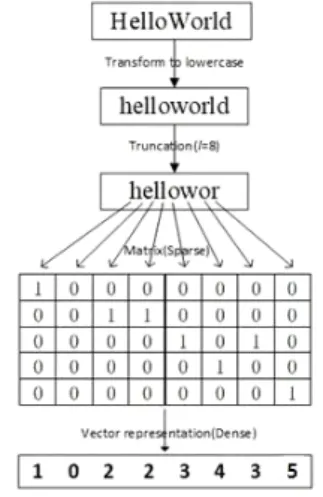
We give an example to illustrate. In this example, we set alphabet = ‘hlowr’ (Note: ‘’ are not included), l=8 and we want to encode the text ‘HelloWorld’ (Note: ‘’
are not included). The encoding process is shown in Figure 2. First, all the input characters are converted to lowercase and only the length of the 8 character is retained, the excessive part will be truncated and the insufficient part will be complemented by 0. Each character is represented by a column vector such as ‘o’
can be represented as ‘00100’. The character which is not appeared in the alphabet will be represented as zero column vectors (e.g. ‘e’ is represented as ‘00000’).
Hence the input text can be converted to a matrix G (note: this matrix is very sparse). The size of the matrix is ∈ℝ
×and G is denoted by Eq.(1), where is the one-hot encoding representation of th character.
(2)
Because the matrix of this representation is very sparse, we can also represent it in a dense way. We only use an integer to represent the position of 1 appeared in the vector. For example, vector [0,0,1,0,0] can be represented by an integer 3.
Fig. 2 Text encoding process
(2) Convolution layer.
A key step for extracting contextual features is the convolution layer. Suppose that there is an input matrix
∈ℝ
×and a convolution kernel ∈ℝ
×. The contextual features extracted from the convolution kernel can be expressed as ∈ℝ
, where
can be denoted by Eq. (3):
*
(3)
Where * is a convolution operator, b is a numeric bias and is a non-linear activation function. A lot of nonlinear activation functions can be used such as tanh, sigmoid, rectified linear unit (ReLU) and leaky ReLU. In our model ReLU is employed to avoid the vanishing gradient problem. Multiple kernels are used for capturing multiple types of contextual features. We use notation
to denote the number of kernels.
(3) Max-pooling layer.
The pooling layer extracts deeper properties from the
output of the convolution layer, which helps to train a
deeper neural network. Max-pooling layer and average-pooling layer are two types of pooling layer. We use max-pooling layer for our task. After convolution operation, each text is denoted as
contextual feature vectors. Suppose that the input vector is ∈ℝ
, the size of max-pooling layer is , the output ∈ℝ
⌊⌋of max-pooling layer is defined by Eq.(4).
max
× × (4) Where
× × represents all the elements from × to × in the input vector. After max-pooling operation, the input vector is converted into an
fixed length vector by extracting the maximum feature of context from each feature vector of context.
(4) Full connection layer (FC layer).
The fully connected layer usually adopts the multi-layer perceptron (MPL) neural network, whose main function is for classification based on the feature extracted by the previous convolution operation and the max-pooling operation.
(5) Output layer.
The final result will be obtained in the output layer by using a softmax function.
3.2. Char-DCNN-MF Model
Char-DCNN-MF model is introduced detail in this section. The model integrates the textual features into the SVD++ model and improves the precision of rating prediction task.
It is known from section 2.1 that the SVD++ model can be expressed in Eq.(5). For simplicity, we use to replace
∈
(5) The author of literature [16] has proved theoretically that the learning model trained by rating and textual information has better performance than that trained only by rating. With this theory, a linear function
is used to replace bias term
, where
is the th item in weighted matrix which is to be learned.
is feature vector for item
which is learned by previous introduced deep CNN. Hence the formulate for rating prediction of user on item is shown in Eq.(6)
(6) As seen in Eq.(5) We change the implicit factor vector of the item from
to
. Vector
represents the item implicit factor vector itself, and then uses implicit preference to supply it. In this paper which is represented in Eq.(7) is a little different from the standard SVD++ model.
∈
(7)
Where is a set of items rated by
represents the similarity between the feature vectors for item and item learned from the deep convolution neural network model.
is calculated by follows:
∥ ∥
(8)
To explain the formula more clearly, how to calculate
is draw in the follows pseudo code.
Algorithm for calculating
Input: (user, item, rating) tuple in training set
is a matrix with number of item rows and number of implicit factor columns
Initialization: is a zero vector
= a set of item feature vectors rated by and learnt from deep CNN
for in
sqrt_
= sqrt(len(
)) for j in
:
* end for
≠sqrt_
end for
The goal of Char-DCNN-MF model is to find the
minima of the object function of equation (9) which
includes loss function and regular terms.
∥
∥
∥
∥
∥
∥
∈
∥
∥
(9) We want to minimize response to
∈ , where
is a normalization parameter used to avoid overfitting. The first item in equation (9) shows the difference between the predicted rating and the actual rating, which is used to represent the fitting degree of the model for the training data. The second term is the normalization term used to balance complexity of the model with the degree of fitting.
Finding the partial derivative of
, the result is as follows:
(10)
There is no effect on the result of the final minimum value for the integer 2, so we ignore it. For simplicity, Let’s make
(11)
hence
is rewritten as follows:
(12)
Similarly the partial derivative of
and
can be obtained as follows:
(13)
In this case, stochastic gradient descent algorithm
(SGD) is used to find the minima of object function. We random select a user item pair , the parameter update rule is presented as follows:
←
←
←
←
∀ ∈
←
(14)
where,
*is the learning rate.
Ⅳ. Experiment and Analysis
In this section, a number of experiments are carried out to illustrate the performance of the proposed model.
First, the details of the experimental configuration is introduced, including the details of the data set, the parameter setting of the deep CNN model, and the experimental environment. Then we compare the Char- DCNN-MF with other different models on three different data sets. Finally, the performance of different models are compared by processing the different sparse data sets.
4.1. Experimental Configuration
The experiments are compared with three actual data
sets: MovieLens-1m (ML-1m), MovieLens-10m (ML-10m)
and Amazon Instant Video (AIV). As deep learning
approach is more powerful when it meets big data, small
data set ML-100k is not chosen in this paper. Data sets
are taken from MovieLens and Amazon, respectively. In
these three data sets, the rating range is from 1 to 5. For
AIV data set, we use the user’s comment on the item as
text context information. However, MovieLens data set
does not contain any text context information, so we
craw movie reviews from IMDB web site. For each data
set, 80% is used as a training set, 10% is used as a
validation set, and 10% is used as a test set. Grid-Search
methodology is used to find the optimal super-
parameters of each model on the validation set. The detail information of these data sets are summarized in Table 1.
Table. 1 data sets information
ML-1m ML-10m AIV
#users 6,040 69,878 29,757
#items 3,544 10,073 15,149
#ratings 993,482 9,945,875 135,188
sparsity 95.5% 98.6% 99.97%
Python and Keras framework are used for implement our model. As we introduce in section 3.1, there are totally 6 convolution layers and 3 max-pooling layers are used in deep CNN model. The detailed configuration of each convolution layer and max pooling layer is given in Table 2 and the full connection (FC) layer configuration is described in Table 3.
Table. 2 The configuration of convolution layer and max-pooling layer
Layer number
Kernel number
Kernel size
Max-pool
ing size Type
1 1024 7 3 Convolution
Layer
2 1024 7 3 Convolution
Layer
3 1024 3 N/A Max-pooling
layer
4 1024 3 N/A Max-pooling
layer
5 1024 3 N/A Max-pooling
layer
6 1024 3 3 Convolution
Layer
Table. 3 The configuration of convolution layer and max-pooling layer
Convolution Layer Neural node number
7 2048
8 2048
9 2 or 5
The dimension of the input feature of the deep CNN
model is 69, and the length of the input feature is fixed to 1014. In other word, the input matrix G is ℝ
×. 69 is the length of alphabet and 1014 is obtained from multiple experiments. 1014 length have been able to capture enough text context information. To prevent the problem of over fitting, instead of using
normalizer related to weights of deep CNN, dropout technology [17]
which implements very simple in Keras framework is used for regularizing in the 7th and 8th fully connected layers, and the ratio of dropout is 0.5. The weight parameters are initialized by the Gauss distribution with average 0 and variance 0.02. The size of min-batch is 128. Adam [18] optimal algorithm is used for training our deep CNN model.
It is well known that the deep convolution neural network usually needs to be trained with large data sets to avoid the problem of over fitting and get high performance. So the AIV data set is used for training the Char-DCNN-MF model. AIV data set has collected 34,686,770 user reviews of the item from 1996 to 2014 and rating range is from 1-star to 5-star. We can use this data set in two ways: (1) all 5-star data is used and the rest are discarded, (2) we convert the rating to 0 and 1, where 1-star and 2-star are converted to negative feedback 0, 4-star and 5-star are converted to positive feedback 1, and as the preference tendency of 3-star is not clear, we drop it. In the later experiment we can observe that method (2) helps to improve the prediction accuracy for ratings. By preprocessing the data set, the training set includes 3,600,000 samples, and the test set includes 400,000 samples.
4.2. Experimental Configuration
Our baseline model is SVD++, Figure 3 compares the
precision of rating prediction between SVD++,
Char-DCNN-MF(-), and Char-DCNN-MF. The different
between Char-DCNN-MF(-) and Char-DCNN-MF is
that Char-DCNN-MF(-) does not use item feature vector
to denote
. That is to say,
for Char-
DCNN-MF(-) model and the other parts of the model are
the same as the Char-DCNN-MF model.
Fig. 3 Compare with baseline model
Figure 3 shows that the accuracy of the Char- DCNN-MF model is better than the other two models.
As analyzed above, Char-DCNN-MF model adds the representation information of text content to SVD++
model, which greatly improves the precision of rating prediction. In addition, the performance of Char-DCNN- MF model is superior to that of Char-DCNN-MF(-) model, which indicates that it is a correct decision to estimate item bias
with a linear function
. According to our calculations, the Char-DCNN-MF model increases the precision of the ML-1m, ML-10m, and AIV data sets by 3.63%, 3.55%, and 4.52% respectively.
4.3. Comparison with Other Matrix Factorization Models In this section our model is compared with the following models which have been introduced in section 1:
(1) PMF[19]: PMF (Probabilistic Matrix Factorization) uses only rating information for collaborative filtering to model user preference matrices as a result of two lower-ranking users and video matrices.
(2) CTR [12]: CTR (Collaborative Topic Regression) combines PMF model and LDA (Latent Dirichlet Allocation) model for recommendation. It uses both ratings and documents.
(3) CDL [13]: CDL (Collaborative Deep Learning) uses SDAE approach to analyze documents in order to
enhance rating prediction precision.
(4) ConvMF [14]: ConvMF (Convolutional Matrix Factorization) is a new context-aware recommendation model, that integrates convolution neural network (CNN) into PMF.
The accuracy parameter of CTR and CDL is set to be 1 if
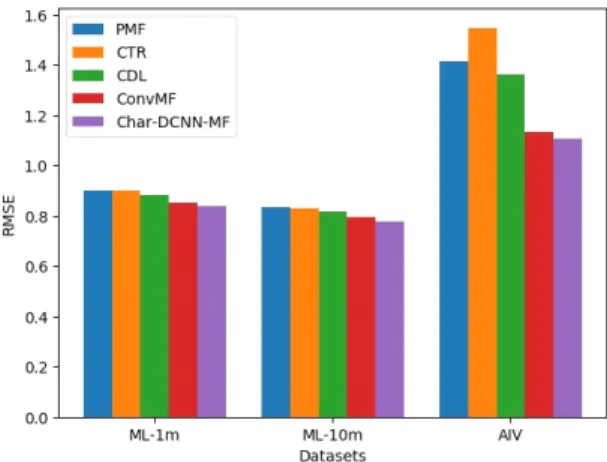
is observed, and 0 otherwise. The rest of the CDL parameters is set by [13]. RMSE is used for evaluation and the result is presented in Figure 4. We can see that the performance of Char-DCNN-MF is the best on all data sets.
Fig. 4 RMSE for different models
Compared to the best competitor ConvMF, the improvement with Char-CNN-MF is 1.59% in ML-1m, 2.44% in ML-10m and 2.45% in AIV. We also observe that the precision between PMF, CTR and CDL is not quite different, however ConvMF and Char-DCNN-MF is much greater than that of PMF, CTR and CDL. This is because PMF, CTR and CDL only use ratings for recommendation, so the precision increase is limited.
However, ConvMF and Char-DCNN-MF use contextual information which effectively improves the precision.
Thus we can draw a conclusion that deeper capture
contextual feature helps matrix factorization models
enhance their precision even when enough ratings are
given. The reason why Char-DCNN-MF model is better
than ConvMF model is that Char-DCNN-MF use
character-level to extract text feature while ConvMF use
word-level to extract text feature. The character-level can better represent the text features than the word-level.
AIV is an extremely sparse and skewed data set, and the RMSE value of all models is higher relative to the MovieLens data set. However, the slowest increase ratio of RMSE in Char-DCNN-MF model shows that Char-DCNN-MF builds accurate latent model for item by analyzing text information incorrectly even if the data is sparse or skewed, and this ability is much better than ConvMF.
Ⅴ. Conclusions
Deep learning methods show high performance in many application fields of AI, and recently many researchers concentrate on using deep learning methodology to improve the performance of recommender systems.
Deep convolution neural network shows high performance to represent image or text features. For this reason we propose a deep understanding auxiliary information model, Char-DCNN-MF, and combines SVD++ model to enhance the rating prediction accuracy of the recommender system. Char-DCNN-MF takes the auxiliary information of the item as an original signal from the perspective of character, and then designs a deep CNN framework to represent the feature vector of the text. Finally, the feature vector is integrated into the SVD++ model. The experiments results demonstrate that Char-DCNN-MF significantly outperforms the other competitors.
In the further study, we try to research RNN to model subsidiary information and combines matrix factorization for recommendation. We will also investigate recommender system based on deep learning in different fields, such as news, commerce and social network.
ACKNOWLEDGEMENT
This paper was supported by Wonkwang University in 2018.
REFERENCES
[ 1 ] J. Redmon, S. Divvala, R. Girshick, and A. Farhadi, “You Only Look Once: Unified, Real-Time Object Detection,”
Computer Vision and Pattern Recognition (cs.CV) arXiv preprint arXiv:1506.02640v5, 2016 [Online]. Available:
https://arXiv.org/abs/1506.02640v5.
[ 2 ] K. He, X. Zhang, S. Ren, and J. Sun, “Deep Residual Learning for Image Recognition,” Computer Vision and Pattern Recognition (cs.CV) arXiv preprint arXiv:1512.03385v1, 2015 [Online]. Available: https://arXiv.org/abs/1512.03385.
[ 3 ] Y. Zhang, W. Chan, and N. Jaitly, “Very deep convolutional networks for end-to-end speech recognition,” in Proceeding of 2017 IEEE International Conference on Acoustics, Speech and Signal Processing (ICASSP), New Orleans, LA:
IEEE Signal Processing Society, pp. 4845-4849, Mar. 2017.
[ 4 ] Y. Zhang, M. Pezeshki, P Brakel, S. Zhang, C. L. Y. Bengio, and A. Courville, “Towards end-to-end speech recognition with deep convolutional neural networks,” Computation and Language (cs.CL) arXiv preprint arXiv:1701.02720, 2017 [Online]. Available: https://arXiv.org/abs/1701.02720.
[ 5 ] M. Guignard, M. Schild, C. S. Bederian, N. Wolovick, and A. J. Vega, “Performance Characterization of State-Of- The-Art Deep Learning Workloads on an IBM “Minsky”
Platform,” in Proceedings of the 51st Hawaii International Conference on System Sciences(HICSS-51), Waikoloa Village, HI: HICSS, pp. 5619-5626, Jan. 2018.
[ 6 ] M. Abbes, Z. Kechaou, and A. M. Alimi, “Enhanced Deep Learning Models for Sentiment Analysis in Arab Social Media,” Neural Information Processing. ICONIP 2017 (International Conference on Neural Information Processing).
LNCS, vol. 10638. Springer, Cham, pp. 667-676, 2017.
[ 7 ] Y. Kim, “Convolutional Neural Networks for Sentence Classification,” Computation and Language (cs.CL) arXiv preprint arXiv:1408.5882, 2014 [Online]. Available:
https://arXiv.org/abs/1408.5882.
[ 8 ] B. Mitra and N. Craswell, “Neural Text Embeddings for Information Retrieval,” in Proceedings of the Tenth ACM International Conference on Web Search and Data Mining.
Cambridge, UK: ACM New York, NY, pp. 813-814, Feb.
2017.
[ 9 ] N. Craswell, W. B. Croft, J. Guo, M. de Rijke, and B. Mitra,
“Report on the SIGIR 2016 Workshop on Neural Information Retrieval (Neu-IR),” in SIGIR Forum, Workshop Report vol. 50, no. 2, pp. 96-103, Dec. 2016.
[10] M. Quadrana, A. Karatzoglou, B. Hidasi, and P. Cremonesi,
“Personalizing Session-based Recommendations with
Hierarchical Recurrent Neural Networks,” Machine Learning (cs.LG) arXiv preprint arXiv:1706.04148v5, 2017 [Online]. Available: https://arXiv.org/abs/1706.04148.
[11] Y. Wu, C. DuBois, A. A. Zheng, and M. Ester,
“Collaborative Denoising Auto-Encoders for Top-N Recommender Systems,” in Proceedings of the Ninth ACM International Conference on Web Search and Data Mining.
San Francisco, CA: ACM New York, NY, pp. 153-162, Feb.
2016.
[12] C. Wang, and D.M. Blei, “Collaborative Topic Modeling for Recommending Scientific Articles,” in Proceedings of the 17th ACM SIGKDD International Conference on Knowledge Discovery and Data Mining. San Diego, CA:
ACM New York, NY, pp. 448-456, Aug. 2011.
[13] H. Wang, N. Wang, and D.-Y. Yeung, “Collaborative Deep Learning for Recommender Systems,” in Proceedings of the 21th ACM SIGKDD International Conference on Knowledge Discovery and Data Mining. Sydney, NSW, Australia:
ACM New York, NY, pp. 1235-1244, Aug. 2015.
[14] D. Kim, C. Park, J. Oh, S. Lee, and H. Yu, “Convolutional Matrix Factorization for Document Context-Aware Recommendation,” in Proceedings of the 10th ACM Conference on Recommender Systems. Boston, MA: ACM New York, NY, pp. 233-240, Sep. 2016.
[15] Y. Koren, “Factorization Meets the Neighborhood: a Multifaceted Collaborative Filtering Model,” in Proceedings of the 14th ACM SIGKDD International Conference on Knowledge Discovery and Data Mining. Las Vegas, NV:
ACM New York, NY, pp. 426-434, Aug. 2008.
[16] D. Pechyony and V. Vapnik, “On the theory of learning with Privileged Information,” in Proceedings of the 23rd International Conference on Neural Information Processing Systems. Vancouver, BC, vol. 2, pp. 1894-1902, Dec. 2010.
[17] N. Srivastava, G. Hinton, A. Krizhevsky, I. Sutskever, and R. Salankhutdinov, “Dropout: a simple way to prevent neural networks from overfitting,” Journal of Machine Learning Research, vol. 15, no. 1, pp. 1929-1958, 2014.
[18] D. P. Kingma, and J. Ba, “Adam: A Method for Stochastic Optimization,” Machine Learning (cs.LG) arXiv preprint arXiv:1412.6980v9, 2017 [Online]. Available: https://arXiv.
org/abs/1412.698.
[19] R. Salakhutdinov and A. Mnih, “Probabilistic Matrix Factorization,” in Proceedings of the 20th International Conference on Neural Information Processing Systems.
Vancouver, BC, pp. 1257-1264, Dec. 2007.
기가기(Ji JiaQi)
2007.7 Dept. of Computer Science and Technology, Nanchang University, B.S., China 2010.1 Dept. of Computer Application Technology, Nanchang University, M.S., China 2018.8 Dept. of computer Engineering, Wonkwang University, Ph.D., Korea
※관심분야 : Big Data Processing, Recommender System, Machine Learning
정영지(Chung Yeongjee)
1995 ~ 원광대학교 컴퓨터·소프트웨어공학과 교수 1993 ~ 1995 한국전자통신연구원
1987 ~ 1993 삼성종합기술원 연세대학교 전기공학과 공학박사
※관심분야 : 컴퓨터 네트워크,빅데이터 정보처리, 모바일 컴퓨팅