고등학생을 위한 아침급식용 간편식단 개발
김정은·지명순†
대전대학교 식품영양학과·영동대학교 호텔외식조리학과†
Development of Convenient Menu School Breakfast Program for High School Students
Jung-eun Kim and Myoung-Soon Ji† Dept. of Food Nutrition, Daejeon University
†Dept of Hotel Food Service & Culinary Art, Youngdong University
Abstract
To help reduce the 'breakfast-skip' rate of the high school students and improve such 'breakfast-skipping' practice this study devised a new covenience menu for school breakfast Program. Dictated by a dietitian the form of cooking was rendered within directly-cookable convenient food; The price of menu ranged from 1,500-2,000won taking into account the parents' survey ; the menu formation drew largely from the student food preference survey and their favorites. The composition of menu - the Korean dish and the western dish put together- were of two folds and was based on the two: main menu, subsidiary menu. While main menu used rice, the subsidiary one used fruits, salads, milk, and juices. Energy intake sufficiency standard was set at a level of between 1/4 and 1/3 of the relevent group(mid&high students, 15-18 yrs old)'s approximated energy need, drawn from the Dietary Reference Intakes For Koreans(2010). 10 disparate, divised menus were tested deliberately- cooked at a site, thereafter qualifed and supplemented to meet the targeted energy amount. The nuturitional facts of each menu set were measured through the usage of CAN-PRO 3.0, Computer Aided Nutritional Analysis Program, for professionals.
Completed menu set were then given in photograph. The results of this study were as follows : The results of this study were as follows : the newly developed menu's calories and nuturitional content were as follows in the ratio of Dietary Reference Intakes For Koreans(2010) : Calories 95.7%(4.3% below the targeted intake standard), Protein(131.1%), Calcium(130.2%) the both of which marked higher than the recommended daily intake, iron(71.0%), Potassium(93.1%) both of which figure lower than the recommended daily intake. The cost of ingredients per each person was 1,335won, which was lower than the targeted cost(1500won). When calculated, hypothetically provided breakfast's labor hour needed per 1 meal is shown to be average 1.2 minute. In conslusion : Convenience style school breakfast program would bring an increse in the intake of high school students' breakfast, which may contribute not only to the sound physical growth but to academic performance. Various developments of the school breakfast program is much needed continually.
Key words : School Breakfast Program, High School Students, Convenient Menu
1)
†Corresponding author : Myoung-Soon Ji, Youngdong University, 310 Daehakro, Youngdong-eup, Youngdong-gun, Chungbuk,370-701, korea
Tel: +82-43-740-1501 Fax: +82-43-740-1509 E-mail: [email protected]
http://dx.doi.org/10.9724/kfcs.2013.29.4.343
I. 서 론
학교 급식은 성장기 학생들에게 필요한 영양을 공급하고 건강증진 및 편식교정, 식습관 지도 등 올바른 식습관을 형성 하는데 많은 영향을 미친다. 나아가 미래 사회에 건강한 인 재를 육성하는데 밑바탕이 된다. 따라서 학교급식의 목적은 다른 급식 유형과는 차별화된 특성을 가지며 영양적인 측면 과 아울러 교육적인 측면에서 그 역할에 의미가 부여된다. 하지만 우리나라 학교급식은 점심급식에만 초점이 맞추어져 있어 하루 세끼의 영양을 충분히 섭취해야 하는 성장기 청소 년들의 증가하는 아침결식률에 대한 대책 마련이 시급하다 (Lee PS 2007, Oh YM 2006).
청소년의 아침결식은 우리나라뿐만 아니라 미국, 영국, 캐 나다, 일본, 호주 등 세계 각국이 직면한 문제이다. 이를 해 결하기 위해 상설적 또는 시범적으로 학교에서 아침급식을 제공함으로써 아침결식을 줄이기 위해 아침급식 실시의 확대 및 보급을 위한 노력을 꾀하고 있다(Kim YS 등 2008). 일찍 이 미국은 학교 아침급식 프로그램(School Breakfast Program) 을 1966년 저소득층 지역의 학생들과 장거리 통학을 하는 학 생들에게 영양공급과 건전한 학교생활을 위하여 최초로 실시
하였다. 1975년 영구적으로 정착되었고, 2009년에는 아침급식
프로그램에 참여하는 학생 수가 약 1100만 명에 이르고 있다. 이중 71%는 무료, 9.4%는 감면된 가격을 적용 받고 있다
(USDA 2010). 미국의 성공적인 학교 아침급식 운영은 학습효
과 증진과 건강한 식습관 형성에 크게 이바지 하였다(USDA
2009). 아침식사의 효과는 아침결식률을 낮추는 것은 물론 바
람직한 영양섭취, 학생의 결석 및 지각률의 감소, 수업태도의 개선과 학습 능력을 향상시켰다(National School Breakfast Week 1991, Yang IS 1997, Kim HB 2001).
우리나라 고등학생의 높은 아침결식률의 주된 이유는‘시 간부족’과‘입맛이 없어서’가 대부분으로(Yi BS 2004, Yi BS 등 2006, Kim JE 2008, Park KM 2009) 학생들의 아침 결식률 에 영향을 미치는 것으로 나타났다. 대부분의 고등학생들은 입시 부담을 안고 0교시 수업으로 이른 등교를 하고 있는 현 실에서 아침식사를 할 충분한 여유가 없는 것으로 파악된다. 따라서 바쁜 아침시간에 간편하면서도 다양한 메뉴를 개발하 여 학생의 기호를 만족시켜야한다. 메뉴는 빠듯한 아침시간에 학생들의 아침식사를 여유롭게 할 수 있어야 하고, 조리의 편 리성도 고려되어야 한다. 이러한 조건을 만족시키는 것은 한 식과 양식을 결합한 간편식이 가장 적합할 것으로 판단된다.
국내에서는 아침급식의 필요성에 대한 연구들이 보고되고 있고(Kim YS 2007, Kim JE 2008, Lee KW 2008, Yang IS 등
2008), 실천적인 해결방안을 위해 아침균형식단을 개발한 연
구(Lee SY 등 2004)와 아침식사 대용식으로 죽 이용방안을
제시(Youn YH 2003), 아침 메뉴에 대한 선호도(Kim JY 등 2009), 한국형‘학교아침급식’식단 개발(Kim YS 등 2008), 쌀 시리얼을 이용한 중학생의 학교급식 아침식단 개발(Choi JH
2012)등이 행해졌다. 하지만 기숙사가 있는 학교에서만 아침
급식이 제공되고 있는 실정이다.
고등학생의 높은 아침결식의 주된 이유는‘시간부족’이라
는 점과 아침급식의 운영에 있어 이른 조리시간 등의 제약을 받고 있다. 따라서 점심급식과는 차별화된 구체적인 해결방안 이 현실적으로 필요하다. 따라서 본 연구는 아침급식을 효율 적으로 대량 생산이 가능하도록“간편식단”을 구성하여 표준 레시피를 개발하였다.
Ⅱ. 연구내용 및 연구방법
1. 식단 개발배경
아침급식 간편식단 개발은 설문조사(Kim JE 2011)를 통해 얻은 영양사, 학부모 및 학생의 아침급식 요구도 조사 결과를 바탕으로 하였다. 영양사가 선호하는 아침급식 제공방법과 학 부모가 희망하는 아침급식 비용, 학생들의 기호도 조사 결과 를 토대로 하였다. 우리나라 청소년 1일 권장량의 1/3의 영양 공급을 아침식사로 제공하는 식단을 개발하였다. 또한 구체적 인 레시피는 아침식사 관련 연구문헌들(Kim MK 2004, Lee SY 등, 2004, Kim YS 등 2008, Kim MK 2008, Kim BE, 2010) 과 웹 자료를 활용하였다.
1) 아침급식의 조리형태
실질적인 개발 과정에서는 우선적으로 급식 운영자인 영양 사의 의견을 적극적으로 반영하였다. 아침 급식의 운영에 있 어 이른 아침에 제공되어야 하는 특성을 감안하여 효율적으 로 제공할 수 있고, 전처리 과정과 조리법이 복잡하지 않으면 서 직접조리가 가능한“편의식 급식”으로 주 메뉴와 보조메 뉴 2가지를 기본으로 하였다. 식단 구성의 주 메뉴는 쌀을 이용하였고, 보조메뉴는 과일 및 샐러드류, 우유 및 주스류 등을 활용하였다.
2) 아침식단 단가 결정
현재 우리나라에서 학교급식의 비용부담은 학부모가 책임 지고 있으므로 학부모의 의견을 적극적으로 수용하였다. 아침 급식비의 적정 수준으로 점심급식보다 저렴한 1,000~2,000원 이었다. 따라서 식단 단가는 식재료비를 1,500원선에 맞추어 메뉴를 개발하였다. 실질적인 학교급식 비용에는 식재료뿐만 아니라 인건비를 포함한 운영비를 고려하여야 하나 본 연구 에서 개발한 식단은 식재료비만을 고려하였다(Kim YS 등 2008).
3) 아침식단 메뉴 구성
아침급식 메뉴 선정기준은 이른 등교시간으로 인해 입맛이 없는 점을 고려하여 학생들의 기호도 조사 결과와 학생들이 아침급식으로 먹고 싶어 하는 음식을 조사하여 개발하였다. 아침급식 식단의 영양 목표 섭취 기준은 에너지 섭취 충족에 초점을 맞췄다. 에너지 섭취 충족 기준은 Dietary Reference Intakes for Koreans(2010) 중ㆍ고등학생(15~18세)의 에너지 필
Menu 1 Menu 2 Menu 3 Menu 4 Menu 5 Fig. 1. Example of convenient Menu for School Breakfast Program in 1stweek
Menu 6 Menu 7 Menu 8 Menu 9 Menu 10
Fig. 2. Example of convenient Menu for School Breakfast Program in 2ndweek 요추정량의 1/4에서 1/3수준으로 정하였다.
개발된 아침식단 메뉴들은 6월 22일부터 10월 22일까지 5차 례에 걸쳐 실제 조리 작업이 이루어졌다. 목표 에너지량을 충 족시키기 위해서 수정, 보완하고 검증 한 후 10월 28일 총 2 주 식단을 개발 하였다. 완성된 식단은 사진으로 제시하였다.
2. 식단 영양가 및 단가 분석
본 연구에서 개발된 각 식단의 열량 및 영양소 함량은 영 양평가 프로그램인 CAN-PRO 3.0(Computer Aided Nutritional Analysis Program)전문가용(The Korean Nutrition Society, 2005) 을 이용하여 산출하였다. 2010 국민건강 영양조사에 의하면
12~18세 영양섭취기준 미만인 것은 칼슘, 칼륨, 철분 등이었
다. 따라서 이들 영양소를 위주로 Dietary Reference Intakes for Koreans(2010)과 비교하여 영양평가가 이루어 졌다.
1인당 식단단가는 현재 고등학교 급식소에서 사용되고 있 는 식재료비를 참고하였고, 우유는 교육과학기술부 2009 학교 우유 급식 관리기준에 의하여 학교 우유 급식에 납품하는 단 가 200㎖ 기준으로 330원인 단가를 참고하였다. 하지만 이는 식단의 계절, 공급업체의 선정, 생산 지역에 따라 상당한 가 격 차이가 있을 것이라고 사료된다. 목표 식단가 1,500원과 개발된 식단가를 비교 평가하였다.
3. 아침급식 노동생산성 지표 산출
본 연구에서 개발한 아침급식 식단의 노동생산성 지표를 산출하기 위해서 1주간 1,000식을 제공하는 학교아침급식소 (주 5일급식)에서 4명의 작업자(관리자포함)가 근무할 경우 학교아침급식 상황을 가상으로 설정하였다. 아침급식을 위한 작업시간은 기존 기숙사 아침급식의 시간과 식단표를 참고하 였다. 현재 충청권 고등학교 기숙사 아침급식에서는 당일조리 를 하고 있었고, 5시~7시 사이에 조리작업을 시작하여 배식은 평균 7시 20분쯤 이루어졌다. 조리작업 시간이 짧아야 하므로
전처리는 대부분 전일에 하고 있었다. Yang IS 등(2008)의 서 울 및 경기도의 아침급식 실시교의 고등학교에서는 주로 5시 부터 6시 30분 사이에 작업을 시작하여 배식은 평균 7시경에 이루어지고, 전처리는 대부분 전일에 하고 있다고 하여 본 연 구와 유사한 경향을 보였다. 또한 아침급식 실시교에서 제공 되는 메뉴형태는 주로 한식위주였다. 아침급식 운영 시 주된 문제점으로는(Yang IS 등 2008, Kim JE 2011) 이른 시각 근무 가능한 조리인력 구하기의 어려움이 있다는 것이다. 따라서 본 연구에서는 이른 아침에 소수 인원으로 조리가 가능한 간 편식단으로 구성하였으므로 전날 전처리 작업을 제외한 조리작 업을 1시간 이내로 할 수 있도록 메뉴를 개발하였다. 각 작업 원의 작업이 시작되어 아침식사시작 전까지의 시간을 기준으로 하여 작업원별 아침급식작업시간을 합계하여 아침급식에 투여 된 총 노동시간을 산정하여 1식당 노동시간을 산출하였다.
* 아침급식작업시간대 1식당 노동시간(minutes per meal)
=일정기간 동안의 총 노동시간(분) ÷ 일정기간 동안 제공한 총 식수
Ⅲ. 결과 및 고찰
1. 식단 개발
메뉴 개발은 학생들의 아침식사 기호도 조사 결과와 아침 급식으로 제공되기를 희망하는 음식으로 돈가스, 삼겹살, 피 자, 탕수육 등을 주로 활용하여 간편식단으로 개발하였다. 간 편식으로 개발한 아침급식 메뉴는 모두 10가지이다. 주식으로 는 균형 잡힌 영양 공급을 위하여 쌀을 이용하였고 성장기 학생들에게 필수 영양소인 칼슘 섭취를 돕기 위해서 우유를 식단 개발에 적극 이용하였다. 또한 채소 및 과일류를 매일 포함시켜 철 이용률과 비타민과 무기질 섭취를 높이고자 하 였다. 1주차 식단의 주 메뉴로는 라이스 커틀렛, 삼겹살 비빔 밥, 치즈 피자 밥 그라탕, 멸치밥 탕수를 개발하였다. 주먹밥
은 김치볶음을 넣어 만든 것이 선호도가 높아 주먹밥 속에 메추리ㆍ소세지를 넣어 단백질을 보충한 식단을 개발하였다 (Figure 1).
청소년기 성장에 도움을 주는 영양소는 단백질과 칼슘, 각 종 비타민으로 성장호르몬의 분비를 촉진, 근육의 발달을 돕 는다. 특히 칼슘은 뼈의 성장 및 치아조직의 생성, 신체기능 의 조절 등에 밀접한 연관이 있는 영양소이므로 2주차 식단 메뉴 개발에 칼슘급원 식품을 적극 활용하였다(Figure 2).
개발한 메뉴 중 고등어 밥전의 경우, 고등어는 단백질이 풍부하고 특히 w-3계 지방산인 DHA(decosahexaenoic acid)는 뇌기능 향상, 시력을 좋게 하는 효과가(Choi HJ 등 2007)있 다. 고등어는 가격이 저렴하고, 청소년기에 필요한 영양소를 공급하기에 좋은 생선이다. 브로콜리 쌀 스프의 경우, 브로콜 리는 비타민 C를 레몬의 2배, 감자의 7배나 함유하고 있고, 철분도 다른 채소에 비해 두 배나 더 많이 들어 있으며, 암 예방 및 성인병 예방에 효능이 좋은 것으로 알려져 있어(Park
JH 2009) 쌀과 함께 브로콜리를 넣어 끓이는 스프를 개발하
였다. 오트밀 죽에서, 오트밀은 귀리를 납작하게 눌러 가공한 것으로 라이신 등의 필수아미노산의 함량이 많다. 또한 식이 섬유를 많이 함유 하고 있으며 포만감을 느끼게 하여 음식 섭취를 줄여서 체중 감소를 촉진시키고, 수용성 식이 섬유인
β-glucan을 함유하고 있어 혈중 콜레스테롤을 낮춰 심장병을
예방하고(Rural Development Administration National Institute of Crop Science 2009), 변비완화 작용 등으로 영양학적으로 주목받고 있다. 또한 가공된 귀리는 조리 시간이 짧고 간단 하여 조리시간을 단축시킬 수 있다. 누룽지 샐러드와 햄ㆍ치 즈 말이 사탕 떡은 쌀을 원료로 사용하는 전통식품으로 주성 분은 탄수화물이다. 백미는 78%가 복합당질로 구성된 전분으 로 혈당을 높여주며 뇌는 혈당을 주 에너지원으로 사용하기 때문에 뇌의 활동을 원활히 하는데 중요한 역할을 하고 있다
(Kim MK 2004). 또한 성장을 돕는 라이신인 필수아미노산 함
량이 옥수수나 조, 밀가루 보다 약 2배 정도 높으며 체내 이 용률도 밀보다 쌀이 우수하다(Maclean 등 1978). 특히 쌀은 비타민 B 복합체가 풍부하여 각기병을 예방하고, 나트륨 함 량이 적어 혈압 상승을 방지하며, 충치예방 등이 알려지고 있 다(Lee MK 2005). 1주차 식단과 2주차 식단의 주식은 쌀을 이용하여 개발한 메뉴들로 밀을 이용한 인스턴트식품의 잦은 섭취로 인해 나타나는 비만, 당뇨병, 고지혈증, 고혈압, 성인 병 등의 질병을 예방할 수 있고, 쌀 소비를 확대시킬 수 있 을 것으로 사료된다.
2. 개발된 아침식단의 평가
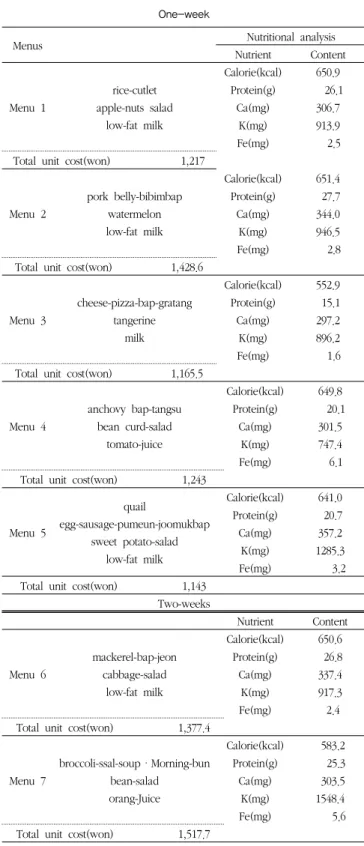
개발된 아침급식 간편식단의 영양 평가 및 가격 평가를 Table 1에 나타냈다.
1) 식단의 영양성분 및 단가 분석
개발된 아침급식 간편식단의 2주 식단의 영양가와 단가를 분석하였다. 식단 영양가는 한국인 영양섭취기준(KDRIs)에서
제시한 영양소 권장섭취량(%RI) 또는 충분섭취량(%AI)에 대한 백분율로 나타냈다.
One-week
Menus Nutritional analysis
Nutrient Content
Menu 1
rice-cutlet apple-nuts salad
low-fat milk
Calorie(kcal) 650.9 Protein(g) 26.1
Ca(mg) 306.7
K(mg) 913.9
Fe(mg) 2.5
Total unit cost(won) 1,217
Menu 2
pork belly-bibimbap watermelon low-fat milk
Calorie(kcal) 651.4 Protein(g) 27.7
Ca(mg) 344.0
K(mg) 946.5
Fe(mg) 2.8
Total unit cost(won) 1,428.6
Menu 3
cheese-pizza-bap-gratang tangerine
milk
Calorie(kcal) 552.9 Protein(g) 15.1
Ca(mg) 297.2
K(mg) 896.2
Fe(mg) 1.6
Total unit cost(won) 1,165.5
Menu 4
anchovy bap-tangsu bean curd-salad
tomato-juice
Calorie(kcal) 649.8 Protein(g) 20.1
Ca(mg) 301.5
K(mg) 747.4
Fe(mg) 6.1
Total unit cost(won) 1,243
Menu 5
quail
egg-sausage-pumeun-joomukbap sweet potato-salad
low-fat milk
Calorie(kcal) 641.0 Protein(g) 20.7
Ca(mg) 357.2
K(mg) 1285.3
Fe(mg) 3.2 Total unit cost(won) 1,143
Two-weeks
Nutrient Content
Menu 6
mackerel-bap-jeon cabbage-salad
low-fat milk
Calorie(kcal) 650.6 Protein(g) 26.8
Ca(mg) 337.4
K(mg) 917.3
Fe(mg) 2.4
Total unit cost(won) 1,377.4
Menu 7
broccoli-ssal-soupㆍMorning-bun bean-salad
orang-Juice
Calorie(kcal) 583.2 Protein(g) 25.3
Ca(mg) 303.5
K(mg) 1548.4
Fe(mg) 5.6 Total unit cost(won) 1,517.7
Table 1. Analysis nutritive value and ingredient cost in developed convenient Menu for School Breakfast Program
Menu 8
oat-meal-juk squid-ba-vegetable-salad
orang-juice
Calorie(kcal) 579.9 Protein(g) 23.7
Ca(mg) 364.4
K(mg) 1402.3
Fe(mg) 5.0 Total unit cost(won) 1,165.5
Menu 9
nurungji-salad bean curd-nuts-shake
melon
Calorie(kcal) 644.5 Protein(g) 21.1
Ca(mg) 534.9
K(mg) 1548.9
Fe(mg) 7.0 Total unit cost(won) 1,5021.2
Menu 10
hamㆍcheese-mari-satang-tteok fruit-vegetable-salad
milk
Calorie(kcal) 634.7 Protein(g) 22.7
Ca(mg) 480.9
K(mg) 753.8
Fe(mg) 1.4
Total unit cost(won) 1,284.3
(1) 식단 1
라이스 커틀렛, 사과 견과류 샐러드, 저지방 우유로 구성하 였다. 열량은 650.9kcal(100.1%)로 에너지 함량의 목표량에 충 분히 충족되었다. 단백질은 26.1g(156.3%)으로 권장섭취량 보 다 56.3% 초과되었다. 칼슘은 306.7mg(108.3%)으로 권장량에 충분히 충족되었다. 칼륨은 913.9mg(78.1%)으로 충분섭취량 보다 낮은 수준이었다. 철분은 2.5mg(47.2%)으로 권장량 보다 낮은 수준이었다. 식단 1의 단가는 1,217원으로 목표단가의
81.13%로 목표단가보다 낮게 나타났다.
(2) 식단 2
삼겹살 비빔밥, 수박, 저지방 우유로 구성하였다. 열량은
651.4kcal(100.2%)로 에너지 함량의 목표량에 충분히 충족되었
다. 단백질은 27.7g(165.9%)으로 권장섭취량 보다 초과되었다. 칼슘은 344.0mg(121.4%)으로 권장량 보다 21.4%가 초과되었
다. 칼륨은 0.9mg(81.0%)로 충분섭취량 보다 낮은 수준이었
다. 철분은 2.8mg(52.8%)으로 권장량 보다 낮은 수준이었다.
단가는 1,428원으로 목표단가의 95.24%로 목표 단가보다 약간
낮게 나타났다. (3) 식단 3
치즈 피자 밥 그라탕, 귤, 우유로 구성하였다. 영양 분석결 과 열량(85.1%)은 목표량보다 낮게 나타났고, 단백질(90.4%),
철분(30.2%)은 권장량보다 부족한 것으로 나타났으며, 칼륨
(76.6%)도 충분섭취량보다 낮게 나타났다. 하지만 칼슘
(104.9%)은 권장섭취량에 충분히 충족되었다. 단가는 1,165.5
원으로 목표단가의 77.7%로 목표단가보다 낮게 나타났다. (4) 식단 4
멸치밥 탕수, 두부샐러드, 토마토 주스로 구성하였다. 열량
(100.0%)은 목표량에 충족되었고, 칼슘(106.4%)도 권장섭취량 에 충분히 충족되었다. 칼륨(63.9%)은 충분섭취량 보다 낮았 고, 철분(115.1%)과 단백질(120.4%)은 권장섭취량 보다 초과되
었다. 단가는 1,243원으로 목표단가의 82.9%로 목표단가보다
낮게 나타났다. (5) 식단 5
메추리ㆍ소세지 품은 김치 주먹밥, 고구마 샐러드, 저지방 우유로 구성하였다. 열량(98.6%)은 목표 섭취량에 거의 충족 되었고, 단백질(124.0%), 칼슘(126.1%)과 칼륨(111.0%)은 초과 되었고, 철분(60.4%)은 부족한 것으로 나타났다. 단가는 1,143 원으로 목표단가의 76.2%로 목표 단가 보다 낮게 나타났다.
(6) 식단 6
고등어 밥전, 양배추 샐러드, 저지방 우유로 구성하였다. 열량(100.1%)은 목표량이 충분히 충족되었고, 단백질(160.5%), 칼슘(119.1%)은 초과되었고, 칼륨(78.4%)과 철(45.3%)은 부족 한 것으로 나타났다. 단가는 1,377.4원으로 목표단가의 91.8%
로 목표단가 보다 낮게 나타났다. (7) 식단 7
브로콜리 쌀 스프+모닝빵(2), 콩샐러드, 오렌지 주스로 구
성하였다. 열량(89.7%)은 목표량 보다 낮게 나타났고, 칼슘
(107.1%), 철분(105.7%)은 충분히 충족되었고, 단백질(151.5%), 칼륨(132.3%)은 초과되었다. 단가는 1,517.7원으로 목표단가의
101.2%로 목표단가에 만족시켰다.
(8) 식단 8
오트밀 죽, 오징어바 채소샐러드, 오렌지 주스로 구성하였
다. 열량(89.2%)은 목표량 보다 낮게 나타났고, 단백질
(142.0%), 칼슘(128.6%)과 칼륨(120.0%)은 초과되었고, 철분
(94.3%)은 낮게 나타났다. 단가는 1,469원으로 목표단가의
97.9%로 목표단가 보다 약간 낮게 나타났다. (9) 식단 9
누룽지 샐러드, 두부․견과류 쉐이크, 메론으로 구성하였다. 열량(99.2%)은 목표량에 거의 충족되었고, 단백질(126.3%), 칼 슘(189.0%), 칼륨(132.4%), 철분(132.1%)은 권장섭취량 보다 초과되었다. 단가는 1,501.2원으로 목표단가의 100.1%로 목표 단가를 만족시켰다.
(10) 식단 10
햄ㆍ치즈말이 사탕떡, 과일 채소 샐러드, 우유로 구성하였
다. 열량(97.6%)은 목표량에 약간 못 미치는 것으로 나타났
고, 단백질(136.0%), 칼슘(169.7%)은 초과되었다. 칼륨(64.4%) 과 철분(26.4%)은 부족한 것으로 나타났다. 단가는 1,165.5원 으로 목표단가의 77.7%로 목표단가 보다 낮게 나타났다.
Menu 2
pork belly-bibimbap
rice 150g, pork belly 80g, vegetable (cucumber 15g, carrot 10g, cabbage 15g, lettuce 10g, perilla leaf 10g, kimchi 15g), Chokochujang 10g, a little salt and a little black pepper
1. Season pork with salt and pepper. Fry the pork and drain oil on paper tower.
2. Julienne vegetables 0.2cm.
3. Julienne pork 0.5cm.
4. Chop Kimchi.
5. Place rice in a bowl and arrange the pork, vegetables, Kimchi attractively.
6. Add Chokochujang.
watermelon 100g low-fat milk 200㎖
Menu 3
cheese-pizza-bap- gratang
rice 180g, vegetable(green pepperㆍred pepperㆍcarrot 10g, onion 14g), Mushroom Cream Soup 15g, Tomato Sauce 25g, cheese 6g
1. Cut vegetables into 1cm cubes.
2. Put half-cup of water in soup and boil until thick.
3. Saute the vegetables slightly.
4. Put the rice in gratin bowl or iron plate. Pour the soup and then put tomato sauce, vegetables and cheese. Cook in an oven for 5 minutes.
tangerine 1개
milk 200㎖
Menu 4
anchovy bap-tangsu
rice 110g, anchovy 15g, onion 16g, carrot 12g, vegetable(green pepperㆍredpaprikaㆍyellow paprika 4g), soybean oil 18g
(Batter) starch 40g, egg 15g, soybean oil 1g, water 40g (Sauce) sugar 1TS, soy sauce
1TS, vinegar 1TS, water 200g, starch 1TS
1. Dice carrot, onion, green pepper, and paprika 2cm.
2. Mix rice with fried anchovy(fried without oil).
3. Make 2 into bite-sized pieces(3cm).
4. Batter: Mix starch, egg, water, and soybean oil.
5. Dredge 3 with batter and deep-fry in oil. Drain oil on paper tower.
6. Sauce: Add sugar, vinegar, soy sauce, 200ml water to 1 and boil down. Add 1T starch and 1T water.
7. When the sauce is done, deep-fry the rice once more shortly in hot oil.
bean curd-salad
-Main Ingredients: bean curd
60g, lettuce 15g, Sprout Vegetables 2g, carrot 3g (Dressing) thick soy 1TS, vinegar 1TS, sugar 1TS, garlic 1/3ts, a little sesame oil
1. Blanch bean curd in boiling water.
2. Cut the tofu into 1cm cubes.
3. Dressing: Blend soy sauce, vinegar, sugar, sesame oil, and garlic.
4. Put the bean curd and vegetables in a bowl and put sauce.
tomato-juice 180㎖ 3. 아침급식 노동생산성 지표 산출
(1) 학교아침급식 작업시간대의 1식당 노동시간
가상으로 아침급식으로 제공된 간편식의 1식당 노동시간을 계산한 결과 1,000식에서 1식에 투입되는 아침급식작업시간은 평균 1.2분으로 나타났다. 양일선 등(2008)의 연구에서는 아침 급식실시교의 한식 제공횟수는 주당 5.08±1.41회로 밥을 위 주로 하는 식사가 제공되고 있었고, 1식당 노동시간은 조식이 5.4분으로 나타났다. 따라서 본 연구에서 개발된 간편식의 급 식생산성이 더 높은 것으로 나타나 기존 아침급식에 비하여 이른 아침에 노동시간을 단축시킬 수 있을 것이라고 사료된 다. Yi BS(1997)과 Kim EM 등(2006)의 급식의 생산성에 관한 연구에서는 생산 식수가 커짐에 따라 1식에 소요되는 시간은 감소하는 경향을 보였으므로 아침급식에 참여하는 학생 수 가 많을수록 아침급식의 생산성이 더 효율적일 것으로 보여 진다.
4. 학교아침급식 간편식의 표준레시피
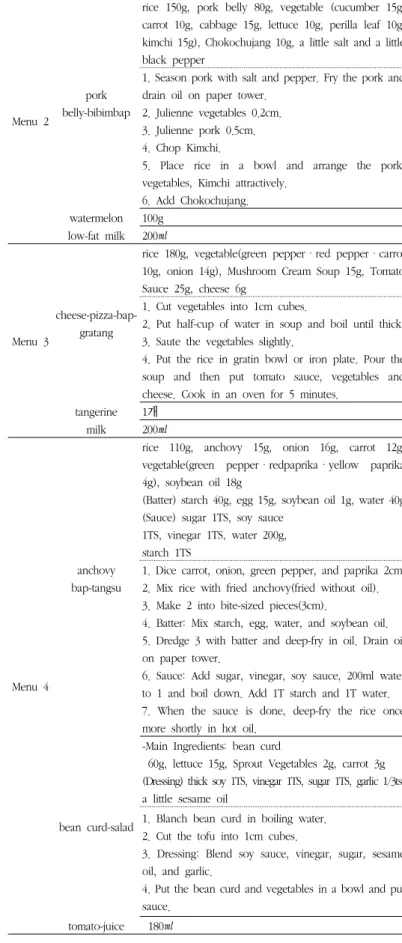
본 연구에서 개발된 학교아침급식 간편식단의 레시피를 Table 2에 정리하였다.
Menus Ingredient(g/person) method
Menu 1
rice-cutlet
rice 60g, pork(loin)50g, egg 2TS, sugar 1/2ts, thick soy 1ts, crushed garlic 3g, a little sesame oil, Bread crumbs 4g, Flour 2TS, a suitable amount of soybean oil 6g, a little salt and a little black pepper (Ketchup sauce) Ketchup 2TS, onion 15g, carrot 8g 1. Season the ground pork with thick soy sauce, sugar, garlic, salt and black pepper.
2. Mix rice to 1 and knead well.
3. Make the mixed rice round and flat.
4. Dredge the mixed rice with flour, egg, bread crumbs in order. Deep fry in 170℃ oil until toasted.
5. Mince onion and carrot and fry. Add ketchup and continue frying.
6. Put the rice on a plate and pour the sauce. Put the side vegetables nicely.
apple-nuts salad
apple 60g, mayonnaise 1TS, sugar 2g, walnut 3.5g, almond slice 2g
1. Dice apple 1cm each side.
2. Melt sugar in mayonnaise and mix apple, walnut and almond.
low-fat milk 200㎖
Table 2. Recipe of developed convenient Menu for School Breakfast Program
Menu 5
quail egg- sausage-pumeun
-joomukbap
rice 110g, a two pieces of Vienna sausage 2개, a two pieces of quail egg, chop up a vegetable(kimchi 2T, onion 1T, Zucchini 1T, carrot 4g), laver 2g, ketchup 2T, a little salt, a little sesame oil
1. Blanch sausages. Boil quail eggs in water with 3~4 vinegar added and peel the shells.
2. Chop Kimchi, onion, carrot and zucchini finely.
3. Prepare 1tp of Kimchi and 1tp for each vegetables.
4. Oil a frying pan. Fry onion at a high heat and then add carrot.
5. When onion and carrot are cooked through, add and fry zuncchini and kimchi at low heat.
Add ketchup and mix with the vegetables.
6. Add rice to the vegetables and fry together.
Season with salt and add small amount of sesame oil at last.
7. Put the quail eggs and sausages on the fried rice and put the rice on top again and make rice balls.
8. Cut seaweed finely and put on the rice balls.
sweet potato-salad
sweet potato 70g, carrot8g, sweet corn 20g, Almond 5g, Mayonnaise 15g, sugar 2g 1. Boil Sweet potatoes for 15 minutes.
2. Chop carrot finely. Remove water from corn.
3. Mix all the ingredients in mayonnaise and put sliced almond.
low-fat milk 200㎖
Menu 6
mackerel-bap-jeon
mackerel 60g(cooked 30g), rice 110g, onion 14g, greenㆍred pepper 10g, egg 25g, Grape Seed Oil 4.2g, a little salt and a little black pepper 1. After cleaning mackerel, season with salt and black pepper and then cook in oven for 15 minutes.
2. Mince onion and peppers and saute the vegetables after seasoning with salt.
3. Separate the meckerel meat from the bones.
4. Mix rice with 2 and 3. Make the mixed rice into 5 rice balls(28g each).
5. Coat the rice balls with egg.
6. Fry the rice balls front and back.
cabbage-salad
cabbage 70g, onion 10g, carrot 6g, fruit cocktail 20g, sugar 4g, mayonnaise 15g
1. Chop cabbage, onion, and carrot in a blender.
2. Dressing: Blend fruits, sugar dissolved water, mayonnaise, onion , and carrot in a blender.
3. Put vegetables in a bowl and put the dressing.
low-fat milk 200㎖
Menu 7
broccoli-ssal -soupㆍmor ning-bun
-Main Ingredients: broccoli 65g, potato 70g, onion 100g, button mushroom(small) a piece, rice flour 3T
-Other ingredients: milk 100ml, water 100g, Grape Seed Oil 2g, a little salt and a little black pepper
- two pieces of Morning Buns
1. Blanch brocoli florets in boiling water with a little salt.
2. Julienne onion, and slice potato and button mushroom.
3. Oil a pot with olive or grape seed oil. Fry onion and when onion is clear, add and fry other vegetables.
4. Before potato is fully cooked pour water and a little salt and boil. Turn off the gas stove and grind with hand blender.
5. Put sifted rice flour and stir the soup. Turn on the gas stove and boil and add milk until the soup gets think.
6. Season with salt and a litte black pepper. (According to one's preference, add milk, soy bean milk, or whipped cream for thicnkness of the soup.)
bean-salad
-Main Ingredients: kidney beanㆍpea(can)50g, sweet corn 30g, head lettuce 15g
-Other ingredients: plain yogurt 38g, sugar 10g, apple vinegar 2g 1. Remove water rom kidney beans, peas, and sweet corn.
2. Tear head lettuce to pieces.
3. Dressing: Blend plain yogurt, sugar, and apple vinegar.
4. Place beans and sweet corn and put head lettuce on the top. Pour the sauce.
orang-Juice 200㎖
Menu 8
oat-meal-juk
oatmeal 70g, milk 200ml, sugar 2g, salt 1g
1. Wash oatmeal and macerate in cold water for 1 minute.
Throw away water and wash the oatmeal again.
2. Boil the oatmeal in 250~300ml water at medium heat for 10 minutes. When oatmeal soaks water, put 150ml milk and boil at low heat for 5 minutes.
3. When oat meal becomes like porridge, add 50ml milk and season with slat. (According to one's preference, add sugar.)
squid-ba-ve getable
-salad
squid 25g, Frying Mix 1/2ts, batter(ice water35g, Frying Mix 12.5g), soybean oil 6g, head lettuce 15g, vegetable(green pepperㆍred pepperㆍred cabbage,ㆍcarrot 4g), cherry tomato 60g
(honey mustard) mayonnaise 10g, mustard 5g, oligosaccharides 4g
1. Julienne green pepper, red pepper, and red cabbage.
Wash and remove water from head lettuce and tear into pieces. Cut cherry tomatoes in half.
2. Cut squid trunk 1.5cm by 3.5cm. Mix with 1/2ts frying mix.
3. Add 35g water to frying mix. Dredge 3 in this mixture.
4. Deep-fry the dredged squid.
5. Honey Mustartd Sauce: Blend Mayonnaise, mustard, and oligosaccharides.
6. Put head lettuce and vegetables on a plate and place deep-fried squid. Pour the sauce and sprinkle ground peanuts.
orang-juice 200㎖
Menu 9
nurungji-salad
-Main Ingredients: nurungji 50g, head lettuce 15g, yellow paprika 5g, red paprika 5g
-Other ingredients: onion 10g, corn 20g, cream cheese 20g, cherry tomato 20g, oligosaccharides 15g, vinegar 6g, olive oil 6g, frying oil 8g
1. Deep-fry nurungji in hot oil (over 180℃) and drain oil on paper tower.
2. Vegetables: Julienne paprika 0.2cm. Tear 15g head lettuce into pieces.
3. Corn Garlic Cheese Dressing: Grind cheese, onion, corn, oligosaccharides, olive, chopped garlic, and vinegar in a blender.
4. Pour the dressing on deep-fried nurungju and vegetables.
bean curd-nuts
-shake
milk 200㎖, bean curd 60g, peanut 5g, almond 3g, salt 1g
1. Blanch tofu in boiling water.
2. Grind milk, bean curd, and peanuts in a blender.
3. Add salt to season.
(According to one's preference, ad sugar.) melon 100g
Menu 10
hamㆍcheese- mari-satang-
tteok
nonglutinous rice powder 50g, sticky rice flour 12.5g, butter 0.6g, milk 6g, Cheddar Cheese 30g, sliced ham 15g, sugar 4g, salt 0.25g
1. Put steamer on a pot when steam rises and steam for 15 minutes.
2. Divide rice cake into 3 and add natural color powder.
Make jeolpyeon(pounded rice cake).
3. Cut 3 sides into the size of ham and cheese and cut 1 side 1cm larger.
4. Put ham and cheese and roll.
fruit-vegetable -salad
apple 45g, sweet persimmon 45g, banana 45g, head lettuce 15g
(sauce) plain yogurt 12g, kiwi 3g 1. Dice fruits 1.5cm each side.
2. Cut the banana round the way it is.
3. Wash head lettuce well and tear to pieces.
4. Dressing: Grind kiwi and mix with yogurt.
5. Mix the fruits with the dressing.
milk 200㎖
Ⅳ. 결론 및 요약
본 연구는 고등학생의 아침결식률 감소를 위한 방안을 모 색하고자 하였다. 그 방안으로 학교에서 아침급식을 실시하는 것으로 간편식단을 개발하여 효율적으로 대량 생산할 수 있 는 표준화된 레시피를 개발하였다.
1) 고등학생을 위한 아침급식용 간편식단은 영양사 설문조 사를 통해 얻은 결과 중 직접조리가 가능한 ‘편의식 급식’ 을 선호한 점을 토대로 식단 단가(1,500~2,000원)는 학부모의 의견을 반영하였고, 메뉴 선정은 학생들의 기호도를 고려하여
식단 10가지를 개발하였다. 식단 구성은 주 메뉴와 보조메뉴 2가지를 기본으로 주식은 쌀을 이용하고, 보조메뉴는 과일 및 샐러드류, 우유 및 주스류로 구성하였다.
2) 개발된 아침급식 간편식단의 열량 및 영양소 함량은 한 국인 영양섭취 기준(2010)으로 열량의 경우 95.7%로 목표 섭 취 기준보다 4.3% 낮았고, 단백질(137.3%)과 칼슘(128.1%)은 권장섭취량 보다 높게 나타났으며, 철분(70.1%)과 칼륨(93.7%) 의 경우 권장 섭취량 보다 낮게 나타났다.
3) 1인당 식재료비의 단가는 평균 1,335원으로 목표단가
(1,500원)보다 낮게 나타났다. 4) 1식당 노동시간
가상으로 아침급식으로 제공된 간편식의 1식당 노동시간을 계산한 결과 1,000식에서 1식에 투입되는 아침급식작업시간은 평균 1.2분으로 나타났다.
연구 결과, 이른 아침 조리가 가능하도록 단순조리의 편리 성과 학생의 기호성을 맞춘 간편식 제공은 아침결식 위험 집 단인 고등학생에게 아침식사 섭취를 증가시킬 수 있다고 사 료된다. 또한 목표단가는 1,500원선으로 아침급식 실시로 인 한 경제적 부담을 최소화하였다. 개발된 간편식단은 필수영양 소인 철분과 칼륨이 권장 섭취량 보다 낮게 나타났으므로 이 를 보완한 식단 개발이 필요하다.
본 연구는 향후 우리나라 실정에 맞는 아침급식을 계획하 고, 효율적인 운영과 관리를 위한 기초자료로 활용될 수 있을 것이다. 이상의 연구 결과를 실제 급식에 적용하여 관능평가 및 개발된 메뉴의 표준화를 위한 연구가 뒷받침되어야 할 것 이다.
참고문헌
Choi HJ, Kim KK, Lim SY. 2007. Effect of intake of dried mackerel on fatty acid compositions in liver and nervous tissue. Journal of Life Science 17(4): 546-551.
Choi JH. 2012. Developing rice cereal-based menu for middle school students' breakfast and analyzing its application possibility.
Master's Thesis. The Graduate School of Education Hanyang University.
http://blog.naver.com/twoyelove316/130084681952
Kim HB. 2001. School Meals of United States of America. Nonghyup research department. CEO Focus vol 79. p 19
Kim EM, Jeong MK, Lee MA, Kim IH. 2006. Analysis on Work and Labor Productivity in Elementary School Foodservice Systems.
KOREAN. J FOOD COOKERY. 22(6):875-881
Kim YS. 2007. Factors affecting intention to participate in school
breakfast programs of middle and high school students in Seoul. Master's Thesis. The Seoul University of Korea.
Kim MK. 2008. 100 kinds of nutrients Smart Folks. Sungandang Kim YS, Kim HL, Park YH, Choe JS, Yun JH. 2008. Development of
School Breakfast Program in Korea.National Institute of Agricultural Science and Technology. pp 534-550
Kim JE. 2008. Study of the actual state of breakfast of students in elementary, junior high and high school and demand on national school breakfast program. Master's Thesis. The Daejeon University of Korea.
Kim JY, Ahn HS. 2009. Eating Habits in Relation with Skipping Breakfast and Preferences in Breakfast Menus of High School Students in Seoul. The Journal of Living Culture Research 24(1): 61-75 Kim BE. 2010. The color of the pang pang bouncing bongsik
cooking. Crown.
Kim JE. 2011. The Research for Degree of Demand at School Breakfast Program and Development of Convenient Menu for High School Students. ph. D. Thesis. The Daejeon University of Korea.
Kim MK. 2004. study on dietary life of workers and development of nutritional convenient foods for workers. Master's Thesis.
Yeungnam University.
Lee SY, Lee YS, Park JS, Bai YH, Kim YO, Park YS. 2004.
Developing Breakfast Menus for Most Easily Breakfast-Skipping Groups. Korean. J Community Nutrition 9(3):315-325
Lee MK. 2005. Characteristics and Breadmaking of Rice Flours Prepared by Moisture-Heat Treatment. ph. D. Thesis. Chonnam National University.
Lee PS. 2007. Identifying the Operational Factors for School Breakfast Program using Conjoint Analysis. Master's Thesis. Yonsei University
Lee KW. 2008. A Survey on the necessity of breakfast service at child care centers and a case study of breakfast service at a child care center. Seoul National University.
Maclean CW, Klein GR, Massa E, Graham GG. 1978. Protein quality conventional and high protein rice and digestibility of glutinous and non-glutinous rice by preschool children. J. Nutr. 108: 1740 Ministry of Health and Welfare. 2010. The Fifth Korea National
Health and Nutrition Examination Survey-Nutrition Examination Survey. p334-336.
National School Breakfast Week. 1991. School Food Service Journal 45(7): 21
Oh YM. 2006. Nutritional Analysis of Middle School Lunch Service
Menu in Daejeon and Development of Menu Enriched with Calcium. Master's Thesis. Education Chungnam National University of Korea.
Park JH. 2009. Studies on physicochemical and sensual characteristics of tofu made with broccoli juice. Master's Thesis. Educational Graduate School of Yongin University.
Park KM. 2009. Studies on the Relationship between Adolescents Eating behaviors for Breakfast and Snack in Seoul. Master's Thesis. The Konkuk University of Korea.
Rural Development Administration National Institute of Crop Science.
2009. production and Edible naked oats growth pp 6-7
The Korean Nutrition Society. 2005. Nutritional assessment program CAN-Pro 3.0 professionals.
The Korean Nutrition Society. 2010. Dietary Reference Intakes for Koreans
United States Department of Agriculture USDA 2009. School Breakfast Program. Retrieved June 6, 2009, from
United States Department of Agriculture USDA 2010. Child Nutrition Programs: School Breakfast Program. June 14. 2010
Yang IS. 1997. Enhancing the School Foodservice Management through National School Breakfast Program. Journal of THE KOREAN DIETETIC ASSOCIATION. 3(2):223-238
Yi BS. 1997. Work Analysis through Work Sampling Methodology and Development of Standardized Staffing Indice in School Foodservice Systems. ph. D. Thesis. The Yonsei University of Korea.
Youn YH. 2003. Study of Korean Traditional Gruel as Breakfast Alternative. Master's Thesis. Traditional Culture and Arts Sookmyung Women's University of Korea.
Yi BS. 2004. A Comparative Study on Dietary Life and Recognition of Diet Related Factors in Elementary, Middle and High School Students. Journal of THE KOREAN DIETETIC ASSOCIATION.
10(3):364-374
Yang IS, LEE BS, Cha JA, Han GS, Chae IS, Lee JM. 2004.
FOODSERVICE IN INSTITUTIONS. p 253
Yi BS, Yang IS. 2006. An Exploratory Study for Identifying Factors Related to Breakfast in Elementary, Middle and High School Students. Korean. J Community Nutrition. 11(1):25-38
Yang IS, Lee BS, Sin SE, Kang HS, Park MK, Kim HY, Lee PS, Lee SY, Kim HR, Kim YS. 2008. Efficient operating system development for School Breakfast Program. National Institute of Agricultural Science and Technology. pp 551-569
2012년 8월 20일 접수; 2013년 3월 5일 심사(수정); 2013년 3월 11일 채택