Citation: Lee JH, Lee CH, Oh SY, Kwak WG, Oh HJ, Yun W, Lee JK, Jeong JT, Choi YS, Liu SD, Choi YI, Ch JH. 2017. Effect of bone boiling duration on bone extract supplement quality for broilers as to growth performance, leg bone length, and blood profile. Korean Journal of Agricultural Science 44:060-066.
DOI: https://doi.org/10.7744/kjoas.20170007
Editor: Jung Min Heo, Chungnam National University, Korea
Received: November 21, 2016
Revised: February 13, 2017
Accepted: February 16, 2017 Copyright: © 2017 Korean Journal of Agricultural Science.
This is an Open Access article distributed under the terms of the Creative Com- mons Attribution Non-Commercial License (http:
//creativecommons.org/licenses/by-nc/4.0/) which permits unrestricted non-commercial use, distribution, and reproduction in any medium,
OPEN ACCESS
ANIMAL
Effect of bone boiling duration on bone extract supplement quality for broilers as to growth performance, leg bone length, and blood profile
Ji-Hwan Lee, Chang-Hee Lee, Seo-Young Oh, Woo-Gi Kwak, Han-Jin Oh, Won Yun, Jin-Kyu Lee, Ji-Taek Jeong, Yeong-Seok Choi, Shu-Dong Liu, Yang-Il Choi, Jin-Ho Cho
*Department of Animal Science, Chungbuk National University, #52 Naesudong-ro, Heungdeok-gu, Cheongju, Chungbuk 28644, Korea
*Corresponding author: [email protected]
Abstract
This study was conducted to investigate the influence of bone boiling duration on bovine bone extract supplement quality in terms of growth performance, leg bone length, and blood profile in broilers. A total of twenty ROSS 308 broilers (initial BW of 970 ± 50 g) were randomly divided into the following 4 treatment groups: CON (basal water), T1 (1 : 1 ratio water to bone extract boiled for six hours), T2 (1 : 1 ratio water to bone extract boiled for 12 hours), and T3 (1 : 1 ratio water to bone extract boiled for 24 hours). The broilers were allowed free access to the source of fluid or diets. Average daily feed intake (ADFI), average daily gain (ADG), and feed efficiency showed no significant differences among treatments during this experiment. However, broilers fed bone extract boiled for six hours showed a tendency for increased ADG to other treatments (p < 0.17). No significant differences were observed in organ weights (liver, spleen, bursa of fabricius) or blood profiles among the treatments during the experiment, but broilers fed bone extract boiled for six hours showed a tendency for decreased cholesterol, triglycerides, and HDL compared to the control diet. In the case of leg bone length, there were significant difference (p < 0.05) on tibia and femur among treatments. It was concluded that the six hour-boiled bone extract supplementation had beneficial effects on growth performance and blood profile of broilers.
Keywords: blood profile, boiling duration, bone extract, broiler, leg bone length
Introduction
As the economy of South Korea grew in the 2000s, consumer’s perceptions of food are changing
(Kim et al., 2016). Recently, internal type of meat by-product import volume has increased by
44.7 thousand tons, while bovine by-product import volume increased by 15.8 thousand tons from
2009 to 2015 (Korea Meat Trade Association, 2015). Koreans have traditionally consumed bone
extracts obtained from shank, tail, and feet bones of cattle (Ha et al., 2008; Choi et al., 2016).
Furthermore, bone extract obtained by prolonged boiling has been used as a nutritional supplement by pregnant women, middle-aged people, and in growing children for growth promotion. Collagen, chondroitin sulfuric acid, and minerals are abundant in bone extracts and are beneficial substances for development and fracture recovery in humans (Seol and Jang, 1990; Kim et al., 2007). Furthermore, collagen contains substances that are closely related to tenderness, which is related to the deposition of major protein in muscle. Among minerals present in bone extracts, Ca and P are closely related to the formation of eggshell, teeth, and bone. Bone extracts can be characterized from the elution of nutritional contents according to boiling duration. The extracts’ contents in Ca, P, Mg, protein, total free amino acids, and collagen increased over time (Kim, 2006). However, the availability of shank, tail, and feet bone extracts derived from Hanwoo cattle have been decreasing due to the time-consuming nature and difficulty of simmering these broths for a long time (Yoon, 2015). This decline is expected to accelerate in modern society.
Although consumption of bone by-products has positive effects for humans, such as growth improvement, there have been no studies on consumption of bone by-products by animals. Therefore, the present study was performed to determine the effects of boiling duration on bone extract quality for supplementing broiler diets and enhancing their growth performance, organ weight, leg bone length, and blood profiles.
Materials and Methods
Animals, housing, diets, and experimental design
A total of 20 ROSS 308 broilers with an average initial BW of 970 ± 50 g were used in a 2-week experiment.
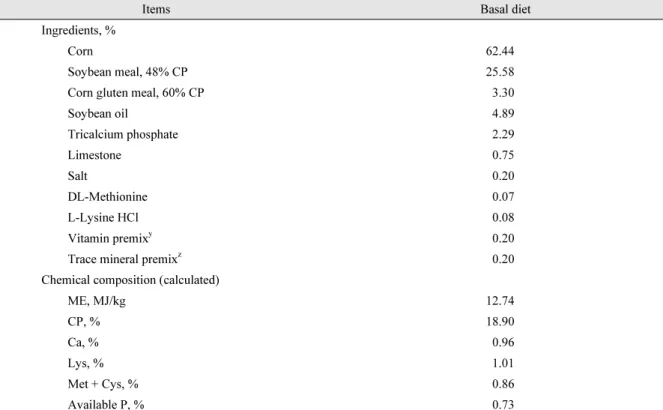
Broilers were randomly divided into 4 dietary treatment groups according to a randomized complete block design (RCBD) with 5 replicates per treatment. The 4 treatments were as follows: CON (basal water), T1 (1 : 1 ratio water to bone extract boiled for 6 hours), T2 (1 : 1 ratio water to bone extract boiled for 12 hours), and T3 (1 : 1 ratio water to bone extract boiled for 24 hours). The composition of the basal diet is shown in Table 1. Broilers were housed in a stainless-steel pen (0.5 m × 0.4 m × 0.4 m) with a slatted floor and plastic feed and water dispensers or container. All broilers were fed the same basal diet and given ad libitum access to diet, source of fluids, or bone extract. The room temperature was maintained at 25 ± 1°C during the entire experimental period and the relative humidity was maintained around 65%. This experiment was conducted during 2 weeks at the swine nutrition and physiology laboratory in Chungbuk National University.
Sampling and Measurements
The broilers were weighed individually, and feed and fluid intakes were recorded at 1 d and 14 d. In the case of
average daily gain (ADG), average daily feed intake (ADFI), and average daily source of fluid intake (ADSI), they
were calculated by respectively subtracting the mean value from day 14 from that of day 1 and dividing the result by
the experimental period length. At the end of the experiment, blood samples were collected from the wing vein into
sterile syringes. After collection, the samples were transferred into both a vacuum (clot activator with gel) and
K
3EDTA vacuum tubes (Becton Dickinson Vacutainer Systems, Franklin Lake, NJ, USA) and stored at -4°C. After
samples for serum analysis were centrifuged at 3,000 × g for 15 min, it stored at -4°C according to the method of Wang
et al. (2013). Red blood cell (RBC) and white blood cell (WBC) concentrations were analyzed using an automatic
blood analyzer (ADVIA, Bayer, Tarrytown, NY) and the concentration of cholesterol, triglycerides, high density
Table 1. Diet composition (as-fed basis).
Items Basal diet
Ingredients, %
Corn 62.44
Soybean meal, 48% CP 25.58
Corn gluten meal, 60% CP 3.30
Soybean oil 4.89
Tricalcium phosphate 2.29
Limestone 0.75
Salt 0.20
DL-Methionine 0.07
L-Lysine HCl 0.08
Vitamin premix
y0.20
Trace mineral premix
z0.20
Chemical composition (calculated)
ME, MJ/kg 12.74
CP, % 18.90
Ca, % 0.96
Lys, % 1.01
Met + Cys, % 0.86
Available P, % 0.73
y
Provided per kilogram of diet: 15,000 IU vitamin A; 3,750 IU vitamin D3; 37.5 mg vitamin E; 2.55 mg vitamin K3; 3 mg vitamin B1; 7.5 mg riboflavin; 4.5 mg vitamin B6; 24 mg vitamin B12; 51 mg niacin; 1.5 mg folic acid; 126 mg biotin; and 13.5 mg pantothenic acid.
z
Provided per kilogram of diet: 37.5 mg Zn (as ZnSO
4); 37.5 mg Mn (as MnO
2); 37.5 mg Fe (as FeSO
4․ 7H
2O); 3.75 mg Cu (as CuSO FeSO
4․ 5H
2O); 0.83 mg I (as KI); and 0.23 mg Se (as Na2SeO
3․ 5H
2O).
lipoprotein cholesterol (HDL-C), and low density lipoprotein cholesterol (LDL-C) were analyzed using an automatic biochemical analyzer (RA-1000, Bayer Corp., Tarrytown, NY). After killing broilers by cervical dislocation, organs (liver, spleen, and bursa of fabricius) were removed, cleaned, and weighed. The weight of organs was expressed as a percentage of body weight. When legs were removed from carcasses, the meat was separated from the bones. Then, these bone samples were dried at 80°C for at least 24 hours and leg bone lengths were measured with a ruler.
Statistical analysis
All experimental data were analyzed in a randomized complete block design using the GLM procedure of SAS (SAS Institute Inc., 2002). The means of the treatments were also compared using Duncan’s multiple range test (Duncan, 1955). The variability in the data was expressed as standard error (SE). Probability values less than 0.05 were considered significant.
Results
Growth performance
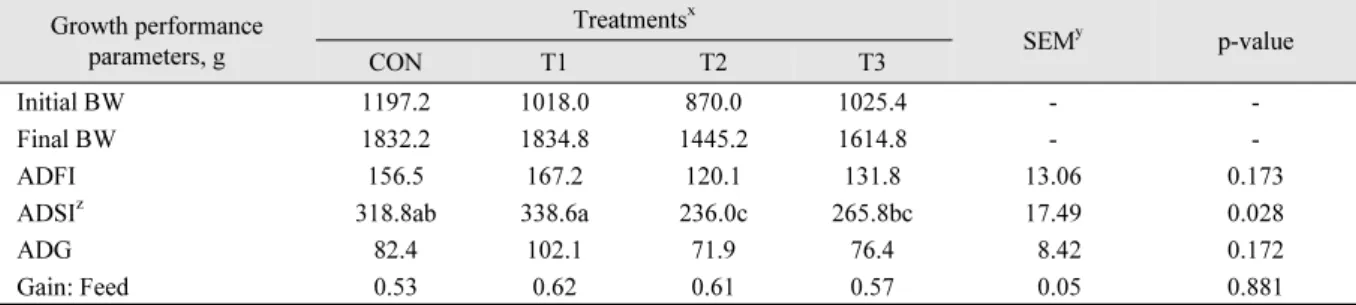
Table 2 shows growth performance in broilers according to bone extract supplement of different boiling time.
ADFI, ADG, and feed efficiency are not significantly different among the treatments. However, broilers fed water
Table 2. Effects of supplementation of bone extract on growth performance in broilers.
Growth performance parameters, g
Treatments
xSEM
yp-value
CON T1 T2 T3
Initial BW 1197.2 1018.0 870.0 1025.4 - -
Final BW 1832.2 1834.8 1445.2 1614.8 - -
ADFI 156.5 167.2 120.1 131.8 13.06 0.173
ADSI
z318.8ab 338.6a 236.0c 265.8bc 17.49 0.028
ADG 82.4 102.1 71.9 76.4 8.42 0.172
Gain: Feed 0.53 0.62 0.61 0.57 0.05 0.881
a - c: Means in the same row with different letters differ (p < 0.05).
xCON (basal water), T1(1 : 1 ratio water and bone extract boiled for 6 h), T2 (1 : 1 ratio water and bone extract boiled for 12 h), T3 (1 : 1 ratio water and bone extract boiled for 24 h).
yStandard error of means (means are 5 replicates per treatment).
zAverage daily source of fluid (or bovine bone stock) intake.
boiled for 6 hours tended to improve their average daily gain (ADG) more than with other treatments, and treatment groups fed bone extract showed a tendency to increase by 19.2, 17.3, and 7.7%.
Organ weight
Table 3 shows organ weights in broilers according to bone extract supplement of different boiling time. The weights of liver, spleen, and bursa of fabricius were not significantly different among treatments.
Table 3. Effects of supplementation of bone extract on organ weight (% body weight) in broilers.
Type of organ,% Treatments
ySEM
zp-value
CON T1 T2 T3
Liver 2.78 2.75 2.93 2.80 0.23 0.946
Spleen 0.09 0.11 0.11 0.11 0.01 0.689
Bursa of Fabricius 0.16 0.20 0.16 0.15 0.03 0.711
y
CON (basal water), T1 (1 : 1 ratio water and bone extract boiled for 6 h), T2 (1 : 1 ratio water and bone extract boiled for 12 h), T3 (1 : 1 ratio water and bone extract boiled for 24 h).
z
Standard error of means (means are 5 replicates per treatment).
Leg bone length
Table 4 shows leg bone length in broilers according to bone extract supplement of different boiling time. It was significantly different among treatments in the Tibia and Femur. The length of broilers fed T2 was smaller than the control (p < 0.05).
Table 4. Effects of supplementation of bone extract on leg bone length (cm) in broilers.
Leg bone, cm Treatments
ySEM
zp-value
CON T1 T2 T3
Tibia 8.52ab 8.12bc 7.78c 8.93a 0.21 0.033
Femur 7.02a 6.54ab 5.8c 6.32bc 0.20 0.032
a - c: Means in the same row with different superscripts differ (p < 0.05).
y
CON (basal water), T1 (1 : 1 ratio water and bone extract boiled for 6 h), T2 (1 : 1 ratio water and bone extract boiled for 12 h), T3 (1 : 1 ratio water and bone extract boiled for 24 h).
z
Standard error of means (means are 5 replicates per treatment).
Blood profile
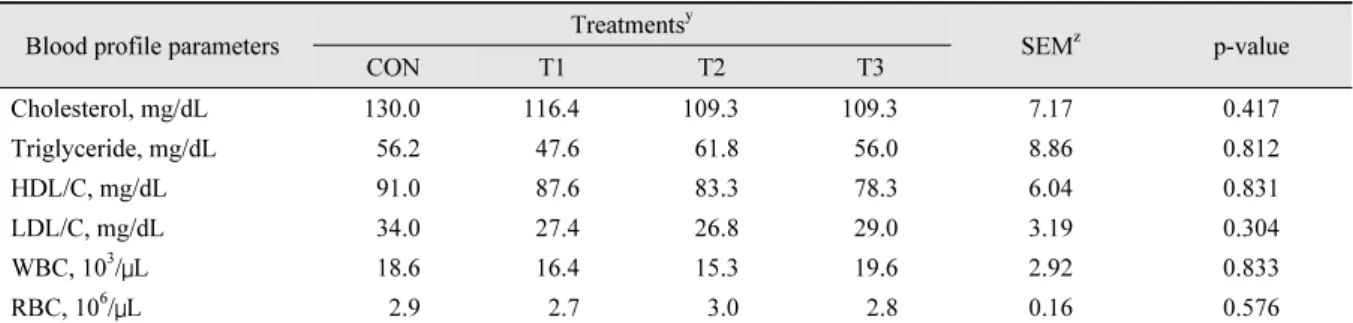
Table 5 shows blood profiles of broilers according to bone extract supplement of different boiling time. There were no significant differences among treatments in blood cholesterol, triglyceride, HDL-C, LDL-C, WBC, and RBC concentrations. However, cholesterol, triglyceride, and LDL-C contents showed a tendency to decrease compared to the control.
Table 5. Effects of supplementation of bone extract on blood profile in broilers.
Blood profile parameters Treatments
ySEM
zp-value
CON T1 T2 T3
Cholesterol, mg/dL 130.0 116.4 109.3 109.3 7.17 0.417
Triglyceride, mg/dL 56.2 47.6 61.8 56.0 8.86 0.812
HDL/C, mg/dL 91.0 87.6 83.3 78.3 6.04 0.831
LDL/C, mg/dL 34.0 27.4 26.8 29.0 3.19 0.304
WBC, 10
3/ μL 18.6 16.4 15.3 19.6 2.92 0.833
RBC, 10
6/ μL 2.9 2.7 3.0 2.8 0.16 0.576
y
CON (basal water), T1 (1 : 1 ratio water and bone extract boiled for 6 h), T2 (1 : 1 ratio water and bone extract boiled for 12 h), T3 (1 : 1 ratio water and bone extract boiled for 24 h).
z