DOI : http://dx.doi.org/10.5394/KINPR.2013.37.2.187
A Study on Measuring the Efficiency of Korea-China Car Ferry Routes by using Data Envelopment Analysis
Nam-Yeon Lee․Ji-Yeong Pak․†Gi-Tae Yeo
*,** Graduate school of Logistics, Incheon National University, Incheon 406-772, Korea
†Graduate school of Logistics, Incheon National University, Incheon 406-772, Korea
Abstract : In this prolonged economic recession, the countries in Northeast Asia play a crucial role in the global market and the relationship between Korea and China gets more attention due to its significant achievement during the past 20 years after the establishment of diplomatic ties in 1992. In this regards, this study presents general overview of Korea-China Car Ferry Route and evaluates the efficiency level of each operating route using DEA model. Incheon-Yingkou, Incheon-Lianyungang, Pyeong Taek- Lianyungang are analyzed as efficent routes, while from the view point of passenger efficiency, 4 routes i.e, Incheon-Dalian, Incheon-Dandong, Pyeong Taek- Weihai, Gunsan-Shidao are also noted as efficient routes. Consequently, other inefficient routes can benchmark these efficient routes by increasing cargo volume and passengers.
Key words : Korea-China route, Car Ferry, DEA, BCC-O
* [email protected] 032)835-4590
** [email protected] 032)835-4590
†Corresponding author, Corresponding author, [email protected] 032)835-8196
1. Introduction
Since Korea and China established diplomatic ties in 1992, bilateral trade volume has grown 35-folds and exceeded 200 billion dollars in 2011 which accounts for more than 20% of Korea's overseas trade. 24% of Korea's exports are to China and the ratio has increased on average by 23%
annually, rising twice as fast as exports to other areas.
As the trade between the two countries expands, so does the cargo volume. For the past two decades, shipping cargo volume has increased 57-folds and number of passengers also grown 38 times bigger so that more than 4 million TEUs and 12 million passengers have been carried out by Korea-China Car Ferry Routes. After opening the initial car ferry route in 1990, which is 2 years before the establishment of Korea-China diplomatic ties, 15 car ferry routes are currently being operated in this area.
Due to this remarkable quantitative growth, Korea-China corridor, currently a closed system, gets more attention, especially this year which marks the 20th anniversary of 'Korea-China Maritime Consultative Meeting' by which all the maritime issues in this area are handled and decided.
Different from other normal shipping routes, Korea-China shipping routes have been well-protected and controlled with restrictions by the two nations' governments to prevent fiercely destructive competition. However, in this
severe economic downturn and prolonged shipping industry slump, problems like nowadays' oversupply of tonnage and low freight rate in this routes become so serious that it is expected to be changed according to the current global market situation.
In this regard, the purpose of this research is to understand the current situation in Korea-China Car Ferry Routes and evaluate the efficiency of each operating route using financial and operational data. Even though there have been vast researches and papers using DEA in logistics and transport fields to assess the performance such as transit systems, ports or logistics companies, ferry service has not been a many scholars' choice to investigate.
Therefore, there is no preceding study of the efficiency of Korea-China Ferry Routes using DEA model. By conducting DEA(Data Envelope Analysis) with 3 input variables(vessel size, passenger capacity, container capacity, and 2 output variables(average cargo volume, number of passengers), this study presents empirical result for estimating the competitiveness of each car ferry route.
2. Literature Review
Like many other research areas, DEA has been applied for the assesment of efficiency of transportation and logistics sector. In maritime sector, especially for assessing
the global competitiveness or production efficiency of container ports, numerous researches can be found using DEA model. Wang et al.(2003) used both DEA and FDH(Free Disposal Model) approaches to study the efficiency of 28 world's leading container ports and compared the results for the first time within container terminal industry. Culliane et al.(2006) assessed effectiveness of the world's top 30 container ports applying DEA and SFA(Stochastic Frontier Analysis) to the same set of data and compared the results. Tongzon (2001) selcted 16 ports as DMUs. The number of crane/berth/tug/terminal, delay time and labor were used as input variables. Output variable selection consists of cargo throughput and ship working rate. Valentine et al.(2002) assessed the efficiency of 12 container ports, as DMUs, in Europe and Northeast Asia. A number of containers, total length of berths, and total length of berths only for container ship were selected for input variables.
Total cargo throughput (ton) was the only output variable of the research. Oh et al.(2001) used both CCR and BCC model for assessing the production efficiency among 28 container ports. Total length of berths, a number of gantry cranes, total area of CY and total area of CFS were the input variables.
Output variables were total throughput and port usage.
Hahn et al.(2009) evaluated the efficiency of Seoul's exclusive bus routes using DEA and analyzed the factors by Tobit Regression that the most important element which has influence on the exclusive buses is the length of intervals.
In addition to these studies, numerous researches about Korea-China trade routes of various transportation modes can be found by Korean authors. Regarding shipping routes, Lee et al.(2008) stated the characteristics of Korea-China trade and present condition of Korea-China liner shipping.
They claimed that the strategies of Korean-flag shipping lines for the up-coming complete opening of Korea-China shipping route should be prepared to predominate over Chinese-flag liner shipping companies and suggested specific solutions according to in-depth interview with major shipping lines.
Regarding Multi-modal transportation routes, Yoo (2007) studied multimodal transportation system between Korea and China such as Sea and Air System, explaining the characteristics and the present situation. He introduced the concept of new RFS(Road Feeder System) and estimated the expected effect of this new transportation system after implementing in Korea-China trade route. He concluded that the positive effects of RFS would be shorter lead time, price competitiveness, increase of cargo volume and
creation of added value, less cargo damage, and increase of logistics effectiveness in the region.
Also, Cho et al.(2007) emphasized the importance of integrated intermodal transportation system in Northeast Asia due to rapid increase of trade volume. They introduced the concept of rail-ferry and explained the merits of it in logistics, in cost, and in service. In this research, the possibility of introduction of rail-ferry among Korea, China and Japan was examined and the possible routes was suggested.
Kim et al.(2007) studied the circumstances of Korea-Japan shipping environment including car ferry system and highlighted the strong merits of car ferry such as fast transit time and availability of transporting both cargo and passengers together at the same time but these merits are also the factors of higher rate compared to container ships. Park et al. (2011) pointed out the recent increase of car ferry routes between Korea and Japan and stated that international car ferry system has become more attractive for certain shippers who need door-to-door service to transport their special and expensive cargo, compared to bulk cargo which is more likely to cause claims for concealed damage. Moon (2011) showed the development of Korea-China car ferry routes since the first opening in 1990, summarizing agendas of all 18 'Korea-China Maritime Consultative Meeting' from 1993 to 2010 and took the focus on car ferry routes between Incheon port and Chinese ports. In spite of Korea-China trade routes' importance, scant research has been investigated regarding the efficiency of the car ferry routes between two countries. DEA can be considered as an appropriate methodology to reveal the efficiency of car ferry companies in a quantitative manner.
3. DEA Model
Since the basic model of DEA(Data Envelopment Analysis) was developed by Charnes, Cooper and Rhodes (CCR approach), it has been broadly applied for evaluating the relative efficiencies of a set of comparable DMUs(Decision Making Units).
There exists various kinds of DEA models but the most frequently used models are CCR model (by Charnes, Cooper and Rhodes) and BCC model which was developed by Banker, Charnes, Cooper. The big difference between CCR model and BCC model is whether returns to scale is constant or variable. CCR model allows the concept of
Input/Output Variable Unit Input
Vessel size(V1) G/T
Passenger capacity(V2) Person
Container capacity(V3) TEU
Output (Average) Cargo volume(U1) TEU
(Average) Passenger(U2) Person
constant returns to scale, while BCC model assumes returns to scale is variable. Also, DEA model can be described as input oriented model, or output oriented model, according to its character. Input oriented model has a purpose to minimize inputs while maintaining the levels of outputs, on the other hand, output oriented model aims to maximize outputs. Therefore, in this research, we apply output oriented DEA-CCR model to study the efficiency of car ferry routes between Korea and China. Unlike normal circumstances in other shipping routes, a situation in Korea-China ferry routes can be described as rather special. It is strictly controlled and operated by the annual 'Korea-China Maritime Consultative Meeting' and all the issues including opening a new ferry route, deploying additional ferry, or allowing container vessels into ferry route and other detailed issues concerning maritime affairs between the two nations. Consequently, in this area, to change or adjust input factors according to market economy in an aspect of efficiency is not as easy as it is for other areas. Therefore, with such given conditions, we apply output oriented DEA-BCC model to measure efficiency level of existing car ferry routes. BCC-model equation is as follows.
(1) subject to:
(2)
, ≥ ≻ ⋯
measuring DMU
the weight of output variable r,
the weight of input variable i
measured value of input variable i in DMU j
measured value of output variable r in DMU j
number of output variables,
number of input variables
object DMU ( ⋯
)
represents the indicator of returns to scale. In case of increasing return is
≺
, in case of being constant return is
, in case of decreasing return is
≻
. Equation(1) is as follows when it changes dual problem.
(3)subject to:
(4)
, ,, ≥ ,
4. Selecting DMU and Analysis
4-1. Data and Selecting DMU
It is important to single out the DMUs and input/output variables because these can have an effect on the analysis results (Ryoo, 2005). Input/output variables have to be selected to meet the evaluation purpose in measuring the efficiency (Cullinane et al, 2005). In addition, it is strongly stressed that the efficiency measurement is valid if DMU’s homogeneity remains high (Thanassoulis, 2001). The DMU of this study is car ferry route between Korea and China and there is a lot of similarity with the function and the business field.
Vessel size, passenger capacity and container capacity are selected as the input variables. The number of vessel has maintained to a similar extent in the Korea-China routes. For this reason, vessel size is more reflective characteristic of a car ferry than the number of vessel. Car ferry carries both passenger and container due to the nature of its purpose, which made to select passenger capacity and container capacity as the variables according to the routes respectively.
Capacity is a general variable to be considered in measuring transport efficiency. In case of a car ferry, it plays both roles to transport cargo and passenger. Therefore capacity is divided into two variables as passenger capacity and container capacity. In the output variable selection, average cargo volume(TEU/service for once) and passenger (person/service for once) are selected according to car ferry itself purpose. Cargo volume and passenger are affected by the input variables to measure their efficiency.
Table 1 Input/output variables
There are 15 Korea-China car ferry routes but the car ferry route from Pyeong-taek to Rizhao doesn’t exist in the data in 2010. Therefore, 14 routes are
variable Routes
(V1) Vessel
size (G/T)
(V2) Passenger
capacity (person)
(V3) Container
capacity (TEU)
Cargo volume (TEU)
(U1) Average cargo Volume
(TEU/
service for once:
Round trip) Passenger
(person) (U2) Average Passenger (person/
once service:Round
trip) Incheon/
Weihai 26,463 731 280 54,096 376 144,734 1005
Incheon/
Qingdao 29,554 660 325 55,500 385 118,520 823
Incheon/
Tianjin 26,463 800 274 36,496 380 83,128 866
Incheon/
Dalian 12,365 450 140 20,569 143 88,073 612
Incheon/
Dandong 16,,446 850 159 19,696 137 100,967 701
Incheon/
Yantai 16,071 392 293 37,122 258 92,514 642
Incheon/
Shidao 19,534 1000 253 38,710 269 127,286 884
Incheon/
Yingkou 12,304 290 228 17,444 182 47,608 496
Incheon/
Qinhuangdao 12,034 348 228 16,278 170 60,731 633
Incheon/
Lianyungang 16,071 392 293 43,435 452 58,519 610
Pyeong Taek/
Rongcheng 25,151 720 267 36,402 253 202,705 1,408
Pyeong Taek/
Lianyungang 8,577 668 170 30,643 319 76,668 799
Pyeong Taek
Weihai 24,000 750 214 12,740 88 128,932 895
Gunsan/Shidao 17,022 750 203 14,582 101 151,249 1,050
selected except for the route from Pyeong-taek to Rizhao as the DMU. Data source as of 2010 is from Korea-China Car ferry Association. Also, cargo volume and passenger took an average based on round trip for one-time service.
Table 2 Selected DMUs and data
Year: 2010
Descriptive statistics is summarized as follows (Table 3).
It is essential to note a correlation, which means the degree of relationship connecting two variables. But, a scant of papers mentioned the proper range of correlation. Cho(2006) accepted 0.869 as a correlation and Ryoo(2005) also present 0.987 as a correlation between variables. In this paper, 0.74 is the highest score in correlation and it is acceptable score as compared with Cho and Ryoo’s studies. Moreover, these variables are very essential in measuring the efficiency of car ferry routes so they can be considered as proper variables.
Table 3 Descriptive statistics on input/output data
Vessel
size
Passenger capacity
Container capacity
Cargo
volume Passenger
Max 29554 1000 325 452.44792 1407.6736
Min 8577 348 140 88.472222 495.91667
Average 18718.214 640 236.28571 250.92312 815.95288
SD 6315.543 188.39131 51.66987 113.67481 226.50757
Table 4 Correlation between variables
Vessel
size
Passenger capacity
Container capacity
Cargo
volume Passenger
Vessel size 1 0.4861946 0.551757 0.3518743 0.5907511
Passenger
capacity 0.4861946 1 -0.130219 -0.0369608 0.5970191
Container
capacity 0.551757 -0.130219 1 0.7410088 0.0292111
Cargo volume 0.3518743 -0.0369608 0.7410088 1 0.0378442 Passenger 0.5907511 0.5970191 0.0292111 0.0378442 1
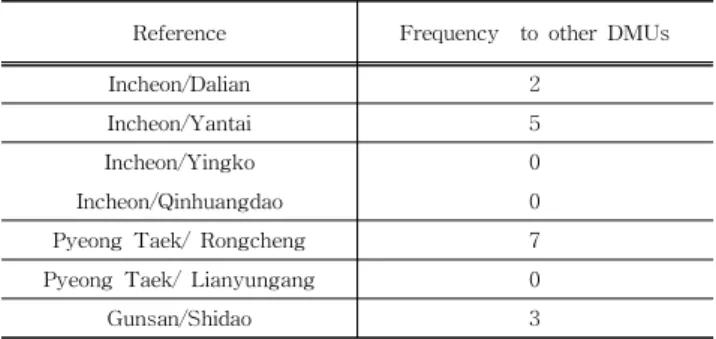
Lastly, In order to present efficient routes, the reference sets are shown in Table5.
Table 5 Frequency in reference set
Reference Frequency to other DMUs
Incheon/Dalian 2
Incheon/Yantai 5
Incheon/Yingko 0
Incheon/Qinhuangdao 0
Pyeong Taek/ Rongcheng 7
Pyeong Taek/ Lianyungang 0
Gunsan/Shidao 3
4-2. Efficiency analysis of BCC-O model
The result of relative efficiency among Korea-China car ferry routes, Incheon-Qinhuangao, Incheon-Dalian, Pyeong Taek- Lianyungang, Pyeong Taek-Rongcheng, Incheon-Weihai, Incheon-Lianyungang showed efficient routes.
Fig. 1 Distribution of efficiency score
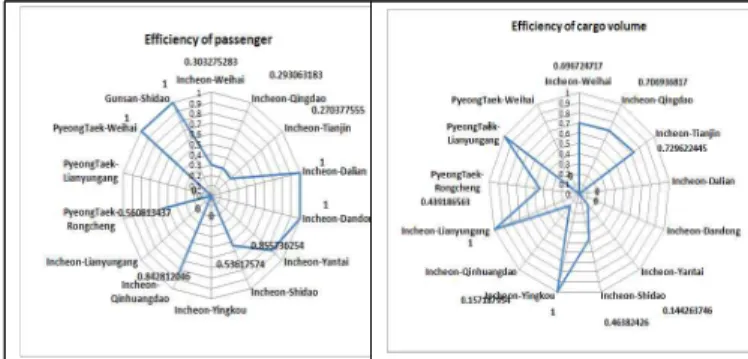
More specifically, the efficient routes in terms of cargo efficiency are Incheon-Yingkou, Incheon-Lianyungang,
DMUs Efficiency
score Output variables Projection Percentage
Pyeong Taek/
Weihai 0.667
Input
Vessel size 24000 24000 0
Passenger
capacity 750 707.71 -5.64
Container
capacity 214 214 0
out put
Cargo volume 88 246.21 178.29
Passenger 895 1342.72 49.97
Incheon/
Shidao 0.831 Input
Vessel size 19534 19534 0
Passenger
capacity 1000 613.83 -38.62
Container
capacity 253 236.62 -6.47
out put
Cargo volume 269 323.57 20.37
Passenger 884 1063.95 20.37
Incheon/
Yingkou 0.833 Input
Vessel size 12304 12304 0
Passenger
capacity 394 394 0
Container
capacity 228 228 0
out put
Cargo volume 182 218.14 20.05
Passenger 496 642.10 29.48
Incheon/
Dandong 0.965 Input
Vessel size 16446 15561.6 -5.38 Passenger
capacity 800 596.25 -25.47
Container
capacity 160 160 0
out put
Cargo volume 137 170.33 24.53
Passenger 701 810.64 15.61
Incheon/
Yantai 0.939 Input
Vessel size 16071 14451.88 -10.07 Passenger
capacityy 392 392 0
Container
capacity 293 150.04 -14.66
out put
Cargo volume 258 274.59 6.51
Passenger 642 684.30 6.51
Incheon/
Qingdao 0.955 Input
Vessel size 29554 22695.02 -23.21 Passenger
capacity 660 608.08 -7.87
Container
capacity 325 284.71 -12.40
out put
Cargo volume 385 403.50 4.69
Passenger 823 861.69 4.69
Gunsan/
Shidao 0.963 Input
Vessel size 17022 17022 0
Passenger
capacity 750 687.51 -8.33
Container
capacity 203 203 0
out put
Cargo volume 101 276.35 172.90
Passenger 1,050 1090.71 3.84
Incheon/
Tianjin 0.968 Input
Vessel size 26463 22378.2 -15.44 Passenger
capacity 800 600.90 -24.89
Container
capacity 279 284.71 0
out put
Cargo volume 380 392.71 3.30
Passenger 866 894.49 3.30
PyeongTaek-Lianyungang. And Incheon-Dalian, Incheon-Dandong, PyeongTaek- Weihai, Gunsan-Shidao are efficient Korea-China routes from a passenger perspective. As a result, inefficient routes are needed to benchmark for these efficient routes.
Fig. 2 Efficiency score of cargo volume and passenger
As for this analysis's result, to improve inefficiency DMU of 8 Korea-China routes, Pyeong Taek-Weihai route needs to handle 246.21 TEU and 1342.72 passengers more than what it handles now. In case of Incheon-Shidao, cargo volume has to increase 20.37%(323.57TEU) of cargo volume and 20.37%
(1063.95) of passenger similarly. It needs to increase 20.05% of cargo volume and 29.48% of passenger in the route between Incheon and Yingkou. In the route of Incheon-Dandong, required cargo volume is 170.33(24.53) and required passenger is 810.64(15.61). 6.51% increase is required in the cargo volume and passenger of Incheon-Yantai route. Incheon-Qingdao route needs to increase 4.69% in cargo volume and passenger respectively. The cargo volume needs to increase 172.9% and passengers need 3.84% increasing in the route of Gunsan-Shidao. Lastly, the route between Incheon-Tianjin needs 3.30 % increasing of cargo volume and passengers in order to improve its inefficiency.
Table 6 Effective management of inefficient DMU
5. Conclusions
For the past 20 years of mutual exchange in trade and culture since the establishment of diplomatic ties in 1992, Korea and China have developed such a remarkable achievement together and it is crucially important to
strengthen this bond further for the two nations’ future growth, especially in this severe global economic recession and prolonged shipping industry slump. In shipping, Korea-China corridor has been controlled by the two nations’ governments through ‘Korea-China Maritime Consultative Meeting’ which is held every year since 1993.
In this regard, this research provides some information about car ferry routes between Korea and China. We attempt to understand the actual state of this route and estimate the efficiency of every operating route with empirical data by conducting DEA. Among various kinds of DEA models, we chose output oriented DEA-BCC model by the nature of Korea-China car ferry routes which are being protected by the two countries, unlike other normal shipping routes. Currently, there are 15 car ferry routes that are actively working and in this research, this operating routes are the DMUs (we use 14 routes due to the unavailability of data 2010’s Pyeong-taek to Rizhao route data). As for the input variables, vessel size, passenger capacity and container capacity are selected and cargo volume (TEU/service for once) and passenger (person/service for once) are used as the output variables.
As a result, among 14 car ferry routes, Incheon-Qinhuangao, Incheon-Dalian, Pyeong Taek- Lianyungang, PyeongTaek-Rongcheng, Incheon-Weihai, Incheon-Lianyungang are proven to be efficient routes. In the aspect of cargo efficiency, following 3 routes such as Incheon-Yingkou, Incheon-Lianyungang, Pyeong Taek- Lianyungang are analyzed as efficent routes, while from the view point of passenger efficiency, 4 routes i.e, Incheon-Dalian, Incheon-Dandong, PyeongTaek-Weihai, Gunsan-Shidao are also noted as efficient routes. Therefore, these efficient routes in terms of route itself, cargo efficiency or passenger efficiency, can be a benchmark against other routes. More specifically in the point of cargo volume and passenger, the inefficient 8 routes need to improve its efficiency level by increasing certain number of TEUs and passengers. In Pyeong Taek-Weihai route, 246.21 TEU and 1342.72 passengers are needed to increase its efficiency. Between Incheon and Shidao, 20.37%(323.57TEU) of more cargo volume and 20.37%
(1063.95) of more passengers have to be transported. In the case of Incheon and Yingkou route, 20.05% of cargo volume and 29.48% of passengers have to be handled more. It is required to be increase 24.53% (170.33TEU) and 15.61%(810.64) passenger in Incheon-Dandong route, and 6.51% of both cargo volume and passengers(274.51 TEU/684.30 passengers) have to be raised in
Incheon-Yentai route. Between Incheon-Qingdao, 4.69% on both cargo volume and passenger have to be increased (403.50 TEU/861.69 passengers). In Gunsan-Shidao route, 172% (276.35 TEU) and 3.84% (1090.71 passengers) are needed and lastly, in the route between Incheon and Tianjin, 3.30% on both cargo volume (392.71 TEU) and passenger (894.49 passengers) are required to be raised for improving its efficiency level. With this analysis, the efficiency of currently operating 14 car ferry routes between Korea and China can be estimated and evaluated. In the future, the decisions in ‘Korea-China Maritime Consultative Meeting’ have to be made on the basis of them for the upcoming change within Korea-China shipping routes according to a global market situation. This research can be useful for those who are offering car ferry services in unefficient routes. To improve their efficiency, aggressive marketing activity for prospective customers can be a good solution. Cooperation with related ports and other related associations, or with other ferry service companies are recommended to promote the routes. However, strengthening the ties between the two regions in industry, which can generate more exchange of people and cargo, is the most crucial and fundamental element for increasing efficiency in these routes and it is the thing which cannot be done by the effort of car ferry service operators or terminal operators alone.
This study has the limitations to show the dynamic changes in measuring efficiency and its productivity. In future research, the DEA-Window model and Malmquist analysis that can measure dynamic changes of efficiency will be conducted.
References
[1] Cho, S. H. and Kim, H. D.(2007), “An Alternative for Establishing a Logistics Cooperation System among Korea, China and Japan Focused on Rail-Ferry System”, Journal of Korea Port Economics Association, Vol. 23, No.1, pp.
61-73.
[2] Cho, Y. K.(2006), "Measuring the Efficiency of Container Ports in Korea, China and Japan", The Northest Asia Economic Association of Korea, Vol. 1, No. 3, pp. 1-22.
[3] Hong, S. J. and Zhang, A.(2010), "An efficiency study of airlines and air cargo/passenger divisions: a DEA approach", World Review of Intermodal Transportation Research, Vol. 3, pp. 137-149.
[4] Kim, H. K. Choi, J. H. and Kwon, H. J.(2007), "A Study on Distinguished Competitiveness on Marine Cargo Transportation of Korea-Japan Route Car Ferry Company", The Journal of Maritime Business, Vol. 9, pp. 167-190.
[5] Lan, L. W. and Lin, E. T. J.(2003), “Technical Efficiency and Service Effectiveness for the Railway Industry: DEA approaches”, Journal of the Eastern Asia Society for Transportation Studies, Vol. 5, pp. 2932-2947.
[6] Lee, C. B. and Bae, C. H. and Yang J. H.(2008), "A Study on a Strategies of Korean-Liner Shipping Companies for coping with the Opening of a Shipping Route between China and Korea", Journal of Korea Port Economic Association, Vol. 24, No. 2, pp. 289-315.
[7] Moon, K. S.(2011), "A Study on The Origin/Destination Analysis of Container Cargo in Passenger Terminal at Incheon Port", In-ha University Master Degree Thesis.
[8] Oh, M. Y., Kim, S. S. and Kim, M. J.(2002), "Analyzing Efficiency in the Seoul’s Urban Bus Industry Using Data Envelopment Analysis", Journal of Transportation Research Society of Korea, Vol. 20, No. 2, pp. 59-68.
[9] Oh, S. D. and Park, N. K. (2001), "A Method of Measuring the International Competitiveness of Container Ports: A DEA Approach, Focused on Productivity Analysis", Journal of Korea Port Economic Association, Vol. 24, No. 17(1), pp. 27-52.
[10] Park, S. K. and Kim, J. H.(2011), "A Study on Concealed Damage through car ferry International Multimodal Transport between Korea and Japan", Journal of Korean navigation and port research, Vol. 35, p. 6.
[11] Ryoo, D. K.(2005), "Efficiency Measurement of Container Terminals in Korea Using DEA", The Korean Association of Shipping and Logistics, No. 47, pp. 21-38.
[12] Thanassoulis, E.(2001), "Introduction to the Theory and Application of Data Envelopment Analysis", Massachusetts, Kluwer Academic Publishers.
[13] Tongzon, J.(2001), "Efficiency Measurement of Selected Australian and Other International Ports Using Data Envelopment Analysis,", Transportation Research, Part A, Vol. 35, pp. 113-128.
[14] Yoo, B. C.(2007), "Strategies to Develop a RFS Sea and Air System between Korea and China", The Graduate School of Aviation Industry and Business Administration, Korea Aerospace University Master Degree Thesis.
[15] Yu. M. M.(2008), "Assessing the technical efficiency, service effectiveness, and technical effectiveness of the world’s railways through NDEA analysis", Transportation Research Part A: Policy and Practice, Vol. 42 , No. 10, pp.
1283-1294.
[16] Valantine, V. C., and R. Gray(2002), " Competition of Hub Ports: A Comparison between Europeand the Far East," Proceedings of the 2nd International Gwangyang Port Forum and Int'l Conference for the 20th Anniversary of Korean Association of Shipping Studies, Korean Association of Shipping Studies, pp.
161-176.
[17] Wang, T. F., Cullinane, K. and Song, D. W.(2003)
“Container port production efficiency: A Comparative Study of DEA and FDH approaches”, Journal of the Eastern Asia Society for Transportation Studies, Vol. 5, pp. 698-713.
Received 29 January 2013 Revised 9 April 2013 Accepted 9 April 2013