중압 자외선과 과산화수소 공정을 이용한 하수 3차 처리수중 총유기탄소와 미량오염물질 제거
이재엽
1a⋅ 김일호
1b,2†1
한국건설기술연구원 국토보전연구본부 ⋅
2과학기술연합대학원대학교 건설환경공학과
Removal of Total Organic Carbon and Micropollutants in Tertiary Treated Sewage by Medium Pressure UV/H 2 O 2
Lee Jai-Yeop
1a⋅ Kim Ilho
1b,2†1
Department of Land, Water and Environment Research, Korea Institute of Civil Engineering and Building Technology
2
Department of Construction Environment Engineering, University of Science & Technology (Received 1 June 2020, Revised 17 July 2020, Accepted 21 July 2020)
Abstract
This study evaluated the applicability of UV-AOP process using medium-pressure UV lamp and H
2O
2to remove TOC and emerging micropollutants in the effluent from a sewage treatment plant. The UV lamp with higher output(1.6 ∼ 8.0 kW) showed slightly higher amount of power in removing TOC of 1 mg/L(0.09 kWh/mg/L ∼ 0.11 kWh/mg/L), however it was found that there was no significant difference for each cases. In addition, under the condition that the H
2O
2concentration is sufficient, as the power consumption of the UV lamp increases, the unit TOC removal concentration per unit H
2O
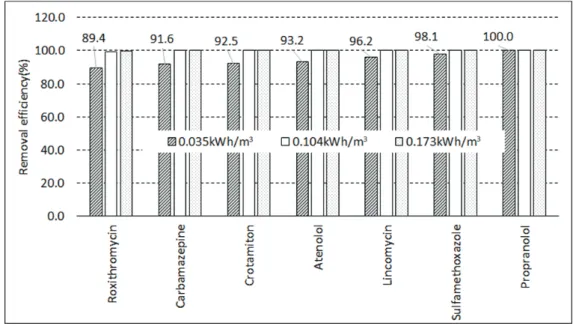
2decomposition concentration also increases, resulting in effective removal of TOC. The removal rate of 7 new trace contaminants, such as antibiotics by the UV-AOP tested, was at least 89.4%, and the ability to remove the emerging micro pollutants in the process was very effective. But, it was judged that it could not be excluded that the probablity of transforming to oxidated by-product in the case of a low TOC removal efficiency. Depending on the operating conditions of the UV and H
2O
2processes, a higher BOD concentration is found in the treated water than in the influent, and it is necessary to review the UV power and proper injection conditions of H
2O
2to maintain the BOD concentration increase below a certain level.
Key words : AOP, Micropollutant, Pharmaceuticals, TOC, UV
1a 수석연구원(Senior Researcher), [email protected], https://orcid.org/0000-0002-4663-1890
1b,2†