• 검색 결과가 없습니다.

A Study on the Influence of Family Affection Interaction Behavior on Experience Value in Family Tourism

N/A
N/A
Protected

Academic year: 2021

Share "A Study on the Influence of Family Affection Interaction Behavior on Experience Value in Family Tourism"

Copied!
8
0
0

로드 중.... (전체 텍스트 보기)

전체 글

(1)

A Study on the Influence of Family Affection Interaction Behavior on Experience Value in Family Tourism

Yue Wang

1

, Jae-yeon Sim

2

, Hyung-Ho Kim

3*

1

Professor, College of Business Administration, Jilin Engineering Normal University

2

Professor, Dept. of Business Management, Sehan University

3

Professor, Dept. of Air Transport & Logistics, Sehan University

가족여행에서 가족 간의 상호작용 행동이 체험 가치에 미치는 영향에 관한연구

왕월

1

, 심재연

2

, 김형호

3*

1

길림공정사범학원 공상관리학원 교수,

2

세한대학교 경영학과 교수,

3

세한대학교 항공교통물류학과 교수

Abstract Family tourism has become the mainstream demand of the tourism market, and it is also an effective way to obtain happiness. This paper takes family tourists as the research object, takes the family tourism family affection interaction behavior and the experience value relationship as the link, Empirically tests the family tourism "interaction behavior-social support-experience value" conceptual model and the relationship hypothesis. The results showed that interaction of family affection had a positive and significant effect on the functional, cognitive and emotional experience value of family tourists. Family interaction in family tourism has a significant positive impact on social support. Social support has significant positive effects on functional, cognitive, emotional and overall experiential values. This conclusion expands the theoretical and empirical research on the relationship between interaction behavior and experience value, and provides a basis for understanding the interaction behavior and experience value of family love from the perspective of tourism experience essence.

Key Words : Family tourism, Family interaction, Travel experience, Experience value

요 약 가족여행은 관광시장에서 수요가 점차로 커지고 있고, 가족 간의 행복을 얻는 효과적인 방법이기도 하다. 본 논문은 가족여행객을 연구대상으로 가족 간의 애정교류행태와 체험 가치의 관계를 연결하여, 가족여행에서 “상호작용- 사회적지지–체험가치”의 개념모형에 관련한 가설을 실증·분석하였다. 연구결과로는 가족애에 대한 상호작용은 가족관 광객의 기능적, 인지적, 감정적 체험가치에 대해서 모두 긍정적이고 중요한 역할을 하는 것으로 나타났다. 사회적 지지 는 기능적, 인지적, 감정적 등의 전반적인 체험가치에 대해서 모두 긍정적인 영향이 있는 것으로 나타났다. 본 연구는 상호작용 행동과 체험 가치의 관계에 대한 실증적 연구를 확대하였고, 여행의 본질적인 측면에서 가족 간의 상호작용 행동과 체험가치를 이해할 수 있는 근거를 제공하였다.

주제어 : 가족여행, 가족 상호작용, 여행경험, 체험가치

*Corresponding Author : Hyung-Ho Kim([email protected]) Received October 17, 2019

Accepted December 20, 2019 Revised November 11, 2019

Published December 28, 2019

(2)

1. Introduction

With the decisive achievement of the strategic goal of building a moderately prosperous society in all respects, tourism has increasingly become an important part of people's better life. Family is the "basic cell" of society and the "basic unit"

of tourism consumption. Family tourism has been more and more recognized as an important way of life and tourism for modern families. There are a lot of interpersonal interactions in tourism activities. The interaction between family members reflects the family affection and care, so it is named as family interaction. Family interaction is the main content of family tourism, which is different from other forms of tourism, and it is also an important factor affecting tourism experience. Then, how does family interaction affect the experience value of family tourists?

From the perspective of social support, this paper analyzes the internal logical relationship and influence mechanism between family interaction behavior and experience value.

2. Theoretical basis and literature review

2.1 Social support theory

The study of social support theory originated from the 1970s and started in social psychology, health and other related studies[1].In 2006, Rosenbaum proposed that commercial cooperation, strangers, personal friendship and close family members could provide social support as long as they interact with each other[2]. Social support includes tangible assistance such as money, information, materials and services, as well as psychological and emotional intangible support, such as empathy, care, encouragement, understanding, respect and relaxation[3].

Numerous studies have shown that social support

can positively promote people's physical health and life satisfaction[4,5]. Therefore, family interaction in family tourism is an effective way for family tourists to obtain social support, which is closely related to the smooth development of family tourists' tourism activities and the improvement of tourism experience quality.

2.2 Experience value

Experience value, derived from customer value, is the product of experience economy era.

At present, there is no consensus on the understanding of experience value in academic circles. The first view holds that experience value is one of the dimensions of customer value, a kind of value judgment in the process of consumption, and a part of customer value[6].

The second view holds that experience value is equal to perceived value and is the perceived evaluation of the total utility of a product or service[7].The third view holds that experience value is customer value with the feature of value co-creation[8].

To sum up, this paper agrees with the third view that experience value not only has the basic characteristics of customer value, but also embodies the characteristics of value co-creation based on interaction. This paper defines

"experience value" as the value perception and overall evaluation obtained by consumers in the process of experience [9].Family tourism experience value refers to the value experience and overall evaluation of tourism experience that family tourists can obtain through family tourism experience.

The evaluation of experience value mainly

focuses on three aspects: first, functional value,

the evaluation of functional attributes of the

travel itself, such as the convenience of travel,

rationality of itinerary arrangement, service level,

etc; Second, cognitive value, the perception that

individuals and their families gain from tourism

at the cognitive level, such as increasing their

(3)

knowledge, broadening their horizons, and their perception of life; Thirdly, emotional value, the perception of emotions, emotions and mental states in the process of tourism, such as physical and mental relaxation, intimacy, sense of belonging, happiness and good memories, etc.[10].

3. Research models and hypotheses 3.1 Research model

According to the theory of social support, family tourists obtain various social resources for travel through interactive behaviors, and social support is the result of interactive behaviors.

Social support is found in social relationship interaction networks[11], which has played a positive role in promoting personal physical and mental health, life satisfaction and happiness.

The above theories and viewpoints can be described as follows: family tourists obtain beneficial social support resources through the interaction of family affection, and social support can meet various needs of family tourists, thereby affecting the experience value of tourists. Therefore, this paper proposes the conceptual model and relationship hypothesis of family tourism "family interaction behavior-social support-experience value", as shown in Fig. 1.

Fig. 1. Hypothesis model

3.2 Specific research hypothesis

Family interaction behavior in family tourism is the affection and care between family members in the tourism context, and it is also the process of family members creating the tourism experience together. During the trip, they interact closely with each other, share with each other and care for each other through physical contact and emotional infection, so as to create happy memories belonging to the family and improve the experience perception of family tourists[12]. Therefore, this paper proposes the following hypothesis:

H1: family interaction has a significant positive impact on tourism experience value.

H1a: family interaction has a significant positive impact on functional experience value.

H1b: family interaction has a significant positive impact on cognitive experience value.

H1c: family affection interaction has a significant positive impact on emotional experience value.

According to the social support theory, social support is a social resource that people can obtain through interaction with the main body in formal or informal interpersonal network. This kind of social support helps individuals to meet their material deficiencies, information shortages, social and emotional needs. Thus, interactive behavior is an effective way for people to obtain beneficial social support in social life, and social support is the result of interactive behavior.

Therefore, this paper proposes the following hypothesis:

H2: family interaction has a significant positive impact on social support.

The research results of many social support

theories show that both the social support that

an individual actually gets and the care or

support that he or she perceives from others will

(4)

act on the individual's psychology and make people have a better experience. According to the stability effect theory, the social support family tourists get in tourism plays a stable effect on their expectation and perception of tourism experience, which will promote tourists to make positive evaluation on the experience value. In addition, from the perspective of needs, this kind of social support meets people's needs and enables family tourists to perceive the resources and benefits obtained, thus increasing the value of their tourism experience[13]. Therefore, this paper proposes the following hypothesis:

H3: social support has a significant positive impact on experience value.

H3a: social support has a significant positive impact on functional experience value.

H3b: social support has a significant positive impact on cognitive experience value.

H3c: social support has a significant positive impact on emotional experience value.

4. Research design 4.1 Questionnaire preparation

The questionnaire consists of four parts: family travel information, family interaction behavior scale, social support scale and experience value scale. In the first part, 12 questions are selected.

The last three parts were measured by likert scale. In the scale, affection interaction variables include 5 measurement items. The social support scale has 6 items. The experience value scale sets 12 items from three dimensions: functional experience value, cognitive experience value and emotional experience value. We prepared the initial questionnaire of this paper. In order to improve the reliability and validity of the scale, a pre-survey was conducted, 100 questionnaires were distributed and 86 valid questionnaires were obtained. SPSS20.0 was used for item analysis.

Among them, KMO value was 0.879, indicating

that common factors existed among all measurement indicators, and significance probability value p = 0.000 (less than 0.05), indicating that it was suitable for factor analysis.

However, three questions with load values greater than 0.4 should be eliminated .Finally, 32 measurement items were determined.

4.2 Data collection and description statistics A total of 386 questionnaires were collected from the survey on the interaction behavior and experience value of family tourism. Excluding invalid questionnaires, 310 valid questionnaires were collected, and the total effective questionnaire recovery rate was 80.31%. In terms of the composition of family tourism members, parents and minor children accounted for the highest proportion (42.75%), adult children and parents 19.85%, husband and wife accounted for 20.71%, three generations and above accounted for 14.62%, and families with other relatives accounted for 2.07%, indicating that the nuclear family had the most parent-child travel. From the perspective of tourism destination types, rural tourism, hot spring resort and seaside resort are most popular with family tourists, accounting for 21.46%, 24.67% and 18.89% respectively, followed by urban tourism, forest mountain and theme park, indicating that leisure vacation and cultural sightseeing are more popular with families. From the perspective of the motivation of family tourists to travel, they focus on leisure vacation (56.39%), viewing scenery (34.62%), expanding knowledge (32.78%), visiting relatives and friends (27,34%), and accompanying family members (26.94%), which is basically consistent with the statistics of big data family tourists' consumption behavior.

5. The empirical analysis

5.1 Exploratory factor analysis

(5)

Hypothesis

Model Unstandardized

coefficients Standardized coefficients

t-value Sig

Independent t-value Sig

variable

Dependent

variable  Std.error 

H1 AI

FV 0.206 0.047 0.206 5.108 0.000

CV 0.243 0.047 0.243 6.034 0.000

EMV 0.502 0.047 0.502 12.474 0.000

F=111.513(p<.001), 

=.374, Adj. 

=.355

H2 AI SS 0.554 0.042 0.554 13.291 0.000

F=176.658(p<.001), 

=.307, Adj. 

=.306

H3 SS

FV 0.183 0.037 0.183 4.926 0.000

CV 0.304 0.037 0.304 8.197 0.000

EMV 0.379 0.037 0.379 10.237 0.000

F=66.748(p<.001), 

=.459, Adj. 

=.452 Table 1. Results of regression analysis

In this paper, SPSS20.0 was used for exploratory factor analysis and reliability analysis of the questionnaire scale data, with the purpose of testing the suitability and reliability of the scale preparation and measurement items. Exploratory factor analysis of the first element of family interaction in the questionnaire "family interaction behavior and tourism experience"

showed that KMO was 0.881, Bartlett spherical test value was 90.635, and significance level p value was 0.00 (<0.05).Each index is qualified and suitable for exploratory factor analysis. The analysis results divide the affection interaction into AI1,AI2,AI3 and AI4. The factor load value was.746~.817(≥.4), the commonality value was.429~.669(≥.4), the initial characteristic value was 3.306(≥1.0), and the accumulative contribution rate of variance was 73.369%, indicating high force. The reliability of the 4 questions of kinship interaction was.809(≥.7), indicating that the data was reliable. The exploratory factor analysis results of the second factor, social support, showed that KMO was 0.842, Bartlett spherical test value was 164.890, and significance level p value was 0.00 (<0.05). Each index is qualified and suitable for exploratory factor analysis. The analysis results divide social support into four factors: SS1,SS2,SS3 and SS4.

The factor load value was.769~.804(≥.4), the commonality value was.556~.839 (≥.4), the initial characteristic value was 4.006(≥1.0), and the cumulative contribution rate of variance was 86.369%, indicating high force. The reliability of the 4 questions of social support was.976(≥.7), indicating that the data was reliable. Exploratory factor analysis of the experience value of the third factor showed that KMO was 0.862, Bartlett spherical test value was 88.863, and significance level p value was 0.00 (<0.05).Each index is qualified and suitable for exploratory factor analysis. The analysis results divide the experience value into FV,CV and EMV. Factor load value was.648~.873(≥.4), common value was.576~.806(≥.4), initial characteristic value was 1.253~4.006(≥1.0), cumulative variance contribution rate was 71.412%, FV was composed of four questions, reliability was.879, explanatory force was 24.612%, CV was composed of four questions, reliability was.847, explanatory force was 23.496%, EV was composed of four questions, reliability was.843, explanatory force was 23.304%.Indicates that the data is trusted.

5.2 Regression analysis test hypothesis

This study hypothesized the influence

relationship of the model according to relevant

(6)

theories. Multiple regression analysis and single regression analysis were conducted, and the analysis results were shown in table 1. H1 assumed that the correlation analysis of affection interaction (AI) on experience value (EV) showed that F=111.513(p<0.001), which was statistically significant, R

2

=.374, Adj.R

2

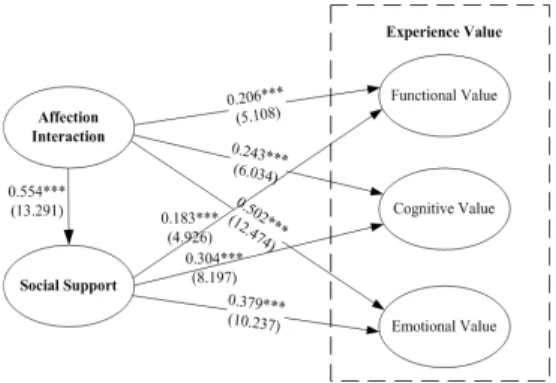
=.355. AI has an effective effect on FV (beta AI→FV=.206, t=5.108, p<.001) in EV (FV, CV, EMV). AI has an effective effect on CV(beta AI→CV=.243, t=6.034, p<.001) in EV (FV, CV, EMV).and AI has an effective effect on EMV (beta AI→EMV=.502, t=12.474, p<.001), and H1 is verified, and the assumption is true. H2 assumed that the correlation between affection interaction (AI) and social support (SS) showed that F=176.658 (p<0.001), which was statistically significant, R

2

=.307, Adj.R

2

=.306. AI had a significant effect on SS(beta AI→SS=.554, t=13.291, p<.001), H2 was verified and the hypothesis was true.

According to the correlation analysis of H3 hypothesis that social support (SS) influences value experience (EV), F=66.748(p<0.001) is statistically significant, R

2

=.459, Adj.R

2

=.452. SS had an effective effect on the FV (beta SS→

FV=.183, t=4.926, p<.001) in EV (FV, CV, EMV), SS had an effective effect on the CV(beta SS→

CV=.304, t=8.197, p<.001) in EV (FV, CV, EMV), and SS had an effective effect on the EMV (beta SS→EMV=.379, t=10.237, p<.001),and H3is verified, and the assumption is true.

Fig. 2. The influence of family affection interaction on tourism experience value

* indicates P < 0.05; ** indicates P < 0.01; *** indicates P < 0.001.

6. Conclusions

The innovation of this paper is to analyze the relationship between family tourism interaction behavior and experience value from the perspective of social support. On the basis of social support theory and experience value theory, interactive behavior theory is added to construct the relationship model of "interactive behavior — social support — experience value".

Empirically examining the influence mechanism of family affection interaction on family tourism experience value as shown in fig. 2, the following conclusions are drawn:

First, family interaction has positive effects on functional, cognitive and emotional experience values of family tourists Significant facilitation effect. Family tourists interact with family affection in tourism, which is conducive to enhancing tourists' understanding of tourism situation, broadening tourists' vision, increasing knowledge and enhancing emotions.

Second, Family interaction in family tourism has a significant positive impact on social support. Family trip The interaction behavior of relatives in the travel context is conducive to the family tourists to obtain all kinds of help and support they need during the trip. During the trip, through the sincere relationship between family members and family members, the relationship needs of people as social people can be satisfied[14]. In the interaction between family members, tourists can feel the trust, respect, recognition and care from family members, so as to obtain psychological satisfaction.

Third, social support has a significant positive

impact on functional, cognitive, emotional and

overall experience value. As a social person, people

hope to establish or maintain a harmonious relationship

with others in communication, including with

family members, hope to be accepted by others,

establish contact with others, care and be cared,

so as to experience comfort, pleasure and

(7)

happiness[15]. Therefore, social support meets the material and spiritual needs of family tourists in their travel, which not only ensures the smooth progress of tourism activities, but also enhances the perception of experience value of family tourists.

REFERENCES

[1] K. S. Rook & P. Ituarte. (2010). Social Control, Social Support, and Companionship in Older Adults’ Family Relationship and Friendship. Personal Relationship, 6(2), 199-211.

DOI : 10.1111/j.1475-6811.1999.tb00187.x

[2] M. S. Rosenbaum. (2017). Exploring the Social Supportive Role of Third Places in Consumers’Lives.

Journal of Service Research, 9(1), 59-72.

DOI:10.1108/JSM-10-2011-0147

[3] J. M. Song & H. J. Fan. (2013). A meta-analysis of the relationship between social support and subjective well-being.

Advances In Psychological Science, 21(8), 1357-1370.

DOI: 10.3724/SP.J.1042.2013.01357

[4] H. L. Yang & X. F. Ju. (2017). The impact of social support and personal goals on health. Management Science, 30(1), 53-61.

DOI:10.3969/j.issn.1672-0334.2017.01.005

[5] Z. D. Zheng & Y. H. Zheng. (2017). Social support affects the health and life satisfaction of the elderly - retesting based on the intergenerational economy's support for endogenous perspectives Population and economy, (04), 63-76.

DOI : 10.3969/j.issn.1000-4149.2017.04.007

[6] M. B. Holbrook & E. Hirschman. (1982). The experiential Aspects of consumption: Consumer Fantasies, Feeling, and Fun. The Journal of Consumer Research, 9(2), 132-140.

DOI : 10.1086/208906

[7] M. B. Holbrook. (1999). Consumer Value: A Framework for Analysis and Research. London: Rout ledge.

ISBN: 0415191920

[8] S. Mckechnie & C. Tynan. (2009). Hedonic meaning creation through Christmas consumption: A Review and model. Journal of Customer Behavior, 8(3), 237-255.

DOI:10.1362/147539209x469326

[9] X. J. Li. (2008). Tourism experience research: progress and thinking. Tourism Tribune, 23(6), 90-95.

DOI:10.3969/j.issn.1002-5006.2008.06.020

[10] Y. J. Xie & Y. Xu. (2016). Tourism experience harmony: a multi-dimensional generic analysis of situational mechanism. Economic Management, 38(8), 149-159.

DOI:CNKI:SUN:JJGU.0.2016-08-014

[11] J. Siddall, E. S. Huebner & X. A. Jiang. (2013). A Prospective

Study of Differential Sources of School-Related Social Support and Adolescent Global Life Satisfaction.

American Journal of Orthopsychiatry, 83(1), 107-114.

DOI:10.1111/ajop.12006

[12] K. Bai & G. Q. Fu. (2011). Perspective of the Theory of Localization inthe Study of Family Travel Decision

- makingand Train of Thoughts for Analysis. Tourism Tribune, 26(12), 49-56.

DOI:10.3969/j.issn.1002-5006.2011.12.014

[13] M. S. KIM & J. H. Lee. (2017). Structural Relationship Between Social Support, Job Stress and Child Care Teachers‘Burnout. Journal of The Korea Convergence Society, 8(10), 281-294.

DOI:10.15207/JKCS.2017.8.10.281

[14] J. Lee & I. S. KO. (2018). The Relationship of Caregiving Appraisal and Family Function among Senile Dementents‘Families using In-home Services for the Long-Term Care Insurance. Journal of The Korea Convergence Society, 9(8) , 319-330.

DOI:10.15207/JKCS.2018.9.8.319

[15] H. S. Kim & S. S. Kim. (2017). A Converged Study about Influences of Job Stress, Job Security, Depression, Family Bond, Subjective Health Status, Social Support on Quality of Life in Married Middle-Aged Male. Journal of The Korea Convergence Society, 8(3), 101-114.

DOI:10.15207/JKCS.2017.8.3.101

왕 월(Yue Wang) [정회원]

․ 2004년 7월 : 지린농업대학교 관리학 과(이학사)

․ 2009년 12월 : 지린대학교 관리학과 (관리학석사)

․ 2018년 5월 ~ 현재 : 세한대학교 대 학원 경영학과(박사과정)

․ 2004년 5월 ~ 현재 : 길림공정기술사 범학원 공상관리학원 조교수

․ 관심분야 : 관광, 경영

․ E-Mail : [email protected]

심 재 연(Jae-Yeon Sim) [정회원]

․ 1985년 2월 : 조선대학교 회계학과(경 영학사)

․ 1990년 2월 : 조선대학교 대학원 회 계학과(경영학석사)

․ 1995년 2월 : 조선대학교 대학원 경 영학과(경영학박사)

․ 1995년 3월 ~ 현재 : 세한대학교 경 영학과 교수

․ 관심분야 : 회계정보시스템, 정부회계, 인적자원관리

․ E-Mail : [email protected]

(8)

김 형 호(Hyung-Ho Kim) [정회원]

․ 1989년 2월 : 경희대학교 전자계산공 학과(공학사)

․ 1992년 8월 : 경희대학교 전자계산공 학과(공학석사)

․ 2018년 2월 : 인천대학교 동북아물류 대학원(물류학박사)

․ 1998년 3월 ∼ 현재 : 세한대학교 항 공교통물류학과 교수

․ 관심분야 : 신경회로망, 항공운송, 시스템다이내믹스

․ E-Mail : [email protected]

수치

Fig. 2. The influence of family affection interaction on  tourism  experience  value

참조

관련 문서