Vol. 41, No. 1, March 2015, 63-71 http://dx.doi.org/10.15230/SCSK.2015.41.1.63
국소 보습제 도포가 정상 영유아 피부에 미치는 영향에 관한 연구
현 무 열⋅이 용 희⋅오 원 종⋅유 광 호⋅박 귀 영⋅김 명 남⋅홍 창 권⋅김 범 준† 중앙대학교 의과대학 피부과학교실
(2015년 1월 26일 접수, 2015년 2월 16일 수정, 2015년 3월 18일 채택)
Effects of Topical Moisturizers on the Skin of Healthy Full-term Infants and Toddlers
Moo Yeol Hyun, Yonghee Lee, Won Jong Oh, Kwang Ho Yoo, Kui Young Park, Myeung Nam Kim, Chang Kwun Hong, and Beom Joon Kim†
Departments of Dermatology, Chung-Ang University College of Medicine, 224-1, Heukseok-dong, Donjak-gu, Seoul 156-755, Korea
(Received January 26, 2015; Revised February 16, 2015; Accepted March 18, 2015)
요 약: 보습제는 피부과에서 가장 흔하게 사용하는 제품 중 하나로, 피부장벽을 유지시키고 피부가 촉촉하고 건강하게 보이게 하며, 영유아의 정상적인 피부발달에 매우 중요하게 작용한다. 하지만 보습제 도포가 정상 영유 아의 피부에 어떠한 영향을 미치는지에 대한 연구는 제한적이다. 이에 건강한 정상 영유아에서 일반적인 보습제 도포가 피부에 미치는 영향을 알아보고자 본 연구를 진행하였다. 31명의 피부염이 동반되지 않는 건강한 6 - 36개 월 연령의 영유아를 대상으로, 하루 2회 목욕 후 눈과 기저귀 착용 부위를 제외한 전신에 존슨즈 베이비 내츄럴 너리싱 로션을 4주간 도포하였다. 임상적 평가는 도포 전후, 1주, 4주에 실시하였다. 매 방문시 피부수분도와 경표피수분손실도, 피부산도 및 거칠기를 측정하였으며 피부표면을 촬영하여 비교하였고 보습제 도포 후 발생한 피부 발진을 포함한 모든 부작용을 기록하였다. 보습제 도포 후 피부수분도는 통계적으로 유의하게 증가하였으 며, 경표피수분손실도와 거칠기는 통계적으로 유의하게 감소하였다. 피부산도는 약산성으로 조절되었으며, 육안 적으로 피부표면은 매끄럽게 변화한 것이 관찰되었다. 임상 시험 기간 동안 부작용은 관찰되지 않았다. 본 실험 을 통해 보습제 도포가 영유아의 피부에 있어 수분을 증가시키고, 피부장벽기능 증강과 약산성의 피부산도 조절 및 거칠기의 호전을 야기하며, 4주간의 보습제 도포가 미치는 영향의 정도를 확인할 수 있었다.
Abstract: Moisturizers are the most prescribed products in dermatology. Treatment with moisturizers aims to maintain skin integrity and overall well-being by providing a healthy appearance. Moisturizers perform very important functions in baby care; however, there are few studies on the effects of moisturizers on the skin of infants. To investigate the effects of moisturizers on the skin of healthy full-term infants and toddlers, thirty-one healthy, full-term, 6- to 36-month-old infants and toddlers without any dermatologic conditions received moisturizer applied to the whole body except the eyes and diaper area after bathing twice daily for 4 weeks. Clinical assessments were conducted before treat- ment, immediately after the treatment period, and 1 and 4 weeks after treatment. At all visits, skin hydration, trans- epidermal water loss (TEWL), skin pH, and skin roughness were measured, the skin surface was photographed, and any adverse events were recorded. After using moisturizer, skin hydration significantly increased and TEWL and rough- ness significantly decreased. The skin pH was modified to mildly acidic and the skin surface was visually smoother than before treatment. There were no statistical significant differences of effects of moisturizers according to age and
1)
† 주 저자 (e-mail: [email protected]) call: 02)6299-1544
sex, and adverse events were not observed. The results of moisturizer application on the skin were increased skin hydra- tion, recovery of barrier function, balancing skin pH within a mildly acidic range, and increasing the smoothness of the skin surface for 4 weeks.
Keywords: baby, moisturizer, skin
1. Introduction
Moisturizers are the most frequently prescribed prod- ucts in dermatology. Treatment with moisturizers aims to maintain skin integrity and general well-being of the in- dividual through providing a healthy appearance[1]. The use of moisturizers by mankind has historic roots. The ancient Egyptians frequently anointed their bodies with oils. The Bible describes application of oils to the skin, and ancient Greek and Roman cultures regularly applied oil-containing products. Humans have recognized the val- ue of externally applied lipids for thousands of years, and continue to value them[2].
An excellent discussion of moisturizers has been pro- vided by Draelos, who defines moisturizers as externally applied compounds comprising multiple components, in- cluding occlusive ingredients and humectants[3]. Moreover, moisturizers perform multiple functions executed by a great variety of ingredients. Apart from the moistening the skin, they affect the structure and barrier function of diseased and healthy looking skin[4]. Application of moisturizers to the skin induces changes in both super- ficial and deep layers. The chemical and physical charac- teristics of the individual ingredients determine the over- all performance of the formulation[4].
Moisturizers also perform very important functions in babies. Immediately after birth the skin barrier of healthy full-term neonates is competent, yet skin-barrier function continues to develop throughout at least the first year of life[5]. Special care procedures are required to ensure healthy development and protect the skin from irritation and inflammation, as well as to create a sense of well-be- ing[6]. Although there are a lot of products that claim to promote the moistening effect, provide protection, and enhance development of baby skin, studies on the actual
effects of moisturizer on baby skin are limited.
In this study, we aimed to evaluate the effects of moisturizers on the skin of healthy full-term infants and toddlers. In addition, we figure out any dependencies of effects on the differences of age or sex.
2. Material and Methods
A single-center, single-agent, subject and evaluator- opened clinical study was undertaken to investigate the effects of moisturizer on infants and toddlers after 4 weeks of normal use. This study was performed in ac- cordance with the principles of the Declaration of Helsinki and Korean Good Clinical Practice, and local regulatory requirements. The study was reviewed and ap- proved by the Institutional Review Board. Parents/guard- ians of all subjects provided written informed consent prior to study participation.
2.1. Trial subjects
The trial subjects were healthy full-term Korean male and female children aged 6- to 36- months without any dermatologic conditions (e.g., atopic dermatitis, eczema, psoriasis, rosacea, diaper rash, or seborrheic dermatitis) and the parent or legal guardian who regularly cared for them. Parents and legal guardians aged at least 18 years were eligible to enroll their child in the study. The pa- rents and guardians were instructed to apply the provided test lotion twice a day for 4 weeks and not to apply other body moisturizer to the infant throughout the study.
Subjects with clinically determined moderate to severe
dryness, erythema, rash, or an overall skin condition
which, in the Investigator’s judgment, made the subject
ineligible or placed the subject at risk were excluded
from the study.
Purified water Phenoxyethanol
Glycerine Carbomer
Cetyl alcohol Potassium cetyl phosphate
Soybean oil Hydrogenated palm glycerides citrate
Hydrogenated stearyl olive esters Methylparaben
Olive leaf extract Tetrasodium EDTA
Cornstarch Ethylparaben
Mauritia flexuosa fruit oil Sodium hydroxide
Chamomilla recutita flower extract Propylparaben
Aloe barbadenisis leaf juice Sodium cocoyl amino acid
Tocopherol Sarcosine
Tocopheryl acetate Potassium aspartate
Dimethicone Magnesium aspartate
Table 1. Ingredients of the Test Product,, Johnson’s Baby Natural Nourishing Lotion
Face
& Neck
Arm
& Hand
Leg
& Foot Trunk (Front) Trunk (Back) inc. Buttocks
Age Number of Fingertip Unit
<1 yrs 1 1 11/2 1 11/2
1 ∼ 2 yrs 11/2 11/2 2 2 3
3 ∼ 5 yrs 11/2 2 3 3 31/2
Table 2. Parent’s Guide to the Use of Topical Treatment
2.2. Materials
The test product was a commercially available mois- turizer, Johnson’s Baby Natural Nourishing Lotion (Johnson and Johnson Korean, Inc., Korea), containing purified water, glycerol, potassium phosphate, extraction of olive leaf, palm oil, vitamin E, and essential minerals (Table 1).
The pH of this product was near 5.5, mild acidic. The adults had to apply the test product on the whole body of the infant excluding eyes and diaper area twice daily after bathing for 4 weeks. They continued to use their regular brand of baby-wash and shampoo provided they had been using the product for at least 1 month prior to the start of the test. All participating parents or legal guardians were instructed to apply a thin layer of the tri-
al lotion by the adult fingertip unit method (Table 2).
The infants were not allowed to shower, bathe, or swim for at least 5 hours after application of the test product.
Subjects were evaluated in the clinic at baseline (before using product), immediately after using the prod- uct, and after 1 and 4 weeks. Parents or legal guardians were instructed not to apply any product to the subjects for 24 h before each visit to the clinic. After washing the test areas, the subjects rested in an area maintained at 20
∼ 25 ℃ and 40 ∼ 60% humidity for 30 min to accom-
modate to this atmosphere. A single researcher performed
all measurements for objective analysis and the same
skin area was evaluated at every visit.
Subjects
Sex
Male 12 (38.7)
Female 19 (61.3)
Age
month, mean ± SD 21.5 ±10.1 6 ∼ 12 mth 8 (25.8) 13 ∼ 24 mth 8 (25.8) 25∼ 36 mth 15 (48.4) Table 3. Subject Characteristics
2.3. Measurement of skin hydration, TEWL and pH Skin hydration was measured using a Corneometer CM 825 (Courage-Khazaka electronic GmbH, Germany) to determine the moisture content of the stratum corneum (SC) using an electrical capacitance method. This meas- urement is given in arbitrary units (AU) that are propor- tional to the dielectric constant of the surface layer of the skin and increase as the skin becomes more hydrated.
Transepidermal water loss (TEWL), which reflects the amount of water escaping through the SC, was measured using Vapometer (Delfin Technologies, Inc., USA) on the subjects’ forearms. Skin pH was measured using a skin-pH-meter PH905 (Courage-Khazaka electronic GmbH, Germany). Triplicate measurements were taken on one dorsal forearm (selected by the clinician) of each cooper- ative subject at each test visit.
2.4. Skin surface and texture analysis
The skin surface was photographed with Folliscope and the skin texture was imaged and measured using Visioscan VC98 (Courage-Khazaka electronic GmbH, Germany) and Primos premium (GFM, Teltow, Germany) on one dorsal forearm at each test visit. The average roughness (R3 and Ra) value was analyzed using the photographed images.
2.5. Adverse event
Adverse events were assessed during the time of test.
On every visit, the investigator-evaluator was responsible
for documenting all reported and observed adverse events such as erythema, dead skin cells, rashes, and swelling.
2.6. Data and statistical analysis
To investigate the influence of age and sex, we ana- lyzed all data with grouping by age and sex: three groups by age (6 ∼ 12 months, 13 ∼ 24 months and 25 ∼ 36 months), and two groups by sex (male and female).
The statistical analysis package SPSS 19.0 was used to evaluate the efficacy of the test product for skin hydra- tion, TEWL, skin texture, and skin pH. The results of skin improvements were calculated and evaluated as percentages. Parametric test, c, and non-parametric Wilcoxon signed ranks test were used. The data are giv- en as averages and standard deviation. Pearson correla- tion coefficient was used to analyze relationship between age and biophysical parameters and impaired t-test was done for finding correlation between sex and biophysical parameters. The significance level was set as 5% (i.e., a p value < 0.05 is statistically significant).
3. Results
3.1. Subject’s characteristics
Thirty-one subjects (12 males and 19 females) were initially invited and all subjects completed the entire treatment protocol and returned for follow-up visits.
Subjects ranged in age from 6 to 36 months (6 ∼ 12 months [n=8], 13 ∼ 24 months [n=8], and 25 ∼ 36 months [n=15]) with an average age of 21.5 ± 10.1 months (Table 3).
3.2. Biophysical measurements
Skin hydration values measured by Corneometer were 36.81 ± 7.98 AU before treatment, 53.37 ± 8.38 AU im- mediately after treatment, 43.80 ± 7.49 AU at 1 week af- ter, and 49.15 ± 6.82 AU at 4 weeks after product use.
There was a statistically significant increase (p < 0.05) in AU immediately after, 1 week after, and 4 weeks after product use (Figure 1).
An increase in TEWL indicates impairment to the skin
Figure 1. Changes in corneometer measurements during the trial period. The AU value increases as the skin becomes more hydrated. The mean value of corneometer measurements increased significantly after application of moisturizer (*p <
0.05 versus baseline).
Figure 2. Changes in corneometer measurements during the trial period. The AU value increases as the skin becomes more hydrated. The mean value of corneometer measurements increased significantly after application of moisturizer (*p < 0.05 versus baseline).
Figure 3. Changes in skin pH during the trial period. Skin pH increased significantly and then stabilized near a value of pH 5.5 (*p < 0.05 versus baseline).
(A)
(B)
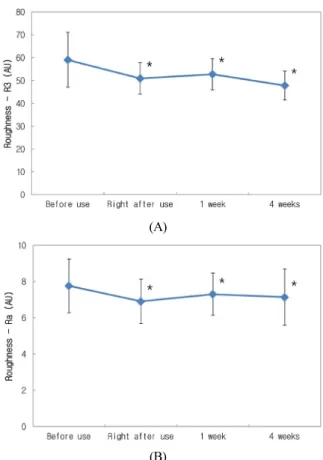
Figure 4. Changes in skin roughness during the trial period.
(A) Roughness measured by Visioscan (B)Roughness measured by Primos premium (*p < 0.05 versus baseline).
barrier, whereas a decrease in TEWL means repair of the skin barrier. As shown in Figure 2, skin TEWL values were 12.39 ± 2.73 (before treatment), 10.92 ± 2.69 (immediately after treatment), 11.83 ± 2.55 (1 week after treatment), and 11.31 ± 2.65 (4 weeks after treatment).
Compared with baseline, there were statistically sig- nificant decreases in TEWL immediately after, 1 week after, and 4 weeks after product use.
Skin pH values were 4.81 ± 0.36 before treatment, 5.10 ± 0.32 immediately after use, 5.48 ± 0.57 at 1 week after, and 5.48 ± 0.74 at 4 weeks after product use.
Therefore, a small but significant increase in pH values
was observed in at all time points after product use (Figure 3).
To investigate skin roughness, R3 was measured using
Visioscan and Ra was measured using Primos premium;
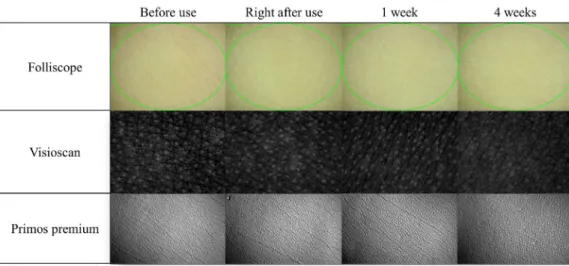
Figure 5. Visual changes in the skin surface photographed by Folliscope, Visioscan, and Primos premium during the trial period.
Application of moisturizers to the skin induced a visible improvement of skin roughness.
Age Sex
(p-value) (Pearson correlation coefficient) (p-value)
Corneometer 0.205 0.268 0.276
TEWL 0.058 0.758 0.097
pH 0.176 0.342 0.374
R3 -0.118 0.527 0.880
Ra 0.094 0.615 0.462
Table 4. Correlation between Age, Sex and Biophysical Parameters