1. 서 론
최근 정치 경제 사회 문화 전반에서 4차 산업혁명 이 중심 화제가 되고 있다. 4차 산업혁명은 인공지능 (AI), 사물인터넷(IoT), 로봇기술, 빅 데이터, 가상현 실(VR) 등이 주도하는 차세대 산업기술이 가져올 새 로운 변화를 의미한다[1,2]. 인공지능(AI·Artificial Intelligence)은 대표적인 4차 산업혁명의 핵심 개념
으로 많은 기대를 받고 있다[3]. 인간의 두뇌가 작용 하는 기능을 컴퓨터가 스스로 추론하고 판단하게 되 면서 인간과 닮은 로봇이 출산율 저하와 고령화 사회 로의 진입에 따른 인력 부족을 대체하고 새로운 패러 다임을 가져올 수 있을 것이라는 기대심리 때문이다 [4,5].
AI는 잠재력이 상당한 산업으로 현재도 많은 관련 기술들이 개발되고 있다. AI스피커나 AI챗봇 등은
AI 노인 돌봄 로봇의 혁신특성과 노인소비자특성이 수용의도에 미치는 영향
엽 효†, 김치용††
The Effect of the Innovative Characteristics and the Consumer Characteristics of the AI Elderly Care Robot on the
Intention to Acceptance
Ye. Xiao†, Chee-Yong Kim††
ABSTRACT
The purpose of this study is to identify the effect of the innovation characteristics that AI Elderly Care Robots have on elderly consumers and to verify the acceptance or mediated resistance by the elderly of the innovation characteristics. Research was conducted throughout this study of the characteristics of the elderly so that the study results could contribute to the improvement of the quality and manufacture of AI Elderly Care Robots by lowering the psychological resistance of the elderly. Survey questions were answered by senior citizens aged 65 and older. The SPSS25 and AMOS22 programs were used for analysis. The analysis confirmed that innovation resistance has a significant mediated effect on the characteristics of elderly consumers and their willingness to accept the innovation characteristics of the AI Elderly Care Robots. Through this study, Ram’s innovation resistance model has been verified empirically and it is estimated that by considering the specificities of elderly consumers and using the information to contribute to the development and modification of AI Elderly Care Robots will increase the willingness of the elderly to accept the innovation characteristics of the AI Elderly Care Robots.
Key words: AI, AI Senior Care Robot, Innovative Resistance, Ram, Mediation Effect
※ Corresponding Author : Chee-Yong Kim, Address:
(47340) 176 Um Gwang-ro, Busanjin-gu, Busan City, Dong-Eui University, TEL : +82-10-4584-4036, FAX : +82-51-890-2265, E-mail : [email protected] Receipt date : Sep. 15, 2020, Revision date : Sep. 28, 2020 Approval date : Oct. 13, 2020
††
Dept. of Storytelling, Graduate School, Dong-Eui University
(E-mail : [email protected])
††
Major of Game Animation Engineering, Dong-Eui
University
상용화된 기술 중 일부이며, AI로봇은 교사, 판매원, 아이나 노인 돌봄 도우미 등의 서비스직뿐만 아니라 판사나 변호사의 업무를 대체할 수도 있다.
소비자들은 AI가 가지는 혁신특성들로 인하여 AI 로봇 수용 이전에 혁신저항을 겪게 된다. 혁신저항은 Ram(1978)[4]이 Sheth(1981)[6]의 혁신저항 모델을 수정하여 제시한 개념으로 그에 따르면 혁신저항이 란 혁신기술이 가져오는 혜택보다는 혁신기술 사용 으로 인한 위험성에 대해 과도하게 인지함으로써 기 술의 수용을 늦추고, 구매행동에도 영향을 미치게 되 는 것을 의미한다[6,7]. 본고에서 다룰 AI 노인돌봄 로봇은 노인 돌봄 인력 부족 현상과 관련하여 독거노 인에 대한 효율적인 복지 및 치매 노인에 대한 관리 등으로 기대효과가 높음에도 불구하고, 변화에 대한 저항성이 높은 노인들의 경우 높은 혁신저항으로 인 하여 제품 수용에 걸리는 시간이 길어질 가능성이 높다.
한국에서는 AI 노인돌봄 로봇에 대해 복지부가 2019년 경증 치매 환자를 대상으로 치매 돌봄 AI 로 봇의 상용화를 예고한 이후[8] 그 활용에 관한 관심 이 높아졌을 뿐만 아니라 관련 시장의 전망 등이 주 목받기 시작하였다. AI 노인 돌봄 로봇은 낙상 방지, 의료 정보 제공, 생활, 정서, 안전 관리와 외로움 감소 등, 치매 노인들뿐만 아니라 일반적인 노인들에게도 일상생활에 대한 지원이 가능하다는 점에서 사회적 효용성이 높다. 이러한 AI노인돌봄 로봇의 장점에도 불구하고 이를 노인치매나 노인건강과 관련하여 진 행한 연구는 미미하다. 주 사용자인 노령층이 이를 어떻게 수용할 것인지에 대해서는 보다 전문적인 분 석이 필요하다.
본 연구에서는 AI노인돌봄로봇의 사용자인 65세 이상 노인 199명을 모집단으로 AI 노인돌봄 로봇의 혁신특성, 노인소비자 특성, 혁신저항, 수용의도에 해당하는 총 17문항의 설문을 진행한다. 사용자인 노 인의 특성 및 AI 노인 돌봄 로봇의 혁신특성을 살펴 보고 이러한 독립변인과 종속변인인 수용 의도 사이 에서 혁신저항이 가지는 매개효과의 정도를 검증할 것이다. 본 논문은 Ram(1978)의 혁신저항 모델에 주 목하여 AI 노인돌봄 로봇의 혁신특성이 노인 소비자 가 느끼는 혁신저항에 실제 영향을 주는지 검토하고, AI 노인돌봄 로봇 및 노인소비자의 특성과 수용의도 사이에서 혁신저항이 가지는 매개효과와 상관관계
를 측정하고자 한다. Ram의 혁신저항 모델은 예측 변인들의 인과관계에 관해서 실증적 연구가 수반되 지 않아 인과관계에 대해서는 명료하게 설명되지 못 한다는 한계가 있다. 이에 본 연구는 AI 노인돌봄 로봇에 대한 혁신저항과 수용을 설명하는 토대가 될 수 있을 것으로 보인다.
논문의 구성은 다음과 같다. 2장에서는 연구의 기 본 이론이 되는 AI 노인돌봄 로봇과 노인소비자의 특성 그리고 Ram의 혁신저항 모델에 대하여 정의 및 고찰한 다음, 3장에서는 가설을 토대로 한 연구모 형을 소개하고 이에 대한 연구문제와 연구방법을 서 술한다. 그리고 4장에서는 제한한 가설에 대한 SPSS 와 AMOS분석 결과를 통해 가설의 검증을 진행하 고, 이에 따른 가설의 채택과 기각 여부를 결정한 뒤 5장에서 결론을 맺는다.
2. 이론적 배경
2.1 노인 2.1.1 개념
AI 노인돌봄 로봇의 개념과 특성을 이해하기 위해 서는 먼저 주 사용자인 노인의 특성을 살펴볼 필요가 있다. 1951년 국제노년학회에서는 노인을 ‘인간의 노 화 과정에서 나타나는 생리적, 심리적, 환경적 변화 및 행동의 변화가 상호작용을 하는 복합형태의 과정 에 있는 사람’으로 규정하였다[6]. 국제 기준상 노인 의 기준연령은 만 65세 이상을 의미하며, 일반적으로 노인은 환경변화의 적응이 느리고, 인체 기능과 여러 기관의 감퇴 현상이 일어나 심리적으로 변화가 생기 게 된다. 또한 사회적 지위와 역할의 상실 및 노동능 력이 감소되어 의존자로 살아가게 된다. 신체적, 심 리적, 사회적, 경제적 측면에서 국가 차원의 돌봄과 보호가 절실하다고 할 수 있다[7].
2.1.2 노인소비자의 특성
Ram의 혁신저항 모델에 따르면, 혁신저항을 일으 키는 유발요인 중 하나는 소비자 특성으로 노인소비 자의 경우 소비자특성이 일반적인 소비자집단보다 독특한 면이 있다. 노인소비자특성은 심리적 특성과 인구 통계적 특성으로 나눌 수 있다[11]. 심리적 특성 에는 개성, 신념, 태도 등이 해당되며, 인구 통계적 특성으로는 나이, 학력, 소득 등을 들 수 있다[12].
여기서 개성은 자신감, 독단성, 변화지향성과 같은 개인특성을 의미하며 노인의 경우 개인특성이 고착 화되고 변화 지향성에 대하여 부정적인 경향을 띤다 [13]. 신념은 혁신제품에 관한 정보, 편익 등에 관한 믿음을 의미하여 노인소비자가 혁신제품을 신뢰하 는 정도를 의미한다. 태도란 주어진 사실에 대한 한 결같이 호의적이거나 비호의적으로 반응하려는 학 습된 성향을 일컫는다[14]. 본 연구의 설문에서는 개 성(3문항), 신념(3문항), 태도(3문항)에 대한 질문을 사용하였다.
2.2 AI 노인돌봄 로봇 2.2.1 개념
AI 노인돌봄 로봇이란 노인의 신체 변화와 생활 수준, 신체활동 및 일상생활의 특징을 반영하여 노인 의 삶의 질을 높이기 위해 노인 친화 기술을 적용한 AI로봇을 말한다[15]. AI 노인돌봄 로봇이 지원 가능 한 범위는 원격모니터링이나 일상대화에서부터 심 전도 측정 및 위급상황에 병원 호출 등과 같은 의료 지원에 이르기까지 상당히 광범위하다. 고령화 사회 에서 노인 인구가 늘어남에 따라 AI노인돌봄로봇의 활용가치는 더욱 높아질 것이다[16].
2.2.2 종류
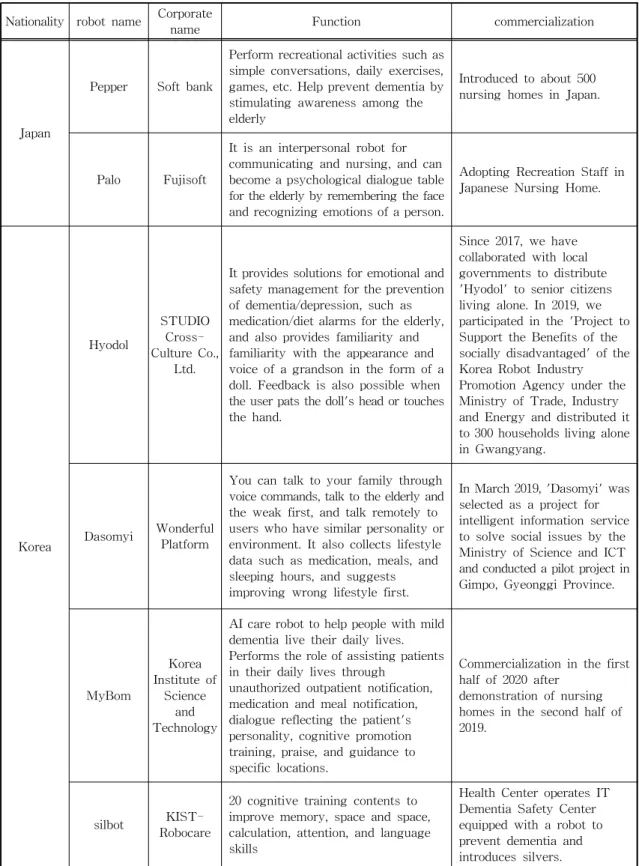
AI 노인돌봄 로봇 개발은 기업에서뿐만 아니라 고 령화가 진행되는 많은 국가에서 적극적인 투자를 통 해 이루어지고 있다. 고령화 사회로 급격하게 진입 중인 동아시아 국가들을 중심으로 살펴보면, 일본의 경우 소프트뱅크와 후지소프트사에서 요양원에서 활용하는 AI 로봇을 상용화하여 도입하였다. 한국의 경우에는 KIST를 포함한 연구소나 기업에서 AI 로 봇을 적극적으로 개발하고, 지자체에서 AI 로봇을 구입하여 개인에게 별도로 제공하거나, 보건소에서 활용하고 있다. 중국은 2020년 후반 상용화를 목표로 AI 로봇 개발에 박차를 가하고 있다. 그 내용은 Table 1과 같다.
2.2.3 AI 노인돌봄 로봇의 혁신특성
위와 같은 AI 노인돌봄 로봇의 역할을 정리하면 다음과 같다. 첫째, 생활데이터 분석을 통해 건강문 제를 예측한다. 둘째, 움직임 감지를 통해 위험을 예 측한다. 셋째, 약물 복용이나 식습관 관리를 통해 만
성병 환자의 치료를 보조한다. 넷째, 개인 맞춤형 서 비스 제공으로 자택에서 요양하며 치료할 수 있게 돕는다. 다섯째, 대화를 통해 외로움을 완화시키는 등 심리적 고립감을 해소시킨다[17].
과거에도 요양보호사가 제공하는 서비스는 많았 으나, AI는 기존의 서비스 품질에 대한 문제점을 해 소하고 편의성과 유용성을 높여 고령층의 노후를 지 원하는 사회안전망의 기능을 하게 될 것으로 보인다. 다만 AI 로봇은 기존의 요양보호사와는 다른 혁신특 성을 가지고 있으며 Ram(1978)의 정의에 따라 소비 자가 AI 로봇을 채택하기까지 다음과 같은 혁신특성 이 고려될 것으로 보인다[4,18]. 본 연구에서 정의하 는 AI 노인돌봄 혁신특성의 종류는 아래 여섯 가지 로 한정하였다.
첫째, 상대적 이점(3문항)으로, 노인소비자가 혁 신 제픔에 대해 기존의 제품이나 제품이 등장하기 전의 생활보다 혁신제품을 받아들일 때 더 좋다고 인식하는 정도를 말한다. 둘째, 적합성(3문항)으로, 혁신이 기존 가치 또는 과거 경험에 비하여 부합되는 정도를 말한다. 셋째, 위험성(3문항)은 혁신을 수용 함으로써 지각된 위험을 말한다. 넷째, 복잡성(3문 항)은 사용자가 혁신을 이해하거나 사용하는데 어려 운 정도이고 다섯째, 다양성(3문항)은 혁신이 다양하 게 사용될 수 있는가의 정도이며, 마지막 여섯째는 복귀성(2문항)은 혁신 수용 후 혁신 수용 이전으로 복귀할 때 느끼는 정도이다[18].
2.3 혁신저항과 수용의도 2.3.1 Ram의 혁신저항
Ram은 혁신저항을 "혁신을 채택할 때 수반되는 변화들에 대한 소비자들의 저항"이라고 정의하고, ' 변화에 대한 저항'의 한 유형으로 보았다[4,19] . 즉, 혁신저항은 혁신채택으로 인해 야기되는 변화에 '부 정적 태도'가 나타나는 것이다[19]. Ram(1987)의 연 구는 Sheth(1981)[6,20] 의 연구 및 기존 연구에서의 단순화된 혁신저항 요인을 수정하여 신제품에 대한 사용자의 저항에 영향을 주는 다양한 요인들이 어떤 것인가를 구별하고, 이들 저항 요인들 간에 관계를 나타내는 이론적 혁신저항 모델을 개발하였다. Ram 에 의하면 신제품이 출시될 때, 사용자는 신제품이 가지는 혁신특성에 노출되게 된다. 이 때 사용자가 혁신을 수용하면서 변화의 정도를 높게 지각하면 그
Table 1. Development of AI elderly care robots by country Nationality robot name Corporate
name Function commercialization
Japan
Pepper Soft bank
Perform recreational activities such as simple conversations, daily exercises, games, etc. Help prevent dementia by stimulating awareness among the elderly
Introduced to about 500 nursing homes in Japan.
Palo Fujisoft
It is an interpersonal robot for communicating and nursing, and can become a psychological dialogue table for the elderly by remembering the face and recognizing emotions of a person.
Adopting Recreation Staff in Japanese Nursing Home.
Korea
Hyodol
STUDIO Cross- Culture Co.,
Ltd.
It provides solutions for emotional and safety management for the prevention of dementia/depression, such as medication/diet alarms for the elderly, and also provides familiarity and familiarity with the appearance and voice of a grandson in the form of a doll. Feedback is also possible when the user pats the doll's head or touches the hand.
Since 2017, we have collaborated with local governments to distribute 'Hyodol' to senior citizens living alone. In 2019, we participated in the 'Project to Support the Benefits of the socially disadvantaged' of the Korea Robot Industry Promotion Agency under the Ministry of Trade, Industry and Energy and distributed it to 300 households living alone in Gwangyang.
Dasomyi Wonderful Platform
You can talk to your family through voice commands, talk to the elderly and the weak first, and talk remotely to users who have similar personality or environment. It also collects lifestyle data such as medication, meals, and sleeping hours, and suggests improving wrong lifestyle first.
In March 2019, 'Dasomyi' was selected as a project for intelligent information service to solve social issues by the Ministry of Science and ICT and conducted a pilot project in Gimpo, Gyeonggi Province.
MyBom
Korea Institute of
Science and Technology
AI care robot to help people with mild dementia live their daily lives.
Performs the role of assisting patients in their daily lives through
unauthorized outpatient notification, medication and meal notification, dialogue reflecting the patient's personality, cognitive promotion training, praise, and guidance to specific locations.
Commercialization in the first half of 2020 after
demonstration of nursing homes in the second half of 2019.
silbot KIST- Robocare
20 cognitive training contents to improve memory, space and space, calculation, attention, and language skills
Health Center operates IT
Dementia Safety Center
equipped with a robot to
prevent dementia and
introduces silvers.
사용자는 혁신에 저항하게 된다. 혁신에 대한 저항은 수용의도를 저하시킬 가능성이 높다[7]. 기업이 혁신 저항의 원인을 처리하고 사용자의 욕구에 맞게 혁신 을 수정한다면 수용의 가능성을 높일 수 있다. 2.3.2 혁신저항의 매개효과
매개효과란 상호작용과 같은 개념으로 독립변인 간 상호작용 효과가 있을 때, 종속변인에 대한 중재 효과가 있다고 해석하는 것을 말한다. 본 논문에서는 AI 노인돌봄 로봇의 혁신특성과 수용의도 사이에서 혁신저항이 매개효과를 일으키며, 노인특성과 수용 의도 사이에서 혁신저항이 매개효과를 일으킬 것이 라 보았다. 본고에서는 매개효과를 검증하기 위해 구 조방정식 모형(structural equation modeling)과 다 중회귀 분석(multiple regression analysis) 방법을 사용한다.
2.4 연구 변수의 조작적 정의 및 선행연구
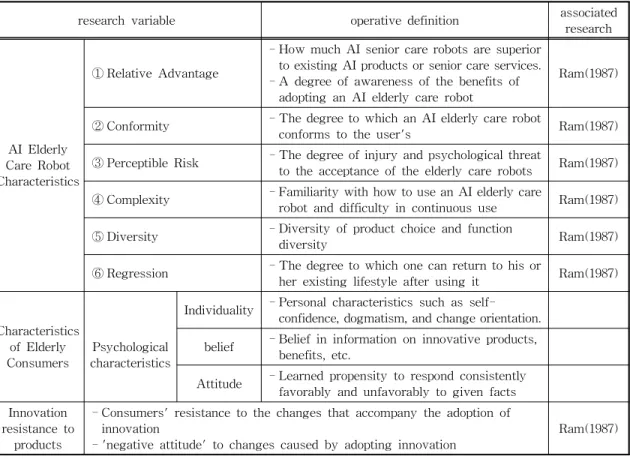
위와 같은 이론적 배경을 근거로 연구 변수를 다 음과 같이 설정하였다. 구체적인 조작적 정의와 설문 문항 작성을 위해 참고한 논문은 Table 2와 같다.
3. 연구 문제 및 연구방법
3.1 연구모형
연구모형의 구성은 첫째, AI 노인돌봄 로봇의 인 지된 특성(AI Elderly Care Robot Characteristics:
ACRC)의 하위항목으로 상대적 이점(relative ad- vantage:RA), 적합성(Conformity:CF), 위험성(Per- ceptible Risk:PR), 복잡성(Complexity:CP), 다양성 (Diversity:DI), 복귀성(Regression:RE)의 여섯 가지 요인을 각 2~3문항씩 총 17문항으로 구성하였다. 둘 째, 노인소비자의 특성(Characteristics of elderly Consumers:COC)으로는 개성(Individuality:ID), 신
Table 1. Continued
Nationality robot name Corporate
name Function commercialization
Korea
Bo Mi I KIST- Robocare
One-on-one desk type cognitive training robot (table type) that helps activate brain function and prevent dementia by providing brain
improvement contents using robots to the elderly and the elderly at risk of dementia.
In use of the robot cognitive therapy center at Ewha Womans University Mokdong Hospital (targeted for high risk of dementia or dementia, purpose of cognitive training) Distributed operation of general furniture and Gangseo Dementia Center (total 41 units).
Bomi II KIST- Robocare
Daily Care Robot provides various services and functions to prevent dementia for the elderly and the elderly at risk of dementia.
Cognitive training is possible through various brain improvement contents mounted on the robot, and emergency call service and medication notification functions are provided.
scheduled for commercialization.
China Alpha Mini Ubitech
From simple conversations to medication and meal alarms to various tricks.
Humanoid robot that resembles a human figure. The arms and legs are equipped with 14 precision sub-motor for free movement.
Sales scheduled for the second half of 2020 after a
demonstration of nursing
homes in the second half of
2019.
념 (belief:BE), 태도(Attitude:AT) 세 가지 하위 요 인을 각 3문항씩 총 9문항으로 설정하였다. 그리고 혁신저항(Innovation resistance to products:IRP)과 제품수용의도(Product acceptance degree:PAD)에 대해서는 각 4문항씩 단일요소로 구성하였다. 연구 설계모형은 Fig. 1과 같다.
3.2 연구가설
앞 장에서 고찰한 이론적 배경을 바탕으로 Table 3과 같은 가설을 설정하였다.
즉, AI 노인돌봄 로봇 특성과 혁신저항의 관계에 대해서 H 1. 인공지능 노인돌봄 로봇의 지각된 혁신 특성 요인은 혁신저항에 영향을 미칠 것이라는 대가 설 아래 다음과 같이 영향관계가 나타날 것이라 보았 다. H1-1 지각된 이점이 낮을수록 혁신저항이 클 것이다(-). H1-2 지각된 적합성이 낮을수록 혁신저 항이 클 것이다(-). H1-3 지각된 위험이 높을수록 혁신저항이 클 것이다(+). H1-4 지각된 복잡성이 높 을수록 혁신저항이 클 것이다(+). H1-5 지각된 다양 성이 낮을수록 혁신저항이 클 것이다(-). H1-6 지각 된 복귀성이 낮을수록 혁신저항이 클 것이다(-).
노인소비자 특성과 혁신저항의 관계에 대해서는 H 2. 노인소비자 특성은 혁신저항에 영향을 미칠 것 이라 보는 대가설 아래 다음과 같은 세가지 가설을 설정하였다. H2-1 노인소비자의 개성이 강할수록 혁
Table 2. Operational definition and pre-study of research variables
research variable operative definition associated
research
AI Elderly Care Robot Characteristics
① Relative Advantage
- How much AI senior care robots are superior to existing AI products or senior care services.
- A degree of awareness of the benefits of adopting an AI elderly care robot
Ram(1987)
② Conformity - The degree to which an AI elderly care robot
conforms to the user's Ram(1987)
③ Perceptible Risk - The degree of injury and psychological threat
to the acceptance of the elderly care robots Ram(1987)
④ Complexity - Familiarity with how to use an AI elderly care
robot and difficulty in continuous use Ram(1987)
⑤ Diversity - Diversity of product choice and function
diversity Ram(1987)
⑥ Regression - The degree to which one can return to his or
her existing lifestyle after using it Ram(1987)
Characteristics of Elderly
Consumers Psychological characteristics
Individuality - Personal characteristics such as self- confidence, dogmatism, and change orientation.
belief - Belief in information on innovative products, benefits, etc.
Attitude - Learned propensity to respond consistently favorably and unfavorably to given facts Innovation
resistance to products
- Consumers' resistance to the changes that accompany the adoption of innovation
- 'negative attitude' to changes caused by adopting innovation Ram(1987)
Fig. 1. Research model.
신저항이 클 것이다(+). H2-2 노인소비자의 신뢰가 낮을수록 혁신저항이 클 것이다(-). H2-3 노인소비 자의 태도가 비호의적일수록(낮을수록) 혁신저항이 클 것이다(-).
혁신저항과 수용의도의 관계에 대해서는 H 3. 인 공지능 노인돌봄 로봇에 대한 혁신저항은 제품 수용 의도에 부적 영향을 미칠 것이다(-).라는 단일 가설 을 세웠다.
혁신저항의 매개효과에 대한 가설로는 H 4. 혁신 저항은 매개효과를 가질 것이라는 대가설 아래 다음 두 가지 가설을 세웠다. H 4-1. AI 노인돌봄 로봇의 혁신특성과 수용의도 사이에 혁신저항이 매개효과 를 가질 것이다. H 4-2. 노인소비자특성과 수용의도 사이에 혁신저항이 매개효과를 가질 것이다.
3.3 자료 수집 및 분석 방법
AI 노인돌봄 로봇 제품에 대한 수용에 있어 사용
자인 노인들의 저항에 영향을 미칠 수 있는 설문의 측정 변수 및 측정 문항은 Ram(1987)과 유필화, 이승 희(1994)의 혁신저항 모델을 참고하여 표 1과 같이 작성하였다. 결과의 오류를 줄이기 위해 역문항은 엑 셀을 통해 응답 순위를 순문항 순으로 수정하였다. 설문대상자의 일반적 특성에 대한 설문 항목을 제외 한 설문 문항들은 리커트 5점 척도로 측정하였다. 본 연구에서는 spss25.0 과 AMOS22.0을 사용하여 통 계분석을 수행하였다.
4. 연구 결과 및 고찰
4.1 표본의 일반적 특성
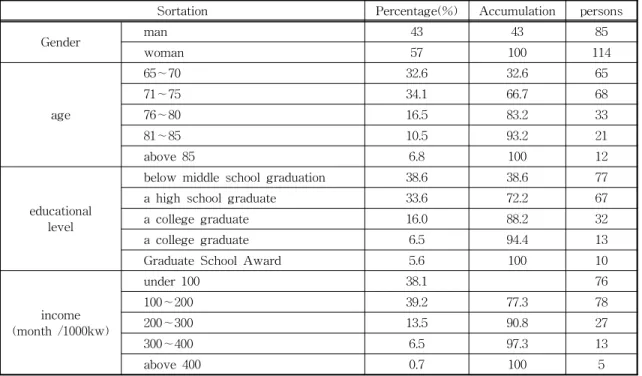
Table 4는 설문조사에 응한 노인소비자 199명의 일반적 특성을 정리한 것이다. 총 199개 표본의 성별 및 연령, 최종학력, 월평균 소득을 포함한 인구통계 학적 특성을 보여준다. 표본의 성별 분포는 남자가
Table 3. Research Theory
Research Theory
1. Relationship between Characteristics of AI Elderly Care Robots and Innovative Resistance
H 1 The perceived innovation characteristic factor of artificial intelligence elderly care robots will affect innovation resistance.
H1-1 The lower the perceived advantage, the greater the resistance to innovation (-) H1-2 The lower the perceived suitability, the greater the resistance to innovation (-) H1-3 The higher the perceived risk, the greater the resistance to innovation.(+) H1-4 The higher the perceived complexity, the greater the resistance to innovation.(+) H1-5 The lower the perceived diversity, the greater the resistance to innovation (-) H1-6 The lower the perceived return, the greater the resistance to innovation (-) 2. Relationship between the Characteristics of Older Consumers and Innovation Resistance
H 2. The characteristics of elderly consumers will affect innovation resistance.
H2-1 The stronger the individuality of elderly consumers, the greater the resistance to innovation. (+) H2-2 The lower the confidence of elderly consumers, the greater the resistance to innovation. (-) H2-3 The more unfavourable (lower) the attitude of elderly consumers is, the greater the resistance will
be to innovation (-).
3. Relationship between innovation resistance and acceptance
H3 Innovative resistance to artificial intelligence elderly care robots will affect the purpose of product acceptance.(-)
4. Mediation effects of innovation resistance
H 4 Innovative resistance will have a mediating effect.
H4-1 Innovative resistance between the innovation characteristics and acceptance intention of AI elderly care robots will have a mediating effect.
H4-2 Innovation resistance between the characteristics of elderly consumers and their willingness to accept
them will have a mediating effect.
85명(46.6%), 여자가 114명(53.4%)이며, 연령 분포는 66∼70세가 명(%)으로 가장 많았다. 교육수준은 고 졸이 118명(37.9%)으로 가장 많았고, 다음으로 전문 대졸 53명(17.0%)로 나타났다. 월평균 소득은 150∼
250만원 미만(88명, 28.3%)이 가장 많은 것으로 나타 났다.
4.2 확인적 요인분석
요인선정의 적절성을 검증하기 위하여 먼저 KMO 와Bartlett검정을 실시하였다. KMO는 변수들 간 상 관관계가 다른 변수들에 의해 잘 설명되는 정도로, 충족 기준은 >.5이다. 본 연구에 사용한 변수들은 .822의 검정결과를 보여 선정이 적절했다고 할 수 있 다. Bartlett검정은 요인분석 모형의 적합성 여부를 나타내는데, 유의확률이 .05이하에서 설명력을 갖는
다. Table 5에 제시된 바와 같이 본 결과에서는 유의 확률 p 값이 .000으로 요인분석이 적절하였음을 알 수 있다.
AMOS를 통해 확인한 요인분석 결과는 Fig. 2와 같다. 판별타당성은 잠재변수 간 상관관계가 낮은지 확인하는 지표로 Fig. 2의 (a)에서 나타나듯, 0.08이 상 0.21이하의 수치이므로 상관계수의 수치가 낮게 나타나 판별타당성이 확인되었다. 집중타당성은 .7 이상에서 유의한 관계를 확인할 수 있는데, Fig. 2의 (b)에 보이는 바와 같이 0.72이상 0.95 이하인 높은 수치로 관계가 있음을 확인할 수 있었다.
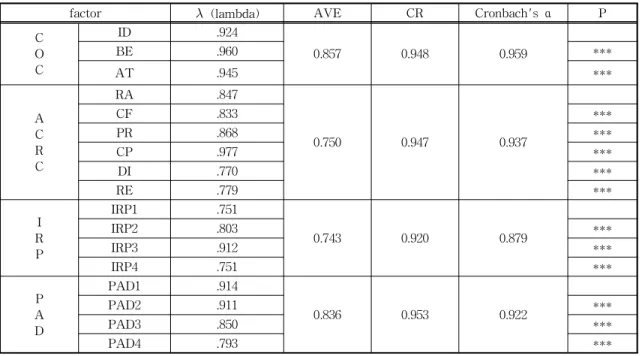
SPSS 분석에서는 관측변수별 요인적재량 0.5미 만의 항목은 분석방해 요소로 판단하여 이를 제거 후 분석에 사용하였으며, 평균분산추출AVE(Average Variance Extracted)를 이용하여 0.5이상, 개념신뢰 도(Construct reliability) 0.7이상 기준으로 집중타당 성을 확인하고, 평균분산추출(AVE)와 상관관계계 수를 비교하여 판별타당성을 검증하며, 크론바흐 알 파(Cronbach’s α)계수 0.7이상임을 확인하여 각 요인 별 신뢰도를 검증하였다. 도출된 표준화 계수 값 (.751∼.977)은 검증만족기준인 .5이상을 충분히 만 족하고 있다. 또한 평균분산추출값인 AVE값(.743
Table 4. General characteristics of a sample
Sortation Percentage(%) Accumulation persons
Gender man 43 43 85
woman 57 100 114
age
65∼70 32.6 32.6 65
71∼75 34.1 66.7 68
76∼80 16.5 83.2 33
81∼85 10.5 93.2 21
above 85 6.8 100 12
educational level
below middle school graduation 38.6 38.6 77
a high school graduate 33.6 72.2 67
a college graduate 16.0 88.2 32
a college graduate 6.5 94.4 13
Graduate School Award 5.6 100 10
income (month /1000kw)
under 100 38.1 76
100∼200 39.2 77.3 78
200∼300 13.5 90.8 27
300∼400 6.5 97.3 13
above 400 0.7 100 5
Table 5. KMO and Bartlett
KMO and Bartlett
Kaiser-Meyer-Olkin .822
Bartlett
approximation chi-square 3055.067
degree of freedom 136
significance probability .000
∼.857)의 검증만족 기준 .5이상을 만족하여 기준을 충족하였다. 개념신뢰도 C.R.값(.920∼953)과 크론 바흐 알파(.879∼.959)값 또한 신뢰기준인 .7이상을 충분히 만족하므로 모두 기준치 이상의 값들로 구성
되어 본 연구의 자료는 집중타당성을 충분히 확보하였 다. 구체적인 결과값은 Table 6에 보이는 바와 같다.
모형 적합도는 χ²=469.365로 나타났고, df=113, p<.001으로 나타났다. χ²통계량은 χ²값이 작고 확률
(a) Unstandardized estimates (b) Standardized estimates
Fig. 2. AMOS estimates.
Table 6. The performance for proposed algorithm and conventional algorithms
factor
(lambda) AVE CR Cronbach's α P
C O C
ID .924
0.857 0.948 0.959
BE .960 ***
AT .945 ***
A C R C
RA .847
0.750 0.947 0.937
CF .833 ***
PR .868 ***
CP .977 ***
DI .770 ***
RE .779 ***
I R P
IRP1 .751
0.743 0.920 0.879
IRP2 .803 ***
IRP3 .912 ***
IRP4 .751 ***
P A D
PAD1 .914
0.836 0.953 0.922
PAD2 .911 ***
PAD3 .850 ***
PAD4 .793 ***
*** p < .001
값이 크면(p>.05) 모델이 적합하며, 반대로 χ²값이 크고 확률 값이 작으면(p<.05) 모델이 적합하지 않다 고 볼 수 있다(김계수, 2006). 본 연구에서는 모형의 적합도 분석을 위한 χ²값이 통계적으로 유의하게 나 타나고 있다(p<.001). 추가분석결과로 RMR, GFI, TLI, CFI, RMSEA의 모형 적합도를 평가해보면, RMR=.330, GFI=.938, TLI=.916, CFI=.930, RMSEA=
.097이고 결과값은 적합성 기준을 모두 만족하기에 위 모형은 분석에 적합한 모형이라 할 수 있다. 결과 값 및 기준은 Table 7에 정리하여 제시하였다.
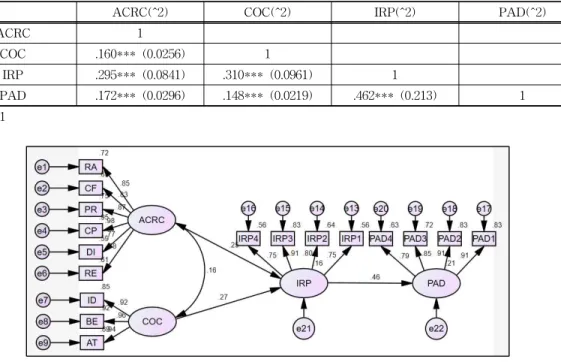
요인별 상관계수 분석 결과는 Table 8과 같으며, 각 요인 간의 상관계수로 볼 때 서로 강한 양(+)적인 상관관계를 가지고 있음을 알 수가 있다. 이 중 가장 상관관계가 높은 것은 .462인 혁신저항(IRP)과 수용 의도(PAD)의 관계이다. 이는 Ram의 혁신저항모델 이 본 연구에서도 실증적으로 증명되었음을 보여준 다. 두 수치를 제곱하면 0.213444가 되고, 이 값은 각
각의 AVE 값인 0.743, 0.836보다 작다. 이는 판별타 당성을 만족하기 위해서는 평균분산추출(AVE)값이 상관계수의 제곱값보다 반드시 커야 한다는 명제를 만족하므로 상관계수의 타당성을 확보하였다.
모형 적합도는 Fig. 3에서 확인 할 수 있으며, 적합 도 수치는 CMIN(χ2) = 324.450, df = 115, CMIN/df = 2.821(p<.001)로 나타났고, TLI = .918, CFI = .931, RMR = .034, GFI = .851, RMSEA = .096 으로, 위 모 형은 상당히 적합하게 짜여져 있음을 알 수 있다. Fig.
3에 해당하는 구조방정식 모형의 경로 분석 결과는 Table 9과 같다.
4.4 Sobel test
노인특성과 수용의도, 혁신특성과 수용의도 사이 에서 각각 혁신저항의 매개효과 검증을 위하여 비표 준화 회귀계수값과 오차값을 토대로 Sobel Test를 진행하였다. 그 결과는 Table 10과 같다.
Table 7. Positive factor analysis goodness-of-fit index
CMIN(χ²) df p RMR IFI TLI CFI RMSEA
data 469.365 113 .000 .330 .938 916 .930 .97
Criteria - - - <.5 >.9 >.9 >.9 1>
Table 8. Correlation analysis
ACRC(^2) COC(^2) IRP(^2) PAD(^2)
ACRC 1
COC .160*** (0.0256) 1
IRP .295*** (0.0841) .310*** (0.0961) 1
PAD .172*** (0.0296) .148*** (0.0219) .462*** (0.213) 1
***p<.001
Fig. 3. Model suitability.
소벨테스트의 경우 +1.96보다 크거나 -1.96보다 작으면 매개효과가 유의하다고 판단한다. 본 연구에 서 확인한 경로분석의 결과는 두 경로 모두 2.99와 3.06으로 매개효과도 있고 소벨 테스트도 유의하다 고 결론 내릴 수 있다. 즉 초기에 설정하였던 연구가 설이었던 노인소비자특성과 수용의도 사이에 혁신 저항이 매개효과를 가진다는 가설과 AI노인돌봄로 봇의 혁신특성과 수용의도 사이에 혁신저항이 매개 효과를 가진다는 두 가설 모두 채택되었음을 확인할 수 있다.
4.5 가설 검증 결과
앞에서 진행한 분석 결과를 초기에 설정한 가설에 따른 결과의 채택과 기각으로 나누어 정리하여 표로 정리하면 Table 11과 같다.
AI 노인돌봄 로봇의 혁신특성 중 지각된 이점, 지 각된 적합성, 지각된 다양성, 지각된 복귀성은 그 특 성이 낮을수록 혁신저항이 크기 때문에 부적 상관관 계를 가질 것이라고 보았던 가설이 모두 채택되었다. 혁신특성 중 지각된 위험과 지각된 복잡성은 그 특성 이 높을수록 혁신저항이 크기 때문에 정적 상관관계 가 있다는 가설이 모두 채택되었다. 노인소비자 특성 에 해당하는 개성, 신뢰, 태도는 게성이 강할수록, 신 뢰가 낮을수록, 태도가 비호의적일수록 혁신저항이 크다는 가설이 채택되었다. 그리고 AI 노인돌봄 로 봇의 혁신특성과 수용의도사이, 노인 소비자특성과 수용의도 사이에 각각 혁신저항이 매개효과를 가질
Table 9. Path analysis
Path Estimate S.E. CR p
IRP<-ACRC .229 .067 3.412 ***
IRP<-COC .170 .047 3.647 ***
PAD<-IRP .470 .081 5.809 ***
Table 10. Sobel test independent
variable mediator
variable dependent
variable Sobel test
statistic one tailed
probability two tailed probability
ACRC IRP PAD 2.9949 0.0016 0.0032
COC IRP PAD 3.0694 0.0010 0.0021
Table 11. Hypothesized Verification
Hypothesized Verification
H1-1 The lower the perceived advantage, the greater the resistance to innovation (-) Adoption H1-2 The lower the perceived suitability, the greater the resistance to innovation (-) Adoption H1-3 The higher the perceived risk, the greater the resistance to innovation.(+) Adoption H1-4 The higher the perceived complexity, the greater the resistance to innovation.(+) Adoption H1-5 The lower the perceived diversity, the greater the resistance to innovation (-) Adoption H1-6 The lower the perceived return, the greater the resistance to innovation (-) Adoption H2-1 The stronger the individuality of elderly consumers, the greater the resistance to
innovation. (+) Adoption
H2-2 The lower the confidence of elderly consumers, the greater the resistance to
innovation. (-) Adoption
H2-3 The more unfavourable (lower) the attitude of elderly consumers is, the greater the
resistance will be to innovation (-). Adoption
H3 Innovative resistance to artificial intelligence elderly care robots will affect the purpose
of product acceptance.(-) Adoption
H4-1 Innovative resistance between the innovation characteristics and acceptance intention
of AI elderly care robots will have a mediating effect. Adoption H4-2 Innovation resistance between the characteristics of elderly consumers and their
willingness to accept them will have a mediating effect. Adoption
것이라는 가설 모두 채택되었다.
5. 결 론
본 연구는 AI 노인돌봄 로봇 제작에 있어 노인특 성을 고려하고 노인의 심리적 저항성을 낮추어 제품 의 질적 향상에 기여하기 위하여 시행된 연구이다. 본 연구의 목적은 노인소비자 특성과 AI 노인돌봄 로봇의 혁신특성이 AI 노인돌봄 로봇에 대한 수용의 도에 미치는영향을 규명하고, 혁신저항의 매개효과 를 검증하는 데 있다. 본 연구를 통해 설문을 수행하 기 위해 65세 이상 노인 199명을 대상으로 설문의 답변을 얻었다. 분석에는 SPSS25와 AMOS22 프로 그램을 활용하였다.
연구 결과, 구체적으로는 첫 번째 가설인 ‘H 1. 인 공지능 노인돌봄 로봇의 지각된 혁신특성요인은 혁 신저항에 영향을 미칠 것이다.’에 해당되는 소 가설 여섯 가지인 상대적 이점, 적합성, 위험성, 복잡성, 다양성, 복귀성의 상관관계는 모두 높은 유의성을 가 지고 있었다. 즉 지각된 이점과 적합성, 다양성, 복귀 성이 낮을수록 혁신저항이 크고 위험과 복잡성이 높 을수록 혁신저항이 크다는 가설은 채택되었다. 두 번 째 가설인 ‘H 2. 노인소비자특성요인은 혁신저항에 영향을 미칠 것이다.’에 대한 소 가설은 개성이 강할 수록, 신뢰가 낮을수록, 태도가 비호의적일수록 각각 혁신저항도가 높았다. 세 번째 가설인 ‘H 3. 인공지능 노인돌봄 로봇에 대한 혁신저항은 제품수용의도에 부적 연관을 가질 것다.’ 또한 상관성에 있어 높은 유의수준으로 채택되었다. 네 번째 가설인 ‘H 4. 혁신 저항은 매개효과를 가질 것이다.’에 대한 경로인 ‘노 인소비자특성-> 혁신저항 -> 수용의도’ 가설과 ‘AI 노인돌봄 로봇의 혁신특성 ->혁신저항 ->수용의도’
가설 이 두가지 소 가설 모두 유의한 매개효과를 가 짐으로 인하여 채택되었다.
본 연구를 통하여 Ram의 혁신저항모델을 실증적 으로 검증하였으며, 혁신저항이 노인소비자의 특성 과 수용의도 사이, AI 노인돌봄 로봇의 혁신특성과 수용의도 사이에 각각 유의미한 매개효과를 가짐을 확인하였다. 본 연구는 노인소비자가 가지는 특수성 을 고려하여 AI 노인돌봄 로봇의 기술혁신특성을 검 증하여 향후 AI 노인돌봄 로봇 개발 및 수정에 기여 할 수 있다는 점에서 연구의 의의가 있다. 다만 본 연구는 다양한 조절효과를 가져오는 요인들을 고려
하지 않았다는 점에서 한계가 있고, 인구 통계적 특 성에 따라 어떠한 차이가 있는지 비교 검정을 진행하 지 않았다. 후속연구에서는 이러한 점들을 고려하여 여러 요인을 추가로 검정하고 인구 통계적 특성별 차이를 구체적으로 분석하는 논문을 진행하여 본 고 의 방향을 보다 발전시켜 볼 필요가 있을 것이라 사 료된다.
REFERENCE
[ 1 ] The Fourth Industrial Revolution, by Klaus Schwab (2015), https://www.weforum.org/
(accessed July 24, 2020).
[ 2 ] S.J. You, “Fourth Industrial Revolution and Artificial Intelligence,” Korea Multimedia Society, Vol. 21, No. 4, pp. 1-8, 2017.
[ 3 ] J.S. Kim, H.D. Moon, and S.P. Hong, “Efforts of Major Countries to Secure Technological Competitiveness in Enabler and Artificial Intelligence(AI) in the Era of the Fourth Industrial Revolution,” Korea Multimedia Society, Vol. 21, No. 3, pp. 8-15, 2017.
[ 4 ] S. Ram, “A Model of Innovation Resistance,”
Advances in Consumer Research, Vol. 14, No.
1, pp. 208-212, 1987.
[ 5 ] K.M. Rhee, “Source of Imagination for Multi- media Content Design,” Korea Multimedia Society, Vol. 19, No. 2, pp. 8-15, 2007.
[ 6 ] J.N. Sheth, “Psychology of Innovation Resis- tance: The Less Developed Concept (LDC) in Diffusion Research,”Research in Marketing, Vol. 13, No. 3, pp. 273-282, 1981.
[ 7 ] S. Ram and J.N. Sheth, “Consumer Resis- tance to Innovations: The Marketing Problem and Its Solutions,” J ournal of Consumer Marketing, Vol. 6, No. 2, pp. 5-14, 1989.
[ 8 ] Ministry of Health and Welfare(2019), www.
mohw.go.kr (accessed August 12, 2020).
[ 9 ] International Association of Gerontology and Geriatrics (2016), https://www.iagg.info/
(accessed August 23, 2020).
[10] R.J. Havighurst, “Personality and Patterns of Aging,” The Gerontologist, Vol. 8, No. 1-2,
pp. 20-23, 1968.
[11] M. Kleijnen, N. Lee, and M. Wetzels, “An Exploration of Consumer Resistance to Inno- vation and Its Antecedents,” Journal of Economic Psychology, Vol. 30, No. 3, pp. 344- 357, 1989.
[12] S.Y. Lee and J.S. Lee, “A Study on the Elderly People`s Education of Korean Metropolitan Region,”J ournal of Public Administration of Korea, Vol. 15, No. 2, pp. 101-123, 2001.
[13] M.H. Lee, A Study of the Effect of Leisure Satisfaction and Leisure Commitment on the Quality of Life in the Elderly: Focusing on Mediation Effect of Psychological Well-be- ing, Doctor’s Thesis of Yemyung Grauate University, 2017.
[14] Y,J. Kim,Structural Analysis of Household's Financial Statement: Focused on Retirement Preparation, Doctor’s Thesis of Ewha Womans University, 1998.
[15] B.J. Copeland, "Machine Intelligence," The Essential Turing: The Ideas that Gave Birth to the Computer Age, Oxford University Press, Oxfordshire county, 1948.
[16] Y.H. Lee, The Effect of Leisure P rogram P articipation on Social Relationships of the Elderly, Doctor’s Thesis of Hanyang Univer- sity, 2017.
[17] Y.H. Kim,The Effect of Innovation Diffusion Characteristics on Perceived Risk, Innova- tion Resistance and Intention to Use-focus- ing on the SIREN ORDER of Starbucks, Doctor’s Thesis of Sejong University, 2019.
[18] W.C. Shin,Effects of Innovation Characteris- tics of Cloud Computing Services, Techno- stress on Innovation Resistance and Accep- tance Intention: Focused on Public Sector, Doctor’s Thesis of Kookmin University, 2018.
[19] S. Ram, “A Model of Innovation Resistance,”
Advances in Consumer Research, Vol. 14, No.
1, pp. 208-212, 1987.
[20] J.N. Sheth, “Psychology of Innovation Resis- tance: The Less Developed Concept (LDC) in Diffusion Research,”Research in Marketing, Vol. 4, No. 3, pp. 273-282, 1981.
엽 효
2013년 중국 사천미술학원을 졸 업 디자인학 학사 2018년 중국 동화대학교 디자인
학 석사
2014년 취학 전 교육 대학에서 근 무
2014년 시각 커뮤니케이션, 브랜드 이미지 등 전문적 연 구 종사
2015년 그래픽 디자인 강좌장 역임
2019년 한국 동의대학교 대학원 스토리텔링학과 박사학 위 과정
김 치 용