Design and Implementation of Advanced Traffic Monitoring System based on Integration
of Data Stream Management System and Spatial DBMS
Ying Xia
*Hongmei Gan
**GyoungBae Kim
***Abstract The real-time traffic data is generated continuous and unbounded stream data type while intelligent transport system (ITS) needs to provide various and high quality services by combining with spatial information. Traditional database techniques in ITS has shortage for processing dynamic real-time stream data and static spatial data simultaneously. In this paper, we design and implement an advanced traffic monitoring system (ATMS) with the integration of existed data stream management system (DSMS) and spatial DBMS using IntraMap. Besides, the developed ATMS can deal with the stream data of DSMS, the trajectory data of relational DBMS, and the spatial data of SDBMS concurrently. The implemented ATMS supports historical and one time query, continuous query and combined query.
Application programmer can develop various intelligent services such as moving trajectory tracking, k-nearest neighbor (KNN) query and dynamic intelligent navigation by using components of the ATMS.
Keywords : Traffic Monitoring System, Data Stream Management System, Spatial DBMS, Intelligent Transportation System
***Professor, Chongqing University of Posts and Telecommunications(South-west JiaoTong University), [email protected]
***Master Student, Chongqing University of Posts and Telecommunications, [email protected]
***Assistant Proessor. Computer Education Department of Seowon University, [email protected](corresponding author) Manuscript received:2009.02.04 Revised:2009.04.02 Accepted:2009.04.13
1. Introduction
Intelligent transportation system (ITS) [1] applies innovative and advanced technologies such as in- formation processing, sensor network, mobile commu- nications, GPS and auto-control to make trans- portation systems more efficient and customers serv- ice-oriented. Recent developments in network and sensor device technologies enable us to easily obtain real time traffic information by which the advanced traffic monitoring system (ATMS) can be developed to provide real time traffic monitoring[22].
ATMS need to handle stream data and spatial data concurrently because continuous and unbounded stream data of traffic information are arrived from the sensor network and many applications use the spatial data to implement map services. Data stream
management system (DSMS) [2,3] efficiently handles data stream and executes query whenever new data stream arrives, while it cannot manages the spatial data. While, spatial database management system (SDBMS)[4] can deal with large volume of static and spatial data storage and query but can not process continuous and unbounded data stream. The existing traffic monitoring prototype system [5,6,7,8] combined with DSMS and SDBMS only involves in stream processing on regular areas and is based on specially developed data stream management systems.
Since the objective of DSMS is real-time process-
ing a large number of arriving data stream from sen-
sors and, on the other hand, that of SDBMS is han-
dling the large volume of stored spatial data in data-
base[23], it is difficult to combine DSMS and
SDBMS. In this paper, we design and implement a
GIS based ATMS with the integration of existed DSMS and SDBMS using IntraMap [9]. Our devel- oped ATMS can deal with the stream data of DSMS, the trajectory data of relational DBMS, and the spa- tial data of SDBMS concurrently. And also the im- plemented ATMS supports three kinds of query: his- torical one time query, continuous query and combine query. Historical one time query is only involved in the static and historical data that stored in relational DBMS or SDBMS. The continuous query is related with time-varying data stream that process by DSMS. The combine query is processed based on in- tegration of stream data, relational data and spatial data. These queries can serve for various intelligent services such as moving trajectory tracking, k-near- est neighbor (KNN) query and dynamic intelligent navigation.
The remained contents are organized as follows.
Related works of SDBMS and DSMS are reviewed in section 2. In section 3, the data types and query models of ATMS are presented. Section 4 highlights the system architecture, proposes data integrating and query execution methods. Then, we show the ex- ecution examples and performance evaluation of the implemented ATMS. Finally, section 5 gives the con- clusion of this paper.
2. Related works
SDBMS supports spatial data models, abstract data types (ADTs) and query language. It plays an im- portant role for efficient spatial data management in many GIS applications. Several commercial SDBMS have developed and widely used, such as ESRI [10]
Arc/View in Canada, ERDAS IMAGINE, MapInfo [11] in America, GEOMania [12] GDK and KSIC's IntraMap in Korea, SuperMap [13] in China. ERDAS Imagine is a GIS product developed by ERDAS, pro- vides the most comprehensive interoperable geospatial solutions available. Arc/View is the world's most popular desktop GIS and mapping software. With Arc/View you can create intelligent, dynamic maps using data from virtually any source and across most popular computing platforms. Arc/View provides data visualization, query, analysis, and integration capa- bilities along with the ability to create and edit geo- graphic data. MapInfo support address geo- coding、site selection、mapping customer/competitor locations, problem notification, emergency response coordination, data visualization and analysis. MapInfo
datasets in native (TAB) format and in interchange (MIF/MID) format are supported for reading and writing. Update of existing files is not currently supported. SuperMap is developed by SuperMap com- pany in BeiJing of China, with most functions of GIS software. IntraMap is a high-end geographic in- formation software that supports GIS data manage- ment and spatial query tools in both C/S and internet environment, developed by KSIC (Korea geoSpatial Information & Communication Co., Ltd.). It supports visualization, edit data, decision-making, geo- processing, and so on. The biggest advantage of KSIC's products is that spatial data can in accord- ance with attribute data across Microsoft Access database.
DSMS [14,15] can process huge and fast data streams from multiple sources, enable real time re- sponse in despite of unpredicted system loads. It re- quires an integrated model on both persistent rela- tions and time-varying data streams to support con- tinuous queries. New processing paradigms and methods have been proposed and implemented in several stream processing systems to achieve the similar objectives. However, they can only handle streaming point locations naively while do not have adequate support to take account of the spatial and temporal information simultaneously.
Here we present some stream processing systems.
CarTel [5] is a mobile sensor computing system de- signed to collect, process, deliver and visualize mobile sensor data. It provides a simple query-oriented pro- gramming interface and manages intermittent and variable network connectivity. CarTel is powerful in processing mobile sensor data, but is weakness in combine queries involved in SDBMS and DSMS.
STREAM [16] is a general-purpose DSMS that sup- ports a declarative query language and is designed to handle high-volume data streams with large numbers of complex continuous queries. PLACE [6] is a query processor for handling real time spatio-temporal data streams in regular region with a scalable loca- tion-aware database server, but it is helpless in the irregular spatio-temporal queries. Nile [17], a query processing engine for data streams, extends the query processor engine of an object-relational database management system, Predator [18], to process con- tinuous queries over data streams. But Nile can't support spatio-temporal queries. KOREDstream [19]
is a prototype DSMS developed by the Database Lab
of Inha University in Korea who corporately studied
spatial DBMS and SDBMS with us.
In this paper the KOREDstream system is used as our SDBMS engine because of its easily accessed through its easy and detail user interface. And the data types and query model which studied in [20] is used for system test data generation and system per- formance test. This kind of data types and query model is studied in section 3 more detail.
3. Data types and Query model
This section presents the data types and query models of the ATMS for traffic monitoring according to the user requirements in ITS. In the ATMS, stream data and spatial information can be processed simultaneously.
3.1 Data types
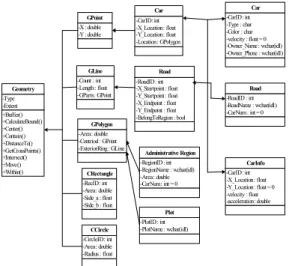
There are commonly kinds of data in ATMS such as road networks, car information, sensor data, and so on. The data model is displayed in Figure 1. All of the data can be divided into three types:
1) Spatial data: As the basic data in GIS and ITS, spatial data abstract the entries in real world into geometry model and are stored in SDMBS. Spatial data are mainly presented in map which consists of four layers:
• Road:main elements of the map, it presents the whole road network and be abstracted as lines in the map.
• Car:moving objects on the road, it is abstracted as a point in the map.
• Administrative Region:district is divided ac- cording to administrative boundaries and ab- stracted as polygon in the map.
• Plot:polygon contains other entries such as shopping mall, park, gas station and so on, it is abstracted as polygon in the map.
2) Attribute data: It describes the static attribute information of filtered historical stream data and spa- tial objects such as roads, cars, districts and surface features. This information is stored in relational DBMS (RDBMS) or SDBMS.
3) Stream data: Data streams are continuously supplied. The data stream s is represented as the se- quence of tuples <(a1, t1), (a2, t2), …., (am, tn)>, where am is attribute value of the tuple and tn is the timestamp. These data describe the changing attrib- ute information of objects such as speed and position of a car and processed by DSMS.
Road -RoadID : int -X_Startpoint : float -Y_Startpoint : float -X_Endpoint : float -Y_Endpoint : float -BelongToRegion : bool
Car -CarID : int -X_Location : float -Y_Location : float -Location : GPolygon
+Buffer() +CalculateBound() +Center() +Contain() +DistanceTo() +GetCrossPoints() +Intersect() +Move() +Within()
Geometry -Type -Extent
GPoint -X : double -Y : double
GLine -Count : int -Length : float -GParts : GPoint
GPolygon -Area : double -Centriod : GPoint -ExteriorRing : GLine
CRectangle -RecID : int -Area : double -Side_a : float -Side_b : float
CCircle -CircleID : int -Area : double -Radius : float
Administrative Region -RegionID : int -RegionName : wchar(idl) -Area : double -CarNum : int = 0
Plot -PlotID : int -PlotName : wchar(idl)
Car -CarID : int -Type : char -Color : char -velocity : float = 0 -Owner_Name : wchar(idl) -Owner_Phone : wchar(idl)
Road -RoadID : int -RoadName : wchar(idl) -CarNum : int = 0
CarInfo -CarID : int -X_Location : float -Y_Location : float = 0 -velocity : float -acceleration : double
Fig. 1. Data model of ATMS
3.2 Query model
ATMS supports three types of query: historical one time query, continuous queries and combine query, which are proposed in MITRE technical report in 2006[20].
• Historical one time query:These queries in- volve in historical data such as car's trajectory, they are processed once over snapshot of data set.
• Continuous query:These queries are produced over time and continuously reflect the data arriving. It may have various forms depending on the mutability of objects and queries, and may ask about the present or future informa- tion. For example,
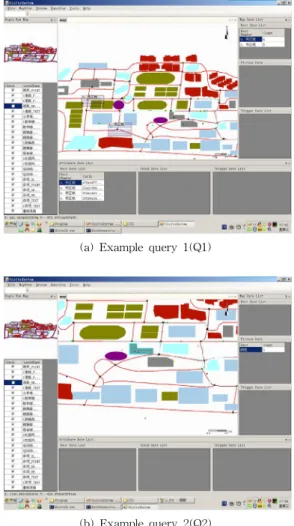
Q1: Which cars are speeding at present?
Select CarID, Speed, X_location, Y_location, Timestamp
From CarStreamTable Where Speed > StandardValue;
•Combine query:The combine queries in our system are defined as queries involved in rela- tional query, spatial query and stream query. For example,
Q2:How many taxi are in the NanShan area within the next 5 minutes?
SELECT count(CarID)
FROM CarStreamTable, Car_Table, District_Table WHERE StreamDataTable.location in District_Table.area
AND Car_Table.car_type = 'taxi' AND District_Table.name = NanShan AND CarStreamTable.Timestamp BETWEEN present_ moment AND present_moment + 5;
4. Implementation of the ATMS
The ATMS integrates DSMS and commercial SDBMS to support various queries for intelligent transportation system.
4.1 The System Architecture
The architecture of ATMS consists of four layers:
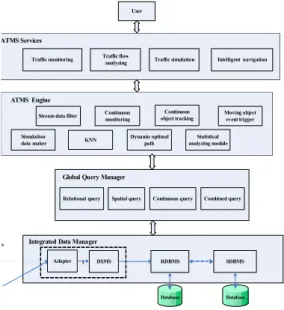
ATMS services, ATMS engine, global query man- ager and integrated data manager. ATMS services provide users advanced traffic monitoring services which are implemented by using the combination of various functions of ATMS engine. ATMS Engine is a component-based core part which provides general functions with the support global query manager.
Global query manager parsing SQL or continuous query language (CQL) and send the data processing requirement to integrated data manager which is comprised of DSMS, relational DBMS (RDBMS) and SDBMS. Figure 2 shows architecture of ATMS.
l
User
Traffic monitoring Traffic flow
analyzing Traffic simulation Intelligent navigation ATMS Services
ATMS Engine
Moving object event trigger Continuous
monitoring
Stream data filter Continuous
object tracking
Simulation
data maker Dynamic optimal
KNN path
Global Query Manager
Relational query Spatial query Continuous query Combined query
Adapter DSMS RDBMS SDBMS
Database Database
Statistical analyzing module
Integrated Data Manager rs
Fig. 2. System architecture of ATMS
Integrated data manager is emphasis on hybrid data management and processing. Because data com-
ing from different streams and their type or fields may be different, it is necessary to create an un- bounded relational table for each stream. Each deliv- ery unit from a stream is regarded as tuple with a timestamp in the relation. The last layer of Figure 2 shows that real-time stream data such as position and speed of vehicles are gathered from sensors and sent to adapter. Adapter is a stream process engine.
It receives and cleans stream data, then sends them to DSMS at a special speed. If the arrived vehicle record already exists in the table, then just update it, otherwise a new tuple is inserted. Historical data such as trajectories of vehicles are store in RDBMS if necessary. RDBMS and SDBMS can exchange data to each other to support combine query.
Global query manager supports historical one time query, continuous query and combine query with the support of the integrated data manager. As soon as the global query manager receives a query, it checks the feasibility, validates and executes the query plans, finally feeds back to applications.
ATMS Engine is component-based and provides several strategies for real-time monitoring and management. Stream data Filter checks stream data that match the given conditions. Continuous Monitoring monitors not only the traffic flow of a specific area but also each car's status real-time and continuous. Continuous objects tracking tracks the moving objects real time and continuously. Moving object event trigger executes pre-defined actions whenever an anomaly event is automatically checked.
KNN performs constant monitoring of k-nearest neighbor queries over moving cars within a geo- graphic area. Dynamic optimal path supports dynamic shortest or best path searching. Statistical analyzer using the forecasting methods to analyze the traffic conditions based on the historical data and spatial data. Simulation data Maker allows user change the map, adjust the interrelated road sections, or modify the attribute information for traffic simulation.
ATMS services provide advanced traffic monitor-
ing services based on relative components of ATMS
Engine. For example, Traffic Monitoring provides real
time traffic monitoring with the support of moving
object event trigger, continuous monitoring, stream
data filter, and continuous object tracking com-
ponents. Traffic flow Analyzing plays an important
role in traffic prediction and planning based on the stream data filter and statistical analyzing components. Traffic Simulation is used to simulate the traffic situation after traffic planning and im- plemented by continuous monitoring and simulation data Maker components. Intelligent Navigation searches for the shortest or best path involving KNN and dynamic optimal path components.
4.2 Query Processing of ATMS
Historical one time query focus on querying from the existing data repositories, static sources data from RDBMS or SDBMS are joined to make a result set. In a standard historical query view, the admin- istrator or client submit a query request that may be related to former multiple data, to achieve this, raw data is combined with information from multiple sources to create a result set on the client display.
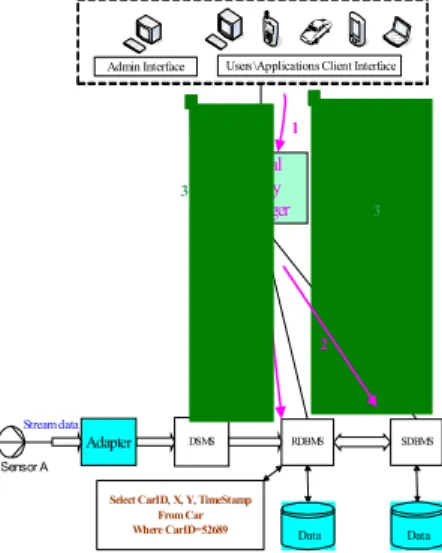
Figure 3 shows the typical sequence of operation. For example trajectory query “Select CarID, X, Y, TimeStamp From Car Where CarID=52689” on RDBMS in Figure 3, when the global query manager receives the registered query (step 1), it analyses the user request, analyzes queries, performs query opti- mization, and constructs query plans. Then generates one-shot queries to RDBMS or SDBMS (step 2) and the result is returned to user (step 3).
Sensor A
Data Data
RDBMS SDBMS
Adapter DSMS Stream data
Global Query Manager 1
2 3
Admin Interface Users\Applications Client Interface
Select CarID, X, Y, TimeStamp From Car Where CarID=52689
3
2
Fig. 3. Historical one time queries processing
Continuous query is activated by anticipated events such as data occurring to accesses dynamic stream data in DSMS. A continuous query is activated by
events, such as data arrival and time progress, and it generates differential results using new data that have arrived after the last execution of the query.
Continuous queries involved in both current and fu- ture results. In this scenario, the query represents a live combination of occurring and anticipated events.
Figure 4 depicts a typical transaction flow. The re- turns for current events are expected to return multi- ple results over time as the dataset stream continually evolves. With regard to “Q1: Which cars are speeding at present?” in Figure 4, when the global query man- ager receives the registered query (step 1), it analy- ses the user request and generates continuous queries to DSMS (step 2). A window could be specified by time intervals in a FROM clause for each data stream. When a continuous query starts, tuples arriv- ing within the window are rapidly returned (step 3).
We can specify a window for each data stream.
Windows are defined by time intervals in a FROM clause. When a continuous query is triggered, tuples arriving within the windows are used to generate the results.
Sensor A
Admin Interface Users\Applications Client Interface
Data Data
RDBMS SDBMS
Adapter DSMS Stream data
Global Query Manager 1
2
Select CarID, speed, timestamp From CarStreamTable Where speed >StandardValue
3
Fig. 4. Continuous queries processing
Combine query refers to query on both dynamic
stream data in DSMS and static data in RDBMS or
SDBMS. The global query manager analyses the
combine query and generates continuous query and
relative subqueries. Some results return from RDBMS
and SDBMS are regarded as filter conditions or
joined together. Finally, integrated data manager re-
turn the executed results user. For combined queries,
the order of return is not certain. Current events may
occur either before or after the results of a historical
query are returned. We must filter large numbers of stream data using DSMS for SDBMS while execut- ing some queries that involved in information in DSMS and DBMS. The potential processing of com- bined queries are depict as follows (Figure 5). For example in Figure 5, “How many taxis are in the NanShan area within the next 5 minutes?” when the global query manager receives the registered combine query (step 1), it analyses the user request and gen- erates subqueries to DSMS, RDMBS and SDBMS (step 2). It first inquire about the are of NanShan district on SDBMS, then filter the coming stream on DSMS for 5 minutes according to the X,Y coor- dinate to judge whether cars are in the NanShan area or not. Finally, it checks car type using gathered the CarID from relational DBMS and shows the results of the combine query on the map by using functions of spatial DBMS (step 3, 4).
Sensor A
Data Data
RDBMS SDBMS
Adapter DSMS Stream data
Global Query Manager 1
2 2 2
4
Admin Interface Users\Applications Client Interface
Select CarID, Type From Car Where Car.Type = “ taxi”
Select RegionID, Area From Administrative Region Where RegionName = “ NanShan”
Select CarID, X_Location, Y_Location, timestamp From Car, Administrative Region, CarInfor Where CarInfor.Location in Administrative
Region.Area And Timestamp BETWEEN ( presen_ moment ,present_moment + 5 minutes)
3 3