INTRODUCTION
Silver carp, Hypophthalmichthys molitrix (Val.), is a phytoplanktivorous f ilter-feeder, feed algae of various sizes (Cremer and Smitherman, 1980;
Smith, 1989). The usage of silver carp to improve water quality in eutrophic lakes has been inves- tigated since the 1970s (Sirenko et al., 1976; Ka-
jak et al., 1977; Smith, 1985; Laws and Weisburd, 1990; Starling, 1993; Lieberman, 1996). Silver carp feeds moving and unmoving targets through a mechanical f iltration. Food items are passed through the gill matrix with numerous pores, and towards the esophagus by the sucking and pumping actions of the suprabranchial organ (Wilamovski, 1972; Lazzaro, 1987), and mastica- ted by the pharyngeal teeth (Xie, 1999).
* Corresponding authors: Tel: 82) 063-850-7162, Fax: 82) 063-852-9115, E-mail: [email protected]
─
─ 319 ──
Feeding Behavior of One- -year- - old Silver Carp,
Hypophthalmichthys molitrix, on Dominant Phytoplankton During a Summer in the Enclosure of
Shallow- -hypertrophic Lake
Kim, Baik--Ho*, Min--Kyu Choi and Noriko Takamura1 (Institute for Environmental Science, Wonkwang University, 344-2
Shinyong-dong, Iksan, Chollabuk-do 570-749, Korea
1National Institute for Environmental Studies, 16-2 Onogawa, Tsukuba, Ibaraki 305-0053, Japan)
여름철에 우점하는 식물플랑크톤에 대한 1년생 백연의 먹이습성. 김백호*∙최민규∙Taka- mura Noriko (원광대, 1일본국립환경연구소)
수심이 얕은 부영양호수에서 우점하는 식물플랑크톤에 대한1년생 백련어의 섭식특성을 조사하고 자, 1997년 5월 23일부터 9월 18일까지 호수의 연안에 4개의 enclosure를 설치하고, 어류투입 이 후의 각enclosure 수중과 어류의 장 내용물 중의 식물플랑크톤 군집의 변화를 비교하였다. 조사기 간동안 각 enclosure의 수온, 플랑크톤의 총생물량, 어류 아가미의 여과공 등은 시간에 따라 큰 변 화가 없었으며, 어류성장은 주로 투입된 어류의 밀도에 의존되었다. 어류의 내용물에 의하면, 저밀
도 투입 enclosure에서 수중과 어류 전장간의 플랑크톤군집의 유사도가 높게 나타났으며
(p<0.05), 전체적으로 모든 enclosure에서 크기가 큰(>100,000µm3) 식물플랑크톤-Oscillatoria, Anabaena, Melosira등은 어류투입이후 크게 감소되지 않았다. 어류의 먹이선택지수(α)와 플랑크 톤의 크기(Ingestion unit)사이에도 매우 낮은 상관성을 보였다(r = 0.001, p>0.5). 식물플랑크톤의 분석결과, 백연은 남조나 녹조에 비해 규조를 더 선호하였는데, 이는 규조의 세포벽이 다른 조류에 비해 소화과정동안 쉽게 파괴되지 않고, 저배율의 현미경적시야에서도 간단히 확인된다는 점 등, 선택지수를 과대평가하게 되는 단점이 있기 때문에 백련어의 먹이습성에 대한 방법론적 개선이 필 요하다고 판단된다.
Key words : Feeding selectivity, Similarity index, Silver carp, Phytoplankton, Ingest- ion unit, Enclosure
Studies of silver carp demonstrated that f ilter- pore sizes (FPS) ranged between 12 and 41µm (Wilamovski, 1972; Liu, 1981; Hampl et al., 1983;
Spataru et al., 1983), but silver carp could f ilter up to 4.5µm (Xie, 1999), perhaps because of sec- retion of digestive mucus (Lazzaro, 1987) or pro- gressive clogging of prey in the gill matrix (Dur- bin and Durbin, 1975). These studies also found that the FPS generally does not change as the fish grows, but they were unable to precisely de- termine the actions of the gill rakers or the di- gestive acids and/or enzymes in the intestine on specif ic prey (Bitterlich, 1985a, b, c). Therefore, the size of the prey f iltered, the mechanism by which the f ish breaks down algal cells and the process of digestion of algae as they are move along the digestive tract are still unclear.
Silver carp unselectively consumes cyanobacte- ria, and unavoidably feed algae only when abun- dant (Vovk, 1974; Xie, 1996), although they much prefer diatoms to green algae, euglenoids and cyanobacteria (Prowse, 1964; Xie and Takamura, 1996). Bitterlich (1985a, b, c) reported that the digestive enzymes in the intestine of stomachless f ish did not completely digest cells, because of the neutral pH; large populations of cyanobac- teria have been observed in the hindgut of f ish (Malyarevskaya et al., 1972; Kajak et al., 1977), and these cells did not display morphological ch- anges during a digestion (Moriarty et al., 1973).
However, feeding experiments have shown that the f ish could very well assimilate isotope-label- ed algae such as Microcystis and Euglena (Zhu and Deng, 1983), Anabaena (Herodek et al., 1989) and green algae (Iwata, 1976). Our previous stu- dy (Fukushima et al., 2000), has shown that the presence of silver carp signif icantly suppressed the chlorophyll-a concentration of phytoplank- ton>40µm, and induced the outbreak of phyto- plankton<2µm. Nevertheless, the microscopic examination revealed that the f ish rarely remove larger algae such as Oscillatoria, Anabaena and Melosira, which were abundant in a hypertro- phic lake during the summer.
Therefore, the silver carp’s feeding selectivity and its ability to digest various algae, particular- ly in hypertrophic lakes, are still not clear. The objectives of the study were to determine: 1) the major characteristics of the prey of silver carp; 2) the quantities and types of algae ingested and remained in the f ish intestine; and 3) any differ- ence between the phytoplankton communities in
the water and the intestine of silver carp with di- fferent f ish stocking densities and culture times.
MATERIALS AND METHODS
This lake is the second largest in Japan (16,800 ha), shallow (mean depth 4 m, maximum depth 7 m) and hypertrophic. The annual means of total phosphorus and total nitrogen are 0.095 and 1.150 mg/L, respectively (Takamura et al., 1996).
The water residence time is 0.55 y, and there is virtually no vertical stratif ication. The lake is the main local source of water for drinking, irri- gation and industrial use, but it has been affect- ed by heavy blooms of cyanobacteria since the 1970s (Takamura et al., 1992)
We set up to 4 enclosures (each 5×5 m×2.5 m deep) near the shore of Lake Kasumigaura (140�
02′N, 36�00′E), after the method of Fukushima et al. (2000). Two enclosures (1A and 2A) allocat- ed for f ish stocking from 22 May to 23 July, 1997 (Stock A), and other two enclosures (1B and 2B) from July 23 to 18 September, 1997 (Stock B) (Table 1). Fish were reared in enclosures 1A and 2A during early summer at low and high densiti- es, respectively. Enclosures 1B and 2B were free of silver carp during early summer but were sto- cked on 23 July at low and high densities, res- pectively. The water temperature in the enclo- sures ranged from 17~29�C during the experi- ments. The mean (±SD) fork length and body weight of the silver carp in 1A and 2A were 139
±10 mm and 39±9 g, respectively, when stocked on 22 May, while those in 1B and 2B were 182±
14 mm and 87±20 g, respectively, when stocked on 23 July. At the end of each stocking period, we collected the f ish from the enclosures, mea- sured their size and weight and calculated their percent growth. Fish growth was calculated as (f inal biomass-initial biomass)/(initial biomass)
×100. Dead or lost silver carp were replaced with individuals of similar size throughout the experiment.
To observe the gill apparatus and the supra- branchial organ, the FPS and the gut contents of silver carp, 10 f ish were sampled from each en- closure on the f inal day of each stocking period, with the exception of enclosure 1A, from which only 7 were sampled, totally 37 f ish. First of all the head of f ish was removed with a scissor, f ixed with ethanol and placed in a glass bottle.
To measure the FPS the gill arch and the supra-
branchial organs were removed and observed under a Nikon dissecting microscope. The analy- sis of the gut content was made after dissecting 1-cm pieces of foregut and hindgut from the f ish with scissors. Each gut fragment was squeezed with f ine forceps to remove the gut juice, which was then preserved in formalin (f inal concentra- tion 3~5%).
Qualitative and quantitative analyses of phyto- plankton were carried out with integrated water samples. These samples were collected by lower- ing a column sampler (diameter 5 cm, capacity 4.7 L) close to the sediment at the center of the enclosure on 20 and 23 July for 1A and 2A, and on 15 and 18 September for 1B and 2B. A 100 mL subsample from each water sample was pre- served with 1% Lügol’s iodine solution. We co- unted the number of each type of phytoplankton in the water samples and f ish intestines under a Nikon inverted light microscope. Nineteen domi- nant phytoplankton were identified to the speci- es level, and others to the generic level. The cell length and width of the dominant phytoplankton species were measured, and the average volume of the cells was calculated according to Wetzel and Likens (1991).
To measure the function of algae as a food for silver carp, namely, ingested unit (IU) is newly defined as a measurement of mean size and sha- pe of phytoplankton occurred in the water. The size calculation included the usual number of phytoplankton forming a colony; we used data from over 100 cells of each solitary species. We also ignored the change in the structure and di- mensional ornamentation of each phytoplankton in water. Because the lived cell is commonly big- ger than that of f ixed cell, as 1.33 times in case of 2% Lügol’s iodine solution (Strathmann, 1967), and 1.28 times in and 0.5% glutaraldehyde solu- tion (Verity et al., 1992). In conclusion, our IU values were slightly over- and under-estimated compared to the lived phytoplankton in enclo- sures. The IU value included non-chlorophyllous
parts, cytoplasmic connections between many branches (Westella and Dictyosphaerium), mucil- agenous sheaths (Phormidium) and hyaline lay- ers between the cell wall and the nucleoplasm (Kirchneriella, Sphaerocystis and Oocystis), apart from the f lagella and spines of Microspora, Te- traspora, Volvox and Scenedesmus. To examine whether or not ingested algae remained alive, chloroplasts or chromatophores were observed in the cells in the f ish’s intestine by the method of Takamura and Yasuno (1983).
We calculated Shoener’s (1970) index to assess similarities in phytoplankton between the for- egut and the water, and the hindgut and the wa- ter. For the former similarity, we sampled the water from each enclosure at the same time that f ish were collected. For the latter similarity, we compared the contents of water samples obtained 3 d before f ish sampling with the hindgut con- tents, because we had estimated the gut-passa- ge time in fish of this size at this water tempera- ture to be 66 h (Liu, 1990). To evaluate the selec- tive preference of silver carp for individual phy- toplankton species, we calculated the α index of Chesson (1983) for each dominant phytoplankton species by comparing the phytoplankton biomass in the foregut with that in water sampled on the same day as the f ish samples were taken.
To evaluate the statistical significance in the difference of similarity in phytoplankton commu- nity between the foregut and the water, the hindgut and the water, and the foregut and the hindgut, the Mann-Whitney test for nonparame- tric testing was applied. Simple correlation an- alyses between the IU values and total biomass of each phytoplankton species, and selectivity of silver carp on phytoplankton species were con- ducted.
RESULTS
The growth of the silver carp (expressed as %) was affected by a density of f ish stocked: the bio-
Table 1. Number, biomass, percent growth and f ilter pore size (FPS) of silver carp stocked in the 4 enclosures.
Enclosure No. f ish Initial biomass Final biomass Fish growth FPS (µm) No. f ish for FPS
(g/m3) (g/m3) (%) Mean±SD (range) measurement
1A 15 9.1 31.2 242 18.4±1.3 (16.4~20.2) 7
2A 57 37.4 76.5 105 18.9±1.4 (16.9~21.5) 10
1B 15 20.9 42.5 103 20.0±1.0 (18.8~21.8) 10
2B 57 78.8 93.9 19 19.6±1.1 (18.2~21.3) 10
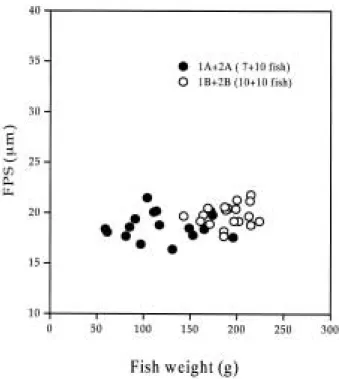
mass of f ish was greater in the low-density en- closure than that of the high-density, and Stock A than for Stock B, respectively (Table 1). The f iltering apparatus of the silver carp used in the study generally appeared to be similar to that described by Wilamovski (1972). The distance be- tween adjacent ribs or rakers re-measured aver- aged 82.3µm (n = 37, SD = 3.5) in this study. The average FPS of the f ish (59~272 g) was 19.3µm (range 16.4~21.8µm), and there was a weak re- lationship (r = 0.38, p = 0.019, n = 37) between the FPS and the f ish weight (Fig. 1 and Table 1).
Totally 201 taxa occurred in this study, but only 19 dominant phytoplankton contributed
>95% of the total algal biomass (Table 2). Only in enclosure 1A were all of these phytoplankton species present; the number of dominant phyto- plankton species in the Stock B enclosures drop- ped. The IU values of the phytoplankton species ranged from about 1,100 to 777,000µm3. Cyano- bacteria, Merismopedia tenuissima was the most abundant (1010~1012 µm3) in each of the 4 enclo- sures over the experimental periods. The phyto- plankton biomass tended to decrease signif ican- tly (r = 0.58, p<0.01 for all enclosures; Fig. 2)
Fig. 1. Relationship between f ilter pore size (FPS) and weight of silver carp in the four enclosures. Ten f ish were examined from each enclosure, except for 1A, where only 7 were examined.
Fig. 2. Total biomass and ingested unit (IU) values of phytoplankton species in the four enclosures. Algal biomass below 10∙6µm3was counted as zero. The IU value of each phytoplankton species is listed in Table 2.
IU of phtoplankton (µm3) Total algal biomass (µm3/mL)
with decreasing volume of individual cells or co- lonies.
The similarity index between the phytoplank- ton community in the f ish intestine and the wa- ter in each enclosure varied in close relation to the average weight of the f ish, or inversely to the stocking density (Fig. 3). The similarity index was higher in enclosures with smaller f ish but lower f ish density, both for the foregut and hind- gut, than in enclosures with large f ish and high- er f ish density, respectively (p<0.05, except for similarity indices of the foregut between 1B and 2B, U-test).
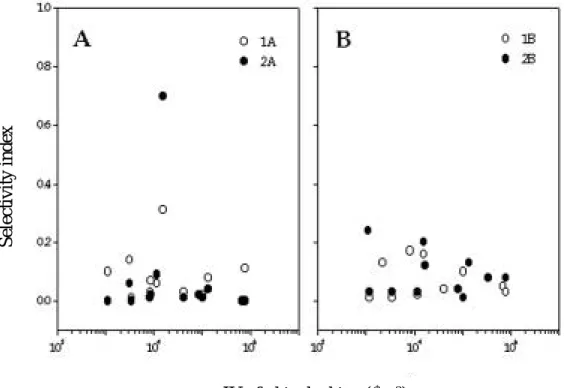
The α index of Chesson (1983) showed that sil- ver carp greatly preferred 5 diatoms, namely Ni- tzschia, Aulacoseira, Cyclotella, Melosira and Sy- nedra despite the fact that cyanobacteria occurr- ed abundantly in each enclosure. Of these, Cyclo- tella meneghiniana (13~17µm) was most pre- ferred by f ish, with a selectivity index of 0.2~0.7 (Table 2). This diatom was preferred in other en- closures as well. Two other diatoms, Aulacoseira granulata (α= 0.14 for 2A) and Nitzschia acicu- laris (α= 0.24 for Stock-B) were also selectively ingested. In contrast, the selectivity indices for Lyngbya limnetica, Melosira distans and Chla- mydomonas (>15µm) were consistently low across all the enclosures (α= 0.03). There was no relationship between the selectivity indices and
Table 2. Feeding selectivity (Chesson’s αindex) of silver carp for each dominant phytoplankton species, and their ingested unit (IU) values, in the 4 enclosures. The IU values include cytoplasmic connections and mucilagenous sheaths, but exclude f lagella and spines.
Dominant species Selectivity index IU values
1A 2A 1B 2B (µm3)
Nitzschia acicularis 0.00 0.10 0.24 0.24 1108.4
Chlamydomonas sp. (>15µm) 0.00 0.00 0.03 0.01 1169.0
Coelosphaerium sphaericum 0.00 0.00 0.00 0.13 2208.0
Aulacoseira granulata 0.06 0.14 0.00 0.00 3126.8
Lyngbya limnetica 0.00 0.01 0.03 0.01 3427.1
Monoraphidium contortum 0.01 0.00 0.00 0.17 8146.0
Dictyosphaerium pulchellum 0.02 0.03 0.00 0.00 8377.6
Chodatella wratislaviensis 0.02 0.07 0.00 0.00 8722.3
Ankistrodesmus falcatus 0.09 0.06 0.03 0.02 11641.5
Cyclotella meneghiniana 0.70 0.31 0.20 0.16 15598.5
Westella botryodies 0.00 0.00 0.12 0.00 16755.2
Scenedesmus protuberans 0.01 0.03 0.00 0.04 41147.6
Synedra unla 0.00 0.00 0.04 0.00 79892.4
Melosira distans 0.02 0.02 0.00 0.00 84496.2
Oscillatoria agardhii 0.01 0.02 0.01 0.10 103118.2
Actinastrum Hantzschia 0.04 0.08 0.13 0.00 134481.0
Kirchneriella obesa 0.00 0.00 0.08 0.00 337789.5
Merismopedia tenuissima 0.00 0.00 0.00 0.05 678348.8
Anabaena f los-aquae 0.00 0.11 0.08 0.03 777014.7
Fig. 3. Similarities between phytoplankton communities in the f ish intestine and water in the four enclosu- res. The index was calculated by the method of Sh- oener (1970), and was used to compare the compo- sition of phytoplankton species in the foregut and the water, and in the hindgut and the water. For analysis of gut contents, 10 f ish were collected from each enclosure, except for enclosure 1A, where only 7 were collected.
IU values of phytoplankton in any of the enclo- sures (r = 0.001, p>0.05, Fig. 4).
DISCUSSION
The feeding behavior of most f ilter feeders is greatly inf luenced by various factors, such as vi- sibility, size and density of prey, acclimation (Adamek and Spittler, 1984; Lazzaro, 1987), tem- perature (Reynolds, 1984; Szumiec, 1997) and cy- anobacterial toxins (Tidwell et al., 1992; Fuku- shima et al., 2000). In our feeding experiments with 1-y-old silver carp during f ive summer mo- nths, the stocking density remarkably inf luenced its feeding habit; in particular, f ish growth was remarkably retarded in enclosure 2B with a high density of stocked f ish. But, there were no major changes in FPS of silver carp (16.4~21.8µm) with f ish size (59~272 g) and water temperature (23~26�C) in each enclosure during the study period. Despite the fact that the present work is based on f ish of small or limited size, our results unequivocally suggest that the stocking density
controls the feeding behavior of silver carp dur- ing summer in the eutrophic lake.
Over the experiment periods, Anabaena, Meri- smopedia and Oscillatoria, showing high IU val- ues (100,000µm3), occurred abundantly in water even in the presence of silver carp. The results showed a highly signif icant relationship between the abundance and IU values of each phytopl- ankton in all the enclosures, without regard to the presence or density of f ish (Fig. 2). In gener- al, cyanobacteria may be ingested unselectively when occurring abundantly (Kajak et al., 1977;
Tidwell et al., 1992), but they are not at all prefe- rred and are even avoided by silver carp (Sirenko et al., 1976). The feeding behavior of silver carp in cyanobacteria-rich lake is not fully understood due to complex relationships among algal grow- th, mortality and feeding preferences of f ish (Sie- gel, 1998), and also because the f ish f ind it diff i- cult to digest cyanobacteria (Payne, 1978; Bold and Wynne, 1985; Starling and Rocha, 1990).
The morphological characteristics of phytoplank- ton and their abundance may be important in de-
Fig. 4. Feeding selectivity (Chesson’s αindex) of silver carp and ingested unit (IU) values of phytoplankton. We calculated the selectivity index for each major phytoplankton by the method of Chesson (1983), based on the relative algal abundance in the foregut of f ish and water. For analysis of the gut content 10 f ish were collected from each enclosure, except for enclosure 1A, where only 7 were collected.
IU of phtoplankton (µm3)
Selectivity index
termining the relevant prey of 1-y-old silver carp in highly mixed waters.
Our result that silver carp more preferred dia- toms than cyanobacteria and green algae, is in accordance with previous observations (Prowse, 1964; Xie, 1999) and seems to be due mainly to the ease with which diatoms can be distinguish- ed from the mixed debris in f ish intestine. Low selectivity for cyanobacteria and green algae may be due to diff iculties in distinguishing the dissociated cells from colonies or f ilaments. Ap- propriate techniques need to be developed to cl- early understand and generalize the feeding be- havior of stomachless f ish such as silver carp.
Our findings indicate that the composition and relative abundance of phytoplankton in the wa- ter was more similar to that in f ish fore-gut at low density than at high density. The density ef- fect was significant in both the Stock A and Sto- ck B experiments (Fig. 3, p<0.05, U-test). Be- cause of the low grazing pressure, algae in the low-density enclosures, may more easily form aggregates or colonies in the water column than those in high-density enclosures. The results from an analysis of foregut content of fish may also confirm that f ish ingest unselectively algal aggregates or colony as bulk or mass from water.
Although the feeding selectivity of silver carp is still controversial and unclear if it really does oc- cur (Kajak et al., 1972; Sirenko et al., 1973), it may be one of the expectations that there were weak relationship between the selectivity indices and the IU values of phytoplankton (r<0.1 for two low-density enclosures). In addition, al- though introduction of silver carp strongly in- duced the outbreak of small cryptomonads (<40 µm) such as Cryptomonas and Plagioselmis (Fu- kushima 2000), they were hardly found in fish gut, and then they had a low selectivity or no selectivity through the computation.
The present work revealed that the manipula- tion of silver carp did not effectively suppress the large f ilamentous phytoplankton with high IU values. However, the f ish were able to maintain growth by using diatoms and other algae, rather than cyanobacteria and green algae.
ABSTRACT
The feeding behavior of 1-year-old silver carp, Hypophthalmichthys molitrix (Val.) on phytopl- ankton species in a shallow hypertrophic lake
was studied from 22 May to 18 September, 1997.
Over the experimental period, the f ilter-pore siz- es of the f ish, the total biomass of the phytopla- nkton and the water temperature in each enclo- sure changed little with time. The f ish biomass in each enclosure increased with time, while their percentage of weight gain correlated nega- tively to the stocking density, due perhaps to competition for prey. An analysis of gut contents of silver carp showed a strong similarity between the algal communities in the foregut and the water, and was signif icant for the f ish enclosure with a low density (p<0.05). The presence of sil- ver carp rarely suppressed the abundance of phy- toplankton such as Oscillatoria, Anabaena and Melosira even at high ingestion levels. There were weak relationships between the IU values of each phytoplankton and the selectivity of f ish on them (r = 0.001, p>0.5). There was no doubt that the silver carp fed unselectively when cya- nobacteria populations were high, even though the selectivity index for diatoms was slightly hig- her than those for cyanobacteria, green algae and cryptomonads. Improvements in methodolo- gies are needed to clearly understand and gene- ralize the feeding behavior of silver carp.
REFERENCES
Adamek, Z. and P. Spittler. 1984. Particle size selec- tion in the food of silver carp, Hypophthalmich- thys molitrix. Folia. Zool. Brno. 33: 363-370.
Bitterlich, G. 1985a. Digestive enzyme pattern of two stomachless filter feeders, silver carp, Hypophtha- lmichthys molitrix Val. and bighead carp, Ari- stichtchys nobilis Rich. J. Fish. Biol. 27: 102-112.
Bitterlich, G. 1985b. The nutrition of stomachless ph- ytoplanktivorous f ish in comparison with Tilapia.
Hydrobiologia 121: 173-179.
Bitterlich, G. 1985c. Digestive process in silver carp (Hypophthalmichthys molitrix) studies in vitro.
Aquaculture 50: 123-131.
Bold, H.C. and M.J. Wynne. 1985. Introduction to the algae. 2nd Ed. Prentice-Hall Inc., NJ, USA, 720 pp.
Brett, M.T. and D.C. Müller-Navarra. 1997. The role of highly unsaturated fatty acids in aquatic food- web processes. Freshwater Biol. 38: 483-499.
Chesson, J. 1983. The estimation and analysis of pre- ference and its relationship to foraging models.
Ecology 64: 1297-1304.
Cremer, M.C. and R.O. Smitherman. 1980. Food ha- bits and growth of silver and bighead carp in cag- es and ponds. Aquaculture 20: 57-64.
Deegan, L.A., B.J. Peterson, H. Golden, C.C. Mcivor
and M.C. Miller. 1997. Effects of f ish density and river fertilization on algal standing stocks, inver- tebrate communities, and f ish production in an Arctic river. Can. J. Fish. Aquat. Sci. 54: 269-283.
Durbin, A.G. and E.G. Durbin. 1975. Grazing rates of the Atlantic menhaden as a function of particle size and concentration. Mar. Biol. 33: 265-277.
Fukushima, M., N. Takamura, B.H. Kim, M. Naka- gawa, L. Sun and Y. Zheng. 2000. The responses of an aquatic ecosystem to the manipulation of the f ilter-feeding silver carp (Hypophthalmich- thys molitrix). Verh. Int. Verein. Limnol. in press.
Hampl, A., J. Jirasek and D. Sirotek. 1983. Growth morphology of the filtering apparatus of silver carp (Hypophthalmichthys molitrix). II. Microsco- pic anatomy. Aquaculture 31: 153-158.
Herodek, S., I. Tatrai, J. Olah and L. Vörös. 1989.
Feeding experiments with silver carp (Hypophth- almichthys molitrix Val.) fry. Aquaculture 83: 331 -44.
Iwata, K. 1976. Morphological and physiological stu- dies on the phytoplankton feeders of cyprinids-II.
Developmental changes of assimilation eff iciency in terms of carbon, estimated by using 14C-label- ed green algae in Carassius auratus cuvieri, Hy- pophthalmichthys molitrix and C. auratus gran- doculis. Jpn. J. Limnol. 38: 19-32.
Kajak, Z., I. Spondiewska and R.J. Wisnewski. 1977.
Studies on food selectivity of silver carp, Hypoph- thalmichthys molitrix (Val.). Ekol. Pol. 25: 227-39.
Laws, E.A. and R.S.J. Weisburd. 1990. Use of silver carp to control algal biomass in aquaculture po- nds. Prog. Fish-Cult. 52: 1-8.
Lazzaro, X. 1987. A review of planktivorous fishes:
their evolution, feeding behaviors, selectivities and impacts. Hydrobiologia 146: 97-167.
Lieberman, D.M. 1996. Use of silver carp (Hypophth- almichthys molitrix) and bighead carp (Aristich- tchys nobilis) for algae control in a small pond: ch- anges in water quality. J. Freshwat. Ecol. 11: 391 -397.
Liu, H.L. 1990. The apparatus of f iltering and feed- ing of silver carp and bighead carp. J. Dalian Fi- sheries College 1: 13-33.
Liu, J.K., 1981. Research on Donghu Lake Ecology (1).
In: Report of Donghu Experimental Station of Lake Ecosystems, Chinese Academy of Sciences, Science Press of China. pp. 337-339.
Malyarevskaya, A.Y., T.I. Birger, O.M. Arsan and V.D. Solomatina. 1972. Metabolic relationship be- tween blue-green algae and f ish. Hydrobiological J. 8: 35-41.
Moriarty, D.J.W., J.P.E.C. Darlington, E.G. Dunn, C.
M. Moriarty and M.P. Telvin. 1973. Feeding and grazing in Lake George, Uganda. Proc. Roy. Soc.
Lond. 184B: 299-319.
Payne, A.I. 1978. Gut pH and digestive strategies in estuarine grey mullet (Mugilidae) and tilapia
(Cichlidae). J. Fish. Res. Board. Can. 13: 627-629.
Prowse, G.A. 1964. Some limnological problems in tropical fish ponds. Verh. Int. Verein. Limnol. 15:
480-484.
Reynolds, C.S. 1984. The ecology of freshwater phyto- plankton. Cambridge University Press, Cambrid- ge.
Shoener, T.W. 1970. Non-synchronous spatial over- lap of lizards in patchy habitats. Ecology 51: 408- 418.
Siegel, D.A. 1998. Resource competition in a discrete environment: why are phytoplankton distribu- tions paradoxical? Limnol. Oceanogr. 43: 1133- 1146.
Sirenko, L.A., P.S. Vovk, A.Y. Malyarevskaya and T.
I. Birger. 1976. Control of eutrophication of Dnie- per Reservoir by algae removal and herbivorous fishes introduction. Limnologica 10: 603-606.
Smith, D.W. 1985. Biological control of excessive phy- toplankton growth and the enhancement of aqua- cultural production. Can. J. Fish. Aquat. Sci. 42:
1940-1945.
Smith, D.W. 1989. The feeding selectivity of silver carp, Hypophthalmichthys molitrix (Val). J. Fish.
Biol. 34: 817-828.
Spataru, P., G.W. Wolhfarth and G. Hulata. 1983.
Studies on the natural food of different f ish spe- cies in intensively manured polyculture ponds.
Aquaculture 35: 283-298.
Starling, F.L.R.M. and J.A. Rocha. 1990. Experimen- tal study of the impacts of planktivorous fishes on the plankton community and eutrophication of a tropical Brazilian reservoir. Hydrobiologia 200/
201: 581-991.
Starling, F.L.R.M. 1993. Control of eutrophication by silver carp (Hypophthalmichthys molitrix) in the tropical Paranoa Reservoir (Brasilia, Brazil): a mesocosm experiment. Hydrobiologia 257: 143- 152.
Strathmann RR. 1967. Estinating the organic carbon from cell volume or plasma volume. Limnol. Ocea- nogr. 12: 411-418.
Szumiec, M.A. 1997. Potential growth and yield of one-and two-year-old carp, Cyprinus carpio L.
in climatic conditions of La Dombes (France). Aq- uacult. Res. 28: 237-145.
Takamura, N. and M. Yasuno. 1983. Food Selection of the Ciliated Protozoa, Condylostoma vorticella (Ehrenberg) in Lake Kasumigaura. Jpn. J. Lim- nol. 44: 184-189.
Takamura, N., A. Otsuki, M. Aizaki and Y. Nojiri.
1992. Phytoplankton species shift accompanied by transition from nitrogen dependence to phos- phorus dependence of primary production in Lake Kasumigaura, Japan. Arch. Hydrobiol. 124: 129- 148.
Takamura, N., Y. Ishikawa, H. Mikami, H. Mikami, Y. Fujita, S. Higuchi, H. Murase, S. Yamanaka, Y.
Nanjyo, T. Igari and T. Fukushima. 1996. Abund- ance of bacteria, picophytoplankton, nanof lage- llates and ciliates in relation to chlorophyll a and nutrient concentrations in 34 Japanese waters.
Jpn. J. Limnol. 57: 245-259.
Tidwell, J.H., C.D. Webster, J.A. Clark and D.H.
Yancey. 1992. Effects of Yucca shidigera extract on water quality and fish growth in recirculating water aquaculture systems. Prog. Fish-Cult. 54:
196-201.
Verity, P. and Others. 1992. Relationships between cell volume and carbon and nitrogen of marine photosynthetic nanoplankton. Limnol. Oceanogr.
37: 1434-1446.
Vovk, P.S. 1974. The possibilities of using silver carp Hypophthalmichthys molitrix (Val.) to increase the f ish productivity and to decrease the eutro- phication of the Dniepr reservoirs. Vopr. Ikhtiol.
14: 406-414, in Russian.
Wetzel, R.G. and G.E. Likens. 1991. Limnological an- alyses. 2nd ed. Springer-Verlag, New York, NY.
Wilamovski, A., 1972. Structure of the gill apparatus and the suprabranchial organ of Hypophthalmich- thys molitrix Val. (silver carp). Bamidgeh 24: 87- 98.
Xie, P. 1996. Experimental studies on the role of pl- anktivorous f ishes in the elimination of Microcys- tis bloom from Donghu Lake using enclosure me- thod. Chin. J. Oceanol. Limnol. 14: 193-204.
Xie, P. and N. Takamura. 1996. Impact of filter-feed- ing silver and bighead carps on the long-term ch- anges in the community structure of Cladocera in Lake Donghu. Acta Hydrobiol. Sini. 20: 47-59, Suppl., in Chinese.
Xie, P. 1999. Gut contents of silver carp, Hypophthal- michthys molitrix, and the disruption of a centric diatom, Cyclotella, on passage through the eso- phagus and intestine. Aquaculture 180: 295-305.
Zhu, H. and W. Deng. 1983. Studies on the digestion of algae by f ish (II) Microcystis aeruginosa and Euglena sp. digested and absorbed by silver carp and big head. Trans. China Ichth. Soc. 3: 77-91.