*Corresponding author: Kang Bo Shim Phone: +82-31-695-0650; Fax: +82-31-695-0638;
E-mail: [email protected]
Kang Bo Shim , Min Tae Kim, Sung Gook Kim, Kun Ho Jung, Weon Tai Jeon, Su Hyun Shin, Jae Un Lee1, Jong Ki Lee1 and Young Up Kwon1
1Crop Cultivation & Environment Research Division, Department of Central Area Crop Science, National Institute of Crop Science, Rural Development Administration, Suwon 16429, Korea
2Central Crop Division, Department of Central Area Crop Science, National Institute of Crop Science, Rural Development Administration, Suwon 16429, Korea
Received: 3 July 2018/ Revised: 13 September 2018/ Accepted: 27 September 2018 Copyright ⓒ 2018 The Korean Society of Environmental Agriculture
This is an Open-Access article distributed under the terms of the Creative Commons Attribution Non-Commercial License (http://creativecommons.org/licenses/by-nc/3.0) which permits unrestricted non-commercial use, distribution, and reproduction in any medium, provided the original work is properly cited.
ORCID Kang Bo Shim
https://orcid.org/0000-0002-7582-9791
160
Abstract
BACKGROUND: Mixed cropping of legume and grass was effective system in view point of providing organic matter and nitrogen or reducing the nitrogen starvation of following crop. The relation of the change of N and P constituents depending on the cropping types and those effects on the growth and nutrient uptake of the following crop were observed.
METHODS AND RESULTS: Three cropping types, hairy vetch mono cropping, barley mono cropping, and mixed cropping of hairy vetch and barley were applied. Soil properties, growth characteristics, and nitrogen production of green manure crops were observed. In additions, the effect of cropping types on the growth pattern of corn as the following crop was observed. In the mixed cropping system, creeping type hairy vetch climbed to the erect type barely for light utilization resulting in improvement of light interception rate and higher LAI (Leaf Area Index) than in mono cropping. Mixed cropping showed higher biomass production and soil nitrogen availability among the cropping types, indicating relatively much more nutrient
supply and higher yield production of following crop.
CONCLUSION: Mixed cropping showed relatively higher LAI (dry matter) mainly because of intense competition for light utilization usually after flowering stage. Mixed cropping also showed relatively higher yield of corn, the following crop rather than other types, mainly due to the more biomass production potential and higher N and P production ability. Therefore, mixed cropping was adaptable method to reduce or replace chemical fertilizer application for environmentally-friendly agriculture.
Key words: Hairy vetch, LAI, Legume grass mixed cropping, Nitrogen fixation
Introduction
Green manure crop is an environmentally friendly and labor saving organic fertilizer by soil fertility improvement and chemical fertilizer or composts application reduction (Jeon et al., 2009, 2010). Hairy vetch is readily to decomposed and rapidly release nitrogen due to lower C/N ratio (Sarrantonio et al., 1988; Varco et al., 1989 ; Power et al., 1991 ; Seo et al., 2000). Legume crop (as green manure) is effective to reduce chemical nitrogen fertilizer requirement for the following crop due to atmospheric nitrogen fixation and releasing nitrogen into the soil (Campiglia et al.,
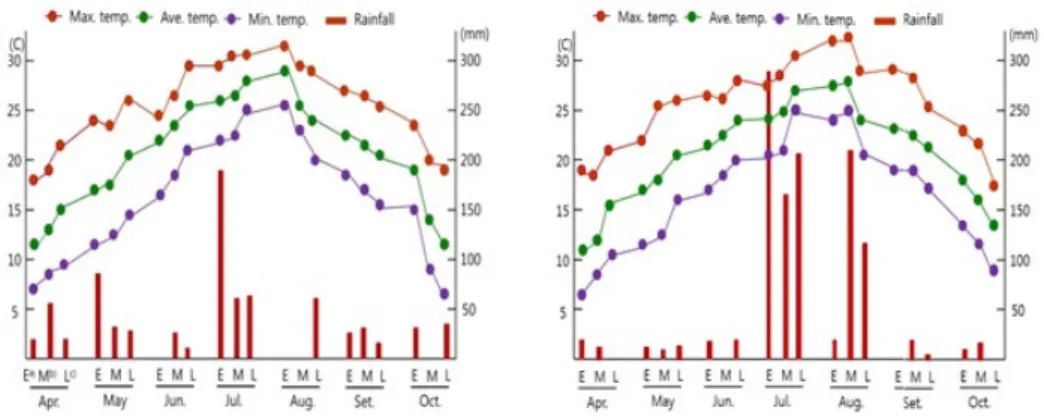
Fig. 1. Temperature and rainfall patterns during the crop cultivation period of 2016~2017. a) E : Early month, b) M : Middle month, c) L : Late month
2010 ; Cazzato et al., 2003). Mixed cropping was efficient system for biomass production by natural light utility improvement and nutrient provision to the following crops (Rauber et al., 2001 ; Ramos et al., 2011 ; Arata et al., 2013). Recently, green manure crop has considered an important factor for environmentally -friendly agriculture. For example, input of gramineae crops such as barley, rye and wheat in soil reduced nitrogen (N) leaching from arable soil and could conserve organic matter and physical properties of soil (Astier et al., 2006). Gramineae crops such as rye and barley with high carbon to nitrogen ratio (C/N ratio) would provide a little amount of N constituent to the following crop due to the N immobilization.
Low C/N ratio of green manure crops such as hairy vetch symbiotically supply more N to soil by fixing atmospheric nitrogen and increase N availability during crop cultivation. Mixed cropping system of legume and grass would reduce nitrogen starvation by incorporating gramineae crops with higher C/N ratio (Rasmussen et al., 2007 ; Arata et al., 2013). There is little research on macro- nutrients mobilization in the mixed green manure cropping system. This study was tested nitrogen (N) and phosphorus (P) absorption of the succeeding crop corn in order to evaluate the effect of green manure in cropping systems in arable soil.
Materials and Methods Experimental plot managements
This experiment was conducted at the experiment farm of National Institute of Crop Science, Suwon from 2016 to 2017. The experimental design was randomized complete block with three replications.
Main treatments were three cropping types (hairy
vetch mono cropping, barley mono cropping, mixed cropping of hairy vetch and barley). Each plot size was 10×15 m.
Meteorological Analysis of Soil Chemical Properties We got the meteorological data from Agriculture Meteorology Information Service, Rural Development Administration and analyzed the temperature and rainfall patterns during the experiment period.
Temperature is one of the most important factors to determine crops yield potential. Monthly temperature and precipitation patterns were different year by year.
Average temperature in 2016 (left diagram) was higher than that in 2017 by 0.7℃. But precipitation was 383 mm less than that of 2017 (Fig. 1).
Soil Sample Collection and Analysis of Soil Chemical Properties
To analyze soil properties, porous cups was put at 20 cm depth from the soil surface and collect the soil sample after incorporating green manure crops.
Inorganic soil N content was measured by micro diffusion method. For plant available soil P and K analysis, 0.5 M NaHCO3, 1 M NH4C2H3O2 extraction were used respectively. Soil pH was analyzed with pH electrode in a 1:1 ratio of soil and water suspension. Soil organic matter was analyzed by weight loss on ignition at 360℃. General soil property of the plot was shown in the Table 1. Acidity was 5.5 and soil organic matter 12.0 g/kg. Total nitrogen and Available P2O5 was 1.05 and 385 mg/kg respectively.
Plant Sampling and Maintenance
Hairy vetch and barley were sown at 10th October (2016). Mixed rate was hairy vetch 50% + barley 50%
Source DFd) Mean square F - value Pr > P Green
Manure crops
Ba) HVb) HV+Bc)
N 4 1021.3611 14.17* 0.0153
P 4 4.43625 8.84* 0.0340
DW 4 10.10444 62.09** 0.0010
Corn
B HV HV+B
N 4 10.76625 31.53** 0.0036
P 4 1.58152 70.81** 0.0008
DW 4 108573.9444 40.71** 0.0022
a)Mono barley cropping, b)Mono hairy vetch cropping, c)Mixed hairy vetch and barley cropping, d)Degree of Freedom.
*P<0.05, **P<0.01
(100 seeds (spot sowing) + 200 seeds (line sowing)).
Hairy vetch and barley shoot were harvested after 2 weeks flowering (about 10th May, 2017). After weighting total biomass, the samples were incorporated into the plot with rotatory machine. C and N constituent were measured one week interval after returning to the soil with nitrogen and carbon analyzer. For total P content, we used HClO4 extraction and analyzed using ICP atomic emission spectrometer (720-ES Series, Varian Inc., Palo Alto, California, USA). After 4 weeks of incorporating green manure crops, corn was sown on 17th June by hand with 60 cm and 25 cm distance of inter-hill and inter-row distance respectively in each plot. Chemical fertilizer was not applied to all plots during corn cultivation period.
SPAD value for chlorophyll contents was measured at the next leaf from the upper-most leaf at silk stage.
About 110 days after sowing, thirty corn plants in each plot were chosen and sampled to measure total N and P constituents. Total fresh weight and ear weight of corn were measured from the thirty plants at maturity. Dry weight of the samples was measured after drying at 60℃ for 48 hours. Fresh weight and dry weight of samples was analyzed after drying at 60℃ for 48 hours before incorporating green manure crops to the soil. At maturity, thirty corn plants in each plot were chosen and sampled to measure yield potential of total fresh weight and ear
weight. To measure dry weight, samples were treated at the condition of 60℃ for 48 hours.
Statistical Analysis
The collected Data were subjected to analysis of variance (ANOVA) and the mean significant differences were compared by Duncan’s multiple range test (DMRT) at P≤0.05. All data were analyzed using SAS package (Ver. 9.2).
Results and Discussion Yield and nutrients of green manure
Table 2 showed that total nitrogen, phosphate content, dry weight of green manure crop and corn yield were statistically different depending on cropping types. The fresh weight of mixed hairy vetch and barley cropping (HV/B) was 6.1 ton per hectare which was 42∼53% higher than those of mono green manure (Table 3). Also, amount of total nitrogen in HV/B plot was about 172 kg per hectare which is about 28, 272% higher than that of mono hairy vetch and barley cropping respectively. Mixed cropping such as hairy vetch and barley might be to improve soil fertility and yield production of following crop due to the input of C and N by the increased biomass.
Both hairy vetch and barely in mixed cropping
Cropping types Fresh weight of green manure crops (ton/ha)
Nitrogen production amount (kg/ha)
mono barley cropping (B) 4.3b 63.0b
mono hairy vetch cropping (HV) 3.3b 134.2ab
mixed hairy vetch and barley cropping (HV/B) 6.1a 171.5a
Means within a column followed by the same letter are not significantly different (α=0.05) by Duncan multiple range test.
Table 3. Fresh weight of green manure crops and nitrogen production
Cropping types Before flowering1) After flowering2)
Mono barley cropping (B) 3.2b 4.6b
Mono hairy vetch cropping (HV) 5.7a 7.9ab
Mixed hairy vetch and barley cropping (HV/B) 4.3ab 8.5a
1)Before flowering : 12 April, 2)After flowering : 12 May Table 4. LAI value before and after flowering of hairy vetch
Fig. 2. Nitrogen concentration in soil after incorporating green manure crops. Each value shows the mean ± SEM of three replications.
would compete each other for light utilization which in turn caused to increase LAI (Leaf Area Index) value or higher SPAD (Soil Plant Analysis Development) value than mono cropping. According to the previous studies, hairy vetch climbed to the oat for light utilization in the mixed cropping resulting in improvement of light interception rate (Caballero et al., 1986, 1995). Mono cropping showed lower the LAI value than that of mixed cropping (Table 4). It was observed that LAI would be sharply increased after flowering of hairy vetch. In many studies, gramineae crops showed positive effect for using nutrient, especially N and P uptake when mixed with legume crops (Rasmussen et al., 2007 ; Jeon et al., 2009). Table 3 also showed similar results that mixed cropping of hairy vetch and barley showed relatively higher LAI value than that of mono cropping of hairy vetch or barley especially after flowering of hairy vetch.
Effect of cropping types on the growth pattern of corn as following crop
The nitrogen content in soil after incorporation of barley and hairy vetch in the mixed cropping was kept high until early June, while that in the mono barley was low (Fig. 2). Gradual decrease of nitrogen in all cropping after 29th June might be due to nitrogen uptake by following corn that grew dynamically during those days. According to the previous studies, higher C/N ratio of incorporated crops results in temporal nitrogen starvation during early growth of the following crop through decomposition of incorporated green manure by soil microorganisms (Chaves et al,
2004). In our experiment, soil nitrogen content after incorporation of barley and hairy vetch was higher than that in mono barely cropping indicating that hairy vetch had a role of nitrogen supplier after incorporation.
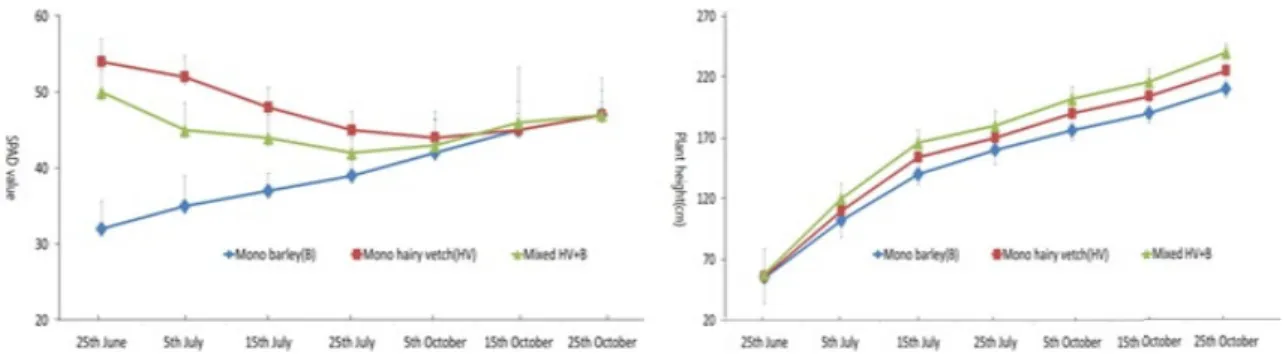
Light utilization is very important factor to determine corn ear production potential in the reproductive stage. The SPAD values of corn leaves were relatively higher in the mono hairy vetch cropping than the others during the vegetative growth stage (Fig. 3).
But as the growth stage was proceeding, the SPAD values of all cropping recorded to 45∼46 indicating that cropping types could much affect the growth of corn in an early stage rather than late stage. Usually mono hairy vetch cropping is easily decomposed and increases soil nitrogen concentration in a short time after incorporation into the soil. In the vegetative growth stage of corn, mono hairy vetch cropping showed higher SPAD values than that of mixed.
Otherwise, mixed cropping showed higher SPAD
mean±SEM of three replications.
Cropping types Total N(g/m2) Total P(g/m2) Ear yield(g/m2)
Mono barley cropping (B) 7.2b 1.7b 534b
Mono hairy vetch cropping (HV) 9.6ab 2.6a 759ab
Mixed hairy vetch and barley cropping (HV/B) 11.2a 3.1a 915a
Table 5. Ear yield, nitrogen and phosphate constituent of corn depending on cropping types in 2016∼2017
values than mono cropping type due to the longer nitrogen providing potential in the reproductive stage.
The change of plant height by cropping types showed similar pattern with that of SPAD value. Plant height showed relatively higher in the mono hairy vetch type than mono barley and mixed types. As the growth stage of corn was proceed, the difference of plant height was bigger, especially after 15th July even though no statistical difference was observed.
Ear yield of corn was different depending on cropping types (Table 5). Mixed cropping of hairy vetch and barley showed relatively higher corn yield rather than other types mainly due to the more biomass production potential and higher N and P production ability. The experiment result also showed that following corn easily uptake main constituents especially in mixed cropping through whole growth stage and, in turn, relatively higher N, P content and ear yield per plant. Of course, we have to study on the accurate nutrients movement mechanism to investigate the effect of cropping types on the main nutrients absorption of following crops.
Discussion
The main purpose of this study is to find out whether green manure crops application can replace chemical fertilizer in upland crops (including corn) cultivation. It was observed that mixed cropping
showed relatively higher LAI (dry matter) mainly because of intense competition for light utilization usually after flowering stage. We observed that mixed cropping contained higher total N and P constituent of barley than those of mono barley cropping and provided much more soil nutrients to the following crops. Of course, many factors might be involved in determining the growth and yield potential of following crops according to the cropping types.
There were no previous studies relating to the main nutrients absorption, any scientific mechanism on nutrients movement in mixed cropping was not revealed. Further studies to investigate the mechanism of nutrition effect on the following crops through the soil as well as green manure crops are needed.
Note
The authors declare no conflict of interest.
Acknowledgment
This research was supported by a grant from the development of optimum utilization and stable production technology of green manure crops for soil fertility improvement in upland soil (Project No:
PJ01122702018), Rural Development Administration, Korea.
References
Arata, T., Matsumaura, A., Asakura, S., Yamawaki, K., Hattori, R., & Daimon, H. (2013). Evaluation of mixed cropping of oat and hairy vetch as green manure for succeeding corn production. Plant Production Science, 16(4), 383-392.
Astier, M., Maass, J. M., Etchevers-Barra, J. D., Pena, J. J.,
& de León González, F. (2006). Short-term green manure and tillage management effects on maize yield and soil quality in an Andisol. Soil and Tillage Research, 88(1-2), 153-159.
Caballero, R., Goicoechea, E. L., & Hernaiz, P. J. (1995).
Forage yields and quality of common vetch and oat sown at varying seeding ratios and seeding rates of vetch. Field Crops Research, 41(2), 135-140.
Campiglia, E., Caporali, F., Radicetti, E., & Mancinelli, R.
(2010). Hairy vetch (Vicia villosa Roth.) cover crop residue management for improving weed control and yield in no-tillage tomato (Lycopersicon esculentum Mill.) production. European Journal of Agronomy, 33(2), 94-102.
Cazzato, E., Annese, V., & Corleto, A. (2003). N2 fixation of annual fodder legumes in Mediterranean environment. 1. Estimation of N2 fixation by isotope dilution. Rivista di Agronomia, 37, 57-61.
Chaves, B., De Neve, S., Hofman, G., Boeckx, P., & Van Cleemput, O. (2004). Nitrogen mineralization of vegetable root residues and green manures as related to their (bio) chemical composition. European Journal of Agronomy, 21(2), 161-170.
Chu, G. X., Shen, Q. R., & Cao, J. L. (2004). Nitrogen fixation and N transfer from peanut to rice cultivated in aerobic soil in an intercropping system and its effect on soil N fertility. Plant Soil, 263(1), 17-27.
Jeon, W. T., Seong, K. Y., Kim, M. T., Oh, G. J., Oh, I. S.,
& Kang, U. G. (2010). Changes of soil physical properties by glomalin concentration and rice field using different green manure crops in paddy. Korean Journal of Soil Science, 43(2), 119-123.
Jeon, W. T., Seong, K. Y., Lee, J. K., Kim, M. T., & Cho,
H. S. (2009). Effects of seeding rate on hairy vetch (Vicia villosa L.) - rye (Secale cereale L.) mixtures for green manure production in upland soil. Korean Journal of Crop Science, 54(3), 327-331.
Power, J. F., Doran, J. W., & Koerner, P. T. (1991). Hairy vetch as a winter cover crop for dryland corn production. Journal of Production Agriculture, 4(1), 62-67.
Ramos, M. E., Altieri, M. A., Garcia, P. A., & Robles, A.
B. (2011). Journal of Sustainable Agriculture, 35(7), 726-744.
Ramos, M. E., Altieri, M. A., Garcia, P. A., & Robles, A.
B. (2011). Oat and oat-vetch as rainfed fodder-cover crops in semiarid environments: effects of fertilization and harvest time on forage yield and quality. Journal of Sustainable Agriculture, 35(7), 726-744.
Rasmussen, J., Eriksen, J., Jensen, E. S., Esbensen, K. H.,
& Hogh-Jensen, H. (2007). In situ carbon and nitrogen dynamics in ryegrass clover mixtures. Soil Biology and Biochemistry, 39(3), 804-815.
Rauber, R., Schmidtke, K., & Kimpel-Freund, H. (2001).
The performance of pea (Pisum sativum L.) and its role in determining yield advantages in mixed stands of pea and oat (Avena sativa L.). Journal of Agronomy and Crop Science, 187(2), 137-144.
Sarrantonio, M., & Scott, T. W. (1988). Tillage effects on availability of nitrogen to corn following a winter green manure crop. Soil Science Society of America Journal, 52(6), 1661-1668.
Seo J. H., Lee, H. J., Hur, I. B., Kim, S. J., Kim, C. K., &
Jo, H.S. (2000). Use of hairy vetch green manure as nitrogen fertilizer for corn production. Korean Journal of Crop Science, 45(5), 294-299.
Varco, J. J., Frye, W. W., Smith, M. S., & MacKown, C. T.
(1989). Tillage effects on nitrogen recovery by corn from a nitrogen-15 labeled legume cover crop. Soil Science Society of America Journal, 53(3), 822-827.
Xiao, Y., Li, L., & Zhang, F. (2004). Effect of root contact on interspecific competition and N transfer between wheat and fababean using direct and indirect 15N techniques. Plant and Soil, 262(1-2), 45-54.