Comparison of early and late surgery following colonic stenting for obstructive colorectal cancer
저자 (Authors)
Hyunji Lee, Sung Uk Bae, Seong Kyu Baek, Woon Kyung Jeong
출처 (Source)
KOREAN JOURNAL OF CLINICAL ONCOLOGY13(2), 2017.12, 96-101 (6 pages)
발행처 (Publisher)
대한종양외과학회
Korea society of Surgical Oncology
URL
http://www.dbpia.co.kr/Article/NODE07292378APA Style Hyunji Lee, Sung Uk Bae, Seong Kyu Baek, Woon Kyung Jeong (2017). Comparison of early and late surgery following colonic stenting for obstructive colorectal cancer. KOREAN JOURNAL OF CLINICAL ONCOLOGY, 13(2), 96-101.
이용정보 (Accessed)
저작권 안내
DBpia에서 제공되는 모든 저작물의 저작권은 원저작자에게 있으며, 누리미디어는 각 저작물의 내용을 보증하거나 책임을 지지 않습니다. 그리고 DBpia에서 제공되는 저작물은 DBpia와 구독 계약을 체결한 기관소속 이용자 혹은 해당 저작물의 개별 구매자가 비영리적으로만 이용할 수 있습니다. 그러므로 이에 위반하여 DBpia에서 제공되는 저작물을 복제, 전송 등의 방법으로 무단 이용하는 경우 관련 법령에 따라 민, 형사상의 책임을 질 수 있습니다.
Copyright Information
Copyright of all literary works provided by DBpia belongs to the copyright holder(s)and Nurimedia does not guarantee contents of the literary work or assume responsibility for the same. In addition, the literary works provided by DBpia may only be used by the users affiliated to the institutions which executed a subscription agreement with DBpia or the
계명대학교 114.71.5.***
2019/01/04 14:24 (KST)
INTRODUCTION
An estimated 10%–30% of colorectal cancer patients suffer from colon obstruction, which can lead to pathological distention, bac- terial infection, electrolyte imbalance, necrosis, and colon perfora- tion [1]. Emergency surgery, an effective treatment option for acute malignant colonic obstruction, consists of tumor resection and stoma creation, followed by later stoma reversal. Emergency sur- gery, however, is associated with a high morbidity rate of up to 40%
[2]. Additionally, stoma creation decreases patient quality of life.
Colonic stenting as a bridge to surgery is an alternative to emer- gency surgery in patients with acute malignant colonic obstruc-
tion. Colonic stenting alleviates acute obstruction, helps surgeons avoid emergency surgery, and enables preoperative bowel prepara- tion for elective surgery. Therefore, it provides an opportunity for patients with obstructive colorectal cancer to undergo single-stage surgery with primary bowel anastomosis and avoid stoma-related complications and inconvenience [3]. Moreover, colonic stenting has shown no adverse effect on perioperative mortality, long-term survival, or progression of colorectal cancer [4].
Despite the widespread use of colonic stenting, the optimal in- terval between colonic stenting and surgery after achieving bowel decompression is controversial. Few studies have investigated the interval [5]. This study aimed to compare the outcomes of early versus late surgery after colonic stenting for obstructive colorectal cancer.
METHODS
Study population and design
From March 2004 to August 2014, the medical records of obstruc- tive colorectal cancer patients who underwent surgery after colon- ic stent insertion at Keimyung University Dongsan Medical Center
Article
pISSN 1738-8082 ∙ eISSN 2288-4084
Comparison of early and late surgery following colonic stenting for obstructive colorectal cancer
Hyunji Lee, Sung Uk Bae, Seong Kyu Baek, Woon Kyung Jeong
Department of Surgery, Keimyung University Donsan Medical Center, Daegu, Korea
Purpose: Colonic stenting as a bridge to surgery is an alternative to emergency surgery in patients with acute malignant colonic obstruction.
This study aimed to compare the outcomes of early and late surgery after colonic stenting for obstructive colorectal cancer.
Methods: From March 2004 to August 2014, the medical records of obstructive colorectal cancer patients who underwent surgery after co- lonic stent insertion were retrospectively reviewed. The patients were divided into early surgery (≤7 days after stenting) and late surgery (>7 days after stenting) groups.
Results: Eighty-four patients underwent colonic stenting for obstructive colorectal cancer. Forty-six patients were ultimately enrolled: 18 in the early and 28 in the late surgery groups. The mean ages were 63.7 and 71.8 years, respectively (P=0.01). Blood loss was lower in the early surgery group (median [interquartile range], 50 [50–50] mL vs. 50 [50–100] mL; P=0.020). The time to first flatus was longer in the early surgery group (3.0 [3.0–5.0] days vs. 2.0 [2.0–3.0] days; P=0.010). The time to first soft food intake was similar. Postoperative complications did not differ (16.7% vs. 14.3%, respectively; P=0.525) and no patients died.
Conclusion: Surgical outcomes were similar between early and late surgery. However, the former featured less blood loss, indicating less sur- gical difficulty. These results show that early surgery can be performed safely in obstructive colorectal cancer patients after colonic stenting if the patient’s clinical condition is amenable to early surgery.
Keywords: Colorectal neoplasm, Endoscopic stenting, Intestinal obstruction
Received: Sep 25, 2017 Accepted: Oct 23, 2017 Correspondence to: Woon Kyung Jeong
Department of Surgery, Keimyung University Dongsan Medical Center, 56 Dalseong-ro, Jung-gu, Daegu 41931, Korea
Tel: +82-53-250-7072, Fax: +82-53-250-7322 E-mail: [email protected]
Copyright © Korean Society of Surgical Oncology
This is an Open Access article distributed under the terms of the Creative Commons Attri- bution Non-Commercial License (http://creativecommons.org/licenses/by-nc/4.0) which permits unrestricted non-commercial use, distribution, and reproduction in any medium, provided the original work is properly cited.
Hyunji Lee et al. • Early and late surgery following colonic stenting
were retrospectively reviewed. The exclusion criteria were as fol- lows: age < 20 years, severe comorbidity as judged by an American Society of Anesthesiologists (ASA) score of 4, surgery with pallia- tive intent, history of preoperative chemotherapy or radiotherapy, iatrogenic colonic perforation during colonic stenting, and failed colonic decompression after colonic stenting.
In the European guidelines, a 5- to 10-day interval between co- lonic stenting and elective surgery was suggested [5]. The suggest- ed time interval was thought to be too broad for clinical imple- mentation and required to become more explicit. Hence, we de- cided to compare the time intervals of within 7 days versus after 7 days. The patients were divided into two groups: surgery ≤ 7 days after stenting (early surgery group) and surgery > 7 days (late sur- gery group).
The two groups were compared in terms of patient demograph- ics, clinical data, and perioperative outcomes. Postoperative mor- bidity and mortality were defined as an adverse event and death occurring within 30 days after colorectal surgery, respectively. Data on the following postoperative complications were collected and analyzed: surgical and non-surgical infections, urinary complica- tions, and anastomotic leakage. Anastomosis leakage was defined as the symptoms and signs of peritonitis caused by anastomotic dehiscence, which was confirmed by abdominal computed to- mography scan imaging.
Colonic stenting and bowel preparation
The colonic stents were inserted under fluoroscopy guidance by endoscopists with relevant experience and expertise. Successful co- lonic stenting was defined as complete stent coverage of colonic ste- nosis, passage of stool, and relief of the bowel obstruction as as- sessed by the resolution of clinical symptoms and radiological signs.
The patients who were judged as having successful colonic stent- ing received mechanical bowel preparation using polyethylene glycol starting 2 days before surgery.
Statistical analyses
Statistical analyses were performed with PASW Statistics ver. 18 software (SPSS Inc., Chicago, IL, USA). The data are displayed as frequencies and percentages for categorical variables and were an- alyzed with the Pearson’s chi-square test or Fisher exact test. The Kolmogorov-Smirnov test was used to test the distribution of con- tinuous variables. Normally distributed variables were subjected to examination with Student’s t-test and the results are expressed as mean±standard deviation. Non-normally distributed continuous variables were examined with the Mann-Whitney U test and the results are presented as median (interquartile range). The Ka- plan-Meier method was used to analyze survival. Two-tailed val-
ues of P< 0.05 were considered statistically significant.
RESULTS
Demographics and clinical findings
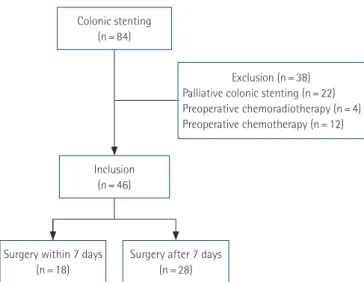
A total of 84 patients underwent colonic stenting for obstructive colorectal cancer. Patients who received colonic stenting for pallia- tive purposes (n= 22) or received preoperative chemoradiotherapy (n= 4) or chemotherapy (n= 12) after stent insertion were exclud- ed. Forty-six patients were enrolled in this study. Of them, 18 were assigned to the early surgery group and 28 were assigned to the late surgery group (Fig. 1).
The mean interval from colonic stenting to surgery between the two groups was significantly different (5.3±1.3 days vs. 15.4±6.2 days, respectively; P< 0.010). The interval ranges of two groups were 3 to 7 days and 8 to 33 days, respectively. The mean age of the early surgery group was younger than that of the late surgery group (63.7 years vs. 71.8 years; P= 0.010). There was no significant dif- ference in sex ratio, body mass index, comorbidities, ASA score, tumor location, T stage, N stage, or American Joint Committee on Cancer stage (Table 1).
A total of 10 patients with stage IV colorectal cancer underwent surgery for primary colorectal cancer (six in the early group and four in the late group). Combined resection for metastatic lesions was performed simultaneously in three patients (two in the early group and one in the late group). One patient in the late surgery group un- derwent radiofrequency ablation for liver metastasis (Table 2).
Perioperative results and complications
Operations, surgical approach, stoma rate, and operation time did not differ significantly between the two groups (Table 3). No con-
Fig. 1. Flowchart showing patient selection process in this study.
Colonic stenting (n = 84)
Exclusion (n = 38) Palliative colonic stenting (n = 22) Preoperative chemoradiotherapy (n = 4) Preoperative chemotherapy (n = 12)
Inclusion (n = 46)
Surgery within 7 days (n = 18)
Surgery after 7 days (n = 28)
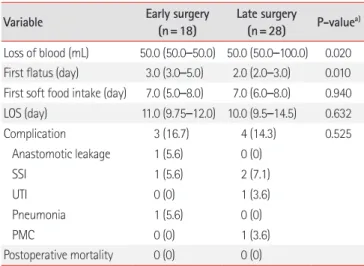
The postoperative course and complications are shown in Table 4. The degree of blood loss was lower in the early surgery group than in the late surgery group (median [interquartile range], 50 [50–50] mL vs. 50 [50–100] mL; P= 0.020). The time to first flatus was longer in the early surgery group (3.0 [3.0–5.0] days vs. 2.0 [2.0–3.0] days; P= 0.010). However, the time to first soft food in- take (7.0 [5.0–8.0] days vs. 7.0 [6.0–8.0] days; P= 0.940) and length of stay (11.0 [9.75–12.0] days vs. 10.0 [9.5–14.5] days; P= 0.632) were similar. No significant difference was seen in postoperative complications (16.7% vs. 14.3%, respectively; P= 0.525). Anasto- mosis leakage occurred in one patient in the early surgery group who underwent anterior resection and a right lobectomy for sig- moid colon cancer with liver metastasis 3 days after colonic stent- ing (patient 4 in Table 2). On postoperative day 7, anastomosis leakage was diagnosed and managed with resection of the anasto- mosis and end colostomy. A total of three patients experienced a surgical site infection (SSI). One in each group had a superficial in-
Variable surgery
(n=18)
surgery (n=28)
P-valuea)
From colonic stenting to surgery (day) 5.3± 1.3 15.4± 6.2 < 0.010b)
Age (yr) 63.7 (11.3) 71.8 (8.9) 0.010b)
Sex (male:female) 15:3 19:9 0.315
BMI (kg/m2) 22.9± 3.3 23.3± 3.1 0.554b)
Comorbidity 0.729
Hypertension 6 (33.3) 5 (17.9)
Diabetes 1 (5.6) 5 (17.9)
Cardiovascular disease 4 (22.2) 6 (21.4)
Pulmonary disease 2 (11.1) 0 (0)
ASA score 0.403
I 6 (33.3) 5 (17.9)
II 10 (55.6) 17 (60.7)
III 2 (11.1) 6 (21.4)
Tumor location 0.051
Right colon 3 (16.7) 0 (0)
Left colon 14 (77.8) 23 (82.1)
Rectum 1 (5.6) 5 (17.9)
T stage 0.131
1 0 (0) 1 (3.6)
2 0 (0) 0 (0)
3 11 (61.1) 23 (82.1)
4 7 (38.9) 4 (14.3)
N stage 0.863
0 9 (50.0) 12 (42.9)
1 4 (22.2) 8 (28.6)
2 5 (27.8) 8 (28.6)
AJCC stage 0.280
2 7 (38.9) 12 (42.9)
3 5 (27.8) 12 (42.9)
4 6 (33.3) 4 (14.3)
Values are presented as mean± standard deviation or number (%).
BMI, body mass index; ASA, American Society of Anesthesiologists; Right co- lon, from the cecum to proximal transverse colon; Left colon, from the distal transverse colon to sigmoid colon; AJCC, American Joint Committee on Cancer.
a)Pearson’s χ2 test. b)Student’s t-test.
Table 2. Surgical resections in patients with stage IV colorectal cancer
Patient Group Primary cancer location Metastasis location Surgery for primary cancer Combined resection for metastasis
1 Early Descending colon Peritoneum Left hemicolectomy -
2 Early Sigmoid colon Liver Anterior resection Right posterior sectionectomy (simultaneous)
3 Early Descending colon Peritoneum Left hemicolectomy -
4 Early Sigmoid colon Liver Anterior resection Right lobectomy (simultaneous)
5 Early Sigmoid colon Liver (multiple) Anterior resection -
6 Early Rectum Liver (multiple) Low anterior resection -
7 Late Sigmoid colon Liver Anterior resection Left hepatectomy (simultaneous)
8 Late Rectum Liver Low anterior resection Radiofrequency ablation (simultaneous)
9 Late Sigmoid colon Liver (multiple) Anterior resection -
10 Late Descending colon Peritoneum Left hemicolectomy -
Table 3. Perioperative outcomes between two groups
Variable Early surgery
(n=18)
Late surgery
(n=28) P-valuea)
Operations 0.111
Left hemicolectomy 4 (22.2) 4 (14.3) Anterior resection 6 (55.6) 21 (75.0) Hartmann’s procedure 1 (5.6) 3 (10.7) Right hemicolectomy 3 (16.7) 0 (0)
Surgical approach 0.194
Open 9 (50.0) 15 (53.6)
Laparoscopic 7 (38.9) 13 (46.4)
Robotic 2 (11.1) 0 (0)
Stoma creation 3 (16.7) 6 (21.4) > 0.990
Operation time (min) 180± 54 175± 68 0.826b)
Values are presented as mean± standard deviation or number (%).
a)Pearson’s χ2 test. b)Student’s t-test.
Hyunji Lee et al. • Early and late surgery following colonic stenting
cisional SSI, while one patient in the late surgery group had organ/
space SSI and underwent percutaneous drainage. No case of mor- tality occurred in either group.
Cancer recurrence, disease-free survival, and overall survival During a median follow-up period of 30 months (range, 7–97 months), the disease recurrence rate was not different significantly between the two groups (3/18, 16.7% vs. 9/28, 32.1%; P= 0.315).
Systemic recurrence occurred in three and seven patients in these groups, respectively. Two patients in late surgery group experi- enced local recurrence (Table 5).
The 5-year disease-free survival rate was similar in the early and late surgery groups (72.6% and 64.0%, respectively; P= 0.558) (Fig.
2A). The 5-year overall survival rate was lower in the late than early surgery group, but the difference was not significant (56.1% vs.
60.8%, respectively; P= 0.437) (Fig. 2B).
DISCUSSION
The optimal timing of surgery after colonic stenting has not been established. In the European guidelines, the suggested time interval between colonic stenting and surgery is 5–10 days when colonic stenting is used as a bridge to elective surgery in patients with po- tentially curable left-sided colon cancer [5]. The time interval in the guideline was determined based on a few studies with different qualities. For this reason, the recommendation on the time interval is weak and the level of evidence is low. In a meta-analysis compar- Table 4. Postoperative course and complications
Variable Early surgery
(n=18)
Late surgery
(n=28) P-valuea) Loss of blood (mL) 50.0 (50.0–50.0) 50.0 (50.0–100.0) 0.020 First flatus (day) 3.0 (3.0–5.0) 2.0 (2.0–3.0) 0.010 First soft food intake (day) 7.0 (5.0–8.0) 7.0 (6.0–8.0) 0.940 LOS (day) 11.0 (9.75–12.0) 10.0 (9.5–14.5) 0.632
Complication 3 (16.7) 4 (14.3) 0.525
Anastomotic leakage 1 (5.6) 0 (0)
SSI 1 (5.6) 2 (7.1)
UTI 0 (0) 1 (3.6)
Pneumonia 1 (5.6) 0 (0)
PMC 0 (0) 1 (3.6)
Postoperative mortality 0 (0) 0 (0) Values are presented as median (IQR) or number (%).
LOS, length of stay; SSI, surgical site infection; UTI, urinary tract infection;
PMC, pseudomembranous colitis; IQR, interquartile range.
a)Pearson’s chi-square test.
Table 5. Recurrence sites of the two groups Variable Early surgery
(n=18)
Late surgery
(n=28) P-value
Recurrence 3 (16.7) 9 (32.1) 0.315
Local 0 2
Systemic 3 7
Liver 2 3
Lung 1 0
Peritoneum 0 2
Multiple organs 0 2
Values are presented as number (%).
Fig. 2. (A) Disease-free and overall survival rates of the two groups.
The 5-year disease-free survival rate in the early surgery (72.6%) and late surgery (64.0%) groups (P=0.558). (B) The 5-year overall survival rates were 56.1% vs. 60.8%, respectively (P=0.437).
0 20 40 60 80 100 Time after surgery (mo)
1.0
0.8
0.6
0.4
0.2
0
Cumulative disease-free survival rate
Early surgery Late surgery
A
0 20 40 60 80 100 Time after surgery (mo)
1.0
0.8
0.6
0.4
0.2
0
Cumulative overall survival rate
Early surgery Late surgery
B
performed after a median 10 days after colonic stenting [6]. This study, however, did not aim to determine the optimal time interval between colonic stenting and surgery. Moreover, the median 10 days resulted from statistical analysis of the data from the included studies. A retrospective study concluded that a duration of 7–9 days after colonic stenting in patients with obstructive left-sided colon cancer is sufficient to subsequently perform a safe surgical procedure. This study, however, has limitations for drawing the conclusion. It was a single arm study that did not compare the pa- tient groups according to the time interval after colonic stenting whose conclusion was supported by limited and logically flawed descriptions [7]. Thus, well-designed, highly reliable studies are re- quired to conclude the optimal timing of surgery after colonic stenting.
In this study, the patients in the early surgery group were young- er than those in the late surgery group. It is a common belief that the general health and performance status of young patients are better than those of older ones. Older patients usually require more preoperative examinations. Nonetheless, age does not usually in- fluence the timing of surgery after colonic stenting. In our previ- ously published study comparing the postoperative outcomes of obstructive colorectal cancer patients aged < 70 years and those aged ≥ 70 years, the time interval between colonic stenting and surgery did not differ significantly between the two groups and the postoperative complications were similar [8]. According to the re- sults of the previous study, the difference in age between the early and late surgery groups is not thought to affect the comparison of the postoperative outcomes. In addition, comorbidities, ASA score, and other variables influencing on the preoperative check- up and postoperative complications, did not differ between the two groups in the present study.
The operation time and blood loss are variables representative of surgical difficulty [9]. In this study, the operation time did not dif- fer significantly between the two groups. Estimated blood loss was lower in the early surgery group, which indicates a lower degree of surgical difficulty. These results show that early surgery can be per- formed without increased surgical difficulty.
The postoperative course of the two groups was similar in this study. Despite the early surgery group having a longer time to first flatus, no significant differences were found in the time to first soft food intake or, eventually, length of stay.
The postoperative complication rate is similar between two groups (16.7% vs. 14.3%, respectively; P= 0.525). The complication rate (7/46, 15.2%) was consistent with those of other studies of 8.5%–25% [8,10,11].
wall edema is thought to contribute to the occurrence of anasto- mosis leakage. The time interval after colonic stenting to achieve an appropriate bowel thickness for safe anastomosis, although not well known, is influenced by many factors such as stent expansion, obstructive bowel length, obstruction duration, and nutritional status. In the present study, one patient who underwent anterior resection 3 days after colonic stenting with a simultaneous right lo- bectomy for liver metastasis developed anastomosis leakage on postoperative day 7. Thus, 3 days might be an insufficient time for the normal physiology of the bowel to resume. Additionally, a wide range of surgical interventions would be another risk factor for anastomosis leakage. Except for that one patient, no other patients in the early surgery group developed anastomosis leakage regard- less of stoma status. In the present study, achieving a suitable bowel status for a safe anastomosis was possible within 7 days. The rates of anastomosis leakage in all patients and those without a stoma were 2.2% (1/46) and 2.7% (1/37), respectively. These rates are con- sistent with those of other studies (range, 0%–10.6%) [6-8].
In this study, the surgical timing did not affect oncologic out- comes. No significant differences were noted in 5-year disease-free and overall survival rates. In the literature, few studies have ana- lyzed the effect of surgical timing after colonic stenting on onco- logic outcomes. Oncologic outcomes between elective surgery fol- lowing colonic stenting and emergency surgery are controversial.
Some studies reported comparable oncologic outcomes of elective surgery after colonic stenting to emergency surgery [12-14]. In contrast to our findings, worse oncologic outcomes of colonic stenting were published [15,16]. These outcomes are mainly asso- ciated with tumor cell dissemination caused by tumor perforation related to colonic stenting and stent placement [16-18]. A longer interval between colonic stenting and surgery may increase the risk of stent-related complications including tumor perforation [5].
In the present study, no tumor perforation or other stent-related complications occurred in enrolled patients regardless of the surgi- cal timing, which might be a reason for the lack of oncologic dif- ferences between the two groups.
There are limitations of the present study. First, it was not a pro- spective controlled study, so it carries the risk of selection bias. Sec- ond, its relatively small number of enrolled patients may reduce the power of its results.
In conclusion, outcomes were similar between early and late surgery patients. However, early surgery patients had less blood loss, which indicates a lower degree of surgical difficulty. These re- sults show that early surgery can be performed safely to treat ob- structive colorectal cancer patients after colonic stenting if the pa-
Hyunji Lee et al. • Early and late surgery following colonic stenting
tient’s clinical condition is amenable to early surgery.
CONFLICT OF INTEREST
No potential conflict of interest relevant to this article was reported.
REFERENCES
1. Tan CJ, Dasari BV, Gardiner K. Systematic review and meta-analy- sis of randomized clinical trials of self-expanding metallic stents as a bridge to surgery versus emergency surgery for malignant left-sided large bowel obstruction. Br J Surg 2012;99:469-76.
2. Iversen LH, Bulow S, Christensen IJ, Laurberg S, Harling H, Dan- ish Colorectal Cancer Group. Postoperative medical complications are the main cause of early death after emergency surgery for co- lonic cancer. Br J Surg 2008;95:1012-9.
3. Dulucq JL, Wintringer P, Beyssac R, Barberis C, Talbi P, Mahajna A.
One-stage laparoscopic colorectal resection after placement of self-expanding metallic stents for colorectal obstruction: a pro- spective study. Dig Dis Sci 2006;51:2365-71.
4. Zhang Y, Shi J, Shi B, Song CY, Xie WF, Chen YX. Self-expanding metallic stent as a bridge to surgery versus emergency surgery for obstructive colorectal cancer: a meta-analysis. Surg Endosc 2012;
26:110-9.
5. van Hooft JE, van Halsema EE, Vanbiervliet G, Beets-Tan RG, De- Witt JM, Donnellan F, et al. Self-expandable metal stents for ob- structing colonic and extracolonic cancer: European Society of Gastrointestinal Endoscopy (ESGE) Clinical Guideline. Gastroin- test Endosc 2014;80:747-61.e1-75.
6. De Ceglie A, Filiberti R, Baron TH, Ceppi M, Conio M. A me- ta-analysis of endoscopic stenting as bridge to surgery versus emer- gency surgery for left-sided colorectal cancer obstruction. Crit Rev Oncol Hematol 2013;88:387-403.
7. Abdussamet Bozkurt M, Gonenc M, Kapan S, Kocatass A, Tem- izgonul B, Alis H. Colonic stent as bridge to surgery in patients with obstructive left-sided colon cancer. JSLS 2014;18:e2014.
00161.
8. Park CH, Baek SK, Bae OS, Jeong WK. Influence of old age on the postoperative outcomes of obstructive colorectal cancer surgery after the insertion of a stent. Ann Surg Treat Res 2015;89:183-9.
9. Veenhof AA, Engel AF, van der Peet DL, Sietses C, Meijerink WJ,
de Lange-de Klerk ES, et al. Technical difficulty grade score for the laparoscopic approach of rectal cancer: a single institution pilot study. Int J Colorectal Dis 2008;23:469-75.
10. Kim JS, Hur H, Min BS, Sohn SK, Cho CH, Kim NK. Oncologic outcomes of self-expanding metallic stent insertion as a bridge to surgery in the management of left-sided colon cancer obstruction:
comparison with nonobstructing elective surgery. World J Surg 2009;33:1281-6.
11. Jimenez-Perez J, Casellas J, Garcia-Cano J, Vandervoort J, Gar- cia-Escribano OR, Barcenilla J, et al. Colonic stenting as a bridge to surgery in malignant large-bowel obstruction: a report from two large multinational registries. Am J Gastroenterol 2011;106:2174- 80.
12. Kim HJ, Choi GS, Park JS, Park SY, Jun SH. Higher rate of perineu- ral invasion in stent-laparoscopic approach in comparison to emergent open resection for obstructing left-sided colon cancer.
Int J Colorectal Dis 2013;28:407-14.
13. Kavanagh DO, Nolan B, Judge C, Hyland JM, Mulcahy HE, O’Connell PR, et al. A comparative study of short- and medi- um-term outcomes comparing emergent surgery and stenting as a bridge to surgery in patients with acute malignant colonic obstruc- tion. Dis Colon Rectum 2013;56:433-40.
14. Kim HJ, Huh JW, Kang WS, Kim CH, Lim SW, Joo YE, et al. Onco- logic safety of stent as bridge to surgery compared to emergency radical surgery for left-sided colorectal cancer obstruction. Surg Endosc 2013;27:3121-8.
15. Gorissen KJ, Tuynman JB, Fryer E, Wang L, Uberoi R, Jones OM, et al. Local recurrence after stenting for obstructing left-sided co- lonic cancer. Br J Surg 2013;100:1805-9.
16. Sloothaak DA, van den Berg MW, Dijkgraaf MG, Fockens P, Tanis PJ, van Hooft JE, et al. Oncological outcome of malignant colonic obstruction in the Dutch Stent-In 2 trial. Br J Surg 2014;101:1751- 7.
17. Maruthachalam K, Lash GE, Shenton BK, Horgan AF. Tumour cell dissemination following endoscopic stent insertion. Br J Surg 2007;94:1151-4.
18. Suarez J, Jimenez-Perez J. Long-term outcomes after stenting as a
“bridge to surgery” for the management of acute obstruction sec- ondary to colorectal cancer. World J Gastrointest Oncol 2016;8:
105-12.