Objectives : This study was intended to understand characteristics of symptoms, oriental medicine prescription and laboratory test results according to elapsed time of stroke.
Methods : Through the medical records of 205 stroke inpatients in the oriental medical hospital in the year 2010, we investigated manifested symptoms, administered oriental medicine prescription and clinical pathological examination results. Collected items were classified to depend on stroke types, cerebral infarction and hemorrhage. We analyzed association between manifested symptoms, the oriental medicine prescription, and laboratory test results of stroke patients and elapsed time.
Chi-square tests were performed to determine the significance level of association.
Results : All symptoms, prescriptions and laboratory test results in cerebral infarction patients were associated with elapsed time. Especially, symptoms, prescriptions and pathological examination results showed very high statistical significance with elapsed time (a symptom; chi-square(df)
=164.3(22), p<0.001, prescription; chi-square(df)=93.5(22), p<0.001, and pathological examination results; chi-square(df)=164.3(22), p<0.0004). But in the case of cerebral hemorrhage, there was not statistical significance.
Clinical Analysis of Symptoms and Oriental Medical Prescriptions According to Elapsed Time of Stroke in
Oriental Medical Hospital Inpatients
Hen-Ja Yun 1 , Kang-Keyng Sung 2
1 Won-Kwang Bu-bu Oriental Clinic
2 Dept. of Oriental internal medicine, Oriental Medical School, Won-Kwang University
ABSTRACT
49)
•Corresponding Author : Kang-Keyng Sung
•543-8, Juwol-Dong, Nam-Gu, Gwangju, 503-310, Korea
•Tel : +82-62-670-6412 Fax : +82-62-670-6767 E-mail : [email protected]
•접수 : 2012/ 04/ 25 수정 : 2012/ 06/ 05 채택 : 2012/ 06/ 08
•This paper was supported by wonkwang university in 2010
Conclusions : The elapsed time of stroke may be an essential requisite in catching symptoms and prescribing for stroke patients in oriental medical treatment.
Key word : Stroke, Elapsed Time, Oriental Medicine Prescription, Symptoms, Clinical Analysis
Ⅰ. Introduction
The phase of disease is an important factor for diagnosis and prescription in the oriental medical area. Stroke patients have neurologic symptoms associated with damaged brain areas 1) . In addition to those protopathic symptoms, various secondary symptoms also are caused in the development process of stroke 1) . These successive symptoms are appeared diversely in a manner of physiologic or psychological side and become very important factors in terms of diagnosis and prescription of stroke patients in oriental medical treatment 2) . The symptom is affected by diverse factors such as damaged brain area, stroke type, sex, ages, elapsed time, complications, genetic factor and environmental factor 3) . However, it is not easy to understand the correlation between unique symptom, or oriental medicine prescription and the factors affecting stroke symptom. This study adopted a retrospective method which investigates medical records for 205 stroke patients admitted at the oriental medical hospital in the year 2010. We analyzed correlation between manifested symptoms, the oriental medicine prescription, and laboratory test results of stroke patients and elapsed time.
Ⅱ. Material and Method
1. Data selection
Data for this study are obtained from the medical recording chart of the stroke inpatients admitted at Wonkwang University Gwangju Oriental Medical Hospital from January to December 2010. Through a screening of a medical record retrospectively, 205 stroke patients diagnosed with cerebral infarction or cerebral hemorrhage by CT or MRI was selected as a subject for this study.
We first classified patients into cerebral infarction and hemorrhage and analyzed sex. The demographic characteristics of the patients are summarized in Table 1.
2. Data analysis
We investigated manifested symptoms, administered
oriental medicine prescriptions, blood test results,
the urine test results according to elapsed time in
each group of patients. Manifested symptoms and
clinical pathological examination results were
investigated at the same time point that
administered prescription. The names of symptoms
were rearranged according to name in DONG
YANG EU HAK DAE SA JEON(oriental medical
sym * time table
symptom Acute Subacute time Chronic total
Hemiparesis 59 49 39
147
30.584 41.107 75.309
40.14 33.33 26.53
Table 2. The Appeared Symptom over the Elapsed Time of Cerebral Infarction dictionary 4) ). We investigated the prescription
every time it changed. Adjusted prescriptions among the administered oriental medical prescriptions were attributed to original oriental medical prescriptions.
Collected prescription reclassified into the oriental pharmacy categories. The elapsed time was arranged into acute stage(1week), sub acute stage(2-3week) and chronic stage(after 4week). Statistical treatment was taken on the data over five times.
3. Statistics
Chi-square tests were performed to determine the significance level of association between manifested symptoms, clinical pathological factors, and the oriental medicine prescription of stroke patients and elapsed time. Statistical calculations were performed using SPSS system version 18.
Ⅲ. Results
1. The demographic characteristics of the patients
The chart retrospectively reviewed included 205 stroke patients. Cerebral infarction patient was 167(81%), among them male was 86(42%), and female was 81(39%). Cerebral hemorrhage patient was 38(19%), male was 25(12%), and female
was 13(7%).
Stroke type Number
of stroke Sex Male Female Cerebral infarction 167(81%) 86(42%) 81(39%) Cerebral Hemorrhage 38(19%) 25(12%) 13(7%)
Total 205(100%) 111(54%) 94(46%) Table 1. The demographic characteristics of the
patients
2. Correlation between manifested symptoms and elapsed time of stroke
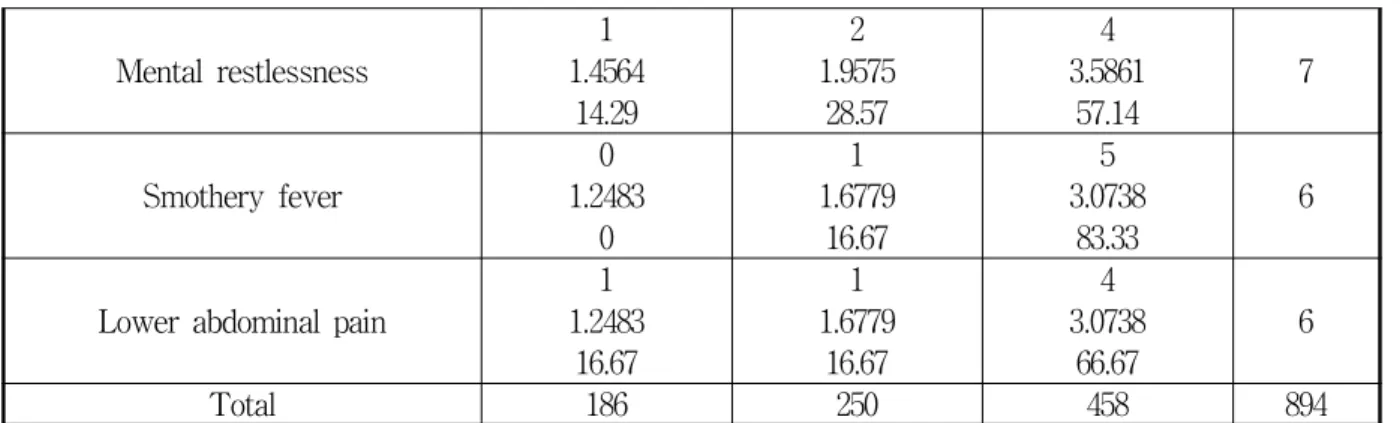
Symptoms in cerebral infarction patients were 51 different kinds and appeared at 945 times.
Among them, symptoms over 5times had a strong statistical correlation with elapsed time. Symptoms in cerebral infarction patients showed very high statistical significance(chi-square(df)=230.3022(62), p<0.0001, Table 2).
According to stroke phase, frequent symptoms were different. In acute state, hemiparesis(59), numbness(29) and confusion(17) appeared frequently, and over time Musculoskeletal Pain(55), Lack of Gi, Anorexia(42), Abdominal Distension(26)and Dizziness(21) showed up in order of frequency.
Symptoms In cerebral hemorrhage appeared at
194 times for 43 different kinds. But there was a
not statistical correlations with stroke phase.
Musculoskeletal pain 13 17 55
85
17.685 23.77 43.546
15.29 20 64.71
Anorexia 3 14 38
55
11.443 15.38 28.177
5.45 25.45 69.09
Lack of Gi 0 12 42
54
11.235 15.101 27.664
0 22.22 77.78
Numbness 29 16 6
51
10.611 14.262 26.128
56.86 31.37 11.76
Thirst 5 17 21
43
8.9463 12.025 22.029
11.63 39.53 48.84
Confusion 17 15 8
40
8.3221 11.186 20.492
42.5 37.5 20
Facial palsy 8 14 17
39
8.1141 10.906 19.98
20.51 35.9 43.59
Abdominal Distension 1 10 26
37
7.698 10.347 18.955
2.7 27.03 70.27
Dizziness 4 11 21
36
7.4899 10.067 18.443
11.11 30.56 58.33
Tension 1 2 22
25
5.2013 6.9911 12.808
4 8 88
Constipation 2 5 17
24
4.9933 6.7114 12.295
8.33 20.83 70.83
Dysuria 3 3 15
21
4.3691 5.8725 10.758
14.29 14.29 71.43
Cough 3 10 8
21
4.3691 5.8725 10.758
14.29 47.62 38.1
Weakness 6 1 13
20
4.1611 5.5928 10.246
30 5 65
Insomnia 6 5 8
19
3.953 5.3132 9.7338
31.58 26.32 42.11
Nausea 2 3 12
17
3.5369 4.7539 8.7092
11.76 17.65 70.59
Spontaneous sweating 1 6 10
17
3.5369 4.7539 8.7092
5.88 35.29 58.82
Night sweating 4 5 7
16
3.3289 4.4743 8.1969
25 31.25 43.75
Difficulty in speaking 2 7 5
14
2.9128 3.915 7.1723
14.29 50 35.71
Low back pain 3 5 5
13
2.7047 3.6353 6.66
23.08 38.46 38.46
Headache 0 3 9
12
2.4966 3.3557 6.1477
0 25 75
Chest and abdominal pain 6 3 3
12
2.4966 3.3557 6.1477
50 25 25
Aphasia with stiffness of the tongue 3 2 6
11
2.2886 3.0761 5.6353
27.27 18.18 54.55
Diarrhea 0 3 7
10
2.0805 2.7964 5.123
0 30 70
Epigastric fullness 0 1 9
10
2.0805 2.7964 5.123
0 10 90
Fear, palpitation and severe palpitation
0 3 6
9
1.8725 2.5168 4.6107
0 33.33 66.67
Fever and aversion to cold 1 2 6
9
1.8725 2.5168 4.6107
11.11 22.22 66.67
Frequent urination 2 2 4
8
1.6644 2.2371 4.0984
25 25 50
Mental restlessness 1 2 4
7
1.4564 1.9575 3.5861
14.29 28.57 57.14
Smothery fever 0 1 5
6
1.2483 1.6779 3.0738
0 16.67 83.33
Lower abdominal pain 1 1 4
6
1.2483 1.6779 3.0738
16.67 16.67 66.67
Total 186 250 458 894
Total Number of appearance of Symptom=894, chi-square(df)=230.3022(62), p<0.0001
sym * time table
LAB Acute Subacute time Chronic total
RBC 38 39 78
155
49.381 35.869 69.75
24.52 25.16 50.32
PCT 45 33 73
151
48.107 34.943 67.95
29.8 21.85 48.34
Hct 19 19 52
90
28.673 20.827 40.5
21.11 21.11 57.78
Lym% 34 26 27
87
27.717 20.133 39.15
39.08 29.89 31.03
Glucose 38 19 23
80
25.487 18.513 36
47.5 23.75 28.75
Table 3. The LAB of Cerebral Infarction-total 3. Correlation between clinical pathological
factor and elapsed time of stroke
41 different kinds of a pathological factor in blood and urine of cerebral infarction patients showed an abnormal response. Abnormal pathological factors over 5times in cerebral infarction patients showed very high statistical significance(chi-square(df)=
126.828(78), p<0.0004, Table 3). RBC, PCT, Hct, Lym%, glucose, Triglyceride, Mono%, Neu%, ESR, Protein(UA), Total cholesterol, Hgb, Eos%, Leukocytes(UA) and WBC(UA).
Were abnormal states frequently. In cerebral
hemorrhage were 39 kinds but there were a not
statistical correlation with stroke phase.
Triglyceride 26 14 35
75
23.894 17.356 33.75
34.67 18.67 46.67
Mono% 19 15 30
64
20.39 14.81 28.8
29.69 23.44 46.88
Neu% 17 12 35
64
20.39 14.81 28.8
26.56 18.75 54.69
ESR 6 18 33
57
18.16 13.19 25.65
10.53 31.58 57.89
Protein(UA) 12 15 26
53
16.885 12.265 23.85
22.64 28.3 49.06
Total cholesterol 22 8 19
49
15.611 11.339 22.05
44.9 16.33 38.78
Hgb 10 8 24
42
13.381 9.7192 18.9
23.81 19.05 57.14
Leukocytes(UA) 9 9 23
41
13.062 9.4878 18.45
21.95 21.95 56.1
WBC(UA) 9 5 24
38
12.106 8.7936 17.1
23.68 13.16 63.16
Eos% 13 8 16
37
11.788 8.5622 16.65
35.14 21.62 43.24
Glucose(UA) 19 7 11
37
11.788 8.5622 16.65
51.35 18.92 29.73
HDL cholesterol 18 5 8
31
9.8763 7.1737 13.95
58.06 16.13 25.81
Occult blood(UA) 6 6 19
31
9.8763 7.1737 13.95
19.35 19.35 61.29
PDW 8 9 12
29
9.2391 6.7109 13.05
27.59 31.03 41.38
MPV 10 4 14
28
8.9205 6.4795 12.6
35.71 14.29 50
Neu# 8 11 9
28
8.9205 6.4795 12.6
28.57 39.29 32.14
Eos# 9 8 7
24
7.6462 5.5538 10.8
37.5 33.33 29.17
WBC 6 9 8
23
7.3276 5.3224 10.35
26.09 39.13 34.78
Creatinine 11 5 7
23
7.3276 5.3224 10.35
47.83 21.74 30.43
HbA1c 11 4 8
23
7.3276 5.3224 10.35
47.83 17.39 34.78
ALP 7 4 10
21
6.6904 4.8596 9.45
33.33 19.05 47.62
K 5 3 11
19
6.0532 4.3968 8.55
26.32 15.79 57.89
MCV 8 5 4
17
5.416 3.934 7.65
47.06 29.41 23.53
MCH 6 5 6
17
5.416 3.934 7.65
35.29 29.41 35.29
PLT 4 5 7
16
5.0974 3.7026 7.2
25 31.25 43.75
r-GTP 7 4 5
16
5.0974 3.7026 7.2
43.75 25 31.25
Na 5 3 8
16
5.0974 3.7026 7.2
31.25 18.75 50
BUN 7 2 5
14
4.4603 3.2397 6.3
50 14.29 35.71
Mono# 4 6 2
12
3.8231 2.7769 5.4
33.33 50 16.67
RBC(UA) 1 2 8
11
3.5045 2.5455 4.95
9.09 18.18 72.73
RDW 4 2 4
10
3.1859 2.3141 4.5
40 20 40
AST 5 2 3
10
3.1859 2.3141 4.5
50 20 30
Cl 5 1 2
8
2.5487 1.8513 3.6
62.5 12.5 25
ALT 3 1 3
7
2.2301 1.6199 3.15
42.86 14.29 42.86
Lym# 3 0 3
6
1.9115 1.3885 2.7
50 0 50
total 497 361 702 1560
Total Number of appearance of abnormal pathological factor =1560, chi-square(df)=126.828(78), p<0.0004
sym * time table
prescription Acute Subacute time Chronic total
Sopung-tang 22 12 3
37
9.25 9.6566 18.093
59.46 32.43 8.11
Table 4. The oriental Medicine Prescription Changed Depending on Elapsed Time of Cerebral Infarction 4. Correlation between administered oriental
medicine prescriptions and elapsed time of stroke.
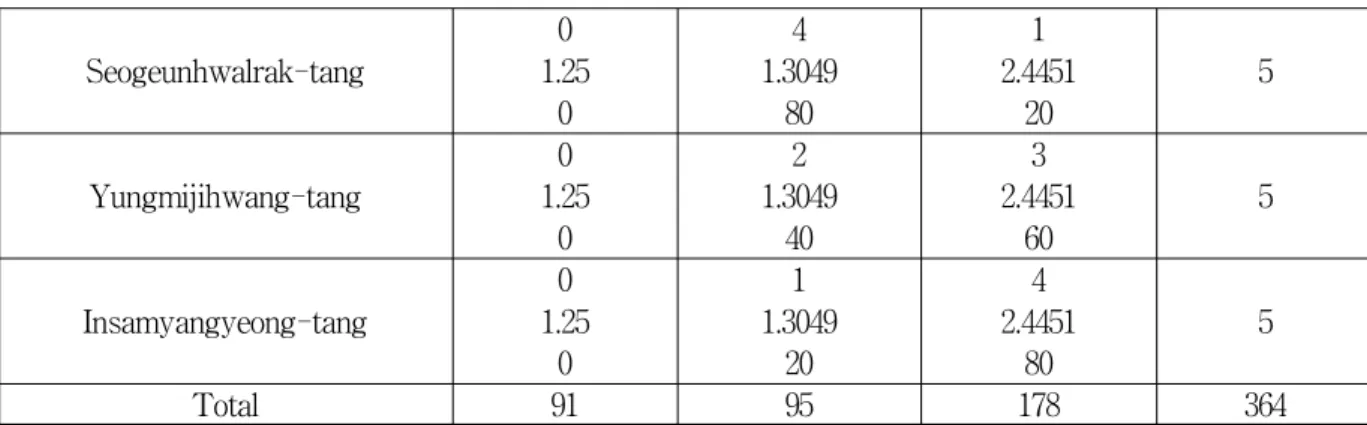
116 different kinds of oriental medicine prescriptions were used at 507 times for cerebral infarction patients. Oriental medicine prescriptions used were classified to 18 kinds of pharmacy category. All prescription and pharmacy category showed a high
level correlation with elapsed time in cerebral infarction
patients showed very high statistical significance
(prescription; chi-square(df)=164.0948(62), p<0.0001,
pharmacy category; chi-square(df)=99.8037(28),
p<0.0001, Table 4, Table 5) In cerebral hemorrhage,
medicine prescriptions and pharmacy category were
60 and 17 respectively. There were a not statistical
correlation with stroke phase.
Seunghyangjeonggi-san 16 10 5
31
7.75 8.0907 15.159
51.61 32.26 16.13
Sungihwalheyl-tang 4 11 9
24
6 6.2637 11.736
16.67 45.83 37.5
Cheongsimyeonja-eum 5 5 11
21
5.25 5.4808 10.269
23.81 23.81 52.38
Mangum-tang 7 1 11
19
4.75 4.9588 9.2912
36.84 5.26 57.89
Boyanghwano-tang 3 2 11
16
4 4.1758 7.8242
18.75 12.5 68.75
Taehwa-hwan 0 3 12
15
3.75 3.9148 7.3352
0 20 80
Oyaksungi-san 0 3 11
14
3.5 3.6538 6.8462
0 21.43 78.57
Gamidaebo-tang 0 1 12
13
3.25 3.3929 6.3571
0 7.69 92.31
Bojungikgi-tang 1 6 5
12
3 3.1319 5.8681
8.33 50 41.67
Ssanghwa-tang 0 1 11
12
3 3.1319 5.8681
0 8.33 91.67
Cheonmagudeung-eum 4 4 4
12
3 3.1319 5.8681
33.33 33.33 33.33
Sopunghwalheyl-tang 6 1 3
10
2.5 2.6099 4.8901
60 10 30
Jihwangeum-ja 2 0 8
10
2.5 2.6099 4.8901
20 0 80
Hyangsaeukgunja-tang 0 5 5
10
2.5 2.6099 4.8901
0 50 50
Dansamhwano-tang 6 1 2
9
2.25 2.3489 4.4011
66.67 11.11 22.22
Igigeopung-tang 4 2 3
9
2.25 2.3489 4.4011
44.44 22.22 33.33
Gwibi-tang 1 0 7
8
2 2.0879 3.9121
12.5 0 87.5
Haewulhwajung-tang 1 0 7
8
2 2.0879 3.9121
12.5 0 87.5
Gochimu-san 2 3 2
7
1.75 1.8269 3.4231
28.57 42.86 28.57
Samreongbagchul-san 0 2 5
7
1.75 1.8269 3.4231
0 28.57 71.43
Sunpunggwengi-san 1 3 3
7
1.75 1.8269 3.4231
14.29 42.86 42.86
Ganghwalyupung-tang 1 2 3
6
1.5 1.5659 2.9341
16.67 33.33 50
Dochwalgisaeng-tang 2 2 2
6
1.5 1.5659 2.9341
33.33 33.33 33.33
Jechu-geon 0 3 3
6
1.5 1.5659 2.9341
0 50 50
Gamihaeo-tang 2 1 2
5
1.25 1.3049 2.4451
40 20 40
Banhabaekchulceonma-tang 0 1 4
5
1.25 1.3049 2.4451
0 20 80
Bopeyangyeong-geon 1 3 1
5
1.25 1.3049 2.4451
20 60 20
Bunsimgi-eum 0 0 5
5
1.25 1.3049 2.4451
0 0 100
Seogeunhwalrak-tang 0 4 1
5
1.25 1.3049 2.4451
0 80 20
Yungmijihwang-tang 0 2 3
5
1.25 1.3049 2.4451
0 40 60
Insamyangyeong-tang 0 1 4
5
1.25 1.3049 2.4451
0 20 80
Total 91 95 178 364
Total Number of Used Prescription=364, chi-square(df)=164.0948(62), p<0.0001
sym * time table
time total
Acute Subacute Chronic
dispelling wind (袪風) 54 39 36
129
27.818 34.364 66.818
41.86 30.23 27.91
invigorating and replenishing (補益)
7 12 45
64
13.801 17.049 33.15
10.94 18.75 70.31
regulateing Gi (理氣) 6 15 41
62
13.37 16.516 32.114
9.68 24.19 66.13
therapy for invigoration (補養) 2 12 29
43
9.2727 11.455 22.273
4.65 27.91 67.44
regulateing the blood (理血) 16 7 17
40
8.6258 10.655 20.719
40 17.5 42.5
promote digestion and remove food stagnancy (消導)
2 7 26
35
7.5476 9.3235 18.129
5.71 20 74.29
draining Fire (瀉火) 6 6 12
24
5.1755 6.3932 12.431
25 25 50
calming the Wind (治風) 5 6 7
18
3.8816 4.7949 9.3235
27.78 33.33 38.89
relieving phlegm (除痰) 0 7 6
13
2.8034 3.463 6.7336
0 53.85 46.15
Table 5. The 제제of Cerebral Infarction
exterior and interior (表裏) 2 2 5
9
1.9408 2.3975 4.6617
22.22 22.22 55.56
clearing summer heat (淸暑) 0 4 4
8
1.7252 2.1311 4.1438
0 50 50
calming the spirit (安神) 2 3 3
8
1.7252 2.1311 4.1438
25 37.5 37.5
Harmonizing (和解) 0 1 7
8
1.7252 2.1311 4.1438
0 12.5 87.5
Purgation (瀉下) 0 3 3
6
1.2939 1.5983 3.1078
0 50 50
dispelling superficial pathogens (發表)
0 2 4
6
1.2939 1.5983 3.1078
0 33.33 66.67
Total 102 126 245 473
Total Number of Pharmacy category =473, chi-square(df)=99.8037(28), p<0.0001,