Exploring the Impact of a STEM Integration Teacher Professional Development Program on Secondary Science and
Mathematics Teachers’ Perceptions of Engineering and Their Attitude toward Engineering Integrated Teaching
Hui-Hui Wang1 and Younkyeong Nam2,*
1Youth Development and Agriculture Education, Purdue University, Illinoi, 47907, USA
2Convergence Research Institute, Sungkyunkwan University, Suwon, 440-746, Korea
Abstract: This study explores the impact of a STEM integration teacher professional development program focusing on teachers’ perception of engineering and their attitudes toward integrating engineering into teaching. A total of sixty-eight teachers from ten schools participated in the program for five days. Data are collected from three main sources including (1) pre and post concept maps probing teachers’ perceptions about the engineering discipline, (2) a pre and post survey measuring teachers’ self-efficacy of teaching science/mathematics within the engineering context, and (3) engineering integrated science and (or) mathematics lesson plans and teaching reflections. This study utilizes both qualitative and quantitative research methods depending on the data we have collected. The results show that both science and math teachers thought that integrating engineering into teaching provided valuable outcomes, i.e., promoting students’ learning about engineering and improving their interest in science or math through real-world problem solving exercises.
Participants also felt more comfortable about integrating engineering in their teaching after the program. The results also imply that the teachers’ understandings of engineering become more concrete after the program. This study also provides an overview of the challenges and advantages of teaching engineering in K-12 science and mathematics classrooms.
Keywords: engineering education, teacher professional development, STEM education
Introduction
In the executive report to President Barack Obama, Prepare and Inspire: K-12 Education in Science, Technology, Engineering, and Math (STEM) Education for America’s Future, the President’s Council of Advisors on Science and Technology stated that the education system in the United States must prepare students to have a strong foundation in science, technology, engineering and mathematics (STEM) (President’s Council of Advisors on Science and Technology, 2010). The report also pointed out that if
the U.S. wants to remain a leader among nations in many aspects in the future, the education system needs to inspire and motivate students to study STEM subjects to support the need in the workforce of STEM fields (President’s Council of Advisors on Science and Technology, 2010). The report clearly stated the pressing need to improve the quality of K- 12 STEM education. In order to improve STEM education in K-12, the report claims that schools need to recruit and maintain qualified teachers in STEM fields. The report concluded that the progress and prosperity of the United States in the future will depend on the quality of STEM education.
Educators are mobilizing at the national and state level to meet the call to increase students’ interest and achievement in STEM fields. Many states, such as Minnesota, Texas, Oregon, and Massachusetts, support the STEM education movement with legislated efforts such as the addition of engineering standards to the existing science standards (Minnesota academic standards:
*Corresponding author: [email protected]
*Tel: +82-10-4753-1765
*Fax: +82-31-290-7996
This is an Open-Access article distributed under the terms of the Creative Commons Attribution Non-Commercial License (http://
creativecommons.org/licenses/by-nc/3.0) which permits unrestricted non-commercial use, distribution, and reproduction in any medium, provided the original work is properly cited.
Science K-12, 2009; National Governors Association, 2007). This situation is similar with South Korea’s educational context. As a result of national spotlight on STEM education as a possible solution to improving students’ interest in science, research about STEM education for K-12 students has been increased dramatically during last five years (e.g Son et al., 2014).
In many aspects, engineering has been considered the bridge to connect STEM subjects together. For example, by providing a gateway that turns abstract scientific and mathematics concepts into concrete real- life applications (Erin, 1998; Katehi et al., 2009; Roth, 2001), engineering can potentially act as a catalyst to improve student learning and achievement in science and mathematics (Akins and Burghardt, 2006; Fortus et al., 2004; Katehi et al., 2009; Thornburg, 2009).
Furthermore, building an engineering project can also serve as a pedagogical strategy to combine problem solving, creative thinking and presentation skills in other STEM subjects as well (Erwin, 1998; Katehi et al., 2009; Lewis, 2006; Roth, 2001; Thornburg, 2009).
The importance of integrating engineering into K-12 science education has been reflected in the recently released national document, Next Generation Science Standards in the U.S. (NGSS Lead States, 2013). This national standards includes “Engineering and technology and application of science” as one of four science disciplines.
Although integrating engineering into science and mathematics teaching and learning has many advantages, engineering rarely receives attention in K-12 classrooms.
In South Korea, STEM education has been received attention from many science and mathematics educators during last five years. However, engineering integrated science teaching has only recently introduced as a new pedagogical approach over the past three years (Kim and Kim, 2014).
Much research has suggested that the majority of K- 12 science and mathematics teachers lack engineering knowledge and experience, as well as how to utilize engineering to connect other STEM subjects (Cunningham and Knight, 2004; Oware et al., 2007). In other words,
many science and mathematics teachers may have difficulty implementing curriculum that calls for the infusion of engineering concepts into their teaching.
This may impede achieving the goal of STEM literacy in K-12 schools in the U.S because teachers’ perceptions and understandings of engineering affect their teaching practice of how to develop and implement engineering integrated lesson plans and how to assess students’
learning of engineering (Guzey et al., 2014). More importantly, teachers’ understandings of what important concepts in a discipline affect their attitude and self- efficacy of teaching the concepts in their classroom (Kwak, 2002). In other words, teachers’ understandings of engineering and engineering practices affect their attitude and pedagogical approach of how to teach engineering.
To help teachers integrate engineering into their teaching, it is imperative to develop and implement quality professional development programs that teach more in-depth knowledge of engineering and how to integrate engineering into science, mathematics and technology. Yet, unfortunately we do not have enough research that examines how we can help teachers improve their understanding of engineering and how to integrate it into their science or mathematics teaching.
This study explores the impact of a STEM integration teacher professional development program focusing on teachers’ perception of engineering and their attitudes on integrating engineering and teaching. This study also provides an overview of the challenges and advantages of teaching engineering in K-12 science and mathematics classrooms. The research questions that guide this study are:
1) How did the teachers’ perceptions of engineering change after the program?
2) How did the teachers’ attitudes of integrating engineering into science/mathematic teaching change after the program?
3) What were the teachers’ challenges and advantages of integrating engineering with science/mathematics teaching?
Literature Review: Teaching Engineering in K-12 Classroom
Engineering education in K-12 schools is in its early development. The report, Engineering in K-12 Education, recently released by the National Academy of Engineering and National Research Council (Katehi et al., 2009) provided a very insightful view of engineering education in K-12. The report claimed three main principles for K-12 engineering education.
First, it believed K-12 engineering education should emphasize engineering design. Second, K-12 engineering should incorporate important science, mathematics, and technology concepts and skills. Finally, K-12 engineering should align with 1) systems thinking, 2) creativity, 3) optimism, 4) collaboration, 5) communication, and 6) attention to ethical considerations to promote engineering “habits of mind” (pp. 4-6). In summary, the report concluded that there is no widespread agreement on what should be taught in K-12 engineering.
However, it pointed out that the key engineering ideas that have been used in K-12 classrooms are engineering design (which related to data analysis), constraints, modeling, optimization, trade-offs, and systems. Based on the report, which reviewed the 34 engineering programs, engineering was embedded and interwoven in science, math, and technology.
On the other hand, many research studies have suggested that building an engineering project requires an interdisciplinary approach that incorporates knowledge from science, mathematics, and technology (Brophy et al., 2008; Douglas et al., 2004; Thornburg, 2009), as well as skills related to problem solving, creative thinking and communication (Erwin, 1998; Katehi et al., 2009; Lewis, 2006; Roth, 2001; Thornburg, 2009).
The existing research also suggests that integrating engineering into science and mathematics classrooms may benefit students’ learning in science and mathematics too (Cantrell et al., 2006; Katehi et al., 2009).
Therefore, given the importance of teaching engineering in K-12, such as to increase students’ awareness of engineering as a career path, and to bridge science, mathematics, technology and other enabling subjects,
it is imperative that K-12 students be given opportunities to practice engineering in their formal education.
The report, Engineering in K-12 Education (Katehi et al., 2009) suggested the first principle to teach engineering in K-12 is engineering design. Engineering design is the process engineers use to solve engineering problems and to develop products. It also encapsulates the essence of the engineering profession. In 1958, Ver Planck in the report, Task Force on Engineering Analysis and Design, believed that engineering design is using creativity and imagination to search for solutions. Peterson (1990) suggested that engineering design is “almost invariably multidisciplinary (p. 531).”
According to the 2011-2012 Criteria for Accrediting Engineering Programs, the Accreditation Board for Engineering and Technology (ABET) defined engineering design as “the process of devising a system, component, or process to meet desired needs. It is a decision- making process (often iterative), in which the basic sciences, mathematics, and the engineering science are applied to convert resources optimally to meet these stated needs (p.4).” Overall, engineering design has been treated as a pedagogical strategy to bridge science and mathematics concepts to solve ill-defined (open-ended) problems, develop creative thinking, formulate solutions and make decisions, and consider alternative solutions to meet a variety of constraints.
A college student, whose major is engineering, may spend his/her four years just learning what engineering design is. Therefore, in order to adapt engineering design into K-12 sittings, engineering design has been simplified to fit the purpose for different programs in K-12. For example, the Engineering is Elementary (EiE) projects by the Boston Museum of Science, which focus on elementary students, feature lessons and learning activities that use five steps of the engineering design cycle: ask, imagine, plan, create, and improve. An example for secondary education is Power of the Wind: How can we think like an engineer program by the University of Illinois. The engineering design cycle has eight steps: (1) what is the challenge?
(2) How have others solved this? (3) Brainstorm
possible solution: What are the design criteria and constrains? (4) Which of the possible solutions do you choose? (5) Build prototype. (6) How does it work?
Try it and test again. (7) How do you learn from the design of others? and (8) How can you use your new ideas to improve your design? Despite the fact that the engineering design model has many variations, they all have very basic and similar processes, which are cycling between identifying the problem, creative thought, analysis, and decision-making.
As engineering integration is considered as a core task for effective STEM education, 41 States in U.S.
already include engineering in their academic standards (Carr et al., 2012). Although many are aware of the importance of integrating engineering into K-12, a relatively limited amount of research has focused on teachers’ attitudes of integrating engineering into their teaching. In terms of perceptions of engineering, science and mathematics teachers perceive that science, mathematics, and engineering are related in a very natural way (Wang et al., 2009) and that engineering education can provide many benefits to students (Douglas et al., 2004). They also perceive that engineering is not accessible to a large number of their students, particularly girls and minorities (Douglas et al., 2004). Teachers’ perceptions of engineering affect their teaching practice such as choosing pedagogical approaches and assessment methods (Guzey et al., 2014). More importantly, teachers’ perceptions and understandings of engineering affect their self-efficacy of teaching engineering (Brophy et al., 2008). Yet, many teachers in classroom feel that they are not prepared for teaching engineering or engineering integrated curriculum because of lack of knowledge of what engineering is and what effective pedagogical approach for engineering education is (Brophy et al., 2008; Cunningham, 2008). In other words, many teachers are overwhelmed by the new national STEM education reform effort which focuses on engineering integration. Thus, to fulfill the premise of national science education reform documents, high-quality and systemic professional development is necessary (Roehrig et al., 2012)
Methodology
This study uses both qualitative and quantitative research methods depending on the data we have collected. The data for this study came from three main sources: 1) pre and post concept maps probing teachers’ perceptions about the engineering discipline, 2) a pre and post survey measuring teachers’ self- efficacy of teaching science/mathematics within the engineering context, and 3) engineering integrated science and (or) mathematic lesson plans and teaching reflections.
Participants
The participants, who registered in the STEM Integration professional development program, were secondary science and mathematics teachers. The majority of these teachers taught in urban or suburban public schools. A total of sixty-eight teachers from ten schools participated in the program. However, some teachers did not stay in the entire training. Therefore, the pre and post tests, “what is engineering” concept maps, and the “teachers’ self-efficacy of teaching science/mathematics within engineering context survey,”
have a different number of participants than the total number of participants in the programs. Furthermore, eight groups, with 3-4 teachers, mixed with math and science teachers, had the same participants’ name on both the pre and post concept maps. On the other hand, the pre and post surveys had the same question sets that ask participants’ self-efficacy of teaching science/mathematics within engineering. A total of fifty-two pre and post surveys (from 28 mathematics teachers and 24 science teachers) were used for this study.
The STEM Integration Teacher Professional Development Program
This research was conducted in one of the Minnesota Department of Education funded professional development programs for teachers to learn about STEM integration.
The secondary STEM Integration teacher-training module was a professional development program that provided
STEM integration experience for STEM teachers in grades 6-12. Primarily filled with science and mathe- matics teachers, the program sought to help science and mathematics teachers become familiar with the new Minnesota science standards and to encourage the integration of engineering into their science and mathematics teaching. The training provided instructional strategies to aid secondary school teachers in implementing STEM contexts into their classrooms and to increase their understanding of the connection between the various STEM areas. The overall goal of the STEM Integration professional development program was to develop teachers’ deeper understanding of the subjects they teach and to explore mechanisms for integration across the STEM disciplines. The professional development program was a five-day training that was spread throughout the academic year. Professional Learning Community (PLC) sessions were held in between each training day. The PLC activities were highly structured and allowed the teachers to meet and reflect on what they learned during the training sessions and share/learn how to implement the training into their classrooms. The training topics included: (1) exploring engineering as a discipline and the engineering design cycle, (2) exploring mathematical connections to engineering design cycles lessons, (3) exploring mathematical thinking through Model-Eliciting Activities (Lesh and Doerr, 2003), (4) technology integration to enhance learning of science, engineering and mathematics, and (5) orchestrating student discussions around STEM concepts.
The first and second day of training focused on engineering concepts. We adapted the engineering design cycle from the Power of the Wind: How can we think like an engineer by the University of Illinois.
The facilitators used hands-on activities to connect engineering with science, mathematics and technology, which provided great STEM integration samples that could be used by teachers in their classrooms.
Data Collection
Concept map.The pre and post concept maps were developed by teacher groups based on the question,
“What is engineering?” We asked the teachers to brainstorm their understanding of the engineering discipline and to develop a concept map that could represent their overall perceptions before and after the program. Specifically, we asked the teachers to place the concept of “Engineering” at the center of the concept map. Therefore, the structure of the concept map is similar between groups because it has the same core concept in the center. This process helped us to understand how teachers conceptualize the discipline of “engineering” in relation with other concepts.
Survey of teachers’ self-efficacy of teaching science/
mathematics within the engineering context. The teachers’ self-efficacy of teaching science/mathematics within the engineering context was a five scales survey (strongly disagree, disagree, sometimes agree/
sometimes disagree, agree, and strongly agree) that included 25 items. The survey was intending to explore teachers’ self-efficacy of teaching science/
mathematics and their underlying perceptions of how STEM activities impacted their implementation of science/mathematics teaching and student learning.
There was a section particularly focused on the value of integrating engineering into science/mathematics.
This section included nine items. The purpose of the questions was to investigate teachers’ attitudes of integrating engineering into their teaching. Two out of nine survey items were reverse items. However, these two reverse items had a typo in them, and the typo caused confusion for the participants. Therefore, we took out the two reverse items. Therefore, a total of seven items were analyzed in this study. Each teacher participant was also asked to complete the survey before and after the program.
STEM lesson plans and teaching reflections. During each PLC session, teachers handed in lesson plans and reflections about their teaching. In this study we used the documents collected from the PLC sessions which were particularly focused on sharing ideas and reflections about the topic of integrating engineering into science or mathematics teaching.
Data analysis
Concept map analysis. First, we analyzed the concept maps using a qualitative method. Researchers have used both quantitative and qualitative concept map analysis methods depending on the purpose. The quantitative approach is mostly used to probe the richness of a person’s conceptual understanding of a concept by representing the complexity of the concept with numerical scores. Counting nodes and giving different weights to the arrows between the nodes is the basic way to develop a representative score.
Despite the merits of the quantitative method, we chose a qualitative approach to analyze the concept maps because the main purpose of the analysis was not to measure the complexity of a concept but to understand how the teachers perceive the engineering discipline both in the relationships between different disciplines and between different components in the engineering discipline. Based on the qualitative concept map analysis method developed by Kinchin et al., (2000), we followed three distinguishable steps: 1) First, we defined different layers in each concept map.
Because we already gave the teachers the central node, “What is engineering,” when we asked them to develop the concept map, most of them constructed
concept maps as a radial structure by placing
“engineering” at the center. We defined the first layer concepts that are connected to the core concept and the second layer concepts that connected to the first layer concepts, and so forth. Most of the concept maps had two layers but a few of them had three layers. 2) Second, we made an analytic table that presents concepts in different layers. This process helped us to find the most common concepts in each layer and to compare the common concepts in each group. 3) Finally, we made propositions based on the common concepts we found from the prior steps. This process helped us to clarify the relationships between the concepts regarding the layer where the concept was placed and the arrows between the concepts. The authors of this article participated in the analysis process. To support the reliability of the analysis, results from the qualitative concept map analysis were peer reviewed; inter-rater reliability was above 87%
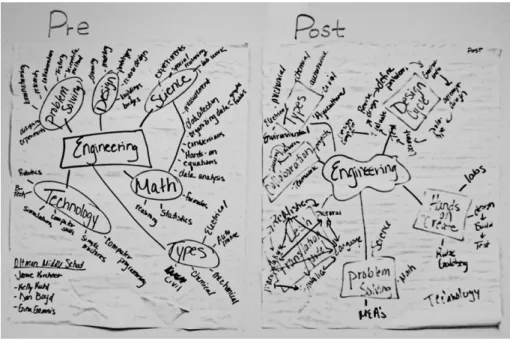
for all layers and common concepts. Figure 1 presents a sample pre and post concept map from a group.
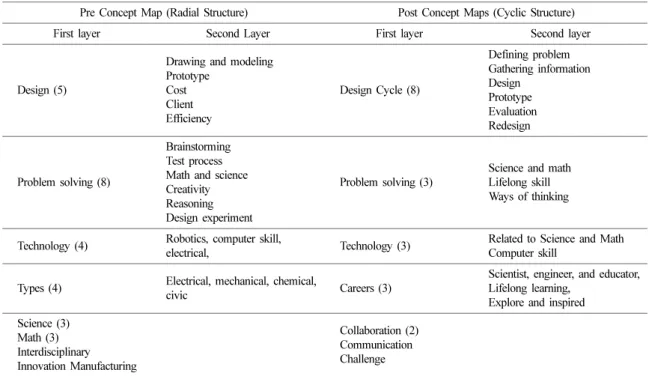
Table 1 in Result section shows layers and common concepts found from the concept map analysis.
Survey analysis. Data from the Likert scale items were converted to numerical data based on the five
Fig. 1. Examples of Group 1’ Pre and Post Concept Map.
point scale system (strongly agree=5, agree=4, neutral
=3, disagree=2, and strongly disagree=1). A paired samples t-test with p< .05 was run to examine the mean score difference between the pre and post survey on teachers’ self-efficacy of teaching science/
mathematics within the engineering context.
STEM lesson plans and teaching reflections. We utilized a qualitative data analysis method to analyze participant teachers’ lesson plans and reflection. The purpose of this analysis determine evidence of the teachers’ challenges and advantages of integrating engineering into science and (or) mathematics teaching.
To do this, we triangulated the lesson plan and teaching reflection analysis results. The lesson plan was analyzed based on two important aspects of STEM lessons that we emphasized during the program:
1) applying engineering design cycle both as a teaching strategy and a tool to improve students’
problem solving skills in science/mathematics and 2) consistent connections of content knowledge between engineering and science/math. We used these two aspects as themes to analyze the challenges and
advantages of STEM lessons we were looking for.
The teaching reflection analysis was directly focused on finding the challenges and advantages in regards to integrating engineering. From the analysis we tried to connect how these challenges and advantages relate to the teachers’ attitudes toward teaching science/
mathematics integrated with engineering.
Results
In this section, results from data analysis were described in order to answer the research questions: 1) first, information is shared on teachers’ perception of engineering as a result of the professional development program based on their pre-post concept map analysis, 2) second, teacher’s attitude toward teaching engineering with science and mathematics were described based on the seven self-efficacy survey questions, 3) finally, challenges and advantages of engineering integrated teaching were described based on the qualitative analysis of participant teachers’ lesson plans and reflections.
Table 1. Comparison of the Main Concepts in the Pre and Post Concept Maps
Pre Concept Map (Radial Structure) Post Concept Maps (Cyclic Structure)
First layer Second Layer First layer Second layer
Design (5)
Drawing and modeling Prototype
Cost Client Efficiency
Design Cycle (8)
Defining problem Gathering information Design
Prototype Evaluation Redesign
Problem solving (8)
Brainstorming Test process Math and science Creativity Reasoning Design experiment
Problem solving (3)
Science and math Lifelong skill Ways of thinking
Technology (4) Robotics, computer skill,
electrical, Technology (3) Related to Science and Math
Computer skill
Types (4) Electrical, mechanical, chemical,
civic Careers (3)
Scientist, engineer, and educator, Lifelong learning,
Explore and inspired Science (3)
Math (3) Interdisciplinary Innovation Manufacturing
Collaboration (2) Communication Challenge
Note: numbers in ‘( )’ indicate total numbers of the concept appeared in the pre-post concept maps
STEM Integration program’s impact on the teachers’ perceptions of engineering
To find evidence of the impact of the STEM integration program on the teacher’s perceptions of the engineering discipline, we compared the pre and post concept maps the teacher groups developed. Based on the analysis process, we found differences between the pre and post concept maps in three aspects: 1) the overall structure of the pre and post concept maps had changed, 2) the major nodes connected to the central concept of engineering (first layer concepts) had changed, and 3) the meaning of the first layer concepts had changed. The Table 1 presents the comparison between pre and post concept maps regarding the structures and concepts in the first layer (major node connected to the central concept,”
Engineering”) and second layers (major node connected to the first layer concepts).
The most frequent concepts in the first layer were:
problem solving (8), design (5), technology (4), types (4), and other disciplines such as science (3) and math (3). Compared to this result, Compared to the pre- concept map, the most frequent concepts in the first layer of the post concept maps were ‘processes of the design cycle (8) that we emphasized during the professional development program.
In addition, there were structural differences between the pre and post concept maps. Most of the pre concept maps were a radial structure with the
“engineering” concept at the center and other concepts to the central node as a tree. Compared to the radial structure of the pre concept maps, the post concept maps were mainly cyclic structures showing the process of design cycle. The direction of the arrows that connected the nodes showed that the teachers understood engineering as cyclic processes. This result is also evidenced by teachers’ reflections about their learning during the program and lesson plans. At the beginning of the program, teacher reflections showed that the teachers were trying to understand how science, math, and engineering were different but connected and related to each other. They reflected that they did not understand what engineering was. In the following,
examples of teacher reflections show the teachers’
perceptions about engineering at the beginning of the program:
“I learned a lot today about what engineering really is. I felt that learning the science concepts first and then engineering are? It really helped me understand the different between science and engineering.”
“I did like the math connection to the experiment, seeing connection to math, science and the world around us is my objective.”
“It was good to experience the investigation and see the connection between science and engineering. I want to try and draw the connections”
After the program, teacher reflections showed that they have more concrete understanding about what engineering is. They mentioned a lot about engineering design and emphasized the iterative process of engineering problem solving as a cyclic process. In the following, examples of teacher reflections show the teachers’ perceptions about engineering at the end of the program:
“My class just set up a greenhouse in our courtyard and would like to create/design way to package the plants for sale. As I reflect on today’s lesson, I loved the time given to use for exploration, discovery and implement”
“I am interested in implementing more of the design process and having my students more collaboratively to design an actual product. The collaboration piece coupled with students getting to take ownership of their learning through the design process will be very exciting.”
Lesson plan analysis results echoed the teachers’
reflection about their learning of what engineering is.
95% of the teachers used engineering design cycle as the center piece of their lesson plan design. In the lesson plan, these teachers had a pre-determined design challenge, such as design a device to protect an egg from breaking from dropping it from 2 meter high, or design a kite that could fly with minimal weight and material. They described about how they guided their students to use engineering process, such as brainstorming ideas, testing prototype and redesigning
to make a product better. The lesson plans also showed that the teachers followed engineering design process to design and implement their STEM integration lessons, such as they labeled as day 1 giving the challenge, day 2 brainstorming and designing a prototype, day 3 testing, and so on. Teachers’ lesson plan echoed their concept maps that integrating engineering is like using a glue to integrate other disciplines.
The meaning of the frequent concepts also changed in the pre and post concept maps. Although “problem solving” and “design” appeared in both concept maps, the meaning of these two concepts differed from pre to post. In the pre concept maps, “design” was associated with reasons (clients and efficiency), tools and skills (drawing and modeling, and prototype), and constraints (cost) of engineering activities. However, in the post concept maps, “design” was replaced by
“design cycle” and became a concrete cycling process used to describe how engineers solve an engineering problem through the cyclic thinking process. Furthermore, in the pre concept map, “problem solving” included specific thinking skills, such as reasoning, creativity, and test process. However, in the post concept maps,
“problem solving” became general lifelong skills that had more abstract meanings. Comparing the pre and post concept maps, “problem solving” in the pre concept maps indicated similar meanings such as
“design cycle” in the post concept maps.
Teachers’ perceptions and understandings of engineering and engineering practices positively affect their teaching practices of choosing lesson topics as well as pedagogical approaches for engineering integrated lesson planning.
Both concept map and lesson plan analysis show that there is a strong relationship between the teachers’
perception of engineering and their practices of lesson planning. This results imply that teachers need systematic professional development program that support teachers’
understandings of engineering and pedagogical skills (e.g. Guzey, et al., 2014). The change of teachers’
perceptions of engineering is the first step to change their practice of teaching and consequently to change student learning in STEM classrooms.
STEM Integration program’s impact on the teachers’ attitudes of integrating engineering into their teaching
Overall, participants tended to have positive attitudes toward integrating engineering into their teaching in both pre and post tests for all the seven survey items (M 3.5). This phenomenon was particularly evident in survey items 3, 4, 5 and 7 (M >4) (Fig. 2).
A paired samples t-test was conducted to compare the survey items before and after the STEM Integration professional development program (Table 2). Two items were significantly different in pre and post test (Table 2). The first survey item that was significantly different was I am comfortable with integrating engineering contexts into my science/mathematics teaching (Pre-test: M=3.5, SD=1, Post-test: M=3.81, SD=0.841; t (51)=−2.10, p= .041<0.5). This suggested that after the program, teachers felt more comfortable integrating engineering contexts into their teaching.
The second survey item that had significant difference pre and post test was, Integrating engineering helps me teach science/mathematics in a more effective way (Pre-test: M=4.08, SD= .52, Post-test: M=3.85, SD=
.72; t(51)=2.47, p= .017< .05). This item had a higher mean score in the pre test than the post test. This suggested that after the training, the participants believed that integrated engineering could not provide a more effective way of teaching either in science or Fig. 2. Teachers’ Attitudes toward Teaching Science/Mathe- matics within Engineering Context Before and After the Pro- gram
mathematics. The rest of survey items did not have statically significant. Therefore, either the teachers had already agree or strongly agree the survey items, such as 3, 4, 5 and 7, or the change was not big enough to make statistically significant. This situation was expected based on the teacher’s reflection during early stage of the training. In the teachers’ reflection after the first and second day of the program, they already thought that engineering is an potential way of teaching science and mathematics because engineering could connect the disciplines with real world by offering a context of problem solving within a real world situation. The teachers’ also thought that engineering integration would be a good pedagogical approach to improve students’ interests in STEM discipline. In the following teachers’ reflection about their attitude toward teaching science and mathematics were quoted:
“Each segment we covered in the beginning helped me to change some of my misconceptions by doing the various excises. That’s’ what an engineering does. Tries out thing that prove theories and then make a new connection.” (Day 1)
“Seeing connection to math, science and the world around us is my objective. This class modeled all those connections. I like all the modeling.” (Day 1)
“I am interested in implementing more of the design process and having my students more
collaboratively to design an actual product. The collaboration piece coupled with students getting to take ownership of their learning through the design process will be very exciting.” (Day 2)
As the quote shows, the teachers’ expectation about engineering integrated science/mathematics teaching was already positive and did not change much throughout the program. The significant decrease of the teachers’ attitude about the effectiveness of using engineering integration for teaching science and mathematics showed that even if they had positive attitude about engineering integration at the beginning, they experienced challenges of using engineering integration in terms of facilitating science and mathe- matics teaching within engineering integrated approach.
For example, one of the teachers worried about how she would get enough time to plan science lessons within engineering integration: “I would need more support in simply finding more time to plan out effective lessons. Simply not enough time to plan or work collaboratively with grade level teams” The challenges of teaching science/mathematics that the teachers’ shared during the program were also described in detail the last section of Result. Compared to the teachers’ attitude and expectation about engineering integrated teaching, their engineering teaching confidence has been improved after the program as one of the teachers reflected: “I am beginning to feel more Table 2. Summary Results of Paired Sample Test (N=52)
Survey Items Mean SD
t p
Pre Post Pre Post
1. I am comfortable with integrating engineering contexts into my science/
mathematics teaching. 3.50 3.81 1.00 .84 -2.10 .041*
2. Integrating engineering helps me teach science/mathematics in a more effective
way 4.08 3.85 .52 .72 2.47 .017*
3. Integrating engineering helps me to connect science/mathematics to the real-
world. 4.38 4.29 .57 .64 1.15 .255
4. Integrating engineering helps me adopt more problem-solving into my teaching. 4.33 4.15 .62 .75 1.54 .129 5. Integrating engineering promotes students’ learning and interest in science/
mathematics. 4.12 4.04 .51 .66 .81 .420
6. Integrating engineering makes learning in science/mathematics easier for
students who find science/mathematics difficult. 3.50 3.73 .92 .77 -1.95 .057
7. I will integrate engineering in my future science/mathematics teaching. 4.17 4.17 .59 .65 .00 1.00
* indicate significance at p< .05.
comfortable with what engineering is and looks like.”
However, as the following quotes showed, some of the teachers’ confidence of teaching engineering was limited in the material we used during the program:
“I feel confident about implementing the engineering design process, but have hesitations with curriculum outside of the EIE kits.”
“I feel much more confident implementing engineering design activities in my classroom because at all the activities we have done.”
This reflection showed that using some of well- developed engineering curriculum adopted during the program was helpful for the teachers to get a clear concept about what engineering curriculum should look like and improved their confidence about teaching engineering.
The teachers’ challenges and advantages of integrating engineering into science and (or) mathematic teaching.
Making coherent connections between science and (or) mathematic content knowledge and engineering was important to making the engineering integrated curriculum more meaningful for both teaching and learning. Although most of the lesson plans tried to integrate engineering into science or mathematics, most of the lesson plans from the program only focused on one discipline and the other discipline acted as a supplement or support materials. Figure 3 presents a snapshot of an engineering lesson plan for designing Kite. This lesson was created by a high school mathematics teacher, Dian. The major focuses of this lesson were: 1) create a scale drawing, 2) coordinate proof of the two different quadrilaterals, 3) history of kits, and 4) the engineering design cycle.
However, this lesson was little or no science content.
As the Figure 3 shows, this lesson plans did not have very robust content knowledge integration. This lesson plan example only focused on mathematic content knowledge and ask students to follow criteria that asked to use certain mathematics knowledge for developing kites. Even if one of three ‘Design Challenge’
was ‘The kite should fly’, the teacher did not mention
any scientific knowledge that is related to the topic such as air resistance. Another example was a collaborative science and math lesson, packaging engineering. It was developed and implemented by a science and a math teacher. The topic (or engineering challenge) given to the students was to design an object, such as a box or a bag, to ship stained glass windows to Europe. In this lesson, the science teacher, Kathy, was responsible for integrating science concepts with engineering concepts and the mathematics teacher, Nate, was responsible for integrating mathematic concepts with engineering. Kathy’s teaching was focusing on using design cycles: give a challenge to the students, encourage them to find useful information from the internet or a book, and then design a package. Nate’s teaching was focusing on geometry, using the shape of the stained glass. It seemed to us, without a larger context, that Nate was teaching regular mathematics.
As for Kathy, she was mostly teaching engineering design, but with only a few science concepts. We talked to Nate and Kathy about their lesson plan during the gallery walk. Kathy suggested that she and Nate had hard time to think about a STEM lesson plan that they could do in both math and science classroom. Therefore, they searching for some ideas from the Internet and found the packaging engineering lesson plan. So, they twisted it to fit their needs.
Kathy also indicated although they think packaging engineering lesson plan fitted their needs, she still had challenge to integrated science in the lesson plan.
The second challenge was impeded by time and technological capabilities. From the teachers’ reflections, both Kathy and Dian said the lesson went longer than they had planned because students needed more time to complete the project or to come up with their own ideas. Kathy also mentioned that her students’ had varying computer abilities. Therefore, she needed to spend more time teaching her students how to use computers than she had originally planned.
From most teachers’ reflections, integrating engineering into science or mathematics provided a fun and engaging learning environment. Teachers were happy to see students highly engaged with their project. For example, Kathy
wrote that her students were struggling to look for information on the internet, but it was fun to see students come up with new, creative ideas and how they were excited to actually create the box that they wanted. Dian also wrote that her kids had fun and enjoyed the idea of creating something. They also really enjoyed testing their design because it challenged their creativities. As for Nick, he wrote that he was pleased to see that his students enjoyed the mathematics challenge by using a real world problem and integrating engineering provided a context where his students could really put math into use.
Another challenges that most of the teachers frequently mentioned in their reflection could be summarized in three categories: 1) lack of financial support to prepare teaching materials or lesson plans,
2) lack of time to design engineering integrated science/mathematics lesson plans, and 3) necessity of follow-ups of the program or professional development support. In the following quotes, teachers addressed these issues explicitly:
“I would need more tips and ideas on how to embed the activities into my curriculum as well as more resources for materials that are accessible and low cost.”
“(I would need) planning time to be collaborative, finances for materials, and new ideas that fit in with current standards.
“(I would need) more engineering and science ideas.
Projects/lessons tend to filter down and we always need new ideas”
“Need money for projects and time to write
Design challenge:
1. The kite must be at least one square foot and no more than nine square feet of surface area.
2. It will consist of material readily available from the school-home environment (paper, fabric, etc.) 3. The kite should fly!
Critical Questions:
1. Why does a kite fly?
2. What design(s) fly better than others?
3. Do kites have any practical uses?
4. Why is it so much fun to fly a kite?
Suggested Resources
A list of suggested resources and internet sites are listed at the end of this packet. Additionally, available resources will be on reserve in the school library.
Problem Set
A kite is a special quadrilateral, but it is not a parallelogram or a trapezoid. A quadrilateral is a kite if and only if it has exactly two distinct pairs of congruent consecutive sides, and its diagonals intersect. Since a kite is not a parallelogram or a trapezoid, we cannot assume that it has any of the same characteristics as these quadrilaterals.
Determine if a kite has any of the following characteristics. Write yes or no. This could help you check your kite before the fly day 1. Both pairs of opposite sides are parallel.
2. Both pairs of opposite sides are congruent.
3. The diagonals bisect each other 4. One diagonal bisects the other diagonal.
5. The diagonals are congruent.
6. Each diagonal bisects a pair of opposite angles.
7. One diagonal bisects a pair of opposite angles.
8. The diagonals are perpendicular.
9. Both pairs of opposite angles are congruent.
10. One pair of opposite angles are congruent.
Flying the Kite Launching
In good winds, you should be able to launch your kite from your hand. Standing with your back to the wind, hold your kite up to catch the wind. Let the line out smoothly, as fast as the wind lifts your kite.
Fig. 3. Kite Design Lesson Example.
curriculum”
“Continued collaborative planning time. Site for idea sharing: teachers can upload and download activity ideas”.
“(I need) more lesson ideas, PD time to work on lessons and incorporation of NSE(national science education standards). Money for EIE kits at each grade level”
As the teachers shared, even after the program, the teachers felt that they need more resources including preparation time and financial support for developing new engineering curriculum. They also mentioned the necessity and support for professional learning community to keep updating and sharing new ideas collaboratively between the teacher participants.
Conclusion
From the comparison between the pre and post concept maps, we found two important changes in the teachers’ perceptions of Engineering. First, after the program, the teachers developed more concrete ideas about the Engineering Design Cycle as a problem solving process in an engineering context. The concept of “design cycle” in the post concept maps included more concrete and clear problem solving processes and thinking skills in the engineering context. By using the “design cycle” concept as a major sub- concept of engineering, the teachers described engineering not as a process of making a product but rather as a cognitive process of problem solving. Second, the teachers also presented engineering as more of a problem solving process rather than a product. In the pre concept maps, the teachers presented engineering as an interdisciplinary subject that required concrete knowledge about other disciplines such as science, math, and technology. They also presented engineering more as product development based on a client’s need.
They also emphasized communication or a collaborative process as an important part of engineering.
Overall, both science and mathematics teachers thought integrating engineering into teaching provided valuable outcomes, such as promoting students’
learning about engineering and improving their interest in science or math by providing real-world problem solving exercises. Teachers felt more comfortable integrating engineering in their teaching after the program. The lesson plan analysis results show that the engineering design process became one of the major focuses for teachers to integrate engineering into their teaching.
The results also imply that the teachers’ understanding of engineering become more concrete after the program.
However, at the same time, the teachers were struggling to combine engineering with their science or math content knowledge in developing engineering integrated lesson planning. The significant decrease of the teachers’ attitude about the effectiveness of using engineering integration for teaching science and mathematics indicated that the teachers experienced multiple layers of challenges of using engineering integration approach for teaching certain science and mathematics knowledge. For example, they struggled to manage their class time and to teach both their regular curriculum and the engineering integrated curriculum. If the integrated engineering curriculum were designed to use engineering design cycle as their teaching strategy, it would require more time for teaching certain science or mathematic concepts because students need to take the lead to design, plan and analyze their work. Usually students need more time to complete a project or a task in a classroom. The above issues all affected the teachers’ attitudes about integrating engineering. These were the factors that caused them to think that integrating engineering into science and math is an ineffective way to teach these subjects.
Implications
This study gave us useful implications for the program of current study as well as for future teacher professional programs for integrating engineering into secondary science and mathematics curriculum. First, we found that giving a concrete and well developed strategy, such as the engineering design cycle, was important. We focused on teaching engineering and
engineering practices such as design cycle during the first and second day of training. During those days, first we gave various opportunities to the teachers to share their initial ideas of what engineering is and what important component concepts of engineering practices are. For example at the beginning of the program, teachers collaboratively developed concept maps of engineering. Between the training days, teachers met and shared ideas and resources about engineering teaching. After the last training, teacher gathered to present their lesson plans, called a Gallery Work.
During the Gallery Work, teacher presented their lessons and learned from each other about various approaches of developing engineering lessons. Through these experiences, teachers had shared their ideas about engineering and challenged and learned from peers’ and instructors’ knowledge and skills for developing high-quality engineering lesson plans.
Second, presenting exemplary engineering lesson plans during the program helped the teachers to understand criteria to evaluate the quality of engineering lesson plans. During the program, we adapted the engineering lesson plans from the Power of the Wind:
How can we think like an engineer by the University of Illinois. The facilitators used hands-on activities to connect engineering with science, mathematics and technology, which provided great STEM integration samples that could be used by teachers in their classrooms. The engineering design cycle and lesson plans we adapted and used for the program has helped the teachers to understand the engineering discipline and how to integrate engineering into their teaching.
Throughout the program, most of the teachers used the engineering design cycle as their major teaching strategy and improved their understandings of this teaching strategy in their lessons. Participant teacher’s understandings of engineering and teaching strategies were reflected in the comparison of their pre-post concept and their lesson plans. This result imply that improvement of teachers’ conceptual understandings of engineering positively affect their teaching practices (Lim, 2003). Based on this result, we also argue the needs of high-quality teacher professional development
programs. Teacher’s attitude toward engineering teaching has not changed significantly as a result of the program participation. Interestingly, teachers showed a positive attitude toward engineering teaching throughout the program. However, their confidence of teaching engineering have improved significantly. The result shows that one of the important reason of this phenomena was the high quality materials and lesson plans adopted in the program. Teachers felt more confidence because of the examples and resources they have experience during the program.
There were two fundamental challenges for the teachers to integrate engineering into science and (or) mathematic teaching: 1) making consistent connections between science and (or) mathematic content knowledge and engineering, and 2) insufficient time to prepare and teach engineering integrated curriculum. The first challenge was related to both the teachers’ knowledge of other subject curriculums or standards (such as knowledge of science curriculum for mathematic teachers) as well as their knowledge of engineering. If the engineering integrated curriculum was designed to teach both science and mathematics content knowledge, science and mathematics teachers need to work closely to choose appropriate topics to address content knowledge that is appropriate for the grade level they teach. As a program provider, we need to consider how to solve this problem by providing useful strategies such as grouping teachers and reorganizing the sequence of the regular curriculum. If the engineering integrated curriculum is not designed purposefully to address certain content knowledge, students might learn little to no content knowledge from the curriculum. We found a couple lesson examples with student projects that could be done by not applying science or mathematics knowledge but by their hands-on trial and error.
The second challenge was related to the school context and policy for improving engineering education in K-12 classrooms. The teachers needed more time to prepare engineering integrated curriculum, more material or equipment to implement their curriculum, and more time to cover the curriculum to give students the
opportunity to solve real word problems through a cyclic critical thinking and decision making process.
While the teachers knew that the engineering integrated curriculum could engage more students in the lesson and make them more interested in learning science, it was not enough to make the teacher develop more lessons after the program. If there is not enough support from schools and districts, such as more workshops or teacher networks to share their ideas or knowledge, and financial support to buy materials and equipment, we could not guarantee that they will use the engineering integrated curriculum for their future teaching.
Acknowledgment
We sincerely appreciate Prof. Tamara Moore (School of Engineering Education, Purdue University) and Prof. Gillian Roehrig (University of Minsonesota, STEM Education Center) for their help in collecting data for this study.
References
Accreditation Board for Engineering and Technology (ABET), 2010, Criteria for accrediting engineering programs. Baltimore, MD, ABET, Inc. Available online at http://www.abet.org/Linked%20Documents-UPDATE/
Program%20Docs/abet-eac-criteria-2011-2012.pdf. Last retrieve at Nov. 2014.
Akins, L. and Burghardt, D., 2006, Work in progress:
Improving K-12 mathematics understanding with engineering design projects. in Frontiers in education conference, New York. New York: Institute of Electrical and Electronics Engineerings. 13-14.
Bae, S.A. and Geum, Y.C., 2009, Development model of activity-centered STEM education program in industrial and technical high school. Korea Home and Career Education Journal, 15, 345-368. (in Korean)
Baek, Y.S., Park, H.J., Kim Y., Noh, S. G., Park, J.Y., Lee, J., Jeong, J.S., Choi, Y., and Han, H., 2011, STEAM education in Korea. Journal of Learner-Centered Curriculum and Instruction, 11, 149-171. (in Korean) Brophy, S., Klein, S., Portsmore, M., and Rogers, C., 2008,
Advancing engineering education in P-12 classroom.
Journal of Engineering Education, 97, 369-387.
Cantrell, P., Pekcan, G., Itani, A., and Velasquez-Bryant,
N., 2006. The effect of engineering modules on student learning in middle school science classroom. Journal of Engineering Education, 95, 301-309.
Carr, R.L., Bennett, L.D. IV, and Strobel, J., 2012, Engineering in the K-12 STEM standards of the 50 U.S. states: An analysis of presence and extent. Journal of Engineering Education, 101, 539-564.
Cunningham, C. and Knight, M., 2004, Draw an engineering test: Development of a tool to investigate students’ ideas about engineers and engineering. Paper presented at the American Society for Engineering Education Annual Conference and Exposition. Salt Lake City, Utah, June 20-23. Available online at http://soa.
asee.org/paper/conference/paper-view.cfm?id=19444 Cunningham, C., 2008, Elementary teacher professional
development in engineering: Lessons learned from Engineering is Elementary. Paper presented at the American Society for Engineering Education Annual Conference & Exposition. Pittsburgh, PA.
Douglas, J., Iversen, E., and Kalyandurg, C., 2004, Engineering in the K-12 classroom: An analysis of current practices and guidelines for the future. The American Society for Engineering Education, Washington, DC, USA, Available online at http://www.engineeringk12.
org/Engineering_in_the_K-12_Classroom.pdf
Erwin, B., 1998, K-12 education and systems engineering:
A new perspective. Proceedings of the American Society of Engineering Education National Conference, Session 1280: p6, Seattle, WA
Foutus, D., Dershimer, R.C., Krajcik, J.S., Marx, R.W., and Mamlok-Naaman R., 2004, Design-based science and student learning. Journal of Research in Science Teaching, 41, 1081-1110.
Guzey, S.S., Tank, K., Wang, H.H., Roehrig, G., and Moore, T. 2014, A highquality professional development for teachers of grades 3-6 for implementing engineering into classrooms. School Science and Mathematics, 114, 139-149.
Katehi, L., Pearson G., and Feder, M., 2009, Engineering in K-12 education: Understanding the status and improving the prospects, National Academy of Engineering and National Research Council. Washington, DC, USA, 234 p.
Kim, B. and Kim, J. 2014, Analysis of articles related STEAM education using network text analysis method.
Journal of Korean Elementary Science Education, 33, 674-682. (in Korean)
Kinchin, I.M., Hay, D.B., and Adams, A., 2000, How a qualitative approach to concept map analysis can be used to aid learning by illustrating patterns of conceptual development. Educational research, 42, 43- 57.
Kwak, Y., 2002, Relationship between preservice science
teachers’ relativist epistemology and their pedagogical beliefs, Journal of Korean Earth Science Society, 23, 221-233. (in Korean)
Lesh, R. and Doerr, H. (Eds.), 2003, Beyond constructivism: Models and modeling perspectives on mathematics problem solving, learning, and teaching, Lawrence Erlbaum, Mahwah, NJ, USA, 597 p.
Lewis, T., 2006, Design and inquiry: Bases for an accommodation between science and technology education in the curriculum? Journal of Research in Science Teaching, 43, 255-281.
Lim, C.H., 2003, Science teaching practices and science teaching efficacy beliefs by development of elementary school teachers’ pedagogical content knowledge, Journal of Korean Earth Science Society, 24, 258-272. (in Korean)
Minnesota academic standards: Science K-12., 2009, Retrieved from http://education.state.mn.us/mdeprod/
groups/Standards/documents/Publication/013906.pdf National Governors Association., 2007, Innovation
America: Building a science, technology, engineering and math agenda. National Governors Association Center for Best Practices, Washington, DC, USA, 32 p.
Oware, E., Capobianco, B., and Diefes-Dux, H., 2007, Gifted students’ perceptions of engineers? A study of students in a summer outreach program. Paper presented at the American Society of Engineering Education Annual Conference and Exposition, Honolulu, Hawaii, June, 24-27. Available online at http://
soa.asee.org/paper/conference/paper-view.cfm?id=5401 Peterson, C.R., 1990, The desegregation of design.
Engineering Education, 80, 530-532.
President’s Council of Advisors on Science and
Technology (US), 2010, Prepare and Inspire: K-12 Education in Science, Technology, Engineering, and Math (STEM) for America’s Future: Executive Report.
Executive Office of the President, President’s Council of Advisors on Science and Technology, Washington, DC, USA, 108 p.
Roehrig, G.H., Moore, T.J., Wang, H.-H., and Park, M.S., 2012, Is adding the E enough?: Investigating the impact of K-12 engineering standards on the implementation of STEM integration. School Science and Mathematics, 112, 31-44.
Roth, W.M., 2001, Learning science through technological design. Journal of Research in Science Teaching, 38, 768-790.
Son, J.H., Kim, J., and Kim Y.J., 2014, Effects of astronomical STEAM program using co-teaching on self-directed learning attitude of elementary science gifted students, Journal of Korean Earth Science Society, 35, 572584,
Thornburg, D., 2009, Hands and minds: Why engineering is the glue holding STEM together. Thornburg Center for Space Exploration. Retrieved from http://www.tcse- k12.org/pages/hands.pdf.
Ver Planck, D.W., 1958, Engineering analysis and design.
The Engineering Science, Report of the Follow-up Committee (ad hoc) on Evaluation of Engineering Education, ASEE, Washington, D.C.
Wang, H.H., Moore, T.J., Roehrig, G.H., and Park, M.S.
(2011). STEM integration: teacher perceptions and practice. Journal of Pre-College Engineering Education Research (J-PEER), 1, 1-13. DOI: 10.5703/
1288284314636
Manuscript received: July 22, 2015 Revised manuscript received: September 12, 2015 Manuscript accepted: September 25, 2015