Received October 15, 2008; Accepted December 6, 2008 Corresponding author: Yun Kyung Shin
Tel: +82 (55) 862-9640 e-mail: [email protected] 1225-3480/24311
굴, Crassostrea gigas 의 대사율에 미치는 수온 및 개체크기의 영향
신윤경, 허영백1, 명정인2, 이식3
국립수산과학원 남해특성화연구센터, 1양식환경연구센터,
2육종연구센터, 3전남대학교
Effect of Temperature and Body Size on Oxygen Consumption and Ammonia Excretion of Oyster, Crassostrea gigas
Yun Kyung Shin, Young-Baek Hur1, Jeong-In Myeong2 and Sik Lee3 South sea Mariculture Research Center, NFRDI, Namhae, 668-821, Korea
1Aquaculture Environment Research Center, Tongyoung, 650-943, Korea
2Genetics and Breeding Research Center, 656-842, Korea
3Department of Applied Mathmatics, Chonnam National University, Yeosu 550-749, Korea
ABSTRACT
The tendency of metabolism in oyster, Crassostrea gigas, was investigated in relation to the water temperature and salinity. Oxygen consumption and ammonia excretion were measured and O:N ratio were calculated according to the water temperature from February 2007 to September 2008 and body size. The relationship between oxygen consumption and body weight has been examined in C. gigas. The weight-specific oxygen consumption rate (mg O2/g/h) varied inversely with size. Oxygen consumption and ammonia excretion increased with an increase in water temperature. O:N ratio measured in this study ranged from 8 to 40 under ordinary sea water and the ratio was 8 at 25℃ and 16 at 10℃. This indicates that oyster mainly use the protein as the primary catabolic substrate during gametogenesis. Lower O:N ratio in winter suggests that oysters have to meet their energy demand by metabolizing protein to survive in stressful conditions such as low temperature and lack of sufficient food supply. This studies will provide the basic data for oyster culture farm in assessing the carrying capacity and sustainable management.
Key words: oyster, oxygen consumption, ammonia excretion, temperature, O:N ratio.
서 론
수서생물의 산소소비율과 암모니아 질소배설률에 의한 대사 율은 수온에 직접적으로 영향을 받으며, 개체크기에 반비례한 다(Fry, 1971; Dabrowski, 1986). 사육환경의 측면에서 용 존산소의 농도는 수온과 생물의 수용밀도에 따라 반비례한다 (Piper et al., 1982). 그러므로 산소의 고갈과 독성대사부산 물의 생성은 양식장 환경에서 양식생물의 수용밀도를 저하하
는 주요요인으로 여겨진다. 산소농도의 감소는 성장감소를 초 래하고(Brett, 1979), 주요 대사산물인 암모니아질소는 생물 의 서식밀도와 투여하는 먹이량에 따라 증가하므로 이온화 되 지 않은 암모니아(NH3)의 양이 증가할수록 독성 영향에 의해 수질을 악화시키는 요인이 되며, 암모니아(NH3)의 농도 50-200 μg/l의 범위에서는 성장을 감소시키는 것으로 보고되 고 있다(Colt and Armstrong, 1981).
굴은 상업적인 수산자원의 가치 및 서식지의 다양성을 포한 한 경제적(Breitburg et al., 2000; Mallin et al., 2000), 생 태적인(Posey et al., 1999) 이점을 제공하고 있다. 이외에도 굴의 아가미에 의한 여과작용은 수중의 부유물질과 영양염을 감소시켜 수질을 개선시키는 역할을 하며(Gerritsen et al., 1994; Brumbaugh et al., 2000), Crassostrea virginica
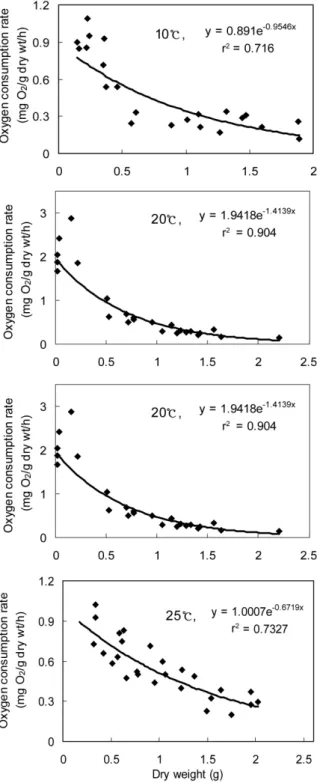
Fig. 1. The relationship between weight specific oxygen consumption and dry flesh weight for oyster, Crassostrea gigas, at 33 ± 0.5 psu.
군락은 수괴 내 75% 이상의 chlorophyll a 농도를 감소시킨 다.
우리나라 연안의 굴 양식어장은 주로 내만에 위치하고 있어,
산업화, 도시화 및 장기연작 등의 영향으로 인해 오염 부하량 이 증가하고 있으며, 특히 적정 어획량을 고려하지 않은 과도 한 양식시설물의 배치로 인해 성장둔화, 생산량 감소 및 집단 폐사를 일으키는 원인으로 되고 있다.
굴에 관한 국내의 연구는 종묘생산, 생식주기(Choi et al., 2003b), 생리(Shin et al., 2002; Kim et al., 2002), 병리 (Park and Chun, 1989; Choi et al., 2003a), 모패건강도 (Park et al., 1999) 및 양식장 환경용량(Cho et al., 1996;
Park et al., 2002; Lee et al., 2002) 등 모든 분야에 걸쳐 많은 연구가 수행되어오고 있으나 자료의 활용과 이용은 부진 한 실정이다. 또한 매년 예측하지 못한 해양환경의 변화가 발 생함에 따라 단일종의 양식보다는 보다 효과적이고 생태 친화 적인 환경을 구성하여 생산량을 증가시키기 위해 해조류, 어류 및 패류 등을 대상으로 먹이단계를 달리하는 복합양식을 추구 하고 있다. 본 연구는 굴의 생태친화적인 양식을 위하여 어장 의 적정수용력 및 지속적인 양식장 관리를 위하여 기초자료를 제공할 목적으로 굴의 계절별 수온에 따라 산소소비율 및 암모 니아 질소배설률 등의 대사율을 측정하여 계절별로 어장에서 소요될 굴의 생리적 요소들을 추정하였다.
재료 및 방법
굴(Crassostrea gigas)은 경남 통영군 통영만에서 양식하 고 있는 종을 대상으로 2007년 2월에서 2008년 9월까지 계 절별로 채취하여 실험실로 옮긴 뒤 5 ton 수조에서 Isochrysis galbana, Chaetoceros sp., Tetracelmis sp. 등 을 같은 비율로 섞어서 먹이로 공급하면서 각 실험수온 및 염 분에서 2주일간 순치시킨 후 실험에 사용하였다. 실험에 사용 된 크기는 각고 30-110 mm의 다양한 개체를 이용하여 개체 크기에 따른 산소소비율 및 암모니아 질소배설률을 측정하였 다
계절별 수온은 10, 15, 20 및 25 ± 0.5℃였으며, 염분은 26.0과 33 ± 0.5 psu였다. 산소소비율의 측정은 산소검량기 (Orbisphere 3600/Swizerland)를 사용하여 실험 전후의 차 를 측정 후 개체크기별로 나타냈으며, 암모니아 질소배설률은 실험 용액을 채취하여 phenolhypochlorite(Solorzano, 1969) 법에 의해 발색시켜 분광광도계로 측정하였다.
그리고 산소소비율에 미치는 수온의 영향을 알아보기 위한 온도계수(Q10)는 다음의 식을 이용하여 구하였다(Beiras et al., 1995).
Q RRT T
R1, R2 : oxygen consumption rate at temperature T1
and T2, respectively
실험동물의 건조중량은 80℃에서 24시간 건조시킨 후 측정
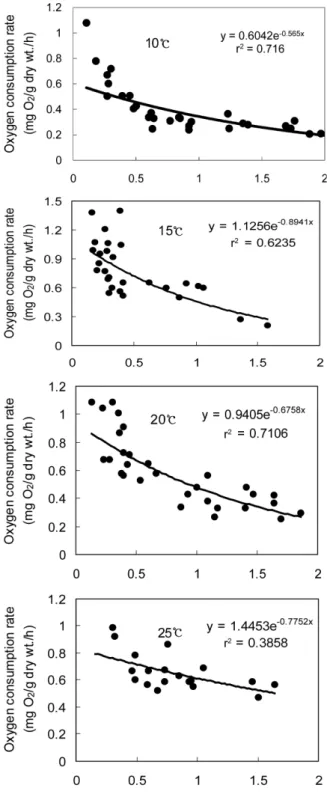
Fig. 2. The relationship between weight specific oxygen consumption and dry flesh weight for oyster, Crassostrea gigas, at 26 ± 0.5 psu.
Temperature range (℃)
Q10
26 ± 0.5 psu 33 ± 0.5 psu
10-20 1.40 1.38
15-25 1.45 1.44
Table 1. Temperature coefficient (Q10) of oxygen consumption rate for oyster, Crassostrea gigas: flesh dry weight, 1.5 g.
하였으며, 자료 분석에 사용한 통계처리는 SPSS-통계패키지 를 이용하여 ANOVA 및 Duncan's range test에 의해 판정 하였다.
결 과
수온 및 염분에 따른 굴의 일반적인 대사경향을 알아보기 위해 각고 30-110 mm, 육중 1.5 - 15.7 g의 개체를 대상으 로 개체크기에 따른 산소소비율과 암모니아 질소배설률을 측 정한 결과를 Fig. 1-4에 나타냈다.
먼저 산소소비율의 경향을 보면, Fig. 1과 2에서 보는 바와 같이 굴의 무게에 대한 산소소비율은 지수함수곡선으로 나타 낼 수 있었는데 모든 수온구에서 개체의 무게가 작을수록 산소 소비율은 증가하였으며, 일반해수(33 ± 0.5 psu) 및 26 ± 0.5 psu에서 수온증가에 따라 산소소비율은 유의하게 증가하 였다 (p < 0.05).
Fig. 1과 2에 나타낸 식에 의하면 일반해수에서는 건조육중 이 1.0 g인 개체들의 경우 10, 15, 20 및 25℃에서 각각 0.28, 0.37, 0.45 및 0.55 mgO2/g dry wt/h을 나타냈으며, 염분 26 ± 0.5 psu 에서는 각각 0.34, 0.46, 0.54 및 0.68 mgO2/g dry wt/h으로 수온증가에 따라 산소소비율은 증가하 는 경향을 보였고 일반해수에 비해 26 ± 0.5 psu에 노출된 굴의 산소소비율이 약 14-19% 증가하는 경향을 보였다.
Table 1은 굴의 산소소비율에 미치는 수온의 영향을 온도 계수 Q10의 값으로 나타낸 것이다. 온도계수 Q10은 건조육중 1.5 g의 개체를 대상으로 산출하였으며, 실험 염분과 수온범위 에서 1.38-1.45의 범위에 있었으며, 수온 증가에 따른 일반적 인 증가 경향을 나타내었다.
Fig. 3과 4는 굴의 계절별 수온과 염분에 따른 암모니아 질 소배설률의 변화를 나타낸 것이다. 암모니아 질소배설률은 개 체의 무게가 작을수록 증가하는 지수함수곡선형으로 나타났으 며, 산소소비율의 경우와 유사하였다. 암모니아 질소배설률은 수온의 증가에 따라 증가하는 경향을 보였으며, 일반해수에 비 해 26 ± 0.5 psu에서 배설량이 증가하였다.
각 수온별 산소소비율과 암모니아 질소배설률의 원자비를 Fig. 5에 나타내었다. O:N 원자비는 모든 염분구의 15℃와 20℃에서 25-40의 값을 나타내었으며, 25℃에서는 5-8의 값
을 나타내어 대사율이 여름철에는 현저히 저하됨을 암시하였 다.
Fig. 4. The relationship between weight specific ammonia excretion and dry flesh weight for oyster, Crassostrea gigas, at 26 ± 0.5 psu.
Fig. 3. The relationship between weight specific ammonia excretion and dry flesh weight for oyster, Crassostrea gigas, at 33 ± 0.5 psu
고 찰 동물의 산소소비는 체중의 지수함수로 나타내며, R(대사율)
= aW(체중) b의 방정식으로 나타낸다(Davies, 1966). 여기
Fig. 5. Atomic O:N ratio variation of oyster, Crassostrea gigas, with seasonal temperature.
서 a는 종간에 값이 달라지는 비례상수이며, b는 실험적으로 결정된 지수를 나타내며, 체중의 변화에 따른 대사율의 변화를 나타내는데 이는 종 간 뿐만 아니라 같은 종 내에서도 Mytilus edulis의 경우 0.027(Bayne, 1971)과 -0.43 (Rotthauwe, 1958)으로 연구자에 따라 다르게 나타난다. 일 반적으로 변온동물의 비체중호흡률은 체중증가에 따라 감소하 며, 이때 b의 값은 0.16-1.02의 범위에서 변화한다(Widdow, 1978). 본 실험에서 굴의 경우, 일반해수 수온 10, 15, 20 및 25℃에서 산소소비율에 대한 관계식은 R = 0.891W-0.164, R
= 1.6036W-0.269, R = 1.9418W-0.335 및 R = 1.0007W-0.172 으로 변형하여 나타낼 수 있었으며, b의 값은 -0.16--0.34의 범위를 나타내어 전형적인 변온동물의 대사경향을 보였다.
굴(Crassostrea gigas)의 산소소비율에 관한 보고는 다양 하게 찾아볼 수 있다. Bougrier et al.(1995)에 의하면 굴의 산소소비율은 수온 20℃에서 1.37 mgO2/g/h을 보고하였으 며, Mao et al.(2006)은 수온 22.8℃에서 1.72 mgO2/g/h 그 리고 Ren et al.(2000)은 0.59 mgO2/g/h으로 본 실험의 결 과와 유사하였으나, 다소 낮은 값을 보였으며, 이러한 결과들 은 같은 종 내에서도 많은 차이를 보여주고 있음을 알 수 있 다. 굴의 산소소비에 관한 이러한 차이들은 산소소비율 측정을 위한 실험조건의 차이와 개체군 간의 유전적 차이에 기인할 것 으로 추정된다. 암모니아 질소배설률도 수온의 증가에 따라 증 가하여 비체중산소소비율과 같은 경향을 나타내었으며, 계절 에 따라 변화하였는데, Mao et al.(2006)에 의하면 수온이 증 가하는 여름에 5.4 μmol NH4-N/g/h을 나타낸 후 겨울에 0.51 μmol NH4-N/g/h으로 감소하여 질소배설률은 수온에 의존하며(Jobling, 1981), 계절에 따른 변화양상을 나타내는 데(Newell and Bayne, 1980), 이는 본 실험의 암모니아 질 소배설의 변화와 유사한 양상을 나타내었다.
본 실험에서 O:N 원자비는 일반해수에서 8-40, 26 ± 0.5 psu에서는 5-30의 범위를 나타내었다. Wang et al.(1998)은 굴 건조육중 6.62 g의 큰 개체는 60-280, 건조육중 0.08 g의 작은 개체에서는 33-205의 범위를 보고하였는데 이 값은 실내 에서 같은 조건하에서 수행된 값이므로 높은 값을 나타낸 것으 로 여겨진다. 그러나 본 연구에서 측정된 값은 계절별로 굴 어 장에서 채취하여 순치시킨 후 측정된 값이므로 먹이와 수온이 감소하는 겨울에는 낮은 값을 보이며, 수온이 올라가는 봄과 여름에는 높은 값을 나타내는 O:N 원자비의 계절성을 나타내 는 것으로 여겨진다. O:N 원자비는 단백질, 지질 및 탄수화물 에 대한 동물의 이화작용의 지표로서 이용된다(Bayne et al., 1976). 순수단백질이 이용될 경우 최소의 O:N 원자비는 7이 고, 탄수화물과 지질이 이화될 경우에는 더욱 높은 값을 제시 하였다(Mayzaud and Conover, 1988). 본 실험에서 O:N 원자비는 일반해수의 경우, 15℃와 20℃에서 30 이상으로 높
았으나 25℃에서는 최저로 감소하여 8을 나타내었다. 수온 2 5℃는 7-8월의 여름철 굴의 산란기와 일치한다. 20 이하의 낮 은 O:N 원자비는 해산 패류에서 영양적인 스트레스 지표로서 (Bayne et al., 1985) 이용되고 있으며, 주요 대사기질이 단 백질에 의존하고 있음을 시사하고 있다. 그러나 O:N 원자비의 계절적 변화는 항상 생리적 스트레스에 기인하는 것은 아니라 고 생각하며, 산란기전후 나타나는 O:N 원자비의 감소는 외부 환경에 의한 생리적 스트레스라기보다는 산란으로 인해 체내 대사기질이 탄수화물이나 지방보다는 단백질의 이용을 더욱 많이 요구하여 이용되고 있는 것으로 여겨진다.
따라서 본 실험의 결과를 종합하여 보면 굴은 수온 증가에 따라 대사율이 증가하는 전형적인 변온동물의 대사경향을 나 타내었으며, 저염분에서는 일시적인 대사율의 증가를 보였다.
또한 O:N 원자비의 변화양상으로 보아 15℃와 20℃에서 성 장이 주로 일어날 것으로 추정되며, 25℃ 전후의 산란기동안 대사기질로서 단백질의 요구가 증가할 것으로 여겨진다. 이러 한 굴의 생리학적 자료는 생태친화적인 양식어장을 구성하기 위한 적정수용력 및 기초지속적인 양식장 관리를 위한 자료로 활용이 가능할 것으로 여겨진다.
요 약
수온 및 염분에 따른 굴의 일반적인 대사경향을 알아보기 위하여 수온과 개체크기에 따른 산소소비율과 암모니아 질소 배설률을 측정하였으며, O:N원자비를 산출하였다. 산소소비 율과 암모니아 질소배설률은 개체의 크기가 작을수록 높았으 며, 수온증가에 따라 증가하였다. O:N 원자비는 일반해수에서 8-40의 범위에 있었으며, 수온 25℃에서 O:N 원자비는 8로 감소하였는데, 이는 산란기에 주요 대사기질로서 단백질을 이 용하며, 단백질의 요구가 큰 것으로 추정된다. 이 결과는 굴양 식장의 지속적인 관리 및 적정 수용력 산정을 위한 기초자료로
활용이 가능하다.
감사의 말씀
본 연구는 국립수산과학원 남해특성화연구센터의 RP-2008- AQ-118의 지원에 의해 수행되었습니다.
참고문헌
Bayne, B.L. (1971) Oxygen consumption by three species of lamellibranch mollusc in declining ambient oxygen tension. Comparative Biochemical Physiology, 40: 955-970.
Bayne, B.L., Bayne, C.J., Carefot, T.C. and Thompson, R.J. (1976) The physiological ecology of Mytilus californianus: Conrad 1. metabolism and energy balance. Oecologia Berl, 22: 211-228.
Bayne, B.L., Brown, D.A., Burns, K., Dixon, D.R., Ivanovici, A., Livingstone, D.R., Lowe, D.M., Moore, M.N., Stebbing, A.R.D. and Widdows, J. (1985) The Effects of Stress and Pollution on Marine Animals.
384 pp. Praeger Press, New York.
Beiras, R., Pérez, A.C., Albentosa, M. (1995) Short term and long term alterations in the energy budget of young oyster Ostrea edulis L. in response to temperature change. Journal of Experimental Marine Biology and Ecology, 186: 221-236
Bougrier, S., Geairon, P., Deslous-Paoli, J.M., Bacher, C.
and Jonquieres, G. (1995) Allometric relationships and effects of temperature on clearance and oxygen consumption rates of Crassostrea gigas Thunberg.
Aquaculture, 134: 143-154.
Breitburg, D.L., Coen, L.D., Luckenbach, M.W., Posey, M.H. and Wesson, J.A. (2000) Oyster reef restoration: convergence of harvest and conservation strategies. Journal of Shellfish Research, 19(1):
371-377.
Brett, J.R. (1979) Environmental factors and growth.
In: Fish Physiology, Vol. 8. (ed. by Hoar, W.S., Randall, D.J. and Brett, J.R.) pp. 599-675. Academic Press, New York.
Brumbaugh, R.D., Sorabella, L.A., Garcia, C.O., Goldsborough, W.J. and Wesson, J.A. (2000) Marking a case for community-based oyster restoration: an example from Hampton Roads, Virginia, USA.
Journal of Shellfish Research, 19(1): 397-400.
Cho, E.I., Park, C.K. and Lee, S.M. (1996) Estimation of carrying capacity in Kamak Bay. Journal of Korean Fisheries Society, 29(5): 709-715. [in Korean with English abstract]
Choi, D.L., Choi, H.J., Lee, N.S. and Park, M.S. (2003a) First record of mycoplasma-like organism in Pacific oyster, Crassostrea gigas in Korea. Journal of Korean Fisheries Society, 6(3): 135-139. [in Korean with English abstract]
Choi, Y.H., Kim, T.I., Hur, Y.B., Go, C.S. and Chang, Y.J. (2003b) Gametogenic cycle and fine structure of
ripe germ cells in the Pacific oyster, Crassostrea gigas on the South Coast of Korea. Journal of Fisheries Science and Technology, 6(2): 51-58. [in Korean with English abstract]
Colt, J.E. and Armstrong, D.A. (1981) Nitrogen toxicity to fish, crustaceans and mollusks. In: Proceedings of the Bio-Engineering Symposium for Fish Culture.
(ed. by Allen, L.J. and Kinney, E.C.) pp. 39-42.
American Fisheries Society, Fish Culture Section, Bethesda, MD.
Dabrowski, K.R. (1986) Active metabolism in larval and juvenile fish: ontogenetic changes, effect of water temperature and fasting. Fish Physiology and Biochemistry, 1: 125-144.
Davies, P.S. (1966) Physiological ecology of Patella. I.
the effect of body size and temperature on metabolic rate. Journal of Marine Biology, 46:
647-658.
Fry, F.E.J. (1971) The effects of the environmental factors on the physiology of fish. In: Fish Physiology, Vol. 6. (ed. by Hoar, W.S. and Randall, D.J.) pp. 1-98. Academic Press, New York.
Gerritsen, J., Holland, A.F. and Irvine, D.E. (1994) Suspension-feeding bivalves and the fate of primary production: an estuarine model applied to Chesapeake Bay. Estuaries and Coasts, 17(2):
403-416.
Jobling, M. (1981) Some effects of temperature, feeding and body weight on nitrogenous excretion in young plaice Pleuronectes platessa L. Journal of Fish Biology, 18: 87-96.
Kim, W.S., Yoon, S.J., Kim, Y. and Kim, S.Y (2002) endogenous rhythm in oxygen consumption by the Pacific oyster Crassostrea gigas (Thunberg). Journal of Fisheries Science and Technology, 5(3): 191-199..
[in Korean with English abstract]
Lee, W.C., Kim, H.C., Choi, W.J., Lee, P.Y., Koo, J.H.
and Park, C.K. (2002) Modification of an ecosystem model for carrying capacity of shellfish system.
Journal of Korean Fisheries Society, 35(4): 386-394.
[in Korean with English abstract]
Mallin, M.A., Burkholder, J.M., Cahoon, L.B. and Posey, M.H. (2000) North and South Carolina coasts.
Marine Pollution Bulletin, 41(1-6): 56-75.
Mao, Y., Zhou, Y., Yang, H. and Wang, R. (2006) Seasonal variation in metabolism of cultured Pacific oyster, Crassostrea gigas, in Sanggou Bay, China.
Aquaculture, 253: 322-333.
Mayzaud, P. and Conover, R.J. (1988) O/N atomic ratio as a tool to describe zooplankton metabolism.
Marine Ecology Progress Series, 45: 289-302.
Newell, R.I.E. and Bayne, B.L. (1980) Seasonal changes in the physiology, reproductive condition and carbohydrate content of the cockle Cardium (=Cerastoderma) edule (Bivalvia: Cardiidae). Marine Biology, 56: 11-19.
Park, M.S. and Chun, S.K. (1989) Study on Marteilioides chungmuensis Comps et al. 1986
parasite of the Pacific oyster, Crassostrea gigas.
Journal of Fish Pathology, 2(2): 53-70. [in Korean with English abstract]
Park, M.S., Lyu, H.Y. and Lee, T.S. (1999) Investigation on the cause of bad natural seed collection of the Pacific oyster, Crassostrea gigas. relationships between the conditions of mother shell and the viability of the released egg and larvae based on the pathological and embryological survey. Journal of Korean Fisheries Society, 32(1): 62-67. [in Korean with English abstract]
Park, J.S., Kim, H.C., Choi, W.J., Lee, W.C. and Park, C.K. (2002) Estimating the carrying capacity of a coastal bay for oyster culture. Journal of Korean Fisheries Society, 35(4): 395-407. [in Korean with English abstract]
Piper, R.G., McElwain, I.B., Orme, L.E., McCraren, J.P., Fowler, L.G. and Leonard, J.R. (1982) Fish Hatchery Management. 517 pp. US Department of the Interior, Fish and Wildlife Service, Washington, DC.
Posey, M.H., Alphin, T.D. and Powell, C.M. (1999). Use of oyster reefs as habitat for epibenthic fish and decapods. In: Oyster Reef Habitat Restoration: A Synopsis and Synthesis of Approaches. (ed. by Luckenbach, M.W., Mann, R. and Wesson, J.A.) pp.
229-237. Virginia Institute of Marine Science, Williamsburg, VA.
Ren, J.S., Ross, A.H. and Schiel, D.R. (2000) Functional descriptions of feeding and energetics of the Pacific oyster Crassostrea gigas in New Zealand. Marine Ecological Progressive Series, 208: 119-130.
Rotthauwe, H.E. (1958) Untersuchungen zur Atmungsphysiologie und Osmoregulation bei Mytilus edulis mit einem kurzen Anhang über die Blutkonzentration von Dreissensia polymorpha in Abhänfigkeit von Elektrolytgehalt des Aussenmediums. Veröffentlichungen des Instituts für Meeresforschung in Bremerhaven, 5: 143-159.
Shin, Y.K., Kim, S.Y., Moon, T.S. and Park, M.S., (2002) Seasonal changes of biochemical composition in cultured bivalves. Korean Journal of Malacology, 18(1): 1-8. [in Korean with English abstract]
Wang, R., Dong, S.L. and Zhang, S. (1998) Study on the respiration and excretion of Argopecten Irradians and Crassostrea Gigas. Journal of Ocean University Oingdao 28(2): 223-239. [in Chinese with English abstract]
Widdows, J. (1978) Combined effects of body size, food concentration and season on the physiology of Mytilus edulis. Journal of Marine Biology, 58:
109-124.