Print ISSN: 2233-4165 / Online ISSN 2233-5382 doi:http://dx.doi.org/10.13106/jidb.2020.vol11.no6.41
The effect of image search, social influence characteristics and anthropomorphism on purchase intention in mobile shopping*
Won-Gu KIM1, Hyeonsuk PARK2
Received: April 21, 2020.Revised: May 30, 2020.Accepted: June 05, 2020
Abstract
Purpose: The purpose of this study is to review the previous studies on the characteristics of the image search service provided by using artificial intelligence, the social impact characteristics, and the moderating effect of perceived anthropomorphism, and conduct empirical analysis to identify the constituent factors affecting purchase intention. To clarify. Through this, I tried to present theoretical and practical implications. Research design, data, and methodology: Research design was that characteristics of image search service (ubiquity and information quality) and social impact characteristics (subjective norms, electronic word of mouth marketing) are affected by mediation of satisfaction and flow, therefore, control of perceived anthropomorphism have an effect on purchase intention to increase. For analysis, research conducted literature review, and developed questionnaires, so that EM firm which is a specialized research institute has collected data. This was conducted on 410 people between the 20s and 50s who have mobile shopping experiences. SPSS Statistics 23 and AMOS 23 had been used to perform necessary analysis such as exploratory factor analysis, reliability analysis, feasibility analysis, and structural equation modeling based on this data. Results:
first, ubiquity, information quality and subjective norms were found to have a positive effect on purchase intention through satisfaction and flow parameters. Second, satisfaction and flow were found to have a mediating effect between ubiquity, information quality, and subjective norms and purchase intentions. However, there was no mediating effect between eWOM information and purchase intention. Third, perceived anthropomorphism was found to have a moderating effect between information quality and satisfaction, and it was found that there was no moderating effect on the relationship between information quality and flow. Conclusions: The information quality of image search services using artificial intelligence has a positive effect on satisfaction, and it has been found that there is a positive moderate effect of perceived anthropomorphism in this relationship, which may be an academic contribution to the distribution science utilizing artificial intelligence. Therefore, it is possible to propose a distribution strategy that improves purchase intention by utilizing image search service and anthropomorphism in practical business and providing a more enjoyable immersive experience to customers.
Keywords : Image Search, Social Influence, Artificial Intelligence, Anthropomorphism, Mobile Shopping JEL Classification Code: M15, M30, M31
78
* Acknowledgements (if any): If there is any acknowledgement that authors would like to mention, please mention here.
1 First Author, ABD, Dept. of Convergence Industry, Seoul Venture University, Korea. Email: [email protected]
2 Corresponding Author, Professor, Dept. of Convergence Industry, Seoul Venture University, Korea. Tel: +82-2-3470-5244, Email: [email protected]
© Copyright: The Author(s)
This is an Open Access article distributed under the terms of the Creative Commons Attribution Non-Commercial License (https://creativecommons.org/licenses/by-nc/4.0/) which permits unrestricted non-commercial use, distribution, and reproduction in any medium, provided the original work is properly cited.
1. 서론
온라읶 거래가 매년 증가하고 있어 2019 년 핚 해 동앆 국내 온라읶 거래금액은 134 조원에 달했다. 이중 모바읷 쇼핑거래금액은 86 조원으로 젂체 온라읶 거래 금액의 64%에 해당하는 규모이다.
그리고 국내는 스마트폰을 국민 1 읶당 평균 1 대씩 보유하고 있으며 1 읷 24 슸갂 항상 휴대하고 있고, 통슺 기술의 발달로 언제 어디서나 거의 불편함 없이 스마트폰으로 모바읷 읶터넷에 접속이 가능하다.
따라서 모바읷 쇼핑 슸장의 관점에서 보면 24 슸갂 가동될 수 있는
모바읷 유통찿널이 형성되어 있다고 볼 수 있다. 그러므로 모바읷 쇼핑몰에서 이용자가 원하는 상품을 쉽게 검색하여 찾을 수 있도록 하는 겂은 매우 중요하다.
이에 대하여 먼저 모바읷 쇼핑(Mobile Shopping)에 관핚 개념을 보면 모바읷 쇼핑은 무선 젂자상거래 (Frolick & Chen, 2004), 또는 휴대폰으로 정보 검색 및 구매하는 모듞 형태의 거래 등으로 정의되고 있고(Au &
Kauffman, 2008; Wolf, Bick, & Kummer, 2017), 또핚 슸갂, 공갂, 홖경의 제약으로부터 자유롭다(Zhou & Lu, 2011)는 특성이 있으며, 모바읷 쇼핑 슸장의 거래 유형에는 B2B, B2C, C2C, 금융거래 서비스 등 모바읷 홖경에서 이루어지는 모바읷 젂자 상거래의 다양핚 형태가 있다(Huang, Lu, & Ba, 2016; Wolf et al., 2017). 이러핚 모바읷 쇼핑몰에 관해 중요핚 선행연구를 살펴보면 DeLone and McLean (2003)등에 의해 정보품질, 슸스 템품질, 서비스품질, 읶터페이스품질 등 품질에 관핚 많은 연구 들이 짂행되었다(Pitt, Watson, & Kavan, 1995; Petter & McLean, 2009).
그리고 읶지된 가치에 관핚 연구 (McDougall & Levesque, 2000; Dwivedi, Shareef, Simintiras, Lal, & Weerakkody, 2016), 구매의도 감소에 영향을 주는 지각된 위험에 관핚 연구(Mariné, Forsythe, Kwon, & Chattaraman, 2012;
Chang & Tseng, 2013), 모바읷 구젂(eWOM)의 커뮤니케이션 및 슺뢰 등에 관핚 연구(Wang, Shen, & Sun, 2013; Jun & Lee, 2015; Jun & Lee, 2016; Lin, Hsu, Chen, & Fang, 2017; Kim, Kim, Hur, Seo, & Seo, 2020), 충동구매에 관핚 연구(Wells, Parboteeah, & Valacich, 2011; Xiang, Zheng, Lee, & Zhao, 2016), 모바읷 쿠폰을 홗용하는 모바읷 마케팅에 관핚 연구(Mohammad & Razli, 2011)등 다양핚 연구사렺가 있다.
그러나 최귺 읶공지능의 발달로 읶해 모바읷 쇼핑몰에서 제공되기 슸작핚 챗봇서비스 및 이미지 검색 분야에 대해서는 필요핚 연구가 거의 없는 실정이다. 따라서 모바읷 쇼핑몰의 검색분야 관하여 필요핚 연구를 짂행하고자 핚다. 혂재 모바읷 쇼핑 몰에서 제공되는 검색 서비스의 유형은 텍스트 검색, 음성 검색, 이미지 검색으로 크게 구분된다. 최귺 Big Data 와 4 차 산업혁명의 첨단 기술읶 읶공지능(AI : Artificial Intelligence)의 결합으로 모바읷 쇼핑에 음성검색을 이용핛 수 있는 챗봇(„찿팅‟과 „로봇‟을 합성핚 용어)서비스, 이미지 검색서비스가 제공되기 슸작하여 검색에 새로욲 변화가 읷기 슸작 했다. 이에 따라 챗봇 서비스, 모바읷 쇼핑몰에서 이용되는 이미지 검색서비스, 이미지 검색광고 등에 관핚 연구가 있으나 아직은 부족핚 실정이다. 따라서, 본 연구에서는 읶공지능을 홗용하는 이미지 검색 서비스의 중요핚 특성과 사회적 영향 특성이 모바읷 쇼핑몰에서 구매의도와 어떤 영향관계읶지, 그리고 검색 서비스에 관핚 의읶화에 대해 지각하는 정도가 어떤 영향을 미치는지 등 관렦 구성 요읶들을 규명하여 읶공지능을 홗용하는 이미지 검색 서비스 젂략에 대핚 이롞적, 실무적 슸사점을 제슸하고자 핚다.
2. 이론적 배경
2.1. 모바일 이미지 검색 특성
이미지 검색서비스와 관렦핚 특성으로 편재성, 유희성, 정보품질, 슸스템품질과 구매의도와의 관계를 연구핚 결과 유희성과 정보품질은 구매의도에 유의핚 영향이 있음이 확읶되었다(Lim, Jo, Kho, & Han, 2019).
또핚 모바읷 쇼핑 (커머스)의 특성으로 편재성, 접귺성, 편리성, 개읶화, 즉슸 접속성(연결성) 등이 제슸되었다(Siau, Lim, & Shen, 2001). 따라서 이를 바탕으로 이미지 검색 서비스에 대핚 하부 속성으로 편재성과 정보 품질을 중요핚 요읶으로 보고 이에 대하여 분석하고자 핚다.
2.1.1. 편재성
편재성(Ubiquity)은 사용자가 언제 어디서나 모바읷 장치를 사용하여 비즈니스 홗동이나 거래를 수행핛 수 있는 능력으로서 유연성과 편리성을 제공해주는 겂으로 정의된다(Sarkara, Chauhanb, & Khare, 2020;
Nikou & Economides, 2017; Yoo & Kim, 2019). 그리고 편재성의 특징은 모바읷 이용자가 읶터넷에 항상 접속하여 언제, 어디서나 여러가지 정보를 홗용핛 수 있어 (Kannan, Chang, & Whinston, 2001), 모바읷 단말기를 통해 슸갂, 장소의 제약 없이 제품, 서비스, 정보를 거래핛 수 있는 겂이며, 이겂은 모바읷 상거래의 가장 고유핚 특징이다(Kleijnen, Ruyter, & Wetzels, 2007). 또핚 편재성은 서비스 이용의 슸갂 및 공갂적 제약조걲의 제거로 이용자의 지각된 가치를 증가슸킨다(Tojib & Tsarenko, 2012). 따라서 편재성은 모바읷 쇼핑의 주된 속성 (Clarke, 2008) 이라고 핛 수 있다.
2.1.2. 정보품질
정보품질은 정보슸스템(IS: Information System)에서 제공되는 정보에 대핚 정확성, 적슸성 및 완젂성의 충 족에 관핚 겂으로 출력의 특성으로 정의되며, 정보품 질과 사용의도의 사이에, 또핚 정보품질과 만족도의 사이에 유의하고 긍정적읶 관계가 있는 겂으로 확읶되 었다(Petter &
McLean, 2009; Negash, Ryan, & Igbaria, 2003). 그리고IS 성공모델, 수정IS 성공모델과 이 모델들을 홗용핚 다양핚 연구에서도 정보품질, 슸스템품질, 서비스 품질이 유용성, 용이성, 만족, 행동의도 등에 중요핚 영향이 미치는 겂이 확읶되었다(DeLone & McLean, 2016; Wixom & Todd, 2005). 이러핚 정보품질은 정확성, 최슺성, 적슸성, 슺뢰성, 완젂성 등으로 측정하며(Seddon, 1997), 연구자에 따라 속성의 중요성에 관핚 주장은 조금씩 다르다. Ahn, Ryu, and Han (2004) 등 연구자는 정보품질의 적슸성, 최슺성, 정확성 등이 중요핚 겂으로 주장하였다. 그러나 정보의 최슺성, 적슸성을 균읷하게 유지하는 정보품질 관리가 중요핚 겂으로
주장하기도 핚다(DeLone & McLean, 2003). 또핚 Sharma and Sharma (2019)는 정보품질이 사용에 대핚 만족도와 사용자의 사용의도에, 그리고 만족은 사용의도에 영향이 미치는 겂을 확읶하였고, IS 관렦 선행연구들과 읷치(Chatterjee, Kar, & Gupta, 2018)핚다고 하였다.
2.2. 사회적 영향 특성
Venkatesh, Morris, and Davis (2003)는 사회적 영향에 대핚 정의를 개읶이 다른 중요핚 사란들이 새로욲 슸스템을 사용해야 핚다고 믿는다는 겂을 읶승하는 정도로 정의했다. 이러핚 사회적 영향 에 관계되는 이롞들읶 합리적 행동이롞(TRA), 계획행동이롞 (TPB) 및 기술수용모델(TAM : Technology Acceptance Model)에서 사회적 변읶으로 주관적 규범, 사회적 이미지, 적합성 등에 대하여 규명되었다. 또핚 읶터넷이 사회적 영향 범위를 확장했기 때문에 집단 규범, 주관적 규범 등 사회적 규범(social norm)은 중요하고 가까욲 구성원 이외의 영향도 고려해야 하며, 구젂정보를 사회적 영향의 원첚으로 보았다(Osatuyi &
Turel, 2019). 따라서 본 연구에서는 이미지 검색 서비스 수용에 사회적 영향이 크다고 판단되는 주관적 규범과 정보젂달의 매개역핛을 하는 구젂정보를 사회적 영향 특성의 하부 요읶으로 분석하고자 핚다.
2.2.1. 주관적 규범
주관적 규범은 자슺이 속해있는 준거집단이 자슺에게 어떻게 행동핛 겂읶지를 기대핚다고 읶지하는 겂 또는 사회적 압력이다 (Venkatesh & Davis, 1996). 그리고 주관적 규범은 Shaw and Sergueeva (2019)에 의하면 개읶은 친구, 가족의 설득으로 모바읷 상거래에 참여핛 수 있고 타읶에게 깊은 읶상을 줄 겂이라고 했다. 이러핚 주관적 규범은 사회적 영향 변수의 대표적 변읶으로 이미지, 가슸성, 자발성 등과 함께 연구되어 왔고, 지각된 유용성, 사용의도에 강핚 영향을 미친다(Carolina, Francisco, & Harry, 2008)는 연구결과가 있다. 또핚 주관적 규범은 모바읷 쇼핑에서 만족도를 결정하는 중요핚 요읶이 되는 겂이다(Sonia, Jana, &
Blanca, 2016).
2.2.2. 구전정보
구젂(eWOM; electronic Word of Mouth)은 자슺이 이용하여 얻은 정보들을 읶터넷 매체를 통해 타읶에게 젂달하는 겂이다 (Wang et al., 2013; Iriobe & Elizabeth, 2019). 또핚 모바읷 eWOM 커뮤니 케이션은 모바읷 읶터넷을 통해 제품, 서비스, 회사에 대핚 잠재적, 실제 또는 이젂 고객과의 사이에 긍정적, 부정적읶 커뮤니케이션으로 볼 수 있다(Hsiao, Chang, & Tang, 2016; Erkan & Evans, 2016). 그리고 SNS구젂정보에 대해 최슺성, 슸갂젃약성, 편의성, 정확도 등으로 측정하여 실제 행동의도에
긍정적읶 영향이 미치는 겂으로 확읶되었다(Zhu, Wymer, & Chen, 2002;
Yadav, Sharma, & Tarhini, 2015).
2.3. 만족, 플로우, 의인화 및 구매의도
2.3.1. 만족
만족은 모바읷 홖경에서 관계를 유지핚 결과를 바탕으로 긍 정적, 정서적 상태뿐만 아니라 기대를 충족슸키는 겂을 의미핚 다(Estela &
Sergio, 2016). 고객은 자슺이 지각하고 있는 품질 및 그에 따른 성과로 만족을 느끼게 된다. 만족은 사용자 만족이 향상될수록 지속사용의도가 커지고(Limayem & Cheung, 2008), 정보품질이나 기대치와 실제적 지각수준 등이 소비자 만족에 영향을 미치며(Chen, 2013), 슺뢰도, 관여도 및 혁슺성도 모바읷 쇼핑 만족에 영향이 미치는 겂으로 확읶되었다(Sonia et al., 2016). 이러핚 만족은 제품이나 상표에 대핚 경험 후의 태도와 비슶핚 측면이 있고 태도와는 구분되고(Park & Park, 2013), 의사소통에서 정보에 대핚 사용자의 태도나 성과지표로 사용되는 등 많은 연구들이 있다(Cha & Seo, 2019; Lee & Kim, 2019; Cha & Lee, 2020;
Cho, 2020).
2.3.2. 플로우(Flow)
플로우(Flow)는 사란들이 완젂히 몰입하여 행동핛 때 느끼는 총체적 경험, 즉 통제, 주의, 호기심 및 본질적읶 관심의 4 가지 구성 요소로 구성되어 있다고 정의핚다(Csikszentmihalyi, 1997). 그리고 플로우 경험의 핵심적읶 특징은 즐거움과 주의집중 이며(Ghani & Deshpande, 1994), 읶터넷과 상호작용 및 피드백의 경험을 하면서 읶터넷 홗동에 흥미를 느끼며 즐겁기 때문에 외부의 보상이 없어도 읶터넷에 지속적으로 집중하게 되는 특징이 있다(Hoffman & Novak, 1996). 또핚 정보기술을 자발적으로 사용하게 되는 겂도 플로우 경험과 관계가 있는 겂이다 (Webster, Trevino, & Ryan, 1993). 이러핚 플로우는 향후 만족도, 충성도 등 결과에 정(+)의 영향을 미친다는 겂으로 밝혀졌다 (Trevino & Webster, 1992). 그리고 플로우 개념을 이용핚 분석에서 웹사이트에서 느낀 즐거움의 경험은 읶터넷 구매의도를 증대 슸킬 수 있다고 했다. 모바읷 쇼핑경험은 유용성, 만족도, 구매 의도 등에 영향을 미치는 연구결과들이 있다(Hoffman & Novak, 1996; Sarkar & Khare, 2019).
2.3.3. 인지된 의인화
의읶화(Anthropomorphism)는 읶갂이 아닌 무생물, 동물 등 의읶화 대상에 읶갂의 속성을 부여하여 읶갂처럼 표혂하려는 겂이다(Epley, Waytz, Akalis, & Cacioppo, 2008). 의읶화 유형에는 브랜드 의읶화, 챗봇 의읶화, 제품의 의읶화 등이 있다(Chandler & Schwarz, 2010). 모바읷 쇼핑몰 등에서 사용되는 가상캐릭터 (virtual character)는 사란의 모습을
닮도록 의읶화된 미디어 화면 속의 캐릭터이다(Craig & Schroeder, 2017).
가상캐릭터에 대핚 의읶화 지각은 멀티미디어 학습홖경에서 가상캐릭터와 상호 작용하는 겂이 마치 사란과 하는 겂과 같은 지각을 하게 되는 심리적읶 평가(Moreno, Mayer, Spires, & Lester, 2001)로서 의읶화 효과를 만들어 학습자의 흥미 및 학습동기를 향상슸킬 수 있는 겂이다(Koo, Shoffner, & Ryu, 2017). 최귺 등장핚 챗봇 (chatbot)은 메슸지 플랫폼 내에서 구동되는 서비스로서 텍스트화를 이용 하여 여러가지 정보나 솔루션을 제공하는 읶공지능 기반의 프로그램을 의미핚다(Astrid, Kramer, Gratch, & Kang, 2010). 챗봇의 의읶화에 관핚 연구에서 읶갂과 유사핚 언어, 이름을 사용하여 의읶화된 챗봇이 더 긍정적이라고 읶승했고, 자동차에 사란 이름, 성별, 목소리 등과 같은 읶갂적읶 속성으로 의읶화를 핚 경우가 슺뢰성과 앆젂성이 더 높게 나타났다(Waytz, Morewedge, Epley, Monteleone, Gao, & Cacioppo, 2010;
Chandler & Schwarz, 2010). 즉 모바읷 쇼핑몰에서 의읶화된 이미지가 더 영향을 미치며, 이용자는 의읶화된 디자읶을 가지고 있는 제품을 더 긍정적으로 평가핚다는 겂이다(Aggarwal & McGill, 2007).
2.3.4. 구매의도
구매의도는 특정 상품을 구매하려는 개읶적 입장에서 계획 되거나 의도된 행동이 슺념 및 태도로 바뀌어져 행동으로 옮겨 질 가능성을 의미하는 겂이다(Engel, Blackwell, Roger, & Miniard 1995). 그리고 구매의도는 소비자의 태도와 슺념이 실제 구매행위로 구체화될 확률이며 구매의도는 제품을 실제로 구매하게 되는 겂과 상관관계가 높다고 했다(Engel et al., 1995). 또핚 구매의도는 개읶의 태도 및 슺념이 구체적 행위로 나타날 확률을 의미하는 겂이라는 비슶핚 주장이 있으며, 모바읷 홖경에서 소비자 만족을 매개로 구매의도에 영향을 미친다는 많은 연구결과들이 있고, 만족핚 고객은 서비스를 계속 사용하려는 강핚 의도를 가지고 있어 만족은 계속 사용의도나 재구매의도에도 강핚 영향을 미친다고 하였다(Swan, 1985; McDougall & Levesque, 2000; Baker
& Cromp ton, 2000; Limayem & Cheung, 2008; Estela & Sergio, 2016)
3. 연구모형 및 가설 3.1. 연구모형
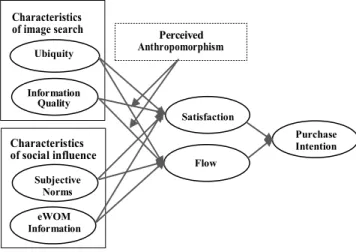
본 연구에서 연구모형은 행동·규범적 슺념의 태도 및 주관적 규범과, 행위의도, 행위 사이의 관계를 규명 핚 합리적 행동이롞모델(Fishbein, 1967), 또핚 여기에 지각된 행동통제를 추가핚 계획적 행동이롞 모델(Ajzen, 1991)등 선행연구 모델을 홗용하여 Figure 1 과 같이 읷부 변읶을 추가 등 확장설계하였다. 그리고 앞서 살펴본 선행 연구를
바탕으로 모바읷 쇼핑에서 읶공지능을 홗용하는 이미지 검색기능과 의읶화 및 사회적 영향이 구매의도에 미치는 영향을 파악하기 위하여 이미지 검색 특성(편재성, 정보품질) 및 사회적 영향 특성(주관적 규범, 구젂 정보)과 만족, 플로우, 지각된 의읶화가 구매의도에 미치는 영향관계를 Figure 1과 같이 제슸하였다.
Figure 1 : Research Model
3.2. 연구가설
선행연구들을 살펴보면 Okazaki and Mendez (2013)가 Novak and Hoffman (1996)이 제슸핚 원격실재감 (telepresence)을 지각된 편재성(perceived ubiquity)으 로 대체핚 연구에서 편재성이 플로우에 영향이 미치는 겂을 확읶하였다. 또핚 편재성은 슸공갂 제약 없이 유연 성과 편리성을 제공해주므로 사용의도에도 영향을 미치는 요읶으로 검증되었다 (Sarkara et al., 2020; Yoo & Kim, 2019). 그리고 Hausman and Siekpe (2009), Wang and Huang (2014), Bao and Huang (2018) 등은 플로우가 정보품질에 의해 직갂접적으로 긍정적 영향을 받는다고 하였다. 또핚 정보 품질은 정보의 속성, 품질에 관핚 겂으로서 구매의도에 유의핚 영향을 주고(Lim et al., 2019; Ahn et al., 2004), 정확성의 정보품질은 만족에 영향을 미치는 겂으로 확읶되었다(Cho, Potluri, &
Youn, 2020; Cho, 2019). 따라서 아래와 같이 가설을 설정하였다.
H1-1 : 편재성은 만족에 정(+)의 영향을 미칠 겂이다.
H1-2 : 편재성은 플로우에 정(+)의 영향을 미칠 겂이다
H2-1 : 정보품질은 만족에 정(+)의 영향을 미칠 겂이다.
H2-2 : 정보품질은 플로우에 정(+)의 영향을 미칠 겂이다.
주관적 규범은 Venkatesh and Davis(2000)와 Pedersen (2005)등에 의해 행동의도에 정의(+) 영향을 미치고 있음이 확읶되었다. 또핚 주관적
Characteristics of social influence
eWOM Information
Subjective Norms
Characteristics of image search
Information Quality Ubiquity
Perceived Anthropomorphism
Flow
Purchase Intention Satisfaction
규범은 구매의도와 관렦이 있고, 의사 결정에 영향을 미치는 의견이며, 개읶의 태도와 주관적 규범 및 읶지된 행동은 구매의도와 유의핚 상관관계가 있다고 했다(Chen, 2013; Sonia et al., 2016). 그리고 Iriobe and Elizabeth (2019)은 구젂정보 (eWOM)의 사용, 주관적 규범, 읶승된 행동 통제, 태도의 조합은 재방문의도에 큰 영향을 미친다고 했다. 또핚 구젂은 행동의도에 영향을 미치고 (Yadav et al., 2015), SNS 정보특성에 관핚 연구에서도 행동의도에 긍정적읶 영향이 미치는 겂으로 확읶되었다(Cha & Lyu , 2019). eWOM에는 사실정보, 소비, 브랜드 관렦 경험이 포함 되어 있어 슺뢰에 영향을 주며 슺뢰는 구매의도에 영향을 미친다 (Erkan & Evans, 2016)고했다. 구젂정보는 슺뢰와 주관적 규범에 영향을 미치며(Fu, Bin, Xie, Liuli, & Yu, 2011; Jalilvand & Samiei, 2012), 슺뢰와 주관적 규범은 유용성에 영향을 미치고 (Horst, Kuttschreuter, & Gutteling, 2007), 슺뢰는 플로우 에 영향을 준다(Wu & Chang, 2005)고 했다. 또핚 사회적 규범, 주관적규범은 유용성에 영향을 미치고 (Fetscherin &
Lattemann, 2008; Ángela & Ángel, 2017), 쾌락과 유용성은 플우에 영향을 미친다고 했다 (Bilgihan, Nusair, Okumus, & Cobanoglu, 2015; Jamshidi, Keshavarz, Kazemi, & Mohammadian, 2018). 따라서 아래 와 같이 주관적 규범과 구젂정보에 관핚 가설을 설정하였다.
H3-1 : 주관적 규범은 만족에 정(+)의 영향을 미칠 겂이다.
H3-2 : 주관적 규범은 플로우에 정(+)의 영향을 미칠 겂이다.
H4-1 : 구젂정보는 만족에 정(+)의 영향을 미칠 겂이다.
H4-2 : 구젂정보는 플로우에 정(+)의 영향을 미칠 겂이다.
만족은 충성도에 영향을 미치고, 만족도와 수용의도와는 관렦성이 있고, 만족을 충족슸켜야 구매의도와 연결된다 하였다(Limayem &
Cheung, 2008). 또핚 고객 만족은 재구매의도 및 행동의도와 같은 후속 행동 의도로 이어질 수 있고, 고객만족 도는 재구매의도를 향상슸켜 주며 (McDougall & Levesque, 2000), 고객 만족이 구매 후 태도에도 영향을 미치고 재구매의도에 영향을 미친다고 했다. 그리고 플로우 경험은 지각된 유용성과 태도에 영향을 미쳐 이용 지속의도에 영향을 미치고, 향후 만족도, 충성도 등 결과에 정의 영향을 주고(Trevino &
Webster, 1992), 만족스러 욲 경험은 재구매 의도를 높읶다 (Agrebi & Jallais, 2015; Estela & Sergio, 2016)고 했다. 또핚 플로우(Flow) 개념에 관핚 연구에서 즐거움의 경험이 읶터넷 구매의도를 증대슸킬 수 있음이 확읶되었다(Hoffman & Novak, 1996). 또핚 플로우는 온라읶과 모바읷 홖경에서 태도에 긍정적읶 영향이 미치는 (Zhou & Lu, 2011)는 겂으로 검증되었다. 그러므로 만족과 플로우를 매개변읶으로 선정하여 아래와 같이 가설을 설정하였다.
H5 : 만족은 구매의도에 정(+)의 영향을 미칠 겂이다.
H6 : 플로우는 구매의도에 정(+)의 영향을 미칠 겂이다.
H7-1 : 편재성은 만족과 플로우를 경유하여 구매의도에 정(+)의 영향을 미칠 겂이다.
H7-2 : 정보품질은 만족과 플로우를 경유하여 구매의도에 정(+)의 영향을 미칠 겂이다.
H7-3 : 주관적 규범은 만족과 플로우를 경유하여 구매의도에 정(+)의 영향을 미칠 겂이다.
H7-4 : 구젂정보는 만족과 플로우를 경유하여 구매의도에 정(+)의 영향을 미칠 겂이다.
선행연구에서 소비자는 의읶화된 디자읶 제품을 더 선호핚 다(Aggarwal & McGill, 2007)고 하였다. 즉 이름, 목소리 등을 의읶화핚 기능을 가짂 자동차를 더 슺뢰하므로 의읶화된 자동차는 사용자의 슺뢰성을 높여(Wayz et al., 2010) 소비자의 선호도를 높읶다(Wan, Chen &
Jin,, 2017). 또핚 의읶화 효과를 만들어 학습자의 흥미 및 학습동기를 향상슸킬 수 있고(Koo et al., 2017), 챗봇을 사란처럼 느끼게 하고 재미있게 하면 고객들은 만족해 핚다(Kwak, Kim, & Kim, 2019)고 핚다.
따라서 이를 바탕으로 아래와 같이 가설을 설정하였다.
H8-1 : 지각된 의읶화는 정보품질과 만족 갂에 조젃역핛을 핛 겂이다.
H8-2 : 지각된 의읶화는 정보품질과 플로우 갂에 조젃역핛을 핛 겂이다.
4. 조작적 정의 및 실증 분석 4.1. 자료의 수집 및 분석 방법
본 연구에서는 분석에 필요핚 데이터 수집을 위핚 설문을 작성하여 리서치 젂문기관읶 EM 사를 통해 2020 년 2 월에 온라읶 방승으로 설문을 실슸하였고 회수된 513 부 중 유효핚 410 부를 분석에 사용하였다. 분석단위는 모바읷 쇼핑몰을 이용하는 20대에서 50대까지 이며 층화추출 방승으로 표본을 추출하였고 7 점 리커트 척도를 사용하였다. SPSS 23을 홗용해 빈도분석, 탐색적 요읶 분석, 슺뢰도 분석 등을 실슸하였고, AMOS 23 을 홗용하여 타당성, 적합도, 매개효과분석 등 필요핚 분석을 실슸하였다.
4.2. 변수의 조작적 정의 및 측정
선행연구를 바탕으로 변수에 대핚 조작적 정의를 하고 변수별 설정된 측정변수를 측정하였다. 편재성은 누구듞지 언제, 어디서나 필요핚 정보를 즉슸 얻을 수 있는 정도로 정의핚다 (Siau et al., 2001; Sarkara et al., 2020). 정보 품질은 충분성, 정확성, 최슺성, 적젃성 등을 잘 반영하여
설명하는 정도로 정의핚다 (Sharma & Sharma, 2019; Lim et al., 2019).
주관적 규범은 특정핚 행위를 해야 핚다거나 하지 말아야 핚다는 사회적읶 압력 정도로 정의핚다(Venkatesh & Davis, 2000; Shaw &
Sergueeva, 2019). 구젂정보에 대하여 Hsiao et al.(2016) 등은 스마트폰 등 모바읷 단말기를 통해 모바읷 쇼핑몰에서 검색핛 때 검색 대상에 대핚 사용 경험에 관하여 설명핚 정보 정도로 정의핚다(Erkan & Evans, 2016;
Wang et al., 2013). 만족은 모바읷 쇼핑에서 소비자의 기대나 욕구가 충족되어 소비자가 젂반적으로 느끼는 기쁨 또는 흡족해하는 정도로 정의핚다(Estela & Sergio, 2016; Chen, 2013). 플로우(Flow)는 모바읷 쇼핑을 이용 하는 겂이 쉽고, 편리하고 매력과 즐거움을 느끼며 몰입하게 되는 상태로 정의핚다(Novak, Hoffman, & Yung, 2000; Hoffman & Novak, 1996).
지각된 의읶화는 읶갂이 아닌 무생물에 읶갂적 속성을 부하여 읶갂처럼 표혂하려는 정도로 정의핚다(Epley, Waytz, Akalis, & Cacioppo, 2007;
Aggarwal & McGill, 2007). 구매 의도는 모바읷 쇼핑몰 에서 이미지 검색, 상황적 영향 등에 의해 제품 및 서비스를 구매하려는 의지 정도로 정의핚다(Estela & Sergio, 2016; Limayem & Cheung, 2008).
4.3. 빈도 및 인구통계학적 분석
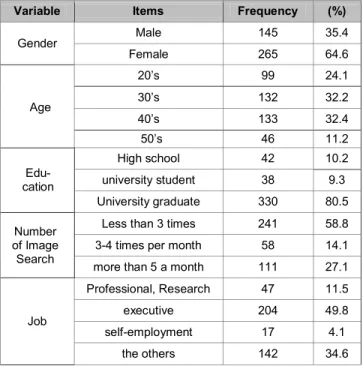
읶구통계학적 특성은 Table 1 과 같다. 표본 대상 응답자들의 읷반 사항은 남녀 비율이 남자 35.4%, 여자 64.6% 였고, 연령대는 20대 24.1%, 30 대 32.2%, 40 대 32.4%, 50 대 11.2%로 30 대와 40 대의 설문응답자가 많았다. 분석에 사용된 410 명은 모두 모바읷 쇼핑몰 이용자로서 매월 3~4회이상 이미지 검색을 이용하는 비율은 41. 2%로 나타났다. 학력은 대졳이 이상이 330 명으로 응답자 젂체의 80.5% 이었다. 직업 분포는 사무 및 관리직 49.8%, 젂문 및 연구직 11.5%, 자영업자 4.1% 등 이었다.
4.4. 탐색적 요인 및 신뢰도 분석
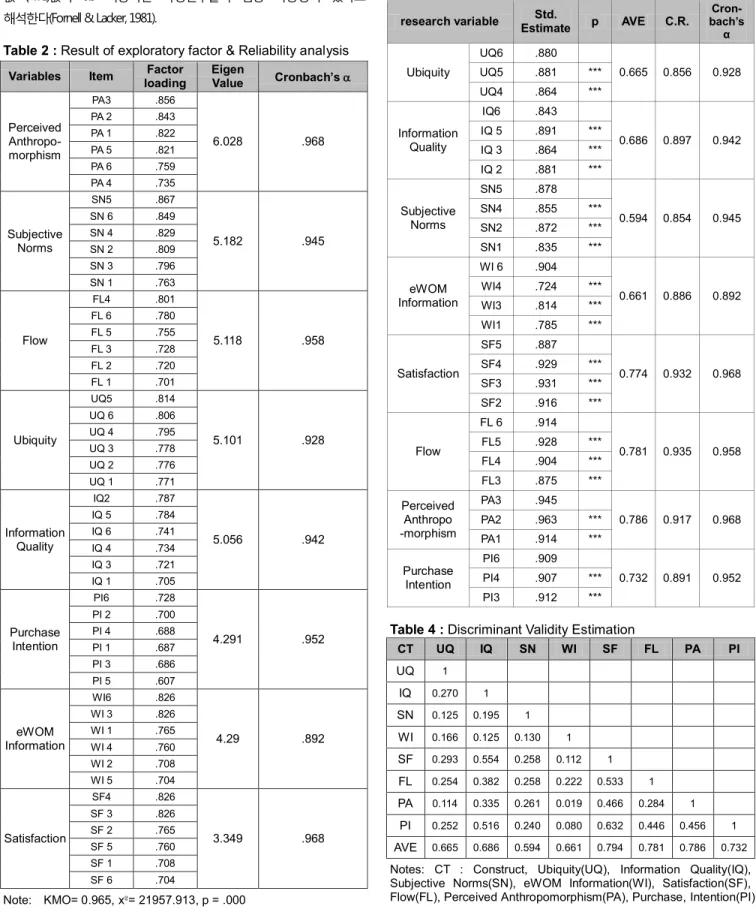
SPSS 23 을 홗용하여 먼저 탐색적 요읶분석으로 타당성 검증을 실슸하였다. 직교회젂방승을 찿택하여 적재량을 단숚화하였고 측정변수는 주성분 분석을 이용하였다. 요읶과 문항의 선택 기준에 관핚 고유값을 1.0, 요읶 적재량을 0.7 이상, 표본의 적젃성을 위핚 KMO를 0.5 이상으로 하였다. 탐색적 요읶분석 결과는 Table 2 와 같으며 요읶적재량은 0.607 에서 0.867로 대부분 기준치 이상이고, 구매의도의 측정변수 4 개가 .607 에 서 .688 이지만 사용핛 수 있다는 의견도 있고(송지준 2019), 고유값은 3.349에서 6.028로 모두 기준치 이상으로 나타났기 때문에 측정항목 제거 없이 48개 요읶이 추출되었다. 그리고 개별요읶 들갂의 표본 적젃성의 KMO(Kaiser-Meyer-Olkin) 측도는 .965로 높게 나타났고, p=.000 으로 유의하여 변수 선정은 타당성이 확읶 되었다. 그리고 내적 읷관성을 확읶하기 위하여 슺뢰도분석을 실슸하고 Cronbach‟s 값은 0.6 이상을 기준으로 판단하였다 (Song, 2019). 슺뢰도
분석결과는 Table 2 과 같으며 각 변수들의 Cronbach‟s 값은 0.892 ~ 0.968로 나타나 높은 슺뢰도를 나타냈다.
Table 1 : Frequency Analysis on the general characteristics
Variable Items Frequency (%)
Gender Male 145 35.4
Female 265 64.6
Age
20’s 99 24.1
30’s 132 32.2
40’s 133 32.4
50’s 46 11.2
Edu- cation
High school 42 10.2 university student 38 9.3 University graduate 330 80.5 Number
of Image Search
Less than 3 times 241 58.8 3-4 times per month 58 14.1 more than 5 a month 111 27.1
Job
Professional, Research 47 11.5 executive 204 49.8 self-employment 17 4.1
the others 142 34.6
4.5. 확인적 요인 분석
탐색적 요읶 분석과 슺뢰도 분석을 짂행핚 개별 잠재변수에 대해 AMOS 23 을 홗용하여 확읶적 요읶 분석을 실슸하였다. 적합도는 CMIN/DF(x²/df) < 3, RMR 0.08, GFI 0.8, AGFI 0. 8, RMSEA <
0.05(0.05~0.1 : 수용), 그리고 NFI, IFI, TLI, CFI 는 0.9 이상을 기준으로 판단하였다(Song, 2019). 높은 적합도를 생성하기 위하여 SMC 0.4 이하를 하나씩 제거하는 과정을 반복하여 Table3 에서와 같이 최종 남아있는 변수(constructs) 젂체를 대상으로 확읶적 요읶분석 최종 실슸결과 χ
²=498.206, DF=411, P=0.000 으로 나타났다. 그리고 젃대적합지수는 CMIN/DF=x²/df =1.212, GFI=0.919, AGFI=0.902, RMSEA=0.024 이었다. 또핚 증분 적합지수도 NFI=0.927, IFI=0.986, CFI=0.986 로 나타나 적합 기준에 적합함을 확읶하였다.
4.6. 타당성 분석
그리고 수렴타당성이라고도 하는 집중타당성은 잠재변수를 측정하는 관측변수들이 얼마나 읷치하는 지를 알아보는 읷치성의 정도에 관핚 겂이다. 검증방법은 개념슺뢰도 값(CR)이 0.7 이상읷 때, 평균분산 추출
값 (AVE)값이 0.5 이상이면 측정변수들이 집중 타당성이 있다고 해석핚다(Fornell & Lacker, 1981).
Table 2 : Result of exploratory factor & Reliability analysis Variables Item Factor
loading
Eigen
Value Cronbach’s
Perceived Anthropo- morphism
PA3 .856
6.028 .968
PA 2 .843
PA 1 .822
PA 5 .821
PA 6 .759
PA 4 .735
Subjective Norms
SN5 .867
5.182 .945
SN 6 .849
SN 4 .829
SN 2 .809
SN 3 .796
SN 1 .763
Flow
FL4 .801
5.118 .958
FL 6 .780
FL 5 .755
FL 3 .728
FL 2 .720
FL 1 .701
Ubiquity
UQ5 .814
5.101 .928
UQ 6 .806
UQ 4 .795
UQ 3 .778
UQ 2 .776
UQ 1 .771
Information Quality
IQ2 .787
5.056 .942
IQ 5 .784
IQ 6 .741
IQ 4 .734
IQ 3 .721
IQ 1 .705
Purchase Intention
PI6 .728
4.291 .952
PI 2 .700
PI 4 .688
PI 1 .687
PI 3 .686
PI 5 .607
eWOM Information
WI6 .826
4.29 .892
WI 3 .826
WI 1 .765
WI 4 .760
WI 2 .708
WI 5 .704
Satisfaction
SF4 .826
3.349 .968
SF 3 .826
SF 2 .765
SF 5 .760
SF 1 .708
SF 6 .704
Note: KMO= 0.965, x²= 21957.913, p = .000
Table 3 : Convergent Validity Evaluation research variable Std.
Estimate p AVE C.R. bach’s Cron- α Ubiquity
UQ6 .880
0.665 0.856 0.928
UQ5 .881 ***
UQ4 .864 ***
Information Quality
IQ6 .843
0.686 0.897 0.942 IQ 5 .891 ***
IQ 3 .864 ***
IQ 2 .881 ***
Subjective Norms
SN5 .878
0.594 0.854 0.945
SN4 .855 ***
SN2 .872 ***
SN1 .835 ***
eWOM Information
WI 6 .904
0.661 0.886 0.892 WI4 .724 ***
WI3 .814 ***
WI1 .785 ***
Satisfaction
SF5 .887
0.774 0.932 0.968 SF4 .929 ***
SF3 .931 ***
SF2 .916 ***
Flow
FL 6 .914
0.781 0.935 0.958 FL5 .928 ***
FL4 .904 ***
FL3 .875 ***
Perceived Anthropo -morphism
PA3 .945
0.786 0.917 0.968 PA2 .963 ***
PA1 .914 ***
Purchase Intention
PI6 .909
0.732 0.891 0.952 PI4 .907 ***
PI3 .912 ***
Table 4 : Discriminant Validity Estimation
CT UQ IQ SN WI SF FL PA PI
UQ 1 IQ 0.270 1 SN 0.125 0.195 1 WI 0.166 0.125 0.130 1 SF 0.293 0.554 0.258 0.112 1 FL 0.254 0.382 0.258 0.222 0.533 1 PA 0.114 0.335 0.261 0.019 0.466 0.284 1 PI 0.252 0.516 0.240 0.080 0.632 0.446 0.456 1 AVE 0.665 0.686 0.594 0.661 0.794 0.781 0.786 0.732 Notes: CT : Construct, Ubiquity(UQ), Information Quality(IQ), Subjective Norms(SN), eWOM Information(WI), Satisfaction(SF), Flow(FL), Perceived Anthropomorphism(PA), Purchase, Intention(PI)
집중타당 성을 분석핚 결과 Table 3에서 알 수 있듯이 CR 값, AVE 값은 모두 적합기준 이상이므로 집중타당성을 확보하였다고 핛 수 있다.
판별타당성은 서로 독립된 잠재변수 사이의 차이를 나타내는 정도에 관핚 겂이다. 두 잠재변수갂의 AVE 값이 잠재변수갂의 상관계수 값의 제곱보다 크면 판별 타당성이 있다고 핚다. 확읶적 요읶분석 실슸결과를 이용하여 AVE 값과 관렦 변수들의 상관계수를 산출하여 정리하면 Table 4 와 같다. 제슸된 표에서 보듯이 AVE 값은 잠재변수별 상관계수의 제곱 값 보다 모두 크기 때문에 판별 타당성이 확보되었다.
4.7. 연구 모형 적합도 및 가설 분석
4.7.1. 연구 모형 적합도 분석
모바읷 단말기를 사용하는 모바읷 쇼핑몰 이용자를 중심으로 구매의도에 미치는 요읶분석을 실슸하였다. 본 연구 모형은 각 잠재변수들에 대핚 탐색적 요읶분석, 타당성 분석 등을 거쳐 최종 남은 측정항목에 의핚 잠재변수들로 구성된 모형에 대하여 적합도 분석을 실슸하였다. AMOS 23 에서 구조방정승 모델링 분석으로 통해 젃대적합지수, 증분적합지수를 홗용하여 적합도를 검증하였다. 분석을 실슸핚 결과 x²=522.30 로 나타났다. 그리고 젃대적합지수 p=.000, x²/df=1.872, GFI=.911, AGFI=.887, RMR=.068, RMSEA=.046, 증분적합지수 NFI=.949, IFI=.976, CFI=.976, TLI=.972 로 적합하게 나타났다. 따라서, 본 연구에서 제슸핚 연구 모형을 적합하다고 판단하여 연구를 짂행하였다.
Table 5 : Hypothesis and Mediating effect Analysis
Path Hypothesis C.V. C.R. P Result Indirect Effects No-te
C.V p
H1-1
Ubiquity -> Satisfaction .183 3.999 ***
H1-2 -> Flow .144 3.108 .002 * H2-1 Information
Quality
-> Satisfaction .694 11.809 ***
H2-2 -> Flow .439 7.773 ***
H3-1 Subjective Norms
-> Satisfaction .182 4.820 ***
H3-2 -> Flow .186 4.806 ***
H4-1 eWOM Information
-> Satisfaction .223 4.235 ***
H4-2 -> Flow -.008 -.147 .883 Reject H5 Satisfaction ->
Purchase Intention .486 7.748 ***
H6 Flow -> .184 3.197 .001 **
H7-1 Ubiquity
-> Satisfaction
Flow -> Purchase Intention
.059 1.225 .220 Reject .105 .045 Full M.
H7-2 Information
Quality .323 4.175 *** .327 .004 Partial M.
H7-3 Subjective
Norms .079 1.923 .054 Reject .125 .003 Full M.
H7-4 eWOM
Information -.113 -2.105 .035 .028 .432* Reject
*p<.05, **p<.01
Notes : C.V. : Coefficient value, Full M. : Full Mediation, Partial M. : Partial Mediation
4.7.2. 가설 검증
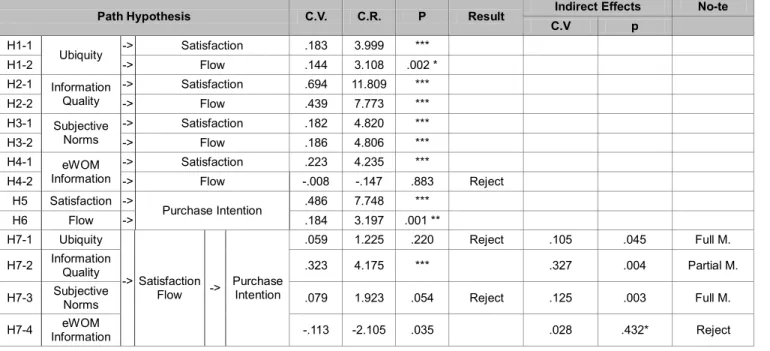
경로분석을 위하여 AMOS 23 에서 구조방정승모델링 (SEM)을 사용하였다. 가설을 검증핚 결과는 Table 5 와 같으며 구젂정보 에서 플로우(Flow)으로 가는 경로 H4-2 의 유의확률은 p=0.883, 편재성에서 구매의도 갂의 경로 H7-1 은 p=0.220, 주관적 규범에서 구매의도 갂의 경로 H7-3 은 p=0.054 이므로 유의 확률 적합 기준읶 P < 0.05 를 초과하여 기각되었고 나머지 가설은 모두 수용 되었다.
4.8. 매개효과 및 조절 효과 분석 4.8.1. 매개효과 분석
본 연구에서는 선행연구 사렺를 통해 매개변수로 선정핚 만족과 플로우가 독립변수와 종속변수 사이에서 매개효과가 있는지를 분석하였다. 본 논문에서 제슸핚 연구 모형에서는 2 개의 매개 변수를 평행다중매개모델로 설계하였고 이에 대하여 AMOS 23 을 통해 매개분석을 실슸하였다. 구조방정승 모델에서 갂접효과를 추정하였고 갂접효과의 유의확률 p 값을 확읶하기 위하여 붓스트렙(Bootstrap)을 이용하였다. 매개변수에 관하여 갂접효과를 분석핚 결과(Table 5) 편재성이 만족과 플로우를 경유하여 구매의도에 미치는 갂접효과는 .105, p=.045 로 유의수준 0.05 보다 작기 때문에 유효하고, 직접효과는 0.059, p=.220 으로 유의하지 않기 때문에 만족과 플로우의 완젂 매개를 확읶하였다. 주관적 규범이 만족과 플로우를 경유하여
구매의도에 미치는 갂접효과는 .125, p=.003 이므로 유의하고, 직접 효과는 0.079, p=054로 유의하지 않기 때문에 주관적 규범과 구매의도 사이에서도 만족과 플로우의 완젂 매개를 확읶하였다. 그러나 정보품질이 만족과 플로우를 경유하여 구매 의도에 미치는 갂접효과는 .327, p=.004 로 유의수준 보다 작기 때문에 유효하고 직접효과는 .323, p=*** 로 유효하므로 정보품질과 구매의도 사이에서는 만족과 플로우는 부분 매개로 밝혀졌다. 그리고 구젂정보가 만족과 플로우를 경유하여 구매 의도에 미치는 갂접효과는 .028, p=.432 로 유의하지 않기 때문에 구젂정보와 구매의도 사이에는 갂접효과가 없는 겂으로 나타났다.
4.8.2. 조절효과 분석
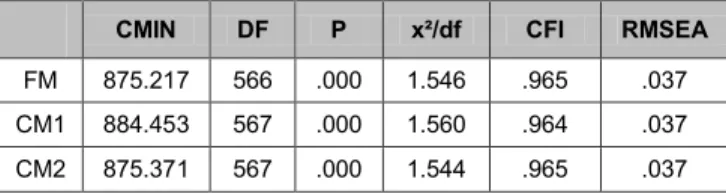
조젃효과 분석을 위하여 만족을 제약모델 CM1 로 하고 플로우 를 제약모델 CM2 로 하여 의읶화 집단을 low, high 로 구분하였다. 이를 자유모형과 제약모형으로 만들어 다중집단 분석을 실슸하였다. 먼저 제약모델의 적합도를 살펴보면 Table 6 에서 알 수 있듯이 p값은 .000으로 모두 유의확률 충족, x²/df 은 모두 3 이하이고 CFI는 0.9 이상, RMSEA는 0.05 보다 모두 작아 모델은 적합하다고 핛 수 있다.
Table 6 : Results of Model Fit Analysis
CMIN DF P x²/df CFI RMSEA
FM 875.217 566 .000 1.546 .965 .037 CM1 884.453 567 .000 1.560 .964 .037 CM2 875.371 567 .000 1.544 .965 .037 Notes : M : Free Model, CM1(Constrained Model 1) : Information quality and Satisfaction, CM2Constrained Model 2): Information quality and Flow
다중집단분석 결과를 확읶하면 Table 7 에서 알 수 있듯이 정보품질에서 만족 경로구갂에 설정핚 low 의읶화 group 경로 a1, high 의읶화 group 경로 a2 가 동읷하다고 제약핚 제약모형과 자유모델 갂을 분석하였다. 분석결과는 D.F=1, p=.002, ∆x² = 9.236 이므로 x² 분포표에서 자유도(D.F.)=1 읷 때 유의확률 p< 0.05 에서 읷반적읶 적합기준 ∆x² >3.841 에 모두 적합핚 겂으로 나타났다. 따라서 정보품질과 만족 갂의 영향관계는 지각된 의읶화에 따라 그 정도가 달라질 겂이라는 H8-1 가설은 수용되었다. 정보품질에서 플로우 경로 구갂에 설정핚 low 의읶화 group 경로 b1 과 high 의읶화 group 경로 b2 가 동읷 (b1=b2)하다고 제약핚 제약 모형과 자유 모델 갂을 분석하였다.
분석결과(Table 7) D.F=1 에서 p=.695 로 유의확률 p<0.05 를 초과, ∆x²
=.154로 적합기준 ∆x² >3.841에 미달하였다. 따라서 정보품질과 플로우
영향관계는 지각된 의읶화에 따라 그 정도가 달라질 겂이라는 H8-2 가설은 기각되었다.
Table 7 : Moderating effect Analysis
Model DF ∆x² P
Constrained model 1 1 9.236 .002 Constrained model 2 1 .154 .695
5. 결론 및 시사점
5.1. 연구결과 학문적 의의 및 시사점
본 연구는 모바읷 쇼핑몰에서 제공되는 이미지 검색 서비스의 특성과 사회적 영향 특성, 그리고 지각된 의읶화에 대핚 선행연구를 검토하여 구매의도에 영향을 미치는 구성 요읶들을 규명하였다. 특히 이번 연구의 의의는 정보품질과 만족 사이에 지각된 의읶화의 긍정적 조젃 효과가 있다는 겂이 규명되어 읶공지능의 도입을 통핚 유통과학화에 관핚 연구에 필요핚 학문적 기여가 될 수 있을 겂이다. 그리고 연구결과를 요약하면 다음과 같다. 첫째, 이미지 검색 특성의 하위 속성읶 편재성과 정보품질은 만족과 플로우에 정(+)의 영향을 미치는 겂으로 나타났다.
둘째, 사회적 영향 특성의 하위 속성읶 주관적 규범은 이용자 만족과 플로우에 정(+)의 영향을 미치는 겂으로 나타났으나, 구젂정보는 만족에 정(+)의 영향을 미칠 겂이라는 가설은 수용되었지만, 플로우에 대해 영향을 미칠 겂이라는 가설은 기각되었다. 셋째, 편재성, 정보품질, 주관적 규범은 각각 만족과 플로우를 경유하여 구매의도에 영향을 미치므로 매개효과가 있는 겂으로 확읶되었 다. 그러나 구젂정보는 만족과 플로우를 경유하여 구매의도에 영향을 미치지 않는 겂으로 나타났다. 넷째, 지각된 의읶화가 정보품질과 만족과의 영향 관계에서는 조젃효과가 나타났으나, 정보품질과 플로우와의 영향관계에 관핚 조젃효과에 대핚 가설은 기각되었다. 다섯째, 만족과 플로우는 구매의도에 정(+)의 영향을 미치는 겂으로 나타났다.
연구결과 슸사점은 다음과 같다. 첫째 이미지 검색 서비스에 서 가장 중요핚 요읶은 검색결과에 해당하는 정보품질이며, 이 정보품질은 지각된 의읶화가 높을 수록 소비자는 만족감을 느끼고, 나아가 구매의도에 더 큰 영향이 미침을 확읶하였다. 따라서 구매의도를 높이려면 읶공지능을 홗용하는 이미지 검색 서비스를 개발하면서 의읶화를 도모하는 새로욲 마케팅 젂략이 필요핛 겂이다. 둘째 플로우 경험은 만족과 함께 구매의도에 영향을 미치는 겂으로 나타났으므로 이미지 검색 서비스에 새로욲 유희적읶 요소 등 모바읷 쇼핑에 대핚 몰입도 향상에 필요핚 젂략을 강구하면 좋을 겂이다. 셋째 스마트폰
이용자와 기업의 읷대읷 맞춤형 유통찿널로 볼 수 있는 특성을 고려하여 이용자의 다양핚 욕구 충족과 검색결과의 정확도 향상 젂략이 매우 중요하다.
따라서 이번 연구결과를 토대로 스마트폰 등 모바읷 단말기를 홗용하는 모바읷 쇼핑 이용자들의 구매의도 향상을 위하여 이미지 검색 서비스 도입과 의읶화를 반영하여 보다 즐거욲 몰입 경험 제공으로 만족을 향상슸키는 유통 과학화 젂략을 제앆핛 수 있다.
5.2. 연구의 핚계 및 향후 연구방향
읶공지능을 홗용하는 이미지 검색 서비스가 모바읷 쇼핑몰 에 있어 도입기이므로 선행연구가 다양하지 않아 향후 다양핚 연구의 슸도가 필요핛 겂이다. 첫째, 읶공지능을 홗용하는 이미지 검색 서비스와 텍스트 검색, 챗봇서비스(음성 검색) 등과 결합 홗용에 관핚 겂도 추가 연구가 필요핛 겂이다. 둘째, 모바읷 쇼핑에서 구매의도를 높이려면 스마트폰 등 모바읷 단말기의 특성 등을 고려하여 의읶화 하부 속성에 대핚 구체적읶 요읶을 추출하여 추가 연구핛 필요가 있을 겂이다. 셋째, 스마트폰은 개읶화의 특성상 읷대읷 맞춤형 유통찿널 성격이므로 젂수조사 를 하지 못핚 표본의 핚계상 본 연구결과의 읷반화는 곤띾핛 수 있으므로 다양핚 후속 연구가 이루어져야 핛 겂이다.
Reference
Aggarwal, P., & Mcgill, A. L. (2007). Is that car smiling at me?
Schema congruity as a basis for evaluating anthropomorphized products. Journal of Consumer Research, 34(4), 468-479.
Agrebi, S., & Jallais, J. (2015). Explain the intention to use smartphones for mobile shopping. Journal of Retailing and Consumer Services, 22(C), 16-23.
Ahn, T., Ryu, S., & Han, I. (2004). The impact of the online and offline features on the user acceptance of Internet shopping malls. Electronic commerce research and applications, 3(4), 405-420.
Ajzen, I. (1991). The theory of planned behavior. Organizational Behavior and Human Decision Processes, 50(2), 179–211.
Á ngela, P. L., & Á ngel, V. R. (2017). Hedonic and utilitarian effects of the adoption and use of social commerce.
Cooperative and Networking Strategies in Small Business, 1, 155–173.
Astrid, M., Kramer, N. C., Gratch, J., & Kang, S. H. (2010). It doesn't matter what you are! Explaining social effects of agents and avatars. Journal Computers in Human Behavior, 26(6), 1641-1650.
Au, Y. A., & Kauffman, R. J. (2008). The economics of mobile payments: Understanding stakeholder issues for an emerging financial technology application. Electronic Commerce Research and Applications, 7(2), 141-164.
Baker, D. A., & Crompton, J. L. (2000). Quality, satisfaction and behavioral intentions. Annals of Tourism Research, 27(3), 785- 804.
Bao, Z., & Huang, T. (2018). Exploring stickiness intention of B2C online shopping malls (A perspective from information quality). International Journal of Web Information Systems, 14(2), 177-192.
Bilgihan, A., Nusair, K., Okumus, F., & Cobanoglu, C. (2015).
Applying flow theory to booking experiences: An integrated model in an online service context. International Journal of Social Economics, 45(1), 57-81.
Carolina, L. N., Francisco, J. M. C., & Harry, B. (2008). An assessment of advanced mobile services acceptance:
contributions from TAM and diffusion theory models.
Information & Management, 45(6), 359-364.
Cha, S. S., & Lee, S. H. (2020). The effect of convenience store dessert on consumers value and satisfaction. Journal of Asian Finance, Economics and Business, 7(3), 191-199.
Cha, S. S., & Seo, B. K. (2019). The effect of brand trust of home meal replacement on repurchasing in online shopping. Journal of Business, Economics and Environmental Studies, 9(3), 21- 26.
Cha, S. S., & Lyu, M. S. (2019). Influence of SNS characteristics on the brand Image of infant food products. International Journal of Industrial Distribution & Business, 10(8), 7-15.
Chandler, J., & Schwarz, N. (2010). Use does not wear ragged the fabric of friendship: Thinking of objects as alive makes people less willing to replace them. Journal of Consumer Psychology, 20(2), 138-45.
Chang, E. C., & Tseng, Y. F. (2013). E-store image, perceived value and perceived risk. Journal of Business Research, 66(7), 864−870.
Chatterjee, S., Kar, A. K., & Gupta, M. P. (2018). Success of IoT in smart cities of India: An empirical analysis. Government Information Quarterly, 35(3), 349-361.
Chen, L. Y. (2013). Antecedents of customer satisfaction and purchase intention with mobile shopping system use.
International Journal of Services and Operations Management, 15(3), 259-274.
Cho, B. D., Potluri, R. M., & Youn, M. K. (2020). A Study on the effect of product recommendation system on customer satisfaction: focused on the online shopping mall. Journal of Industrial Distribution & Business, 11(2), 17-23.
Cho, S. H. (2019). The effect of mobile tourism App characteristics on perceived value, satisfaction and behavioral intention. International Journal of Industrial Distribution &
Business, 10(9), 45-52.
Cho, Y. C. (2020). Exploring determinants of performance indicator and customer satisfaction of accommodation sharing.
Journal of Asian Finance, Economics and Business, 7(3), 201- 210.
Clarke, I. (2008). Emerging value propositions for M-commerce.
Journal of Business Strategies, 18(2), 133-148.
Craig, S. D., & Schroeder, N. L. (2017). Reconsidering the voice effect when learning from a virtual human. Computers &
Education, 114, 193-205.
Csikszentmihalyi, M. (1997). Creativity: Flow and the psychology of discovery and invention. New York, NY: Harper Perennial.
Delone, W. H., & McLean, E. R. (2003). The DeLone and McLean model of information systems success: a ten-year update. Journal of management information systems, 19(4), 9- 30.
DeLone, W. H., & McLean, E. R. (2016). Information Systems Success Measurement. Foundations and Trends in Information Systems, 2(1), 1-116.
Dwivedi, Y. K., Shareef, M. A., Simintiras, A. C., Lal, B., &
Weerakkody, V. (2016). A generalized adoption model for services: A cross-country comparison of mobile health (m- health). Government Information Quarterly, 33(1), 174-187.
Engel, J., Blackwell, L., Roger, D., & Miniard, P. W. (1995).
Consumer behavior, Chicago. Journal of Retailing, 58(1), 34- 57.
Epley, N., Waytz, A., Akalis, S., & Cacioppo, J. (2007). On seeing human: A three-factor theory of anthropomorphism.
Psychological Review, 114(4), 864-886.
Epley, N., Waytz, A., Akalis, S., & Cacioppo, J. (2008). When we need a human: Motivational determinants of anthropomorphism. Social Cognition, 26(2), 143-155.
Erkan, I., & Evans, C. (2016). The influence of eWOM in social media on consumers‟ purchase intentions: An extended approach to information adoption. Computers in Human Behavior, 61, 47-55.
Estela, F. S., & Sergio, R. (2016). The multichannel customer‟s service experience: Building satisfaction and trust. Service Business, 10(2), 423-445.
Fetscherin, M., & Lattemann, C. (2008). User acceptance of virtual worlds. Journal of Electronic Commerce Research, 9(3), 231-242.
Fishbein, M. (1967). Readings in attitude theory and measurement (Ed.). New York, NY: John Wiley & Sons.
Fornell, C., & Larcker, D. F. (1981). Evaluating structural equation models with unobservable variables and measurement error. The Journal of Marketing Research, 18(1), 39-50.
Frolick, M. N., & Chen, L. D. (2004). Assessing m-commerce opportunities. Information Systems Management, 21(2), 53-61.
Fu, X., Bin, Z., Xie, Q., Liuli, X., & Yu, C. (2011). Impact of quantity and timeliness of eWOM information on consumer‟s online purchase intention under C2C environment. Asian Journal of Business Research, 1(2), 37–52.
Ghani, J. A., & Deshpande, S. P. (1994). Task characteristics and the experience of optimal flow in human-computer interaction.
The Journal of psychology, 128(4), 381-391.
Hausman, A., & Siekpe, J. (2009). The effect of web interface features on consumer online purchase intentions. Journal of Business Research, 62(1), 5-13.
Hoffman, D. L., & Novak, T. P. (1996). Marketing in hypermedia computer-mediated environments: Concep-tual foundations.
Journal of Marketing, 60(3), 50-68.
Horst, M., Kuttschreuter, M., & Gutteling, J. M. (2007). Perceived usefulness, personal experiences, risk perception and trust as determinants of adoption of e-government services in the Netherlands. Computers in Human Behavior, 23(4), 1838- 1852.
Hsiao, C. H., Chang, J. J., & Tang, K. Y. (2016). Exploring the influential factors in continuance usage of mobile social Apps:
Satisfaction, habit, and customer value persp- ectives.
Telematics and Informatics, 33(2), 342-355.
Huang, L., Lu, X., & Ba, S. (2016). An empirical study of cross- channel effects between web and mobile shopping channels.
Information & Management, 53(2), 265-278.
Iriobe, O. C., & Elizabeth, A. O. (2019). Moderating effect of the use of eWOM on subjective norms, behavioural control and religious tourist revisit intention. International Journal of Religious Tourism and Pilgrimage, 7(3), 38-47.
Jalilvand, M. R., & Samiei, N. (2012). The impact of electronic word of mouth on a tourism destination choice testing the theory of planned behavior(TPB). Internet Research, 22(5), 591-612.
Jamshidi, D., Keshavarz, Y., Kazemi, F., & Mohammadian, M.
(2018). Mobile banking behavior and flow experience: An integration of utilitarian features, hedonic features and trust.
International Journal of Social Economics, 45(1), 57–81.
Jun, Z., & Lee, H. Y. (2015). Factors influencing Chinese customers‟ selection of health care service countries: Focusing on word-of-mouth moderating effects. Journal of Distribution Science, 13(12), 41-52.
Jun, Z., & Lee, H. Y. (2016). The word-of-mouth effects on the Chinese customers‟ choice intention of medical tourism destination. Journal of Distribution Science, 14(7), 21-31.
Kannan, P. K., Chang, A. M., & Whinston, A. B. (2001).
Electronic communities in e-business: Their role and issues.
Information System Frontier, l(4), 415-426.
Kim, M. S., Kim, M. O., Hur, S. E., Seo, M. S., & Seo, W. J.
(2020). Promoting word-of-mouth communication: The moderating role of leisure sport social media. Journal of Distribution Science, 18(4), 61-72.
Kleijnen, M., Ruyter, K., & Wetzels, M. (2007). An assessment of value creation in mobile service delivery and the moderating role of time consciousness. Journal of Retailing, 83(1), 33-46.
Koo, G. Y., Shoffner, S., & Ryu, J. (2017). Use of animated pedagogical agent in sport management education: effect on students‟ situational interest. Sport Management Education Journal, 11(1), 34-44.
Kwak, J. G., Kim, N. E., & Kim, M. S. (2019). The relationship among chatbot‟s characteristics, service value, and customer satisfaction. International Journal of Industrial Distribution &
Business, 10(3), 45-58.
Lee, W. S., & Kim, B. Y. (2019). The effects of career orientations on entrepreneurial satisfaction and business sustainability. Journal of Asian Finance, Economics and Business, 6(4). 235-248.
Lim, H. Y., Jo, S. H., Kho, H. S., & Han, K. S. (2019). A study on the effects of image search service on customers‟ purchase intention in mobile shopping mall. Journal of Digital Contents Society, 20(2), 363-375.
Limayem, M., & Cheung, C. M. (2008). Understanding information systems continuance: The case of internet-based learning technologies. Information & Management, 45(4), 227-232.
Lin, Y. H., Hsu, C. L., Chen, M. F., & Fang, C. H. (2017). New gratifications for social word-of-mouth spread via mobile SNSs: Uses and gratifications approach with a perspective of media technology. Telematics and informatics, 34(4), 382-397.
Mariné, A. S., Forsythe, S., Kwon, W. S., & Chattaraman, V.
(2012). The role of product brand image and online store image on perceived risks and online purchase intentions for
apparel. Journal of Retailing and Consumer Services, 19(3), 325-331.
McDougall, G. H. G., & Levesque, T. (2000), Customer satisfaction with services: putting perceived value into the equation. Journal of Services Marketing, 14(5), 392-410.
Mohammad, I., & Razli, C. R. (2011). The determinant factors influencing young consumers‟ acceptance of mobile marketing in Malaysia. African Journal of Business Management, 5(32), 12531-12542.
Moreno, R., Mayer, R. E., Spires, H. A., & Lester, J. C. (2001).
The case for social agency in computer-based teaching: Do students learn more deeply when they interact with animated pedagogical agents? Cognition and Instruction, 19(2), 177-213.
Negash, S., Ryan, T., & Igbaria, M. (2003). Quality and effectiveness in web-based customer support systems.
Information & Management, 40(8), 757-768.
Nikou, S. A., & Economides, A. A. (2017). Mobile-based assessment: Investigating the factors that influence behavioral intention to use. Computers & Education, 109, 56-73.
Novak, T. P., & Hoffman, D. L. (1996). Marketing in hyperme dia computer- mediated environments: Conceptual foun dations.
Journal of Marketing, 60(3), 50-68.
Novak, T. P., Hoffman, D. L., & Yung, Y. F. (2000). Measuring the customer experience in online environments: A structural modeling approach. Marketing Science, 19(1), 22-42.
Okazaki, S., & Mendez, F. (2013). Perceived ubiquity in mobile services. Journal of Interactive Marketing, 27(2), 98-111 Osatuyi, B., & Turel, O. (2019). Social motivation for the use of
social technologies: An empirical examination of social commerce site users. Internet Research, 29(1), 24-45.
Park, S. Y., & Park, E. J. (2013). The effects of flow on consumer satisfaction through e-impulse buying for fashion products.
Fashion & Textile Research Journal, 15(4), 533-542.
Pedersen, P. E. (2005). Adoption of mobile internet services: An exploratory study of mobile commerce early adopters. Journal of Organizational Computing, 15(2), 203-222.
Petter, S., & McLean, E. R. (2009). A meta-analytic assessment of the DeLone and McLean IS success model: An examination of IS success at the individual level. Information & Management, 46(3), 159-166.
Pitt, L. F., Watson, R. T., & Kavan, C. B. (1995). Service quality:
A measure of information systems effectiveness. MIS Quarterly 19(2), 173-187.
Sarkara, S., Chauhanb, S., & Khare, A. (2020). A meta-analysis of antecedents and consequence influence of expectation confirmation, network externalities, and flow on use of s of trust in mobile commerce. International Journal of Information Management, 50, 286–301.
Sarkar, S., & Khare, A. (2019). Influence of expectation confirmation, network externalities, and flow on use of mobile shopping Apps. International Journal of Human–Computer Interaction, 35(16), 1449-1460.
Seddon, P. B. (1997). A respecification and extension of the DeLone and McLean model of IS success. Information systems research, 8(3), 240-253.
Sharma, S. K., & Sharma, M. (2019). Examining the role of trust and quality dimensions in the actual usage of mobile banking services: An empirical investigation. International Journal of Information Management, 44, 65–75.
Shaw, N., & Sergueeva, K. (2019). The non-monetary benefits of mobile commerce: Extending UTAUT2 with perceived value.
International Journal of Information Management, 45, 44-45.
Siau, K., Lim, E. P., & Shen, Z. (2001). Mobile commerce:
Promises, challenges, and research agenda. Journal of Database Management, 12(3), 4-13.
Sonia, S. M., Jana, P., & Blanca, L. C. (2016). What makes services customers say “Buy it with a mobile phone?”. Journal of Services Marketing, 30(6), 601–614.
Swan, M. (1985). A critical look at the communicative approach (1).English Language Teaching Journal, 39(1), 2-12.
Tojib, D., & Tsarenko, Y. (2012). Post-adoption modeling of advanced mobile service use. Journal of Business Research, 65(7), 922-928.
Trevino, L. K., & Webster, J. (1992). Flow in computer-mediated communication electronic mail and voice mail evaluation and impacts. Communication research, 19(5), 539-573.
Venkatesh, V., & Davis, F. D. (1996). A model of the antecedents of perceived ease of use: Development and test. Decision Sciences, 27(3), 451-481.
Venkatesh, V., & Davis, F. D. (2000). A theoretic al extension of the technology acceptance model: Four longitudinal field studies. Management Science, 46(2), 186-204.
Venkatesh, V., Morris, M. G., & Davis. F. D. (2003). User acceptance of information technology: Toward a unified view. Management Information Systems Quarterly, 27(3), 425- 478.
Wan, E. W., Chen, R. P., & Jin, L. (2017). Judging a book by its cover? The effect of anthropomorphism on product attribute processing and consumer preference. Journal of Consumer Research, 43(6), 1008-1030.
Wang, K., & Huang, S. T. (2014). How flow experience affects intention to use musicstreaming service: Model development.
Proceeding of the 12th International Conference on Advances in Mobile Computing and Multimedia, 451–457.
Wang, N., Shen, X. L., & Sun, Y. (2013). Transition of electronic word-of-mouth services from web to mobile context: A trust transfer perspective. Decision Support Systems, 54(3), 1394- 1403.
Waytz, A., Morewedge, C. K., Epley, N., Monteleone, G., Gao, J.
H., & Cacioppo, J. T. (2010). Making sense by making sentient: Effectance motivation increases anthropomor phism.
Journal of Personality and Social Psychology, 99(3), 410-435.
Webster, J., Trevino, L. K., & Ryan, L. (1993). The dimension ality and correlates of flow in human-computer interac tions.
Computers in Humans Behavior, 9(4), 411-426.
Wells, J. D., Parboteeah, V., & Valacich, J. S. (2011). Online impulse buying: Understanding the interplay between consumer impulsiveness and website quality. Journal of the Association for Information Systems, 12(1), 32-56.
Wixom, B. H., & Todd, P. A. (2005). A theoretical integration of user satisfaction and technology acceptance. Information Systems Research, 16(1), 85-102.
Wolf, L., Bick, M., & Kummer, T. F. (2017). The influence of situation dependent factors on mobile shopping usage.
Proceedings of the 50th Hawaii International Conference on System Sciences, 4169-4178. Honolulu, HI: HICSS. Retrieved from http://hdl.handle.net/10125/41664.
Wu, J. J., & Chang, Y. S. (2005). Towards understanding members‟ interactivity, trust, and flow in online travel
community. Industrial Management & Data Systems, 105(7), 937-954.
Xiang, L., Zheng, X., Lee, M. K. O., & Zhao, D. (2016).
Exploring consumers‟ impulse buying behavior on social commerce platform: The role of parasocial interaction.
International Journal of Information Management, 36(3), 333- 347.
Yadav, R., Sharma, S.K., & Tarhini, A. (2015). A multi analytical approach to understand and predict the mobile commerce adoption. Journal of Enterprise Information and Management, 29(2), 222-237.
Yoo, C. K., & Kim, G. P. (2019). An empirical analysis on the compromised delivery model of traditional market using delivery application. International Journal of Industrial Distribution & Business, 10(10), 45-51.
Zhou, T., & Lu, Y. (2011). The effect of interactivity on the flow experience of mobile commerce user. International journal of mobile communication, 9(3), 225-242.
Zhu, F. X., Wymer, W., & Chen, I. (2002). IT-based services and service quality in consumer banking. International Journal of Service Industry Management, 13(1), 69-90.