Priority MAC based on Multi-parameters for IEEE 802.15.7 VLC in Non-saturation Environments
Vu Van Huynh* Associate Member, Le Nam-Tuan Le* Regular Member, Yeong Min Jang*° Lifelong Member
ABSTRACT
Priority MAC is an important issue in every communication system when we consider differentiated service applications. In this paper, we propose a mechanism to support priority MAC based on multi-parameters for IEEE 802.15.7 visible light communication (VLC). By using three parameters such as number of backoff times (NB), backoff exponent (BE) and contention window (CW), we provide priority for multi-level differentiated service applications. We consider beacon-enabled VLC personal area network (VPAN) mode with slotted version for random access algorithm in this paper. Based on a discrete-time Markov chain, we analyze the performance of proposed mechanism under non-saturation environments. By building a Markov chain model for multi-parameters, this paper presents the throughput and transmission delay time for VLC system. Numerical results show that we can apply three parameters to control the priority for VLC MAC protocol.
Key Words : Visible Light Communication (VLC), Priority MAC, and Markov chain.
※ This work has been supported partially by ‘Broadcasting-Communications R&D Program’ of Korea Communications Commission/Korea Communications Agency (No. 11911-01111).
* Department of Electronics Engineering, Kookmin University, ([email protected]), (°: corresponding author) 논문번호:KICS2011-08-373, 접수일자:2011년 8월 24일, 최종논문접수일자:2012년 3월 13일
Ⅰ. Introduction
Visible light communication (VLC) is one type of short-range optical wireless communication system utilizing light emitting diode (LED) and laser diode (LD) as optical source [1]. In VLC system, visible light is used as a transmission medium and used as illumination purpose. The using of VLC has some advantages such as: harmless to human body, providing high security, high data rates, license free frequency band, and no interference with radio frequency system (RF) especially aircraft equipment or medical instruments.
In IEEE 802.15.7 VPAN, three topologies are supported: peer-to-peer topology, star topology and broadcast topology. In star topology, a central controller device refers to as a VPAN coordinator and this VPAN coordinator allows other devices to join its network. In this paper, we consider
beacon-enabled mode which uses slotted carrier sense multiple access mechanism with collision avoidance (CSMA-CA) for transmission in the contention access period (CAP) of the superframe.
There are many literatures which have analyzed the CSMA-CA by using a discrete-time Markov chain model in IEEE 802.11 distributed coordination function
[2-6]and in IEEE 802.15.4 sensor networks
[7-9].
Data packets with various levels of importance
are considered in VLC system. Supporting priority
in VLC system is necessary for different types of
data packets. In
[5]and
[7], the priority is supported
by using backoff exponent and contention window
in WLAN and WPAN networks. The priority is
also supported by using backoff exponent and
number of backoff times in
[10]for WPAN
networks. We propose a mechanism to provide
priority by using three parameters: backoff
Packet arrived
NB =0 , CW0= 0, B E=B E[ l], NB max= NB[l] , CW=CW[l]
Channel idle?
L ocate backoff period boundary
Delay for random (2BE[ l]-1) unit backoff periods
Perform CCA
NB =NB +1,B E=B E+1 ,CW=CW[ l]
NB >NB m ax
CW0 =CW0+1
CW0 =CW?
F ail Success
no
yes yes
no no
yes
exponent, contention window and backoff times in VLC networks. We recognize that these parameters have an important role in CSMA-CA algorithm, so we use all of them to support priority not only two parameters as using in [5], [7], and [10]. Based on discrete-time Markov chain model, we analyze two performance metrics such as throughput and transmission delay in VLC system applying proposed mechanism.
The rest of this paper is organized as follows:
Section II overview basic characteristic of IEEE 802.15.7 VLC; Section III describes the proposed priority MAC based on multi-parameters; The analytical model is given in Section IV; Section V presents the numerical results; finally, Section VI summarizes conclusions.
Ⅱ. Basic Characteristic of IEEE 802.15.7 VLC
A coordinator in a VPAN uses a superframe structure to bound its channel time. The superframe includes two parts: active portion and inactive portion. The active portion of each superframe shall be divided into aNumSuperframeSlots equally spaced slots of duration
×aBaseSlotDuration and is composed of three parts: a beacon, a CAP, and a CFP. The aBaseSlotDuration is also defined as the uniformly sized slot of superframe.
This paper considers slotted CSMA-CA to access the channel. In slotted CSMA-CA of IEEE 802.15.7, first the MAC sublayer initializes two variables: NB and BE. NB is the number of backoff times which the algorithm tries to backoff due to the busy of the medium. BE is the backoff exponent, which is related to the number of backoff periods a device shall wait before attempting to access a channel. In slotted CSMA-CA of IEEE 802.15.7, clear channel assessment (CCA) procedure is performed only onetime; therefore, CW is not considered one variable for each transmission attempt. In the proposed mechanism, we maintain three variables which are NB, BE, and CW to support priority MAC in VLC system.
Ⅲ. Proposed Priority MAC based on Multi-parameters
In this section, we consider a VPAN with a star network topology, and number of devices with beacon-enabled slotted CSMA/CA and ACK. The slotted CSMA-CA algorithm in beacon-enabled mode is considered under non-saturation environments.
It is the realistic environments in which the packets are sending by the devices follow the Poisson process with arrival rate of λ. Each device belongs to one of L +1 multi-level priority and this priority of device remains constant during a superframe. We assume that each device has a finite queue size;
when the buffer is empty, the device will not attempt any transmission; when the buffer is full, the device will reject new packets coming from the upper layers. We have the probability that a device has packets in the queue after transmitting a packet is given by
. In addition, when the collision occurs, the packet is dropped and if the device has packet in the queue it will transmit a new packet.
The MAC sublayer will retry the transmission of the packet until a positive acknowledgment is received.
Fig. 1
.
Random access algorithm supported priority.A. Multi-level Priority with Multi-parameters
We define multi-level priority for differentiated
services as L levels. We have the set of levels priority {level0, level1, ... , levelL}.
LevelL < level(L-1) < ... < level0 (1)
Equation (1) shows the order of multi-level priority in VLC system. In this equation, level0 and levelL indicate the highest and lowest priority levels.
We propose multi-parameters with three variables:
NB, BE and CW to support multi-level priority.
Multi-parameters are a mechanism assigning various values of NB, BE, and CW according to the priority levels. We differentiate the corresponding multi-parameters of priority levels l (0 ≤ l ≤L) as follows:
NB[0] ≥ NB[1] ≥ … ≥ NB[L] (2) BE[0] ≤ BE[1] ≤ … ≤ BE[L] (3) CW[0] ≤ CW[1] ≤ … ≤ CW[L] (4)
Equation (2) describes that a device with a larger NB has a better chance of transmission than a device with a smaller NB maximum value in general. It means that a device with a high priority can retry to perform more backoff period than a device with a low priority in the case that the channel is sensed busy.
Equation (3) shows that a device with a smaller BE has prior chance to access the channel compared with a device containing a larger BE. In addition, when a device with a larger BE value still reduces the backoff counter, a device with a smaller BE can access the channel if the backoff counter equal 0.
Finally, equation (4) is an intuitive relationship like equation (3). A device with smaller CW can transmit data before a device with larger CW. In other word, a device with high priority can access the channel when a device with low priority still performs the CCA procedure.
By using multi-parameters mechanism, VLC system can guarantee a better rate of successful transmission for a device with high priority when we compare with the IEEE 802.15.7 MAC protocol.
B. Operating of Access Algorithm with
Multi-parameters Supported Multi-level Priority
In this subsection, we describe the operation of modified CSMA-CA algorithm of IEEE 802.15.7 with multi-parameters to provide multi-level priority.
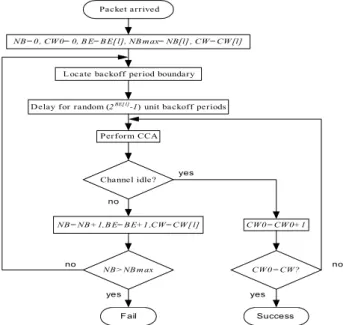
Figure 1 presents the operation of beacon-enabled mode slotted CSMA-CA supported priority MAC.
The CSMA-CA algorithm first initializes the NB, CW0 to zero and three values of BE, NBmax and CW depend on the priority levels of packet arrived.
Based on BE value, the algorithm locates the boundary of the next backoff period. The device generates a random number in the range 0 to
and then it waits until the random number is reduced to zero in order to perform CCA.
The PHY layer performs a CCA to check whether the channel is busy or not. If the channel is sensed busy, the algorithm will increase the NB and BE values by one while the CW is reserved by CW[l]
value. If the NB value is equal or less than NBmax value, the algorithm will relocate backoff period boundary. Then it will apply backoff delay process again. If the channel is idle, the MAC sublayer will increase CW0 by one. After that, if this CW0 is less than CW, the algorithm performs CCA again;
otherwise the packet is transmitted successfully.
The transmission of the packet is performed in the current superframe. If the superframe length is not enough for packet transmission, the next superframe is deferred to transmit packet.
Ⅳ. Analytical Model
A. Markov Chain Model
We consider a VPAN with n devices which are
divided into L +1 priority levels and the number of
devices in each level is
. The beacon enable with
slotted CSMA-CA algorithm is used in
non-saturation environments. Let s(l,t) and c(l,t) be
value of NB and value of the backoff counter or
state of sensing the channel, respectively. Figure 2
represents the Markov chain model which a node
transmits a packet. In Figure 2, we denote some
MAC parameters such as:
,
,
m[l] = NBmax, and CW = CW[l] for priority l
-1,0
0,0
0 ,1 0 ,2 0,W0-2 0,W0-1
0,-1 0,-2 0,-(C W [l]-1) 0 ,-C W [ l]
1,0
1 ,1 1 ,2 1,W1-2 1 ,W1-1
1,-1 1,-2 1,-(C W [l]-1) 1 ,-C W [ l]
m [l],0
m [l],1 m[l],2 m[l],Wm[l]-2 m[l],Wm[l]-1
m [l],-1 m[l],-2 m [l],-(C W [ l]-1 ) m[l],-C W [l]
...
P0
1-P0
1/W0 1 /W0 1/W0
1/W0 1/W0
1 1 1 1 1
1/W1 1 /W1 1/W1 1/W1
1 /Wm 1/Wm 1 /Wm 1/Wm
a1 a2 a3 aCW[ l]-1 aCW[l]
1 1 1 1
1
1 1 1
1 1
a1 a2 a3 aCW [l] -1 aCW [l]
a1 a2 a3 aCW[l]-1 aCW[l]
1 -a2
1-a2
1 -aCW[l]
1 -aCW [l]
1 -aCW[l]
aCW[l]+1
aCW[l]+1
aCW[l]+1
1 -P1
P1
1 -a1
1 -a1
1 -a1
1 -a2
1- a3
1-a3
1-a3
1 - aCW[l]+1
1 - aCW[l]+1
1- aCW[l]+ 1
{0, | 1, 0} P W j0/ 0, ? 0, ? ]0
P j− = ∈ W
{, 1| , } 1, ? , , ?1, i [ m] i ? ] P i j− i j = ∈ j∈ W
[ ] [ [
1, ? , , ? , ]
{ , ( ? ? , } j i 1]
P i− +j │i j− =
α
+ ∈ m j∈− CW llevel. (-1,0) represents the state of an empty queue
of a device. When a device is in (-1,0) state , it will perform CSMA-CA algorithm to access the channel. The probability that one packet is generated during the δ time interval (δ is the duration of the unit backoff period) is:
≥
where N(δ) be the number of packets that arrived during the δ time interval.
The state transition probabilities associated with the Markov chain of Figure 2 are:
(5)
(6)
(7) (8)
,
∈ ∈ ∈
(9)
∈ ∈
(10)
Fig. 2
.
Markov chain model.average successful transmitted data bytes average time
[
inteva ]= ]
[l l
[ ]
S E
E
∈ (11)
Equation (5) is the probability of empty queue which was empty in the previous state. Equation (6) shows the probability of going back to the first backoff stage from the idle stage. Equation (7) represents the reducing of backoff counter. Equation (8) gives the probability of finding channel idle in the j stage. Equations (9) and (10) are the probability of going to the backoff stage when the channel is busy. Equation (11) represents the probability of going back to the empty queue stage after packet transmission.
We have the stationary distribution of the Markov chain model as:
lim→∞
,
∈ ∈
. With the special case
lim→∞
.
By the normalization condition, we know that:
(12)
According the relationship between stable states we have:
∈ (13)
∈ (14)
By using general recursion formula we can calculate:
∈ (15)
We also have some relationship below:
We set
With the Markov chain regularity we have:
∈
(18)
(19)
Based on the above formulas, we calculate apart of equation (12):
(20) where
Substituting equation (19) and equation (20) into equation (12) we have:
(21)
Now we calculate the probability that a device in priority l level tries to transmit packet in the unit backoff period:
Substituting equation (15) into the above equation we have:
(22)
B. Normalized Throughput
Let S[l] be the normalized throughput of the
device in the l priority level, with l∈[0, L]. Then
the normalized throughput can be expressed as the
following ratio:
Let
be the probabilities that the channel is sensed due to a successful transmission from a device in the l priority level.
≠
(23)
So, the probability of a successful transmission from a device for all priority levels
is:
(24)
Let
denotes the probability that the channel is sensed busy for all priority levels in the unit backoff period. It is given by:
(25)
The probability that the channel is sensed idle for all priority levels is represented by
.
(26)
Let
be the probability of collision for all priority levels.
(27)
Based on the above equations (23 - 27) we can calculate the normalized throughput as following:
(28)
where
,
, and
are the time to transmit the packet payload, the average durations for successful transmission and collision, respectively.
(29)
where L and R are the length of data packet and channel bit rate, respectively.
(30)
(31)
with
,
,
,
, and
are the average durations for transmitting the header, packet transmission, waiting time for ACK with successful transmission, waiting time for ACK with fail transmission, and time for receiving ACK, respectively.
C. Transmission Delay
We define the delay of a packet, D, which is the time elapsed from the instant of the generation of the packet to the instant of the successful reception or drop of it. The value of D is depended on the l priority level. So, E(D) is the mean value of D. The mean value E(D) can be given by:
(32)
where
is the number of collision before transmitting a packet for the priority l level.
(33)
denotes the time interval of average backoff delay and the CCA delay. Let is the mean value of .
(34)
Substituting equations (33), (34), (36), and (37)
into equation (35), we can derive the transmission
delay of a packet.
Parameter Value
aBaseSlotDuration 60
aNumSuperframeSlots 16
macBeaconOrder 15
macSuperframe-Order 15
Carrier Frequency 500 THz
aMaxPHYPacketSize 64 kB
PHY data rate 11.67 kb/s
aTurnaroundTime 8 symbols aUnitBackoffPeriod 20 symbols
SIFS 12 symbols
LIFS 40 symbols
Frame payload 127
Concentrator FOV 60 (degree)
2 4 6 8 10
0 10 20 30 40 50 60 70 80 90
High priority Medium priority Low priority
BE=3,CW=3,NB=5 BE=4,CW=3,NB=5 BE=5,CW=3,NB=5 BE=4,CW=1,NB=5 BE=4,CW=5,NB=5 BE=4,CW=3,NB=7 BE=4,CW=3,NB=1
Throughput [kbps]
Number of devices in each priority level
Ⅴ. Numerical Results
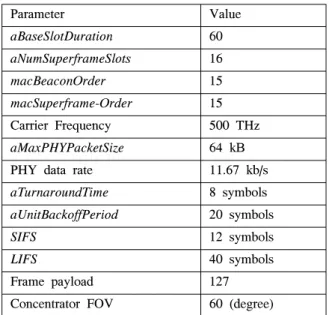
In this section, we present the numerical results about throughput and transmission delay of proposed mechanism. We used NS2 version 2.35 to simulate the VPAN system. The set of parameters used for numerical results are based on the specifications of the IEEE 802.15.7 [1] which are listed in Table 1.
Table 1
.
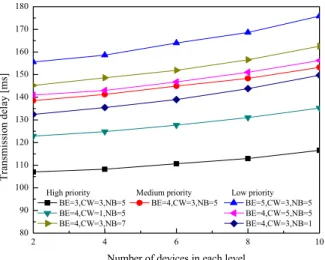
Parameter used in the numerical resultsIn the numerical results, we assume that there are 3 priority levels 0, 1 and 2 (L = 2); therefore, we have high priority (L=0), medium priority (L=1) and low priority (L=2). The numbers of devices in each of the priority levels are same. To evaluate the performance of throughput and transmission delay based on our mechanism, we set the multi-parameters as follow: BE[l] are set to 3, 4, and 5, respectively, and CW[l] is set to 3, NB[l] is set to 5 for any BE[l] value. CW[l] are set to 1, 3, and 5, respectively, and BE[l] is set to 4, NB[l] is set to 5 for any CW[l]; value NB[l] are set to 3, 5, and 7, respectively, and BE[l] is set to 4, CW[l] is set to 3 for any NB[l] value. The multi-parameters set based on the relationship in equations (2), (3), and (4).
Figure 3 presents the throughput for numerical results of three priorities with different number of devices in each priority level. When number of devices is increased, the throughput is decreased
because the device has to run the backoff algorithm more due to more collisions. Figures 4 presents the transmission delay for numerical of three priorities with different number of devices in each priority level. When number of devices increases, the transmission delay increases due to the more collisions. Devices in a level with a smaller BE value may stay fewer backoff states and have chances to transmit prior over devices in levels with larger BE values; therefore, devices in the level with smaller BE values may achieve higher throughput and have lower transmission delay. In addition, from the numerical results, we can see that the BE parameter has the best effects on the throughput and transmission delay to support priority; The numerical results in Figure 3 shows that with BE = 3, we get the highest throughput; and in Figure 4 shows that with BE= 3, we get the lowest delay. NB parameter has the smallest effects on the throughput and delay to support priority.
Fig. 3. Throughput vs. number of devices.
The difference between our results and results in
[10] is that their proposed initial BE parameter does
not produce improved result for higher priority
levels. They got this result because they use too
small the initial BE parameter. In our mechanism,
we use the larger initial BE parameter to
differentiate priority levels and this larger initial BE
parameter shows more effective for differentiating
priority levels. In paper [10], they use BE and NB
parameters to support priority. CW is also one
important parameter in CSMA-CA algorithm and it
2 4 6 8 10 80
90 100 110 120 130 140 150 160 170 180
High priority Medium priority Low priority
BE=3,CW=3,NB=5 BE=4,CW=3,NB=5 BE=5,CW=3,NB=5 BE=4,CW=1,NB=5 BE=4,CW=5,NB=5 BE=4,CW=3,NB=7 BE=4,CW=3,NB=1
Transmission delay [ms]
Number of devices in each level
gives more effect than NB parameter for differentiating priority levels, that why we use three parameters to support priority in our mechanism.
Fig. 4
.
Transmission delay vs. number of devices.
Ⅵ. Conclusion
In this paper, we presented the mechanism to support priority MAC using multi-parameters in IEEE 802.15.7 VLC system. By using a discrete time Markov chain model, we analyzed the throughput and transmission delay of the proposed mechanism which considers multi-parameters MAC in non-saturation environments. According to the numerical results, we showed the performance and the effect of different parameters on throughput and transmission delay. With the best effect on the throughput and transmission delay, the BE parameter is very useful to support the priority. After that, we can support priority by using three parameters in a flexible way.
References