Reproductive toxic agents in work environments and related cases in Korea
Chulyong Park
Department of Occupational and Environmental Medicine, Kang Mijung’s Internal Medicine Clinic, Daegu, Korea
There has been a growing concern and subsequent interest surrounding numerous reproductive toxic agents found in various working and non-working environments. Meanwhile, there have been many efforts in medical fields such as toxicology and epidemiology applying experimental studies to elucidate reproductive toxic agents’ characterization and health effects. However, there remains insufficient research data and inadequate evidence in humans. Adverse reproduc- tive outcomes vary from transient, moderate health effects to severely detrimental consequences, such as permanent infertility or childhood cancer of one’s offspring. Furthermore, upon exposure to toxic agents, the latent period before reproductive health effects are observed is relatively short compared to other occupational diseases (e.g., occupational cancer); instant action is re- quired once exposure to reproductive toxic agents is detected. Therefore, it is very important for workers and healthcare professionals to know about the reproductive toxic agents they are likely to be exposed to. In this review, we discuss the general epidemiology of reproductive health in Korea, and the information regarding these reproductive toxic agents.
Keywords: Abortion; Hazardous substances; Occupational diseases; Reproductive health
Introduction
Reproductive toxic agents are generally defined as materials that may adversely affect human reproductive function, fertility, or fe- tal development and growth [1]. It includes chemical, physical, environmental, and emotional factors like shift work, overwork, or stress. Reproductive toxicity encompasses adverse reproduc- tive health outcomes in both men and women caused by exposure to such agents. Changes in reproductive systems, fertility, and ad- verse pregnancy outcomes can be caused by reproductive toxicity [2]. There are well established data regarding chemicals hazard- ous to reproductive health, but there are still unknown latent haz- ards; especially for commercial chemical products that are consid- ered as trade secrets. Moreover, there are fewer human epidemio- logical data than animal experimental data, which makes it more
Yeungnam Univ J Med 2020;37(1):22-31 https://doi.org/10.12701/yujm.2019.00416
Received: November 25, 2019 Revised: December 9, 2019 Accepted: December 17, 2019 Corresponding author:
Chulyong Park
Kang Mijung’s Internal Medicine Clinic, Apple Tower 9th floor, 311 Dongdaegu-ro, Suseong-gu, Daegu 42117, Korea
Tel: +82-53-753-0024 Fax: +82-53-753-0029 E-mail: [email protected]
difficult to interpret their real-world health effects [3]. For these reasons, it is hard to assess how many risks are there in workplac- es, how many workers are exposed to hazards, and which agents are concerned.
Knowing this, the observed low birth rate and fertility problems are of severe concern in Korea. In 2018, the total fertility rate (TFR) of Korea was 0.98, one of the world’s lowest [4]. More- over, in 2014, approximately 208,000 patients were diagnosed with fertility related problems, rising to 229,000 in 2018 accord- ing to Korean National Health Insurance (NHI) data [5]. Among these figures, the proportion of men increased notably from 22.7% in 2014 to 34.0% in 2018. These data raise concerns about the various reproductive toxic agents that the working population can be exposed to in their work environments, concerning men as well as women. In other words, reproductive toxicity is a health
Copyright © 2020 Yeungnam University College of Medicine
This is an Open Access article distributed under the terms of the Creative Commons Attribution Non-Commercial License (http://creativecommons.org/licenses/by-nc/4.0/)
which permits unrestricted non-commercial use, distribution, and reproduction in any medium, provided the original work is properly cited.
risk factor for all, and is a very damaging occupational health and safety issue, as it can cause problems for the next generation, in the form of fetal malformation and childhood cancers. However, current regulation regarding reproductive health is insufficient and unclear. Although the dangers are mentioned in the Material Safety Data Sheets available at the workplace, detailing whether the material is a reproductive toxicant (Fig. 1) [6], it is very diffi- cult for the average worker to know the exact hazards and toxico- logical properties of the chemical. In addition, general physicians are equally unable to discern the full details of various reproduc- tive toxicity agents unless they are related. In some cases, further- more, the patient’s occupational history is missed, and important information is sometimes overlooked. This review aims to (1) in- troduce the reproductive health-related epidemiology of Korea, (2) discuss several reproductive toxic agents that are widely rec- ognized but as yet not evaluated, and (3) discuss cases of occupa- tional disease caused by reproductive toxic agents in Korea.
Epidemiological perspective of reproduc- tive health in Korea
Since 2012, the number of births and TFR in Korea has been de- clining to its lowest level each year. In 2012, the number of births was about 485,000 and TFR 1.30. In 2017, the number of births was 358,000 and TFR 1.05, falling to the lowest level in the world [7]. According to a 2018 Korean survey of 11,000 women be- tween the ages of 15 and 49, there was an average of 2.2 pregnan-
cies per woman. Among them 1.7 live births, 0.3 spontaneous abortions, and 0.2 artificial abortions, with negative pregnancy outcomes totaling 14.3% [7].
It is not easy to identify a clear causal relationship here, as fac- tors affecting pregnancy and childbirth are numerous, taking into account such influences as age, smoking, drinking, general health, and socioeconomic status, as well as occupational environmental factors [1]. The incidence rate of adverse pregnancy outcomes, including miscarriage, vary from study to study, with reports of up to a 40% rate of miscarriage including unrecognized abortions [8].
According to the 2018 Korean Statistical Information Service, women’s working rate continues to increase to 52.9%, and the working population of women also continues to increase (Fig. 2) [9]. Accordingly, research on the work environment in relation to women’s reproductive health has also been paid due attention.
Concerns have been raised about reproductive health disorders such as miscarriages, menstrual abnormalities, and infertility among women workers in some industries. A study based on NHI health insurance data analyzing about 430,000 pregnancies in 2013, showed working women’s odds ratio (OR) for miscarriage is 1.26 (95% confidence interval [CI], 1.23–1.28), statistically higher than non-working women. In addition, this high OR for miscarriage was represented within several major industries in which many women workers were involved (1) business facilities management and business support services (OR, 1.47; 95% CI, 1.38–1.57); (2) manufacturing (OR, 1.35; 95% CI, 1.31–1.39);
(3) human health and social work activities (OR, 1.33; 95% CI, 1.29–1.37); (4) wholesale and retail trade (OR, 1.29; 95% CI, 1.25–1.34); and (5) professional, scientific, and technical activi- ties (OR, 1.29; 95% CI, 1.22–1.35) [10].
According to a report published by the Korea Occupational Safety and Health Agency in 2014, a survey of all manufacturing companies having five workers or more showed that 1,284 work- places dealt with reproductive toxicity category 1A substances and employed 107,741 workers, those with 1B substances had 157,294 employees at 1,153 workplaces [11,12]. Reproductive toxicity category 2 substances were handled by 206,359 workers in 1,750 workplaces. Among them, 15,449 workers (14.3%), 19,150 workers (12.1%), and 17,682 workers (8.6%) were direct- ly exposed (Table 1). By exposure factor, the total number of women workers exposed to chemical/physical factors was 33,828, which is 6.78% of the 499,194 of women workers in manufactur- ing. Among the physical factors, the number of women workers exposed to high temperatures was 7,025, 20.77% of the total num- ber of women workers experiencing this exposure, 5,855 (6.42%) experienced cold temperatures, and 2,173 (6.42%) were exposed to ionizing radiation. The chemical factor of toluene exposure Fig. 1. The symbol for carcinogenicity, mutagenicity or reproductive
toxicity based on globally harmonized system (GHS). Reprinted
from Occupational Safety and Health Administration [6].
counted 4,920 women, accounting for 14.54% of the total num- ber of women workers experiencing this exposure. Hexane (n-hexane) was 3,315 (9.8%), 1,900 for 2-ethoxy-ethanol (5.62%), 1,833 for N, N-dimethylacetamide (5.42%), 1,806 for carbon monoxide (5.34%), and 1,633 for lead (4.83%). In partic- ular, the proportion of workers exposed to lead or carbon monox- ide, which belong to reproductive toxicity 1A, was 20.3% of
16,833 total women workers exposed to chemical reproductive toxicity factors [12].
In the non-manufacturing workplace sample of the survey, the number of women workers at risk of exposure to reproductive toxic agents was 3,415; 2.43% of the 140,147 women workers in the sample survey. Ionizing radiation was experienced by 1,550 of the women (45.39%). Those exposed to cold, toluene, and lead numbered 1,431 (41.90%), 137 (4.01%), and 44 (1.29%), respec- tively [12].
The legal management and regulation on reproductive toxic agents in Korea consist of the Ministry of Employment and La- bor’s Industrial Safety and Health Act and the Ministry of Envi- ronment’s Hazardous Chemical Substance Management Act. Ar- ticle 39 of the Occupational Safety and Health Act notes that
“The Minister of Employment and Labor shall classify and man- age chemicals and physical factors that cause workers’ health haz- ards according to the classification standards prescribed by the Ordinance of Employment and Labor”. In addition, Appendix 1 of the “Standards for Classification and Labeling of Chemical Substances and Safety Data Sheets” is defined based on epidemi- ological data (Table 2) [11].
Although the details of the Labor Standards Act are partially revised as necessary, the ‘Regulations on Prohibited Substances Table 1. The numbers of workplaces and working populations
using reproductive toxic chemicals, 2014
Category 1A
a)1B
b)2
c)Work place 1,284 1,153 1,750
Total worker 107,741 157,294 206,359
Exposed worker (%) 15,449 (14.3) 19,150 (12.1) 17,682 (8.6)
Man 9,231 12,554 9,833
Woman 6,218 6,596 7,849
Modified from Korea Occupational Safety and Health Agency [11].
a)
It is known to have produced an adverse effect on reproductive ability or capacity or on development in humans, largely based on evidence from human studies.
b)It is presumed to produce an adverse effect on reproductive ability or capacity or on development in humans, largely based on evidence from experimental animals.
c)This category includes substances for which there is some evidence from humans or experimental animals, possibly supplemented with other information, of an adverse effect on reproductive ability or capacity or on development.
Fig. 2. The population of working women and woman’s working rate of Korea from 2009 to 2018. Source from the Korean Statistical Information Service [9].
12,500 12,000 11,500 11,000 10,500 10,000 9,500 0
54 53 52 51 50 49 48
0
Population Working rate
The population of working women (thousands) Working rate (%)
2009 2010 2011 2012 2013 2014 2015 2016 2017 2018
and Occupations, etc. for Pregnant Women,’ which is presented as an appendix in the Act, was revised in November 2001, and has not been revised since. Therefore, there is an immediate and ongoing need to diversify management methods for workers and update management and inventory of reproductive toxicity-relat- ed chemicals.
The United States’ National Institute of Occupational Safety and Health (NIOSH) publishes the NIOSH Pocket Guide to Chemical Hazards (NPG) to provide workers, employers, and health and safety professionals with information on hazardous chemicals handled at work. A total of 49 reproductive toxicity fac- tors are mentioned in the NPG [13]. Meanwhile, the French Na- tional Institute of Research and Safety; Institut National de Re- cherche et de Sécurité (INRS) publishes “DEMETER,” a medical assessment of occupational chemicals on the INRS web page [14]. The goal of this document is to help occupational physicians assess the reproductive toxicity of chemicals encountered in the workplace. DEMETER consists of a factsheet prepared by a group of toxicologists led by the INRS Medical Research Department, which provides information on 179 chemicals as of July 2017. Of these, 61 are highlighted for their reproductive toxicity. As such, the difference between Korean and foreign standards needs to be continually improved by amending relevant laws in consideration of the domestic reality and situation. According to a study in Ko- rea, bisphenol A has a large amount of domestic consumption and distribution which is not yet regulated, calling for instant amend- ment of the relevant Act [15].
Reproductive toxic agents in females
There are six components for normal gestation and reproduction:
(1) fertility, (2) conception, (3) implantation and preclinical ges- tation, (4) clinical pregnancy and fetal development, (5) birth, and (6) postnatal development. Fertility factors include the neu- ro-endocrine gonadal axis, oocyte development and ovulation, and anatomical integrity for passage of sperm and eggs [16]. Ad- verse effects on one or more of these three factors may act as a re- productive toxicity factor. As a result, various effects can be caused such as decreased fertility, infertility, spontaneous abortion, fetal growth retardation, premature birth, and birth defects.
General risk factors for miscarriage are a maternal age of over 35 years of age, previous history of miscarriage, gravida, smoking, drinking, and drug use. In addition to these, miscarriage can be in- duced by exposure to teratogens, mutagens or infections, and ana- tomical abnormalities of the maternal uterus. Therefore, those factors should be considered simultaneously when evaluating oc- cupational and environmental reproductive hazards [17,18]. A
Table 2. Reproductive toxic chemicals in the Occupational Safety and Health Act of Korea
Category Substance
1A Lead and inorganic compounds, as Pb 2-Bromopropane
Lead arsenate, as Pb(AsO
4)2 Warfarin
Carbon monoxide Lead chromate as Cr Lead chromate as Ni 1B Nickel carbonyl, as Ni
Nitrobenzene
N,N-Dimethyl acetamide Dimethylformamide Di-n-butyl phthalate 2-Methoxyethanol Benomyl Benzo(a)pyrene
Borates tetrasodium salts (anhydrous) Borates tetrasodium salts (pentahydrate) Borates tetrasodium salts (decahydrate) 1-bromopropane
Boron oxide
Elemental and inorganic forms of mercury (all forms except aryl and alkyl compounds)
2-Ethoxyethanol 2-Ethoxyethyl acetate
Ethylene glycol methyl ether acetate 2,3-Epoxy-1-propanol
Vanadium pentoxide (respirable fraction or fume; inhal- able fraction)
1,2,3-Tricholoropropane Formamide
2 n-Hexane
Nitrotoluene(o-,m-,p-isomers) Dinitrotoluene
Methyl isocyanate Cyclohexylamine
3-Amino-1,2,4-triazole (or Amitrole) Acrylamide (inhalable fraction and vapor) Allyl glycidyl ether
Carbon disulfide
Cadmium and compounds, as Cd (respirable fraction) Chloroform
Toluene Phenylethylene
Piperazine dihydrochloride 2-Hexanone
Effects on or via lactation Lindane
Modified from Korea Occupational Safety and Health Agency [11]. All
lists are on “Korean Ministry of Employment and Labor’s Notice 2018-
62, partly revised on July 30th, 2018.”
decrease in fertility in women is associated with genetic abnor- malities, endocrine abnormalities, anatomical abnormalities, re- productive toxicity agents, and maternal age. Several epidemiolog- ical studies have reported nitrous oxide, formaldehyde, toluene, 2-bromopropane, and nighttime work as factors that reduce fertil- ity in women [19-23].
Among them, there is relatively strong evidence of reproductive toxicity in ionizing radiation, mercury, lead, polychlorinated bi- phenyls (PCBs), and anesthetic gases. Factors known to cause spontaneous abortion include antineoplastic agents, anesthetic gases, and ethylene oxide, all of which are likely to be encountered by healthcare workers [24-26]. Workers in many industrial fields are working night shifts, including healthcare workers. Night shift work is also known as a major cause of spontaneous abortion, and the link with night shift work is supported by many epidemiologi- cal studies. Therefore, night shift work for pregnant women should be carried out carefully, taking into account the health sta- tus of women workers and workplace conditions [23,27].
Many studies have mentioned the relationship between the use of organic solvents and rates of spontaneous abortion. Since the 1980s, laboratory workers have been recognized to have an in- creased risk of adverse pregnancy outcomes, and organic solvents such as perchloroethylene (PCE), methylene chloride, toluene xylene, and glycol ether, turn out to have strong causation. Wom- en workers working in dry cleaning and pharmaceutical compa- nies are shown to be exposed to similar situations [28]. In addi-
tion, among the women workers in computer chip and semicon- ductor production jobs, there was more of a tendency to experi- ence miscarriage in the workers who handled ethylene glycol ether [29]. Many epidemiological studies have suggested a strong correlation between spontaneous abortion and PCEs. Also, re- ports of increased risk of spontaneous abortion in dry-cleaning workers and PCE poisoning from rice-oil contamination in Japan and Taiwan are representative cases of reproductive toxic hazards [30,31].
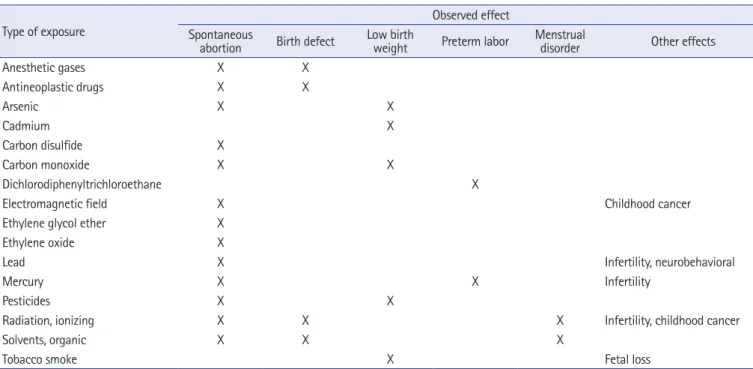
Furthermore, studies on physical activity, heavy lifting [32], and subjective psychological stress [33] have been reported in clinical guidelines as reproductive toxic agents. Physical stress, such as heavy lifting, prolonged standing, and repeated bending of the waist may also act as a detrimental factor, mainly associated with preterm delivery, low birth weight, and spontaneous abor- tion. For this reason, pregnant women in their first trimester are recommended against the above operations in Korea and the United States. Reproductive toxic agents with epidemiological ev- idence and their toxic outcomes are noted in Table 3 [34]. Some of the mechanisms of each reproductive toxicity factor is known, but most are unknown. Ethylene glycol ethers are known to cause reproductive toxicity by breaking the gap junctions of cells [28,35]. Some substances, such as cadmium, act as an asphyxiant or placental toxin [36]. Lead and organic mercury’s toxic effects directly affect the fetus [37–39]. More research in this area is needed because understanding the mechanisms is essential to
Table 3. Female reproductive hazards
Type of exposure Observed effect
Spontaneous
abortion Birth defect Low birth
weight Preterm labor Menstrual
disorder Other effects
Anesthetic gases X X
Antineoplastic drugs X X
Arsenic X X
Cadmium X
Carbon disulfide X
Carbon monoxide X X
Dichlorodiphenyltrichloroethane X
Electromagnetic field X Childhood cancer
Ethylene glycol ether X
Ethylene oxide X
Lead X Infertility, neurobehavioral
Mercury X X Infertility
Pesticides X X
Radiation, ionizing X X X Infertility, childhood cancer
Solvents, organic X X X
Tobacco smoke X Fetal loss
Modified from LaDou and Harrison [34] with permission of McGraw-Hill.
prevent negative health effects from these reproductive toxicity agents.
Reproductive toxic agents in males
The mechanism by which reproductive toxins produce their ef- fect is very complex, but usually occurs during absorption, distri- bution, metabolism, excretion, and repair. In other words, the tox- ic factor enters the body and disrupts the material transfer, energy transfer, and information transfer between cells; preventing cells, organs, and systems from functioning normally. In fact, most of the toxins go through this process, where gonads, hypothalamus, testis, and epididymis are the target organs when reproductive toxicity factors affect men [40,41]. These effects result in dimin- ished spermatogenesis in the testicles or, more seriously, apoptosis of germ cells.
Three systems are required for normal male fecundity: (1) the hypothalamic-pituitary-gonadal (HPG) endocrine axis, (2) sper- matogenesis of the testes, (3) the accessory gland and transport system of the genitalia [42]. As with women, factors affecting any of these three factors can act as reproductive toxicity factors, with HPG endocrine axis or spermatogenesis being the primary target.
Adverse health effects of reproductive toxicity that may occur in
men include decreased libido, erectile dysfunction, and sperm-re- lated problems (e.g., oligospermia, azoospermia, teratospermia, and asthenospermia) [43]. When evaluating reproductive toxic agents in men, their age, medical history, medication, and smok- ing history should be considered. Consideration should also be given to environmental factors that they may be incidentally ex- posed to (e.g. solvents, pesticides, heat, ionizing radiation, etc.).
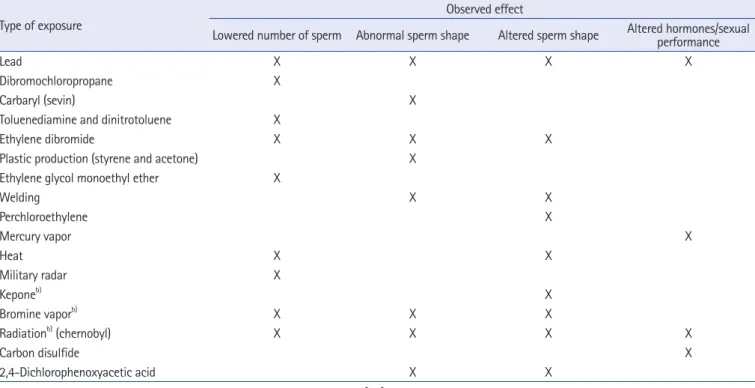
Most reproductive toxic agents in women can also cause repro- ductive toxicity in men, and agents with relatively strong epidemi- ological evidence include 1,2-dibromo-3-chloropropane (DBCP), ionizing radiation, and lead (Table 4) [44].
DBCP caused the first known case of male reproductive toxici- ty due to exposure in the working environment. It has been known to cause reproductive toxicity and developmental disor- ders in animals, causing oligospermia and testicular atrophy. Male workers exposed to DBCP during the chemical manufacturing process similarly showed testicular toxicity in proportion to the exposure dose [45,46]. Workers exposed to high doses of DBCP had damage to spermatogonia and irreversible azoospermia [47].
Occupational and environmental exposure to lead and its ad- verse health effects have been studied for a long time, and as such, the epidemiological evidence has been well established. The risk of reproductive toxicity from lead has become known, with case
Table 4. Male reproductive hazards
a)Type of exposure
Observed effect
Lowered number of sperm Abnormal sperm shape Altered sperm shape Altered hormones/sexual performance
Lead X X X X
Dibromochloropropane X
Carbaryl (sevin) X
Toluenediamine and dinitrotoluene X
Ethylene dibromide X X X
Plastic production (styrene and acetone) X
Ethylene glycol monoethyl ether X
Welding X X
Perchloroethylene X
Mercury vapor X
Heat X X
Military radar X
Kepone
b)X
Bromine vapor
b)X X X
Radiation
b)(chernobyl) X X X X
Carbon disulfide X
2,4-Dichlorophenoxyacetic acid X X
Modified from The National Institute for Occupational Safety and Health [44].
a)