pISSN 2093-596X · eISSN 2093-5978
Article
Distinct Ultradian Rhythms in Plasma Clusterin Concentrations in Lean and Obese Korean Subjects
Jong Han Choi1, Eunheui Jeong2, Byung Soo Youn3, Min-Seon Kim1
1Division of Endocrinology and Metabolism, Department of Internal Medicine, Asan Medical Center, University of Ulsan College of Medicine; 2Division of Endocrinology and Metabolism, Department of Internal Medicine, Veterans Health Service Medical Center; 3Osteoneurogen Inc., Seoul, Korea
Background: Blood levels of many hormones show rhythmic fluctuations with variable duration of cycles. Clusterin/apolipoprotein J is a glycoprotein which is highly expressed in the plasma and has modulatory roles in immune and inflammatory reactions, neuro- biology, lipid metabolism, and leptin signaling. In this study, we examined the diurnal fluctuations of plasma clusterin concentrations in lean and obese young men.
Methods: For the study, 14 subjects (five lean and five obese men; two lean and two obese women) were admitted to the research ward and blood samples were drawn every 30 minutes during light-on period (6:00 AM to 10:00 PM) and every hour during light- off period.
Results: Notably, plasma clusterin concentrations displayed a unique ultradian rhythm with five cycles a day in both men and wom- en. During the light-on period, circulating clusterin levels showed fluctuating curves with 4 hours regular intervals with sharp peaks and troughs. In contrast, single oscillation curve during light-off exhibited a smoothened/lower peak and longer (8-hour) duration. In obese men, these cycles were phase-advanced by approximately 1 hour, and had reduced amplitude of fluctuating curves and blunted diurnal pattern. Cyclic fluctuations of plasma clusterin were preserved under fasting and unexpected meal condition, suggesting that rhythmic oscillations in plasma clusterin levels are not generated by meal-related cues.
Conclusion: These findings firstly demonstrate a novel pattern of plasma clusterin fluctuations with extremely regular cycles.
Keywords: Clusterin; Obesity; Ultradian rhythm; Circadian rhythm
INTRODUCTION
The levels of many biological substances in bodily fluids con- stantly fluctuate with certain patterns or rhythms. These rhyth- mic changes can be categorized according to the temporal length of the cycle [1]. Ultradian rhythms refer to fluctuations with a cycle shorter than a day such as insulin [2], ghrelin [3], and leptin [4]. Diurnal rhythms are fluctuations with a 24-hour-
cycle such as cortisol [5] while infradian rhythms are the ones with cycles longer than 24 hours (i.e., female sex hormones).
These rhythms are generated by feedback regulation of clock genes and hormones or environmental cues. These fluctuations may be helpful for maintaining the overall homeostasis of the subjects.
Diurnal rhythms of certain hormones or biological molecules provide fundamental information that allow for understanding
Received: 2 February 2018, Revised: 21 March 2018, Accepted: 22 March 2018 Corresponding author: Min-Seon Kim
Division of Endocrinology and Metabolism, Department of Internal Medicine, Asan Medical Center, University of Ulsan College of Medicine, 88 Olympic-ro 43-gil, Songpa-gu, Seoul 05505, Korea
Tel: +82-2-3010-3245, Fax: +82-2-3010-6962, E-mail: [email protected]
Copyright © 2018 Korean Endocrine Society
This is an Open Access article distributed under the terms of the Creative Com- mons Attribution Non-Commercial License (http://creativecommons.org/
licenses/by-nc/4.0/) which permits unrestricted non-commercial use, distribu- tion, and reproduction in any medium, provided the original work is properly cited.
of unknown physiological functions of hormones or biological substances. For example, the levels of plasma insulin decrease during fasting and increase after meal intake, and these changes are appropriate for its glucose-lowering effects [2]. The appe- tite-stimulating hormone ghrelin shows a dramatic premeal surge, suggesting its role as a meal initiator [3]. Conversely, the diurnal rhythm of leptin shows a nocturnal rise that may have an appetite-suppressing effect during the night [4].
Clusterin was firstly identified in 1983 from the ram rete tes- tis fluid as a peptide with cluster-forming activity [6,7]. Cluster- in is also called apolipoprotein J [8], sulfated glycoprotein-2 [9], serum protein 40 kD, 40 kD (SP-40/40) [10], or complement ly- sis inhibitor [11]. Clusterin is a heterodimeric glycoprotein composed of disulfide bond-linked α and β chains, with each chain weighing about 40 kDa [12]. Clusterin protein is primarily expressed in epithelial cells of most organs [13]. Specifically, clusterin is highly expressed the testis, epididymis, liver, stom- ach, brain, heart, blood vessels, kidney, and lung [13]. In addi- tion, clusterin is abundant in bodily fluids such as semen, urine, breast milk, cerebrospinal fluid, and plasma [13]. Clusterin has been implicated in multiple biological processes including re- production [6,9], apoptosis [14,15], complement pathway [10,16], lipid transport [8,17], and leptin signaling [18]. We have previously reported that fasting plasma clusterin levels showed a significant positive correlation with the markers of adiposity and systemic inflammation [19]. Clusterin in the plas- ma is known as leptin-binding partner [18] and a component of high density lipoprotein (HDL) [8,17]. In the present study, we aimed to investigate the diurnal profiles of plasma clusterin lev- els under controlled light-darkness and meal intake in both lean and obese subjects. We also examined the effect of prolonged fasting followed by unexpected meal intake on rhythmic fluctu- ations of plasma clusterin.
METHODS
This study was approved by the Institutional Review Boards (2008-0314) at the Asan Medical Center (Seoul, Korea) and carried out in accordance with the guidelines proposed in the Declaration of Helsinki.
Subjects
Ten young (18 to 30 years old) males were recruited in this study through a website advertisement. Five were obese and five were lean according to the Asia-Pacific obesity criteria pro- posed by the Western Pacific Regional Office of the World
Health Organization [20]. The range of body mass index (BMI) in the lean group was 17 to 23 kg/m2 and that of obese group was 27 to 40 kg/m2. To know sexual difference in the diurnal pattern of plasma clusterin levels, four women (two lean and two obese) were also recruited. All subjects had stable body weight (changes less than 3 kg) for at least 3 months before the study. They had no past or present medical problems of diabe- tes, hypertension, other chronic illnesses, and gastrointestinal surgery. They were neither smokers nor heavy drinkers. Sub- jects with irregular sleep and diet patterns or night-time and shift workers were excluded.
On the screening visit, all the subjects signed written in- formed consent and filled out a self-administered questionnaire that included demographic characteristics, general health status, and social history. Anthropometric parameters such as blood pressure, height, weight, and waist circumference were deter- mined by the standard protocols. Subjects also underwent a rou- tine physical examination, measurement of vital signs, electro- cardiography, and routine laboratory tests including a complete blood count, electrolytes, fasting glucose, lipid profiles, and a liver function test to assess if they were suitable for this study.
Study design
Subjects were recommended to intake their meals and sleep on the same schedule of our study for 1 week before the study. Af- ter the 1 week-diet and sleep rhythm adjustment period, subjects were admitted to the Asan Clinical Research Center at 5:00 PM one day prior to study day. After dinner, an indwelling intrave- nous catheter was placed in the antecubital vein. Following an overnight fasting, blood was drawn into ethylenediaminetet- raacetic acid-coated tubes containing aprotinin (250 kallikrein inhibitor units; Sigma-Aldrich, St. Louis, MO, USA) at 30-min- ute intervals from 7:00 AM to 9:00 PM and then hourly until 7:00 AM in the next morning. Breakfast was provided at 8:00 AM, lunch at 12:30 PM, and dinner at 6:00 PM during the study day. The meals were Korean standard meals, which consisted of 60% carbohydrates, 25% fats, and 15% proteins. Korean stan- dard meals were composed of streamed rice, one soup, and three small side dishes (one dish of meat or fish and two dishes of vegetables including Kimchi). Lights were turned off at 10:00 PM and turned on at 6:00 AM. During the light-on period, subjects were awake and remained in bed. After 2 to 3 weeks from the first admission, two lean and two obese male subjects were readmitted in order to evaluate the impacts of fasting and unexpected meal on plasma clusterin fluctuations. Before the second admission, the subjects were informed that they would
undergo fasting until 6:00 PM on the study day; they were per- mitted to only have water during the fasting period. However, a meal was provided at 3:00 PM without any notice to avoid the effect of meal expectation. Blood samples were collected every 30 minutes until 6:00 PM. All subjects included in this study were in a good compliance with the protocol before and during the admission.
Assays
Plasma was immediately separated by centrifugation at 4°C and stored at −70°C until use. Fasting plasma glucose, total choles- terol, triglyceride, and HDL-cholesterol levels were measured by an auto-analyzer (Hitachi E170, Hitachi Ltd., Tokyo, Japan).
Plasma clusterin was assayed with an ELISA (enzyme-linked immunosorbent assay) kit (AdipoGen, San Diego, CA, USA) according to the manufacturer’s instructions. The lower and up- per limits of detection were 0.001 and 5 μg/mL, respectively, and the intra- and inter-assay coefficients of variation were 7.7%
and 8.5%, respectively.
Statistical analyses
All data are presented as mean±SEM. Parameters of plasma clusterin rhythms were compared between lean and obese groups using the Mann-Whitney U test. The Kruskal-Wallis test was used to confirm temporal variations in plasma clusterin lev- els during the day-night cycle. The P values less than 0.05 were considered to be statistically significant. SPSS version 18.0 software (SPSS Inc., Chicago, IL, USA) was used for statistical analysis.
RESULTS
Demographic characteristics and baseline biochemical findings of subjects are shown in Table 1 and in our previous paper [21].
Notably, plasma clusterin levels exhibited five cyclic fluctua- tions per day: four daytime cycles and one nighttime cycle (Fig.
1A). The Kruskal-Wallis test confirmed a significant temporal variation in plasma clusterin concentrations during the day (P<0.001). Except for the fifth cycle at night, the duration of each cycle was approximately 4 hours. During light-on period, peaks of the curves were sharp and constant. In contrast, their trough levels tended to increase, and thus the amplitude of curves tended to decrease as the time approached evening. Dur- ing the light-off period, the temporal length of clusterin cycle almost doubled (about 8 hours) and the values of peak, trough, and amplitude were all lower compared to those of curves dur- ing light-on period (Fig. 1A).
When we compared the rhythmic oscillations in plasma clus- terin levels between lean and obese subjects, the duration of each cycle was similar in both lean and obese subjects (Fig. 1B).
Interestingly, clusterin cycles were phase-advanced by one hour in obese subjects (Fig. 1B). The average trough values of curves tended to be higher in obese group than in lean group especially in the afternoon and evening, whereas the peak values did not significantly differ between lean and obese groups (Table 2). As a result, the amplitude of oscillating curves tended to be lower in obese individuals. We also observed loss of diurnal patterns:
higher curve amplitude in the morning and lower amplitude in the evening. The relative amplitude was greater in lean group than in obesity group (P=0.028), although the absolute ampli- tude did not show significant difference. In addition, the peaks flattened, and we could not point out single peak level.
Table 1. Baseline Demographic and Biochemical Characteris- tics of Lean and Obese Subjects
Characteristic Lean (n=5) Obese (n=5)
Age, yr 23.0±1.0 22.6±2.3
BMI, kg/m2 21.9±0.7 29.8±1.4a
Waist circumference, cm 80.4±2.1 98.4±2.8a Triglyceride, mg/dL 88.6±16.5 78.0±5.7 Total cholesterol, mg/dL 162.0±9.4 186.6±5.3 LDL-C, mg/dL 100.8±7.3 125.8±6.2a
HDL-C, mg/dL 47.4±2.1 46.2±1.5
Fasting glucose, mg/dL 94.0±2.2 101.8±4.5 Values are expressed as mean±SEM.
BMI, body mass index; HDL-C, high density lipoprotein cholesterol;
LDL-C, low density lipoprotein cholesterol.
aP<0.05 vs. lean group.
Table 2. Comparison of Plasma Clusterin Ultradian Rhythm Pa- rameters between Lean and Obese Subjects
Lean (n=5) Obese (n=5) P value Clusterin, μg/mL
Average peak value 41.7±2.9 46.6±2.9 0.261 Average trough value 19.1±2.0 26.0±2.6 0.066 Average absolute amplitudea 22.6±1.5 20.6±0.6 0.251 Average relative amplitudeb 1.3±0.2 0.9±0.1 0.028 Values are expressed as mean±SEM.
aAbsolute amplitude=peak level–next trough level; bRelative amplitude=
absolute amplitude/trough level, comparison between lean and obese groups were performed using the Mann-Whitney U test.
We determined the diurnal patterns of plasma clusterin in two lean and two obese women. Peak and trough values of plasma clusterin in two lean women were lower compared to those in men and obese women (Fig. 2). Similarly to men, four women had striking ultradian oscillations with five cycles. In contrast to obese men, a phase advance in the rhythmic fluctuations of plasma clusterin was not observed in two obese women. More- over, the amplitude of fluctuations were higher in two obese women than in two lean women (Fig. 2).
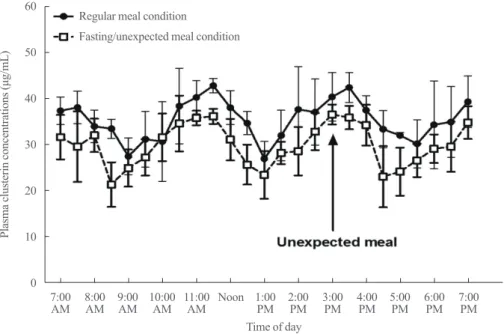
Fating-unexpected meal study revealed that ultradian rhythms of clusterin oscillation remained under prolonged fasting condi- tion and was unaffected by meal intake (Fig. 3). Peak and
trough levels of clusterin curves tended to decrease under pro- longed fasting condition. Moreover, the temporal phase of fluc- tuations tended to be advanced by about 30 minutes to one hour under fasting condition.
DISCUSSION
In this study, we show a previously-unreported, novel pattern of oscillations in plasma clusterin concentrations. The oscillations consisted of five cycles over 24 hours—four daytime cycles and one nighttime cycle. Interestingly, the temporal lengths of cy- cles were strikingly regular—4 hours during light-on and 8
60 50 40 30 20 10 0
60 50 40 30 20 10 0
Plasma clusterin concentrations (μg/mL)Plasma clusterin concentrations (μg/mL)
Time of day Lean Obese
Time of day
7:00 9:00 11:00 1:00 3:00 5:00 7:00 9:00 11:00 1:00 3:00 5:00 7:00 AM AM AM PM PM PM PM PM PM AM AM AM AM
7:00 9:00 11:00 1:00 3:00 5:00 7:00 9:00 11:00 1:00 3:00 5:00 7:00 AM AM AM PM PM PM PM PM PM AM AM AM AM
Fig. 1. Ultradian rhythms in plasma clusterin concentrations of (A) total subjects (n=10) and (B) lean and obese subjects (n=5 per group). P, peak; T, trough; C, cycle; B, breakfast; L, lunch; D, dinner.
A
B
60 50 40 30 20 10 0
Plasma concentration of clusterin (μg/mL)
Time of day
7:00 9:00 11:00 1:00 3:00 5:00 7:00 9:00 11:00 1:00 3:00 5:00 7:00 AM AM AM PM PM PM PM PM PM AM AM AM AM
Fig. 2. Ultradian rhythms in plasma clusterin concentrations of four woman subjects (two lean and two obese). aObese 1: age 28 years, body mass index (BMI) 32.9; bObese 2: age 28 years, BMI 30.4; cLean 1: age 31 years, BMI 19.1; dLean 2: age 23 years, BMI 18.9.
Obese 1a
Lean 1c Obese 2b
60 50 40 30 20 10 0
Plasma clusterin concentrations (μg/mL)
Time of day
7:00 8:00 9:00 10:00 11:00 Noon 1:00 2:00 3:00 4:00 5:00 6:00 7:00 AM AM AM AM AM PM PM PM PM PM PM PM
Fig. 3. Comparison of plasma clusterin diurnal fluctuations between regular three meal condition and fasting-unexpected meal condition (n=4).
Regular meal condition
Fasting/unexpected meal condition
Lean 2d
hours during light-off. In addition, the amplitudes of cyclic fluc- tuations exhibited a distinct diurnal pattern: they were highest in the morning and declined until next early morning. These oscil- lation patterns were conserved in both men and women. At present, there is lack of knowledge for mechanism underlining circadian or ultradian oscillations of circulating clusterin con- centration. Because hepatocytes secrete clusterin, fluctuations in circulating clusterin levels might be generated by rhythmic
secretion of clusterin from the liver [22]. The amplitudes and temporal lengths of oscillating cycles were unaltered during prolonged fasting. However, clusterin cycles in fasted condition showed phase-advancement by 30 to 60 minutes. Thus, these rhythmic fluctuations may be governed by light-dark cycles or the suprachiasmatic clock neurons rather than nutritional cues.
Our results suggest that obesity can affect plasma clusterin oscillations. Of note, we found that in obese men, the temporal
phase of clusterin rhythms was advanced by one hour without alteration in temporal lengths. Moreover, the shape of clusterin curves in obese men was characterized by smoothened peaks, shallow falls, and lower amplitude of cyclic oscillations. Anoth- er interesting characteristic in the clusterin curve of obese men subjects was the loss of reduced amplitude of curve during sleep. It will be interesting to study the impact of altered clus- terin oscillations on human health including sleep quality.
In our study, obese women did not show obesity-related changes in ultradian and circadian oscillation patterns of plasma clusterin, which were observed in obese men. Notably, two obese women showed higher amplitude of fluctuations com- pared to those of two lean women subjects. However, our obser- vation was made in only four women and thus the diurnal pat- terns of blood clusterin in women should be studied in a larger number of women subjects in the future.
Single measurement of plasma clusterin levels in the morning fasting condition revealed that plasma clusterin levels were pos- itively correlated with the adiposity marker BMI [19], although other studies showed no significant correlation between plasma clusterin and BMI [18]. Our current study adds crucial informa- tion on diurnal fluctuations in plasma clusterin levels, and we suggest that the timing of blood sample collection should be taken into consideration in future studies on plasma clusterin.
Our findings are limited by the small sample size but strengthened by the unified condition of blood sampling such as light-dark cycles, feeding, and physical activity. In addition, our study was conducted in young Koreans with no metabolic dis- orders and either normal weight or mild to moderate obesity.
Therefore, further studies will be warranted to confirm ultradian and circadian rhythms of plasma clusterin in different ethnic groups and subjects with different metabolic characteristics or the different degree of obesity. Despite these limitations, plasma clusterin concentrations displayed extremely regular, meal-un- related oscillations. The physiological implications of cyclic os- cillations in circulating clusterin should be investigated in the future.
CONFLICTS OF INTEREST
No potential conflict of interest relevant to this article was re- ported.
ACKNOWLEDGMENTS
This work was supported by grants from the Korea Science and
Engineering Foundation (2015M3A9E7029177, 2017R1A2B300 7123), and the Asan Institute for Life Science (17-327). The funders had no role in study design, data collection and analysis, decision to publish, or preparation of the manuscript.
AUTHOR CONTRIBUTIONS
Conception or design: E.J., B.S.Y., M.S.K. Acquisition, analy- sis, or interpretation of data: J.H.C., E.J., B.S.Y., M.S.K. Draft- ing the work or revising: J.H.C., M.S.K. Final approval of the manuscript: J.H.C., M.S.K.
ORCID
Min-Seon Kim https://orcid.org/0000-0002-4881-0390
REFERENCES
1. Martini L. Encyclopedia of endocrine diseases. Amsterdam;
Elsevier Academic Press; 2004.
2. Lambert AE, Hoet JJ. Diurnal pattern of plasma insulin con- centration in the human. Diabetologia 1966;2:69-72.
3. Cummings DE, Purnell JQ, Frayo RS, Schmidova K, Wisse BE, Weigle DS. A preprandial rise in plasma ghrelin levels suggests a role in meal initiation in humans. Diabetes 2001;
50:1714-9.
4. Sinha MK, Ohannesian JP, Heiman ML, Kriauciunas A, Stephens TW, Magosin S, et al. Nocturnal rise of leptin in lean, obese, and non-insulin-dependent diabetes mellitus subjects. J Clin Invest 1996;97:1344-7.
5. Weitzman ED, Fukushima D, Nogeire C, Roffwarg H, Gal- lagher TF, Hellman L. Twenty-four hour pattern of the epi- sodic secretion of cortisol in normal subjects. J Clin Endo- crinol Metab 1971;33:14-22.
6. Blaschuk O, Burdzy K, Fritz IB. Purification and character- ization of a cell-aggregating factor (clusterin), the major glycoprotein in ram rete testis fluid. J Biol Chem 1983;258:
7714-20.
7. Fritz IB, Burdzy K, Setchell B, Blaschuk O. Ram rete testis fluid contains a protein (clusterin) which influences cell-cell interactions in vitro. Biol Reprod 1983;28:1173-88.
8. de Silva HV, Stuart WD, Park YB, Mao SJ, Gil CM, Wetter- au JR, et al. Purification and characterization of apolipopro- tein J. J Biol Chem 1990;265:14292-7.
9. Collard MW, Griswold MD. Biosynthesis and molecular cloning of sulfated glycoprotein 2 secreted by rat Sertoli
cells. Biochemistry 1987;26:3297-303.
10. Murphy BF, Kirszbaum L, Walker ID, d’Apice AJ. SP- 40,40, a newly identified normal human serum protein found in the SC5b-9 complex of complement and in the im- mune deposits in glomerulonephritis. J Clin Invest 1988;81:
1858-64.
11. Tobe T, Minoshima S, Yamase S, Choi NH, Tomita M, Shi- mizu N. Assignment of a human serum glycoprotein SP- 40,40 gene (CLI) to chromosome 8. Cytogenet Cell Genet 1991;57:193-5.
12. Choi-Miura NH, Takahashi Y, Nakano Y, Tobe T, Tomita M.
Identification of the disulfide bonds in human plasma protein SP-40,40 (apolipoprotein-J). J Biochem 1992;112:557-61.
13. Rosenberg ME, Silkensen J. Clusterin: physiologic and pathophysiologic considerations. Int J Biochem Cell Biol 1995;27:633-45.
14. Viard I, Wehrli P, Jornot L, Bullani R, Vechietti JL, Schiffer- li JA, et al. Clusterin gene expression mediates resistance to apoptotic cell death induced by heat shock and oxidative stress. J Invest Dermatol 1999;112:290-6.
15. Zhang H, Kim JK, Edwards CA, Xu Z, Taichman R, Wang CY. Clusterin inhibits apoptosis by interacting with activat- ed Bax. Nat Cell Biol 2005;7:909-15.
16. Kirszbaum L, Bozas SE, Walker ID. SP-40,40, a protein in- volved in the control of the complement pathway, possesses
a unique array of disulphide bridges. FEBS Lett 1992;297:
70-6.
17. de Silva HV, Stuart WD, Duvic CR, Wetterau JR, Ray MJ, Ferguson DG, et al. A 70-kDa apolipoprotein designated ApoJ is a marker for subclasses of human plasma high den- sity lipoproteins. J Biol Chem 1990;265:13240-7.
18. Arnold T, Brandlhofer S, Vrtikapa K, Stangl H, Hermann M, Zwiauer K, et al. Effect of obesity on plasma clusterin, [cor- rected] a proposed modulator of leptin action. Pediatr Res 2011;69:237-42.
19. Won JC, Park CY, Oh SW, Lee ES, Youn BS, Kim MS.
Plasma clusterin (ApoJ) levels are associated with adiposity and systemic inflammation. PLoS One 2014;9:e103351.
20. World Health Organization Regional Office for the Western Pacific. The Asia-Pacific perspective: redefining obesity and its treatment. Sydney: Health Communications Australia;
2000.
21. Jeong E, Youn BS, Kim DW, Kim EH, Park JW, Namkoong C, et al. Circadian rhythm of serum vaspin in healthy male volunteers: relation to meals. J Clin Endocrinol Metab 2010;
95:1869-75.
22. Burkey BF, Stuart WD, Harmony JA. Hepatic apolipopro- tein J is secreted as a lipoprotein. J Lipid Res 1992;33:1517- 26.