Physiological Properties of Two
JaponicaRice (
Oryza sativaL.) Cultivars: Odae and Ilpum
Hye-Jeong Cho
1, Kweon Heo
2, Takayuki Umemoto
3and Myeong-Hyeon Wang
1,*
1School of Biotechnology, Kangwon National University, Chuncheon 200-701, Korea
2Division of Applied Plant Sciences, Kangwon National University, Chuncheo,200-701, Korea
3Department of Rice Research National Institute of Crop Science Tsukuba, Ibaraki 305-8518, Japan
Received July 13, 2007; Accepted August 17, 2007
The properties of two cultivars of japonica rice, Odae (early ripening variety) and Ilpum (late ripening variety), were compared. They grew on MS (Murashige and Skoog) medium but the growth of both cultivars was strongly retarded by 50 mM or more salt. There was no clear difference between the growths of seedlings of the two cultivars for the first 24 h after germination.
The amylopectin chain-length profiles of the two cultivars did not differ significantly, and amylopectin content was estimated at 16.0 ± 0.4% in cv. Odae and 16.4 ± 0.4% in cv. Ilpum. A total of 114 RAPD (randomly amplified polymorphic DNA) fragments ranging from 0.4 to 2.5 kb were isolated from the two cultivars, 61 from cv. Odae and 53 from cv. Ilpum, indicating that there is little genetic variation between them.
Key words: amylopectin, early ripening variety, germination, japonica rice, late ripening variety, morphology, salt concentration
Rice can respond to a variety of stresses such as salinity, light, drought, and low and high temperature that affect its germination, growth and development. Salinity in particular completely inhibits germination at high levels and induces a state of dormancy at lower levels [Khan et al., 1997]. Dormancy alters enzymatic activities, protein metabolism, and the synthesis of plant growth regulators [Khan et al., 1994], and ions such as calcium, potassium and magnesium have been reported to stimulate seed germination [Noble et al., 1992]. Although these phenomena have been studied in relation to signals and factors in plants [Li et al., 2000], the mechanisms involved remain unclear.
RAPD (randomly amplified polymorphic DNA) analysis is a PCR (polymerase chain reaction)-based procedure that involves amplifying segments of target DNA with random primers. This technique has been extensively
used to examine rice strains that are regarded as different cultivars on the basis of morphological, physiological and enzymatic markers [Maab et al., 1995], and to assess the genetic diversity of various plant species [Virk et al., 1995]. Rice cultivars have been divided into two subspecies, japonica and indica, on physiological and morphological grounds [Oka et al., 1997]. The amylose and amylopectin content of starch, a major constituent of rice endosperm, also differs between these subspecies.
Generally, the rice starch of indica subspecies has a higher amylose to amylopectin ratio [Umemoto et al., 2002]. Genes affecting starch granules have been located on chromosome 6 and one with a major effect has been mapped to the alk locus [Goff et al., 2002; He et al., 1999].
Here we describe differences between two cultivars of japonica rice, differed in ripening period, cv. Odae and Ilpum, based on their physiological and biochemical properties, and on RAPD analysis.
Materials and Methods
Plant materials. Seeds of japonica rice (Oryza sativa L.) cv. Odae (early ripening variety) and Ilpum (late ripening) were obtained from the National Crop Experiment Station (Suwon, Korea). They were soaked in distilled
*Corresponding author
Phone: +82-33-250-6486; Fax: +82-33-241-6480 E-mail: [email protected]
Abbreviations: HPAEC-PAD, High performance anion exchange chromatography equipped with pulsed amperometric detector;
HPLC, High performance liquid chromatography; MS, Murash- ige and Skoog; PCR, Polymerase chain reaction; RAPD, Ran- domly amplified polymorphic DNA; SEM, scanning electron microscopy; TAE, Tris-acetate.
128 Hye-Jeong Cho et al.
water and kept at 25oC in the dark for 2 days Imbibed seeds were germinated in a growth chamber at 25oC with a photoperiod of 16 h light/ 8 h dark.
Physiological morphological analysis. To investigate physiological effects, twenty of seeds were treated with 2% sodium hypochlorite for 15 min, thoroughly washed and inoculated in MS medium (Murashige & Skoog, 1962), respectively. Salt concentrations were 10, 50, 100, 250 and 500 mM and the seeded plates were incubated at 25oC in 16 h light/8 h dark cycle for 10 days.
For morphological characterization, seeds were grown on MS medium at 25oC for 72 h and germinated seeds were fixed at 12 h intervals in formalin : acetic acid: 70%
ethanol (5 : 5 : 90). Fixed seedlings were dehydrated through a t-butyl alcohol series and embedded in paraplast with a melting point of 56-58oC. Sectioning was done with a rotary microtome at 6-8µm thickness, and the sections were stained successively with Heidenhain’s haematoxylin (0.5%) for 20 min, Safranin (1%) for 2 days and Fastgreen (1%) for 30 sec. Stained sections were viewed with a microscope and photographed.
Analysis of amylopectin chain-length profiles. After debranching the starch fraction with Pseudomonas amyloderamosa isoamylase, the amylopectin chain length distribution was determined by HPAEC-PAD (high performance anion exchange chromatography equipped with pulsed amperometric detector) [Umemoto et al., 1999]. Preparation of the debranched samples was scaled down to 1 mg of rice grain powder as starting material, and elution was with a liner gradient of sodium- acetate (0 to 450 mM) in 100 mM NaOH for 85 min at a flow rate of 1 mL/min.
Analysis of amylose content. Ten mg of powdered endosperm was suspended in 600µL of 100% methanol and boiled at 100oC for 10 min. After centrifugation, the pellet was washed twice with 1 mL of distilled water and boiled at 100oC for 60 min to gelatinize the starch. The gelatinized sample was added to 50µL of 600 mM Na- acetate (pH 4.6) and 10µL of 2% NaN3, and 10µL of Pseudomonas amyloderamosa isoamylase (1,420 units, Hayashibara, Okayama, Japan) at 37oC for 24 h. The samples were vacuum dried after boiling at 100oC for 2 min. Separation and detection of the amylose and amylopectin fractions was carried out by HPLC (Waters 2695 Separation Module) with a refractive index detector (Waters 2414) and a TSK gel G3000PWXL column (7.8 mm×30 cm, TOSOH K. K., Osaka, Japan). The dried materials were gelatinized by adding 200µL of 1 N NaOH and incubated at 30oC for 1 h, then added to 800
µL of distilled water. Insoluble materials were removed by centrifugation, and the supernatant was filtered (Cellulose Acetate 0.45µm, ADVANTEC, Tokyo, Japan). Sample
of 100µL were applied to the column pre-equilibrated with eluent composed of 100 mM Na2HPO4, 50 mM NaH2PO4, and 0.02% NaN3, and eluted with the same solution at a flow rate of 0.5 mL/min. The first peak corresponded to amylose and the second and third peaks were malto-oligosaccharides derived from amylopectin.
Percentage of amylose content was calculated from the ratio of carbohydrate in the first peak to the total carbohydrate in the three peaks.
RAPD analysis. Genomic DNA was isolated according to Sambrook et al. (1989) with some modifications. Plant leaves were ground in liquid nitrogen with a mortar and pestle. The powder was extracted with extraction buffer [0.1 M Tris-HCl (pH 8.0), 0.05 M EDTA (pH 8.0), 0.5 M NaCl, 1.25% SDS] and kept on ice for 10 min. Phenol : chloroform (1 : 1) extraction was performed twice, and the DNA was precipitated by the addition of an equal volume of iso-propanol, recovered by centrifugation at 10,000 g for 10 min and dissolved in TE.
RAPD was carried out using 18 random primers (Operon, California, USA) and the 50µL reaction mixtures contained 20 ng of template DNA, 20 mM dNTP mix, 10 pM primer and 2 units of Taq DNA polymerase. A drop of mineral oil was added to each tube to prevent evaporation. PCR was carried out in a DNA thermal cycler at 92oC for 5 min followed by 42 cycles of 92oC for 1 min, 34oC for 1 min, 72oC for 1.5 min and a final extension at 72oC for 7 min. The amplification products were separated electrophoretically on a 1% agarose gel using TAE buffer. The experiments were repeated three times and gave reproducible patterns. Individual RAPD products were scored as present or absent and fragment sizes were determined by comparison with the 1 kb ladder included in each gel as a size standard.
Results and Discussion
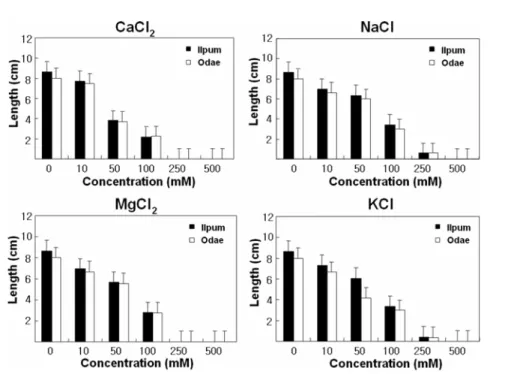
Physiological morphological analysis. The effect of calcium chloride, sodium chloride, magnesium chloride and potassium chloride was determined by measuring seedling shoot lengths. Shoot length decreased rapidly as the concentration of each salts was increased (Fig. 1).
Occasionally the two rice cultivars grew even in 250 mM NaCl and KCl but beyond this salt concentration no seed germination was observed. Progressive reduction in seedling development with increasing salinity has been reported [Munns, 2002]. In earlier studies, physiological mechanisms that underlie traits for salt tolerance could be used to identify new genetic sources of salt tolerance [Munns et al., 2006].
Longitudinal sectioning of embryos of cv. Odae and Ilpum after germination was used to evaluate morphological
changes, specifically plumule and radicle length with respect to time (Fig. 2). There was no significant difference between the seedlings of the two cultivars in the first 24 h of germination. However both plumule and radicle were produced earlier in cv. Odae.
Analysis of amylose content and amylopectin chain- length profiles. The starch composition and structure of the starches of the two cultivars were compared. There was no significant difference in the amylose content of the starch. cv. Odae contained 16.0 ± 0.4% and cv. Ilpum contained 16.4 ± 0.4% amylose. These amylose contents suggest that both cultivars possess the Wxb allele that is
predominant among japonica varieties. The Wx gene codes for granule-bound starch synthase, which is responsible for amylose synthesis [Okagaki et al., 1988].
The structure of the amylopectin was assessed from the chain-length distribution. There was no appreciable difference between cv. Odae and Ilpum in amylopectin structure as determined by this method (Fig. 3). It is a known that the structure and crystalline organization of starch granules, and the molecular structure of amylose and amylopectin, differ between plant species and tissues [Oka et al., 1997]. However, no significant differences in chain length of amylopectin have been reported between Fig. 1. Salt responses of japonia cultivars Odae and Ilpum. Seeds of the cultivars were germinated in MS medium, sup- plemented with various concentrations of CaCl2, NaCl, MgCl2, or KCl for 10 days at 25oC. Bars represent mean ± SEM (scanning electron microscopy) 10 seedlings were used for each measurements.
Fig. 2. Comparison of the germination patterns of Odae and Ilpum. Longitudinal sections of Odae (1-6) and Ilpum (7- 12) were compared with a light microscope after germination for various times. Sections were 6-8µm thick. Co, coleop- tile; ep, epiblast; fl, first leaf; ra, radicle; rc, root cap; sc, scutellum; vs, vascular bundle. Scale bar is 10µm.
130 Hye-Jeong Cho et al.
japonica rice varieties bred in Japan, such as Nipponbare and Kinmaze [Umemoto et al., 2002]. Evidently the Korean rice varieties, cv. Odae and Ilpum, both classified as japonica subspecies, also have similar amylopectin chain distributions.
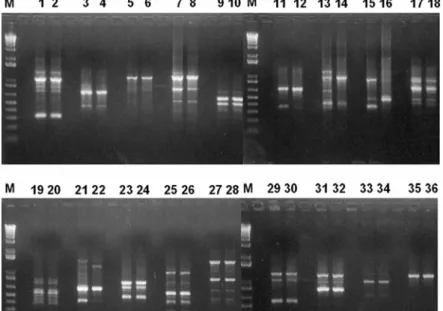
RAPD analysis. As shown in Fig. 4, primers (OPAG- 08; OPAG-09; OPAG-10; OPAG-11, OPAG-13) yielded different RAPD patterns from the two cultivars, whereas the other primers yielded similar pattern. A total of 114 fragments were generated from the DNA of the two cultivars, 61 from Odae and 53 from Ilpum. Clearly there is not much difference between these two cultivars at the genomic level (common band/total band = 104/114).
RAPD has been used to demonstrate polymorphism and clarify phylogenetic relationship in rice [Bao et al., 2002]
and Pisum and to study intraspecific differentiation in garlic (Allium sativum L.) [Maab et al., 1995].
In the present study we have examined possible differences between two important japonica rice cultivars in Korea. We could not find any significant difference in abiotic stress tolerance, biochemical property endosperm and DNA levels.
Acknowledgments. We are grateful for financial support from the BioGreen 21 (Grant 1005013-1-1).
Fig. 3. Comparison of the chain-length profiles of the endosperm amylopectin of Odae and Ilpum. A, Amy- lopectin from Odae and Ilpum analyzed by HPACE-PAD.
B, Chain-length distribution of amylopectin.
Fig. 4. Gel electrophoretic RAPD profiles obtained with Odae and Ilpum genomic DNA and 18 different primers.
RAPD fragments ranged from 0.4-2.5 kb. Lane M is a 1 kb ladder in the first lane of each gel. Lanes 1, 3, 5, 7, 9, 11, 13, 15, 17, 19, 21, 23, 25, 27, 29, 31, 33, 35 are derived from Odae, while lanes 2, 4, 6, 8, 10, 12, 14, 16, 18, 20, 22, 24, 26, 28, 30, 32, 34, 36 are from Ilpum. OPAG-02 (lanes 1, 2); OPAG-03 (3, 4); OPAG-04 (5, 6); OPAG-06 (7, 8); OPAG-07 (9, 10); OPAG-08 (11, 12); OPAG-09 (13, 14); OPAG-10 (15, 16); OPAG-11 (17, 18); OPAG-12 (19, 20); OPAG-13 (21, 22); OPAG-14 (23, 24); OPAG-15 (25, 26); OPAG-16 (27, 28); OPAG-17 (29, 30); OPAG-18 (31, 32); OPAG-19 (33, 34);
OPAG-20 (35, 36).
References
Bao JS, Corke H, and Sun M, (2001) Microsatellites in starch-synthesizing genes in relation to starch physico- chemical properties in waxy rice (Oryza sativa L.).
Theor Appl Genet105, 898-905.
Goff SA, Ricke D, Lan TH, Presting G, Wang R, Dunn M, Glazebrook J, Sessions A, Oeller P, and Varma H (2002) A draft sequence of the rice genome (Oryza sativa L.
ssp. Japonica). Science296, 92-100.
He P, Li SG, Qian Q, Ma YQ, Li JZ, Wang W, Chen Y, and Zhu LH (1999) Genetics analysis of rice grain quality.
Theor Appl Genet98, 502-508.
Khan MA, and Ungar IA (1997) Effect of light, salinity and thermoperiod on seed germination of halophtes. Can J Bot75, 835-841.
Khan MA, and Rizvi Y (1994) Effect of salinity, tempera- ture and growth regulators on the germination and early seedling growth of Atriflex griffithii var. Stocksii. Can J Bot72, 475-479.
Li Z, and Komatsu S (2000) Molecular cloning and charac- terization of calreticulin, a calcium-binding protein involved in the regeneration of rice cultured suspension cells. Eur J Biochem267, 737-745.
Maab HI, and Klaas M. (1995) Infraspecific differentiation of garli (Allium sativum L.) by isozyme and RAPD markers. Theor Appl Genet91, 89-97.
Munns R (2002) Comparative physiology of salt and water stress. Plant Cell Environ25,239-250.
Munns R, James RA, and Lauchli A (2006) Approaches to
increasing the salt tolerance of wheat and other cereals.
Exp Bot57,1025-1043.
Murashige T, and Skoog F (1962) A revised medium for rapid growth and bioassay with tobacco tissue cultures.
Physiol Plant15, 473-497.
Noble CL, and Rogers ME (1992) Arguments for the use of physiological criteria for improving the salt tolerance in crops. Plant Soil 146, 99-107.
Oka H, and Morishima H (1997) Wild and cultivated rice.
In: Matsuo T, Futsuhara Y, Kikuchi F, Yamaguchi H (ed) In Science of the rice plant, Genetics. Nobunkyo. Tokyo.
Okagaki RJ, and Wessler SR (1988) Comparison of non- mutant and mutant waxy genes in rice and maize.
Genetics120, 1137-1143.
Sambrook J, Fritsch EF, and Maniatis T (1989) (2nd ed) Molecular Clonong: A Labortory Manual. Cold spring Harbor Laboratory.
Umemoto T, Nakamura Y, Satoh H, and Terashima K (1999) Differences in amylopectin structure between two rice varieties in relation to the effects of temperature during grain-filling. Starch51, 58-62.
Umemoto T, Yano M, Satoh H, Shomura A, and Nakamura Y (2002) Mapping of a gene responsible for the differ- ence in amylopectin structure between japonica type and indica type rice varieties. Theor Appl Genet 104, 1-8.
Virk PS, Newbury HJ, Kackson MT, and Fords-Lloyd BV (1995) The identification of duplicate accessions within a rice germplasm collection using RAPD analysis. Theor Appl Genet90, 1049-1055.