Improved Corrosion and Abrasion Resistance of Organic-Inorganic Composite Coated Electro-galvanized Steels for Digital TV Panels
Du-Hwan Jo1,†, Sang-Geol Noh1, Jong-Tae Park1, and Choon-Ho Kang2
1Steel Product II Research Group POSCO Technical Research Laboratories, Pohang, 37859, Korea
2Research Infra Group, POSCO Technical Research Laboratories, Pohang, 37859, Korea (Received July 09, 2015; Revised October 13, 2015; Accepted October 13, 2015)
Recently, household electronic industries require environmentally-friendly and highly functional steels in order to enhance the quality of human life. Customers especially require both excellent corrosion and abrasion resistant anti-fingerprint steels for digital TV panels. Thus POSCO has developed new functional electro-galvanized steels, which have double coated layers with organic-inorganic composites on the zinc surface of the steel for usage as the bottom chassis panel of TVs. The inorganic solution for the bottom layer consists of inorganic phosphate, magnesium, and zirconium compounds with a small amount of epoxy binder, and affords both improved adhesion properties by chemical conversion reactions and corrosion resistance due to a self-healing effect. The composite solution for the top layer was prepared by fine dispersion of organic-inorganic ingredients that consist of a urethane modified polyacrylate polymer, hardener, silica sol and a titanium complex inhibitor in aqueous media. Both composite solutions were coated on the steel surface by using a roll coater and then cured through an induction furnace in the electro-galvanizing line.
New anti-fingerprint steel was evaluated for quality performance through such procedures as the salt spray test for corrosion resistance, tribological test for abrasion resistance, and conductivity test for surface electric conductance regarding to both types of polymer resin and coating weight of composite solution. New composite coated anti-fingerprint steels afford both better corrosion resistance and abrasion properties compared to conventional anti-fingerprint steel that mainly consists of acrylate polymers. Detailed discussions of both composite solutions and experimental results suggest that urethane modifications of acrylate polymers of composite solutions play a key role in enhanced quality performances.
Keywords : composite coating, corrosion resistance, abrasion resistance, anti-fingerprint steels, electro-galvanizing steels
†Corresponding author: [email protected]
1. Introduction
To date, zinc and zinc-alloy coated steel sheets have been treated using both chromate chemical conversion and/or chromate-free coating on the zinc surface to en- hance corrosion resistance and additional functional properties. Typically, chromate treatment is effective for rust-prevention on a zinc layer which is widely used be- cause of both performance and economical aspects. The most important reason for the excellent performance of the chromate coating seems to be the polymeric network in the layer through the bridge between Cr(VI) and the oxo-/hydroxo- anion1). Steel makers have used chromate as a protective coating substance of zinc coated steels for a long time. But several years ago, the EPA classified
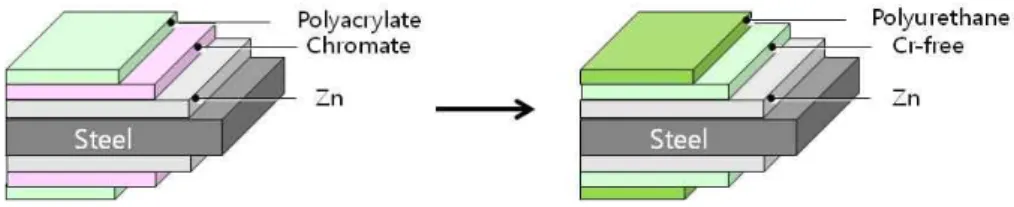
the chemicals as a human carcinogen when inhaled, and heavily regulates their use and disposal. Especially, EU directives have a profound impact on the protective coat- ing for metals. From July 2006, EU directives have tar- geted the electrical and electronic equipment industries with further restrictions2,3). For the last decade, POSCO have made an effort to develop chromate-free galvanizing steels according to the previously described situation4). These chromate-free products are manufacturing and widely using as a materials in household, construction, and automotive steels. In particular, replacing the chro- mate conversion coating on the anti-fingerprint elec- tro-galvanized steels has been developed by introducing organic-inorganic composite technology5-7), as shown in Fig. 1. However, customers require both excellent corro- sion and abrasion resistant anti-fingerprint steels for use as deep drawing parts of digital TV panels. Therefore in this paper, we describe development and quality perform-
Fig. 1. Schemetic diagrams showing coating layers of (a) conventional coated steel and (b) developed coated steel.
ances of environmentally-benign, double layered and com- posite coated electro-galvanized steels as a substitute for the conventional anti-fingerprint analogs.
2. Experimental Details
2.1 Preparation of Composite Solution
The composite coating solutions were prepared as an aqueous solution that comprised of both inorganic sol utions for bottom layer and organic-inorganic solution for top layer. The former solution consists of an inorganic phosphate, silicate, and manganese compound. The latter composite solution was prepared from the mechanical dis- persion of acryl modified polyurethane binder, melamine hardener, micronized silica, titanate compound as an anti- corrosive agent, and fluorine substituted polyethylene wax as a lubricant, respectively. Several miscellaneous addi- tives were added into the resin solution; wetting and stabi- lization agent of pigments, defoamer and so on. The solid content was measured by weight after drying at 150 °C for 30 min. and viscosity of the composite solution was measured by Brookfield method, respectively.
2.2 Production of Composite Coated Steels
The organic-inorganic composite solutions for mass production were prepared from water-borne solutions that had 5±1 cps for the bottom layer and 8±1 cps for the top layer in viscosity as well as 8±1 (bottom) and 16±1 (top) % in solid content at 25 °C. The production was carried out in the electro-galvanizing line (EGL) that the processes consisted of pre-treatment, galvanizing, roll coating, induction curing and cooling section, according in order. The composite solution was coated by three-roll reverse operation on the strip surface8). The curing temper- ature was set at 120±5 °C for the bottom layer and 160±5
°C for the top layer by induction oven. Both coated layers were dried in an induction oven and then cooled to room temperature via air cooling and water quenching section.
The weight of the coated layer was measure with both a portable gauge of infrared wavelength measurement in- strument and wet weight method.
2.3 Performance Evaluation
The quality performances for the surface of anti-finger- print steels were evaluated by the following procedure.
The corrosion resistance was evaluated by salt spray test (SST) with edge sealing by scotch tape for both plain and Ericksen (7mm) drawn parts9). Anti-fingerprint prop- erty was measured by color difference before and after by applying artificial tears solution (JIS-K2246) for 5 seconds. Solvent resistance was evaluated from color dif- ference before and after by applying organic solvent such as isopropyl alcohol, methylethylketone, methylene chlor- ide and toluene by rubbing 10 times at load force of 0.25 kgf/mm2. The electric conductivity was evaluated by sur- face resistance which was measured by four-pin probe method (model, Loresta GP). Thermal resistance was measured by color differences after 1 hour of heating in the oven at a temperature of 250 °C. The friction co- efficient was measured from draw bead tester at measure- ment conditions of loading weight 600 kgf, speed 150 mm/min and length 100 mm without a lubricant. Abrasion property was tested and rated into grades after 10 times rubbing at load force of 0.25 kgf/mm2 without a lubricant.
3. Results and Discussion
In general, anti-fingerprint steels require basic properties such as good corrosion resistance, surface electric con- ductivity, and abrasion resistance for panel usage of home electronic appliances4). Among these characteristics in the organic polymer-based resin coated steels, there are good correlations with coating weights on the zinc surface shown in Fig. 2. As the coating weight increases, electrical con- ductivity decreases due to the insulating property of the coating layer, but anti-corrosive property increases because of the increased barrier effect of the thicker coating layer.
Though higher coating weight gives higher abrasion resist- ance that affords better press formability, a proper coating weights (or thickness) of the Cr-free coating layer for the household appliances are the most important to get ex- cellent electrical conductivity to enhance electromagnetic interference shielding inside instrument. Generally these
Fig. 2. Typical correlation between the coating weights vs. elec- trical conductivity, corrosion resistance, and abrasion property on the organic polymer-based resin coated steels.
Fig. 3. Coating weight diagram based on correlation between bot- tom and top layer; (a) alarming zone for corrosion resistance and abrasion resistance, (b) alarming zone for conductivity.
Fig. 4. Conceptual description of top coating layer between conventional polyacrylate, (a) & (b), and new polyurethane, (c) & (d), before and after curing. Wet films, (a) & (c); dried films, (b) & (d).
characteristics tend to change drastically at about 1000 mg/m2 region by coating weights.
3.1 Composite Coated Steel Sheets
New Cr-free composite technology achieves good re- sults by creating a thin organic-inorganic hybrid layer on the zinc coated surface that replaces the chromate histor- ically used in commercial steels. The concept of the Cr-free double coating layer was designed by mimic poly- meric network structure of chromate layer1). Actually,
chromate provides excellent anticorrosion properties from both the protective and self-healing effects that arise from the inorganic polymeric structure and high valent chro- mium ion. In our research, to afford environmentally- friendly steels, the concept of Cr-free composite coating layer was designed by double layered coating. Double lay- er affords both adhesion property between metal surface and top coating by inorganic bottom layer, and abrasion property by organic-inorganic top layer. The former sol- ution consists of inorganic phosphate, magnesium, and zir- conium compound with a small amount of epoxy binder, and affords both excellent adhesion properties by chemical conversion reaction and corrosion resistance owing to the self-healing effect. The coating weights were set to 250 to 350 mg/m2 to provide both excellent surface quality and productivity, as shown in Fig. 3. The latter composite solution was prepared from the mechanical dispersion of acryl modified polyurethane binder, melamine hardener, micronized silica, titanate compound as an anticorrosive agent and fluorine substituted polyethylene wax as a lu- bricant, respectively. Several miscellaneous additives were added into the resin solution; wetting and stabilization agent of pigments, defoamer as well as others. The resin of the top layer was modified by acrylate modified ure- thane copolymer (molecular weight (MW) ~6x10³ and
~104 (composition, 1:1), Tg = 0 and 10 °C, respectively) which provides both enhanced chemical and thermal re- sistance due to strong binding with the bottom layer com- pared to conventional ethylene acrylate polymer (MW
~104, Tg = -10 °C). While the lower MW polymer pro- vides both increased solution flow property and wetting on the metal surface, the higher molecular weight of - polymer affords better hardness due to toughness of the layer. The conceptual description of the coating layer be- fore and after curing was shown in Fig. 4. Also, the coat- ing weight was adjusted by 600 to 800 mg/m2 to satisfy both electrical conductivity and abrasion resistance, shown in Fig. 3. This explains coating window for provide the best functionality. Zone (a) is alarming area for corrosion resistance and abrasion resistance due to low coating weights. Zone (b) is alarming area for conductivity due
Table 1. Summary of quality evaluation of conventional and new composite coated electro-galvanized steels
Fig. 5. Evaluation results of conventional and new composite coat- ed steels; corrosion resistance, tribology measurement, and thermal endurance.
to high coating weights. Therefore new composite coated steels are developed double layer coated steels with 1000±150 mg/m2 coating weights by a proper combination between the bottom and top layer composite coating solutions. As shown in Fig. 3, both left and below the target coating weight describes alarming region for poor corrosion resistance due to short coating weight. While both right and upper of target coating weight describes alarming region for poor electrical conductivity owing to high coating weight.
3.2 Quality Performance
As the thickness of the coated layer goes to thin, the quality of the layer such as corrosion resistance and press formability is increasingly important. To improve both qualities in this development, small (MW ~6000) and high (MW ~10000) molecular weight polyurethanes were used.
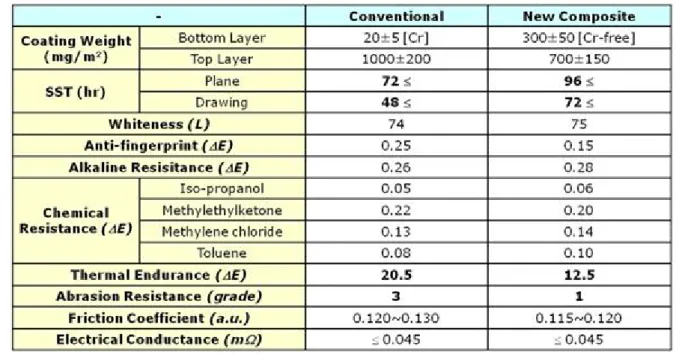
These combinations of molecules were presumably suit- able for the reason of enhanced press formability. In this development, we confirmed that new composite coated steels are suitable for quality certification of digital TV panels. Table 1 shows diverse evaluation results for both conventional and new composite coated steels.
3.2.1 Corrosion Resistance
Corrosion resistance tests of conventional and new composite coated steel products are shown in Fig. 5 and compared corrosion appearance after salt spray test. The composite coated products with coating weights of 300 and 700 mg/m2 for the bottom and top layer, respectively,
show excellent corrosion resistance in Ericksen drawn part from the salt spray test. This result is compared well with conventional anti-fingerprint steels with coating weights of 100 and 1000 mg/m2 for the bottom and top layers, respectively. This suggests that the formation of organ- ic-inorganic hybrid layers among zinc surface and double layers gives an excellent barrier and self-healing effect.
3.2.2 Electric Conductivity
In household appliances surface electric conductivity is important for electrical grounding of the instruments to
Fig. 6. Advanced abrasion property of new composite coated steels; customer evaluation of press formability (34” LED TV back cover, steel thickness 0.8 mm).
shield electromagnetic interference. Therefore, a small coating weight is usually adopted to overcome the draw- back of the insulating property of the organic coating layer in the surface coated steels. The new composite coated steels exhibit surface electrical resistances less than 0.045 mW, which is acceptable for use in electronic appliances.
These results suggest that strong binding between the or- ganic-inorganic composite layer and zinc surface causes high surface electric conductance. New Cr-free composite coated steels that have a thin coating layer less than 1mm with coating weights of 1000±150 mg/m2 assure excellent conductivity.
3.2.3 Thermal Endurance
Fig. 5 shows the thermal endurance results of the com- posite coated steels compared with conventional anti-fin- gerprint steels. Usually, most organic resins cannot with- stand at elevated heating temperature, more than 200 °C, because of thermal breaking or yellowing of the polymer.
This new composite coated steels can withstand the deterio- ration of the coating layer above the typical cure temperature up to 170 °C, even though slightly changed at 250 °C. This result can be explained by the strong binding and thermal stability of both the inorganic bottom layer and urethane based composite top layer on the zinc surface.
3.2.4 Abrasion Resistance
Fig. 5 shows the tribological test for both steels and compared abrasion resistance. Even though there are sim- ilar coating weights between conventional and new com- posite coated steels, the latter exhibits better abrasion re- sistance properties as a 1st grade than 3rd grade when com- pared with the former. This finding can be explained by the strong binding and increased hardness of both the in- organic bottom layer and urethane based composite top layer on the zinc surface.
4. Conclusions
We have developed new Cr-free composite coated steel sheets to enhance abrasion resistance of conventional an- ti-fingerprint steels for application in home electronic
appliances. The new composite coating solutions were pre- pared as an aqueous solution of both Cr-free inorganic sol- ution instead of chromate for the bottom layer and polyur- ethane based composite solution instead of polyacrylate based composite solution for the top layer. The composite coated steels were produced in the electro-galvanized line from the double layer coating with a roll coater. This com- posite steel exhibits excellent functionalities that have ex- cellent corrosion and abrasion resistance, as well as surface conductivity within target coating weights. Experimental results suggest that strong binding among the inorganic bot- tom layer and organic-inorganic top layer on the zinc sur- face plays a key role in the excellent corrosion and abrasion performances. Furthermore, A customer evaluation gives new coated steels quality certification for adaptation of back cover panels of LCD TVs shown in Fig. 6. The new composite coated anti-fingerprint steels are under mass commercial production in the POSCO EGL line.
References
1. A. Gerd, H. Jost, H. Klaus, S. Christoph, K. Ulrich, K. Herbert, S. Peter, O. Manfred, Chromium Compounds, Ullmann's Encyclopedia of Industrial Chemistry, Wiley-VCH Verlag GmbH & Co. KgaA, Weinheim (2005).
2. 32002L0095, Official Journal of the European Union, L 37, p. 19, 13 February (2003).
3. 32002L0096, Official Journal of the European Union, L 37, p. 24, 13 February (2003).
4. D.-H. Jo, M. Kwon, J.-S. Kim, Corros. Sci. Tech., 11, 15 (2012).
5. M. Yamshita et al., Proceedings of The 167th and 168th Nishiyama Memorial Technical Symposium, p. 158, Tokyo (1998).
6. W. J. Van Ooij, A. Seth, T. Mugada, G. Pan and D. W.
Scgaefer, Proceedings of the 3rd International Engineering Congress, Orlando, FL (2004).
7. P. Innocenzi and T. Kidchob, T. Yoko, J. Sol-Gel Sci.
Techn., 35, 225 (2005).
8. D. F. Benjamin, Ph.D. Thesis, University of Minnesota (1994).
9. JIS Z 2371, Japanese Industrial Standard of Methods of neutral salt spray testing, JSA (1994).