
105
J. Appl. Biol. Chem. 53(2), 105-107 (2010)
Short Communication
대장균에서 단백질 분비에 대한 Agarivorans albus YKW-34의 Agarase 시그널펩티드의 효과
이주영1,2·송대근2·손진기1·판철호2*
1강릉원주대학교 해양생물공학과, 2한국과학기술연구원강릉분원 천연물소재센터
Effect of Agarase Signal Peptide from Agarivorans albus YKW-34 on Protein Secretion in Escherichia coli
Joo Young Lee1,2, Dae-Geun Song2, Jin-Ki Son1, and Cheol-Ho Pan2*
1Faculty of Marine Bioscience and Technology, Division of Marine Bioscience Engineering, Kangnung-Wonju National University, Gangneung 210-702, Korea
2Natural Products Research Center, Korea Institute of Science and Technology (KIST) Gangneung Institute, Gangneung 210-340, Korea
Received January 13, 2010; Accepted March 23, 2010
To overcome the limitation of
E. coliexpression system such as inclusion body formation and dis- ulfide bond failure, we tried to express the heterologous protein as a secreted form. We adopted agarase signal peptide (ASP; 23 amino acid residues) from
Agarivorans albusYKW-34 which is one of marine bacteia. When we used ASP to express
β-agarase, about 42% activity was detected in media.
Key words: Agarivorans albus, Escherichia coli, recombinant protein, secretion, signal peptide
1970년대유전자재조합기술이발전하면서대장균에서의재
조합단백질생산이시작되었고, 현재는여러종류의 세균, 효 모, 곰팡이, 곤충세포, 식물세포, 동물세포등에서도재조합단
백질의 생산이 이루어지고 있다. 2000년의 산업용 효소 전체 시장은 약 15억 달러, 국내 효소시장은 약 400억 원 규모로
추산되며, 1980년대 중반까지는 천연효소를 사용하였으나, 이
후부터 재조합 효소가 사용되기 시작하면서 빠르게 천연효소 시장에 침투하였다[Oh, 2004]. 점차 증가하고있는 재조합단 백질의 생산은 사용목적과 생산 규모에 따라서 여러 종류의 발현시스템을사용하고있으나가장많이이용하는것은대장 균이다. 이는유전자재조합 기술초기부터사용되어분자생 물학적연구와발현시스템에대한연구가가장많이되어있 으며경제적으로도장점이있기때문이다[Baneyx, 1999]. 그러
나, S-S 결합이나번역후수식을 필요로하는단백질의경우
에는발현에 실패할수 있으며, 대량발현의 경우에는단백질 의비특이적인 응집이일어나는등대장균에서재조합 단백질
생산을 위하여 극복해야 할 문제가 여전히 존재한다[Waldo,
2003]. 따라서, 이러한문제를해결하기위하여발현수준을조
절하는 프로모터의 사용[Makrides, 1996], 대장균의유전적 개 량[Lara 등, 2006], chaperon co-expression[Kapust와 Waugh, 1999], 재조합단백질의분비[Mergulhão 등, 2005]와같은방법 을 개발하여사용하고있다.
본연구에서는해양미생물인 Agarivorans albus YKW-34로 부터 agarase 유전자 AgaB34를 분리하는 과정에서 agarase가
대장균 세포밖으로 분비되는현상을관찰하여, AgaB34의 추
정 시그널펩티드가대장균에서재조합단백질 분비를위한신 호로사용될수있는 지를확인하고자하였다[Fu 등, 2009]. 그 래서, AgaB34로부터 N-말단 23개 아미노산 잔기에 해당하는 추정의 시그널펩티드를 ASP로 명명하였고, ASP 유무에 따른 대장균에서단백질 분비발현의양상을관찰하기위하여발현 플라스미드를 제작하였다. AgaB34를주형으로 agarase의 N-말
단부터 open reading frame(ORF) 전체를 polymerase chain reaction(PCR)으로 증폭하여 발현 벡터인 pET23b(Merck, Darmstadt, Germany)에 클로닝하여 발현 플라스미드 pET23b- agarase(WT)를 얻었으며, ASP를제외한부분만을 PCR로 증폭
하여 역시발현벡터인 pET23b에클로닝하여발현플라스미드
pET23b-agarase(∆ASP)를얻었다(Fig. 1). 각 발현플라스미드의 염기서열분석을통하여 유전자의변이가 없음을확인하고다 음 실험을진행하였다.
*Corresponding author
Phone: +82-33-650-3652; Fax: +82-33-650-3679 E-mail: [email protected]
doi:10.3839/jabc.2010.019
106 이주영·송대근·손진기·판철호
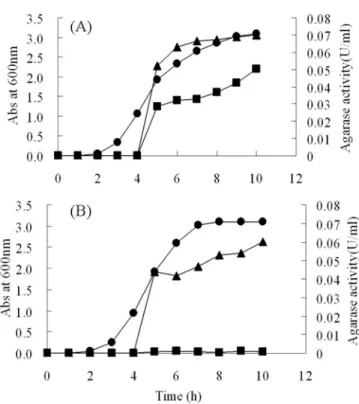
각각의 발현 플라스미드를 E. coli BL21(DE3)(Merck, Darmstadt, Germany)에 형질전환하고, 형질전환 균주를 200 mL Luria-Bertani(LB) 액체 배지에 접종하여 37oC에서 200 rpm으로 진탕 배양하였고, 600 nm 흡광도가 0.5에 이르렀을 때, 재조합단백질의발현을유도하기위하여 isopropyl β-D-1- thiogalactopyranoside(IPTG)를 0.5 mM 되도록 첨가하였다. IPTG를넣고배양온도를 30oC로낮추어 200 rpm으로진탕배 양하면서 세포 안팎의 agarase 활성을 측정하였다(Fig. 2).
Agarase의 활성 측정은 균주를 키우면서 매 시간마다 채취한
균체의용균액과배양액을사용하여환원당을측정하는비색법 을 사용하였다[Miller, 1959]. 즉, 기질로 0.1% agarose 용액을 사용하였고 시료와 기질을 섞어 37oC에서반응시키고 환원당 과반응하는 dinitrosalicylic acid 용액을넣어반응시켜 575 nm
흡광도를측정하여효소활성을 계산하였다. 효소 활성 1 U은 분당 1µmol의 D-galactose를 생산하는 효소량으로정의하였다.
한편각 시료의 단백질량은 Bicinchoninic acid 방법을 사용하 여측정하였다[Smith 등, 1985].
Fig. 2에서 보듯이 IPTG 첨가 이후 pET23b-agarase(∆ASP)
형질전환체는 세포내에서만 agarase 활성을측정할수 있었으
나, pET23b-agarase(WT) 형질 전환체의 경우에는 배양액에서
도 agarase 활성을 측정할 수 있었다. 이 결과는 배양액의
agarase 활성이 autolysis가 아닌분비에의한 것임을간접적으 로보여주고 있다. 10시간배양후 균체와배양액을분리하여,
각각의 agarase 활성과 단백질량을 측정하여 비교함으로써
pET23b-agarase(WT) 형질전환체의경우에는 배양액의비활성 이 세포 내에서 보다 3배 정도 높게 나타남을 알 수 있었다
(Table 1).
해양미생물인 Agarivorans albus YKW-34에서분리한추정
시그널펩티드인 ASP는 23개의아미노산잔기(MKGFTKHSILM ACSIGLAINATA)로 구성되어 있으며 Fig. 2의 결과로부터 대 장균에서 단백질의분비를매개할수있음을확인하였다. 대장 균에서작동하는것으로알려진시그널펩티드를살펴보면각각 의 단백질 분비 경로마다특징을 가지고 있는 것으로 알려져
있다. 우선 typeⅠ 경로의 경우일련의 아미노산 잔기가재조
합 단백질의 C-말단에 붙어 발현되는 것으로 보고되었다 [Fernández와 de Lorenzo, 2001; Gentschev 등, 2002;
Koronakis, 2003]. 따라서 ASP는 type I과는다른경로로단백
질을 분비시킴을 알 수 있다. 한편, type II 경로에는 signal recognition particle(SRP), twin-arginine translocation(TAT), SecB-dependent pathway의 3가지경로가보고되었다[Mergulhão
등, 2005]. 각경로에 해당하는시그널펩티드의아미노산조성
을보면, SRP pathway는높은비극성을가지는아미노산잔기
들로구성되어 있고, TAT pathway는 두 개의 arginine이연속 으로 배열되는특징을가지며, SecB-dependent pathway의경우
Fig. 1. Constructs of (A) pET23b-agarase (WT) and (B) pET23b- agarase (∆ASP) expression plasmid.
Fig. 2. Cell growth (-●-) and intracellular (-▲-) and extracellular (-■-) agarase activity of E. coli BL21 (DE3) transformed with (A) pET23b-agarase(WT) and (B) pET23b-agarase (∆ASP). Results are the representative of three independent experiments.
Table 1. Agarase production from E. coli BL21 (DE3) transformed with pET23b-agarase (WT) and pET23b-agarase (∆ASP), respectively.
Results are the representative of three independent experiments
Agarase (WT) Agarase (∆ASP)
Supernatant Cell lysatye Supernatant Cell lysate
Total Protein (mg) 18.9 78.2 18.1 94.1
Total Activity (U) 7.18 10.01 - 8.61
Specific Activity (U/mg) 0.38 0.13 - 0.09
대장균에서단백질분비에대한 A. albus의 agarase 시그널펩티드의효과 107
에는 18~30개의 아미노산 잔기로 구성되어 있으며 N과 C-말 단에는 극성, 가운데 부분에는 비극성인 아미노산 잔기로 구성 되는 특징을 가지고 있다. 본 연구의 ASP는 전체 23개의 아미 노산 잔기로 이루어져 있으며, N과 C-말단에는 극성, 가운데 부분에는 비극성인 아미노산 잔기로 구성되어 있으며, arginine 잔기는 존재하지 않으므로 type II의 SecB-dependent pathway 를 통하여 재조합 단백질을 분비시키는 것으로 추측할 수 있다 (Fig. 3).
pET23b-agarase(WT) 형질 전환체의 경우, 세포내에 50% 이 상의 agarase 활성이 잔류하는 것으로 나타났다(Table 1). 이는 agarase의 생산 속도가 분비 속도보다 빠르기 때문으로 생각되 며, 재조합 단백질을 효과적으로 분비생산하기 위해서는 시그 널펩티드의 사용과 동시에 분비 경로를 활성화할 수 있는 방법 이 고려되어야 할 것이다. 이를 위하여 ASP의 분비 경로를 보 다 잘 이해하기 위한 후속 연구가 진행 중이며, 진핵세포 유래 의 재조합 단백질의 분비생산 연구가 함께 진행 중이다.
감사의 글
본 연구는 지식경제부 지방기술혁신사업(RTI05-01-02) 지원 으로 수행되었음.
참고문헌
Baneyx F (1999) Recombinant protein expression in Escherichia coli. Curr Opin Biotechnol 10, 263-292.
Barrett CML, Ray N, Thomas JD, Robinson C, and Bolhuis A (2003) Quantitative export of a reporter protein, GFP, by the twin arginine translocation pathway in Escherichia coli. Biochem Biophys Res Comm304, 279-284.
Choi JH and Lee SY (2004) Secretory and extracellular production of recombinant proteins using Escherichia coli. Appl Microbiol Biotechnol 64, 625-635.
Fernández LA and de Lorenzo V (2001) Formation of disulphide bonds during secretion of proteins through the periplasmic- independent type I pathway. Mol Microbiol40, 332-46.
Fu XT, Pan CH, Lin H, and Kim SM (2009) Gene cloning, expression, and characterization of a β-agarase, AgaB34, from Agarivorans albus YKW-34. J Microbiol Biotechnol 19, 257- Gentschev I, Dietrich G, and Goebel W (2002) The 264. E. coli alpha- hemolysin secretion system and its use in vaccine development.
Trends Microbiol10, 39-45.
Kapust RB and Waugh DS (1999) Escherichia coli maltose- binding protein is uncommonly effective at promoting the solubility of polypeptides to which it is fused. Protein Sci 8, 1668-1674.
Koronakis V (2003) TolC-the bacterial exit duct for proteins and drugs. FEBS Lett555, 66-71.
Kyte J and Doolittle RF (1982) A simple method for displaying the hydropathic character of a protein. J Mol Biol 157, 105- Lara AR, Vazquez-Limón C, Gosset G, Bolívar F, López-Munguía132.
A, and Ramírez OT (2006) Engineering Escherichia coli to improve culture performance and reduce formation of by- products during recombinant protein production under transient intermittent anaerobic conditions. Biotechnol Bioeng 94, 1164- Makrides SC (1996) Strategies for achieving high-level expression75.
of genes in Escherichia coli. Microbiol Rev 60, 512-538.
Mergulhão FJM, Summers DK, and Monteiro GA (2005) Recombinant protein secretion in Escherichia coli. Biotechnology Advances23, 177-202.
Miller GL (1959) Use of dinitrosalicylic acid reagent for determination of reducing sugar. Anal Chem31, 426-428.
Oh SH (2004) Trends in the market of the industrial enzyme. Food industry and nutrition9, 10-17.
Pratap J and Dikshit KL (1998) Efficient of signal peptide changes on the extracellular processing of streptokinase form Escherichia coli requirement for secondary structure at the cleavage junction. Mol Gen Genet258, 326-333.
Smith PK, Krohn RI, Hermanson GT, Mallia AK, Gartner FH, Provenzano MD, Fujimoto EK, Goeke NM, Olson BJ, and Klenk DC (1985) Measurement of protein using bicinchoninic acid. Anal Biochem150, 76-85.
Waldo GS (2003) Genetic screens and directed evolution for protein solubility. Curr Opin Chem Biol7, 33-38.
Fig. 3. Hydropathy plots of each signal peptide of type II secretion pathway and ASP by Kyte-Doolittle scale [Kyte and Doolittle, 1982]. (A) SRP pathway (LamB) [Pratap and Dikshit, 1998], (B) TAT pathway (TorA) [Barrett et al., 2003], (C) SecB-dependent pathway (OmpF) [Choi and Lee, 2004], (D) ASP in this study
![Fig. 3. Hydropathy plots of each signal peptide of type II secretion pathway and ASP by Kyte-Doolittle scale [Kyte and Doolittle, 1982]](https://thumb-ap.123doks.com/thumbv2/123dokinfo/5403025.217704/3.892.65.419.135.607/hydropathy-plots-signal-peptide-secretion-pathway-doolittle-doolittle.webp)
