Fat necrosis is a relatively common benign disease that can be the result of trauma (iatrogenic or noniatro- genic) or may have an idiopathic cause (1). Reduction mammoplasty also invokes extensive soft tissue injury and this occasionally leads to fat necrosis. Fat necrosis is often depicted on mammography as characteristic round calcifications with lucent centers (oil cysts) or as dense amorphous solid calcifications (2). On occasion, however, fat necrosis may have atypical imaging and physical examination features that are indistinguishable from malignancy (3). We report a case of fat necrosis simulating malignancy by mammography and ultra-
sonography, which developed in the breast following re- duction mammoplasty.
Case Report
A 63-year-old woman was referred to our hospital due to an abnormal density on a screening mammogram.
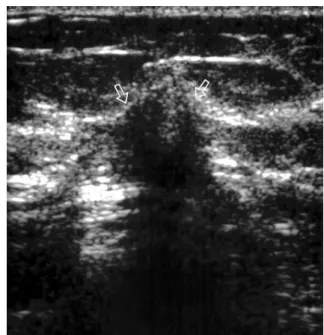
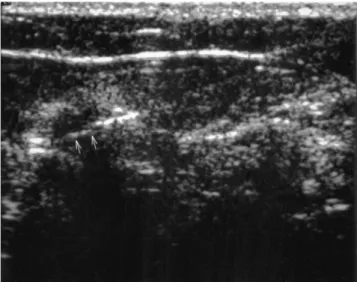
The patient had received bilateral reduction mammo- plasty 10 months previously. The mammogram taken before the mammoplasty showed almost entirely fatty breasts without focal mass or clustered microcalcifica- tions. She has been receiving estrogen therapy for 2 years. The mammogram taken on referral revealed an irregular high density with a spiculated margin in the left upper inner quadrant (Fig. 1). Ultrasonography showed a 1.5 cm sized, ill-defined, and irregular hypoe- choic lesion with posterior acoustic shadowing at the 10 o’clock position in the left breast, 3 cm away from the nipple (Fig. 2). Because of this suspicious imaging find- ing, ultrasonography-guided core biopsy using a 14-
J Korean Radiol Soc 2004;51:573-576
─ 573 ─
Fat Necrosis Simulating Breast Malignancy Following Reduction Mammoplasty: A Case Report1
Yeong Mi Park, M.D., Eun Kyung Kim, M.D.2
1Department of Diagnostic Radiology, Busan Paik Hospital, Inje University College of Medicine
2Department of Diagnostic Radiology, Severance Hospital, Yonsei University College of Medicine
Received July 23, 2004 ; Accepted September 16, 2004
Address reprint requests to : Yeong Mi Park, M.D., Department of Diagnostic Radiology, Busan Paik Hospital, Inje University College of Medicine, 614-735, Gaekum-dong, Busanjin-gu, Busan, Korea.
Tel. 82-51-896-6579 Fax. 82-51-896-1085 E-mail: [email protected]
Fat necrosis is well depicted on imaging by characteristic findings such as oil cysts.
However it may be rarely indistinguishable from carcinoma clinically and radiological- ly, and require biopsy for diagnosis. We report a case of fat necrosis simulating malig- nancy following reduction mammoplasty. The screening mammogram of a 63-year-old woman, who had received bilateral reduction mammoplasties 10 months previously, showed an irregular high-density lesion with a spiculated margin in the upper inner quadrant of the left breast. Ultrasonography revealed a 1.5 cm sized, ill-defined, and ir- regular hypoechoic lesion with posterior acoustic shadowing. The confirm diagnosis was fat necrosis, by ultrasonography-guided core needle biopsy. On the 6-month fol- low-up ultrasonography, the lesion was found to have decreased in size.
Index words :Radiography Fat, necrosis
gauge needle was performed (Fig. 3). A microscopic ex- amination showed aggregates of fat with dense fibrosis and inflammatory cells, suggestive of fat necrosis (Fig.
4). There was no evidence of malignant cells. On the 6- month follow-up ultrasonogram, the lesion was found to have decreased in size (Fig. 5).
Discussion
Reduction mammoplasty is increasing in popularity, and is usually performed for bilateral macromastia or for symmetry after mastectomy and breast reconstruc- tion. Reduction mammoplasty involves elevating the nipple and resecting the skin and glandular tissue from the inferior aspect of the breast (4). The procedure cre- ates scars, fibrotic tissue and alterations in the involved tissue, such as architectural distortion, hematomas, neo- calcifications, or skin thickening that may in some cases mimic a pathologic condition (5). Fat necrosis after re- duction mammoplasty has been reported in up to 10%- 20% of cases (5, 6). Fat necrosis is of clinical concern be- cause it is difficult to distinguish from carcinoma on both physical examination and radiologic images.
The process of fat necrosis results from aseptic saponi- fication of fat by blood and tissue lipases (7). These le- sions may contain both oily fat and hemorrhagic or serosanguineous fluid within the same compartment, as in oil cysts, which result in a fat-fluid layer effect (1).
This can be seen most often in the periareolar and in- ferior portions of the breast, where most surgical dissec-
tion occurs. Our patient, however, revealed fat necrosis in upper inner quadrant of the breast. Dissection for flap raising disrupts blood vessels and causes fat necrosis (8).
Mandrekas et al suggested that the use of electrocautery during breast reduction might be a main cause of fat necrosis (9).
Mammographic features associated with fat necrosis range from lipid cyst to findings suspicious of malignan- cy (3). Oil cysts have been described as the most charac-
Yeong Mi Park, et al: Fat Necrosis Simulating Breast Malignancy Following Reduction Mammoplasty
─ 574 ─
Fig. 2. Ultrasonogram of the left breast revealing a 1.5 cm sized, ill-defined, and irregular hypoechoic lesion with posteri- or shadowing (arrows) in the 10 o’clock position in the left breast, 3 cm away from the nipple.
A B
Fig. 1. A, B. Mediolateral oblique (A) and craniocaudal (B) mammograms showing irregular high density with a spiculated border in the left upper in- ner quadrant (arrows).
teristic lesion associated with fat necrosis (6, 9). Fat necrosis uncommonly manifests as focally clustered, pleomorphic microcalcifications that are mammographi- cally indistinguishable from those of malignancy (3). It also appears as an ill defined or spiculated area of in- creased opacity where fibrosis predominates and pro- duces a desmoplastic response similar to that seen in scirrhous carcinoma (10), and should be included in the differential diagnosis of a spiculated mass in addition to carcinoma, radial scar, and postbiopsy change (3).
By ultrasonography, small anechoic, well-defined sub- cutaneous lesions, which release a yellow oily fluid on aspiration, represent the oil cysts that are found in typi- cal fat necrosis (9). Soo et al (1) demonstrated a wide
range of the sonographic features of fat necrosis, which included cystic, complex, and solid appearing masses with circumscribed or ill-defined margins, often associ- ated with distortions of the normal sonographic archi- tecture. Moreover, distortion of parenchyma may be confused with scarring in postsurgical cases (1, 9).
Short-term follow-up with imaging and physical exam- ination rather than immediate biopsy has been recom- mended, because within a year after reduction mammo- plasty parenchymal distortion and skin thickening sub- side and the breast achieves a new baseline appearance (9). Nevertheless, if a lesion has a suspicious imaging ap- pearance, a biopsy is necessary for confirmation.
The radiologist should be aware of imaging findings of fat necrosis mimicking malignancy following reduction mammoplasty. Although breast imagings reveal suspi- cious findings in patients that have received reduction mammoplasty, a result of fat necrosis on needle biopsy may be acceptable, and short-term follow up (at 6 months) with imaging rather than surgical intervention is recommended.
References
1. Soo MS, Kornguth PJ, Hertzberg BS. Fat necrosis in the breast:
sonographic features. Radiology 1998;206:261-269
2. Mendelson EB. Evaluation of the postoperative breast. Radiol Clin North Am 1992;30:107-138
3. Hogge JP, Robinson RE, Magnant CM, Zuurbier RA. The mammo- J Korean Radiol Soc 2004;51:573-576
─ 575 ─
Fig. 5. Six months follow-up ultrasonogram of the left breast revealing a reduced lesion size, from about 1.5 cm to 1.0 cm in diameter (arrow).
Fig. 3. Ultrasonogram confirming that the needle (arrows) tra- versed the mass.
Fig. 4. Photomicrograph of a biopsy specimen revealing aggre- gates of fat with fibrosis and inflammatory cells, suggestive of fat necrosis (H & E, ×200).
graphic spectrum of fat necrosis of the breast. Radiographics 1995;
15:1347-1356
4. Miller CL, Feig SA, Fos JW4th. Mammographic changes after re- duction mammoplasty. AJR Am J Roentgenol 1987;149:35-38 5. Miller JA, Festa S, Goldstein M. Benign fat necrosis simulating bi-
lateral breast malignancy after reduction mammoplasty. South Med J 1998;91:765-767
6. Danikas D, Theodorou SV, Kokkalis G, Vasiou K, Kyriakopoulou K. Mammographic findings following reduction mammoplasty.
Aesthetic Plast Surg 2001;25:283-285
7. Frates MC, Homer MJ, Robert NJ, Smith TJ. Noniatrogenic breast
trauma. Breast Dis 1992;5:11-19
8. Mitnick JS, Roses DF, Harris MN, Colen SR. Calcifications of the breast after reduction mammoplasty. Surg Gynecol Obstet 1990;
171:409-412
9. Mandrekas AD, Assimakopoulos GI, Mastorakos DP, Pantzalis K.
Fat necrosis following breast reduction. Br J Plast Surg 1994;47:
560-562
10. Bassett LW, Gold RH, Cove HC. Mammographic spectrum of traumatic fat necrosis: the fallibility of “pathognomonic”signs of carcinoma. AJR Am J Roentgenol 1978;130:119-122
Yeong Mi Park, et al: Fat Necrosis Simulating Breast Malignancy Following Reduction Mammoplasty
─ 576 ─
대한영상의학회지 2004;51:573-576
악성종양과 유사한 소견을 보인 유방축소술후 생긴 지방괴사: 증례 보고1
1인제대학교 의과대학 부산백병원 영상의학과학교실
2연세대학교 의과대학 세브란스병원 영상의학과학교실
박 영 미・김 은 경2
지방괴사는 대부분 유성낭종과 같은 특징적인 영상소견을 보이지만 드물게 악성종양과 유사한 임상 및 영상소견 을 보일 수 있으며, 이 경우 감별진단을 위해 조직검사가 불가피하다. 저자들은 유방축소술 후 유방에서 발생한 악 성종양과 유사한 영상소견을 보인 지방괴사를 보고하고자 한다. 10개월 전 유방축소술을 받은 63세 여자환자의 유 방촬영술에서 좌측 유방의 상내측에 불규칙한 모양의 침상경계를 가진 고음영의 병소가 발견되었다. 유방초음파검 사상 1.5 cm 직경의, 경계가 불명확하고 불규칙한 모양을 보이며 후방음영감쇄가 동반된 악성종양의 소견을 보였 다. 초음파유도하조직검사를 시행하여 지방괴사로 진단되었으며, 6개월 후 초음파검사에서 크기가 줄어든 소견을 보였다.