Printed in the Republic of Korea
http://dx.doi.org/10.5012/jkcs.2013.57.2.272
Ginger Extract as Green Corrosion Inhibitor for Steel in Sulfide Polluted Salt Water
Abd El-Aziz S. Fouda*, Ahmed Abdel Nazeer†, Mohamed Ibrahim‡, and Mohamed Fakih‡ Department of Chemistry, Faculty of Science, El-Mansoura University, El-Mansoura-35516, Egypt.
*E-mail: [email protected]
†National Research Center, Electrochemistry and Corrosion Lab., Dokki, Cairo, Egypt
‡Water and waste water company, Dakahlia, Egypt (Received January 7, 2013; Accepted February 26, 2013)
ABSTRACT. Extract of ginger has been evaluated as a green inhibitor for the corrosion of steel in sulfide polluted NaCl solution using potentiodynamic polarization, electrochemical impedance spectroscopy (EIS) and electrochemical frequency modulation (EFM) techniques. Potentiodynamic polarization measurements showed that this extract acts as a mixed type inhibitor but mainly inhibits the cathodic reaction. The inhibition efficiency was found to increase with inhibitor concentra- tion reaching to approximately 83.9% using 250 ppm of ginger. Nyquist plots show a single capacitive loop in uninhibited and inhibited solutions. From EFM the causality factors are very close to theoretical values which indicate that the measured data are of good quality. The adsorption process of the studied extract on steel surface obeys Temkin adsorption isotherm. The results obtained from the different electrochemical techniques were in good agreement which prove the validity of these tools in measurement of corrosion rate. Ginger extract has no effect on Escherichia Coli and can be applied safely on waste water treatment plants.
Key words: Corrosion inhibition, Steel, NaCl, Na2S, Green inhibitor (ginger)
INTRODUCTION
Corrosion is the deterioration of metal by chemical attack or reaction with its environment. It is a constant and continuous problem, often difficult to eliminate com- pletely. Prevention would be more practical and achiev- able than complete elimination. Regarding the chemical structure and chemical behavior, an inorganic compound must be able to oxidize the metal, forming a passive layer on its surface. On the other hand, a molecule of an organic compound must have some features that give it the ability to act as a corrosion inhibitor. Among these, the molecule may have a large structure, double bonds, an active center or group, etc. These features give the molecule the ability to cover a large area of a metal surface with a firmly attached film.1
Apart from the structural aspects, there are also eco- nomic and environmental considerations. Thus, since the whole subject of corrosion is about its destructive eco- nomical effect, the used inhibitor must be cheap. Further- more, due to the recent increasing awareness of green chemistry, it must be a nontoxic and environmentally friendly chemical. One of the sources of these cheap and clean inhibitors is plants. Green corrosion inhibitors are biodegradable and do not contain heavy metals or other
toxic compounds. Some research groups have reported the successful use of naturally occurring substances to inhibit the corrosion of metals in acidic and alkaline environ- ment. Several reports are available on the various natural products used as green inhibitors. Low-grade gram flour, natural honey, onion, potato, gelatin, plant roots, leaves, seeds, and flowers gums have been reported as good inhib- itors. However, most of them have been tested on steel and nickel sheets. Although some studies have been performed on aluminum sheets, the corrosion effect is seen in very mild acidic or basic solutions (mill molar solutions). Many recent researches2−9 have adopted this trend and carried out their work on naturally occurring substances. Prom- ising results were obtained in previous work in this field.
It was reported that Khillah extract inhibits steel corro- sion in HCl solution with inhibition efficiency as high as 99%,2 while opuntia extract inhibits the corrosion of alu- minum in the same acid with efficiency of about 96%.9 The aim of this work is to study: i) The effect of ginger extract as green corrosion inhibitor for the steel in sul- fide polluted salt water using potentiodynamic polariza- tion, electrochemical impedance spectroscopy (EIS) and electrochemical frequency modulation (EFM) techniques and ii) its biological effect on the activity of Escherichia Coli.
EXPERIMENTAL Materials and Methods
The material used is steel which was provided from a bridge in a Talkha sanitation plant, Egypt. These samples have the following chemical composition (wt%): 0.005%
Si, 0.248% Mn, 1.832% Zn and the remainder is iron. For electrochemical measurements, the sheets were welded with Cu-wire for electrical connection and mounted into glass tubes of appropriate diameter using Araldite to offer an active surface of (1 cm2) geometric area to contact the test solution. Prior to each experiment, these sheets were abraded with 800−1200 emery paper, washed with bi-dis- tilled water, degreased with absolute ethanol and then dried.
A conventional electrochemical cell of capacity 100 ml was used containing three compartments for working, plati- num spiral counter and saturated calomel electrode (SCE) as reference electrode. The measurements were carried out in aerated non-stirred 3.5% NaCl with 16 ppm sulfide in the presence of various concentrations of the investigated compound, as environmentally-friendly corrosion inhib- itor. All solutions were freshly prepared from analytical grade chemical reagents using bi-distilled water and were used without further purification. For each run, a freshly prepared solution as well as a cleaned set of electrodes was used. Each run was carried out in aerated stagnant solutions at the required temperature using a water ther- mostat. All experiments were carried out at 25±1oC using circulator thermostat and solutions were not deaerated.
The potentiodynamic polarization curves were carried out at a scan rate of 1 mV s−1 starting from −1.7 V up to −0.1 V (SCE).
Before polarization, the open circuit potential of the work- ing electrode was measured as a function of time during 30 min, the time necessary to reach a quasi-stationary value for the open-circuit potential. Impedance measurements were carried out using AC signals of amplitude 5 mV peak to peak at the open-circuit potential in the frequency range 100 kHz and 0.2 Hz. All impedance measurements were recorded at open circuit potential (OCP) after immersion the electrode for 30 minutes in the test solution. All electrochemical mea- surements were performed with Potentiostat / Galvanostat / Zra analyzer (Gamry PCI300/4). A personal computer with DC 105 software for polarization, EFM140 software for electrochemical frequency modulation and EIS300 soft- ware for EIS measurements and Echem Analyst 5.21 was used for data fitting and calculating.
Preparation of Plant Extracts
The present investigation was carried out using the plant
namely ginger. The uses parts were the bark and the rhi- zomes of ginger. The sample were purchased from the local market and ground into a fine powder to give 500 g of powdered materials which extracted separately by soak- ing at room temperature for six times with methanol (5 L), then the methanolic extract of the sample was concen- trated to nearly dryness under reduced pressure by using the rotary evaporator at 45oC to achieve the crude meth- anolic extract which kept for further investigation.
Botanical aspect of ginger:
English name: ginger
Botanical name: Zingiber officinale Family: Zingiberaceae
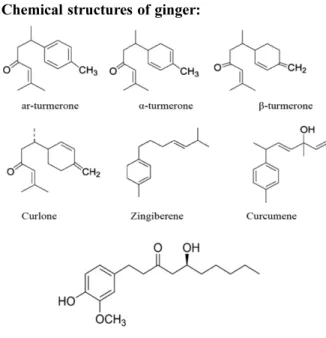
Chemical structures of ginger:
Preparation of Bacterial Agriculture Media
Suspend 50 grams of the medium in one liter of bi-dis- tilled water and dissolve it by heating. Sterilize in auto- clave at 121oC for 15 min. Cool to 45−50oC, mix well and dispense into plates. Allow the plates to solidify. The pre- pared medium should be stored at 8−15oC. The color is violet-red
RESULTS AND DISCUSSION Potentiodynamic Polarization Measurements
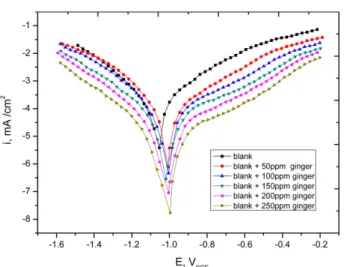
Fig. 1 shows the potentiodynamic polarization curves of steel in sulfide polluted salt water without and with dif- ferent concentrations of ginger extract at 25oC. The obtained electrochemical parameters; cathodic and anodic Tafel slopes (βc and βa) respectively, open circuit potential (EOC), cor-
rosion potential (Ecorr), corrosion current density (icorr): and corrosion rate (C.R.). were obtained and listed in Table 1.
The percentage of inhibition efficiency, I% and the degree of surface coverage (θ) (Table 1) at each concentration was calculated using the equation:10,11
% I = 100 [1− icorr(inh)− icorr] (1) where icorr and icorr(inh) are the corrosion current densities of uninhibited and inhibited solutions, respectively.
An inspection of the results obtained from Table 1 reveals that, the presence of different concentrations of the additive compound reduce the anodic and cathodic cur- rent densities by decreasing the hydrogen evolution and the metal dissolution at the cathode which appears from the table that βc >βa this is due to presence of donor atom having a lone pair of electrons attached with the surface by charge or electron transfer between the inhibitor and the metal surface also the bulky group of the inhibitor makes strike hindrance at the metal surface for the reach of the corrosive medium to the metal surface and the suppres- sion in current increases as the inhibitor concentration
increases, this indicate the inhibiting effects of the inves- tigated compound. The slight shifts of Ecorr values towards less negative direction are found in the presence of var- ious concentrations of this compound in sulfide polluted salt water. Generally, increase in inhibitor concentration shifts corrosion potential to less negative values. This can be explained by a small domination of the anodic reaction inhibition.12 The % I was found to increase with increas- ing the inhibitor concentration.
Adsorption isotherm:
One of the most convenient ways of expressing adsorp- tion quantitatively is by deriving the adsorption isotherm that characterizes the metal/inhibitor/environment sys- tem.13 The values of the degree of surface coverage θ were evaluated at different concentrations of the inhibitor in sulfide polluted salt water. Attempts were made to fit θ val- ues to various adsorption isotherms. The Temkin adsorp- tion isotherm fits the experimental data. A plot of θ against log C for all concentrations of inhibitor is shown in Fig. 2 gives a straight line relationship in all cases which sug- gests that the adsorption of the studied inhibitor on the Fig. 1. Potentiodynamic polarization curves for the corrosion of
steel in 3.5% NaCl +16 ppm Na2S in the absence and presence of different concentrations of ginger at 25oC.
Table 1. The effect of concentration of ginger on the electrochemical parameters calculated by using potentiodynamic technique for cor- rosion of steel in sulfide polluted salt water at 25oC
Conc., ppm −Ecorr, V icorr, µA cm−2 −βc, mV dec−1 βa, mV dec−1 C. R mmy−1 θ I %
Blank 1.056 11470 265 209 133.19 − −
50 1.077 6538 253 196 99.11 0.430 43.0
100 1.063 4269 242 166 53.24 0.628 62.8
150 1.083 3670 221 147 35.76 0.680 68.0
200 1.080 2909 220 144 33.77 0.746 74.6
250 1.058 1858 193 124 19.11 0.839 83.9
Fig. 2. Temkin adsorption isotherm plotted as θ vs. log C of gin- ger for the corrosion of steel in sulfide polluted salt water.
steel surface follow Temkin adsorption isotherm. The strong correlation (R2=0.996) for the Temkin adsorption isotherm plot confirmed the validity of this approach.
KadsC = exp (−2aθ) (2)
where a is molecular interaction parameter, θ is the degree of surface coverage, Kads is the equilibrium constant of adsorption process and C is the inhibitor concentration. It is well known that the equilibrium constant of adsorption (Kads) is related to the standard adsorption free energy (∆Goads) and can be calculated by the following equa- tion:14
Kads= 1/55.5 exp [−∆Goads/RT] (3) Table 2 shows the calculated values of molecular inter- action a, equilibrium constant of adsorption process, Kads
and free energy (∆Gºads) obtained from Temkin plot. The value of a are positive shows that attraction exists in adsorption layer.15 The relatively high and negative free energy values may indicate a relatively strong and spon- taneous adsorption of the investigated compound on the metal surface, which explains its high corrosion inhibi- tion efficiency. A value of −40 kJ mol−1 is usually adopted as a threshold value between chemical and physical adsorption.16 The calculated values of ∆Gºads, for the inves- tigated compound with the metal surface is −35.63 kJ mol−1, which means that the inhibitor is physically adsorbed
through electrostatic interaction.
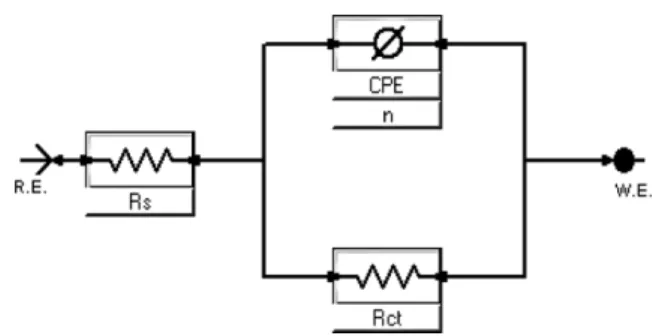
Electrochemical Impedance Spectroscopy (EIS) Fig. 3 shows the Nyquist plot of steel in 3.5% NaCl and 16 ppm Na2S in absence and presence of different con- centrations of investigated compound was investigated by EIS method at 25oC after 20 min immersion. All the impedance spectra were measured at the corresponding open-circuit potentials. It is apparent that Nyquist plots show a single capacitive loop, both in uninhibited and inhibited solutions. The data described a semicircle at low frequencies, indicating that the corrosion process was now under adsorption control, through an inhibitor-formed film, whereas at low frequencies a depressed, capacitive-like semicircle was observed, which correspond to a charge transfer-controlled corrosion process. According to Ram- achandran,15 the film formed in the presence of ginger extract acts as a protective barrier against aggressive ions from the bulk solution. Thus, the corrosion process in the presence of the inhibitor was under diffusion and charge transfer mixed mechanism. The EIS data were simulated using equivalent electric circuits as shown in Fig. 4 where RS represents the solution or electrolyte resistance, Cdl the dou- ble layer capacitance, Rct the charge transfer resistance.
Form the Nyquist plot it is obvious that low frequency data are on the right side of the plot and higher frequen- cies are on the left. This is true for EIS data where imped- ance usually falls as frequency rises (this is not true of all circuits). The capacity of double layer Cdl can be calcu- lated from the following equation:
(4)
where fmax is maximum frequency. The parameters obtained from impedance measurements are given in Table 3. It can see from Table 3 that the values of charge transfer resis- tance increase with inhibitor concentration.17 In the case
Cdl 1
2π fmaxRct ---
= Table 2. The equilibrium constant .of the adsorption process (Kads),
free energy of binding (∆Goads) and the interaction parameter (a) of the investigated compound at 25oC
a Kads, M−1 −∆Goads, kJ mol−1
11.2 1.8×10⁸ 35.63
Fig. 3. Nyquist plots recorded for steel in 3.5% NaCl+16 ppm Na2S with and without different concentrations of ginger at 25oC.
Fig. 4. Electrical equivalent circuit used to fit the impedance spectra.
of impedance studies, % I increases with inhibitor con- centration in the presence of investigated inhibitors. The impedance study confirms the inhibiting characters of these compounds obtained with potentiodynamic polar- ization methods. It is also noted that the Cdl values tend to decrease when the concentration of these compounds increases. This decrease in Cdl, which can result from a decrease in local dielectric constant and/or an increase in the thickness of the electrical double layer, suggests that these compounds molecules function by adsorption at the metal/solution interface.18
EIS data Table 3 shows that the Rct values increase and the Cdl values decrease with increasing the inhibitor con- centrations. This is due to the gradual replacement of water molecules by the adsorption of the inhibitor molecules on the metal surface, decreasing the extent of dissolution reac- tion. The high Rct values, are generally associated with slower corroding system.19,20 The decrease in the Cdl can result from the decrease of the local dielectric constant and/or from the increase of thickness of the electrical dou- ble layer,21 suggested that the inhibitor molecules function by adsorption at the metal/solution interface.
The inhibiting effect of this compound can be attributed to their parallel adsorption at the metal solution interface.
The parallel adsorption is owing to the presence of one or more active center for adsorption. The chemisorptions take place by the formation of a chemical bond between the metal and the adsorbed molecule. Chemisorptions involve charge or charge transfer from inhibitor molecule to the metal surface forming co-ordinate type bond.22
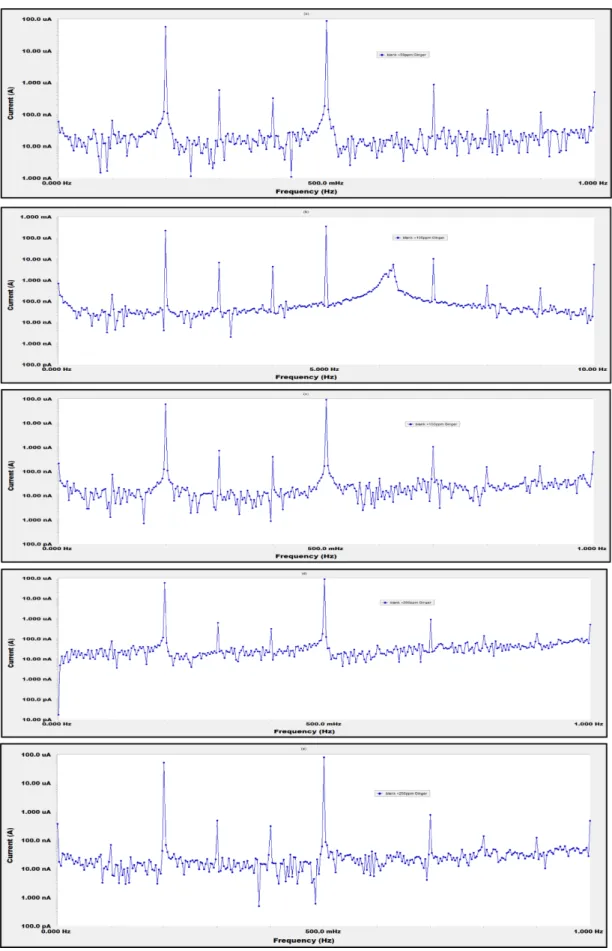
Electrochemical Frequency Modulation (EFM) Intermodulation spectra obtained from EFM measure- ments are presented in Fig. 5 as examples of steel in 3.5%
NaCl+16 ppm Na2S containing different concentrations of ginger at 25oC. Each spectrum is a current response as a function of frequency. The calculated corrosion kinetic parameters in the presence of 3.5% NaCl + 16 ppm Na2S alone and with different concentrations of the investi-
gated inhibitor at 25oC (icorr, βa, βc, CF-2 and CF-3) are given in Table 4. From this Table it is obvious that the cor- rosion current densities decrease by increasing the con- centration of inhibitor and hence the inhibition efficiency increases. Also it is clear that the causality factors are very close to theoretical values which according to EFM the- ory should guarantee the validity of Tafel slope and cor- rosion current densities. In addition the values of causality factors indicate that the measured data are of good quality.23 The obtained results showed good agreement of inhibi- tion efficiency obtained from the potentiodynamic polar- ization, EIS and EFM methods.
Biological Effect of Ginger on Escherichia Coli After the bacterial agriculture of Escherichia Coli in the presence and absence of the inhibitor we found a little effect on the bacterial activity of Escherichia Coli accord- ing to Table 5 and Fig. 6. Ginger is suggested that it has oxygen donor atoms attached with the proteins and lipids on the bacterial tissues surface making a little activity for it. So we found that this inhibitor has no toxicity on the bacterial activity, and can be applied on the waste water plants safely without any problems in treating waste water operations.
Mechanism of Inhibition
Results of the present study have shown that this extract inhibits the acid induced corrosion of steel by virtue of adsorption of its components onto the metal surface. The inhibition process is a function of the metal, inhibitor con- centration, and temperature as well as inhibitor adsorption abilities which is so much dependent on the number of adsorption sites. The mode of adsorption depends on the type of adsorption (physisorption and chemisorption) observed could be attributed to the fact that this extract contains many different chemical compounds which some can adsorbed chemically and others adsorbed physically. This obser- vation may be attributed to the fact that adsorbed organic molecules can influence the behavior of electrochemical reactions involved in corrosion processes in several ways.
Table 3. Electrochemical kinetic parameters obtained by EIS technique for the corrosion of steel in 3.5% NaCl +16 ppm Na2S alone and with different concentrations of ginger at 25oC
Conc., M RsΩcm2 Cdl, µF cm−2 n RctΩ cm2 θ % I
blank 1.294 605.5 0.886 3.863 − −
50 1.194 433.0 0.878 4.782 0.192 19.2
100 1.181 392.1 0.886 10.24 0.623 62.3
150 1.132 367.1 0.878 11.68 0.669 66.9
200 1.122 356.0 0.861 14.87 0.740 74.0
250 1.110 333.6 0.848 25.49 0.848 84.8
Fig. 5. Intermodulation spectrum for steel in 3.5% NaCl + 16 ppm Na2S with various concentrations of ginger at 25oC.
The action of organic inhibitors depends on the type of interactions between the substance and the metallic sur- face. The interactions can bring about a change either in electrochemical mechanism or in the surface available for the processs.23 Also, the inhibition of steel by these extracts may be due to synergistic interactions of its phytochemi- cals constituents.
CONCLUSION
(1) Ginger extract acts as an inhibitor for corrosion of steel in sulfide polluted salt water.
(2) The inhibition efficiency increases with increase in the concentration of the inhibitor.
(3) The inhibition is due to the adsorption of the inhib- itor molecule on the metal surface by charge transfer or by the diffusion of the inhibitor molecules.
(4) The adsorption of these compounds on the metal surface follows Temkin adsorption isotherm.
(5) This inhibitor has no biological effect on the activity of Escherichia Coli, and can be applied safely on waste water treatment plants.
Acknowledgments. The publication cost of this article
was supported by the Korean Chemical Society. And the publication cost of this paper was supported by the Korean Chemical Society.
REFERENCES
1. El-Etre, A. Y. J. Colloid Interface Sci. 2007, 314, 578.
2. El-Etre, A. Y. Appl. Surf. Sci. 2006, 252, 8521.
3. Benabdellah, M.; Benkaddour, M.; Hammouti, B.; Bendah- hou, M.; Aouniti, A. Appl. Surf. Sci. 2006, 252, 6212.
4. Chaieb, E.; Bouyanzer, A.; Hammouti, B.; Benkaddour, M. Appl. Surf. Sci. 2005, 246, 199.
5. Müller, B. Corros. Sci. 2002, 44, 1583.
6. Li, Y.; Zhao, P.; Liang, Q. Hou, B. Appl. Surf. Sci. 2005, 252, 1245.
7. El-Etre, A. Y.; Abdallah, M.; El-Tantawy, Z. E. Corros.
Sci. 2005, 47, 385.
8. Bouyanzer, Hammouti, B.; Majidi, L. Mater. Lett. 2006, 60, 2840.
9. El-Etre, A. Y. Corros. Sci. 2003, 45, 2485.
10. Ammar, I. A.; Darwish, S. Corros. Sci. 1967, 7, 679.
11. Fisher, H. Ann. Univ. Ferrera. Sez. 1960, 3 (Suppl. 3), 1.
12. Stupnisek-Lisac, E.; Gazivoda A.; Madzarac, M. J. Elec- trochim. Acta 2002, 47, 4189.
13. Szklarska-Smiaiowska, Z. Electrochemical and Optical Techniques for the Study of Metallic Corrosion; Kluwer Academic: Netherlands, 1991, p 545.
14. Khamis, E. Corrosion 1990, 46, 476.
15. Ramachandran, S.; Tsai, M.; Blanco, M.; Chen, H.; Tang, W. A. Langmuir 1996, 12, 6419.
16. Oguzie, E. E. Corros. Sci. 2007, 49, 1527.
17. Larabi, L.; Benali, O.; M.Mekelleche, S.; Harek, Y.; J.
Appl. Surf. Sci. 2006, 253, 1371.
18. Lagrenee, M.; Mernari, B.; Bouanis, B.; Traisnel M.;
Bentiss, F.; Corros. Sci. 2002, 44, 573.
19. Bessone, J.; Mayer, C.; Tuttner, K.; Lorenz, W. J. Elec- trochim. Acta 1983, 28, 171.
20. Epelboin, I.; Keddam M.; Takenouti, H. J. Appl. Electro- chem. 1972, 2, 71.
21. Khaled, K. F. Electrochim. Acta 2008, 53, 3484.
22. Khamis, E.; Bellucci, F.; Latahision, R. M.; El-Ashry E.
Sh. Corrosion 1991, 47(9), 667.
23. Abdel-Rehim, S. S.; Khaled, K. F.; Abd-Elshafi, N. S.
Electrochim. Acta 2006, 51(16), 3269.
Table 4. Electrochemical Kinetic parameters obtained by EFM technique for steel in 3.5% NaCl +16 ppm Na2S alone and with different concentrations of ginger at 25oC
Conc., ppm icorr., µA cm−2 βa, mV dec−1 βc, mV dec−1 CF-2 CF-3 C.R, mmy−1 θ % I
blank 13540 278.0 240.6 1.85 2.85 140.31 − −
50 7447 272.3 237.16 1.68 2.74 77.17 0.450 45.0
100 4766 267.42 232.41 1.69 2.70 49.38 0.648 64.8
150 4062 264.31 228.31 1.72 2.82 42.10 0.700 70.0
200 3250 257.41 220.62 1.84 2.90 33.68 0.760 76.0
250 1950 250.81 218.41 1.86 2.93 20.21 0.856 85.6
Table 5. The results obtained from the plate counter for bacterial agriculture
Samples CFU (R1) CFU (R2) CFU (mean)
Control 89×104 95×104 92×104
Ginger 82×104 89×104 86×104
Fig. 6. Bacterial agriculture in the absence and presence of plant extract inhibitor.