ABSTRACT
Background: This study aimed to investigate the incidence and clinical significance of segmental chromosomal aberrations (SCAs) in Korean patients with neuroblastoma.
Methods: Patients diagnosed with neuroblastoma from 2012 to 2018 were included for retrospective review. Fluorescence in situ hybridization (FISH) was used to analyze four SCAs (MYCN amplification, 1p deletion, 11q deletion, and 17q gain). Clinical characteristics at diagnosis, early tumor response (reduction in primary tumor volume and neuron-specific enolase level after the first three cycles of chemotherapy), and survival rates were compared according to SCAs.
Results: Among 173 patients with FISH results, 92 (53.2%) had at least one of the four SCAs, while 25 (14.5%) had two co-aberrations, and eight (4.6%) had three co-aberrations. SCAs detected in our study were MYCN amplification (n = 17, 9.8%), 1p deletion (n = 26, 15.2%), 11q deletion (n = 44, 25.6%), and 17q gain (n = 46, 27.1%). Patients with MYCN amplification showed a better early response but a worse survival than those without (5-year overall survival:
46.2% ± 13.1% vs. 88.6% ± 3.4%). Furthermore, 1p deletion was associated with a better early response but a worse survival; however, it was not an independent factor for survival. We could not find any prognostic significance associated with 11q deletion or 17q gain.
Conclusion: This is the first study investigating SCAs in Korean neuroblastoma patients.
Prognostic significance of SCAs other than MYCN amplification was different from those reported in western countries. Further study with a larger cohort and longer follow-up is needed to confirm our findings.
Keywords: Neuroblastoma; Segmental Chromosomal Aberration; Korean
INTRODUCTION
Neuroblastoma is known for its complex behavior from a very benign tumor to a highly aggressive metastatic tumor with poor prognosis. Traditionally, patients with neuroblastoma have been stratified into different risk groups according to age, stage, pathology, and segmental chromosomal aberrations (SCAs).1 Since it was first reported in 1983, MYCN has
Original Article
Received: Nov 6, 2019 Accepted: Feb 5, 2020 Address for Correspondence:
Meong Hi Son, MD
Department of Pediatrics, Samsung Medical Center, Sungkyunkwan University School of Medicine, 81 Irwon-ro, Gangnam-gu, Seoul 06351, Korea.
E-mail: [email protected]
© 2020 The Korean Academy of Medical Sciences.
This is an Open Access article distributed under the terms of the Creative Commons Attribution Non-Commercial License (https://
creativecommons.org/licenses/by-nc/4.0/) which permits unrestricted non-commercial use, distribution, and reproduction in any medium, provided the original work is properly cited.
ORCID iDs Hana Lim
https://orcid.org/0000-0001-7393-0311 Meong Hi Son
https://orcid.org/0000-0002-3505-5576 Ju Kyung Hyun
https://orcid.org/0000-0001-9371-3808 Hee Won Cho
https://orcid.org/0000-0002-0440-645X Hee Young Ju
https://orcid.org/0000-0001-6744-0412 Ji Won Lee
https://orcid.org/0000-0003-0084-1304 Keon Hee Yoo
https://orcid.org/0000-0002-5980-7912 Ki Woong Sung
https://orcid.org/0000-0001-5989-4772
Hana Lim , Meong Hi Son , Ju Kyung Hyun , Hee Won Cho , Hee Young Ju , Ji Won Lee , Keon Hee Yoo , Ki Woong Sung , and Hong Hoe Koo
Department of Pediatrics, Samsung Medical Center, Sungkyunkwan University School of Medicine, Seoul, Korea
Clinical Significance of Segmental
Chromosomal Aberrations in Patients with Neuroblastoma: First Report in Korean Population
Oncology & Hematology
Hong Hoe Koo
https://orcid.org/0000-0001-8082-1412 Funding
This study was supported by a grant from the National R&D Program for Cancer Control, Ministry of Health and Welfare, Republic of Korea (No. 1520210).
Disclosure
The authors have no potential conflicts of interest to disclose.
Author Contributions
Conceptualization: Lee JW, Yoo KH, Sung KW, Koo HH. Data curation: Hyun JK, Cho HW, Ju HY. Formal analysis: Sung KW. Methodology:
Lim H, Son MH. Writing - original draft: Lim H, Son MH. Writing - review & editing: Hyun JK, Cho HW, Ju HY, Lee JW, Yoo KH, Sung KW, Koo HH.
become the most well studied SCA.2 MYCN amplification has been confirmed as a poor risk factor in many previous studies including ours.3-6 In addition to MYCN amplification, the clinical significance of other SCAs, including 1p deletion, 11q deletion, and 17q gain, has also been studied.7-14 From previous reports, 1p deletion, 11q deletion, and 17q gain are generally known for adverse prognostic factors, but there are still some controversies.9,10,12 With this background, MYCN amplification and 11q deletion are included as risk factors in the International Neuroblastoma Risk Group (INRG) stratification.15 While many Western studies have reported the incidence and clinical significance of SCAs in neuroblastoma, there is no study in Korean neuroblastoma patients. For this reason, we analyzed the incidence and clinical significance of four SCAs (MYCN amplification, 1p deletion, 11q deletion, and 17q gain) in Korean patients diagnosed with neuroblastoma.
METHODS
Patients
Patients diagnosed with neuroblastoma from 2012 to 2018 at Samsung Medical Center were included for retrospective medical review.
Patients transferred from other hospitals with inappropriate tumor specimens for fluorescence in situ hybridization (FISH) were excluded from the analysis. Patients were staged according to the International Neuroblastoma Staging System.16 Pathologic results were classified as ganglioneuroblastoma/differentiating neuroblastoma or poorly differentiated/undifferentiated neuroblastoma. Serum lactic dehydrogenase (LDH), ferritin, neuron-specific enolase (NSE), and urine vanillylmandelic acid (VMA) were routinely measured at diagnosis. Patients were stratified into low-risk, intermediate-risk, and high-risk groups based on age at diagnosis, stage, and MYCN status. In brief, stage 1, 2, and 4S tumors without MYCN amplification were stratified as low-risk tumors, whereas stage 4 tumors in patients older than 18 months or any tumors with amplified MYCN were stratified as high-risk tumors. All other tumors were stratified as intermediate-risk.17
FISH
MYCN amplification, 1p deletion, 11q deletion, and 17q gain were determined using FISH from paraffin-embedded tissue obtained by biopsy or surgery at initial diagnosis. For each FISH study, 50 non-overlapping nuclei were counted and the following probes were used: Vysis LSI N-MYC (2p24) SpectrumGreen/CEP2 SpectrumOrange, Vysis LSI ATM (11q22) SpectrumOrange/CEP11 SpectrumGreen, Vysis TOP2A (17q21)/CEP17 FISH (Abbott Molecular), and ZytoLight SPEC 1p36/1q25 Dual Color probe by Zytovision. The guidelines by the INRG biology committee were used to define SCAs. A four or more-fold increase in the MYCN signal number compared to the reference probe located on chromosome 2q was interpreted as an MYCN amplification. An unbalanced ratio of signal numbers between regions of interest versus reference was interpreted as a deletion while a four or more-fold excess of the region of interest was read as a gain.18
Treatment
An excisional biopsy of the primary tumor was performed at diagnosis if the tumor was resectable. Otherwise, an incisional biopsy was performed, and definitive surgery was deferred until after six or more cycles of chemotherapy. Chemotherapy consisted of two alternating regimens, CEDC (cisplatin, etoposide, doxorubicin, and cyclophosphamide)
and ICE (ifosfamide, carboplatin, and etoposide) as described in a previous study.19 In low-risk patients, the primary treatment was surgery with (stage 2) or without (stage 1) six cycles of chemotherapy. Intermediate-risk patients received nine cycles of chemotherapy and 13-cis-retinoic acid differentiating treatment with or without adjuvant local radiotherapy, depending on whether viable residual tumor existed at the end of chemotherapy. In high-risk patients, tandem high-dose chemotherapy with autologous stem cell transplantation was routinely given as consolidation therapy following induction treatment which included nine cycles of chemotherapy and surgery.20 All high-risk patients received local radiotherapy and differentiating therapy.
Measurement of early response
Early response to chemotherapy was determined by the reduction in primary tumor volume and NSE level after three cycles of chemotherapy. The volume of the primary tumor was measured at diagnosis and after three cycles of induction chemotherapy as previously reported.21 In brief, tumor areas were defined by manual drawing on each slice of stacked computed tomography and magnetic resonance imaging. The tumor volume was calculated by summing the areas of the slice multiplied by the slice thickness using computer software (Advantage Workstation, Volume Share version 2.0; GE Healthcare, Little Chalfont, UK). Absolute tumor volume and the percentage of tumor volume after three cycles of chemotherapy compared with the tumor volume at diagnosis were calculated. Percent NSE levels after three cycles of chemotherapy compared with the NSE level at diagnosis were also calculated.
Statistics
A χ2 test was used for analyzing the difference in categorical variables, and the Mann-Whitney U test was used for comparing the difference in continuous variables. Progression-free survival (PFS) and overall survival (OS) along with standard error were estimated by the Kaplan-Meier method. PFS was calculated from the date of diagnosis until the occurrence of relapse/progression or last contact if the patient remained progression-free. OS was calculated from the date of diagnosis until death from any cause. The log-rank test was used to compare survival rates. All the covariates with P < 0.1 from univariate analysis were used for multivariate analysis. Multivariate analysis for survival was performed with the Cox proportional hazards model. P value < 0.05 was accepted as statistically significant and SPSS ver. 25.0 (IBM Corp., Armonk, NY, USA) was used for all statistical analyses.
Ethics statement
This study was approved by the Institutional Review Board (IRB) of Samsung Medical Center and the requirement for informed consent was waived (IRB 2019-07-153).
RESULTS
Incidence of SCAs
Among 212 patients diagnosed with neuroblastoma between January 2012 and December 2018, FISH results were available in 173 patients. Ninety-two (53.2%) patients had at least one of four SCAs. The numbers of patients with 17q gain, 11q deletion, 1p deletion, and MYCN amplification were 46 (27.1%), 44 (25.6%), 26 (15.2%), and 17 (9.8%), respectively. Twenty- five (14.5%) patients had two co-aberrations and eight (4.6%) had three co-aberrations.
Table 1 shows the pattern of co-aberrations. Among 17 patients with MYCN amplification, 11 (64.7%) had co-aberrations, which were 1p deletion (n = 10, 58.8%), 11q deletion (n = 2,
11.8%), and 17q gain (n = 3, 17.7%) (Fig. 1A). Forty-five (67.2%) patients in the high-risk group had at least one of four SCAs, while intermediate-risk group and low-risk group had 28 (58.3%) and 19 (32.8%) patients, respectively (Fig. 1B).
Clinical characteristics according to SCAs
Table 2 shows clinical characteristics according to the presence/absence of each SCA. MYCN amplified tumors were associated with higher frequencies of abdomen tumor (94.1% vs.
69.9%, P = 0.043), poorly differentiated/undifferentiated pathology (94.1% vs. 45.8%, P <
0.001), and metastatic tumor (82.4% vs. 48.1%, P = 0.007), bigger tumor size (460 mL vs. 60 mL, P < 0.001), higher LDH level (5,193 IU/L vs. 698 IU/L, P < 0.001), higher ferritin level (323 ng/mL vs. 116 ng/mL, P = 0.006), higher NSE level (424.5 ng/mL vs. 30.8 ng/mL, P < 0.001), and lower 24-hour urine VMA level (1.7 mg/day vs. 8.7 mg/day, P = 0.009) compared to MYCN non-amplified tumors. Patients with 1p deletion had similar clinical features as those with MYCN amplification except urine VMA level. The 11q deletion was more often detected in male patients (72.7% vs. 42.2%, P < 0.001) and was associated with higher LDH level, higher NSE level, and higher 24-hour urine VMA level. A 17q gain was associated with a higher frequency of metastatic diseases and higher 24-hour urine VMA level.
Early response to chemotherapy
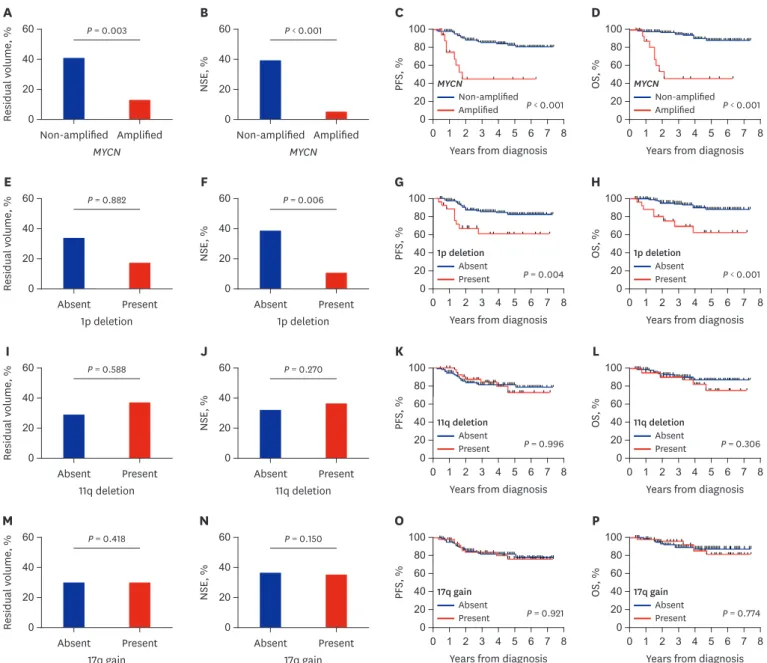
As a surrogate marker of early tumor response, residual primary tumor volume and reduction in serum NSE levels after three cycles of chemotherapy were compared according to the presence/absence of each SCA (Fig. 2). The percent residual tumor volume (12.9% vs. 42.1%, P = 0.003) and NSE level (4.8% vs. 38.9%, P < 0.001) were lower in patients with MYCN amplification than those without (Fig. 2A and B). The 1p deletion was associated with a lower Table 1. Pattern of co-aberrations
Variables MYCN amplification 1p deletion 11q deletion 17q gain No co-aberration
MYCN amplification (n = 17) - 10 (58.8) 2 (11.8) 3 (17.7) 6 (35.5)
1p deletion (n = 26) 10 (38.5) - 7 (26.9) 10 (38.5) 7 (26.9)
11q deletion (n = 44) 2 (4.6) 7 (15.9) - 17 (38.6) 24 (54.6)
17q gain (n = 46) 3 (6.5) 10 (21.7) 17 (37.0) - 22 (47.8)
Data are presented as number (%).
MYCN amplification
a b c d e
1p deletion 11q deletion 17q gain A
MYCN amplification
Low-risk Intermediate-risk High-risk
1p deletion 11q deletion 17q gain B
Fig. 1. Incidence of SCAs. (A) Proportion of co-aberration. (a) Three aberrations (n = 8, 4.6%), (b) two aberrations (n = 25, 14.5%), (c) one aberration (n = 7, 32.9%), (d) no aberration (n = 78, 45.1%), and (e) incomplete analysis (n = 5, 2.9%). (B) Incidence of SCAs according to risk group.
SCA = segmental chromosomal aberration.
NSE level (10.4% vs. 38.9%, P = 0.006); however, there was no difference in residual tumor volume (Fig. 2E and F). There was no difference in early response according to 11q deletion and 17q gain (Fig. 2I, J, M, and N).
Survival
Patients with MYCN amplification had poor survival outcome (5-year PFS: 45.2% ± 13.3% vs.
82.8% ± 3.6%, P < 0.001; 5-year OS: 46.2% ± 13.1% vs. 88.6% ± 3.4%, P < 0.001) (Fig. 2C and D).
Patients with 1p deletion also had poor survival outcome (5-year PFS: 61.2% ± 10.4% vs. 82.1%
± 3.9%, P = 0.004, 5-year OS: 62.7% ± 11.0% vs. 88.1 ± 3.6%, P < 0.001) (Fig. 2G and H).
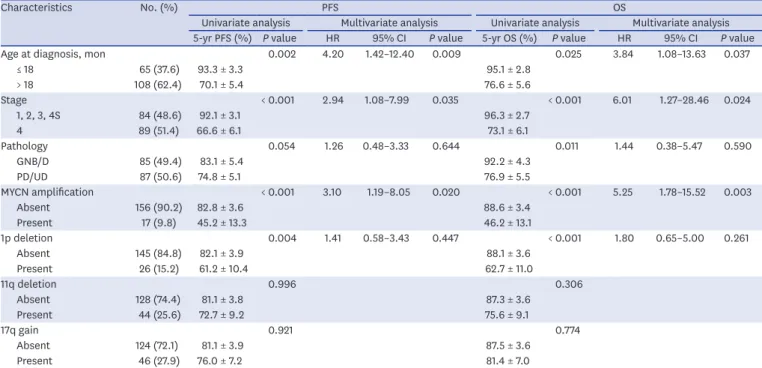
However, there was no difference in survival rates according to 11q deletion or 17q gain (Fig. 2K, L, O, and P). In multivariate analysis for PFS and OS, age over 18 months (PFS: hazard ratio [HR], 4.20, P = 0.009; OS: HR, 3.84, P = 0.037), stage 4 (PFS: HR, 2.94, P = 0.035; OS: HR, 6.01, P = 0.024), and MYCN amplification (PFS: HR, 3.10, P = 0.020; OS: HR, 5.25, P = 0.003) were independent worse prognostic factors (Table 3).
Analysis of patients with MYCN non-amplified tumors
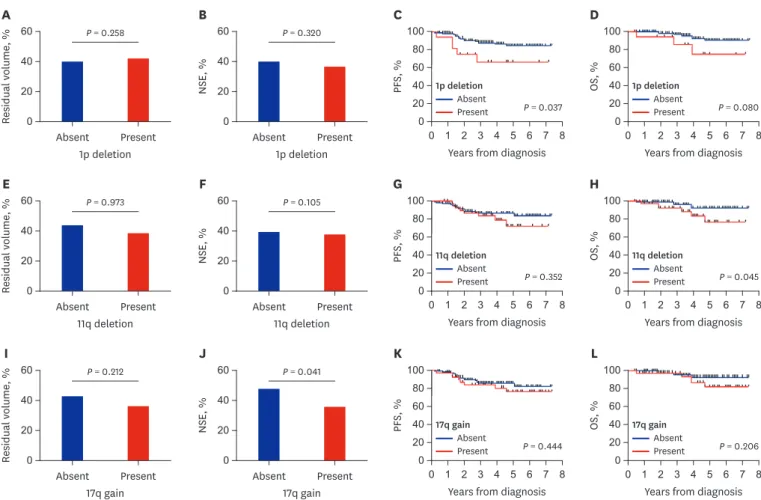
Among the four SCAs, MYCN amplification had dominant prognostic significance as shown above. However, over 90% of patients did not have MYCN amplification; thus, we evaluated the prognostic significance of the remaining three SCAs in patients with MYCN non-amplified tumors. There was no difference in the early tumor response according to the three SCAs (Fig. 3) except for a greater reduction in NSE level in patients with 17q deletion. Patients with 1p deletion showed worse survival (5-year PFS: 66.7% ± 12.4% vs. 84.4% ± 3.8%, P = 0.037;
5-year OS: 74.6% ± 13.2% vs. 90.1% ± 3.6%, P = 0.080) than those without although it was not Table 2. Patient characteristics at diagnosis according to cytogenetics
Parameters MYCN amplification 1p deletion 11q deletion 17q gain
Absent
(n = 156) Present
(n = 17) P value Absent
(n = 145) Present
(n = 26) P value Absent
(n = 128) Present
(n = 44) P value Absent
(n = 124) Present (n = 46) P value
Sex, male 81 (51.9) 6 (35.3) 0.193 72 (49.7) 14 (53.8) 0.694 54 (42.2) 32 (72.7) 0.001 57 (46.0) 28 (60.9) 0.084
Age, yr 2.4 (0.0–19.2) 2.6 (1.2–11.2) 0.740 2.1 (0.0–19.2) 3.3 (0.4–11.4) 0.097 2.5 (0.0–19.2) 2.0 (0.0–11.4) 0.483 2.5 (0.0–19.2) 2.2 (0.0–15.0) 0.764
Age > 1.5 95 (60.9) 13 (76.5) 0.293 88 (60.7) 18 (69.2) 0.409 83 (64.8) 25 (56.8) 0.342 78 (62.9) 29 (63.0) 0.987
Primary site 0.043 0.010 0.913 0.252
Abdomen 109 (69.9) 16 (94.1) 99 (68.3) 24 (92.3) 92 (71.9) 32 (72.7) 86 (69.4) 36 (78.3)
Others 47 (30.1) 1 (5.9) 46 (31.7) 2 (7.7) 36 (28.1) 12 (27.3) 38 (30.6) 10 (21.7)
Stage 0.007 0.004 0.117 0.020
1, 2, 3, 4S 81 (51.9) 3 (17.6) 78 (53.8) 6 (23.1) 67 (52.3) 17 (38.6) 68 (54.8) 16 (34.8)
4 75 (48.1) 14 (82.4) 67 (46.2) 20 (76.9) 61 (47.7) 27 (61.4) 56 (45.2) 30 (65.2)
Pathology < 0.001 0.003 0.088 0.765
GNB/D 84 (54.2) 1 (5.9) 79 (54.9) 6 (23.1) 68 (53.5) 17 (38.6) 62 (50.4) 22 (47.8)
PD/UD 71 (45.8) 16 (94.1) 65 (45.1) 20 (76.9) 59 (46.5) 27 (61.4) 61 (49.6) 24 (52.2)
Risk-group < 0.001 0.002 0.095 0.116
Low 58 (37.2) 0 56 (38.6) 2 (7.7) 49 (38.3) 9 (20.5) 48 (38.7) 10 (21.7)
Intermediate 48 (30.8) 0 41 (28.3) 7 (26.9) 32 (25.0) 15 (34.1) 32 (25.8) 15 (32.6)
High 50 (32.1) 17 (100) 48 (33.1) 17 (65.4) 47 (36.7) 20 (45.5) 44 (35.5) 21 (45.7)
Tumor volume,
mL 60
(1–1,601) 460
(189–850) < 0.001 56
(1–1,601) 255
(25–1,021) < 0.001 71
(1–1,124) 69
(5–1,601) 0.606 69
(2–1,601) 73
(1–1,124) 0.719
LDH, IU/L 698
(287–18,245) 5,193
(2,273–9,583) < 0.001 689
(287–8,170) 1,655
(434–18,245) < 0.001 689
(287–18,245) 921
(410–9,583) 0.012 689
(287–9,583) 824
(343–18,245) 0.123 Ferritin, ng/mL 116
(8–2,881) 323
(100–1,491) 0.006 128
(8–1,255) 271
(32–2.881) 0.027 110
(8–2,881) 213
(19–1,491) 0.069 113
(8–1,588) 193
(19–2,881) 0.198
NSE, ng/mL 30.8
(6.6–724.0) 424.5
(6.5 –967.5) < 0.001 29.0
(6.6–967.5) 156.4
(12.6–930.0) < 0.001 28.0
(6.6–967.5) 74.1
(7.7–930.0) 0.024 27.4
(7.3–967.5) 41.3
(6.6–724.0) 0.134 24HU VMA,
mg/day 8.7
(0.5–106.0) 1.7
(0.4–14.5) 0.009 7.2
(0.5–106.0) 8.9
(0.4–96.5) 0.746 4.8
(0.4–96.5) 19.8
(0.8–106.0) < 0.001 5.5
(0.4–96.5) 10.9
(1.2–106.0) 0.013 Values are presented as median (range) or number (%).
GNB/D = ganglioneuroblastoma/differentiating neuroblastoma, PD/UD = poorly differentiated/undifferentiated neuroblastoma, LDH = lactic dehydrogenase, NSE
= neuron-specific enolase, 24HU VMA = 24-hour urine vanillylmandelic acid.
significant in multivariate analysis (Table 4). Otherwise, there was no difference in survival according to SCAs in patients with MYCN non-amplified tumors.
DISCUSSION
This is the first study reporting the incidence and clinical significance of SCAs in Korean children with neuroblastoma. This is also the first study evaluating the early response to chemotherapy according to SCAs. Unlike previous reports where patients were treated with various protocols at multiple centers, patients in this study were treated with a similar treatment scheme at a single center.
60
0 20
MYCN
A
40
Non-amplified Amplified
Residual volume, %
P = 0.003 60
0 20
MYCN
B
40
Non-amplified Amplified
NSE, %
P < 0.001 100
0
0 1 2 3 4 5 6 7 8 20
Years from diagnosis
C
60 80
S, %PF 40
P < 0.001
100
0
0 1 2 3 4 5 6 7 8 20
Years from diagnosis
D
60 80
OS, % 40
P < 0.001
60
0 20
1p deletion
E
40
Absent Present
Residual volume, %
P = 0.882 60
0 20
1p deletion
F
40
Absent Present
NSE, %
P = 0.006 100
0
0 1 2 3 4 5 6 7 8 20
Years from diagnosis
G
60 80
S, %PF 40
P = 0.004
100
0
0 1 2 3 4 5 6 7 8 20
Years from diagnosis
H
60 80
OS, % 40
P < 0.001
60
0 20
11q deletion
I
40
Absent Present
Residual volume, %
P = 0.588 60
0 20
11q deletion
J
40
Absent Present
NSE, %
P = 0.270 100
0
0 1 2 3 4 5 6 7 8 20
Years from diagnosis
K
60 80
S, %PF 40
P = 0.996
100
0
0 1 2 3 4 5 6 7 8 20
Years from diagnosis
L
60 80
OS, % 40
P = 0.306
60
0 20
17q gain
M
40
Absent Present
Residual volume, %
P = 0.418 60
0 20
17q gain
N
40
Absent Present
NSE, %
P = 0.150 100
0
0 1 2 3 4 5 6 7 8 20
Years from diagnosis
O
60 80
S, %PF 40
P = 0.921
100
0
0 1 2 3 4 5 6 7 8 20
Years from diagnosis
P
60 80
OS, % 40
P = 0.774 1p deletion
Absent Present
1p deletion Absent Present
11q deletion Absent Present
11q deletion Absent Present
17q gain Absent Present
17q gain Absent Present MYCN
Non-amplified Amplified
MYCN
Non-amplified Amplified
Fig. 2. Early response and final outcome in all patients. (A, B, E, F, I, J, M, and N) Reduction in tumor volume and serum NSE level after three cycles of chemotherapy compared with those at diagnosis. (C, D, G, H, K, L, O, and P) PFS and OS according to each SCA.
NSE = neuron-specific enolase, SCA = segmental chromosomal aberration, PFS = progression-free survival, OS = overall survival.
The MYCN amplification has been the most studied SCA in neuroblastoma since it was first reported by Schwab in 1983.2 MYCN amplification is strongly associated with advanced stages, and its adverse prognostic significance was first reported in 1984.3 In our previous study, we reported a better early response but a worse survival outcome in patients with the MYCN amplification than in those without.6 Since MYCN is an oncogene, the tumor has aggressive features if it is amplified.4 MYCN amplification is critical in the maintenance of the pluripotent state, which is associated with activated proliferation and apoptosis. Therefore, it is known to contribute to metastasis from the primary site and also explains why MYCN amplified tumors have a better early response to chemotherapy than non-amplified tumors.
However, if MYCN amplified tumors progress or relapse, mutations in p53 or the p53 pathway may be present, resulting in therapy resistance. Eventually, MYCN amplified tumor have a worse outcome.22
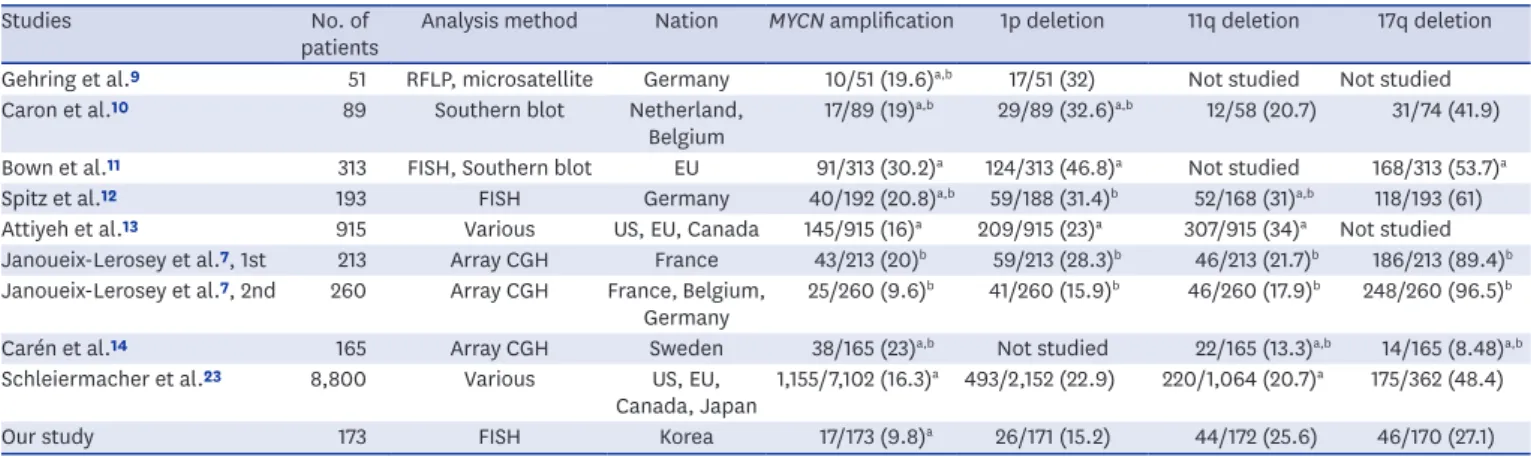
The incidence of each SCA in previous studies varied by a wide range and various analyzing methods were used to detect SCAs. The techniques recommended by INRG to detect SCAs are FISH, polymerase chain reaction, array-based methods, and multiplex ligation- dependent probe amplification.18 FISH was commonly used but other techniques were also used in previous reports from different study groups.7,9-14,23 We used the FISH method and followed the INRG recommendation in the interpretation of SCAs. The incidence of MYCN amplification in this study seems to be lower than in previous reports by different groups using various detection methods (Table 5). Gehring et al.9 considered the methods used to detect the SCAs as one of the reasons for this difference. Another possible reason for this difference might be ethnicity. While previous reports included various ethnic groups, our study only included Korean patients. Further research is needed to elucidate the reason for the difference in the incidence of MYCN amplification according to study groups.
Table 3. Multivariate analysis for PFS and OS in all patients
Characteristics No. (%) PFS OS
Univariate analysis Multivariate analysis Univariate analysis Multivariate analysis 5-yr PFS (%) P value HR 95% CI P value 5-yr OS (%) P value HR 95% CI P value
Age at diagnosis, mon 0.002 4.20 1.42–12.40 0.009 0.025 3.84 1.08–13.63 0.037
≤ 18 65 (37.6) 93.3 ± 3.3 95.1 ± 2.8
> 18 108 (62.4) 70.1 ± 5.4 76.6 ± 5.6
Stage < 0.001 2.94 1.08–7.99 0.035 < 0.001 6.01 1.27–28.46 0.024
1, 2, 3, 4S 84 (48.6) 92.1 ± 3.1 96.3 ± 2.7
4 89 (51.4) 66.6 ± 6.1 73.1 ± 6.1
Pathology 0.054 1.26 0.48–3.33 0.644 0.011 1.44 0.38–5.47 0.590
GNB/D 85 (49.4) 83.1 ± 5.4 92.2 ± 4.3
PD/UD 87 (50.6) 74.8 ± 5.1 76.9 ± 5.5
MYCN amplification < 0.001 3.10 1.19–8.05 0.020 < 0.001 5.25 1.78–15.52 0.003
Absent 156 (90.2) 82.8 ± 3.6 88.6 ± 3.4
Present 17 (9.8) 45.2 ± 13.3 46.2 ± 13.1
1p deletion 0.004 1.41 0.58–3.43 0.447 < 0.001 1.80 0.65–5.00 0.261
Absent 145 (84.8) 82.1 ± 3.9 88.1 ± 3.6
Present 26 (15.2) 61.2 ± 10.4 62.7 ± 11.0
11q deletion 0.996 0.306
Absent 128 (74.4) 81.1 ± 3.8 87.3 ± 3.6
Present 44 (25.6) 72.7 ± 9.2 75.6 ± 9.1
17q gain 0.921 0.774
Absent 124 (72.1) 81.1 ± 3.9 87.5 ± 3.6
Present 46 (27.9) 76.0 ± 7.2 81.4 ± 7.0
GNB/D = ganglioneuroblastoma/differentiating neuroblastoma, PD/UD = poorly differentiated/undifferentiated neuroblastoma, PFS = progression-free survival, OS = overall survival, HR = hazard ratio, CI = confidence interval.
60
0 20
1p deletion
E
40
Absent Present
Residual volume, %
P = 0.258 60
0 20
1p deletion
F
40
Absent Present
NSE, %
P = 0.320 100
0
0 1 2 3 4 5 6 7 8 20
Years from diagnosis
G
60 80
S, %PF 40
P = 0.037
100
0
0 1 2 3 4 5 6 7 8 20
Years from diagnosis
H
60 80
OS, % 40
P = 0.080
60
0 20
11q deletion
I
40
Absent Present
Residual volume, %
P = 0.973 60
0 20
11q deletion
J
40
Absent Present
NSE, %
P = 0.105 100
0
0 1 2 3 4 5 6 7 8 20
Years from diagnosis
K
60 80
S, %PF 40
P = 0.352
100
0
0 1 2 3 4 5 6 7 8 20
Years from diagnosis
L
60 80
OS, % 40
P = 0.045
60
0 20
17q gain
A
40
Absent Present
Residual volume, %
P = 0.212 60
0 20
17q gain
B
40
Absent Present
NSE, %
P = 0.041 100
0
0 1 2 3 4 5 6 7 8 20
Years from diagnosis
C
60 80
S, %PF 40
P = 0.444
100
0
0 1 2 3 4 5 6 7 8 20
Years from diagnosis
D
60 80
OS, % 40
P = 0.206 1p deletion
Absent Present
1p deletion Absent Present
11q deletion Absent Present
11q deletion Absent Present
17q gain Absent Present
17q gain Absent Present
Fig. 3. Early response and final outcome in patients with non-amplified MYCN. (A, B, E, F, I, and J) Reduction in tumor volume and serum NSE level after three cycles of chemotherapy compared with those at diagnosis. (C, D, G, H, K, and L) PFS and OS according to each SCA.
NSE = neuron-specific enolase, PFS = progression-free survival, OS = overall survival, SCA = segmental chromosomal aberration.
Table 4. Multivariate analysis for PFS and OS in MYCN non-amplified patients
Characteristics No. (%) PFS OS
Univariate analysis Multivariate analysis Univariate analysis Multivariate analysis 5-yr PFS (%) P value HR 95% CI P value 5-yr OS (%) P value HR 95% CI P value
Age at diagnosis, mon 0.006 3.97 1.16–13.56 0.028 0.022 5.99 0.76–47.41 0.090
≤ 18 61 (39.1) 94.7 ± 3.0 98.4 ± 1.6
> 18 95 (60.9) 74.5 ± 5.6 81.2 ± 5.7
Stage 0.003 3.43 1.24–9.46 0.017 0.002 9.69 1.22–77.06 0.032
1, 2, 3, 4S 81 (51.9) 93.1 ± 3.0 97.5 ± 2.5
4 75 (48.1) 71.1 ± 6.5 78.8 ± 6.4
Pathology 0.421 0.279
GNB/D 84 (54.2) 83.0 ± 5.4 92.2 ± 4.3
PD/UD 71 (45.8) 81.6 ± 5.1 84.4 ± 5.6
1p deletion 0.037 1.92 0.70–5.30 0.208 0.080 1.65 0.42–6.52 0.476
Absent 138 (89.6) 84.4 ± 3.8 90.1 ± 3.6
Present 16 (10.4) 66.7 ± 12.4 74.6 ± 13.2
11q deletion 0.352 0.045 2.32 0.68–7.90 0.178
Absent 113 (72.9) 86.5 ± 3.5 92.8 ± 3.3
Present 42 (27.1) 72.4 ± 9.2 77.2 ± 9.2
17q gain 0.444 0.206
Absent 111 (72.1) 86.0 ± 3.6 93.2 ± 3.1
Present 43 (27.9) 76.6 ± 7.5 82.3 ± 7.4
GNB/D = ganglioneuroblastoma/differentiating neuroblastoma, PD/UD = poorly differentiated/undifferentiated neuroblastoma, PFS = progression-free survival, OS = overall survival, HR = hazard ratio, CI = confidence interval.
After MYCN amplification has been reported as a significant poor prognostic marker in neuroblastoma, other SCAs have been studied for clinical significance. There have been controversies associated with the prognostic significance of SCAs other than the MYCN amplification. Some studies have reported the 1p deletion, 11q deletion, and 17q gain as worse prognostic factors10,13,24 whereas in other studies they were not reliable prognostic markers.9,12 At present, the reason for this difference is unclear.
In the present study, 1p deletion was associated with unfavorable clinical characteristics and worse outcome in the univariate analysis. However, more than half of the patients with 1p deletion also had MYCN amplification, and 1p deletion was not an independent worse prognostic factor in multivariate analysis. Even when the analysis was confined only to patients with MYCN non-amplified tumors, the 1p deletion was not an independent prognostic factor in multivariate analysis.
Neither 11q deletion nor 17q gain was a significant risk factor for survival in this study. In the INRG risk stratification, the 17q gain was excluded from analysis because data were only available for less than 5% of the patients and the 1p deletion was not a significant factor for OS. Therefore, only the 11q deletion was additionally included in the INRG risk stratification.15 However, we could not find any prognostic significance associated with the 11q deletion and this is consistent with previously reported study with limited number of patients.10 Patients with SCAs other than MYCN amplification was not included in high risk group, but if the patients were not high-risk, the chemotherapy for such patients were varied upon the studies. These are likely to cause a difference in survival outcomes. Here again, further studies with larger cohorts of patients are needed.
In conclusion, this is the first study reporting the incidence and clinical significance of SCAs in Korean children who were treated with essentially the same treatment protocol at a single center. Although both the MYCN amplification and 1p deletion were associated with aggressive clinical features at diagnosis and faster early response but worse survival, MYCN amplification was the only SCA with independent prognostic significance. A further study in a larger cohort of patients with longer follow-up is needed to evaluate whether there are differences in the incidence and clinical significance of SCAs according to ethnic group.
Table 5. Incidence of segmental chromosome aberrations
Studies No. of
patients Analysis method Nation MYCN amplification 1p deletion 11q deletion 17q deletion Gehring et al.9 51 RFLP, microsatellite Germany 10/51 (19.6)a,b 17/51 (32) Not studied Not studied
Caron et al.10 89 Southern blot Netherland,
Belgium 17/89 (19)a,b 29/89 (32.6)a,b 12/58 (20.7) 31/74 (41.9) Bown et al.11 313 FISH, Southern blot EU 91/313 (30.2)a 124/313 (46.8)a Not studied 168/313 (53.7)a
Spitz et al.12 193 FISH Germany 40/192 (20.8)a,b 59/188 (31.4)b 52/168 (31)a,b 118/193 (61)
Attiyeh et al.13 915 Various US, EU, Canada 145/915 (16)a 209/915 (23)a 307/915 (34)a Not studied Janoueix-Lerosey et al.7, 1st 213 Array CGH France 43/213 (20)b 59/213 (28.3)b 46/213 (21.7)b 186/213 (89.4)b Janoueix-Lerosey et al.7, 2nd 260 Array CGH France, Belgium,
Germany 25/260 (9.6)b 41/260 (15.9)b 46/260 (17.9)b 248/260 (96.5)b
Carén et al.14 165 Array CGH Sweden 38/165 (23)a,b Not studied 22/165 (13.3)a,b 14/165 (8.48)a,b
Schleiermacher et al.23 8,800 Various US, EU,
Canada, Japan 1,155/7,102 (16.3)a 493/2,152 (22.9) 220/1,064 (20.7)a 175/362 (48.4)
Our study 173 FISH Korea 17/173 (9.8)a 26/171 (15.2) 44/172 (25.6) 46/170 (27.1)
Corresponding patients number/studied patients number (%).
RFLP = restriction fragment length polymorphism, FISH = fluorescence in situ hybridization, CGH = comparative genomic hybridization.
aAdverse effect; bPercentage was calculated from reported patient numb.
REFERENCES
1. Weinstein JL, Katzenstein HM, Cohn SL. Advances in the diagnosis and treatment of neuroblastoma.
Oncologist 2003;8(3):278-92.
PUBMED | CROSSREF
2. Schwab M, Alitalo K, Klempnauer KH, Varmus HE, Bishop JM, Gilbert F, et al. Amplified DNA with limited homology to myc cellular oncogene is shared by human neuroblastoma cell lines and a neuroblastoma tumour. Nature 1983;305(5931):245-8.
PUBMED | CROSSREF
3. Brodeur GM, Seeger RC, Schwab M, Varmus HE, Bishop JM. Amplification of N-myc in untreated human neuroblastomas correlates with advanced disease stage. Science 1984;224(4653):1121-4.
PUBMED | CROSSREF
4. Seeger RC, Brodeur GM, Sather H, Dalton A, Siegel SE, Wong KY, et al. Association of multiple copies of the N-myc oncogene with rapid progression of neuroblastomas. N Engl J Med 1985;313(18):1111-6.
PUBMED | CROSSREF
5. Spitz R, Hero B, Skowron M, Ernestus K, Berthold F. MYCN-status in neuroblastoma: characteristics of tumours showing amplification, gain, and non-amplification. Eur J Cancer 2004;40(18):2753-9.
PUBMED | CROSSREF
6. Lee JW, Son MH, Cho HW, Ma YE, Yoo KH, Sung KW, et al. Clinical significance of MYCN amplification in patients with high-risk neuroblastoma. Pediatr Blood Cancer 2018;65(10):e27257.
PUBMED | CROSSREF
7. Janoueix-Lerosey I, Schleiermacher G, Michels E, Mosseri V, Ribeiro A, Lequin D, et al. Overall genomic pattern is a predictor of outcome in neuroblastoma. J Clin Oncol 2009;27(7):1026-33.
PUBMED | CROSSREF
8. Schleiermacher G, Janoueix-Lerosey I, Ribeiro A, Klijanienko J, Couturier J, Pierron G, et al.
Accumulation of segmental alterations determines progression in neuroblastoma. J Clin Oncol 2010;28(19):3122-30.
PUBMED | CROSSREF
9. Gehring M, Berthold F, Edler L, Schwab M, Amler LC. The 1p deletion is not a reliable marker for the prognosis of patients with neuroblastoma. Cancer Res 1995;55(22):5366-9.
PUBMED
10. Caron H, van Sluis P, de Kraker J, Bökkerink J, Egeler M, Laureys G, et al. Allelic loss of chromosome 1p as a predictor of unfavorable outcome in patients with neuroblastoma. N Engl J Med 1996;334(4):225-30.
PUBMED | CROSSREF
11. Bown N, Cotterill S, Lastowska M, O'Neill S, Pearson AD, Plantaz D, et al. Gain of chromosome arm 17q and adverse outcome in patients with neuroblastoma. N Engl J Med 1999;340(25):1954-61.
PUBMED | CROSSREF
12. Spitz R, Hero B, Ernestus K, Berthold F. Gain of distal chromosome arm 17q is not associated with poor prognosis in neuroblastoma. Clin Cancer Res 2003;9(13):4835-40.
PUBMED
13. Attiyeh EF, London WB, Mossé YP, Wang Q, Winter C, Khazi D, et al. Chromosome 1p and 11q deletions and outcome in neuroblastoma. N Engl J Med 2005;353(21):2243-53.
PUBMED | CROSSREF
14. Carén H, Kryh H, Nethander M, Sjöberg RM, Träger C, Nilsson S, et al. High-risk neuroblastoma tumors with 11q-deletion display a poor prognostic, chromosome instability phenotype with later onset. Proc Natl Acad Sci U S A 2010;107(9):4323-8.
PUBMED | CROSSREF
15. Cohn SL, Pearson AD, London WB, Monclair T, Ambros PF, Brodeur GM, et al. The International Neuroblastoma Risk Group (INRG) classification system: an INRG Task Force report. J Clin Oncol 2009;27(2):289-97.
PUBMED | CROSSREF
16. Brodeur GM, Pritchard J, Berthold F, Carlsen NL, Castel V, Castelberry RP, et al. Revisions of the international criteria for neuroblastoma diagnosis, staging, and response to treatment. J Clin Oncol 1993;11(8):1466-77.
PUBMED | CROSSREF
17. Lee NH, Son MH, Choi YB, Yi E, Lee JW, Yoo KH, et al. Clinical significance of tyrosine hydroxylase mRNA transcripts in peripheral blood at diagnosis in patients with neuroblastoma. Cancer Res Treat 2016;48(4):1399-407.
PUBMED | CROSSREF
18. Ambros PF, Ambros IM, Brodeur GM, Haber M, Khan J, Nakagawara A, et al. International consensus for neuroblastoma molecular diagnostics: report from the International Neuroblastoma Risk Group (INRG) Biology Committee. Br J Cancer 2009;100(9):1471-82.
PUBMED | CROSSREF
19. Choi YB, Bae GE, Lee NH, Kim JS, Lee SH, Yoo KH, et al. Clinical significance of persistent tumor in bone marrow during treatment of high-risk neuroblastoma. J Korean Med Sci 2015;30(8):1062-7.
PUBMED | CROSSREF
20. Sung KW, Yoo KH, Koo HH, Kim JY, Cho EJ, Seo YL, et al. Neuroblastoma originating from extra-abdominal sites: association with favorable clinical and biological features. J Korean Med Sci 2009;24(3):461-7.
PUBMED | CROSSREF
21. Yoo SY, Kim JS, Sung KW, Jeon TY, Choi JY, Moon SH, et al. The degree of tumor volume reduction during the early phase of induction chemotherapy is an independent prognostic factor in patients with high-risk neuroblastoma. Cancer 2013;119(3):656-64.
PUBMED | CROSSREF
22. Huang M, Weiss WA. Neuroblastoma and MYCN. Cold Spring Harb Perspect Med 2013;3(10):a014415.
PUBMED | CROSSREF
23. Schleiermacher G, Mosseri V, London WB, Maris JM, Brodeur GM, Attiyeh E, et al. Segmental
chromosomal alterations have prognostic impact in neuroblastoma: a report from the INRG project. Br J Cancer 2012;107(8):1418-22.
PUBMED | CROSSREF
24. Bown N, Lastowska M, Cotterill S, O'Neill S, Ellershaw C, Roberts P, et al. 17q gain in neuroblastoma predicts adverse clinical outcome. Med Pediatr Oncol 2001;36(1):14-9.
PUBMED | CROSSREF