• 검색 결과가 없습니다.

Surgical Outcomes in Small Cell Lung CancerMin Ho Ju, M.D., Hyeong Ryul Kim, M.D., Joon-Bum Kim, M.D., Yong Hee Kim, M.D., Dong Kwan Kim, M.D., Seung-Il Park, M.D.

N/A
N/A
Protected

Academic year: 2021

Share "Surgical Outcomes in Small Cell Lung CancerMin Ho Ju, M.D., Hyeong Ryul Kim, M.D., Joon-Bum Kim, M.D., Yong Hee Kim, M.D., Dong Kwan Kim, M.D., Seung-Il Park, M.D."

Copied!
5
0
0

로드 중.... (전체 텍스트 보기)

전체 글

(1)

http://dx.doi.org/10.5090/kjtcs.2012.45.1.40 ISSN: 2233-601X (Print) ISSN: 2093-6516 (Online)

Department of Thoracic and Cardiovascular Surgery, Asan Medical Center, University of Ulsan College of Medicine Received: July 4, 2011, Revised: October 23, 2011, Accepted: November 11, 2011

Corresponding author: Hyeong Ryul Kim, Department of Thoracic and Cardiovascular Surgery, Asan Medical Center, University of Ulsan College of Medicine, 388-1 Pungnap-dong, Songpa-gu, Seoul 138-736, Korea

(Tel) 82-2-3010-3590 (Fax) 82-2-3010-6966 (E-mail) [email protected]

C

The Korean Society for Thoracic and Cardiovascular Surgery. 2012. All right reserved.

CC
This is an open access article distributed under the terms of the Creative Commons Attribution Non-Commercial License (http://creative- commons.org/licenses/by-nc/3.0) which permits unrestricted non-commercial use, distribution, and reproduction in any medium, provided the original work is properly cited.

Surgical Outcomes in Small Cell Lung Cancer

Min Ho Ju, M.D., Hyeong Ryul Kim, M.D., Joon-Bum Kim, M.D., Yong Hee Kim, M.D., Dong Kwan Kim, M.D., Seung-Il Park, M.D.

Background: The experience of a single-institution regarding surgery for small cell lung cancer (SCLC) was re- viewed to evaluate the surgical outcomes and prognoses. Materials and Methods: From July 1990 to December 2009, thirty-four patients (28 male) underwent major pulmonary resection and lymph node dissection for SCLC.

Lobectomy was performed in 24 patients, pneumonectomy in eight, bilobectomy in one, and segmentectomy in one.

Surgical complications, mortality, the disease-free survival (DFS) rate, and the overall survival rate were analyzed retrospectively. Results: The median follow-up period was 26 months (range, 4 to 241 months), and there was one surgical mortality (2.9%). Six patients (17.6%) experienced recurrence, all of which were systemic. Eight pa- tients died during follow-up; four died of disease progression and the other four died of pneumonia or of another non-cancerous cause. The three-year DFS rate was 79.2±2.6% and the overall survival rate was 66.4±10.5%.

Recurrence or death was significantly prevalent in the patients with lymph node metastasis (p=0.001) as well as in those who did not undergo adjuvant chemotherapy (p=0.008). The three-year survival rate was significantly greater in the patients with pathologic stage I/II cancer than in those with stage III cancer (84% vs. 13%, p=0.001).

Conclusion: Major pulmonary resection for small cell lung cancer is feasible in selected patients. Patients with pathologic stage I or II disease showed an excellent survival rate after surgery and adjuvant treatment. Prospective randomized studies will be needed to define the role of surgery in early-stage small cell lung cancer.

Key words: 1. Lung neoplasms 2. Lung surgery 3. Carcinoma, oat cell

INTRODUCTION

Small cell lung cancer (SCLC) has a poor prognosis be- cause of its rapid growth rate and early metastatic dissem- ination [1,2]. In general, systemic chemotherapy, with or without radiotherapy, has been recommended as the appro- priate therapy, and surgery has had only a limited role [3].

Pulmonary resection has been used as part of a combination therapy [4,5] or for residual lesions following concurrent che- moradiotherapy (CCRT). Pulmonary resection has also been

used for mixed type lesions with non-small cell lung cancer

(NSCLC). There have only been a few reports regarding sur-

gical outcomes in patients with SCLC [6-9]. Surgery does

have an established role for treating SCLC. We investigated

the outcomes and risk factors of surgery in the patients from

a single institution who underwent major pulmonary resection

for SCLC within the past 20 years.

(2)

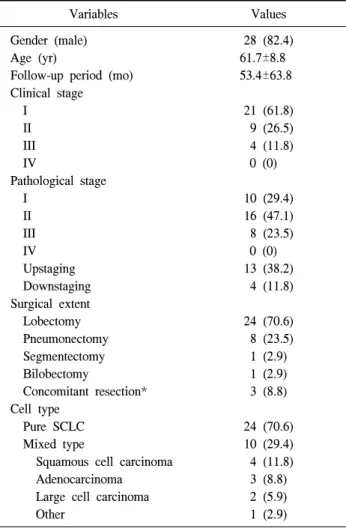
Table 1. Patient characteristics (n=34)

Variables Values

Gender (male) Age (yr)

Follow-up period (mo) Clinical stage I

II III IV

Pathological stage I

II III IV Upstaging Downstaging Surgical extent Lobectomy Pneumonectomy Segmentectomy Bilobectomy

Concomitant resection*

Cell type Pure SCLC Mixed type

Squamous cell carcinoma Adenocarcinoma

Large cell carcinoma Other

28 (82.4) 61.7±8.8 53.4±63.8

21 (61.8) 9 (26.5) 4 (11.8)

0 (0)

10 (29.4) 16 (47.1) 8 (23.5)

0 (0) 13 (38.2) 4 (11.8)

24 (70.6) 8 (23.5) 1 (2.9) 1 (2.9) 3 (8.8)

24 (70.6) 10 (29.4) 4 (11.8) 3 (8.8) 2 (5.9) 1 (2.9)

Values are presented as mean±standard deviation or number (%).

SCLC=small cell lung cancer.

*Major pulmonary resection with surrounding tissues, i.e., chest wall, rib, pericardium, diaphragm, etc.

MATERIALS AND METHODS

A total of 3,194 patients underwent major pulmonary re- section for malignant neoplasm at our institution from April 1990 to December 2009. A pathology review confirmed SCLC in 34 of these patients (0.01%). The pulmonary re- sections were performed via a posterolateral thoracotomy (n=31) or video-assisted thoracoscopic surgery (VATS) (n=3).

Mediastinal lymph node dissections were routinely performed, and all patients who had any component of SCLC seen on histology were included in this study. The Kaplan-Meier anal- ysis was used to plot the survival curves and the rates of freedom from recurrence as well as to compare the survival rates between stage I and II, and stage III disease. Univariate Cox regression analyses were used for risk factor analysis of death or disease recurrence. Statistical analyses were performed using SPSS ver. 16.0 (SPSS Inc., Chicago, IL, USA). Statistical significance was defined as a 2-sided p-value ≤0.05. This study was conducted using a retrospective chart review. The seventh edition of the American Joint Committee on Cancer (AJCC) Cancer Staging was used for the stage classification.

RESULTS 1) Patient characteristics

A total of 34 patients with SCLC underwent major pulmo- nary resection. There were 28 males (82.4%) and six females (17.6%), and the mean age was 64 years (range, 44 to 76 years). Three patients underwent neoadjuvant chemotherapy.

Lobectomy was performed in 24 patients (70.6%), and pneu- monectomy was performed in 8 patients (23.5%). A segmen- tectomy and bilobectomy were both performed in one patient (2.9%) (Table 1). Mediastinoscopic lymph node dissection followed by lobectomy using VATS was performed on three patients. The other thirty-one patients underwent posterolateral thoracotomy.

2) Surgical outcomes

There was one case of surgical mortality (2.9%). This pa- tient died of sudden cardiac arrest, and the cause of shock was thought to be bleeding at the pneumonectomy site. There were no major postoperative complications in any of the oth-

er cases.

Pure SCLC was confirmed in 24 patients (70.6%), and mixed type tumors with NSCLC was confirmed in 10 pa- tients (29.4%) on the postoperative histological examination.

Squamous cell lung cancer was most often accompanied by a mixed histology (n=4, 11.8%). Twenty-six patients had patho- logic stage I or II disease, and eight patients had stage III disease (Table 1).

Thirty patients (88.2%) received adjuvant therapy. Nineteen

patients (55.9%) received only radio-therapy. Ten patients

(29.4%) received CCRT, and one patient (2.9%) received on-

ly chemotherapy. Adjuvant therapy was not performed in

three patients because of either their poor general condition

(3)

Table 2. Treatment combined with surgical resection in patients with small cell lung cancer

Variables Values

Neoadjuvant therapy Adjuvant therapy Radiotherapy only Chemotherapy+radiotherapy Chemotherapy only None

3 (8.8) 30 (88.2) 19 (55.9) 10 (29.4) 1 (2.9) 3 (8.8) Values are presented as number (%).

Table 3. Surgical outcomes for patients with small cell lung can- cer

Variables Values

Recurrence Local Systemic Death

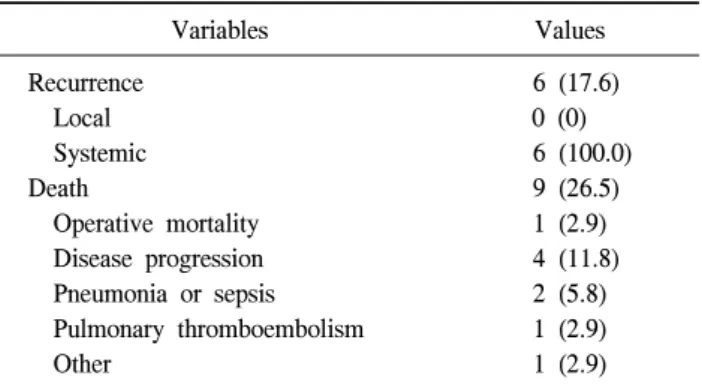
Operative mortality Disease progression Pneumonia or sepsis Pulmonary thromboembolism Other

6 (17.6) 0 (0) 6 (100.0)

9 (26.5) 1 (2.9) 4 (11.8)

2 (5.8) 1 (2.9) 1 (2.9) Values are presented as number (%).

Fig. 1. Overall survival rate determined using the Kaplan-Meier method. The overall survival rate was 66.4±10.5% at five years after surgery.

Fig. 2. Freedom from recurrence rate after surgical resection, de- termined using the Kaplan-Meier method. The freedom from re- currence rate was 79.2±2.6% at five years after surgery.

or other complications (Table 2).

The median follow-up period was 26 months (range, 4 to 241 months). There were eight late deaths (26.5%) during the follow-up period; four died of disease progression and the other four died of pneumonia or another non-cancerous cause.

The cancer recurred in six cases (17.6%), which were all sys- temic recurrences (Table 3).

In this study, the overall five-year survival rate was 66.4%

(Fig. 1) and the three-year disease-free survival rate was 79.2% (Fig. 2). The three-year survival rate according to the pathologic stage was 84% in patients with stage I and II dis- ease and 13% in patients with stage III disease (p=0.001) (Fig. 3).

3) Risk factors for death or recurrence

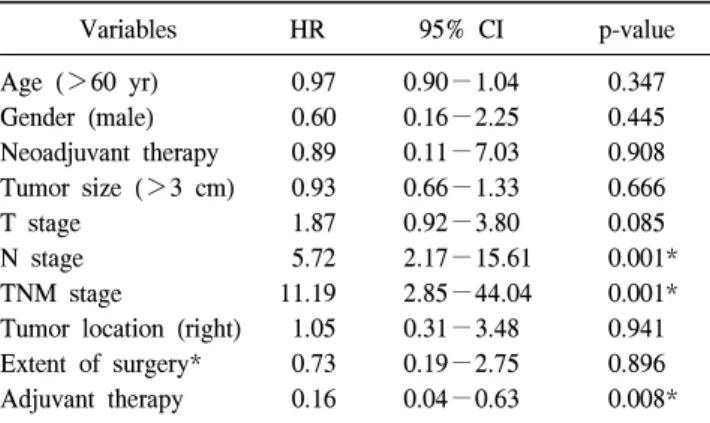
The risk factors for death or disease recurrence were ana- lyzed using the univariate Cox-regression hazard model. As the number of the deaths and patients with disease recurrence

was too small for statistical analysis, we analyzed the risk factors for death or disease recurrence. Lymph node meta- stasis (p=0.001) and the absence of adjuvant chemotherapy (p=0.008) were shown to be risk factors for death or re- currence (Table 4).

DISCUSSION

In general, the role of surgery in SCLC is limited as SCLC is usually treated using chemotherapy or CCRT [3,10].

The important role of chemotherapy in SCLC has been

(4)

Fig. 3. Comparison of the survival rates in the stage I, II, and III groups. The stage I and II groups showed a significantly higher survival rate than the stage III group (p=0.001).

Table 4. Risk factor analysis for death or disease recurrence

Variables HR 95% CI p-value

Age (>60 yr) Gender (male) Neoadjuvant therapy Tumor size (>3 cm) T stage

N stage TNM stage

Tumor location (right) Extent of surgery*

Adjuvant therapy

0.97 0.60 0.89 0.93 1.87 5.72 11.19 1.05 0.73 0.16

0.90−1.04 0.16−2.25 0.11−7.03 0.66−1.33 0.92−3.80 2.17−15.61 2.85−44.04 0.31−3.48 0.19−2.75 0.04−0.63

0.347 0.445 0.908 0.666 0.085 0.001*

0.001*

0.941 0.896 0.008*

HR=hazard ratio; CI=confidence interval; TNM=tumor-node-me- tastasis.

*Comparison of the risk of the extent of surgery by scoring (1=wedge resection, segmentectomy, lobectomy; 2=bilobectomy;

3=pneumonectomy).

well-established by clinical trials [9,11,12]. Despite the devel- opment of new chemotherapeutic agents for decades, SCLC remains a disease with a high mortality rate and a low cure rate, even in limited stage groups [11]. Despite their initial responses to therapy, most patients with SCLC develop local recurrence [12].

There have been some previous reports regarding the role of surgery and its outcome in patients with SCLC. Shah et al. [13] reported that the five-year survival rate was 43%

when treated with only surgery in 28 patients with SCLC.

Schreiber et al. [14] indicated that the use of surgery, partic- ularly lobectomy, was associated with favorable survival outcomes. There were other reports regarding the surgical outcome using adjuvant therapies [1,15-17]. In these reports, in the majority of cases, the use of surgery as part of multi- modality therapy had more successful outcomes than those of conventional therapies. As seen in previous reports, current CCRT protocols have demonstrated local failure rates of ap- proximately 50% [18]. Complete surgical resection after in- duction CCRT has shown control of local relapse in almost 100% [19]. This was particularly noticeable in the early stage groups (T1-2, N0, M0). In our study, 84% of the stage I and II group and 13% of the stage III group patients showed a three-year survival rate. Histologically mixed tumors with both SCLC and NSCLC components may fail to meet CCRT protocol requirements since there is less sensitivity of the NSCLC component to chemotherapy. It has been shown that

the final histological findings for tumors that were initially reported as SCLC indicated that they contained NSCLC com- ponents in 11% to 25% of patients [20]. In our study, 29.4%

of the patients had NSCLC components according to the pathology review.

CONCLUSION

Overall, the five-year patient survival rate was 66.4% in this study. Lymph node metastasis and the absence of ad- juvant chemotherapy were risk factors for patient death or tu- mor recurrence. Our study had some limitations. It was a ret- rospective investigation with only a small number of subjects.

Despite these factors, according to our study results, major pulmonary resection for SCLC was feasible in selected patients. Prospective, randomized studies will be needed to determine the role of surgery in early-stage SCLC.

REFERENCES

1. Chung KY, Hong GP, Kim KD, Kim DJ, Kim JH. Surgical resection of small cell lung cancer (SCLC). Korean J Thorac Cardiovasc Surg 1998;31:1195-9.

2. Ichinose Y, Hara N, Ohta M, Takamori S, Kawasaki M, Hata K. Comparison between resected and irradiated small cell lung cancer in patients in stages I through IIIa. Ann Thorac Surg 1992;53:95-100.

3. Jackman DM, Johnson BE. Small-cell lung cancer. Lancet

(5)

2005;366:1385-96.

4. Kohman LJ. Is there a place for surgery in central small cell lung cancer? Chest Surg Clin N Am 1997;7:105-12.

5. Meyer JA, Comis RL, Ginsberg SJ, et al. Phase II trial of extended indications for resection is small cell carcinoma of the lung. J Thorac Cardiovasc Surg 1982;83:12-9.

6. Warde P, Payne D. Does thoracic irradiation improve sur- vival and local control in limited-stage small-cell carcinoma of the lung? A meta-analysis. J Clin Oncol 1992;10:890-5.

7. Shields TW, Higgins GA Jr, Matthews MJ, Keehn RJ.

Surgical resection in the management of small cell carcino- ma of the lung. J Thorac Cardiovasc Surg 1982;84:481-8.

8. Inoue M, Miyoshi S, Yasumitsu T, et al. Surgical results for small cell lung cancer based on the new TNM staging system. Thoracic Surgery Study Group of Osaka University, Osaka, Japan. Ann Thorac Surg 2000;70:1615-9.

9. Shepherd FA, Ginsberg RJ, Patterson GA, Evans WK, Feld R. A prospective study of adjuvant surgical resection after chemotherapy for limited small cell lung cancer: a University of Toronto Lung Oncology Group study. J Thorac Cardio- vasc Surg 1989;97:177-86.

10. Mountain CF. Clinical biology of small cell carcinoma: rela- tionship to surgical therapy. Semin Oncol 1978;5:272-9.

11. Shepherd FA, Ginsberg RJ, Feld R, Evans WK, Johansen E.

Surgical treatment for limited small-cell lung cancer. The University of Toronto Lung Oncology Group experience. J Thorac Cardiovasc Surg 1991;101:385-93.

12. Elliott JA, Osterlind K, Hirsch FR, Hansen HH. Metastatic patterns in small-cell lung cancer: correlation of autopsy

findings with clinical parameters in 537 patients. J Clin Oncol 1987;5:246-54.

13. Shah SS, Thompson J, Goldstraw P. Results of operation without adjuvant therapy in the treatment of small cell lung cancer. Ann Thorac Surg 1992;54:498-501.

14. Schreiber D, Rineer J, Weedon J, et al. Survival outcomes with the use of surgery in limited-stage small cell lung can- cer: should its role be re-evaluated? Cancer 2010;116:1350- 7.

15. Coolen L, Van den Eeckhout A, Deneffe G, Demedts M, Vansteenkiste J. Surgical treatment of small cell lung can- cer. Eur J Cardiothorac Surg 1995;9:59-64.

16. Meyer JA, Comis RL, Ginsberg SJ, et al. The prospect of disease control by surgery combined with chemotherapy in stage I and stage II small cell carcinoma of the lung. Ann Thorac Surg 1983;36:37-41.

17. Ulsperger E, Karrer K, Denck H. Multimodality treatment for small cell bronchial carcinoma. Preliminary results of a prospective, multicenter trial. The ISC-Lung Cancer Study Group. Eur J Cardiothorac Surg 1991;5:306-9.

18. Turrisi AT 3rd, Kim K, Blum R, et al. Twice-daily com- pared with once-daily thoracic radiotherapy in limited small-cell lung cancer treated concurrently with cisplatin and etoposide. N Engl J Med 1999;340:265-71.

19. Eberhardt W, Korfee S. New approaches for small-cell lung cancer: local treatments. Cancer Control 2003;10:289-96.

20. Asamura H, Kameya T, Matsuno Y, et al. Neuroendocrine

neoplasms of the lung: a prognostic spectrum. J Clin Oncol

2006;24:70-6.

수치

Table 1. Patient characteristics (n=34)
Fig. 1. Overall survival rate determined using the Kaplan-Meier  method. The overall survival rate was 66.4±10.5% at five years  after surgery.
Table 4. Risk factor analysis for death or disease recurrence

참조

관련 문서