Research Article Open Access
Effects of Multipath Electrical Stimulation on the Functional Recovery of Early Stage Patients of Total Knee Arthroplasty
Min-Young Lee, PT, MS⋅Young-Jun Shin, PT, MS⋅Myoung-Kwon Kim, PT, PhD
†Dept. of Physical Therapy, College of Rehabilitation Sciences, Daegu University
Received: January 12, 2018 / Revised: January 29, 2018 / Accepted: February 7, 2018
ⓒ 2018 J Korean Soc Phys Med
| Abstract |
1)PURPOSE: This research was intended to investigate the influence to function recovery at the early stage after surgery, by conducting Multipath Electrical Simulation and isometric exercise treatment as early stage medical treatment method for Total knee arthroplasty patients.
METHODS: The subject of 30 patients having Unilateral Total knee arthroplasty over age 65, Multipath Electrical Simulation and isometric exercise (experiment groupⅠ), Conventional Electrical Simulation and isometric exercise (experiment group Ⅱ) and isometric exercise (control group).
The intervention was performed in 5 times per a week and 60 minutes per a day during 4 weeks. We performed research by conducting Neuromuscular Electrical Stimulation and isometric exercise together and measured pain, range of motion, muscle strength and gait ability before and after intervention.
RESULTS: The result showed therapeutic improvement in
†Corresponding Author : Myoung-Kwon Kim
[email protected], http://orcid.org/0000-0002-7251-6108 This is an Open Access article distributed under the terms of the Creative Commons Attribution Non-Commercial License (http://creativecommons.org/licenses/by-nc/3.0) which permits unrestricted non-commercial use, distribution, and reproduction in any medium, provided the original work is properly cited.
experiment group Ⅰ, experiment group Ⅱ and control group, but Multipath Electrical Simulation and isometric exercise showed significant improvement in function recovery of early stage compared to Conventional Electrical Simulation and isometric exercise, only isometric exercise.
CONCLUSION: Based on research result, in order for early state function recovery of Total knee arthroplasty patients, when conducting neuromuscular electrical stimulation and isometric exercise together, especially when applying Multipath Electrical Stimulation, we could know that it showed more significant improvement to function recovery after surgery. Also, we suggest that Multipath Electrical Simulation may become a useful tool as a method for intervention and performing in various diseases for weakening of Quadriceps muscle.
Key Words: Arthroplasty, Electrical stimulation, Recovery of function
Ⅰ. Introduction
Degenerative arthritis is a disease which shows
Degenerative change by damage of Articular cartilage due
to aging, overuse, external injury and damage on bone and
ligament. It is a disease of the highest frequency among diseases which invades joint and especially, it break out mostly at knee joint where the weight is loaded.
Degenerative arthritis is the most common degenerative joint musculoskeletal disease that causes physical disability (Koo and Na, 2016). The representative symptom of this disease is abnormal contractile action due to Quadriceps weakness (Rudolph et al., 2007) and it may break out even after the surgery (Fisher et al., 1991; McArdle et al., 2002).
Total knee arthroplasty is known as be very helpful to improve function of daily life of Degenerative arthritis patients such as reducing pain, improving movability and correcting bowed legs(Steven-Lapsley et al., 2012a;
Gauchard, 2010). But, Hoogeboom et al. (2015) insisted that complete recovery of muscle function after surgery might be difficult, considering that most patients are in their 60s. It is very important to recover reduced muscular strength into normal state level. Since long time ago, various symptoms were occurred due to joint instability and muscle weakness and efficient plan should be suggested in order to solve weakened muscle function after surgery.
Lower extremity strengthening exercise is known to be effective in patients with knee Degenerative arthritis (Park and Kim, 2017). According to research of Meier et al.
(2008), muscular strength and activity of Quadriceps muscle immediately after surgery was reduced 5~20%
compared to before surgery and muscle atrophy occurred.
Also, Wylde et al. (2011) said that it causes hypofunction of joint accompanying severe pain due to strong mechanical pressure after incision and surgery. As the muscular strength of Quadriceps muscle is closely related to daily life function movement (Mizner et al., 2005) and if the functional disorder of muscle is not improved, it may lead to reduction daily life activity such as fall down, it is very important to recover reduced muscular strength into normal state level and intensive care should be conducted immediately after surgery (Bade et al., 2010). Researches on various strengthening of muscle and rehabilitation of
muscular endurance according to importance of rehabilitation at the beginning stage of surgery aimed at Total knee arthroplasty are consistently performed (Bade and Stevens-Lapsley, 2011). Neuromuscular Electrical Stimulation discharges minute electric currents and causes muscular contraction and it can increase load to muscle through repetitive contraction and increase muscular strength (Huber et al., 2015). After surgery, simultaneous contraction is necessary to improve balance, stability of knee joint medial & lateral, and as muscular strength balance between vastus medialis and vastus lateralis at knee joint is very important, it is being used. According to preceding research of Multipath Electrical Simulation, Bade and Stevens-Lapsley (2011) conducted research aimed at Total knee arthroplasty applying traditional exercise and Multipath Electrical Simulation, and only the group applying Neuromuscular Electrical Stimulation showed significant improvement in muscle strength, functional ability, knee joint range of motion and simultaneously, it applied Electrical Simulation to Quadriceps muscle only, but we could check the muscular strength of Hamstring muscle was improved. Feil et al.
(2011) showed that it has excellent stability of joint and
efficiency such as recovering muscular strength compared
to Multipath Electrical Simulation, from the research
comparing the effect of using Conventional Electrical
Simulation and Multipath Electrical Simulation together
with traditional exercise aimed at Anterior cruciate ligament
surgery patients. Morf et al. (2015) showed more significant
result to increasing muscular strength and reduction of
muscle fatigue in Multipath Electrical Simulation group,
from the result of comparison according to using
Conventional Electrical Simulation and Multipath
Electrical Simulation aimed at early stage of Total knee
arthroplasty patients. According to preceding research,
Neuromuscular Electrical Stimulation showed effective
result in reducing pain of knee joint and functional
improvement such as strengthening muscle, reducing
muscle fatigue and increasing joint stability of Quadriceps muscle. It applied Neuromuscular Electrical Stimulation in vastus medialis among Quadriceps muscle selectively and suggested efficiency and it proved that Multipath Electrical Simulation is more efficient method with various result such as maximum myotility, pain, balance, function evaluation via comparison of Conventional and Multipath Electrical Simulation. Therefore, in order to investigate the influence of Multipath Electrical Stimulation to recovery of function to early stage patients of Total knee arthroplasty, this research would like to investigate the influence to increasing recovery of function by comparing Multipath Electrical Simulation method applied to Quadriceps muscle with Conventional Electrical Simulation, isometric exercise.
In order to reinforce limitation of general rehabilitation method, this research performed two Neuromuscular Electrical Stimulations and conducted knee joint pain, range of motion, muscle strength, gait ability evaluation, so it would like to achieve objective data by quantitatively analyzing the influence and efficiency to improve recovery of function of Total knee arthroplasty patients.
Ⅱ. Methods
1. Participants
This research was conducted from January 2017 to April 2017 aimed at 30 people who understood the purpose of this research and agreed to participate in the experiment among the patients who performed Total knee arthroplasty due to Chronic degenerative arthritis and received medical treatment at a general hospital located in Andong City in Gyeongsangbuk-do. This research was performed after getting approval from Institutional Review Board of Daegu University (IRB number is 1040621-201703-HR-008-02), and the criteria to select the subject of research is 1) The person whose age is over 65 regardless of gender, 2) The patient who was diagnosed as degenerative arthritis and
received unilateral Total knee arthroplast, 3) The patient who received the 1st replacement surgery except for redo-replacement, 4) The patient who is in early stage by receiving Total knee arthroplasty within 10 days ago and who does not have complications such as bleeding or infection, 5) The person whose surgery status does not influence to gait or balance, 6) The person who has no neurologic damage which may influence to balance or gait except for Total knee arthroplasty, 7) The person who is fully aware of the purpose and method of experiment and the patient and his/her family’s consent was achieved among the patients who didn’t skip physical therapy no longer than 3 days due to infection or side effect after surgery, and the criteria for exclusion is 1) The person who has experience of other orthopedic surgery in lower extremity, 2) The person who has cardiovascular disorder, neurologic disorder or other disorder which gives hindrance in activity, 3) The person whose visual status influences to walk or balance, 4) The person who has paralysis in Central nervous system and Peripheral nerve, 5) The person who puts in pacemaker.
2. Intervention
The intervention method of this research is divided into 3 groups, the control group is Quadriceps muscle active isometric exercise group and this group is applying 15 minutes in Interference Current Therapy (ICT) as conservative physical therapy, 30 minutes in Continuous Passive Motion (CPM) and 15 minutes in Quadriceps muscle active isometric exercise. By setting up therapy time same as experimental group, Continuous Passive Motion (CPM) is set up as 30 minutes with one cycle from supine to flexion and extension motion starting from 0° to possible angle in repeated motion and apply up to 120° maximum according to the status of patient’s knee.
Interference Current Therapy (ICT) is attached by utilizing 4-pole arrangement method in Quadriceps muscle medial
& lateral and the application time is 15 minutes. Quadriceps
isometric exercise maintains the angle between maximum extension of knee joint and ankle joint as 90° in sitting position. At this time, perform the contraction in maximum times for 10 seconds and repeat it 10 times. After rest of 50 seconds, perform the next set and perform it in 15 minutes. Multipath Electrical Simulation group uses Kneehab XP 412 (Bio-Medial Research Ltd, Bio-Medial Research Ltd, China) for Multipath Electrical Simulation, performs CPM and ICT under same condition with control group and then applies Quadriceps muscle active exercise together with Multipath Electrical Simulation. For application of Multipath Electrical Simulation, from sitting position, bend hip joint 85∼90° knee joint 40∼60° and then put the feet on the support comfortably from the floor, attach pole set (4 units: 10×20 cm, 3×18 cm, 10×7.5 cm, 7×14 cm) on kneehab band and cover kneehab band on femur above patella. 4 pads are attached suitably in anatomical location of Quadriceps muscle and adjust the strength inside and outside via electric switch. The strength is applied of the maximum contraction strength which the subject patient can endure within the range of 0-200 mA and it is conducted during 15 minutes (Morf et al., 2015;
Walls et al., 2010). At the time of electric stimulus, this experiment was performed after giving sufficient explanation to the subject patient to apply maximum force in knee joint and maintain the extension stance and then maintain the extension status as it is when the stimulus time is over.
Conventional Electrical Simulation group uses Microstim-K13034 (MEDEL GmbH, Germany) for Conventional Electrical Simulation, CPM and ICT under same condition with control group and then applies Quadriceps muscle active exercise together with Conventional Electrical Simulation. For application of Conventional Electrical Simulation, from sitting position, bend hip joint 85∼90° knee joint 40∼60° and then attach one pole on small intestine of thigh front part rectus femoris (nerve motor point) and attach other pole at vastus medialis
motor point. Electric stimulus is applied with the rate of contraction : non-contraction to be 5 : 10 and applied for 15 minutes, the strength will be the maximum contraction strength that the subject of experiment can endure (Morf et al., 2015). In case of electric stimulus, the experiment was performed after giving sufficient explanation to the subject of experiment to maintain the extension by applying maximum force at knee joint and to maintain the extension status as it is when the stimulus is finished.
1) Outcome measures
(1) General characteristic of subject of research 30 people participated in this research. These people were designated as 3 group with 10 people, the experiment
Ⅰ performed Multipath Electrical Simulation and isometric exercise, experiment group Ⅱ performed single path nerve root electric stimulation and isometric exercise and control group performed only isometric exercise.
For randomization, sealed envelopes were prepared in advance and marked inside with A, B or C representing experimentⅠ, Ⅱ and CG, respectively. This randomization was performed by a third party unaware of the nature of the study. Study characteristics and all outcome measures obtained before and after treatment were assessed by Physician 1, who was blinded to treatment allocations.
Intervention was performed in a closed room by Physician 2, who was not involved in subject assessment.
General characteristic of subject of research showed no statistically significant difference between each groups (p
>.05).
(2) Comparison of Visual Analogue Scale
In order to measure subjective pain of thigh muscle
Quadriceps muscle of the leg received knee joint
replacement surgery, Visual Analogue Scale (VAS) was
used. Make the status of no pain which the subject of
experiment can feel at the surgery area as 0 and make
the unbearable status of extreme pain as 10, and on a line
of 10 cm, 0 is marked on the left side and maximum pain 10 is marked on the right side and the subject can indicate on the line directly and then measure the space and digitize the value (Brodie et al., 1990). The assessed reliability was proved as 95% in high scale of reliability and sensitivity (Bijur et al., 2003). For control group and experiment group, quantitative evaluation of pain was measured by minimizing fatigue feeling after finishing exercise and taking rest for 30 minutes before and after experiment during research period of 4 weeks.
(3) Comparison of joint range of motion
In order to measure the range of motion of knee joint of the leg received knee joint replacement surgery, we used range of motion measuring instrument (BPMpro Technology, Brown Spring, USA). This is a tool to visualize the movement of joint and it is printed out on PC screen in 3D animation. For measurement of knee joint range of motion, we measure 2 movements of bending/extension and the data is printed out via sensor attached on the lower part of leg, and the range of motion is measured in which the heel’s moving toward hip. BPMpro sensor indicates
“Patient Incidence Points (PIPs)” at the specific location where the patient feels pain or inconvenience and we can check it via monitor.
(4) Comparison of muscular strength
In order to measure muscular strength of Quadriceps muscle, femoris posterior of the leg which received knee joint replacement surgery, we used digital manual muscle dynamometer (Commander Muscle Tester, JTECH Medical Industries, USA). This is a measuring tool with high reliability (ICC=.96) and validity to measure muscular strength of knee joint (Arnold et al., 2010) and it is very useful for clinical test because it is small-sized and easy to use. For the posture of experiment and using manual muscle dynamometer, we performed the method that Bolgla et al. (2011) conducted before. In order to measure maximal
voluntary isometric contraction (MVIC) force of thigh Quadriceps muscle, we made the patients to sit on a chair and bend articulation coxae in 90° and bend knee joint in 60°, and then we put a small-sized dynamometer in the middle of both ankle bone and lower part of shinbone, not giving pressure to thigh Quadriceps muscle, and fixed it with strap not to be easily moved. In order to measure maximal voluntary isometric contraction force of hamstring, we measured it from prone position. We recorded the measuring location and tried to maintain consistency for every experiment and taught manually the position before the experiment and measured 3 times for interval of contraction for 5 second and rest for 50 seconds same as the research of Walls et al. (2010). The measuring unit is Newton metre (N.m) (Berry et al., 2004; Lee DR et al., 2010).
(5) Change of gait
For gait test, we measured the characteristic of gait by using gait analyzer (GAITRite, CIR system Inc, USA) in order to measure gait factor of subjects of research. Via GAITRite system, we measured time-based gait variable and spatial gait variable among the characteristic of gait.
Gait analyzer is an electronic walking panel with length
of 460cm and width of 89cm and it collects the data for
time and spatial variance due to 12 sensors attached in
every 30cm on the walkway. Collected data was handled
by GAITRite GOLD, Version 3.2b software(CIR system
Inc, USA, 2007). For this research, the subject experiment
maintained standing posture in front of walking panel by
using walker and we measure the subject’s walking to the
opposite side under convenient walking speed according
to oral signal of researcher, the measurement is repeated
for 3 times and we chose the average value for research
data. The inter-measurer reliability of this experiment is
r=.90 and intra-measurer reliability is r=.96 (McDonough
et al., 2001).
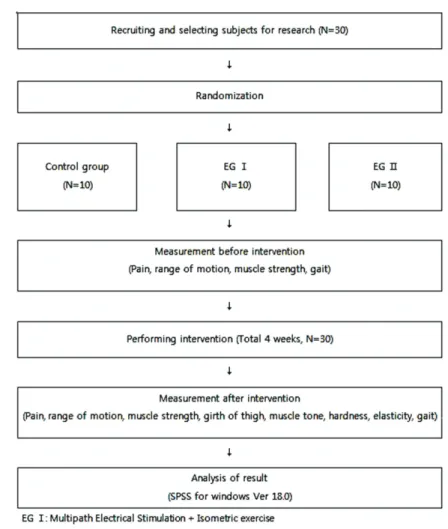
Fig. 1. Study flowchart.
2) Statistical Analysis
We will use SPSS version 18.0 for Windows for statistical handling of the result of this research and the achieved result was described as average ± standard deviation.
We tested general characteristic between groups of subjects with one-way ANOVA. The difference of pre/post experiment of each group was tested by using Paired t-test and for normality test, Levene’s equality of variance was used. In order to compare the difference between groups for variation pre experiment and pre/post experiment, we tested it with one-way ANOVA. And in order to explain
the difference between groups post experiment, we performed Bonferroni method for post analysis and conducted statistics process and statistical significance level(α) was set up as .05.
Ⅲ. Results
A flow chart of the study is shown in Fig. 1. The subjects
of this research are 30 people. They were designated as
3 groups in 10 people, the experimentⅠ performed
Multipath Electrical Simulation and isometric exercise,
Variable EG Ⅰ (n=10) EG Ⅱ (n=10) CG (n=10) Total (n=30) F p
Sex (male/female) 2/8 3/7 1/9 6/24
Age (year) 73.2±5.9
a72.2±8.6 67.4±9.0 70.9±8.1 .52 .24
Height (cm) 155.6±10.2 157.8±8.7 157.3±6.3 156.9±8.3 .18 .83
Weight (kg) 58.9±8.2 60.7±11.4 61.0±12.1 60.3±10.4 .11 .89
*p <.05
a