ABSTRACT
Objective: The impact of beta blockers (BBs) on survival outcomes in ovarian cancer was investigated.
Methods: By using Korean National Health Insurance Service Data, Cox proportional hazards regression was performed to analyze hazard ratios (HRs) with 95% confidence intervals (CIs) adjusting for confounding factors.
Results: Among 866 eligible patients, 206 (23.8%) were BB users and 660 (76.2%) were non-users. Among the 206 BB users, 151 (73.3%) were non-selective beta blocker (NSBB) users and 105 (51.0%) were selective beta blocker (SBB) users. BB use in patients aged ≥60 years, longer duration use (≥1 year), in patients with Charlson Comorbidity Index (CCI) ≥3, and in cardiovascular disease including hypertension was associated with better survival outcome. These findings were observed in both NSBB and SBB. When duration of medication was analyzed based on number of days, NSBB (≥180 days) was associated with improved overall survival (OS) with a relatively shorter period of use compared to SBB (≥720 days). In multivariate Cox proportional hazards model, longer duration of BB medication (≥1 year) was an independent favorable prognostic factor for both OS and disease-specific survival in ovarian cancer patients.
Conclusion: In our nationwide population-based cohort study, BB use was associated with better survival outcomes in ovarian cancer in cases of long term duration of use, in older patients, and in cardiovascular and/or other underlying disease (CCI ≥3).
Keywords: Ovarian Neoplasms; Adrenergic beta-Antagonists; Survival; Treatment Outcome
INTRODUCTION
Ovarian cancer is one of the five leading cause of cancer death among all malignancies worldwide [1]. Further, it is estimated to be the 8th most common cause of death and its incidence has increased approximately 50% over the recent 10 years in Korea [2,3].
Treatment of ovarian cancer includes primary debulking surgery followed by chemotherapy.
Incorporation of bevacizumab has been shown to improve survival outcome [4], but a
Original Article
Received: Jan 4, 2018 Revised: Jul 3, 2018 Accepted: Jul 4, 2018 Correspondence to Dae-Yeon Kim
Department of Obstetrics and Gynecology, University of Ulsan College of Medicine, Asan Medical Center, 88 Olympic-ro 43-gil, Songpa-gu, Seoul 05505, Korea.
E-mail: [email protected] Copyright © 2018. Asian Society of Gynecologic Oncology, Korean Society of Gynecologic Oncology
This is an Open Access article distributed under the terms of the Creative Commons Attribution Non-Commercial License (https://
creativecommons.org/licenses/by-nc/4.0/) which permits unrestricted non-commercial use, distribution, and reproduction in any medium, provided the original work is properly cited.
ORCID iDs Min-Hyun Baek
https://orcid.org/0000-0003-0423-9038 Dae-Yeon Kim
https://orcid.org/0000-0002-8068-3475 Seon Ok Kim
https://orcid.org/0000-0001-9010-5460 Presentation
Poster presented in 30 November 2017, Asian Society of Gynecologic Oncology, Tokyo, Japan.
Min-Hyun Baek ,1 Dae-Yeon Kim ,2 Seon Ok Kim ,3 Ye-Jee Kim,3 Young-Han Park1
1Department of Obstetrics and Gynecology, Hallym University Sacred Heart Hospital, Anyang, Korea
2 Department of Obstetrics and Gynecology, University of Ulsan College of Medicine, Asan Medical Center, Seoul, Korea
3Department of Biostatistics, University of Ulsan College of Medicine, Asan Medical Center, Seoul, Korea
Impact of beta blockers on survival outcomes in ovarian cancer:
a nationwide population-based cohort
study
Funding
This research was supported by Hallym University Research Fund 2016 (HURF-2016-06).
Conflict of Interest
No potential conflict of interest relevant to this article was reported.
Author Contributions
Conceptualization: B.M.H., P.Y.H.; Formal analysis: K.S.O, K.Y.J.; Funding acquisition:
B.M.H.; Project administration: B.M.H.;
Supervision: P.Y.H., K.D.Y.; Visualization: K.S.O., K.Y.J.; Writing – original draft: B.M.H.; Writing – review & editing: B.M.H.
majority of the patients (75%) still experience recurrence and succumb (70%) within five years [5]. Further, the use of bevacizumab is limited by its high cost and numerous adverse effects such as genitourinary fistula, gastrointestinal tract perforation, and hypertension in ovarian cancer patients [4]. Therefore, better therapeutic strategies are needed. The concept of drug repurposing is an alternative method to find promising therapeutic agents by uncovering anti-cancer effects of previously known drugs, reducing the cost, and time involved in finding investigational new drugs (INDs) [6].
Previous pre-clinical studies have shown that beta adrenergic receptors are commonly expressed on the surface of ovarian cancer cells [7]. Activation of these receptors by catecholamines produced due to chronic stress was found to be associated with carcinogenesis and tumor progression via evasion from apoptosis and acquisition of resistance to chemotherapy [8-10]. Catecholamines activate and enhance the expression of matrix metalloproteinases (MMPs) and vascular endothelial growth factor (VEGF) via the cyclic adenosine monophosphate (cAMP)/protein kinase A (PKA) pathway. These events increase invasiveness and metastatic potential of tumors leading to a higher tumor stage and worse survival outcomes in ovarian cancer [8,9,11]. Surprisingly, these pathways were found to be downregulated and even reversed when beta blockers (BBs) were administered to mice in previous preclinical studies [12-14].
Based on such promising evidence, a number of clinical studies sought to evaluate BBs for ovarian cancer treatment, but the results obtained were conflicting [14-21]. Ovarian cancer possesses a variable genetic background with characteristics differing between region and country. It is likely that each nation will need their own surveys and investigations to understand how BBs affect ovarian cancer prognosis in the context of multi-factorial social change. BBs are a treatment of choice for managing hypertension worldwide including Korea.
In addition, they are widely used to control cardiac arrhythmia, congestive heart failure, anxiety, and for secondary prevention of myocardial infarction [10]. It is because they are economically and ethically sound for both patients and researchers. Above all, their safety has been widely accepted over a long history of use. The proportion of the elderly is on the rise in Korea and use of BBs is likely to increase due to higher incidence of hypertension and related heart diseases.
If BBs have an anticancer effect, they can be potential therapeutic agents to relieve the financial burden involved in cancer therapy. Therefore, we performed a nationwide population-based cohort study to investigate the impact of BBs on survival outcomes in ovarian cancer.
MATERIALS AND METHODS
Data
Data collected in the South Korean National Health Insurance Service-National Sample Cohort (NHIS-NSC) database from 2002 to 2013 (released by NHIS in 2014) was used to perform the study. All individuals are enrolled in the NHIS, and NHIS-NSC represents the entire South Korean population (n=46,605,433) in terms of every demographic background with no significant differences [22]. The NHIS made available an encrypted 2.2% sample of the database (n=1,025,340) (national representative cohort) for researchers in 2002.
This was constructed via random stratified sampling per 5-year age groups, gender, income status, prescriptions, diagnosis, mortality, and health insurance status. The data is renewed every year by adding random samples of newborns and deletion of individuals undergoing
Study cohort
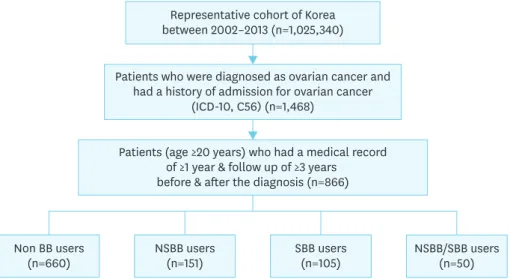
The 6th edition of the Korean Classification of Disease (KCD-6), which is a Korean version of the International Classification of Disease, 10th Revision (ICD-10) has been coded to categorize all diagnoses. We only included patients who were diagnosed with ovarian cancer (C56) and had a record of hospital admission due to ovarian cancer. Only patients who were older than 20 years of age at the time of diagnosis were included. Further, only patients who had a medical record of ≥1 year & follow up of ≥3 years before & after the diagnosis were included for better data accuracy and analysis (Fig. 1).
Definition of BB use
Both brand and generic names of drugs (based on the drug formulary code of the Korean Health Insurance Review and Assessment service), the prescription date, the number of days of supply, and administration route were found in the prescription data. This was coded based on the Anatomical Therapeutic Chemical (ATC) classification system. Selective beta blockers (SBBs) are drugs that block one of the beta1/2 adrenoreceptors. Non-selective beta blockers (NSBBs) are drugs that block all subtypes of beta adrenoreceptors. BB users were defined as individuals with at least one prescription within 90 days of diagnosis. Patients were classified as non-users when there was no prescription within 90 days of diagnosis, because it is customary in Korea to prescribe for 30-90 days period for long-term users.
Mortality
In total, follow-up data for the cohort over a 12-year period until 2013 were available in the database. Follow-up was performed from the date of diagnosis until the last visit, death, or emigration, whichever was first. Information on all-cause and disease specific mortality for all individuals in the cohort was analyzed.
Confounders
Potential confounders such as co-morbidities and medications were identified by sorting based on the ICD-10 and ATC codes. Prior use of diuretics, aspirin, statins, and year of diagnosis were assessed. Information on history and diagnosis of myocardial infarction, congestive heart failure, peripheral vessel disease, cerebrovascular disease, dementia,
Patients who were diagnosed as ovarian cancer and had a history of admission for ovarian cancer
(ICD-10, C56) (n=1,468)
Patients (age ≥20 years) who had a medical record of ≥1 year & follow up of ≥3 years before & after the diagnosis (n=866)
Non BB users
(n=660) NSBB users
(n=151) SBB users
(n=105) NSBB/SBB users
(n=50) Representative cohort of Korea
between 2002–2013 (n=1,025,340)
Fig. 1. Flow diagram of selection of the study patients.
BB, beta blocker; ICD-10, International Classification of Disease, 10th Revision; NSBB, non-selective beta blocker;
SBB, selective beta blocker.
chronic pulmonary disease, connective tissue disease, gastric ulcer, liver disease, diabetes mellitus with/without associated complication, hemiparesis, kidney disease, hematological malignancies, acquired immune-deficiency syndrome (AIDs), and other co-existing malignancies was obtained. The Charlson Comorbidity Index (CCI) was used to categorize and measure the burden of co-morbid diseases [23]. Multivariate Cox proportional hazard model was generated to identify an independent prognostic factor.
Statistical analysis
The proportion and frequency of deaths, covariates, and amount of accumulated person- time were calculated. Survival curves were constructed using Kaplan-Meier estimates and compared with results of the log-rank test. Cox proportional hazard regression was adopted to estimate hazard ratios (HRs) and 95% confidence intervals (CIs). Risk factor modeling was used to build a multivariate model including prior use of other medication, CCI, age group, and year of diagnosis. The p<0.05 was defined as the threshold for statistical significance. SAS software version 9.4 (SAS Institute, Inc., Cary, NC, USA) was used for statistical analysis.
Ethical approval
This study was approved from the Institutional Review Board review (No. 2016-I084) in Hallym University Sacred Heart Hospital.
RESULTS
We analyzed the mortality HRs in ovarian cancer patients based on BB medication use in various cohorts.
Impact of age
Among the 866 ovarian cancer patients, 206 (23.8%) were BB users and 660 (76.2%) were non-users. Among the 206 BB users, 151 (73.3%) were NSBB users and 105 (51.0%) were SBB users. Fifty (24.3%) patients were taking both NSBB and SBB (Fig. 1).
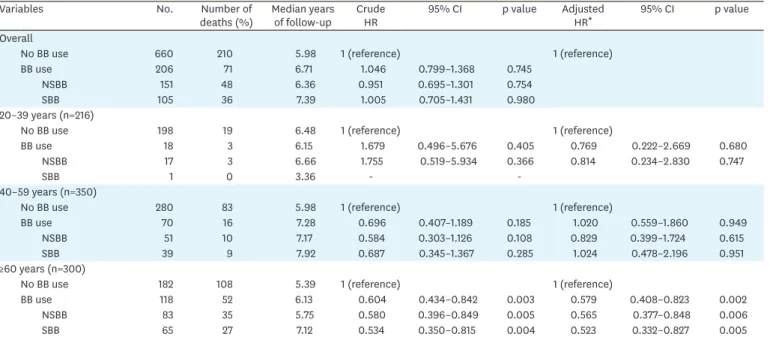
The median follow-up period was 5.98 and 6.71 years for non-users and users, respectively. In total, there was no survival difference between the 2 groups (HR=1.046; 95% CI=0.799–1.368;
p=0.745). However, when patients were sub-grouped based on their age at diagnosis, BB was associated with better survival outcome in patients of age ≥60 (adjusted HR=0.579; 95%
CI=0.408–0.823; p=0.002). Both NSBB (adjusted HR=0.565; 95% CI=0.377–0.848; p=0.006) and SBB (adjusted HR=0.523; 95% CI=0.332–0.827; p=0.005) were associated with better survival outcomes in patients of age ≥60 (Table 1 and Fig. 2A).
Impact of duration of medication
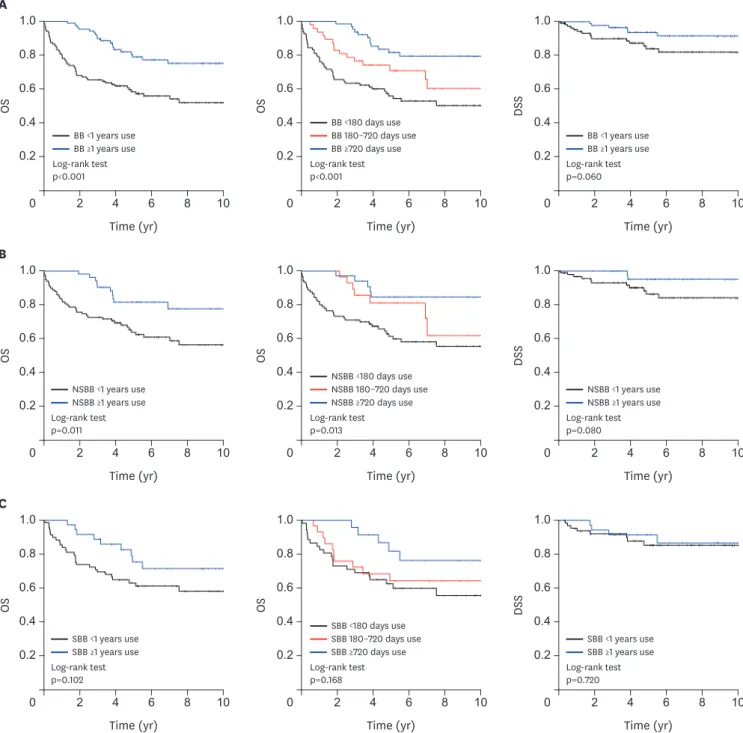
Longer duration of BB medication (≥1 year) was associated with better survival outcome in patients with ovarian cancer regardless of BB type (adjusted HR=0.306; 95% CI=0.187–
0.501; p<0.001). When patients were analyzed based on days of medication use, NSBB was associated with better survival outcome when it was used for ≥180 days (adjusted HR=0.387;
95% CI=0.179–0.837; p=0.016), while such a finding was observed in the SBB group with a longer duration of medication of ≥720 days (adjusted HR=0.275; 95% CI=0.111–0.684;
p=0.005, Table 2 and Fig. 3).
Table 1. Mortality HRs in ovarian cancer patients using BBs, based on age at diagnosis
Variables No. Number of
deaths (%) Median years
of follow-up Crude
HR 95% CI p value Adjusted
HR* 95% CI p value
Overall
No BB use 660 210 5.98 1 (reference) 1 (reference)
BB use 206 71 6.71 1.046 0.799–1.368 0.745
NSBB 151 48 6.36 0.951 0.695–1.301 0.754
SBB 105 36 7.39 1.005 0.705–1.431 0.980
20–39 years (n=216)
No BB use 198 19 6.48 1 (reference) 1 (reference)
BB use 18 3 6.15 1.679 0.496–5.676 0.405 0.769 0.222–2.669 0.680
NSBB 17 3 6.66 1.755 0.519–5.934 0.366 0.814 0.234–2.830 0.747
SBB 1 0 3.36 - -
40–59 years (n=350)
No BB use 280 83 5.98 1 (reference) 1 (reference)
BB use 70 16 7.28 0.696 0.407–1.189 0.185 1.020 0.559–1.860 0.949
NSBB 51 10 7.17 0.584 0.303–1.126 0.108 0.829 0.399–1.724 0.615
SBB 39 9 7.92 0.687 0.345–1.367 0.285 1.024 0.478–2.196 0.951
≥60 years (n=300)
No BB use 182 108 5.39 1 (reference) 1 (reference)
BB use 118 52 6.13 0.604 0.434–0.842 0.003 0.579 0.408–0.823 0.002
NSBB 83 35 5.75 0.580 0.396–0.849 0.005 0.565 0.377–0.848 0.006
SBB 65 27 7.12 0.534 0.350–0.815 0.004 0.523 0.332–0.827 0.005
BB, beta blocker; CCI, Charlson Comorbidity Index; CI, confidence interval; HR, hazard ratio; NSBB, non-selective beta blocker; SBB, selective beta blocker.
*Adjusted for comorbidity level, prior use of diuretics (yes/no), year of diagnosis, aspirin (yes/no), and statins (yes/no). Comorbidity was computed using the CCI score categorized into low (0), medium (1–2), or high (3+).
Time (yr)
OS 0.4
0.2
0 2 4
0.6 0.8 1.0
8
6 10
Time (yr) 0.4
0.2
0 2 4
DSS
0.6 0.8 1.0
8
6 10
Time (yr) 0.4
0.2
0 2 4
OS
0.6 0.8 1.0
8
6 10
Log-rank test vs NSBB p=0.754 vs SBB p=0.980
Time (yr)
DSS 0.4
0.2
0 2 4
0.6 0.8 1.0
8
6 10
Log-rank test vs NSBB p=0.200 vs SBB p=0.721 NSBB use
N0 BB use SBB use
Log-rank test vs NSBB p=0.005 vs SBB p=0.003
NSBB use N0 BB use SBB use
NSBB use N0 BB use SBB use
Log-rank test vs NSBB p=0.055 vs SBB p=0.159
NSBB use N0 BB use SBB use
Time (yr) 0.4
0.2
0 2 4
OS
0.6 0.8 1.0
8
6 10
B
Log-rank test p=0.003
BB use N0 BB use 0.4
0.2
0 2 4
OS
0.6 0.8 1.0
8
6 10
Time (yr) A
Log-rank test p=0.747
BB use N0 BB use
Fig. 2. (A) OS and DSS in patients with ovarian cancer based on BB use (NSBB or SBB) and no BB use. (B) OS and DSS in patients (age ≥60) with ovarian cancer based on BB use (NSBB or SBB) and no BB use.
BB, beta blocker; DSS, disease-specific survival; NSBB, non-selective beta blocker; OS, overall survival; SBB, selective beta blocker.
Impact of CCI
There was no survival difference between the CCI 0 (adjusted HR=1.080; 95% CI=0.119–
9.812; p=0.946) and 1–2 (adjusted HR=0.561; 95% CI=0.217–1.451; p=0.233) groups of ovarian cancer patients using BB medication. However, BB medication use was associated with better survival outcomes in ovarian cancer patients with CCI ≥3 (adjusted HR=0.690; 95%
CI=0.502–0.949; p=0.023). Both NSBB (adjusted HR=0.633; 95% CI=0.438–0.913; p=0.014) and SBB (adjusted HR=0.642; 95% CI=0.424–0.971; p=0.036) were associated with better survival outcomes in patients with CCI ≥3 (Table 3 and Fig. 4A).
Impact of hypertension
BB medication was associated with better survival outcome in ovarian cancer patients with hypertension (adjusted HR=0.647; 95% CI=0.452–0.926; p=0.017). Both NSBB (adjusted HR=0.632; 95% CI=0.414–0.964; p=0.033) and SBB (adjusted HR=0.564; 95% CI=0.365–
0.873; p=0.010) were associated with better survival outcome in patients with hypertension (Table 3 and Fig. 4B).
Impact of cardiovascular disease
Patients with ovarian cancer were considered as also having cardiovascular disease when they had more than one condition among hypertension, myocardial infarction, angina pectoris, and congestive heart failure. BB medication was associated with better survival outcome in ovarian cancer patients with cardiovascular disease (adjusted HR=0.655; 95% CI=0.463–
0.927; p=0.017). Both NSBB (adjusted HR=0.613; 95% CI=0.406–0.926; p=0.020) and SBB Table 2. Mortality HRs in ovarian cancer patients using BBs, based on duration of use
Variables No. Number of
deaths (%) Median years
of follow-up Crude
HR 95% CI p value Adjusted
HR* 95% CI p value
Overall
Nonusers 660 210 5.98 1 (reference) 1 (reference)
Current users with <1 years
BB use 119 52 6.08 1.475 1.089–1.998 0.012 1.045 0.758–1.439 0.789
Current users with ≥1
years BB use 87 19 7.12 0.581 0.363–0.930 0.024 0.306 0.187–0.501 0.000
Current users with <1 years
NSBB use 99 38 6.28 1.222 0.865–1.726 0.256 0.845 0.583–1.225 0.374
Current users with ≥1
years NSBB use 52 10 6.57 0.516 0.274–0.974 0.041 0.292 0.151–0.563 0.000
Current users with <1 years
SBB use 69 27 7.15 1.213 0.812–1.810 0.346 0.754 0.492–1.154 0.193
Current users with ≥1
years SBB use 36 9 7.49 0.663 0.340–1.292 0.227 0.340 0.169–0.683 0.002
Current BB users
<180 days 96 44 6.32 1.580 1.141–2.186 0.006 1.111 0.788–1.566 0.547
≥180 & <720 days 47 15 5.27 0.977 0.579–1.650 0.932 0.528 0.308–0.904 0.020
≥720 days 63 12 8.34 0.485 0.271–0.868 0.015 0.279 0.153–0.511 0.000
Current NSBB users
<180 days 90 36 6.38 1.295 0.909–1.844 0.152 0.913 0.624–1.337 0.641
≥180 & <720 days 28 7 5.29 0.722 0.340–1.534 0.398 0.387 0.179–0.837 0.016
≥720 days 33 5 7.43 0.386 0.159–0.936 0.035 0.235 0.095–0.579 0.002
Current SBB users
<180 days 52 21 6.08 1.273 0.813–1.993 0.292 0.705 0.438–1.133 0.149
≥180 & <720 days 29 10 7.39 1.025 0.543–1.932 0.940 0.718 0.373–1.384 0.322
≥720 days 24 5 8.82 0.522 0.215–1.267 0.150 0.275 0.111–0.684 0.005
BB, beta blocker; CCI, Charlson Comorbidity Index; CI, confidence interval; HR, hazard ratio; NSBB, non-selective beta blocker; SBB, selective beta blocker.
*Adjusted for age (20–39, 40–59, 60–79, ≥80 years), comorbidity level, prior use of diuretics (yes/no), year of diagnosis, aspirin (yes/no), and statins (yes/no).
Comorbidity was computed using the CCI score categorized into low (0), medium (1–2), or high (3+).
Time (yr) 0.4
0.2
0 2 4
OS
0.6 0.8 1.0
8
6 10
Time (yr)
DSS 0.4
0.2
0 2 4
0.6 0.8 1.0
8
6 10
0.4 0.2
0 2 4
OS
0.6 0.8 1.0
8
6 10
Time (yr) A
Log-rank test p<0.001
BB ≥1 years use BB <1 years use
Log-rank test p<0.001
BB 180–720 days use BB <180 days use BB ≥720 days use
Log-rank test p=0.060
BB ≥1 years use BB <1 years use
Time (yr)
OS 0.4
0.2
0 2 4
0.6 0.8 1.0
8
6 10
Time (yr) 0.4
0.2
0 2 4
DSS
0.6 0.8 1.0
8
6 10
Time (yr) 0.4
0.2
0 2 4
OS
0.6 0.8 1.0
8
6 10
B
Log-rank test p=0.011
NSBB ≥1 years use NSBB <1 years use
Log-rank test p=0.013
NSBB 180–720 days use NSBB <180 days use NSBB ≥720 days use
Log-rank test p=0.080
NSBB ≥1 years use NSBB <1 years use
Time (yr)
OS 0.4
0.2
0 2 4
0.6 0.8 1.0
8
6 10
Time (yr) 0.4
0.2
0 2 4
DSS
0.6 0.8 1.0
8
6 10
Log-rank test p=0.168
SBB 180–720 days use SBB <180 days use SBB ≥720 days use
Time (yr) 0.4
0.2
0 2 4
OS
0.6 0.8 1.0
8
6 10
C
Log-rank test p=0.102
SBB ≥1 years use SBB <1 years use
Log-rank test p=0.720
SBB ≥1 years use SBB <1 years use
Fig. 3. OS and DSS of patients with ovarian cancer based on duration of use of (A) BB, (B) NSBB, or (C) SBB.
BB, beta blocker; DSS, disease-specific survival; NSBB, non-selective beta blocker; OS, overall survival; SBB, selective beta blocker.
(adjusted HR=0.597; 95% CI=0.390–0.913; p=0.017) were associated with better survival outcome in patients with cardiovascular disease (Table 3 and Fig. 4C).
Multivariate Cox proportional hazards model and disease-specific survival (DSS) Kaplan Meier survival curve was generated according to DSS. NSBB was associated with better DSS outcome in ovarian cancer patients with CCI ≥3 (p=0.011, Fig. 4A). Although not statistically significant, BB use was associated with a tendency of better DSS outcome which is in accordance to the results with overall survival (OS) (Figs. 2-4).
Multivariate Cox proportional hazards analysis was performed according to both OS and DSS to identify an independent prognostic factor in ovarian cancer patients regardless of Table 3. Mortality HRs in ovarian cancer patients using BBs, based on the CCI, presence of hypertension, and cardiovascular disease
Variables No. Number of
deaths (%) Median years
of follow-up Crude HR 95% CI p value Adjusted HR* 95% CI p value CCI 0 (n=131)
No BB use 111 5 6.06 1 (reference) 1 (reference)
BB use 20 1 8.63 0.814 0.093–7.110 0.853 1.080 0.119–9.812 0.946
NSBB 12 1 7.18 1.537 0.179–13.221 0.695 2.659 0.250–28.321 0.418
SBB 9 0 9.80 - -
CCI 1–2 (n=219)
No BB use 186 34 5.97 1 (reference) 1 (reference)
BB use 33 6 7.45 0.946 0.397–2.257 0.901 0.561 0.217–1.451 0.233
NSBB 24 4 7.28 0.856 0.303–2.417 0.770 0.600 0.196–1.838 0.371
SBB 18 3 8.45 0.821 0.252–2.680 0.744 0.404 0.116–1.410 0.155
CCI ≥3 (n=516)
No BB use 363 171 5.78 1 (reference) 1 (reference)
BB use 153 64 5.78 0.810 0.608–1.080 0.151 0.690 0.502–0.949 0.023
NSBB 115 43 5.75 0.703 0.504–0.983 0.039 0.633 0.438–0.913 0.014
SBB 78 33 6.71 0.793 0.546–1.151 0.223 0.642 0.424–0.971 0.036
No hypertension (n=573)
No BB use 506 128 6.07 1 (reference) 1 (reference)
BB use 67 14 7.39 0.730 0.420–1.268 0.264 0.604 0.341–1.071 0.084
NSBB 59 12 7.17 0.710 0.393–1.283 0.257 0.578 0.312–1.069 0.080
SBB 18 4 9.02 0.738 0.272–1.997 0.549 0.615 0.218–1.733 0.358
Hypertension (n=293)
No BB use 154 82 4.92 1 (reference) 1 (reference)
BB use 139 57 5.87 0.642 0.458–0.901 0.010 0.647 0.452–0.926 0.017
NSBB 92 36 5.55 0.617 0.417–0.913 0.016 0.632 0.414–0.964 0.033
SBB 87 32 6.89 0.534 0.354–0.804 0.003 0.564 0.365–0.873 0.010
No cardiovascular disease (n=527)
No BB use 470 113 6.07 1 (reference) 1 (reference)
BB use 57 13 7.28 0.844 0.475–1.500 0.564 0.638 0.351–1.159 0.140
NSBB 51 12 7.17 0.881 0.486–1.598 0.678 0.640 0.344–1.190 0.159
SBB 16 3 9.17 0.630 0.200–1.985 0.430 0.484 0.143–1.644 0.245
Cardiovascular disease (n=339)
No BB use 190 97 5.47 1 (reference) 1 (reference)
BB use 149 58 6.10 0.653 0.472–0.904 0.010 0.655 0.463–0.927 0.017
NSBB 100 36 5.88 0.601 0.410–0.881 0.009 0.613 0.406–0.926 0.020
SBB 89 33 6.99 0.590 0.397–0.876 0.009 0.597 0.390–0.913 0.017
CCI score: 1, myocardial infarction, congestive heart failure, peripheral vascular disease, cerebrovascular disease, dementia, chronic pulmonary disease, connective tissue disease, gastric ulcer, mild liver disease, and diabetes mellitus without complication; 2, diabetes mellitus with retinopathy, neuropathy, and nephropathy, hemiparesis, kidney disease (≥ moderate), and non-metastatic solid tumor, leukemia, lymphoma, and multiple myeoloma; 3, liver disease (≥
moderate); 6, metastatic solid tumor, and acquired immunodeficiency syndrome.
BB, beta blocker; CCI, Charlson Comorbidity Index; CI, confidence interval; HR, hazard ratio; NSBB, non-selective beta blocker; SBB, selective beta blocker.
*Adjusted for age (20–39, 40–59, 60–79, ≥80 years), year of diagnosis, prior use of diuretics (yes/no), aspirin (yes/no), and statins (yes/no).
BB related underlying diseases. Age ≥60 and CCI ≥3 were independent prognostic factors for both lower OS and DSS. Hypertension and cardiovascular disease were not independent prognostic factors for both OS and DSS. Longer duration of both NSBB and SBB medication (≥1 year) was an independent favorable prognostic factor for OS in ovarian cancer patients (HR=0.266; 95% CI=0.163–0.435; p<0.001), while only NSBB medication (≥1 year) was an independent favorable prognostic factor for DSS (HR=0.178; 95% CI=0.043–0.746;
p=0.018, Table 4).
A
0.4 0.2
2 4
OS
0.6 0.8 1.0
8
6 10
Time (yr)
0.4 0.2
2 4
OS
0.6 0.8 1.0
8
6 10
Time (yr) Log-rank test vs NSBB p=0.038 vs SBB p=0.222
0.4 0.2
2 4
DSS
0.6 0.8 1.0
8
6 10
Time (yr)
0.4 0.2
0 0 0 0 2 4
DSS
0.6 0.8 1.0
8
6 10
Time (yr) Log-rank test vs NSBB p=0.011 vs SBB p=0.258
NSBB use N0 BB use SBB use NSBB use
N0 BB use SBB use
Log-rank test
p=0.151 Log-rank test
p=0.048 BB use N0 BB use BB use
N0 BB use
B
0.4 0.2
2 4
OS
0.6 0.8 1.0
8
6 10
Time (yr)
0.4 0.2
2 4
OS
0.6 0.8 1.0
8
6 10
Time (yr) Log-rank test vs NSBB p=0.015 vs SBB p=0.002
0.4 0.2
2 4
DSS
0.6 0.8 1.0
8
6 10
Time (yr)
0.4 0.2
0 0 0 0 2 4
DSS
0.6 0.8 1.0
8
6 10
Time (yr) Log-rank test vs NSBB p=0.073 vs SBB p=0.229
NSBB use N0 BB use SBB use NSBB use
N0 BB use SBB use
Log-rank test
p=0.010 Log-rank test
p=0.164 BB use N0 BB use BB use
N0 BB use
C
0.4 0.2
2 4
OS
0.6 0.8 1.0
8
6 10
Time (yr)
0.4 0.2
2 4
OS
0.6 0.8 1.0
8
6 10
Time (yr) Log-rank test vs NSBB p=0.008 vs SBB p=0.008
0.4 0.2
2 4
DSS
0.6 0.8 1.0
8
6 10
Time (yr)
0.4 0.2
0 0 0 0 2 4
DSS
0.6 0.8 1.0
8
6 10
Time (yr) Log-rank test vs NSBB p=0.073 vs SBB p=0.353
NSBB use N0 BB use SBB use NSBB use
N0 BB use SBB use
Log-rank test
p=0.010 Log-rank test
p=0.192 BB use N0 BB use BB use
N0 BB use
Fig. 4. OS and DSS of patients with ovarian cancer based on BB use (NSBB or SBB) and no BB use in (A) CCI ≥3, (B) hypertension, and (C) cardiovascular disease.
BB, beta blocker; CCI, Charlson Comorbidity Index; DSS, disease-specific survival; NSBB, non-selective beta blocker; OS, overall survival; SBB, selective beta blocker.
DISCUSSION
Immune-suppression by both physical and psychological stress is a contributory cause of tumorigenesis and disease progression [24]. Previous epidemiologic studies have shown that prolonged exposure of beta adrenergic receptors on ovarian cancer cell surfaces to catecholamines due to chronic stress causes further tumor growth [25]. There have been several retrospective and small pilot clinical studies and preclinical studies investigating the potential role of BBs, but the results were inconsistent.
First, small cohorts in single retrospective center studies with different approaches, patient characteristics, and confounders between the series may have been obstacles to elucidation of the clinical impact of BBs in ovarian cancer [15,16,20]. Second, most previous studies did not further analyze the effect of NSBBs and SBBs in ovarian cancer [15,16,18]. Further, there was no specific mention of “duration” or a clear “definition” of BB medication use in the majority of the previous series [15-17,20]. Tumorigenesis and disease progression in ovarian cancer due to stress responses is considered a “chronic process” and the duration of use among long-term BB users is important to verify efficacy. We additionally analyzed the effect of NSBBs and SBBs. Further, we strictly defined BB users on the basis of at least one prescription within 90 days of diagnosis.
Table 4. Multivariate Cox proportional hazards model in ovarian cancer patients using BBs
Variables BB use NSBB use SBB use
HR 95% CI p value HR 95% CI p value HR 95% CI p value
OS (281 events)
Duration of medication
No 1 1 1
<1 year 0.873 0.635–1.201 0.405 0.666 0.464–0.956 0.028 0.677 0.441–1.041 0.076
≥1 year 0.266 0.163–0.435 <0.001 0.289 0.150–0.558 <0.001 0.253 0.127–0.504 <0.001
Age (≥60 years) 2.470 1.857–3.286 <0.001 2.632 1.961–3.532 <0.001 2.526 1.867–3.416 <0.001 CCI
0 1 1 1
1–2 3.416 1.445–8.077 0.005 2.986 1.257–7.093 0.013 3.682 1.443–9.393 0.006
≥3 8.631 3.798–19.616 <0.001 7.265 3.178–16.608 <0.001 9.476 3.861–23.260 <0.001
Hypertension 1.389 0.812–2.378 0.230 1.349 0.774–2.349 0.291 1.218 0.707–2.099 0.477
Cardiovascular disease 0.842 0.497–1.428 0.524 0.806 0.467–1.388 0.436 0.931 0.546–1.587 0.793
Prior use of diuretics 2.560 1.955–3.353 <0.001 2.606 1.976–3.437 <0.001 2.506 1.890–3.321 <0.001 Prior use of statins 0.370 0.269–0.509 <0.001 0.367 0.261–0.516 <0.001 0.312 0.216–0.451 <0.001 DSS (100 events)
Duration of medication
No 1 1 1
<1 year 0.766 0.430–1.363 0.364 0.590 0.306–1.140 0.116 0.619 0.284–1.351 0.228
≥1 year 0.258 0.108–0.619 0.002 0.178 0.043–0.746 0.018 0.361 0.125–1.042 0.060
Age (≥60 years) 1.893 1.170–3.063 0.009 1.999 1.216–3.288 0.006 1.772 1.070–2.936 0.026
CCI
0 1 1 1
1–2 2.734 0.930–8.035 0.067 2.476 0.837–7.321 0.101 3.246 0.952–11.063 0.060
≥3 5.202 1.869–14.477 0.002 4.610 1.642–12.940 0.004 6.704 2.077–21.641 0.001
Hypertension 2.149 0.648–7.127 0.211 1.892 0.566–6.326 0.300 1.953 0.582–6.548 0.278
Cardiovascular disease 0.383 0.119–1.236 0.108 0.386 0.119–1.245 0.111 0.412 0.127–1.334 0.139
Prior use of diuretics 4.149 2.626–6.555 <0.001 4.072 2.563–6.471 <0.001 4.226 2.630–6.790 <0.001 Prior use of statins 0.321 0.182–0.566 <0.001 0.324 0.176–0.595 <0.001 0.291 0.155–0.545 <0.001 BB, beta blocker; CCI, Charlson Comorbidity Index; CI, confidence interval; DSS, disease-specific survival; HR, hazard ratio; NSBB, non-selective beta blocker;
OS, overall survival; SBB, selective beta blocker.
Finally, there has been no analysis to find a sub-group of patients who could more benefit from BB use. Johannesdottir et al. [18] found no promising effect of BB use on OS in ovarian cancer in their population-based cohort study by using the Danish cancer registry. However, BB use showed a tendency of association with improved survival outcomes in ovarian cancer when administered in an elderly group in the above study in accordance with the results in our series, although they found no statistical significance. A relatively short period of median BB use of 19 months and no subgroup analysis of BBs was a major shortcoming of the above series, preventing conclusions about the association of long term BB use with better prognosis. Above all, 2.55 years is a relatively short follow-up period to truly understand the long-term survival effect of BB medication in ovarian cancer. In our study, the effect of BB was analyzed with 6.71 years of long-term follow up in BB users and 5.98 years in non-users. In addition, duration of medication use was categorized into several groups for better analysis. Also, multivariate analysis according to DSS in addition to OS was performed to truly know the effect of BB.
In our study, BB use in elderly patients (≥60 years) and over a long term (≥1 year) showed prognostic improvement in ovarian cancer. Further, BB medication use was associated with better survival outcomes in ovarian cancer patients with cardiovascular and/or other underlying disease (CCI ≥3). Prolonged exposure to catecholamine due to chronic stress has been correlated with tumorigenesis and disease progression in epidemiologic research [25]. Elderly patients also tend to have a higher incidence of chronic cardiovascular disease, which may lead to longer intake of BBs compared to younger groups. Further, these patients are more prone to stress and may have been exposed for a longer period. Social isolation is an additional problem among the elderly and network support to enable them to deal with stress better by decreasing depression and eventually lowering circulating and disease-related norepinephrine levels should be considered [10]. BBs show their anticancer effects biologically or immunologically and by reducing disease-associated chronic stress psychologically [17]. We consider exposure to BBs for a long period of time due to higher incidence of chronic medical conditions and multiple psycho-social effects to be of
paramount importance in their anticancer effects. BBs can be beneficial agents for improving oncologic outcomes in patients with ovarian cancer, particularly in the elderly (≥60 years), considering the above background.
NSBB use (≥180 days) was associated with improved OS with a relatively shorter medication period than SBB use (≥720 days) in our series. Further, only NSBB medication (≥1 year) was an independent favorable prognostic factor for DSS in multivariate analysis. The reason for NSBBs showing an improved anticancer effect in comparison to SBBs has not been elucidated. We speculate that this may be because NSBBs cover a broad spectrum of beta adrenergic receptors compared to SBBs. NSBBs show anticancer effects by blocking the adrenergic receptor b2 (ADRB2) pathway which activates PKA and increases VEGF and MMP expression [13].
Retrospective study design was a limitation of the present study. BB was used because of its related underlying disease, and bias may still remain even confounders were meticulously adjusted by various methods. Further, detailed subtypes of ovarian cancer could not be identified from the current database. However, high general applicability and low selection bias compared to previous series was a strength of this study. Social characteristics which can be potential confounders were systematically adjusted based on the CCI system. Furthermore, confirmatory analysis was performed by generating multivariate Cox proportional hazards model by adopting both OS and DSS to minimize above mentioned problem.
After all, a prospective clinical trial may be the definite way to know whether BB truly has an anticancer effect on ovarian cancer without any potential bias. The only prospective randomized trial of BB use in ovarian cancer treatment was recently reported by Jang et al.
[26], and propranolol (NSBB) was associated with significant decrease in postoperative cancer antigen levels (CA-125), but not with disease-free survival. A small number of patients (n=22) from a single institution with a short follow-up duration (median, 17 months) was a major shortcoming of this series. Above all, there was no analysis of important parameters such as overall response rate, severe adverse events, and quality of life of the patients, making it difficult to draw conclusions. At the same time, Al-Niaimi et al. [21] reported improved survival outcomes due to perioperative metoprolol (SBB) intake with “Minnesota protocol” among a subgroup of patients who were considered “at risk”. SBBs were tested in patients with no cardiovascular disease including hypertension, potentially repositioning BBs as a new targeted agent in ovarian cancer treatment. Currently, a pilot and prospective study on feasibility of propranolol (NSBB) use in ovarian cancer treatment is ongoing (NCT01308944, NCT01504126, and NCT02013492). Results of these studies will provide a better picture of the anticancer effects of BBs and will be a basis for further well-designed multicenter clinical trials.
In conclusion, BB use was associated with better survival outcomes in ovarian cancer in cases of long-term use, in presence of hypertension, in cardiovascular and/or other underlying disease (CCI ≥3), and in older patients. If BBs are found to show survival improvement in ovarian cancer, they may be re-positioned as new targeted agents, relieving the economic burden involved in cancer treatment for both government and patients by substituting conventional targeted agents.
REFERENCES
1. Siegel RL, Miller KD, Jemal A. Cancer statistics, 2017. CA Cancer J Clin 2017;67:7-30.
PUBMED | CROSSREF
2. Jung KW, Won YJ, Oh CM, Kong HJ, Lee DH, Lee KH. Prediction of cancer incidence and mortality in Korea, 2017. Cancer Res Treat 2017;49:306-12.
PUBMED | CROSSREF
3. Lim MC, Moon EK, Shin A, Jung KW, Won YJ, Seo SS, et al. Incidence of cervical, endometrial, and ovarian cancer in Korea, 1999–2010. J Gynecol Oncol 2013;24:298-302.
PUBMED | CROSSREF
4. Burger RA, Brady MF, Bookman MA, Fleming GF, Monk BJ, Huang H, et al. Incorporation of bevacizumab in the primary treatment of ovarian cancer. N Engl J Med 2011;365:2473-83.
PUBMED | CROSSREF
5. du Bois A, Reuss A, Pujade-Lauraine E, Harter P, Ray-Coquard I, Pfisterer J. Role of surgical outcome as prognostic factor in advanced epithelial ovarian cancer: a combined exploratory analysis of 3 prospectively randomized phase 3 multicenter trials: by the Arbeitsgemeinschaft Gynaekologische Onkologie Studiengruppe Ovarialkarzinom (AGO-OVAR) and the Groupe d'Investigateurs Nationaux Pour les Etudes des Cancers de l'Ovaire (GINECO). Cancer 2009;115:1234-44.
PUBMED | CROSSREF
6. Chong CR, Sullivan DJ Jr. New uses for old drugs. Nature 2007;448:645-6.
PUBMED | CROSSREF
7. Rains SL, Amaya CN, Bryan BA. Beta-adrenergic receptors are expressed across diverse cancers.
Oncoscience 2017;4:95-105.
PUBMED
8. Armaiz-Pena GN, Allen JK, Cruz A, Stone RL, Nick AM, Lin YG, et al. Src activation by β-adrenoreceptors is a key switch for tumour metastasis. Nat Commun 2013;4:1403.
PUBMED | CROSSREF
9. Lutgendorf SK, Cole S, Costanzo E, Bradley S, Coffin J, Jabbari S, et al. Stress-related mediators stimulate vascular endothelial growth factor secretion by two ovarian cancer cell lines. Clin Cancer Res 2003;9:4514-21.
10. Bunch KP, Annunziata CM. Are beta-blockers on the therapeutic horizon for ovarian cancer treatment?
Cancer 2015;121:3380-3.
PUBMED | CROSSREF
11. Sood AK, Bhatty R, Kamat AA, Landen CN, Han L, Thaker PH, et al. Stress hormone-mediated invasion of ovarian cancer cells. Clin Cancer Res 2006;12:369-75.
PUBMED | CROSSREF
12. Lee JW, Shahzad MM, Lin YG, Armaiz-Pena G, Mangala LS, Han HD, et al. Surgical stress promotes tumor growth in ovarian carcinoma. Clin Cancer Res 2009;15:2695-702.
PUBMED | CROSSREF
13. Thaker PH, Han LY, Kamat AA, Arevalo JM, Takahashi R, Lu C, et al. Chronic stress promotes tumor growth and angiogenesis in a mouse model of ovarian carcinoma. Nat Med 2006;12:939-44.
PUBMED | CROSSREF
14. Hefner J, Csef H. The clinical relevance of beta blockers in ovarian carcinoma: a systematic review.
Geburtshilfe Frauenheilkd 2016;76:1050-6.
PUBMED | CROSSREF
15. Diaz ES, Karlan BY, Li AJ. Impact of beta blockers on epithelial ovarian cancer survival. Gynecol Oncol 2012;127:375-8.
PUBMED | CROSSREF
16. Heitz F, du Bois A, Harter P, Lubbe D, Kurzeder C, Vergote I, et al. Impact of beta blocker medication in patients with platinum sensitive recurrent ovarian cancer-a combined analysis of 2 prospective multicenter trials by the AGO Study Group, NCIC-CTG and EORTC-GCG. Gynecol Oncol 2013;129:463-6.
PUBMED | CROSSREF
17. Watkins JL, Thaker PH, Nick AM, Ramondetta LM, Kumar S, Urbauer DL, et al. Clinical impact of selective and nonselective beta-blockers on survival in patients with ovarian cancer. Cancer 2015;121:3444-51.
PUBMED | CROSSREF
18. Johannesdottir SA, Schmidt M, Phillips G, Glaser R, Yang EV, Blumenfeld M, et al. Use of β-blockers and mortality following ovarian cancer diagnosis: a population-based cohort study. BMC Cancer 2013;13:85.
PUBMED | CROSSREF
19. Minlikeeva AN, Freudenheim JL, Cannioto RA, Szender JB, Eng KH, Modugno F, et al. History of hypertension, heart disease, and diabetes and ovarian cancer patient survival: evidence from the ovarian cancer association consortium. Cancer Causes Control 2017;28:469-86.
PUBMED | CROSSREF
20. Heitz F, Hengsbach A, Harter P, Traut A, Ataseven B, Schneider S, et al. Intake of selective beta blockers has no impact on survival in patients with epithelial ovarian cancer. Gynecol Oncol 2017;144:181-6.
PUBMED | CROSSREF
21. Al-Niaimi A, Dickson EL, Albertin C, Karnowski J, Niemi C, Spencer R, et al. The impact of perioperative β blocker use on patient outcomes after primary cytoreductive surgery in high-grade epithelial ovarian carcinoma. Gynecol Oncol 2016;143:521-5.
PUBMED | CROSSREF
22. Lee J, Lee JS, Park SH, Shin SA, Kim K. Cohort profile: the National Health Insurance Service-National Sample Cohort (NHIS-NSC), South Korea. Int J Epidemiol 2017;46:e15.
PUBMED
23. Charlson ME, Pompei P, Ales KL, MacKenzie CR. A new method of classifying prognostic comorbidity in longitudinal studies: development and validation. J Chronic Dis 1987;40:373-83.
PUBMED | CROSSREF
24. Charmandari E, Tsigos C, Chrousos G. Endocrinology of the stress response. Annu Rev Physiol 2005;67:259-84.
PUBMED | CROSSREF
25. Glaser R, Kiecolt-Glaser JK. Stress-induced immune dysfunction: implications for health. Nat Rev Immunol 2005;5:243-51.
PUBMED | CROSSREF
26. Jang HI, Lim SH, Lee YY, Kim TJ, Choi CH, Lee JW, et al. Perioperative administration of propranolol to women undergoing ovarian cancer surgery: a pilot study. Obstet Gynecol Sci 2017;60:170-7.
PUBMED | CROSSREF