• 검색 결과가 없습니다.

Exploring the Catalytic Significant Residues of Serine Protease Using Substrate-Enriched Residues and a Peptidase Inhibitor

N/A
N/A
Protected

Academic year: 2021

Share "Exploring the Catalytic Significant Residues of Serine Protease Using Substrate-Enriched Residues and a Peptidase Inhibitor"

Copied!
10
0
0

로드 중.... (전체 텍스트 보기)

전체 글

(1)

Exploring the Catalytic Significant Residues of Serine Protease Using Substrate-Enriched Residues and a Peptidase Inhibitor

Zahoor Khan

1,2

, Maryam Shafique

2

*, Amir Zeb

3,4

, Nusrat Jabeen

1

, Sehar Afshan Naz

2

, and Arif Zubair

5

1

Department of Microbiology, University of Karachi 75270, Pakistan

2

Department of Microbiology, Federal Urdu University of Arts, Science and Technology, Karachi 75300, Pakistan

3

Division of Applied Life Science, Gyeongsang National University, Jinju 52828, Republic of Korea

4

College of Pharmacy and Graduate School of Pharmaceutical Sciences, Ewha Womans University, Seoul 03760, Republic of Korea

5
Department of Environmental Sciences, Federal Urdu University of Arts, Science and Technology, Karachi 75300, Pakistan

Received: September 28, 2020 / Revised: November 4, 2020 / Accepted: November 30, 2020

Introduction

Bacillus tequilensis has recently emerged as an ideal candidate to produce extracellular enzymes having numerous potential commercial applications [1]. Alkaline protease from Bacillus tequilensis P15 demonstrated effective destaining, dehairing and gelatinolytic potentials [2]. Similarly, a novel keratinase from Bacillus tequilensis Q7 showed excellent dehairing and bating potential [3].

Alkaline protease from Bacillus tequilensis ZMS-2 exhibited multifarious commercial catalytic potential including fibrinolytic, antimicrobial, anti-coagulant, caseinolytic, fibrinolytic and dehairing potentials [1].

Microbial proteases represent a commercially viable group of hydrolytic enzymes which catalyze protein into small peptides and/or free amino acids. They are highly desirable in industries such as leather processing, deter- gent manufacturing, food and feed production, peptide synthesis, photography, silk degumming and waste management [4]. Thus, have a market share of over 65%

in global enzyme market [5]. Proteases are classified Serine proteases are the most versatile proteolytic enzymes with tremendous applications in various industrial processes. This study was designed to investigate the biochemical properties, critical residues, and the catalytic potential of alkaline serine protease using in-silico approaches. The primary sequence was analyzed using ProtParam, SignalP, and Phyre2 tools to investigate biochemical properties, signal peptide, and secondary structure, respectively. The three-dimensional structure of the enzyme was modeled using the MODELLER program present in Discovery Studio followed by Molecular Dynamics simulation using GROMACS 5.0.7 package with CHARMM36m force field. The proteolytic potential was measured by performing docking with casein- and keratin-enriched residues, while the effect of the inhibitor was studied using phenylmethylsulfonyl fluoride, (PMSF) applying GOLDv5.2.2. Molecular weight, instability index, ali- phatic index, and isoelectric point for serine protease were 39.53 kDa, 27.79, 82.20 and 8.91, respectively.

The best model was selected based on the lowest MOLPDF score (1382.82) and DOPE score (-29984.07). The analysis using ProSA-web revealed a Z-score of -9.7, whereas 88.86% of the residues occupied the most favored region in the Ramachandran plot. Ser327, Asp138, Asn261, and Thr326 were found as critical resi- dues involved in ligand binding and execution of biocatalysis. Our findings suggest that bioengineering of these critical residues may enhance the catalytic potential of this enzyme.

Keywords: Catalytic potential, serine protease, caseinolytic, keratinolytic, modeling

*Corresponding author Tel: +92-300-5266109

E-mail: [email protected]

(2)

into various groups based on residues in their active sites and catalytic mechanisms. This includes serine proteases, cysteine proteases, aspartic proteases, metal- loproteases, threonine protease, glutamic protease, and asparagine protease [4, 6]. Serine proteases are charac- terized by the presence of serine residue at their active sites. The catalytic triad of serine exopeptidases and endopeptidases is composed of His (base), Asp (electro- phile) and Ser (nucleophile). Catalysis by serine protease is processed in two steps: In first step, the serine residue and substrate form an acyl-enzyme intermediate. In the second step, the water molecule hydrolyzes the acyl- enzyme intermediate to release the peptide [6]. The main reason behind the growing interest in microbial serine proteases in the last decade is their applications mainly in leather tanning, detergent formulation and diagnostics [7].

Keratin is an insoluble, high sulfur-containing protec- tive protein constituting the bulk of epidermal append- ages such as hair, nails, claws, turtle scutes, horns and feathers. Keratin hydrolysate has vast commercial applications in regenerative medicine materials, tissue engineering, in the production of keratin-based coatings and as fibers in polymer reinforcements [8]. Hair is mainly composed of α-keratin, having high abundance of alanine, leucine, arginine and cysteine [9]. Casein is a complex milk protein composed of α

S1

-, α

S2

-, β-, k-casein and colloidal phosphate calcium [10]. Commercial appli- cations of casein include its use as binding material in plastics industry, in synthesis of cotton fibers and as sta- bilizer in food industry [11, 12]. Bovine casein contains highest fractions of leucine, lycine, isoleucine and valine residues [13].

Bioinformatics tools can reveal catalytic potentials and ligand binding specificities of target enzyme erst- while proceeding towards its bulk production at indus- trial level. Similarly, molecular docking studies help us to predict noncovalent interactions, conformation and binding affinity by characterizing the behavior of ligand molecule(s) in catalytic site of the target protein [14].

Furthermore, improved force fields, motions on the micro-second, and scale processes (protein folding) of Molecular Dynamics (MD) simulation has potential to study spatial and temporal resolution of target protein [15]. This study unveils the biochemical properties, cata- lytic potentials and binding patterns of an alkaline ser-

ine protease using in-silico techniques.

Material and Methods

Primary structure and biochemical properties

As the 3D structure of alkaline serine protease (ASP) from Bacillus tequilensis was not available in Protein Data Bank (PDB), thus, the primary sequence of ASP was obtained from NCBI (GenBank: SPT94135.1). The biochemical properties and Signal peptide for this sequence were investigated using online ProtParam tool [16] and SignalP 5.0 [17], respectively.

Prediction of secondary structure

Phyre2 (Protein Homology/analogy Recognition Engine V 2.0) program was implied to predict the secondary structure for the target enzyme. This online program uses the self-optimized prediction method (SOPM) to increase the second-order forecast improvement rate based on the primary sequence [18].

Identification of conserved sequences

The amino acids sequence alignment was carried out using UniProt-BLAST to identify the sequences having highest level of similarity with ASP. Top 5 sequences having more than 90% identity with ASP were then sub- jected to Multiple Sequence Alignment using CLUSTAL Omega (1.2.4) algorithm in EMBL-EBI to identify con- served residues followed by construction of phylogenetic tree.

Homology modeling and identification of critical residues The primary sequence of ASP was used to identify the best fitted template proteins using basic local alignment search tool for proteins (BLAST-P) and position-specific iterated basic local alignment search tool (PSI-BLAST) in NCBI. During the Protein BLAST, the primary sequences of target serine protease showed highest level of similarity and e-value with the crystallographic struc- ture of subtilisin (PDB ID: 1SBN) from Bacillus subtilis.

Hence, the aligned sequence of target-template proteins was subjected to MODELLER program in Discovery Studio and ten models were generated.

Model validation

The most suitable model was subjected to MD simula-

(3)

tion and energy minimization to obtain the native conformation of the final model. The MD simulation was performed by GROMACS 5.0.7 package with CHARMM36mforce field [19]. The simulation system was prepared in octahedral box with TIP3P water model and neutralized by 0.1 M NaCl solution. The simulation was equilibrated in two steps: NVT equilibration was carried out for 100 ps at 300 K, while the NPT equilibra- tion was performed for 100 ps at 1.0 bar pressure. NVT and NPT equilibrations were carried out by V-rescale and Parrinello-Rahman barostat, respectively. The pro- duction ensemble was carried out for 10 ns under the periodic boundary condition with LINCS algorithm. The stereochemical quality and accuracy of the MD-refined model was validated by ProSA-web [20, 21] and the RAMPAGE [22].

Molecular docking studies

Genetic optimization of ligand docking (GOLD v5.2.2) [23], was used for molecular docking studies of ASP with designated ligands. The modeled protease was used as receptor while amino acids residues (mimicking the binding site of casein and keratin) and PMSF (inhibitor) were prepared as ligands. The binding site of modeled protein was traced from its catalytic site residues and superimposed over the template structure. A total of fifty conformers were generated for each ligand molecule in the binding site of modeled protease via Genetic Algorithm (GA) module implanted in GOLD package.

Finally, the best fitted pose of each ligand was selected based on highest ChemPLP score, conformational stabil- ity and hydrogen bond interactions with the active site residues of the modeled protein. The docking results were analyzed by Discovery Studio and GOLD package.

Results and Discussion

Primary structure and biochemical properties

Analysis by ProtParam revealed that the ASP was a polypeptide of 381 amino acids residues having an esti- mated molecular weight of 39.53 kDa. The estimated half-life was 30 hours (mammalian reticulocytes, in vitro), >20 hours (yeast, in vivo) and >10 hours ( Escherichia coli, in vivo). Furthermore, the instability index was computed to be 27.79, which suggests that the enzyme is stable. The aliphatic index, the Grand aver-

age of hydropathicity (GRAVY) and the isoelectric point for the enzyme were calculated as 82.20, -0.081 and 8.91, respectively.

Signal peptide prediction

Signal peptide for the ASP was predicted using SignalP 5.0, which revealed a cleavage site between res- idue at position no. 29 and 30 with a probability of 0.8903 (Fig. 1). Similarly, the likelihood scores for signal peptide (Sec/SPI), TAT signal peptide (Tat/SPI) and lipoprotein signal peptide (Sec/SPII) were 0.9893, 0.0026 and 0.0065, respectively.

Prediction of secondary structure

The secondary structure of the ASP was predicted by applying Phyre2 program utilizing SOPMA method [18].

The results revealed that the secondary structure of ASP from Bacillus tequilensis was composed of 28% α- helix, 25% β-sheet (Fig. 1). A similar study reported 27%

α-helix and 26% β-sheet in the secondary structure of keratinase from Bacillus mojavensis [24].

Homology modelling and critical residues

During homology modelling, the sequence alignment of the target protein showed high sequence similarity with the crystal structure of subtilisin (PDB ID: 1SBN) from Bacillus subtilis with presence of serine residue in the catalytic pocket classifying it as serine protease (Fig.

2A). The comparative analysis of both the sequences suggested that Asp138, Asn261, Thr326, and Ser327 are the critical residues of the target sequence involved in ligand binding and catalysis.

Structure development

The crystal structure of subtilisin from Bacillus subtilis was used as template for the homology modeling of ASP.

Among the ten models generated by MODELLER pro- gram, the best model of target protein was selected based on the lowest molecular probability density function (MOLPDF) score (1382.82) and DOPE score (-29984.07).

Structure validation

The representative structure for serine protease was extracted after MD simulation refinement (Fig. 2B).

Upon superimposition of the MD-refined serine protease

(4)

and its template structure (PDB ID: 1SBN) suggested that serine protease also folded in identical 3D structure (Fig. 2C). The modelled protease folded in native confor- mation like other serine proteases. The stereo-chemical quality of the refined structure revealed that 88.86% of the residues occupied the most favored region of the Ramachandran plot (Fig. 2D). These results suggest that phi ( φ) and psi (ψ) backbone dihedral angles in the modeled structure are reasonably accurate. Analysis of the structure by ProSA-web revealed a Z-score of -9.7, which was within the range of Z-scores of experimen- tally determined structures (Fig. 2E).

Molecular docking studies

The interaction pattern of the docked ligands sug-

gested that each ligand formed a hydrogen bond (H-

bond) interaction with Ser327 of the serine protease

(Figs. 5 −7). A similar binding of ligand residues in the

substrate binding site has been reported by previous

studies [25, 26]. The formation of H-bond at such residue

is essentially important in ensuring effective binding of

the enzyme with ligand. The establishment of several H-

bonds with other residues of the target protein ensured

tight binding of ligand with target protein is in strong

coherence with earlier studies [25, 27]. Apart from that,

each ligand molecule also formed Van der Waals/hydro-

phobic interactions with the catalytic pocket residues of

the target protein resulting a more workable binding

(Table 1). Current study also foresees that modification

of residues in the catalytic triad can help to enhance the

Fig. 1. Phyre2 analysis of ASP displaying α-helix and β-sheet. The black arrow showing a cleavage site between residue at

position no. 29 and 30 predicted using SignalP 5.0

(5)

catalytic efficiency and substrate specificity of serine protease [27]. All these data suggested that each ligand molecule could potentially bind the substrate binding site of serine protease and may facilitate either the cata- lytic activity or inhibit the target protein.

Docking studies with keratin enriched residues

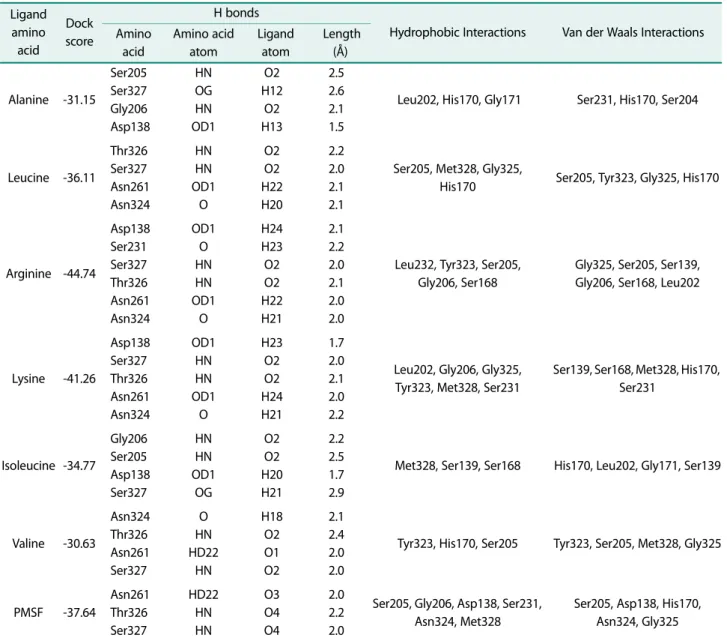
The interaction of alanine residue in the catalytic site

of modelled protease was favored by 4 H-bonds with Ser205, Ser327, Gly206 and Asp138 resulting a docking score of -31.15 kJ/mol. This binding was further stabi- lized by hydrophobic/Van der Waals interactions of Ser231, Leu202, His170, Gly171, and Ser204. The bind- ing of leucine residue with a docking score of -36.11 kJ/

mol was improved by Thr326, Ser327, Asn261 and Asn324 through H-bonding and further supported by Fig. 2. Homology modelling and model validation of ASP. (A) Sequence alignment of ASP with ISBN. (B) Ribbon diagram of ASP.

(C) Ribbon diagram of ASP and ISBN superimposition. (D) Ramachandran plot, showing 88.86% of the residues occupied the most

favored region. (E) Analysis of ASP structure by ProSA-web revealing a Z-score of -9.7.

(6)

hydrophobic/Van der Waals interactions involving Ser205, Met328, Tyr323, Gly325 and His170. Arginine was bound with a dock score of -44.74 kJ/mol due to 6 H- bonds favored by Asp138, Ser231, Ser327, Thr326, Asn261 and Asn324 and hydrophobic/Van der Waals interactions by Leu232, Gly325, Tyr323, Ser205, Ser139, Gly206, Ser168 and Leu202 (Fig. 3).

The binding affinity and dock score of ASP with kera- tin enriched residues suggests its catalytic potential towards keratin. This keratinolytic potential of protease can be well exploited for dehairing during leather pro- cessing. Proteases with keratinolytic/dehairing potential have been reported previously [1, 28] which can serve as effective tools for the replacement of notorious chemicals conventionally in use. During the process of enzymatic dehairing, proteases attack the basal cells of the hair bulb along with cells of malphigian layer tailed by slack- ening of hair and breakdown of the inner root sheath as well as the non-keratinized parts of hair [29]. It is note- worthy that not all proteases are applicable for dehairing

because of their collagenolytic activity [30]. Therefore, such proteases having high keratinolytic and no or low collagenolytic activity are ideal for industrial application [31]. These proteases selectively degrade the soft keratin tissue in the follicle, thereby pulling out intact hairs without affecting tensile strength of the leather [32]. The use proteases in dehairing support the elimination of lime and sodium sulfide, helping to minimize the prob- lem of stream pollution in addition to improved leather quality [33]. The ASP from Bacillus tequilensis showed excellent catalytic potential toward keratin substrate during docking studies and this potential may be further confirmed during empirical studies to use it as a better alternative in deharing.

Docking studies with casein enriched residues

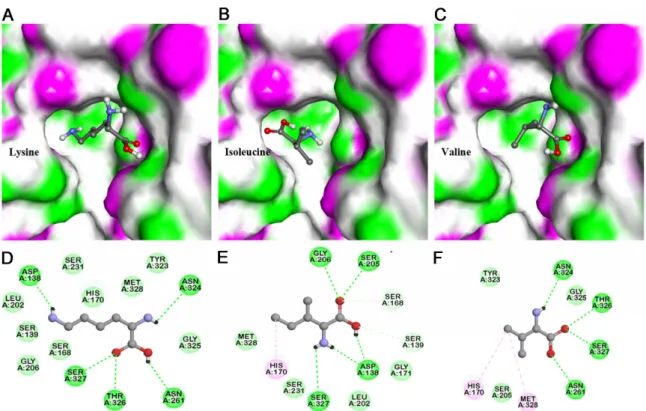
The best docking pose for lysine residue established a

dock score of -41.26 kJ/mol supported by 6 H-bonds with

Asp138, Ser327, Thr326, Asn261 and Asn324 residues of

the ASP. Moreover, non-H bond interactions for this

Fig. 3. Molecular orientation and binding pattern of keratin enriched residues with ASP. (A-C) Depict the 3D orientation of ala-

nine, leucine, and arginine residues from substrate (keratin) in the substrate binding site of ASP. (D-F) Depict the 2D interactions

pattern of alanine, leucine, and arginine with ASP. The interacting residues of ASP are portrayed and labelled. The substrate residues

are represented as ball and stick models. Hydrogen bonds are depicted as dashed lines.

(7)

ligand involved Leu202, Ser139, Ser168, Gly206, Gly325, Tyr323, Met328, His170 and Ser231. Isoleucine was bound in the catalytic triad with 4 H-bonds (Gly206, Ser205, Asp138 and Ser327) and hydrophobic/Van der Waals interactions (Met328, His170, Leu202, Gly171, Ser139 and Ser168) portraying the dock score of -34.77 kJ/mol. Similarly, valine with a dock score of -30.63 kJ/

mol was bound using H-bonds (Asn324, Thr326, Asn261 and Ser327) and hydrophobic/Van der Waals interac- tions (Tyr323, His170, Ser205, Met328 and Gly325) with the modelled structure of ASP (Fig. 4).

The caseinolytic potential of a protease is very ideal for its potential commercial applications in food and phar- maceutical industries. During casein hydrolysis, prote- ase cleaves the peptide bonds within the polypeptide chains of complex structure of casein, leading to genera- tion of peptides of varying length [34]. The caseinolytic potential of protease has immense commercial import- ant as casein hydrolysates are used as calcium binding

peptides [35] and as stabilizers in food industry [12]. The ASP from Bacillus tequilensis showed affinity and bind- ing specificity towards casein enriched residues as observed during in-silico studies, pointing towards its confirmation through empirical studies and potential applications in relevant industries.

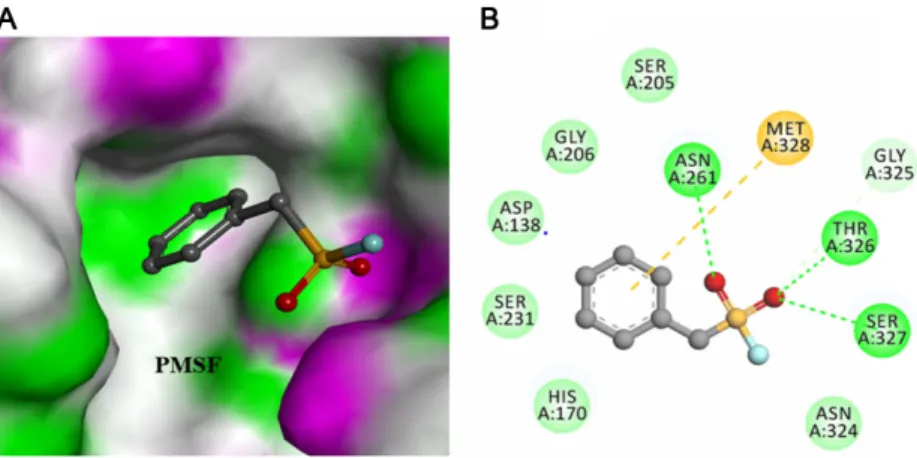
Docking studies with PMSF

In case of PMSF, 3 H-bonds (Asn261, Thr326 and Ser327) were observed with the target protein resulting a dock score of -37.64 kJ/mol. The same bonding of PMSF with Serine residue is reported in previous stud- ies leading to complete inactivation of target protease [25, 26]. Furthermore, a significant number of hydropho- bic/Van der Waals interactions were recorded between PMSF and the modelled structure of serine protease (Table 1). These interactions between ASP and PMSF interactions collectively result into the inhibition cata- lytic activity of enzyme (Fig. 5).

Fig. 4. Molecular orientation and binding pattern of casein enriched residues with ASP. (A-C) Represent the 3D orientation of

lysine, isoleucine, and valine residues from substrate (casein) in the substrate binding site of ASP (D-F) Depict the 2D interactions

pattern of lysine, isoleucine, and valine and ASP. The interacting residues of ASP are portrayed and labelled. The substrate residues

are portrayed as ball and stick models. Hydrogen bonds are depicted as dashed lines.

(8)

Table 1. Docking score and binding pattern of substrates residues and PMSF with ASP.

Ligand amino acid

Dock score

H bonds

Hydrophobic Interactions Van der Waals Interactions Amino

acid

Amino acid atom

Ligand atom

Length (Å)

Alanine -31.15

Ser205 Ser327 Gly206 Asp138

HN OG HN OD1

O2 H12

O2 H13

2.5 2.6 2.1 1.5

Leu202, His170, Gly171 Ser231, His170, Ser204

Leucine -36.11

Thr326 Ser327 Asn261 Asn324

HN HN OD1

O

O2 O2 H22 H20

2.2 2.0 2.1 2.1

Ser205, Met328, Gly325,

His170 Ser205, Tyr323, Gly325, His170

Arginine -44.74

Asp138 Ser231 Ser327 Thr326 Asn261 Asn324

OD1 O HN HN OD1

O

H24 H23 O2 O2 H22 H21

2.1 2.2 2.0 2.1 2.0 2.0

Leu232, Tyr323, Ser205, Gly206, Ser168

Gly325, Ser205, Ser139, Gly206, Ser168, Leu202

Lysine -41.26

Asp138 Ser327 Thr326 Asn261 Asn324

OD1 HN HN OD1

O

H23 O2 O2 H24 H21

1.7 2.0 2.1 2.0 2.2

Leu202, Gly206, Gly325, Tyr323, Met328, Ser231

Ser139, Ser168, Met328, His170, Ser231

Isoleucine -34.77

Gly206 Ser205 Asp138 Ser327

HN HN OD1

OG

O2 O2 H20 H21

2.2 2.5 1.7 2.9

Met328, Ser139, Ser168 His170, Leu202, Gly171, Ser139

Valine -30.63

Asn324 Thr326 Asn261 Ser327

O HN HD22

HN

H18 O2 O1 O2

2.1 2.4 2.0 2.0

Tyr323, His170, Ser205 Tyr323, Ser205, Met328, Gly325

PMSF -37.64

Asn261 Thr326 Ser327

HD22 HN HN

O3 O4 O4

2.0 2.2 2.0

Ser205, Gly206, Asp138, Ser231, Asn324, Met328

Ser205, Asp138, His170, Asn324, Gly325

The table shows the Ligand (as amino acid name; column 1), Docking score for each amino acid ligand in the active site of ASP, the H-bonds between each amino acid ligand and amino acids of ASP where the H-bond forming atoms are represented by their respective number in the corresponding ligand (either ASP amino acid or ligand amino acid). Finally, the hydrophobic interactions and van der Waals interactions made by the amino acid residues (along with their sequence number) of ASP are also shown

Conclusion

Current study highlighted the biochemical properties, secondary structure, catalytic potential of a serine prote- ase from Bacillus tequilensis. The study determined the binding affinity, substrate specificity and substrate rec- ognition pattern of the modelled serine protease with the

keratin and casein enriched residues. Based on these

findings, we can safely assume the keratinolytic and

caseinolytic potential of this ASP. Ser327, Asp138,

Asn261 and Thr326 were found important residues

involved in binding and catalysis, suggesting that modi-

fication of residues at catalytic triad may further

enhance its catalytic potential.

(9)

Acknowledgments

The authors acknowledge Higher Education Commission, Pakistan for the provision of funds for this study through TDF Grant No. 02-078 (awarded to corresponding author) and for Indigenous Ph.D. fellow- ship (awarded to first author).

Conflict of Interest

The authors have no financial conflicts of interest to declare.

References

1. Khan Z, Shafique M, Nawaz HR, Jabeen N, Naz SA. 2019. Bacillus tequilensis ZMS-2: A novel source of alkaline protease with anti- microbial, anti-coagulant, fibrinolytic and dehairing potentials.

Pak. J. Pharm. Sci. 32:1913-1918.

2. Bose A, Chawdhary V, Keharia H, Subramanian RB. 2014. Produc- tion and characterization of a solvent-tolerant protease from a novel marine isolate Bacillus tequilensis P15. Ann. Microbiol. 64:

343-354.

3. Zaraî Jaouadi N, Rekik H, Ben Elhoul M, Rahem FZ, Hila CG, Ben Aicha HS, et al. 2015. A novel keratinase from Bacillus tequilensis strain Q7 with promising potential for the leather bating process.

Int. J. Biol. Macromol. 79: 952-64.

4. Gupta R, Beg QK, Lorenz P. 2002. Bacterial alkaline proteases:

molecular approaches and industrial applications. Appl. Microbiol.

Biotechnol. 59: 15-32.

5. Annamalai N, Rajeswari MV, Balasubramanian T. 2014. Extraction, purification and application of thermostable and halostable alkaline protease from Bacillus alveayuensis CAS 5 using marine wastes. Food Bioprod. Process. 92: 335-342.

6. Rao MB, Tanksale AM, Ghatge MS, Deshpande VV. 1998. Molecular and biotechnological aspects of microbial proteases. Microbiol.

Mol. Biol. Rev. 62: 597-635.

7. Alemu F. 2015. Isolation and screening of protease enzyme pro- ducing bacteria from cheese at Dilla University, Ethiopia. Int. J.

Food. Sci. Nutr. 4: 234-239.

8. Shavandi A, Silva TH, Bekhit AA, Bekhit AE. 2017. Keratin: dissolu- tion, extraction and biomedical application. Biomater. Sci. 5:

1699-1735.

9. Burkhard P, Stetefeld J, Strelkov, Sergei V. 2001. Coiled coils: a highly versatile protein folding motif. Trends Cell Biol. 11: 82-88.

10. Horne DS. 2006. Casein micelle structure: models and muddles.

Curr. Opin. Colloid Interface Sci. 11: 148-153.

11. Su D, Zhong Q. 2016. Formation of thymol nanoemulsions with combinations of casein hydrolysates and sucrose stearate. J.

Food Eng. 179: 1-10.

12. Alongi J, Carletto RA, Bosco F, Carosio F, Blasio AD, Cuttica F, et al.

2014. Caseins and hydrophobins as novel green flame retardants for cotton fabrics. Polym. Degrad. Stabil. 99: 111-117.

13. Rafiq S, Huma N, Pasha I, Sameen A, Mukhtar O, Khan MI. 2016.

Chemical composition, nitrogen fractions and amino acids pro- file of milk from different animal species. Asian-Australas. J. Anim.

Sci. 29: 1022-1028.

14. Trott O, Olson A. 2010. AutoDock Vina: improving the speed and accuracy of docking with a new scoring function, efficient opti- mization, and multithreading. J. Comp. Chem. 31: 455-461.

15. Abraham MJ, Murtola T, Schulz R, Smith JC, Hess B, Lindahl E.

2015. GROMACS: high performance molecular simulations through multi-level parallelism from laptops to supercomputers.

SoftwareX. 2: 19-25.

16. Gasteiger E, Hoogland C, Gattiker A, Duvaud SE, Wilkins MR, Appel RD, et al. 2005. Protein identification and analysis tools on the expasy server. pp. 571-607. 11th Ed. Totowa NJ Hum Publica- tion.

17. Bendtsen JD, Nielsen H, von Heijne G, Brunak S. 2004. Improved prediction of signal peptides: SignalP 3.0. J. Mol. Biol. 340: 783-95.

Fig. 5. Molecular orientation and binding pattern of PMSF with ASP. (A) Shows the 3D orientation of PMSF in the substrate bind- ing site of ASP. (B) Depicts the 2D interactions pattern of PMSF and ASP. The interacting residues of ASP are portrayed and labelled.

H-bonds are depicted as dashed lines.

(10)

18. Kelley LA, Mezulis S, Yates CM, Wass MN, Sternberg MJE. 2015.

The phyre2 web portal for protein modeling prediction and anal- ysis. Nat. Prot. 10: 845-858.

19. Huang J, Rauscher S, Nawrocki G, et al. 2017. CHARMM36m: An improved force field for folded and intrinsically disordered pro- teins. Nat. Methods 14: 71-73.

20. Wiederstein M, Sippl MJ. 2017. Prosa interactive web service for the recognition of errors in three dimensional structures of pro- teins. Nucleic Acid Res. 35: 407-410.

21. Sippl MJ. 1993. Recognition of errors in three dimensional struc- tures of proteins. Proteins 17: 355-362.

22. DePristo MA, de Bakker PIW, Johnson RJK, Blundell TL. 2015.

Crystallographic refinement by knowledge-based exploration of complex energy landscapes. Structure 13: 1311-1319.

23. Verdonk ML, Cole JC, Hartshorn MJ, Murray CW, Taylor RD. 2003.

Improved protein-ligand docking using GOLD. Proteins 52: 609- 623.

24. Rahimnahal S, Shams M, Tarrahimofrad H, Mohammadi Y. 2020.

Analysis to describe the catalytic critical residue of keratinase mojavensis using peptidase inhibitors: A docking-based bioin- formatics study. J. Bas. Res. Med. Sci. 7: 13-28.

25. Kandasamy S, Duraisamy S, Chinnappan S, Balakrishnan S, Thangasamy S, Muthusamy G, et al. 2018. Molecular modeling and docking of protease from Bacillus sp. for the keratin degrada- tion. Biocatal. Agric. Biotechnol. 13: 95-104.

26. Sulaiman NA, Mahadi NM, Ramly NZ. 2017. Substrate binding site of protease from Bacillus lehensis G1 by molecular docking.

J. Academia UiTM. 5: 36-43.

27. Jayalakshmi P, Krishnamoorthy G, Kumar R, Sivaman P. 2011.

Docking conformation of Bacillus licheniformis keratinase enzyme and PMSF ligand T. Drug Invent. Today 3: 200-202.

28. Shaikh M, Shafique M, Naz SA, Jabeen N. 2019. Streptomyces sp.

MM-3 from rhizosphere of Psidium Guajava: A potential candi- date for protease with dehairing properties. Pak. J. Bot. 51: 735- 742.

29. Kuntzel A, Stirtz T. 1958. Hair root studies. J. Am. Leather Chem.

Assoc. 53: 445-466.

30. Huang Q, Peng Y, Li X. 2003. Purification and characterization of extracellular alkaline serine protease with dehairing function from Bacillus pumilis. Curr. Microbiol. 43: 169-173.

31. Zambare VP, Nilegaonkar SS, Kanekar PP. 2007. Production of an alkaline protease by Bacillus cereus MCM B-326 and its applica- tion as a dehairing agent. World J. Microbiol. Biotechnol. 33: 1569- 1574.

32. Thanikaivelan P, Rao JR, Nair BU, Ramasami T. 2004. Progress and recent trends in biotechnological methods for leather process- ing. Trends Biotechnol. 22: 181-188.

33. Sivasubramanian S, Murali MB, Rajaram A, Puvanakrishna R.

2008. Ecofriendly lime and sulfide free enzymatic dehairing of skins and hides using a bacterial alkaline protease. Chemosphere 70: 1015-1024.

34. Sattar H, Aman A, Javeed U, Qadar SAU. 2018. Polyacrylamide beads: Polymer entrapment increases the catalytic efficiency and thermal stability of protease. Mol. Catal. 446: 81-87.

35. Miao J, Liu G, Luo Z, Xia Z, Liu F, Chen Y, et al. 2016. Calcium-binding

peptides isolated from casein hydrolysates enhances intestinal

calcium uptake. FASEB J. 30: 690-1015.

수치

Fig. 4. Molecular orientation and binding pattern of casein enriched residues with ASP
Table 1. Docking score and binding pattern of substrates residues and PMSF with ASP. Ligand  amino  acid Dock score H bonds
Fig. 5. Molecular orientation and binding pattern of PMSF with ASP. (A) Shows the 3D orientation of PMSF in the substrate bind- bind-ing site of ASP

참조

관련 문서