Clinical Characteristics, Treatment Delivery, and Cisplatin Eligibility in Korean Patients Initially Diagnosed with Urothelial Carcinoma
Kwonoh Park , Jong Kil Nam 1 , Bon Jin Koo, Hyun Jung Lee 2 , Tae Un Kim 3 , Hwaseong Ryu 3 , Yun Jeong Hong 4 , Seungsoo Lee 1 , Dong Hoon Lee 1 , Sung Woo Park 1
Medical Oncology and Hematology, Department of Internal Medicine, Pusan National University Yangsan Hospital, Departments of
1
Urology,
2Pathology, and
3Radiology, Pusan National University Yangsan Hospital, Pusan National University School of Medicine, Yangsan,
4Department of Neurology, Uijeongbu St. Mary’s Hospital, The Catholic University of Korea, Seoul, Korea
Objectives: The aim of this study was to examine the clinical presentation, treatment delivery, and cisplatin eligibility of Korean patients with urothelial carcinoma (UC) in a real-world setting.
Methods: We performed a retrospective cohort study of patients initially diagnosed with UC from March 2013 to June 2018. Creatinine clearance >60 mL/min and Eastern Cooperative Oncology Group performance status (0–1) were adopted as cisplatin eligi- bility criteria.
Results: This study included 557 eligible patients. Median age was 71.0 years (range, 33–94 years), and males were dominant (80%). Primary tumor sites were: upper genito- urinary tract, 18%; bladder, 81%; and urethra, 0.4%. Initial disease status was non-muscle invasive bladder cancer (313, 56%), diffuse infiltrating non-muscle invasive bladder cancer (19, 3%), cTanyN0 upper tract UC (75, 13%), cT2-4N0 bladder UC (82, 15%), TanyN1-3 UC (36, 7%), or initially metastatic UC (32, 6%). At the time of analysis (June 2019), following treatments were delivered to 134 patients with localized UC: radical operation with or without perioperative treatment (89, 67%), definitive chemoradiation (7, 5%), and palliative surgery or supportive care only (36, 28%). In total, 89 patients had metastatic UC, including those with recurrent disease (n=57), and 34 (38%) of the 89 were eligible for cisplatin.
Conclusion: Clinical presentations in East Asian UC patients were consistent with those of previous studies in other countries, except for a relatively high incidence of up- per genitourinary tract. Our results can serve as a benchmark for further advances and future research for treatments of UC in East Asian patients. (Ewha Med J 2021;44(3):63-69)
Received December 31, 2020 Revised May 16, 2021 Accepted June 3, 2021 Corresponding author Jong Kil Nam
Department of Urology, Pusan National University Yangsan Hospital, Pusan National University School of Medicine, 20 Geumo-ro, Mulgeum-eup, Yangsan 50612, Korea Tel: 82-55-360-2366, Fax: 82-55-360-2164 E-mail: [email protected]
Key Words
Urothelial carcinoma; Clinical characteristics; Treatment; Cisplatin eligibility; East Asian
This is an Open Access article distributed under the terms of the Creative Commons Attribution Non-Commercial License (http://creativecommons.org/licenses/by-nc/4.0) which permits unrestricted non-commercial use, distribution, and reproduction in any medium, provided the original work is properly cited.
Introduction
The clinical presentation of cancer can differ according to race and geographic region [1]. Patterns of treatment delivery also vary according to patient preferences and health system factors [2,3]. Studies of clinical presentations and treatment de-
liveries of urothelial carcinoma (UC) have examined in Western countries [2-5], while those in East Asian patients are lacking.
For example, proportions of primary sites of UC (e.g., upper
tract urothelial carcinoma [UTUC] or bladder UC) are known
to be differ between East Asian and Western [6], however, they
have not been formally reported in East Asian patients. The
treatment approaches and prognoses in perioperative setting differ by primary site of UC [7,8]. Thus, clinical presentations such as primary cancer sites should also be clarified in East Asian UC patients.
In addition, treatment patterns focusing on radical surgery, perioperative chemotherapy, and palliative chemotherapy in real practice have not been identified in East Asia. Studies in other regions have also shown that guideline-recommended treatment for UC is not actually adopted in real practice setting [2,9]. Therefore, further research is needed to clarify whether actual treatments were provided to East Asian patients based on guidelines. Although treatment changes are emerging for UC using immune check-point inhibitors, cisplatin-based chemotherapy is still recommended as a standard chemother- apy regimen in both perioperative and palliative settings [10- 13]. Patient groups in whom cisplatin-based chemotherapy can be applied are defined with separate criteria called cisplatin eligibility [14], and the criteria are applied in actual treatment and clinical trials. Therefore, information such as proportion of cisplatin-eligible patients is needed.
In-depth studies on disease presentation, treatment delivery, and cisplatin eligibility can be helpful for developing new ther- apeutic protocols and guiding future clinical trials, as well as for providing a deeper understanding of currently used treatments.
Thus, the aim of this study was to examine real-world clini- cal presentation, disease status, treatment delivery, and cisplatin eligibility for Korean patients with UC.
Methods
1. Study design and patients
We performed a retrospective cohort study of patients with UC who were initially diagnosed between June 2013 and June 2018 at Pusan National University Yangsan Hospital. Inclu- sion criteria were (1) initially diagnosed with UC based on pathologic or clinical confirmation using both imaging and cystoscopic findings; (2) completed staging evaluation with an imaging studies such as chest CT, abdomen-pelvic CT, or bone scan; and (3) followed for more than 3 months with a confirmed treatment plan. Patients were excluded if surveillance was performed at our hospital after the end of treatment at an- other hospital or if the patient temporarily visited our hospital due to another problem.
2. Staging and taxonomy
The disease status of UC in this study basically followed the staging classification of the American Joint Committee on Cancer 8th edition and categorizes disease according to treat- ment option (i.e., local treatment, such as transurethral resec- tion and radical surgery, or systemic chemotherapy) into one of the following categories: (1) superficial UC, (2) localized UC, or (3) metastatic UC (Fig. 1). The superficial UC refers to non- muscle invasive bladder cancer (NMIBC), which shows po- tential curative treatment with transurethral resection without radical surgery. The diffuse infiltrating type of NMIBC, which
557 Initially diagnosed with UC during March 2013 to June 2018
332 Superficial UC 193 Localized UC 32 Metastatic UC
cTanyN0 UTUC [75]
cT2-4aN0 Bladder UC [82]
cTanyN+
UC [36]
16 Progressed to MIBC from superficial UC
209 Finally localized UC 89 Finally metastatic UC NMIBC
[313]*
Diffuse infiltrating NMBIC [19]
cM1a [5]
cM1b [27]
57 Progressed to metastatic UC from superficial UC
or localized UC
Fig. 1. Toxonomy of urothelial cancer patients according to disease status. The content below the dotted line represents the number of patient
experiencing recurrence or progression in superficial or localized urothelial carcinoma (UC) at the time of analysis (June 2019). NIMBC, non-
muscle invasive bladder cancer; UTUC, upper tract urothelial carcinoma; MIBC, muscle invasive bladder cancer. *[number] indicates the number
of patients receiving the specified category or attending treatment.
tends to be treated with radical surgery, was classified sepa- rately. The localized UC corresponds to category that has cu- rative potential using radical surgical treatment with or without perioperative treatment; it was classified into three groups: (1) clinically node-negative UTUC (cTanyN0 UTUC); (2) muscle invasive bladder cancer (MIBC, cT2-4N0); and (3) clinically node positive UC (cTanyN1-3 UC). The metastatic UC was treated with palliative chemotherapy due to low possibility of cure. However, this classification according to treatment op- tions is arbitrary. For UC of bladder lesions, traditional classi- fication such as NMIBC, MIBC, and metastatic bladder cancer are described in the Supplementary Tables 1 and 2.
Patterns of practices such as treatment delivery and cisplatin eligibility for localized UC and metastatic UC were described for patient groups reflecting progression from superficial UC at the time of analysis (June 2019) (Fig. 1, content below the dotted line).
3. Treatment and cisplatin eligibility
Radical surgical treatment was defined as radical cystectomy and bilateral pelvic lymph node dissection, or as nephrourec- tomy (or ureterectomy) and regional lymph node dissection.
Pelvic lymph node dissection included external iliac, internal iliac, and obturator lymph nodes. Preoperative chemotherapy was defined as that performed while planning for curative surgery, and postoperative chemotherapy was defined as that applied within 3 months after radical surgery. Perioperative chemotherapy was applied to cisplatin based chemotherapy such as GP (gemcitabine plus cisplatin) or MVAC (metho- trexate, vincristine, adriamycin, cisplatin) [10,12]. Cisplatin eligibility was determined as calculated creatinine clearance (CrCl) ≥ 60 mL/min and Eastern Cooperative Oncology Group performance status 0–1.
4. Statistics
We summarized demographics, clinical presentation, periop- erative clinical findings, operative details, pathologic informa- tion, and laboratory values using descriptive statistics including median, mean, and range. Continuous variables were described by median, and categorical variables were described by abso- lute numbers and percentages. Excel (Microsoft, Redmond, WA, USA) was used for all data entry and management. This study was approved by the institutional review board of Pusan National University Yangsan Hospital (05-2020-074), which
waived the requirement for informed consent due to the retro- spective design.
Results
1. Patient characteristics and initial presentation
During the study period, 692 patients were newly diagnosed
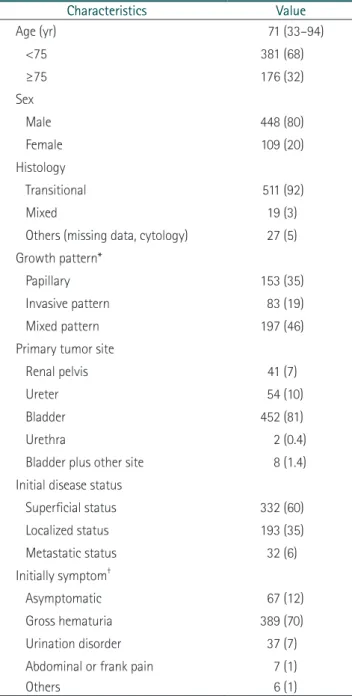
Table 1. Patient characteristics
Characteristics Value
Age (yr) 71 (33–94)
<75 381 (68)
≥75 176 (32)
Sex
Male 448 (80)
Female 109 (20)
Histology
Transitional 511 (92)
Mixed 19 (3)
Others (missing data, cytology) 27 (5) Growth pattern*
Papillary 153 (35)
Invasive pattern 83 (19)
Mixed pattern 197 (46)
Primary tumor site
Renal pelvis 41 (7)
Ureter 54 (10)
Bladder 452 (81)
Urethra 2 (0.4)
Bladder plus other site 8 (1.4)
Initial disease status
Superficial status 332 (60)
Localized status 193 (35)
Metastatic status 32 (6)
Initially symptom
†Asymptomatic 67 (12)
Gross hematuria 389 (70)
Urination disorder 37 (7)
Abdominal or frank pain 7 (1)
Others 6 (1)
Values are presented as number (range) or number (%).
*Growth patterns was identified in 433 patients.
†
Allow duplicate.
as UC, excluding temporary visit patients (n=72) and patients lost to follow-up within 3 months (n=59). A total of 557 pa- tients met the enrollment criteria and was included. The me- dian age of patients was 71.0 years, with 32% being 75 years or older, and the study population was predominantly male (82%). The primary tumor sites were the upper tract (e.g., renal pelvis or ureter) in 17% of the patients and the bladder in 81%
of the patients. The most common initial presenting symptom was gross hematuria (70%), and 67 patients (12%) were di- agnosed while asymptomatic (Table 1). Initial disease staging was observed for 332 patients of superficial UC (NMIBC, 313 patients; diffuse infiltrating NMIBC, 19 patients), 193 patients of localized UC (cTanyN0 UTUC, 75 patients; cT2-4 bladder UC, 82 patients; TanyN1-3 UC, 36 patients); and 32 patients
of initially metastatic UC (Table 2 and Fig. 1, content above the dotted line).
At the time of analysis (June 2019), 209 patients (38%) had localized UC, including 16 relapses of superficial UC, and 89 patients had metastatic UC, including 57 with relapse (17 of superficial UC and 40 of localized UC) (Fig. 1, content below the dotted line).
2. Treatment delivery for localized UC except cTanyN0 UTUC Actual treatment delivery for 132 localized UC patients indi- cated for radical surgery and perioperative chemotherapy was:
radical surgery with or without perioperative treatment (89, 66%), definitive chemoradiation (7, 5%), palliative operation (9, 7%), or supportive care only (29, 22%) (Table 3). Of the 89
Table 2. Initial clinical staging according to primary tumor sites
Bladder (n=452, 81%) UTUC (n=103, 18%) Urethra (n=2, 0.4%)
Staging Number (%) Staging Number (%) Staging Number (%)
Superficial (n=332) 332 (73) - - - -
NIMBC 313/332 (94) - - - -
Diffuse infiltrating 19/332 (6) - - - -
Localized (n=193) 104 (23) - 89 (86) - -
cT2-4N0 82/104 (79) cTanyN0 75/89 (84) - -
cTanyN1-3 22 (21) cTanyN1-3 14/89 (16) - -
Metastatic (n=32) 16 (4) - 14 (14) - 2 (100)
cM1a 4 (25) cM1a 1/14 (7) cM1a 0/2
cM1b 12 (75) cM1b 13/14 (93) cM1b 2/2 (100)
UTUC, upper tract urothelial carcinoma; NMIBC, non-muscle-invasive bladder cancer.
Table 3. Treatment delivery in localized UC who were indicated for radical surgery and perioperative chemotherapy
Characteristics Total
(n=134) cTanyN+UTUC
(n=14) cT2-4N0 Bladder
UC (n=96) cTanyN+Bladder UC (n=24)
Radical surgery 89 (66) 8 (57) 63 (66) 18 (75)
Radical surgery alone (pT2N0) 23/89 (26) 1/8 (12) 21/63 (33) 1/18 (6)
Radical surgery alone (poor PS or patient’s refusal) 32/89 (36) 2/8 (24) 22/63 (35) 8/18 (44)
Radical surgery plus adjuvant chemotherapy 27/89 (30) 4/8 (50) 18/63 (19) 5/18 (28)
Radical surgery plus adjuvant RT 1/89 (1) 0/8 (0) 1/63 (2) 0/18 (0)
Radical surgery plus neoadjuvant chemotherapy 6/89 (7) 1/8 (12) 1/63 (2) 4/18 (22)
Definitive RT or CRT 7 (5) 0 (0) 5 (5) 2 (8)
Palliative surgery 9 (7) 5 (36) 4 (4) 0 (0)
Supportive care only 29 (22) 1 (7) 24 (25) 4 (17)
Values are presented as number (%).
UC, urothelial carcinoma; UTUC, upper tract urothelial carcinoma; PS, performance status; RT, radiation therapy; CRT, chemoradiation therapy.
patients treated with radical surgery, 34 received perioperative treatment (chemotherapy, 33 patients; radiation therapy, one patient), 23 patients did not receive perioperative chemotherapy at the discretion of the clinician due to pathologic staging of pT2N0; and 32 patients did not receive treatment due to poor performance status or patient refusal despite T3-4 or lymph node-positive pathologic staging. Neoadjuvant chemotherapy was administered to only to six (7%) of the 89 patients who were targets of neoadjuvant chemotherapy.
3. Treatment delivery and cisplatin eligibility of patients with metastatic UC
Among 89 patients with metastatic disease, 34 (38%) had cisplatin eligibility. Of the cisplatin eligible patients, 29 (85%) received first-line palliative chemotherapy, 27 patients (79%) were treated with a cisplatin-based chemotherapy regimen. Of the 55 (62%) cisplatin-ineligible patients, 20 (36%) received palliative chemotherapy, and 11 (20%) were treated with a cisplatin-based chemotherapy regimen despite having cisplatin ineligible status (Table 4).
Discussion
This study presented information on clinical presentations, cisplatin eligibility, and actual treatment delivery based on a large Korean papulation with UC. In line with previous results from other countries, the primary initial disease status was su- perficial UC (60%), with metastatic UC patients being relatively rare (6%). Patients older than 75 years of age accounted for
32% of the study population, and cisplatin eligibility among patients with metastatic UC was 38%. While, our results were different from those of previous reports in that the proportion of UTUC was relatively higher (17%), and neoadjuvant che- motherapy was given to only 8% of potential candidates. Our study has strengths in two aspects: it is the first report on clini- cal characteristics of UC patients in East Asian, and it is based on robust dataset from real practice, unlikely population-based databases that mostly lack of available information [2,4].
Regarding the primary site of UC, our data showed that the proportion of Korean UC patients with UTUC was relatively high, up to 17% including superficial UC, compared to data from Western populations. We also identified 36% of meta- static UC patients (33/89) and 43% of localized UC patients (89/209) to have UTUC. Although the cause of this unex- pected finding has not been clarified, it might be due to genetic and environmental differences between East Asian and Western populations. The UTUC is known to be different from blad- der UC in diagnostic method, surgical treatment, and prognosis [7,8,15], and clinical trials tend to be conducted separately [16].
Considering the relatively high proportion of UTUC and insuf- ficient scientific evidence, our study suggests that Korean physi- cians should pay more attention to UTUC, and further clinical trials are needed.
In this study, the application rate of neoadjuvant chemo- therapy was only 7%, different from the international treatment guidelines for UC. This phenomenon is similar to Western data, which report that only 12% of patients with bladder cancer received neoadjuvant chemotherapy [17]. Considering mount- Table 4. First-line palliative treatment delivery in metastatic urothelial carcinoma
Characteristics Total (n=89) Cisplatin eligible (n=34, 38%) Cisplatin ineligible (n=55, 62%)
Palliative chemotherapy 49 (55.7) 29 (85) 20 (36)
GP 33/49 (67) 24/29 (83) 9/20 (45)
MVAC 5/49 (10) 3/29 (10) 2/20 (10)
GCb 7/49 (14) 2/29 (7) 5/20 (25)
Gemcitabine alone 4/49 (8) 0/29 (0) 4/20 (20)
Metastasectomy 2 (2.2) 2 (6) 0 (0)
Palliative surgery 2 (2.3) 0 (0) 2 (4)
Supportive care only 30 (34.1) 0 (0) 30 (55)
Others 6 (6.8) 3 (9) 3 (5)
Values are presented as number (%).
GP, gemcitabine plus cisplatin; MVAC, methotraxate, vinblastine, adriamycin, cisplatin; GCb, gemcitabine plus carboplatin.
ing evidence showing the beneficial role of neoadjuvant che- motherapy in survival [18] and the negative impact of surgical treatment on the availability of perioperative chemotherapy [19,20], neoadjuvant chemotherapy should be applied more actively. However, the wide gap between scientific evidence and real practice is probably due to clinicians’ intuitive concern for the toxicity of cisplatin-based chemotherapy or the ha- bitual delay of surgical treatment. Thus, to create a favorable atmosphere for providing neoadjuvant chemotherapy to UC patients, additional prospective clinical trials are needed to fo- cus on safety and feasibility as well as efficacy.
Palliative chemotherapy was delivered to 56% of patients, in particular 88% of cisplatin-eligible patients. The proportion of metastatic UC patients treated with the standard cisplatin- based chemotherapy was 77%, which is a relatively high proportion compared to 30% to 50% observed in Western populations [21]. This result might be explained by our study analyzing patients between 2013 and 2018, when multiagent chemotherapy such as GP or MVAC were commonly used in combination with antiemetics and granulocyte-colony stimu- lating factor. A prior study showed that the use of chemother- apy has been increasing since the late 2000s [2]. On the other hand, other study reported that cisplatin-based chemotherapy was used in 45% of cisplatin-ineligible patients, but not used in 18% of cisplatin-eligible patients [5]. Our data showed similar findings, with 20% of cisplatin-ineligible patients treated with cisplatin-based chemotherapy. Although the eligibility crite- ria for cisplatin proposed by Galsky et al. [14] is widely used, they cannot fully reflect actual application of cisplatin in real practice. Considering the development of supportive care for chemotherapy-related adverse events, it is necessary to consider modified or updated criteria for cisplatin eligibility, especially in aspects of renal function or comprehensive geriatric assessment including patient comorbidities.
The present study has several limitations. First, it was based on a single-institution cohort, so generalization of our re- sults to general Korean patients needs cautious interpretation.
However, our study used a relatively large sample consisting of initially diagnosed UC patients, and the robust dataset with detailed assessments. Second, the categorization for disease was somewhat arbitrary, unlike the general treatment guidelines for UC. The classification categories were adopted to organize all types of UC, including both UTUC and bladder UC, according
to the actual treatment application. Patient with bladder UC with clinically lymph node involvement (cN+) showed effec- tiveness in curative combined-modality therapy of cystectomy and perioperative chemotherapy compared to palliative che- motherapy [22,23]. The regional lymph node-positive bladder cancer was previously classified as stage IV in the American Joint Committee on Cancer 7th edition but was changed to stage IIIB in the revised 8th edition in 2018. Third, only per- formance status and CrCl were used in the cisplatin eligibility evaluations because other components such as hearing impair- ment and neuropathy could not be determined due to the in- nate limitations of a retrospective study. However, considering that 90% of cisplatin ineligibility evaluations were determined by Eastern Cooperative Oncology Group performance status and CrCl in prior studies [5,11], our findings could be accept- able in real practice.
Our study showed the first real practice-based clinical data for East Asian populations with UC. Clinical presentations in these patients were consistent with those of previous studies in other countries, except for a relatively high incidence of the upper genitourinary tract. Our results could be useful for de- termining treatment options for UC patients and can serve as a benchmark for further advances and clinical trials for treat- ments of East Asian patients with UC.
Supplementary Materials
Supplementary Tables are available from: https://doi.
org/10.12771/emj.2021.44.3.63.
Supplementary Table 1. Patient characteristics of bladder cancer
Supplementary Table 2. Treatment delivery in bladder ca who were indicated for radical surgery and perioperative che- motherapy
References
1. Bach PB, Cramer LD, Warren JL, Begg CB. Racial differences in the treatment of early-stage lung cancer. N Engl J Med 1999;341:1198-1205.
2. Robinson AG, Wei X, Mackillop WJ, Peng Y, Booth CM. Use of
palliative chemotherapy for advanced bladder cancer: patterns
of care in routine clinical practice. J Natl Compr Canc Netw
2016;14:291-298.
3. Snyder C, Harlan L, Knopf K, Potosky A, Kaplan R. Patterns of care for the treatment of bladder cancer. J Urol 2003;169:1697- 1701.
4. Robinson AG, Wei X, Vera-Badillo FE, Mackillop WJ, Booth CM.
Palliative chemotherapy for bladder cancer: treatment delivery and outcomes in the general population. Clin Genitourin Cancer 2017;15:e535-e541.
5. Bamias A, Peroukidis S, Stamatopoulou S, Tzannis K, Koutsou- kos K, Andreadis C, et al. Utilization of systemic chemotherapy in advanced urothelial cancer: a retrospective collaborative study by the Hellenic Genitourinary Cancer Group (HGUCG).
Clin Genitourin Cancer 2016;14:e153-e159.
6. Wu YT, Luo HL, Wang HJ, Chen YT, Cheng YT, Chiang PH.
Gender effect on the oncologic outcomes of upper urinary tract urothelial carcinoma in Taiwan. Int Urol Nephrol 2020;52:1043- 1048.
7. Roupret M, Babjuk M, Comperat E, Zigeuner R, Sylvester RJ, Burger M, et al. European Association of Urology guidelines on upper urinary tract urothelial carcinoma: 2017 update. Eur Urol 2018;73:111-122.
8. Margulis V, Shariat SF, Matin SF, Kamat AM, Zigeuner R, Kikuchi E, et al. Outcomes of radical nephroureterectomy: a series from the Upper Tract Urothelial Carcinoma Collaboration. Cancer 2009;115:1224-1233.
9. Hussain MH, Wood DP, Bajorin DF, Bochner BH, Dreicer R, Lamm DL, et al. Bladder cancer: narrowing the gap between evi- dence and practice. J Clin Oncol 2009;27:5680-5684.
10. von der Maase H, Sengelov L, Roberts JT, Ricci S, Dogliotti L, Oliver T, et al. Long-term survival results of a randomized trial comparing gemcitabine plus cisplatin, with methotrexate, vin- blastine, doxorubicin, plus cisplatin in patients with bladder cancer. J Clin Oncol 2005;23:4602-4608.
11. Bamias A, Tzannis K, Harshman LC, Crabb SJ, Wong YN, Kumar Pal S, et al. Impact of contemporary patterns of chemotherapy utilization on survival in patients with advanced cancer of the urinary tract: a Retrospective International Study of Inva- sive/Advanced Cancer of the Urothelium (RISC). Ann Oncol 2018;29:361-369.
12. Grossman HB, Natale RB, Tangen CM, Speights VO, Vogelzang NJ, Trump DL, et al. Neoadjuvant chemotherapy plus cystec- tomy compared with cystectomy alone for locally advanced bladder cancer. N Engl J Med 2003;349:859-866.
13. International Collaboration of Trialists. Neoadjuvant cispla- tin, methotrexate, and vinblastine chemotherapy for muscle-
invasive bladder cancer: a randomised controlled trial. Lancet 1999;354:533-540.
14. Galsky MD, Hahn NM, Rosenberg J, Sonpavde G, Hutson T, Oh WK, et al. Treatment of patients with metastatic urothelial cancer “unfit” for Cisplatin-based chemotherapy. J Clin Oncol 2011;29:2432-2438.
15. Browne BM, Stensland KD, Moynihan MJ, Canes D. An analysis of staging and treatment trends for upper tract urothelial carci- noma in the National Cancer Database. Clin Genitourin Cancer 2018;16:e743-e750.
16. Birtle AJ, Chester JD, Jones RJ, Johnson M, Hill M, Bryan RT, et al.
Results of POUT: a phase III randomised trial of perioperative chemotherapy versus surveillance in upper tract urothelial can- cer (UTUC). J Clin Oncol 2018;36(6 Suppl):407.
17. Donat SM. Integrating perioperative chemotherapy into the treatment of muscle-invasive bladder cancer: strategy versus reality. J Natl Compr Canc Netw 2009;7:40-47.
18. Advanced Bladder Cancer (ABC) Meta-analysis Collaboration.
Neoadjuvant chemotherapy in invasive bladder cancer: update of a systematic review and meta-analysis of individual patient data advanced bladder cancer (ABC) meta-analysis collabora- tion. Eur Urol 2005;48:202-206.
19. Kaag MG, O’Malley RL, O’Malley P, Godoy G, Chen M, Smaldone MC, et al. Changes in renal function following nephroureter- ectomy may affect the use of perioperative chemotherapy. Eur Urol 2010;58:581-587.
20. Donat SM, Shabsigh A, Savage C, Cronin AM, Bochner BH, Dalbagni G, et al. Potential impact of postoperative early com- plications on the timing of adjuvant chemotherapy in patients undergoing radical cystectomy: a high-volume tertiary cancer center experience. Eur Urol 2009;55:177-185.
21. Sonpavde G, Watson D, Tourtellott M, Cowey CL, Hellerstedt B, Hutson TE, et al. Administration of cisplatin-based chemother- apy for advanced urothelial carcinoma in the community. Clin Genitourin Cancer 2012;10:1-5.
22. Bae WK, Lee HJ, Park SH, Kim JH, Kim HJ, Maeng CH, et al.
Comparative effectiveness of palliative chemotherapy versus neoadjuvant chemotherapy followed by radical cystectomy ver- sus cystectomy followed by adjuvant chemotherapy versus cys- tectomy for regional node-positive bladder cancer: a retrospec- tive analysis: KCSG GU 17-03. Cancer Med 2019;8:5431-5437.
23. Galsky MD, Stensland K, Sfakianos JP, Mehrazin R, Diefenbach
M, Mohamed N, et al. Comparative effectiveness of treatment
strategies for bladder cancer with clinical evidence of regional
lymph node involvement. J Clin Oncol 2016;34:2627-2635.
Supplementary Table 1. Patient characteristics of bladder cancer
Characteristics Total
(n=452) Superficial
(n=332, 73%) MIBC
(n=82, 18%) Metastatic (n=38, 8%)
Age (yr) 69.5 (33–94) 68.0 (34–94) 72.5 (33–89) 73.0 (48–87)
<75 317 (70) 239 (72) 54 (66) 24 (63)
≥75 135 (30) 93 (28) 28 (34) 14 (37)
Sex
Male 378 (84) 281 (85) 64 (78) 33 (87)
Female 74 (16) 51 (15) 18 (22) 5 (13)
Histology
Transitional 414 (92) 313 (94) 68 (83) 33 (87)
Mixed 22 (5) 5 (2) 14 (17) 3 (8)
Others (missing data, cytology) 16 (3) 14 (4) 0 (0) 2 (5)
Growth pattern*
Papillary 151 (33) 136 (41) 3 (4) 2 (5)
Invasive pattern 84 (19) 27 (8) 29 (35) 10 (26)
Mixed pattern 198 (48) 91 (27) 42 (51) 15 (39)
Initially symptom
†Asymptomatic 56 (12) 53 (16) 2 (2) 1 (2)
Gross hematuria 323 (71) 233 (70) 62 (76) 28 (74)
Urination disorder 33 (7) 19 (6) 10 (12) 4 (11)
Abdominal or frank pain 6 (1) 4 (1) 1 (1) 1 (2)
Values are presented as number (range) or number (%).
MIBC, muscle-invasive bladder cancer.
*Growth patterns was identified in 433 patients.
†