제4회 첨단 사이언스 교육 허브 개발(EDISON) 나노물리 경진대회
First-principle investigations of the binding between carbon nanotubes and poly(acrylonitrile)
Juho Lee
Carbon nanotubes (CNTs) have been widely accepted and used as the enhancer for polymer nano-composites due to their remarkable mechanical properties. Understandably, the CNT fiber-polymer matrix interface plays a major role in determining the properties of the CNT- polymer nano-composites. Here, using the LCAODFT Lab tool available on the EDISON Nano- Physics site, we performed first-principles density-functional theory calculations to determine the atomic configurations and binding energies of the CNTs in contact with polymers. For the polymer matrixes, we chose poly(acrylonitrile) (PAN), which is one of the most well-known polymer matrixes for the carbon nanofiber nanocomposites. Different chiralities and diameters of pristine CNTs were considered, and several PAN-CNT configurations were prepared based on the atomistic positions and directions of cyano group in PAN. The most favorable configuration of PAN was obtained when the PAN bound parallel to the surface of CNT. Our finding indicates the binding configurations are determined by the direction of the cyano group dominantly rather than the atomistic position of PAN, or the symmetry of CNTs. The result of increasing the length of CNT diameter suggests that PAN is inclinable to align evenly on the surface of relatively large size of CNT with the configuration parallel to the surface.
These results obtained in this study will provide the starting point for the design of improved PAN-CNT composites for the next-generation ultra-strong and ultra-light carbon nanofibers.
Introduction
Carbon nanotube (CNT) has been highlighted as a superior material due to its great intrinsic properties such as high electrical and thermal conductivity, excellent stiffness against bending and high tensile strength. These desirable properties have enlightened diverse applications in many fields such as tissue engineering, aerospace composites, DNA sequencing and conductive textiles. Using CNTs as an enhancer of polymer composites now has been generally agreed. Over past few decades, it is well established that the CNT fiber-polymer matrix interface play a major role in
determining the properties of composite. The non- covalent interaction of polymer chains around CNT determines the alignment of the polymer which impacts the properties of the composites.
Computational modeling approach has become increasingly popular in order to overcome with the difficulties in devising experiments to study the CNT-polymer interface. Although the propensity of the dynamics of polymers at the interface with CNT has been covered by performing molecular dynamics simulations, quantum level analyses have not been investigated in detail. Here, we performed first-principles density functional theory calculations to demonstrate the atomic
13
- 18 - 제4회 EDISON 사업 SW활용 경진대회 및 성과전시회 | 나노물리
304
제4회 첨단 사이언스 교육 허브 개발(EDISON) 나노물리 경진대회
First-principle investigations of the binding between carbon nanotubes and poly(acrylonitrile)
Juho Lee
Carbon nanotubes (CNTs) have been widely accepted and used as the enhancer for polymer nano-composites due to their remarkable mechanical properties. Understandably, the CNT fiber-polymer matrix interface plays a major role in determining the properties of the CNT- polymer nano-composites. Here, using the LCAODFT Lab tool available on the EDISON Nano- Physics site, we performed first-principles density-functional theory calculations to determine the atomic configurations and binding energies of the CNTs in contact with polymers. For the polymer matrixes, we chose poly(acrylonitrile) (PAN), which is one of the most well-known polymer matrixes for the carbon nanofiber nanocomposites. Different chiralities and diameters of pristine CNTs were considered, and several PAN-CNT configurations were prepared based on the atomistic positions and directions of cyano group in PAN. The most favorable configuration of PAN was obtained when the PAN bound parallel to the surface of CNT. Our finding indicates the binding configurations are determined by the direction of the cyano group dominantly rather than the atomistic position of PAN, or the symmetry of CNTs. The result of increasing the length of CNT diameter suggests that PAN is inclinable to align evenly on the surface of relatively large size of CNT with the configuration parallel to the surface.
These results obtained in this study will provide the starting point for the design of improved PAN-CNT composites for the next-generation ultra-strong and ultra-light carbon nanofibers.
Introduction
Carbon nanotube (CNT) has been highlighted as a superior material due to its great intrinsic properties such as high electrical and thermal conductivity, excellent stiffness against bending and high tensile strength. These desirable properties have enlightened diverse applications in many fields such as tissue engineering, aerospace composites, DNA sequencing and conductive textiles. Using CNTs as an enhancer of polymer composites now has been generally agreed. Over past few decades, it is well established that the CNT fiber-polymer matrix interface play a major role in
determining the properties of composite. The non- covalent interaction of polymer chains around CNT determines the alignment of the polymer which impacts the properties of the composites.
Computational modeling approach has become increasingly popular in order to overcome with the difficulties in devising experiments to study the CNT-polymer interface. Although the propensity of the dynamics of polymers at the interface with CNT has been covered by performing molecular dynamics simulations, quantum level analyses have not been investigated in detail. Here, we performed first-principles density functional theory calculations to demonstrate the atomic
13
제4회 첨단 사이언스 교육 허브 개발(EDISON) 나노물리 경진대회
configurations and the interfacial energy between polymer and pristine CNT. For the polymer matrixes, poly(acrylonitrile) (PAN) was used, which is one of the most well-known polymer matrixes for the carbon nanofiber nanocomposites. Due to its efficiency commercially, PAN has attracted great research interest. Different chiralities and diameters of CNTs were considered, and several PAN-CNT configurations were prepared based on the directions and atomic positions of cyano group in PAN.
Method
First principle calculations presented here were performed based on Density Functional Theory (DFT) using the LCAODFT Lab tool. The exchange- correlation energy was described by the functional of Perdew, Burke, and Ernzerhof (PBE) based on the generalized gradient approximation with a plane wave basis set using projected augmented wave (PAW) potentials and an energy cutoff of 400 eV.
The D3-correction for London dispersion effects was taken into account for generating proper geometry of the molecules. The first Brillouin zone was sampled by a Monkhorst-Pack Γ-points grid of 1 x 1 x 1. The size of simulation box was 25 Å x 25 Å x Z Å to generate proper condition of periodic boundary system. The length of Z was chosen around 17 Å in order to minimize the effect of CNT along with longitudinal axis due to comparison between the different chiralites of CNT; armchair and zig-zag, under supercell (the length of armchair was 17.22Å and zig-zag was 17.04Å). The coordinates of SWCNT were fixed to simplify the computational calculation.
The interaction energy of PAN on CNT was calculated after geometry optimization according to following equation,
E inter = E complex – ( E CNT + E PAN )
where Einter indicates the interaction energy between two molecules so-called formation energy, Ecomplex is the energy of the PAN-CNT complex system, and ECNT and Epolymer are the energies of the CNT and polymer respectively under the same simulation condition.
Preparation of CNT and PAN
In this work, three different pristine CNTs were prepared; armchair (5,5), zig-zag (10,0) and armchair (10,10). Zig-zag (10, 0) was prepared to demonstrate the effect of different symmetry with repeated pattern of “honey comb” shape. The number of repeated units of PAN was chosen based on the following criteria. i) Does the length of PAN include the backbone torsion induced by the alignment of cyano group in PAN? ii) Is it possible to place the PAN on the surface of CNT linearly so that the number of degrees of freedom of PAN can be reduced? Based on the fundamental structural analysis, trimer was determined as a proper length to fulfill with all of conditions suggested above. In this study, only isotactic of PAN was taken into account.
Result
Binding configurations depending on the direction and position of cyano group
In order to demonstrate the alignment propensity of PAN on the surface of CNT, the binding energies of different configurations were calculated. The different configurations were chosen based on the angle between two vectors;
the vector defined starting from carbon to nitrogen in the cyano group, and the normal vector for the axis of the SWCNT. Lie configuration means the angle of 90 between two vectors indicating that 14
- 19 -
제4회 EDISON 사업 SW활용 경진대회 및 성과전시회 | 나노물리
305
제4회 첨단 사이언스 교육 허브 개발(EDISON) 나노물리 경진대회
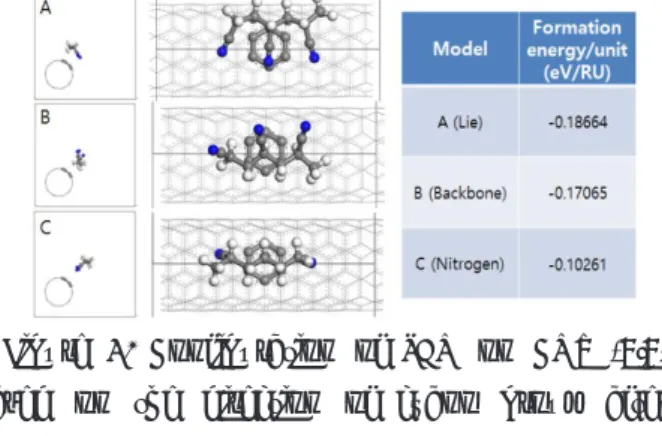
cyano group is aligned parallel to the SWCNT surface. The configurations of backbone and nitrogen are defined when the angles are 0 and 180 respectively. On the surface of armchair (5,5), the most favourable configuration was observed in lie configuration with -0.18664 eV/RU. The binding energy from backbone configuration was slightly lower than the binding energy of lie, -0.17065 eV/RU, as comparing with the energy obtained from the nitrogen configuration, -0.10261 eV/RU.
For the further analysis of the specific atomic position effect of PAN on the CNT, we have initially considered three different preliminary configurations depending on the position of the cyano group in the middle of repeated units; either carbon or nitrogen in the cyano group is on the top of the aromatic ring, and cyano group is on the side of the hexagonal ring. When the nitrogen in the cyano group is on the top of the ring, the strongest binding energy was obtained with -0.19705 eV/RU.
() Unlike the direction of cyano, however, the position of PAN did not significantly influence on the binding energy with 0.0052122 eV/RU standard deviation. These results indicate the binding configuration is dominantly determined by direction of cyano group rather than the position of PAN on the CNT surface.
Weak binding interaction induced by dispersion force between PAN and CNT
Due to the difference in the symmetry, the chirality of CNT is the possible source of altering binding configurations of polymers. Here, we prepared zig-zag (10,0), semi-conductor, and compared the binding configurations with the PAN on the armchair (5,5). Even if the comparison between two different types of CNT without considering position of PAN is straightforward due
to the different symmetry, the preceding results validate the effect of PAN position is trivial on the pristine CNT. The results of binding energies on zig- zag (10,0) CNT were showed similarities in binding energies on armchair (5,5) with less than 0.004 eV/RU difference between same orientation of the polymer. Regardless of the prominent differences of CNTs in the symmetry, the observation of similarity indicates the interaction between PAN and pristine CNT is mostly induced by weak dispersion force, which is accord with the previous study.()
Curvature of CNT surface alters binding affinity of PAN
Alteration of the diameter of CNT controls the curvature of CNT surface, which affects the interfacial area between PAN and CNT. As the result of the difference in the interfacial area, the stability of PAN configurations on the CNT is differed. To demonstrate it in detail, the CNT having longer diameter, (10,10), was prepared, and the initial configurations of PAN were placed at the same orientations with the final trajectory configuration from the result of (5,5). In the results, there was no difference in the preferential stabilities of configurations, and overall binding energies were increased in all systems. However, the increment of binding energies of each configuration was varied, which is proportional to the interfacial area. The highest increment of binding energies comparing with corresponding results from (5,5) systems was lie model with 0.04438 eV/RU, and the increments of backbone and nitrogen models were obtained 0.03084 and 0.01976 eV/RU respectively. These variations in the increment of binding energies suggests that lie configuration is more stable and prone to occur on (10,10) than (5,5), which resulted in uniform alignments of PAN.
15
- 20 - 제4회 EDISON 사업 SW활용 경진대회 및 성과전시회 | 나노물리
306
제4회 첨단 사이언스 교육 허브 개발(EDISON) 나노물리 경진대회
cyano group is aligned parallel to the SWCNT surface. The configurations of backbone and nitrogen are defined when the angles are 0 and 180 respectively. On the surface of armchair (5,5), the most favourable configuration was observed in lie configuration with -0.18664 eV/RU. The binding energy from backbone configuration was slightly lower than the binding energy of lie, -0.17065 eV/RU, as comparing with the energy obtained from the nitrogen configuration, -0.10261 eV/RU.
For the further analysis of the specific atomic position effect of PAN on the CNT, we have initially considered three different preliminary configurations depending on the position of the cyano group in the middle of repeated units; either carbon or nitrogen in the cyano group is on the top of the aromatic ring, and cyano group is on the side of the hexagonal ring. When the nitrogen in the cyano group is on the top of the ring, the strongest binding energy was obtained with -0.19705 eV/RU.
() Unlike the direction of cyano, however, the position of PAN did not significantly influence on the binding energy with 0.0052122 eV/RU standard deviation. These results indicate the binding configuration is dominantly determined by direction of cyano group rather than the position of PAN on the CNT surface.
Weak binding interaction induced by dispersion force between PAN and CNT
Due to the difference in the symmetry, the chirality of CNT is the possible source of altering binding configurations of polymers. Here, we prepared zig-zag (10,0), semi-conductor, and compared the binding configurations with the PAN on the armchair (5,5). Even if the comparison between two different types of CNT without considering position of PAN is straightforward due
to the different symmetry, the preceding results validate the effect of PAN position is trivial on the pristine CNT. The results of binding energies on zig- zag (10,0) CNT were showed similarities in binding energies on armchair (5,5) with less than 0.004 eV/RU difference between same orientation of the polymer. Regardless of the prominent differences of CNTs in the symmetry, the observation of similarity indicates the interaction between PAN and pristine CNT is mostly induced by weak dispersion force, which is accord with the previous study.()
Curvature of CNT surface alters binding affinity of PAN
Alteration of the diameter of CNT controls the curvature of CNT surface, which affects the interfacial area between PAN and CNT. As the result of the difference in the interfacial area, the stability of PAN configurations on the CNT is differed. To demonstrate it in detail, the CNT having longer diameter, (10,10), was prepared, and the initial configurations of PAN were placed at the same orientations with the final trajectory configuration from the result of (5,5). In the results, there was no difference in the preferential stabilities of configurations, and overall binding energies were increased in all systems. However, the increment of binding energies of each configuration was varied, which is proportional to the interfacial area. The highest increment of binding energies comparing with corresponding results from (5,5) systems was lie model with 0.04438 eV/RU, and the increments of backbone and nitrogen models were obtained 0.03084 and 0.01976 eV/RU respectively. These variations in the increment of binding energies suggests that lie configuration is more stable and prone to occur on (10,10) than (5,5), which resulted in uniform alignments of PAN.
15
제4회 첨단 사이언스 교육 허브 개발(EDISON) 나노물리 경진대회
Conclusion
In this report, we performed first-principles density-functional theory computations to explore the atomistic configurations and binding energies based on the direction of cyano group after geometry optimization of PAN on the different type of pristine CNT. Different orientations of PAN on the CNT surface were prepared depending on the directions and positions of the cyano group with respect to the CNT. The most favourable configuration of PAN was obtained when the trimer bound parallel to the surface of CNT.|
Our finding indicates the binding configurations are determined by the direction of the cyano group dominantly rather than the atomistic position of PAN, or the symmetry of CNTs. Additionally, the exploration of the effect of increasing the diameter of CNT resulted in the increment of binding energies proportional to the contact area of PAN with CNT. This result suggests that PAN is inclinable to align evenly on the surface of relatively large size of CNT with the configuration parallel to the surface.
Although varying electrical properties of CNT was not dealt with in this paper, which is in progress, the binding configurations of PAN could be altered due to the electrostatic interaction with high polarized cyano group. We believe these based on the direction of cyano group after geometry optimization findings will provide the starting point for the design of improved PAN-CNT composites for the next-generation ultra-strong and ultra-light carbon nanofibers.
Figure 1. Configuration of PAN on CNT (5,5) based on the direction of cyano group after geometry optimization
Figure 2. Configuration of PAN on CNT (5,5) based on the atomic position of cyano group after geometry optimization
Figure 3. Configurations of PAN on CNT (10,0)
Figure 4. Configurations of PAN on CNT (10,10)
16