Study on the effect of rock permeable characteristics on ground water flow around a potential rock cavern repository
Eun Jin Seo, Yongsoo Hwang, Chul-Hyung Kang Korea Atomic Energy Research Institute 150 Deokjin-dong Yuseong-gu Daejeon, Korea
[email protected] 1. Introduction
For total system performance of a potential radwaste repository, a hypothetical site is assumed with feasible boundary conditions. Assuming a coastal repository, the two dimensional groundwater flow analysis is done by the CONNECTFLOW [1], groundwater transport assessment code. Throughout the simulations, the effect of rock permeability on groundwater pathway is studied by the depth of repository [2]. Path length and travel time from Connectflow analysis will be used as input of safety assessment code, e.g. MASCOT [3].
2. Method and Results
In this study the area in the vicinity of a repository is assumed the two dimensional porous medium and the groundwater flow analysis is performed by using NAMMU [4], continuum porous medium module of Connectflow, groundwater transport assessment code developed by Serco (UK).
2.1. Boundary condition (B.C.) for analysis
The B.C. at the left-hand side is set up to be the highest elevation in the region to implement the no flow B. C. across this line. The B.C. at the bottom line is also set up for the no flow boundary condition, where in real situation the position is set up to the point far away from the domain of interest. The B.C. at the top ground surface is the hydrostatic B.C. and at the sea bottom the pressures from groundwater and sea water are considered.
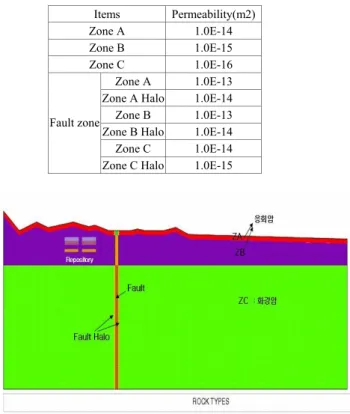
2.2. Other characteristics in the analysis model Figure 1 shows a cross section view of repository and its surrounding geological strata.
There is a fault in width 50 cm including fault halo in width 10 cm. The repository is 60, 80 and 120 m in depth.
Table 1 shows the permeability of each rock type for groundwater flow analysis.
Table 1. Permeability for groundwater flow analysis Items Permeability(m2) Zone A 1.0E-14
Zone B 1.0E-15 Zone C 1.0E-16 Zone A 1.0E-13 Zone A Halo 1.0E-14 Zone B 1.0E-13 Zone B Halo 1.0E-14 Zone C 1.0E-14 Fault zone
Zone C Halo 1.0E-15
Figure 1. Cross sectional view of a repository and its surroundings geological strata
2.3. Groundwater flow analysis
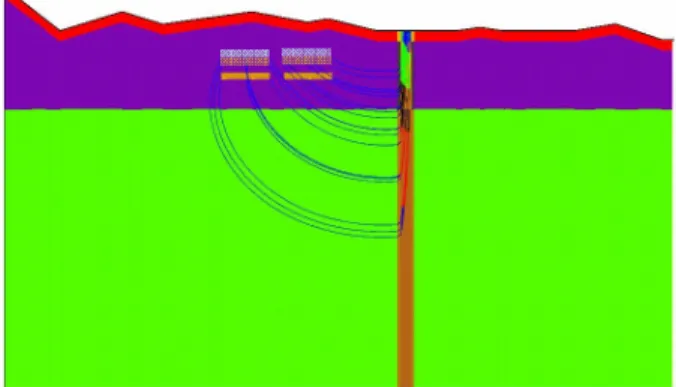
Figure 2 shows the pathway from repository by depth.
Figure 2. Pathway from repository by depth
Figure 3 shows the change of pathway when the permeability of the region ZA decreases by one order. Transactions of the Korean Nuclear Society Autumn Meeting
Since the permeability decreases in ZA, pathway from left side repository changes from the path though ZB at illustrated in Figure 2 to the longer path through ZC at illustrated in Figure 3.
Figure 3. Change of groundwater flow pathway affected by the one order decrease of the permeability in ZA
Figure 4 shows the change of pathway when the permeability of the region ZB decreases by one order.
Since the permeability decreases the gravitational force plays an important role so that the transverse transport of groundwater from ZB to ZC occurs at illustrated in Figure 4.
Figure 4. Change of groundwater flow pathway affected by the one order decrease of the permeability in ZB
Figure 5 shows the change of pathway when the permeability of the region ZC decreases by one order.
In this case the region ZC acts as an impermeable layer in practice so that the groundwater flow cannot pass through the region ZC.
Figure 5. Change of groundwater flow pathway affected by the one order decrease of the permeability in ZC
3. Conclusion
For total system performance of a potential radwaste repository, a hypothetical site is assumed with feasible boundary conditions and the two dimensional groundwater flow analysis is done by the CONNECTFLOW. Throughout the assessment, the effect of rock permeability on groundwater pathway is studied. The change of permeability of the rock affects the groundwater pathway through the rock specially. The increase of permeability in specific rock can be shorten the pathway through the rock and the opposite case can be occurred. It is needed to survey more realistic and accurate permeability of a rock for actual application in the future.
REFERENCES
[1] Serco Assurance, Connectflow (Release 8.1) Technical Summary Document, 2004.
[2] A study on the preliminary generic safety assessment for a LILW repository, KAERI/CR-180/2004, 2004.
[3] Robinson, P. C. and Y. S. Hwang, Confidence Building in MASCOT-K, QRS-1106A-1, v3.0, Quintessa, 2002.
[4] L. J. Hartely, C. P. Jackson and S. P. Watson, NAMMU (Release 6.4) User Guide, AEA Technology, 1998.