DOI 10.17480/psk.2016.60.3.118
ABCB1 유전적 다형성이 만성 골수성 백혈병 환자의 Imatinib 치료 반응에
미치는 영향: 체계적 문헌고찰 및 메타분석
하혜민 · 천부순#
인제대학교 약학대학
(Received April 4, 2016; Revised April 19, 2016; Accepted April 25, 2016)
ABCB1 Polymorphisms and Imatinib Response in Chronic Myeloid Leukemia Patients:
A Systematic Review and Meta-analysis
Hye Min Haand Pusoon Chun#
College of Pharmacy, Inje University, Gimhae 50834, Korea
Abstract — A growing number of studies have demonstrated that ABCB1 gene polymorphisms are associated with the variability of responses to imatinib. However, the effects of ABCB1 polymorphisms on imatinib response in chronic myeloid leukemia (CML) are inconsistent. The aim of the present study was to clarify the associations between ABCB1 poly-morphisms and imatinib response in CML. A systematic literature review was performed. The databases of PubMed, Embase, and Cochrane Library were searched for all published studies from inception to December 2015. The following terms were used with functions of ‘AND’ and ‘OR’: ‘chronic myeloid leukemia’, ‘CML’, ‘ABCB1’, ‘MDR1’, ‘polymorphism’, ‘SNP’, and ‘imatinib’. Using the Review Manager 5, odds ratios (ORs) were pooled to estimate the effect of ABCB1 poly-morphisms on imatinib response in CML. The pooled analysis showed that ABCB1 2677 G allele was significantly asso-ciated with poor response to imatinib in African and Asian patients (GG vs TT, OR: 0.32, p<0.0001; GG+GT vs TT, OR: 0.44, p=0.0005). In subgroup analyses, African patients carrying ABCB1 1236 C allele exhibited higher risk for worse response, whereas Asian patients with 1236 C allele showed better response (CC+CT vs TT, OR: 0.41, p=0.008 for African; OR: 1.65, p=0.03 for Asian). There was no association between C3435T polymorphisms and imatinib response in African, Asian, and Caucasian CML patients.
Keywords □ ABCB1 C1236T polymorphism, ABCB1 G2677T polymorphism, ABCB1 C3435T polymorphism, chronic myeloid leukemia, imatinib, response
만성 골수성 백혈병은 조혈모세포의 이상으로 과립구 백혈구 가 과도하게 증식하는 만성 골수증식성 암이다. 만성 골수성 백 혈병 환자에서 발견되는 중요한 특징인 필라델피아 염색체 (Philadelphia chromosome)는 9번 염색체의 ABL 유전자와 22 번 염색체의 BCR 유전자의 상호전위에 의한 융합으로 생성된다. 이때 생성된 BCR-ABL 융합유전자에 의해 합성되는 발암단백질 P210 BCR-ABL은 강력한 티로신 키나아제(tyrosine kinase) 활
성을 가지며 골수구 전구세포의 세포자멸사(apoptosis)를 억제하 여 이 세포들의 비정상적인 증폭을 일으켜 결국 백혈병을 초래 한다.1)
만성 골수성 백혈병은 병기에 따라 급성기(blastic phase, BP), 가속기(accelerated phase, AP), 그리고 만성기(chronic phase, CP)로 나뉜다. 급성기는 말초혈액 혹은 골수에서 모세포(blasts) 의 비율이 30%를 넘거나 간, 비장, 임파절을 제외한 골수 외에 서 모세포의 침윤이 발견되는 상태이며 가속기는 다음의 기준 중 어느 하나에 속하는 경우에 해당된다: 말초혈액 또는 골수에서 의 모세포 비율이 10~30%; 모세포와 전골수세포(promyelocytes) 를 합하여 말초혈액 또는 골수에서의 비율이 30% 미만; 말초혈 액의 호염기구(basophils) 비율이 20% 이상; 치료와 무관한 혈소 판 감소증(<100×103/μl) 또는 치료에 반응하지 않는 혈소판 증 #Corresponding Author Pusoon Chun
College of Pharmacy, Inje University, 197 Inje-ro, Gimhae, Gyeo-ngnam 50834, Korea
Tel.: 055-320-3886 Fax.: 055-320-3940 E-mail: [email protected]
종설
가증(>1,000×103/μl); 비장 비대; 필라델피아 염색체 외의 염색 체 이상; 지속적인 백혈구증가(>10×103/μl). 반면 골수 외에서 모세포의 침윤이 없이 말초혈액 혹은 골수에서 모세포가 15% 미 만, 호염기구가 20% 미만, 모세포와 전골수세포를 합하여 30% 미만, 그리고 혈소판 수가 100×103/μl 이상인 경우는 만성기에 속한다.2) 만성 골수성 백혈병의 치료에 대한 반응은 혈액학적(hematologic response, HR), 세포유전학적(cytogenetic response, CR) 그리 고 분자적 반응(molecular response, MR)으로 분류한다. 완전혈 액학적 반응(complete HR)은 다음의 기준에 해당하는 경우이다: 백혈구수<10×103/μl; 호염기구<5%; 골수세포, 전골수세포, 골 수모세포가 발견되지 않음; 혈소판<450×103/μl; 비촉지성 비장. 세포유전학적 반응은 골수에서 발견되는 필라델피아 염색체 양 성 세포의 비율에 따라 완전반응(complete CCyR; 0% Ph+ cells), 주요반응(major CyR; 0~35% Ph+ cells), 부분반응(partial CyR; 1~5% Ph+ cells), 소반응(36~65% Ph+ cells, 최소반응 (minimal CyR; 66~95% Ph+ cells), 그리고 무반응(>95% Ph+ cells)으로 분류한다. 반면 분자적 반응은 골수에서 보이는 BCR-ABL 단백질의 양에 따라 완전반응(complete MR; BCR/ ABL mRNA의 미검출) 및 주요반응(major MR; BCR-ABL/ ABL≤0.1%)으로 분류한다.3)
이매티닙(imatinib, STI-571)은 BCR-ABL 티로신 키나아제 (tyrosine kinase)의 ATP 결합부위에 경쟁적으로 결합하여 BCR-ABL 단백질을 불활성 구조로 유지시킴으로써 필라델피아 염색 체에 의해 생성되는 비정상적 BCR-ABL 티로신 키나아제의 활 성을 억제한다. 이매티닙이 필라델피아 염색체 양성 만성 골수성 백혈병(Philadelphia-chromosome-positive CML, Ph+ CML) 만성기 환자의 치료에서 탁월한 성과를 거두고 1차 치료제로 사 용이 권고되고 있음에도 불구하고 상당수의 환자는 이 약물에 대 해 내성을 가지는 것으로 보고되고 있다.4,5)이매티닙 치료에 대 해 내성을 형성하는 가장 중요한 원인이 BCR-ABL 유전자의 돌 연변이 및 증폭에 의한 것으로 알려져 있지만 P-당단백((P-glycoprotein, P-gp) 및 ABCG2 같은 약물 배출 펌프의 증가, 유 기 양이온 수송체(organic cation transporter 1, OCT1) 및 유기 음이온 수송 펩타이드(organic anion transporting polypeptide, OATP) 1A2 등 약물 흡수 수송체의 감소 또한 이매티닙의 치료 반응 소실의 중요한 영향인자가 된다.6)
ATP-binding cassette subfamily B member 1(ABCB1)은 다 약제내성단백(multidrug resistance 1, MDR1)으로도 불리는 유 전자 단백질로 P-당단백이라는 약물의 배출에 주요한 역할을 하 는 세포막수송체를 인코딩한다. P-당단백은 장상피(intestinal epithelium), 간세포, 신장의 근위세뇨관, 혈액뇌장벽(blood-brain barrier) 및 혈액고환장벽의 모세혈관 내피세포 등에 광범위하게 존재하면서 약물의 흡수를 억제하거나 배설을 촉진한다. P-당단 백은 또한 암세포에서 다량 발현하여 암세포내의 항암제 농도를 감소시켜 약제내성을 형성한다.7) ABCB1 단일염기다형성이 만성 골수성 백혈병 환자에서 이매 티닙 치료 반응에 영향을 미친다는 많은 연구결과가 발표되어 왔 으나 연구결과들에 일관성이 없다. 근래에 Zu 등은 메타분석을 통해 아시아인에서 MDR1 C1236T 다형성은 이매티닙의 치료성 과가 나쁜 위험인자가 되지만 MDR1 G2677T와 C3435T 다형 성은 만성 골수성 백혈병 환자의 이매티닙 반응성에 유의한 영 향이 없다고 발표했다.8)반면 최근에 발표된 Zheng의 메타분석 연구에서는 2677G 혹은 3435T allele을 지닌 만성 골수성 백혈 병 환자는 이매티닙의 치료에 대해 저조한 반응을 보였고 1236CC 유전형을 지닌 아시아인 만성 골수성 백혈병 환자는 1236CT 혹 은 1236TT 유전자형을 가진 환자에 비해 이매티닙의 치료에 대 해 더 좋은 반응을 보였다.9)하지만 더 최근에 Wang 등이 발표 한 메타분석에서는 MDR1 다형성인 C1236T, G2677T, 그리고 C3435T 모두 만성 골수성 백혈병 환자의 이매티닙 치료 반응에 영향을 미치지 않은 것으로 나타났다.10) 따라서 본 연구는 메타분석을 통해 ABCB1 단일염기다형성 중 가장 빈번히 발견되는 C1236T, G2677T, 그리고 C3435T이 이매티닙의 치료 반응에 미치는 영향을 규명하고자 수행되었다.
연구방법
문헌검색 만성 골수성 백혈병 환자에서 ABCB1 단일염기다형성이 이매 티닙 치료 반응에 대한 영향을 보고하는 출판물의 검색을 위해 체계적 문헌 고찰을 수행하였다. 2015년 12월 말 현재까지 발표 된 출판물을 대상으로 다음의 용어를 사용하여 PubMed, Embase, 그리고 Cochrane Library 데이터베이스를 검색하였다: ‘ABCB1 polymorphism’, ‘chronic myeloid leukemia’, ‘imatinib’, ‘response’. 또한 출판물의 면밀한 조사를 위해 초기에 선택된 논문들의 참 고문헌 목록을 직접 수기로 검토하였다. 연구의 선정 및 자료추출 본 연구에 포함할 논문의 선정 및 선정된 각 연구들로부터의 자료추출은 공저자 2인이 독립적으로 수행하여 공통으로 선정한 연구 및 추출된 자료만을 활용하였으며 의견이 불일치 하는 부 분이 있는 경우 충분한 논의를 통하여 의견이 합일되는 자료를 사용하였다. 본 연구에 포함한 문헌의 선정기준은 다음과 같다: (1) 만성 골수성 백혈병 환자에서 ABCB1 단일염기다형성과 이 매티닙 치료 반응에 관한 연구; (2) ABCB1 단일염기다형성의 이매티닙 치료 반응의 비교를 위한 오즈비(Odds ratio, OR)의 산 출이 가능한 데이터의 발표; (3) 이매티닙 치료 반응에 대한 기 준 제시. 반면 종설, 논평, 중복되어 출판된 연구, 초록만 발표된연구, 임상적 치료성과를 보여주지 않는 논문, 그리고 이매티닙 에 대한 반응성 비교를 위한 오즈비의 산출이 가능한 유전자형 빈도를 나타내고 있지 않은 연구는 배제하였다. 선정된 연구로부터 추출한 자료는 다음을 포함한다: 연구에 참 여한 만성 골수성 백혈병 환자의 병기(disease phase), 투여한 이 매티닙의 용량, 이매티닙의 복용기간, 각 연구에서 사용한 치료 에 대한 반응 기준, 그리고 이매티닙 치료에 대한 반응군 및 내 성군의 유전자형 빈도. 문헌의 질평가 선정된 연구의 질 평가를 위해 관찰연구의 질 평가도구인 Newcastle-Ottawa Quality Assessment Scale(NOS) 척도를 사 용하였다.11)각 연구의 질은 0~9점 사이의 점수로 매겨졌으며 0~3점은 ‘낮음’, 4~6점은 ‘보통’, 그리고 7~9점은 ‘우수’로 평가 했다.12)연구의 질 평가는 공저자 2인이 독립적으로 수행한 후 두 연구자가 동일한 점수를 부여한 경우 최종 평가하였으며 불 일치하는 평가를 받은 연구의 경우 충분한 논의를 통하여 의견 이 합일되는 점수를 부여하였다. 통계 분석 만성 만성 골수성 백혈병 환자에서 ABCB1 C1236T, G2677T, 그리고 C3435T이 이매티닙 치료 반응에 미치는 영향을 평가하 기 위해 본 연구에 포함된 개별 연구들로부터 가중평균 오즈비 (Odds ratio, OR)를 산출하여 통합된 요약 추정치(pooled estimate)를 구하고 오즈비와 95% 신뢰구간(confidence intervals,
CIs)으로 나타내었다. 요약 추정치는 Z-test의 P값이 0.05 미만 일 때 통계적으로 유의한 것으로 판단하였다. 단일염기다형성의 이매티닙 치료에 대한 영향은 CC vs. TT 및 GG vs. TT, 우성 모델(dominant genetic model, CC vs. CT+TT 혹은 GG vs. GT+TT), 그리고 열성모델(recessive genetic model, TT vs. CC+CT 혹은 TT vs. GG+GT)로 분석하였으며 민족성에 의한 영향은 개별 연구가 이루어진 국가별로 하위집단 분석(subgroup analyses )을 수행하여 관찰하였다. 본 메타분석에 포함된 개별 연구들간의 이질성은 Chisquare-based Q test에 의해 Chi2>df
(자유도) 일 때 연구들간 이질성이 있는 것으로 의심하고 P값이 0.1 미만일 때 통계적으로 유의한 것으로 판정하였다. 연구들간 의 이질성은 또한 Higgin’s I² 통계량으로도 분석하였으며 I²의 값이 25% 미만인 경우 이질성이 ‘없음’으로, 25~50%인 경우 ‘낮음’으로, 50~75%인 경우 ‘중등도’로, 그리고 75% 이상인 경 우를 ‘높음’으로 해석했다.13,14)모든 통계분석은 Review Manager
Version 5(Cochrane Collaboration, Oxford, United Kingdom) 를 이용하여 Mantel-Haenszel method의 고정효과모형(fixed effect model)로 분석하였고 출판비뚤림은 funnel plot으로 관찰 하였다.
연구결과
문헌검색
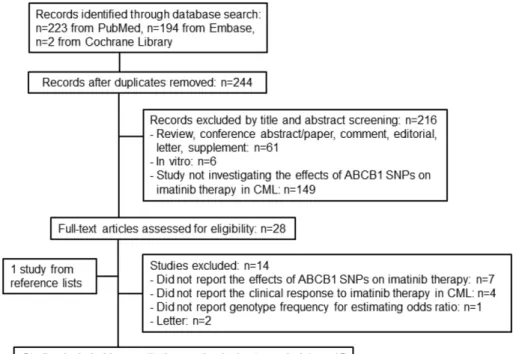
데이터베이스의 검색으로 총 244개의 문헌이 수집되었다. 제 목과 초록의 검토를 통해 선정 및 배제 기준을 만족하는 28편의
논문을 1차적으로 선택하고 전문(full-test)을 검토하여 본 메타 분석에 포함할 최종 논문을 선정하였다. 만성 골수성 백혈병 환 자에서 ABCB1 단일염기다형성이 이매티닙 치료에 대한 임상적 반응에 미치는 영향을 오즈비의 산출이 가능한 유전자형 빈도를 보여주지 않은 논문 12개와 논평(Letter) 형태의 논문 2개를 본 연구에서 배제하였으며 1차적으로 선택된 논문의 참고문헌 목록 을 직접 수기로 검토하는 과정에서 찾은 논문 1개를 추가하여 최 종적으로 2개의 전향적 코호트연구와15,16) 13개의 환자-대조군 연구(case-control studies)를17-29)본 연구에 포함하였다(Fig. 1).
문헌의 질평가를 수행한 결과 6개의 연구가17-22) NOS 등급으로
9점을, 7개의 연구가15,16,23-27) 8점을, 그리고 1개의 연구가28) 7점
Table I − Characteristics of the included studies and genotype frequencies of ABCB1 C1236T polymorphism according to response to imatinib
Study Country CML phase Treatment Response criteria Genotypes (n) Dose/day Duration (months) Responsive Resistant
CC CT TT CC CT TT Kassogue et al., 2015 Morocco CP 400 mg (N=70) 48 CR 15 13 08 16 13 05 Ali et al., 2014 Egypt CP 400 mg (N=100) ≥3 MR 20 30 05 19 23 03 Au et al., 2014 Malaysia CP 400 mg (N=215) ≥6 MR 12 66 40 19 44 34 Seong et al., 2013 Korea CP 400 mg (N=82) ≥6 CR 15 30 18 02 07 10 Gromicho et al., 2012 Portugal NA 400 mg (N=33) 2-73 (46, median) MR 6 06 03 03 12 03
Vivona et al., 2012 Brazil CP 400 mg (N=118) 18 MR 24 46 15 33
Ni et al., 2011 China CP 400 mg (N=52) ≥12 CR 10 12 05 03 07 15 Maffioli et al., 2011 Spain CP 400 mg (N=59) 16.7-110.9 (60.6, median) Response 46 13 5 00 Dulucq et al., 2008 France AP, CP 400 mg (N=85) ≥12 MR 11 20 17 16 18 03 AP, accelerated phase; CML, chronic myeloid leukemia; CP, chronic phase; CR, cytogenetic response; MR, molecular response; NA, not applicable.
Fig. 2 − Forest plot of the association between ABCB1 C1236T polymorphism and imatinib response stratified by country under the recessive genetic model. Squares represent study-specific OR; horizontal lines represent 95% CIs; diamond represents a summary odds ratio estimate with corresponding 95% CI.
을 얻어 ‘우수’로 평가되었으며 1개의 연구는29) 5점을 얻어 ‘보 통’으로 평가되었다. ABCB1 C1236T이 이매티닙 치료에 대한 반응에 미치는 영향 총 9개의 연구가 ABCB1 C1236T의 이매티닙 반응성에 대한 영향 분석에 포함되었으며 3개의 연구가 아시아에서,20,21,24) 3개 의 연구는 유럽에서,17,19,28) 2개의 연구는 아프리카에서,15,27)그 리고 나머지 1개의 연구는 아메리카에서18) 수행되었다. 본 분석 에 포함된 814명의 환자 중 349명(42.9%)은 아시아인, 177명 (21.7%)은 유럽인, 170명(20.9%)은 아프리카인, 그리고 118명 (14.5%)이 아메리카인이었다. 모든 환자가 이매티닙 400 mg을
매일 복용했으며 85.5% 이상의 환자가 만성 골수성 백혈병의 만 성기에 있었다(Table I).
9개의 연구 결과를 종합한 결과 ABCB1 C1236T은 이매티닙 반응성에 유의한 영향을 미치지 않는 것으로 드러났다(CC vs. TT, OR: 0.84; 95% CI: 0.53, 1.33; p=0.46; CC vs. CT+TT, OR: 0.90; 95% CI: 0.64, 1.25; p=0.53; CC+CT vs. TT, OR: 1.03; 95% CI: 0.72, 1.47). 그러나 개별 연구가 이루어진 국가 별 하위집단 분석에서 1236CC 혹은 1236CT 유전자형을 가진 아시아 환자는 1236TT 유전자형을 가진 아시아 환자에 비해 이매티닙에 대한 반응성이 유의한 수준으로 우수한 반면 아프 리카 환자에서는 반대의 결과가 관찰되었다(CC+CT vs. TT: 아시아, OR: 1.65; 95% CI: 1.05, 2.59; p=0.03; 아프리카, OR: 0.41; 95% CI: 0.21, 0.80; p=0.008). 하위집단 분석에 포 함된 연구들간 이질성이 높았으며 출판비뚤림이 관찰되었다(Fig. 2, Fig. 3).
Fig. 3 − Funnel plot for publication bias of the included studies in the subgroup analysis of the effect of ABCB1 C1236T polymorphism on imatinib response stratified by country under the recessive genetic model.
Table II − Characteristics of the included studies and genotype frequencies of ABCB1 G2677T polymorphism according to response to imatinib
Study Country CML phase Treatment Response criteria Genotypes (n) Dose/day Duration (months) Responsive Resistant GG GT TT GG GT TT Kassogue et al., 2015 Morocco CP 400 mg (N=67) 48 CR 21 12 NA 24 10 NA Ali et al., 2014 Egypt CP 400 mg (N=155) ≥3 MR 48 46 06 25 25 05 Elghannam et al., 2014 Egypt AP, BP, CP 400-600 mg (N=96) ≥3 MR 16 11 16 17 34 02 Maffioli et al., 2011 Spain CP 400 mg (N=59) 16.7-110.9
(60.6, median) Response 14 40 4 1 Ni et al., 2011 China CP 400 mg (N=40) ≥12 CR 08 07 02 05 14 04 Sailaja et al., 2010 India AP, BP, CP NA 24 CR 24 44 68 20 29 21 AP, accelerated phase; BP, blast phase; CML, chronic myeloid leukemia; CP, chronic phase; CR, cytogenetic response; MR, molecular response; Response, cytogenetic, molecular, and hematological responses.
Fig. 4 − Forest plot of the association between ABCB1 G2677T polymorphism and imatinib response stratified by country under the allele contrast model. Squares represent study-specific OR; horizontal lines represent 95% CIs; diamond represents a summary odds ratio estimate with corresponding 95% CI.
ABCB1 G2677T이 이매티닙 치료에 대한 반응에 미치는 영향 총 6개의 연구가 ABCB1 G2677T의 이매티닙 반응성에 대 한 영향 분석에 포함되었으며 3개의 연구가 아프리카에서 수 행되었고,15,16,27) 2개의 연구는 아시아에서,24,29) 나머지 1개의 연구가 유럽에서17)수행되었다. 본 분석에는 전체 623명의 환 자가 포함되었다: 아프리카인 318명(51%); 아시아인 246명 (39.5%); 유럽인이 59명(9.5%). 반 이상의 환자가 매일 이매티 닙 400 mg을 복용했으며 만성 골수성 백혈병의 만성기에 있었 다(Table II). ABCB1 G2677T의 이매티닙 치료 반응에 대한 영향을 우성모 델로 분석한 결과 유의한 영향을 미치지 않는 것으로 나타났다 (GG vs. GT+TT, OR: 0.87; 95% CI: 0.61, 1.25; p=0.46). 그 러나 개별 연구가 이루어진 국가별로 하위집단 분석을 수행했을 때 아시아와 아프리카 환자 중 2677GG 혹은 2677GT 유전자형 을 가진 환자는 2677TT 유전자형을 가진 환자에 비해 이매티닙 에 대한 치료 반응이 유의한 수준으로 저조하였다(GG vs. TT, OR: 0.32; 95% CI: 0.19, 0.54; p<0.0001; GG+GT vs. TT, OR: 0.44; 95% CI: 0.27, 0.70; p=0.0005)(Fig. 4, Fig. 5). 본 분석에 포함된 연구들간에 통계적으로 유의한 이질성은 발견되 지 않았으나 출판비뚤림이 관찰되었다(Fig. 6, Fig. 7).
Fig. 5 − Forest plot of the association between ABCB1 G2677T polymorphism and imatinib response stratified by country under the recessive genetic model. Squares represent study-specific OR; horizontal lines represent 95% CIs; diamond represents a summary odds ratio estimate with corresponding 95% CI.
Fig. 6 − Funnel plot for publication bias of the included studies in the subgroup analysis of the effect of ABCB1 G2677T poly-morphism on imatinib response stratified by country under the allele contrast model.
Fig. 7 − Funnel plot for publication bias of the included studies in the subgroup analysis of the effect of ABCB1 G2677T poly-morphism on imatinib response stratified by country under the recessive genetic model.
ABCB1 C3435T이 이매티닙 치료에 대한 반응에 미치는 영향 총 1,076명의 환자를 대상으로 한 11개의 연구가 ABCB1 C3435T의 이매티닙 치료 반응에 대한 영향 분석에 포함되었다: 아시아에서 수행된 7개의 연구에서20-26,29) 670명(62.3%)이, 아프 리카에서 수행된 2개의 연구에서15,27) 225명(20.9%)이, 그리고 유럽에서 수행된 1개의 연구와17) 아메리카에서 수행된 1개의 연 구에서18)각각 63명(5.9%)과 118명(11%)이 본 연구에서 분석되 었다. 80%(839명)가 넘는 환자가 이매티닙 400 mg을 매일 복용 하였으며 4.6%(49명)는 600~800 mg을, 그 나머지는 400 mg 이 하를 매일 복용하였고 95% 이상(1020명 이상)의 환자가 만성 골 수성 백혈병의 만성기에 있었다(Table III). 11개의 연구 결과를 종합한 결과 C3435T은 이매티닙의 치료 효과에 유의한 영향을 미치지 않는 것으로 나타났다(CC vs. TT, OR: 0.93; 95% CI: 0.61, 1.43; p=0.75; I²=16.1%; CC vs.
CT+TT, OR: 0.91; 95% CI: 0.70, 1.19; p=0.51; I²=21.1%; CC+CT vs. TT, OR: 0.90; 95% CI: 0.62, 1.30; p=0.56; I²= 3.4%). 본 분석에 포함된 연구들간에 이질성은 발견되지 않았지 만 출판비뚤림이 관찰되었다(Fig. 8).
고
찰
본 연구는 ABCB1 단일염기다형성 중 가장 빈번히 발견되는 C1236T, G2677T, 그리고 C3435T이 만성 골수성 백혈병 환자의 이매티닙 치료에 대한 반응에 미치는 영향을 규명하기 위해 수 행되었다. 이매티닙이 필라델피아 염색체 양성 만성 골수성 백 혈병 만성기 환자의 치료에서 1차 치료제로 사용이 권고되고 있 음에도 불구하고 많은 환자가 이 약물에 반응하지 않거나 내성 을 형성하는 것으로 보고되고 있으며 이매티닙의 사용으로 치료Table III − Characteristics of the included studies and genotype frequency of ABCB1 C3435T polymorphism according to response to imatinib
Study Country CML phase
Treatment Response criteria Genotypes (n) Dose/day Duration (months) Responsive Resistant CC CT TT CC CT TT Kassogue et al., 2015 Morocco CP 400 mg (N=70) 48 CR 18 12 06 21 11 02 Salimizand et al., 2015 Iran AP (N=11),
CP (N=59)
400 mg (N=56)
600 mg (N=14) 64 CR 06 10 33 03 08 10
Ali et al., 2014 Egypt CP 400 mg (N=155) ≥3 MR 44 47 09 23 28 04 Au et al., 2014 Malaysia CP 400 mg (N=215) ≥6 MR 30 69 19 27 53 17 Seong et al., 2013 Korea CP 400 mg (N=82) ≥6 CR 30 28 05 05 10 04 Shinohara et al., 2013 Japan CP ≤400 mg (N=143);
600 mg (N=1)
3.2-106
(16.5, median) MR 25 31 16 28 33 11 Anthony et al., 2012 Malaysia AP, CP 400 mg (N=45) ≥6 Response 06 13 03 10 09 04 Vivona et al., 2012 Brazil CP 400 mg (N=70),
600 or 800 mg (N=48) 18 MR 24 46 19 29
Maffioli et al., 2011 Spain CP 400 mg (N=63) 16.7-111
(60.6, median) Response 11 48 04 00 Ni et al., 2011 China CP 400 mg (N=52) ≥12 CR 15 12 01 05 14 05 Takahashi et al., 2010 Japan CP
400 mg (N=31); 300 mg (N=17); <300 mg (N=14)
NA MR 07 21 06 08 16 04 AP, accelerated phase; CML, chronic myeloid leukemia; CP, chronic phase; CR, cytogenetic response; MR, molecular response; Response, cytogenetic, molecular, and hematological responses; NA, not applicable.
Fig. 8 − Funnel plots for publication bias of the included studies in the meta-analysis of the effect of ABCB1 C3455T polymorphism on imatinib response stratified by country under the allele contrast model (a), dominant model (b), and recessive model (c), respectively.
에 실패한 경우 나사티닙이나 닐로티닙을 사용하여 우수한 세포 유전학적 반응과 분자적 반응을 거두므로 이매티닙 치료에 대한 반응을 예견하는 바이오마커의 규명은 만성 골수성 백혈병 환자 의 치료를 결정하는데 있어 중요한 요소라고 할 수 있다.30) 본 메타분석의 결과 ABCB1 1236TT 유전자형을 가진 아시아 환자는 1236CC 혹은 1236CT 유전자형을 지닌 환자에 비해 이 매티닙 치료에 대한 반응이 유의한 수준으로 저조한 반면 동일 유전자형을 지닌 아프리카 환자에서는 오히려 이매티닙 치료에 대한 반응이 유의한 수준으로 우수한 것으로 나타났다. 아시아 환자에서 관찰된 본 연구의 결과는 ABCB1 1236TT 유전자형이 아시아 환자에서 이매티닙의 치료성과를 나쁘게 하는 위험인자 가 된다고 발표한 Zu 등의 메타분석과8) 1236CC 유전형을 지닌 아시아의 만성 골수성 백혈병 환자는 이매티닙의 치료 시 더 좋 은 반응을 보일 것이라고 발표한 Zheng 등의 메타분석9)결과와 일치하지만, C1236T가 만성 골수성 백혈병 환자의 이매티닙 치 료성과에 영향을 미치지 않음을 보여준 Wang 등의 메타분석10) 결과와는 일치하지 않는다. 본 메타분석의 결과가 Wang 등의 연 구 결과와 다른 이유는 두 메타분석에 포함된 연구의 차이 때문 으로 보인다. Wang 등의 메타분석에 포함된 Kim 등의 연구와31) Marin 등의 연구는32)이매티닙의 치료에 대한 ABCB1 C1236T (rs1128503)의 영향을 보고하지 않아 본 메타분석에는 포함되지 못했으며, Deenik 등의 연구는33) “논평”으로 발표되어 본 메타 분석에서 배제되었다. 또한 본 메타분석은 Wang 등이 분석하지 않은 Ali 등의 연구,15) Maffioli 등의 연구,17) Gromicho 등의 연
구를19)포함시켜 분석하였다. 한편, 본 연구에서 ABCB1 2677GG 혹은 2677GT 유전자형 을 가진 아시아와 아프리카 환자는 2677TT 유전자형을 가진 환 자에 비해 이매티닙에 대한 반응성이 유의한 수준으로 저조한 것 이 관찰되었으며 이 결과는 Zheng 등이 발표한 연구결과와 일 치한다.9)그러나 이 결과는 G2677T이 만성 골수성 백혈병 환자 의 이매티닙 치료성과에 영향을 미치지 않는다고 주장한 Wang 등의 메타분석10)결과와는 상반된다. 두 메타분석간에 보이는 이 러한 결과의 차이는 각 메타분석에 포함된 연구의 차이에서 기 인한 것으로 보인다. Wang은 ABCB1 G2677T/A(rs2032582)가 이매티닙의 치료 반응에 미치는 영향을 분석하기 위해 Ali 등의 연구,15) Elghannam 등의 연구,16) Ni 등의 연구24)만을 분석했으 나 본 연구는 이 3개의 연구에 더하여 Maffioli 등의 연구,17) Kassogue 등의 연구,27) Sailaja 등의 연구29)도 포함하여 분석하 였다. 본 연구에서 ABCB1 C3435T은 이매티닙의 치료 반응에 유의 한 영향을 미치지 않는 것으로 나타났으며 이 결과는 최근에 Wang 등이 발표한 메타분석 연구10)결과와 일치한다. 본 연구는 선행 메타분석 연구에서 분석되지 않은 연구와29) 가장 최근의 연구를15,22,27)포함하여 분석하였으나 “논평”으로 발 표한 Deenik 등의 논문과33) Dulucq 등의 논문은34)배제하여 분 석에 포함시키지 않았다. Deenik 등은 만성 골수성 백혈병 만성 기 초기의 네덜란드인 46명에게 매일 이매티닙 800 mg을 투여 한 후 ABCB1 다형성이 이매티닙 치료에 분자적 반응에 미치는 영향을 관찰한 결과 1236CT 혹은 1236TT 유전자형을 지닌 환 자는 1236CC 유전자형을 지닌 환자에 비해 반응이 저조했다고 발표하였고 이 결과는 본 연구가 관찰한 1236TT 유전자형을 가 진 아시아 환자에서의 저조한 반응과 일치한다. 반면 Dulucq 등 은 프랑스 환자에서 C1236T 다형성은 이매티닙 치료 반응에 영 향을 미치지 않았다고 주장했다. 본 연구에 포함된 거의 대부분의 환자가 만성 골수성 백혈병 의 만성기에 있었으므로 환자의 병기에 있었으므로 연구들간에 동질성이 보장되었고 대다수의 환자가 하루 400 mg의 이매티닙 을 복용하여 이매티닙의 사용량에 있어서도 연구들간에 차이가 거의 없었다는 장점이 있으나 본 연구에는 몇 가지 한계점이 있 다. 이매티닙 치료에 대한 반응을 평가하기 위한 기준으로 세포 유전학적 반응과 분자적 반응을 구분 없이 사용했으며 이매티닙 의 복용기간이 짧게는 3개월, 길게는 111개월로 연구들간에 매 우 다양하였다. 또한 아시아 외의 지역에서 수행된 연구 결과가 빈약했다. 그럼에도 불구하고 본 연구는 만성 골수성 백혈병의 만성기에 있는 아시아 및 아프리카 환자에서 이매티닙 치료에 대 해 저조한 치료 반응을 예견할 수 있는 수 있는 바이오마커로서 ABCB1 C1236T와 G2677T 단일염기다형성을 제안하는 것에 그 의의가 있다고 하겠다.
결
론
만성 골수성 백혈병의 만성기 환자 중 ABCB1 1236TT 유전 자형 및 2677G allele을 지닌 아시아 환자와 1236C 및 2677G allele을 지닌 아프리카 환자는 이매티닙 치료에 대해 저조한 성 과를 보일 위험이 있다. 반면 ABCB1 C3435T은 만성 골수성 백 혈병 만성기 환자의 이매티닙 치료 반응에 유의한 영향을 미치 지 않는 것으로 보인다.References
1) Kurzrock, R., Kantarjian, H. M., Druker, B. J. and Talpaz, M. : Philadelphia chromosome-positive leukemias: from basic mechanisms to molecular therapeutics. Ann. Intern. Med. 138, 819 (2003).
2) Talpaz, M., Shah, N. P., Kantarjian, H., Donato, N., Nicoll, J., Paquette, R., Cortes, J., O’Brien, S., Nicaise, C., Bleickardt, E., Blackwood-Chirchir, M. A., Iyer, V., Chen, T. T., Huang, F., Decillis, A. P. and Sawyers, C. L. : Dasatinib in imatinib-resistant Philadelphia chromosome-positive leukemias. N.
Engl. J. Med. 354, 2531 (2006).
3) Baccarani, M., Deininger, M. W., Rosti, G., Hochhaus, A., Soverini, S., Apperley, J. F., Cervantes, F., Clark, R. E., Cortes, J. E., Guilhot, F., Hjorth-Hansen, H., Hughes, T. P., Kantarjian, H. M., Kim, D. W., Larson, R. A., Lipton, J. H., Mahon, F. X., Martinelli, G., Mayer, J., Müller, M. C., Niederwieser, D., Pane, F., Radich, J. P., Rousselot, P., Saglio, G., Sauβele, S., Schiffer, C., Silver, R., Simonsson, B., Steegmann, J. L., Goldman, J. M. and Hehlmann, R. : European LeukemiaNet recommendations for the management of chronic myeloid leukemia: 2013. Blood 122, 872 (2013).
4) Breccia, M., Alimena, G., Baccarani, M., Bocchia, M., Di Raimondo, F., Gambacorti-Passerini, C., Gozzini, A., Morra, E., Pane, F., Pregno, P., Rege-Cambrin, G., Rosti, G., Specchia, G., Vigneri, P. and Saglio, G. : Current management of CML patients: Summary of the Italian Consensus Meeting held in Rome, April 11-12, 2013. Crit. Rev. Oncol. Hematol. 90, 181 (2014).
5) National Institute for Health and Care Excellence. Guidance on the use of imatinib for chronic myeloid leukaemia. Available from URL: https://www.nice.org.uk/guidance/ta70/chapter/1-guidance. Accessed 25 January (2016).
6) Bixby, D. and Talpaz, M. : Mechanisms of resistance to tyrosine kinase inhibitors in chronic myeloid leukemia and recent therapeutic strategies to overcome resistance. Hematology Am. Soc. Hematol. Educ. Program 461 (2009).
7) Hodges, L. M., Markova, S. M., Chinn, L. W., Gow, J. M., Kroetz, D. L., Klein, T. E. and Altman, R. B. : Very important pharmacogene summary: ABCB1 (MDR1, P-glycoprotein). Pharmacogenet. Genomics 21, 152 (2011).
8) Zu, B., Li, Y., Wang, X., He, D., Huang, Z. and Feng, W. : MDR1 gene polymorphisms and imatinib response in chronic myeloid leukemia: a meta-analysis. Pharmacogenomics 15, 667 (2014). 9) Zheng, Q., Wu, H., Yu, Q., Kim, D. H., Lipton, J. H., Angelini, S., Soverini, S., Vivona, D., Takahashi, N. and Cao, J. : ABCB1 polymorphisms predict imatinib response in chronic myeloid leukemia patients: a systematic review and meta-analysis. Pharmacogenomics J. 15, 127 (2015).
10) Wang, J. L., Liu, H. J., Li, F., Yang, W. Y., Wang, J. M., Tan, S. F. and Wang, Q. : Multidrug resistance gene (MDR1) polymorphisms may not be directly associated with response to imatinib in chronic myeloid leukemia. Genet. Mol. Res. 14, 14967 (2015).
11) Wells, G. A., Shea, B., O’Connell, D., Peterson, J., Welch, V., Losos, M. and Tugwell, P. : The Newcastle-Ottawa scale (NOS) for assessing the quality of nonrandomised studies in meta-analysis. Ottawa Hospital Research Institute. Available from URL: http://www.ohri.ca/programs/clinical_epidemiology/ oxford.asp. Accessed 20 January (2016).
12) Zheng, J. S., Hu, X. J., Zhao, Y. M., Yang, J. and Li, D. : Intake of fish and marine n-3 polyunsaturated fatty acids and risk of breast cancer: meta-analysis of data from 21 independent prospective cohort studies. BMJ 346, f3706 (2013). 13) Xuan, C., Zhang, B. B., Li, M., Deng, K. F., Yang, T. and Zhang,
X. E. : No association between APOE ε 4 allele and multiple sclerosis susceptibility: a meta-analysis from 5472 cases and 4727 controls. J. Neurol. Sci. 308, 110 (2011).
14) Zhang, B. B., Xuan, C., Deng, K. F., Wu, N. and Lun, L. M. : Association between the MDR1 gene variant C3435T and risk of leukaemia: a meta-analysis. Eur. J. Cancer Care (Engl). 22, 617 (2013).
15) Ali, M. A. and Elsalakawy, W. A. : ABCB1 haplotypes but not individual SNPs predict for optimal response/failure in Egyptian patients with chronic-phase chronic myeloid leukemia receiving imatinib mesylate. Med. Oncol. 31, 279 (2014).
16) Elghannam, D. M., Ibrahim, L., Ebrahim, M. A., Azmy, E. and Hakem, H. : Association of MDR1 gene polymorphism (G2677T) with imatinib response in Egyptian chronic myeloid leukemia patients. Hematology 19, 123 (2014).
17) Maffioli, M., Camós, M., Gaya, A., Hernández-Boluda, J. C., Alvarez-Larrán, A., Domingo, A., Granell, M., Guillem, V., Vallansot, R., Costa, D., Bellosillo, B., Colomer, D. and Cervantes, F. : Correlation between genetic polymorphisms of the hOCT1 and MDR1 genes and the response to imatinib in patients newly diagnosed with chronic-phase chronic myeloid leukemia. Leuk. Res. 35, 1014 (2011).
18) Vivona, D., Bueno, C. T., Lima, L. T., Hirata, R. D., Hirata, M. H., Luchessi, A. D., Zanichelli, M. A., Chiattone, C. S. and Guerra-Shinohara, E. M. : ABCB1 haplotype is associated with major molecular response in chronic myeloid leukemia patients treated with standard-dose of imatinib. Blood Cells Mol. Dis. 48, 132 (2012).
19) Gromicho, M., Magalhães, M., Torres, F., Dinis, J., Fernandes, A. R., Rendeiro, P., Tavares, P., Laires, A., Rueff, J. and Sebastião Rodrigues, A. : Instability of mRNA expression signatures of drug transporters in chronic myeloid leukemia patients resistant to imatinib. Oncol. Rep. 29, 741 (2013). 20) Seong, S. J., Lim, M., Sohn, S. K., Moon, J. H., Oh, S. J., Kim,
B. S., Ryoo, H. M., Chung, J. S., Joo, Y. D., Bang, S. M., Jung, C. W., Kim, D. H., Park, S. Y., Yoon, S. S., Kim, I., Lee, H. G., Won, J. H., Min, Y. H., Cheong, J. W., Park, J. S., Eom, K. S., Hyun, M. S., Kim, M. K., Kim, H., Park, M. R., Park, J., Kim, C. S., Kim, H. J., Kim, Y. K., Park, E. K., Zang, D. Y., Jo, D. Y., Lee, H. W. and Yoon, Y. R. : Influence of enzyme and transporter polymorphisms on trough imatinib concentration and clinical response in chronic myeloid leukemia patients. Ann. Oncol. 24, 756 (2013).
Rosline, H. and Ankathil, R. : Association of genotypes and haplotypes of multi-drug transporter genes ABCB1 and ABCG2 with clinical response to imatinib mesylate in chronic myeloid leukemia patients. Biomed. Pharmacother. 68, 343 (2014).
22) Salimizand, H., Amini, S., Abdi, M., Ghaderi, B. and Azadi, N. A. : Concurrent effects of ABCB1 C3435T, ABCG2 C421A, and XRCC1 Arg194Trp genetic polymorphisms with risk of cancer, clinical output, and response to treatment with imatinib mesylate in patients with chronic myeloid leukemia. Tumour. Biol. DOI 10.1007/s13277-015-3874-4 (2015).
23) Takahashi, N., Miura, M., Scott, S. A., Kagaya, H., Kameoka, Y., Tagawa, H., Saitoh, H., Fujishima, N., Yoshioka, T., Hirokawa, M. and Sawada, K. : Influence of CYP3A5 and drug transporter polymorphisms on imatinib trough concentration and clinical response among patients with chronic phase chronic myeloid leukemia. J. Hum. Genet. 55, 731 (2010). 24) Ni, L. N., Li, J. Y., Miao, K. R., Qiao, C., Zhang, S. J., Qiu,
H. R. and Qian, S. X. : Multidrug resistance gene (MDR1) polymorphisms correlate with imatinib response in chronic myeloid leukemia. Med. Oncol. 28, 265 (2011).
25) Anthony, A., Ankathil, R., Ai-Sim, G., Fadilah, S. A. W. and Baba, A. A. : Influence of ABCB1 C3435T and ABCG2 C421A gene polymorphisms in response to imatinib mesylate in chronic myeloid leukemia patients. IJESD 3, 274 (2012). 26) Shinohara, Y., Takahashi, N., Nishiwaki, K., Hino, M., Kashimura,
M., Wakita, H., Hatano, Y., Hirasawa, A., Nakagawa, Y., Itoh, K., Masuoka, H., Aotsuka, N., Matsuura, Y., Takahara, S., Sano, K., Kuroki, J., Hata, T., Nakamae, H., Mugitani, A., Nakane, T., Miyazaki, Y., Niioka, T., Miura, M. and Sawada, K. : A multicenter clinical study evaluating the confirmed complete molecular response rate in imatinib-treated patients with chronic phase chronic myeloid leukemia by using the international scale of real-time quantitative polymerase chain reaction. Haematologica. 98, 1407 (2013).
27) Kassogue, Y., Dehbi, H., Quachouh, M., Quessar, A., Benchekroun, S. and Nadifi, S. : Lack of association of multidrug resistance gene-1 polymorphisms with treatment outcome in chronic myeloid leukemia patients treated with imatinib. MEJC 6, 229 (2015).
28) Dulucq, S., Bouchet, S., Turcq, B., Lippert, E., Etienne, G., Reiffers, J., Molimard, M., Krajinovic, M. and Mahon, F. X. : Multidrug resistance gene (MDR1) polymorphisms are associated with major molecular responses to standard-dose imatinib in chronic myeloid leukemia. Blood 112, 2024 (2008). 29) Sailaja, K., Surekha, D., Rao, D. N., Raghunadharao, D. and Vishnupriya, S. : Association of MDR1 gene polymorphism (G2677T) with chronic myeloid leukemia. Biology and Medicine 2, 17 (2010).
30) Griffin, J. D., Guerin, A., Chen, L., Macalalad, A. R., Luo, J., Ionescu-Ittu, R. and Wu, E. Q. : Comparing nilotinib with dasatinib as second-line therapies in patients with chronic myelogenous leukemia resistant or intolerant to imatinib--a retrospective chart review analysis. Curr. Med. Res. Opin. 29, 623 (2013).
31) Kim, D. H., Kong, J. H., Byeun, J. Y., Jung, C. W., Xu, W., Liu, X., Kamel-Reid, S., Kim, Y. K., Kim, H. J. and Lipton, J. H. : The IFNG (IFN-gamma) genotype predicts cytogenetic and molecular response to imatinib therapy in chronic myeloid leukemia. Clin. Cancer Res. 16, 5339 (2010).
32) Marin, D., Bazeos, A., Mahon, F. X., Eliasson, L., Milojkovic, D., Bua, M., Apperley, J. F., Szydlo, R., Desai, R., Kozlowski, K., Paliompeis, C., Latham, V., Foroni, L., Molimard, M., Reid, A., Rezvani, K., de Lavallade, H., Guallar, C., Goldman, J. and Khorashad, J. S. : Adherence is the critical factor for achieving molecular responses in patients with chronic myeloid leukemia who achieve complete cytogenetic responses on imatinib. J. Clin. Oncol. 28, 2381 (2010).
33) Deenik, W., van der Holt, B., Janssen, J. J., Chu, I. W., Valk, P. J., Ossenkoppele, G. J., van der Heiden, I. P., Sonneveld, P., van Schaik, R. H. and Cornelissen, J. J. : Polymorphisms in the multidrug resistance gene MDR1 (ABCB1) predict for molecular resistance in patients with newly diagnosed chronic myeloid leukemia receiving high-dose imatinib. Blood 116, 6144; author reply 6145 (2010).
34) Dulucq, S., Preudhomme, C., Guilhot, F. and Mahon, F.-X. : Response: is there really a relationship between Multidrug Resistance Gene (MDR1) polymorphisms and major molecular response to imatinib in chronic myeloid leukemia? Blood 116, 6145 (2010).