Introduction
Farm management information system (FMIS) is a software system used to collect, process, store, and disseminate data in the form of information needed to carry out the operations of a farm (Sørensen et al., 2010). Given that farmers require low cost and ubiquitous access to utilize FMIS, the use of cloud-computing technology has been a growing trend in the FMIS area.
The use of cloud-computing technology in FMIS has several advantages. First, it provides lower overall main-tenance expenses. Next, it reduces the management burden. The strength of cloud computing is that the cloud vendor has the responsibility of maintaining the service or application. In addition, it improves accessibility. A farmer can access the service from anywhere. Finally, it
supports intensive computing power and huge amounts of storage. FMIS often deals with very large data sets, which include weather data, soil data, GPS data, and image data. For these reasons, cloud-computing technology is a promising utility for agricultural data processing and storing.
Recently, researchers have applied cloud-computing technology in the area of FMIS. Kim (2014) proposed an FMIS platform based on cloud computing and conducted a demonstration test on an orchard farm. López- Riquelme et al. (2017) demonstrated that using a cloud service in an agronomic context could be highly beneficial.
The objective of this study is to develop a greenhouse- control system based on private cloud-computing technology. The study describes how to setup a private cloud as an infrastructure-as-a-service (IaaS) model, how to build an application programming interface (API) as a platform-as-a-service (PaaS) model, and how to develop a greenhouse-control application as a software-as-a-
Building a Private Cloud-Computing System for Greenhouse Control
JoonYong Kim1, Chun Gu Lee2, Dong-Hyeok Park2, Heun Dong Park3, Joong-Yong Rhee1,2*
1Research Institute for Agriculture and Life Sciences, Seoul National University, Seoul, Republic of Korea 2Dept. of Biosystems Engineering, Seoul National University, Seoul, Republic of Korea
3Research Team, JiNong Inc., Anyang, Republic of Korea
Received: November 2th, 2018; Revised: November 20th, 2018; Accepted: November 20th, 2018
Purpose: Cloud-computing technology has several advantages, including maintenance, management, accessibility, and computing power. A greenhouse-control system utilizing these advantages was developed using a private cloud-computing system. Methods: A private cloud needs a collection of servers and a suite of software tools to monitor and control cloud-computing resources. In this study, a server farm, operated by OpenStack as a cloud platform, was constructed using servers, and other network devices. Results: The greenhouse-control system was developed according to the fundamental cloud service models: infrastructure as a service, platform as a service, and software as a service. This system has four additional advantages - security, control function, public data use, and data exchange. There are several considerations that must be addressed, such as service level agreement, data ownership, security, and the differences between users. Conclusions: When the advantages are utilized and the considerations are addressed, cloud-computing technology will be beneficial for agricultural use.
Keywords: Farm management information system, Greenhouse-control system, Open stack, Smart farming, Private cloud
J. Biosyst. Eng. 43(4):440-444. (2018. 12) https://doi.org/10.5307/JBE.2018.43.4.440
eISSN : 2234-1862 pISSN : 1738-1266
*Corresponding author: Joong-Yong Rhee Tel: +82-2-880-4605; Fax: +82-2-885-8027 E-mail: [email protected]
service (SaaS) model for smart farming.
Materials and Methods
Cloud-computing technology
Cloud computing is a technology based on the Internet. According to the National Institute of Standard and Technology (NIST), cloud computing is a model for enabling ubiquitous, convenient, on-demand network access to a shared pool of configurable computing resources (e.g., networks, servers, storage, applications, and services), which can be rapidly provisioned and released with minimal management effort or service- provider interaction (Mell and Grance, 2011).
There are typically three types of clouds: public, private, and hybrid. The infrastructure of the public cloud is shared by multiple businesses and is operated by a service provider offering fast provisioning. By contrast, the infrastructure of the private cloud is hosted on-site or in a service provider’s data center, offering greater levels of control and security. A hybrid cloud is an intermediate form of a public and private cloud.
Cloud-computing providers offer their services according to three fundamental models: IaaS, PaaS, and SaaS. Cloud-infrastructure services, known as IaaS, are made of scalable and automated computing resources. IaaS provides services for accessing infrastructures, such as computing, networking, and storage. In the PaaS model, cloud providers support components for de-velopers to build upon and use to create customized applications. SaaS, also known as cloud application services, provides applications. A majority of SaaS applications do not require any downloading or installation on the client side but rather are operated directly through the web browser. SaaS is sometimes referred to as "on-demand software".
A greenhouse-control system based on cloud-computing technology can use any type of cloud. Given that a private cloud provides greater levels of control and security, this system is constructed with the three service models on a private cloud.
Hardware and Software for Private Cloud
Infrastructure
To set up a private cloud infrastructure, a server farm operated by a cloud platform is required to monitor and
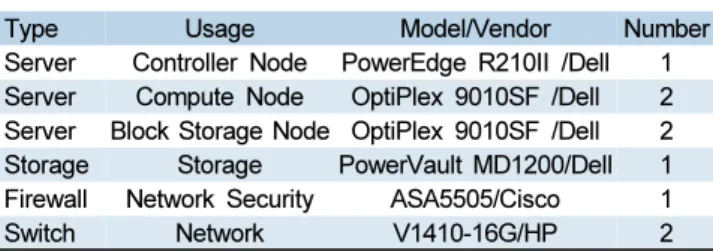
control cloud computing resources. The server farm is a collection of servers and network devices. Table 1 shows the hardware list used.
The cloud platform is a suite of integrated software tools designed to monitor and control cloud computing resources. OpenStack (OpenStack, 2017) is a free and open-source software platform for cloud computing, mostly deployed as IaaS. It began in 2010 as a joint project of Rackspace, Inc. and National Aeronautics and Space Administration (NASA), and many developers have contributed to the project. In this study, the OpenStack was used because of its flexibility, robust architecture, avoidance vendor lock-in, and support by many companies.
Design of Greenhouse Control System
A greenhouse-control system was designed according to cloud service models. Figure 1 shows the cloud service model for the greenhouse-control system. The design consists of four layers. The orange box, purple box, and red box refer to the hardware, OpenStack components, and developed software, respectively. At the bottom, there is a server farm, which is a collection of servers, storage devices, and other network devices. For IaaS,
Table 1. Hardware list for cloud infrastructure
Type Usage Model/Vendor Number Server Controller Node PowerEdge R210II /Dell 1 Server Compute Node OptiPlex 9010SF /Dell 2 Server Block Storage Node OptiPlex 9010SF /Dell 2 Storage Storage PowerVault MD1200/Dell 1 Firewall Network Security ASA5505/Cisco 1 Switch Network V1410-16G/HP 2
(Dell- Austin, TX, USA; Cisco- San Jose, CA, USA; HP- Palo Alto, CA, USA)
Figure 1. Design of greenhouse-control system based on the cloud service model.
there are OpenStack nodes and virtual machines that operate on compute nodes. PaaS consists of two API services for data sharing and collecting. The user can use the greenhouse-control application in the SaaS area.
Results and Discussion
Cloud Service Models for Greenhouse
Control
IaaS for Greenhouse Control System
The first service model of the greenhouse-control system is IaaS. The service model, which operates on a server farm, provides computing resources, such as virtual machines, for the greenhouse-control system. An illustration of the network of the server farm is shown in Figure 2. Only compute nodes can be accessed by public connection for users, while other nodes cannot be accessed by public connection because of network security. The proper components of OpenStack were installed and configured on the nodes.
PaaS for Greenhouse Control System
PaaS is a service model that provides an operating system, software-execution environment, and data- exchange platform. According to Kim et al. (2015), a data-exchange platform for FMIS is necessary for interaction with agricultural information systems, and it consists of a data-collection service and data-sharing service. The data-collection service collects public data, such as weather forecasts and wholesale market data, which are available through OpenAPI. This service was developed based on the agricultural data middleware of Kim et al. (2013). The data-sharing service provides an
API for developing a greenhouse-control system. It is a kind of open API, which makes it possible to access the internal data of this greenhouse-control system. A service provider, who wants to access user data to provide personalized service, can use this application. In this system, the greenhouse-control application, which is a SaaS, is the service.
SaaS for Greenhouse Control System
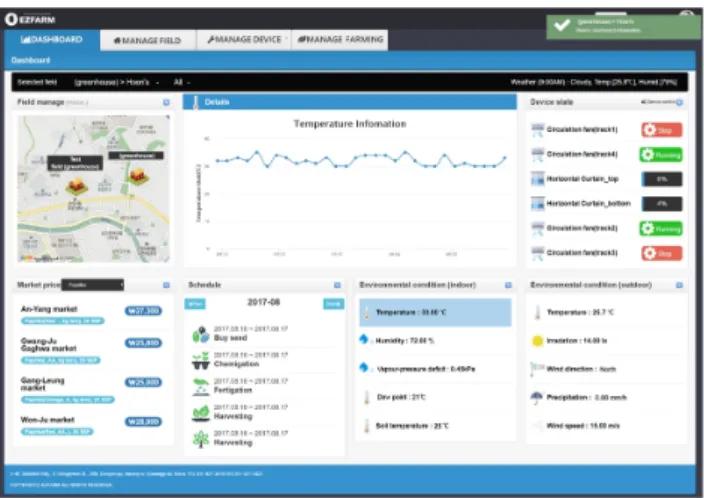
The last service model is SaaS which provides a greenhouse-control application without download or installation. The application operates by utilizing the API of the PaaS. Figure 3 shows a dashboard of the application. The dashboard provides various information: farm location, temperature information, device state, wholesale market price, farming schedule, and environmental conditions (indoor and outdoor). The application has additional functions related to greenhouse control.
Comparison with Another Agricultural
Cloud Software
López-Riquelme et al. (2017) developed an agricultural application using a public cloud. The application handles sensor data collected by wireless sensor nodes on a field. The two systems are similar in that they handle sensor data for agricultural use. However, our system is provided on its own cloud-computing system. Comparing the two systems, our system has four additional advantages. First, a private cloud system was built. It is more configurable and provides higher data security. Second, our system has control functions for a greenhouse
environment. Third, our system could collect public data and users can obtain information from the data, such as crop prices and weather forecasts. Finally, our system supports a data-exchange service that enables it to interact with other systems, even with those that are not on the same private cloud.
Considerations for Applying Cloud
Computing to FMIS
The first consideration that needs to be addressed in applying this cloud-computing system to FMIS is the service-level agreement between the service consumer and service provider. To use the service, the service consumer must pay a fee for the service, based on the service-level agreement. In Rep. Korea, many farmers are not familiar with the concept of paying a service fee for the use of software. Convincing the consumer, in this case, to make an agreement with a service provider might be challenging.
The second consideration is the ambiguity of data ownership and reliability of information. Pesonen et al. (2014) pointed out that data ownership might become a critical issue in efficient information utilization, if the ownership of farm data is not clearly established and access by third parties is not clearly defined. Furthermore, in the case of data aggregation or modification, deter-mining ownership after heavy data manipulation, which added value to the data, might be complicated. For instance, it could raise philosophical issues, such as questioning what the price of information is. Similarly, the reliability of apocryphal information would be suspect.
The third is the difference between users. Regional differences provide an example. Although Rep. Korea is a small country, there are many regional differences like weather, main crops, and soil characteristics. To operate a cloud system, a certain number of users are needed. However, a service or content provider could not satisfy all the users because of their differences.
The fourth consideration is the security of data. A system based on cloud-computing technology has strong openness and complex business uses. Because of its openness, it could face many threats and risks. Although the system utilizes basic hardware and software protection, the importance of security can never be overemphasized.
Conclusions
This greenhouse-control system was developed as an integrated system for a greenhouse environment based on cloud-computing technology. It offers three fun-damental service models on a private cloud. Although there are several studies based on a cloud-computing system, this system exhibits four additional advantages: security, control functionality, public data utilization, and data exchange. To provide this agricultural software, based on cloud-computing technology, for commercial use, it is necessary to address four main considerations. After proper consideration, this approach might be more promising than a legacy system based on a local PC.
Conflict of Interest
The authors have no conflicting financial or other interests.
Acknowledgment
This work was supported by the Korea Institute of Planning and Evaluation for Technology in Food, Agri-culture, Forestry (IPET) through Advanced Production Technology Development Program, and funded by Ministry of Agriculture, Food and Rural Affairs (MAFRA) (316077).
References
Kim, J. -Y. 2014. Development of Interoperable and Scalable Platform for Open Farm Information System. Unpublished Ph.D. diss. Seoul: Seoul National University, Department of Biosystems Engineering.
Kim, J. -Y, C. -G. Lee, S. -H. Baek and J. -Y. Rhee. 2015. Open farm information system data-exchange platform for interaction with agricultural information systems. Agricultural Engineering International: CIGR Journal 17(2): 296–309.
Kim, J. -Y., C. -G. Lee, T. -H. Kwon, G. -H. Park and J. -Y. Rhee. 2013. Development of an agricultural data middleware to integrate multiple sensor networks for a farm environment monitoring system. Journal of Biosystems
Engineering 38(3): 25–32.
https://doi.org/10.5307/JBE.2013.38.1.025
López-Riquelme, J. A., N. Pavón-Pulido, H. Navarro-Hellín, F. Soto-Valles and R. Torres-Sánchez. 2017. A software architecture based on FIWARE cloud for precision agriculture. Agricultural Water Management 183: 123-135.
https://doi.org/10.1016/J.AGWAT.2016.10.020 Mell, P. and T. Grance. 2011. The NIST definition of cloud
computing. Special Publication 800-145. Gaithersburg, MD. USA: National Institute of Standards and Technology.
Pesonen, L. A., F. K. -W. Teye and A. K. Ronkainen, M. O. Koistinen, J. J. Kaivosoja, P. F. Suomi, R. O. Linkolehto. 2014. Cropinfra – An Internet-based service infrastructure to support crop production in future farms. Biosystems Engineering 120: 92–101.
https://doi.org/10.1016/J.BIOSYSTEMSENG.2013.09.005 Sørensen, C. G., L. Pesonen, S. Fountas, P. Suomi, D. Bochtis,
P. Bildsøe and S. M. Pedersen. 2010. A user-centric approach for information modelling in arable farming. Com-puters and Electronics in Agriculture 73(1): 44–55. https://doi.org/10.1016/J.COMPAG.2010.04.003