제 51회 KOSCO SYMPOSIUM 초록집(2015년도 추계학술대회) 83
Laminar Lifted Methane Jet Flames in Co-flow Air
Narayan P. Sapkal*, Won June Lee, Jeong Park*†, Byeong Jun Lee*†, Oh Boong Kwon
ABSTRACT
The Laminar lifted methane jet flames diluted with helium and nitrogen in co-flow air
have been investigated experimentally. The chemiluminescence intensities of OH* and
CH2O* radicals and the radius of curvature for tri-brachial flame were measured using
an intensified charge coupled device (ICCD) camera, monochromator and digital video
camera. The product of OH* and CH
2O* is used as a excellent proxy of heat release
rate. These methane jet flames could be lifted in buoyancy and jet dominated regimes despite the Schmidt number less than unity. Lifted flames were stabilized due to buoyancy induced convection in buoyancy-dominated regime. It was confirmed that
increased OH* and CH
2O* concentration caused an increase of edge flame speed via
enhanced chemical reaction in buoyancy dominated regime. In jet momentum dominated regime lifted flames were observed even for nozzle exit velocities much higher than stoichiometric laminar flame speed. An increase in radius of curvature in addition to the
increased OH* and CH
2O* concentration stabilizes such lifted flames.
Key Words : Schmidt number, Richardson number, Buoyancy effect, Chemical effect, Edge flame speed
* Pukyong National University, Department of Mechanical Engineering, Combustion and Propulsion Lab
** [email protected] † 연락저자, [email protected]
TEL : (051)629-7911
1. Introduction
Laminar lifted flames in non-premixed jets have been studied to clarify the characteristics of flame stabilization[1-3]. Such laminar lifted flames have tri-brachial flame structure: a lea n premixed flame, a rich premixed flame and a trailing diffusion flame, all extending from a single location. Based on cold jet similarity so lution, experimentally it was shown that propa
ne and n-butane fuels (Sc < 1) exhibited stab
le lifted flame, while no stable lifted flame we
re observed for methane and ethane fuels (Sc
< 1) in free jets [1]. Concurrently, for the lift ed flame stabilization in hot co-flow environm ent, the important chemical role of intermediat
e species [6] such as, OH*, CH
2O* in laminar l
ifted flame stabilization has been investigated.
Also it was perceived that product of OH* an
d CH2O* can be used as a proxy for heat rele
ase rate [11]. Furthermore, the triple flame sp eed could be dependent upon many factors su
ch as, mixture strength, heat loss, buoyancy, Lewis number[10]. In this regard, present stud y is to explore why laminar lifted methane jet
flames diluted with helium and nitrogen (Sc <
1) can be stabilized. To confirm effect of buo yancy, Richardson number was evaluated and
chemiluminescence intensities of OH* and CH
2
O* and radius of curvature were measured.
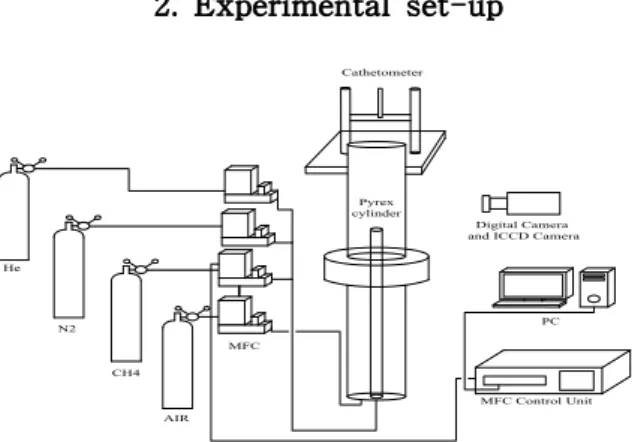
2. Experimental set-up CH4 AIR MFC MFC Control Unit PC N2 He Digital Camera and ICCD Camera Cathetometer
Pyrex cylinder
Fig. 1 Schematic diagram of experimental set-up
제 51회 KOSCO SYMPOSIUM 초록집(2015년도 추계학술대회) 84
urner, a flow control system, visualization syst em. Two co-flow burners used had a central f uel nozzles with 9.4 and 0.95 mm inner diamet ers and length is 100 times of the inner diame ter for the flow inside to be fully developed. T he co-flow air was supplied to the co-axial no zzle with 90.4 mm i.d. passing through glass b eads and aa honeycomb for the velocity to be uniform. The fuel was a pure grade methane diluted with helium and nitrogen and compres sed air was used for the co-flow. The flow ra tes were controlled by mass flow controller. Di gital video camera used to capture image of st ationary lifted flame. Liftoff height was measu red by the cathetometer. ICCD camera and mo nochromator were used to visualize the chemil uminescence and behaviors of lifted flame.
3. Results and Discussion 3.1 Stationary lifted flame
Experiments were conducted using 9.4 mm i.d. nozzle co-flow burner with co-flow jet vel
ocity VCO = 10 cm/s, by varying the fuel nozzl
e exit velocity UO, and fuel mole fraction XF,O
for methane jet flames diluted with helium is as shown in Fig. 2(a). Liftoff heights increase
d non-linearly with UO and were in the range
of several millimeters to 123.7 mm. For a refer
ence, the developing region of a free jet, Zfree
was marked by dotted line. This was obtained
to be [8], Zfree/d= 0.0165 X Red. where Red is
the Reynolds number defined as Uod./v and v
is the kinematic viscosity. The variation in Zfre
e with Uo is nearly linear which substantiates
two different stabilization modes in the develo ping and developed regions of jet flame. Stabil izatio n mechanism has to be the balance
(a)
(b)
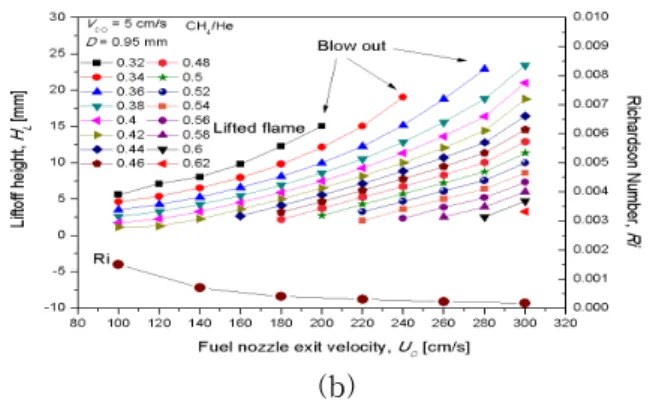
Fig. 2 Liftoff height variation with fuel nozzle exit velocity for methane diluted with helium
(Sc < 1) at various fuel mole fraction for (a)
9.4 mm (b) 0.95 mm.
of edge flame speed to the local flow speed ir respective of the stabilized location in the dev eloped and developing regions. It was noted t hat, lifted flames are observed at smaller nozz le exit velocities less than stoichiometric unstr etched laminar flame speed and this was depi cted well by buoyancy effect. The effect of b uoyancy was evaluated by Richardson numbe
r, Ri = ߡρgd/ρUo2, which was the ratio of buo
yancy induced momentum to the jet momentu m, where g was the gravitational acceleration,
ρ was the unburned density and ߡρ was the d
ensity difference between unburned and burne
d gases. Ri number for 5-30 cm/s is in the r
ange of 0.8848 < Ri < 32.86. The results sho
ws that influence of buoyancy is more effectiv
e at low Uo with high Ri number and hence
the stationary lifted flames were observed. Bu
t with an increase in the Uo the value of Ri
number is decreasing precipitously and buoyan cy effect is suppressed significantly. Also to o
btain the lifted flames at much higher Uo tha
n stoichiometric un-stretched laminar flame sp eed experiments were performed using 0.95 m
m i.d. nozzle with Vco = 5 cm/s. variation of
HL with Uo in laminar lifted methane jet flam
es is shown in Fig. 2(b). Addition of helium d
iluent and increase in the Uo causes an increa
se in the HL non-linearly until the flame is bl
own out. The triple flame structure was attain
ed at high HL. Ri number also evaluated to o
bserve buoyancy effect and it was in the rang
e of 0.0015 < Ri < 0.0017. It is noted that, bu
oyancy effect can be suppressed and lifted fla
mes were obtained at larger Uo than stoichio
제 51회 KOSCO SYMPOSIUM 초록집(2015년도 추계학술대회) 85
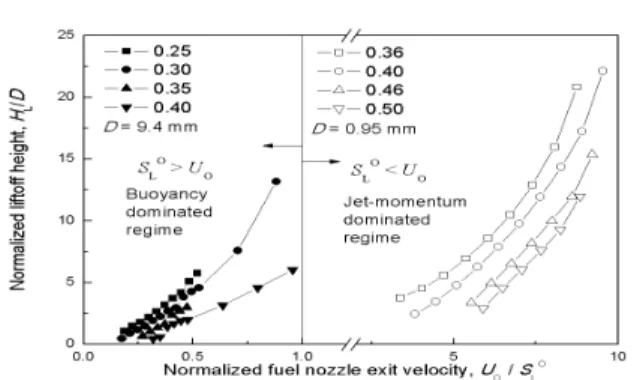
Fig. 3 Normalized liftoff height with fuel nozz le exit velocity considering stoichiometric un-s tretched non-adiabatic laminar burning velocit y for two different fuel nozzles.
e speed.
The lifted flames obtained from two differen t nozzle diameters co-flow burners are shown in Fig. 3. Using 9.4 mm diameter nozzle lifted
flames are obtained at lower Uo than SLo and
with 0.95 mm i.d nozzle lifted flames are obtai
ned at higher Uo than SLo. This stoichiometric
un-stretched non-adiabatic laminar burning ve locity was achieved in a counter flow configur ation through extrapolation of the linear relatio n of flame speed versus global strain rate.
Also, variation of HL with Uo for methane
diluted with nitrogen at various Xf,o is shown
in Fig. 4. The flame edge has a triple flame s tructure even if it was not shown clearly. Wh ile nozzle attached flame edge shows the lean premixed flame wing is merged to the diffusio n flame, such that the bi-brachial structure is exhibited. In this case, lifted flames were obse rved only in the developing region due to buo
yancy effect at low Uo and it was confirmed
by evaluating Ri number. It was in the range
of 0.15 < Ri < 32.11. But at high Uo, Ri nu
mber was decreased still lifted flames were ob served.
Fig. 4. Variation of HL with UO for methane
diluted with Nitrogen (Sc < 1) at various XF,O
Further investigations may require to clarify t he reason behind these lifted flames.
3.2 Stabilization of lifted flames
In the previous discussions, lifted flames we re observed for methane jet diluted with heliu m and nitrogen in buoyancy and jet momentu m dominated regime. So how these lifted flam es were stabilized is questionable. By stabilizat ion mechanism, edge flame speed has to increa se even with the mole fractions of helium and nitrogen despite the reduction in mixture stren gth. To clarify it, flame images were captured by the ICCD camera and chemiluminescence in
tensities of OH* radicals are measured at vario
us conditions. Typical radial distribution of che miluminescence intensity is as shown in the Fi
g.5(a). The OH* chemiluminescence intensities
have maxima at the triple point, indicating a d ouble peak. We investigated the normalized ma
ximum OH* intensity which was defined by th
e ratio of the OH* intensity at triple point to t
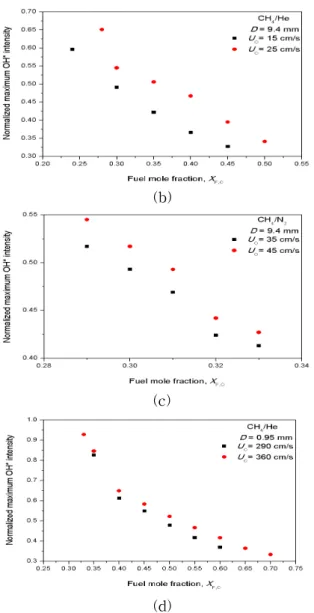
he saturated intensity. Fig. 5 (b) and (c) show
s that normalized maximum OH* intensities de
creased with increasing fuel mole fraction and increased with helium and nitrogen mole fracti
on for D = 9.4 mm nozzle diameter, which cor
responds to buoyancy dominated regime. This implies that, buoyancy induced convection incr eases the reactant fluxes to the edge flame, in creasing the reaction rate of edge flame and h ence edge flame speed. Similar investigations
were observed D = 0.95 mm nozzle diameter a
s shown in Fig. 5(d). Normalized maximum O
H* intensity increases with helium mole fractio
n as well. For such a high Uo, Richardson nu
mber and hence buoyancy effect is negligible, meaning that there are some other reasons.
제 51회 KOSCO SYMPOSIUM 초록집(2015년도 추계학술대회) 86
(b)
(c)
(d)
Fig. 5 (a) Typical Radial distribution of chemi luminescence intensity passing through the tri
ple point at various XF,O. Measured OH* radic
al intensities for (b) methane diluted with heli
um at Uo = 15 and 25 cm/s (c) methane dilut
ed with nitrogen at Uo = 35 and 45 cm/s, usi
ng 9.4 mm nozzle diameter (d) methane dilute
d with helium at Uo = 290 and 360 cm/s usin
g 0.95 mm nozzle inner diameter.
Also, the product of OH* and CH
2O* is obta
ined using monochromatic experiment as show n in Fig. 6, which is the marker for heat rele ase rate as per previous studies [11]. It implie s that, increase in the reaction rate and hence edge flame speed. It is to be noted that, edge flame speed is dependent upon mixture strengt h, buoyancy, fuel concentration gradient and t hereby radius of curvature. Hence important r ole on edge flame speed enhancement may ad dressed to the radius of curvature. Fig. 7, sho
ws the appreciable increase in the radius of c urvature and thereby increasing edge flame sp eed.
Fig. 6. Product of OH* and CH
2O* as marker
for heat release rate.
Fig. 7 Radius of curvature r*cur, of lifted meth
ane jet flame with helium dilution. References
[1] S.H. Chung, B.J. Lee, Combust. Flame 86 (1991) 62-72.
[2] B.J. Lee, S.H. Chung, Combust. Flame 109 (1997) 163-172.
[3] Y.S. Ko, S.H. Chung, Combust. Flame 118 (1999) 151-163.
[4] S.H. Won, J.Kim, K.J. Hong, M.S.Cha, S.H. Chung, Proc. Combust. Inst. 30(2005) 339-347. [5] S.H. Won, S.H. Chung, M.S.Cha, B.J.Lee, Proc. Combust. Inst. 28 (2000) 2093-2099. [6] P.R.Medwell, D.L.Blunck, B.B. Dally, Comb ust. Flame 161 (2014) 465-474.
[7] J.Bukmaster, N.Peters, Proc. Combust. Inst. 21(1986) 1829-1836.
[8] D.S. Lee, K.D.Kihm,S.H. Chung, J.Fluids E ng. 119(3) 716-718 (1997).
[9] G.R. Ruetsch, L. Vervisch, A.Linan, Phys. Fluids 7(6) 1447-1454 (1995).
[10] S.H. Chung Proc. Combust. Inst.31 (2007) 877-892.
[11] R.L. Gordon, A.R. Masri, E. Mastorakos, Combust. Theory Mod. 13(2009) 645-670.