서
론
국화 (Chrysanthemum; Dendranthema grandiflorum)는
전 세계 3대 절화류에 속하며, 국내에서도 장미 다음으 로 생산량이 높은 중요한 화훼작물로 최근에는 분화로서 의 이용도 증가되고 있는 추세이다 (MIFAFF 2005). 또 한 다양한 꽃의 색깔과 형태 등으로 인하여 국내 절화류 시장의 1/4 가량을 차지하고 있으나 재배 및 국내에서 유통되고 있는 대부분이 네덜란드나 일본 등에서 육성된 외국품종으로 막대한 로열티의 증가는 화훼 재배농가에 ─ ─ 227 ──
감마선 조사에 의한 다양한 스프레이 국화 품종의
돌연변이 육종
김상훈 ∙정성진 ∙이긍주1∙김동섭∙김진백∙강시용* 한국원자력연구원 방사선과학연구소 방사선식품육종연구부 1목포대학교 자연과학대학 생명과학부Mutation Breeding of Various Spray Chrysanthemum
Cultivars by Gamma-ray Irradiation
Sang Hoon Kim , Sung Jin Chung , Geung-Joo Lee1, Dong Sub Kim, Jin-Baek Kim and Si-Yong Kang*
Division of Food Irradiation and Radiation Breeding, Advanced Radiation Technology Institute, Korea Atomic Energy Research Institute, Jeongeup 580-185, Korea
1College of Natural Science, Mokpo National University, Muan 534-830, Korea
Abstract -- This study was carried out to analyze mutation rate and spectrum of chrysanthemum by gamma-ray irradiation. Five flower types, 16 cultivars including ‘Geumsu’, ‘Hwiparam’, ‘Ilwol’, ‘Magic’, ‘Moonlight’, ‘Noblewine’, ‘Pinky’, ‘Progy’, ‘Sangtte’, ‘Waterfog’, ‘Whitneypangpang’, ‘Yelloweye’, ‘Yellowpangpang’, ‘Yesmiso’, ‘Yesmorning’, and ‘Yestogether’ were irradiated as 30, 50, and 70 Gy dose during 24 hours. As a result, mutation rate was identified as the highest in sin-gle type among five flower types, but there was a little difference according to cultivars. Mutation rate was increased in proportion to irradiation dose in anemone, pompon, and spider type cultivars, but there wasn’t clear in single and semi-double type cultivars. Mutation spectrum was identified as the highest in the cultivar ‘Noblewine’. The most sensitive cultivars to radiation were revealed as ‘Noblewine’ and ‘Yesmorning’ and the least were ‘Moonlight’, ‘Waterfog’, and ‘Yellowpang-pang’. Consequently, there was much difference in radio-sensitivity according to cultivars of chry-santhemum and flower type was correlated a little with mutation rate.
Key words : Chrysanthemum, Flower type, Gamma ray, Mutation breeding, Radio-sensitivity
The first two authors contributed equally to this work. * Corresponding authors: Si-Yong Kang, Tel. +82-63-570-3310,
큰 부담으로 작용하고 있다. 하지만 최근 들어 로열티 부 담의 경감과 고부가가치 국산 신품종의 개발 및 보급의 필요성에 따라 다양한 국내 육성 품종들의 품종보호출원 이 증가되고 있는 추세이다 (Lim et al. 2008). 그러나 국 내에서 수행되는 국화의 신품종 개발은 주로 교배육종에 의해 이뤄졌으며, 교배육종의 보조 수단 혹은 교배육종 으로 불가능한 품종에 한해 돌연변이 육종을 통한 신품 종 개발이 이뤄지고 있다 (Schum and Preil 1998; Goo et
al. 2003). 돌연변이 육종은 colchicine이나 ethyl methane-sulphonate (EMS) 등의 화학적 돌연변이원 또는 감마선 이나 X선 등의 방사선을 처리하여 돌연변이를 유기한다. 이러한 돌연변이 육종은 열성유전자를 이용하거나 단백 질 함량 등 특수성분을 개량할 경우 또는 교배육종의 한 계성을 해결하려고 할 경우에 이용되며, 화훼류에서는 다양한 화색을 통한 신품종의 시리즈화를 위해 주로 이 용되고 있다 (Schum and Preil 1998). FAO/IAEA 돌연변 이 품종 데이터베이스 (http://www-mvd.iaea.org/MVD/ Default.htm)에 의하면 국화를 포함한 화훼류가 약 570 여 품종이 등록되어 있으며, 종자번식 작물 다음으로 2 위를 차지하고 있다. 화훼류 중에서도 국화가 차지하는 비중이 전체 품종의 40% 이상을 차지하고 있으며, 네덜 란드의 경우 돌연변이체나 이를 교배모본으로 활용하여 육성한 품종이 화훼시장의 30~40%를 차지할 정도로 화훼류의 신품종을 육종하는데 돌연변이 육종방법이 중 요한 역할을 하고 있다고 할 수 있다(Park and Song 2005; Park et al. 2007). 따라서 본 연구에서는 다양한 스프레이 국화 품종에 방사선 처리를 통한 돌연변이체 발생빈도를 조사하여 품 종 별 적정 선량을 탐색하고, 유용한 돌연변이체는 선발, 증식 및 세대 진전을 거쳐 신품종으로 개발하는 것을 목 적으로 하고 있다.
재료 및 방법
실험에 사용한 재료로는 5가지 화형의 스프레이 국화 ‘Geumsu’, ‘Hwiparam’, ‘Ilwol’, ‘Magic’, ‘Moonlight’, ‘Noblewine’, ‘Pinky’, ‘Progy’, ‘Sangtte’, ‘Waterfog’, ‘Whit-neypangpang’, ‘Yelloweye’, ‘Yellowpangpang’, ‘Yesmiso’, ‘Yesmorning’, ‘Yestogether’의 16개 품종을 대상으로 2008년 7월과 8월에 각각 방사선 (감마선) 조사를 실시 하였다. 방사선 조사는 한국원자력연구원 방사선과학연 구소 내 저준위 감마선 조사시설 (60Co)을 이용하여 국 화 삽수체에 30, 50, 70 Gy 선량으로 24시간 동안 실시하 였다. 선량 별 방사선 조사 개체 수는 품종에 따라 100 ~300개 정도의 삽수체를 대상으로 실시하였다 (Table 1). 조사된 삽수체는 한국원자력연구원 방사선과학연구 소 방사선육종시험장 포장에 정식하였으며, 방사선 감수 성 조사는 돌연변이 발생률 그리고 화색 및 화형 돌연변 이 스펙트럼 등을 대상으로 실시하였다. 돌연변이체 선 발은 방사선 조사 후 개화시기에 실시하였다.결과 및 논의
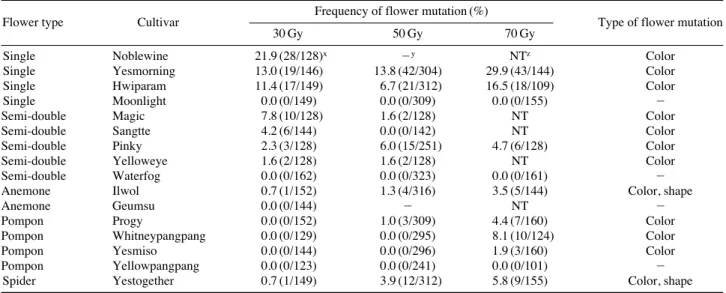
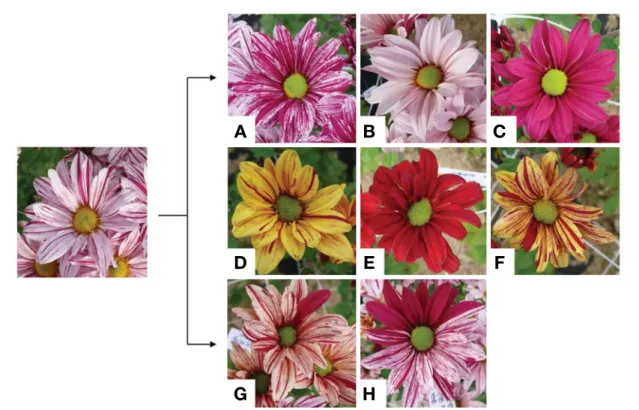
기존 연구결과에서 국화의 돌연변이 유기를 위한 적정 조사선량인 반치사선량 (LD50)이 국화 5개 품종을 이용 하여 실험한 결과 스프레이 계통의 경우 30 Gy 정도, 스 탠다드 계통의 경우 40 Gy 정도로 밝혀졌으며, 품종에 따라 약간의 차이가 나는 것으로 보고되었다 (Goo et al. 2003). 스프레이 국화 ‘Argus’의 경우 돌연변이 유기를 위하여 배양체에 30~50 Gy를 조사하였으며 그 결과 조 사선량에 관계없이 97% 이상의 높은 생존율이 확인되었 고 50 Gy 조사구에서 가장 높은 변이율이 확인되었다 (Park et al. 2007). 그리고 국화 ‘Taihei’를 이용하여 총 조사선량과 단위시간 당 조사선량이 돌연변이 유기와 DNA 함량에 미치는 영향을 보기 위하여 15~60 Gy 선 량으로 조사가 되었으며 돌연변이율은 총 조사선량에 영 향을 받는 것으로 확인되었다 (Yamaguchi et al. 2008). 따 라서 본 연구에서는 기존 연구를 바탕으로 서로 다른 5 가지 화형의 16개 국화 품종을 이용하여 30, 50, 70 Gy 를 조사선량으로 선정하여 조사를 하였고 개화 후 품종, 꽃의 형태, 조사선량 별로 방사선 감수성과 돌연변이율, 변이스펙트럼을 조사하였다. 그 결과 품종, 꽃의 형태, 조 사선량 별로 다양한 돌연변이율과 변이스펙트럼이 확인 되었다 (Table 1). 꽃의 형태에 따른 돌연변이율은 홑꽃형 이 반겹꽃형, 아네모네형, 폼폰형, 스파이더형에 비하여 상대적으로 높은 것으로 보이며 품종에 따라 다소 차이 는 있는 것으로 판단된다. 홑꽃형, 반겹꽃형, 폼폰형에서 는 주로 화색변이의 돌연변이가 관찰되었으나, 아네모네 형과 스파이더형에서는 화색변이와 화형변이가 같이 관 찰되었다. 품종 별로는 ‘Yesmorning’이 70 Gy 조사선량 에서 약 30%, ‘Noblewine’이 30 Gy 조사선량에서 약 22%의 돌연변이체가 확인되었다 (Table 1). 반면 ‘Moon-light’, ‘Waterfog’, ‘Yellowpangpang’의 경우 모든 조사구 에서 변이체가 전혀 발견되지 않아 방사선 감수성이 가 장 낮은 것으로 관찰되었으며, 돌연변이 유기를 위해서 는 보다 높은 선량이 조사되어야 할 것으로 판단된다. 조사선량에 따라서는 아네모네형, 폼폰형, 스파이더형이 조 사선량이 증가함에 따라 돌연변이율이 증가하는 경향이 있으나 홑꽃형과 반겹꽃형의 경우 뚜렷한 경향치가 확 인되지 않았고 품종 별로 다소 차이가 있는 것으로 확인 되었다 (Table 2). 이는 조사선량이 증가할수록 돌연변이 율이 반드시 비례적으로 높아지는 것은 아니라는 것을 의미하며 이러한 결과는 기존의 연구 결과와도 일치한 다 (Goo et al. 2003; Yamaguchi et al. 2008). 품종 별 변이 스펙트럼 비율의 경우 ‘Noblewine’이 5.46%로 가장 높 은 변이스펙트럼이 확인되었으며, 이는 변이의 폭이 넓 은 것으로 육종과정에서 다양한 변이체의 선발 효율이 가장 높다는 것을 의미한다 (Table 3). 주요 품종 별 변이 의 종류는 다음과 같다. 홑꽃 화형인 ‘Noblewine’의 경 우 대조구의 설상화가 연핑크 바탕에 자주줄무늬가 있 는 것이 특징인데 반해 변이체의 경우 노랑 바탕에 자주 줄무늬, 빨강 등의 설상화 화색변이가 확인되었다 (Fig. 1). 복색 반겹꽃 화형인 ‘Magic’의 경우 대조구의 설상 화가 자주색, 흰색 혼합인 것이 특징인데 반해 변이체의 경우 연자주, 노랑 혼합, 다홍 등의 설상화 화색변이가 확인되었다 (Fig. 2). 아네모네 화형인 ‘Ilwol’의 경우 대 조구의 설상화가 노랑색, 관상화가 노랑색 바탕에 빨강 색 중심이 특징이지만 변이체의 경우 빨강색, 노랑색 혼 합의 관상화 변이체와 다홍색, 빨강색의 설상화 변이체 가 확인되었다 (Fig. 3). 그리고 폼폰 화형인 ‘Progy’의 경 우 대조구의 설상화가 연두색인 것이 특징인데 반해 변 Table 1. Mutation frequency and type on chrysanthemum according to cultivar and irradiation dose
Flower type Cultivar Frequency of flower mutation (%) Type of flower mutation 30 Gy 50 Gy 70 Gy
Single Noblewine 21.9 (28/128)x -y NTz Color Single Yesmorning 13.0 (19/146) 13.8 (42/304) 29.9 (43/144) Color Single Hwiparam 11.4 (17/149) 6.7 (21/312) 16.5 (18/109) Color Single Moonlight 0.0 (0/149) 0.0 (0/309) 0.0 (0/155) -Semi-double Magic 7.8 (10/128) 1.6 (2/128) NT Color Semi-double Sangtte 4.2 (6/144) 0.0 (0/142) NT Color Semi-double Pinky 2.3 (3/128) 6.0 (15/251) 4.7 (6/128) Color Semi-double Yelloweye 1.6 (2/128) 1.6 (2/128) NT Color Semi-double Waterfog 0.0 (0/162) 0.0 (0/323) 0.0 (0/161) -Anemone Ilwol 0.7 (1/152) 1.3 (4/316) 3.5 (5/144) Color, shape Anemone Geumsu 0.0 (0/144) - NT -Pompon Progy 0.0 (0/152) 1.0 (3/309) 4.4 (7/160) Color Pompon Whitneypangpang 0.0 (0/129) 0.0 (0/295) 8.1 (10/124) Color Pompon Yesmiso 0.0 (0/144) 0.0 (0/296) 1.9 (3/160) Color Pompon Yellowpangpang 0.0 (0/123) 0.0 (0/241) 0.0 (0/101) -Spider Yestogether 0.7 (1/149) 3.9 (12/312) 5.8 (9/155) Color, shape
xNumber of flower mutants/number of investigated plants are shown in parentheses. yGamma-ray is irradiated, but not scored because of growing deterioration. zNot tested
Table 2. Mutation frequency on chrysanthemum according to flo-wer type and irradiation dose
Flower type Dose (Gy)
30 50 70 Single 11.6±9.0x 6.8±6.9 15.5±15.0 Semi-double 3.2±3.0 1.8±2.5 2.4±3.3 Anemone 0.4±0.5 1.3 3.5 Pompon 0.0±0.0 0.3±0.5 3.6±3.5 Spider 0.7 3.9 5.8 xMean±standard deviation
Table 3. Mutation spectrum of chrysanthemum cultivars by gamma-ray irradiation
Cultivar Flower type Mutation spectrum (%) Noblewine Single 5.46x Yesmorning Single 0.84 Magic Semi-double 0.78 Pinky Semi-double 0.78 Sangtte Semi-double 0.69 Progy Pompon 0.64 Yelloweye Semi-double 0.39 Hwiparam Single 0.35 Yestogether Spider 0.32 Ilwol Anemone 0.32 Whitneypangpang Pompon 0.18 Yesmiso Pompon 0.16 Moonlight Single 0.00 Waterfog Semi-double 0.00 Geumsu Anemone 0.00 Yellowpangpang Pompon 0.00
xIt is calculated using number of different kind of mutants and several same color or shape mutants are considered as only one.
Fig. 2. Mutation spectrum of flower color induced by gamma-ray irradiation in semi-double type chrysanthemum ‘Magic’. Left. Original(wild) type. A~F, mutants in flower color: A, color (white and yellow); B, color (dark red); C, color (yellow); D, color (dark purple and yellow); E, color (dark purple); F, color (yellow and purple).
A
B
C
D
E
F
Fig. 1. Mutation spectrum of flower color induced by gamma-ray irradiation in single type chrysanthemum ‘Noblewine’. Left. Original (wild)
type. A~H, mutants in flower color: A, color (stripe); B, color (not stripe); C, color (purple); D and F, color (yellow); E, color (red); G and H, color (chimera).
A
B
C
D
E
F
이체의 경우 노랑, 연두 혼합, 흰색 등의 설상화 화색변 이가 확인되었다 (Fig. 4). 스파이더 화형인 ‘Yestogether’ 의 경우 대조구의 설상화가 연분홍, 관상화가 아이보리, 연두 혼합이 특징인데 반해 변이체의 경우 설상화와 관 상화에서 화색변이와 화형변이가 같이 확인되었다 (Fig. 5). 이러한 결과들은 기존의 ‘Argus’의 돌연변이 연구에 서 관상화의 화색변이가 설상화보다 다양하게 확인된 결 과와 상충되는 결과이다 (Park et al. 2007). 하지만 감마 선 조사 시 화형변이보다는 화색변이가 많이 발생한 것 은 기존 연구결과와 일치한다 (Broertjes and van Horten 1998; Goo et al. 2003; Park et al. 2007). 본 연구결과에서 는 국화 품종 별 돌연변이를 유기하기 위한 적정 선량을 일부 품종에서 확인할 수 있었으며, 품종 별 방사선 감 수성의 차이를 확인할 수 있었다. 또한 다양한 화색변이 체를 선발함으로써 국화 신품종의 시리즈화가 가능할 것 으로 판단된다.
결
론
본 연구는 다양한 국화 품종에서 감마선 조사선량에 따른 돌연변이율과 변이스펙트럼을 조사하고 품종 별 적 정 조사선량을 확립하기 위하여 수행되었다. 그 결과 품 종, 꽃의 형태, 조사선량에 따라 다양한 돌연변이율과 변 이스펙트럼이 확인되었다. 꽃의 형태에 따른 돌연변이율 은 홑꽃형이 반겹꽃형, 아네모네형, 폼폰형, 스파이더형에 비하여 상대적으로 높은 것으로 확인되었으나 품종 별 로 다소 차이를 보이는 것이 확인되었다. 조사선량에 따 라서는 아네모네형, 폼폰형, 스파이더형의 경우 조사선량 이 증가함에 따라 돌연변이율이 증가하는 경향이 있으나 홑꽃형과 반겹꽃형의 경우 조사선량과 돌연변이율과의 상관관계가 불명확한 것으로 보인다. 품종 별 변이스펙 트럼의 경우 꽃의 형태에 따른 경향치는 확인되지 않았 으며, 16개의 국화품종 중 ‘Noblewine’의 변이스펙트럼 Fig. 3. Mutation spectrum of flower color and shape induced bygamma-ray irradiation in anemone type chrysanthemum ‘Ilwol’. Left. Original (wild) type. A~C, mutants in flower color and shape: A, color and shape (yellow); B, color (red); C, color (chimera).
Fig. 4. Mutation spectrum of flower color induced by gamma-ray irradiation in pompon type chrysanthemum ‘Progy’. Left. Original (wild) type. A~D, mutants in flower color: A, color (yellow); B, color (white); C and D, color (chimera).
A
B
C
A
B
폭이 가장 넓은 것으로 확인되었다. 방사선 감수성이 가 장 높은 품종은 ‘Noblewine’과 ‘Yesmorning’으로 확인 되었으며, 가장 낮은 품종은 ‘Moonlight’, ‘Waterfog’, ‘Yellowpangpang’으로 모든 조사구에서 변이체가 확인 되지 않았다. 결과적으로 국화 품종에 따라 방사선 감수 성의 차이가 많이 나는 것으로 판단되며, 꽃의 형태 또 한 돌연변이율과 상관관계가 있는 것으로 판단된다.
사
사
본 연구는 한국원자력연구원 기관고유사업 및 농촌진 흥청 바이오그린 21사업 (Code 20070301034033)의 연구 비 지원에 의해 수행되었으며, 이에 감사 드립니다.참 고 문 헌
농림수산식품부 (MIFAFF). 2009. 2005년 화훼류재배현황보 고.Broertjes E and van Horten AM. 1998. Applied mutation breed-ing for vegetatively propagated crops. Elsevier, Armsterdam, The Netherlands.
Goo DH, Yae BW, Song HS, Park IS, Han BH and Yu HJ. 2003. Color change in chrysanthemum flower by gamma ray irra-diation. J. Kor. Soc. Hort. Sci. 44(6):1006-1009.
Hwang JC, Chin YD, Chung YM, Kim SG and Jeong BR. 2009. A new spray chrysanthemum cultivar, ‘Noble Wine’ with good color, single type and bi-color petals for cut flower.
Flower Res. J. 17(2):137-140.
The FAO-IAEA Mutant Varieties Database. http://www-mvd. iaea.org/MVD/Default.htm. 2004.
Lim JH, Shin HK, Park SK, Cho HR, Rhee HK, Kim MS and Joung HY. 2008. A new spray chrysanthemum cultivar, ‘Forest Aroma’, an anemone flower type with vigorous and large, green center and white petals for cut flower. Kor. J.
Hort. Sci. Technol. 26(Suppl. II):108-111.
Park IS, Lee GJ, Kim DS, Chung SJ, Kim JB, Song HS, Goo DH and Kang SY. 2007. Mutation breeding of a spray chry-santhemum ‘Argus’ by gamma-ray irradiation and tissue culture. Flower Res. J. 15(1):52-57.
Park IS and Song HS. 2005. Current trends of mutation breeding by radiation technology at domestic and foreign ornamen-tals. J. Kor. Flower Res. Soc. 13(3):184-200.
Schum A and Preil W. 1998. Induced mutations in ornamental plants. Somaclonal variation and induced mutations in crop improvement. p. 332-366. Kluwer Academic Publ., Dordre-cht, The Netherlands.
Yamaguchi H, Shimizu A, Degi K and Morishita T. 2008. Effects of dose and dose rate of gamma ray irradiation on mutation induction and nuclear DNA content in chrysan-themum. Breeding Science 58:331-335.
Manuscript Received: September 25, 2009 Revision Accepted: September 30, 2009 Fig. 5. Mutation spectrum of flower color and shape induced by
gamma-ray irradiation in spider type chrysanthemum ‘Yesto-gether’. Left. Original (wild) type. A~B, mutants in flower color and shape: A, color (pale pink); B, color and shape (yellow).