205
the total amount of narcotic used and therefore less respiratory depression and sedation are the benefits of the epidural PCA al-though there were serious side effects including pruiritus, nau-sea, urine retention and neurologic abnormality12,18). this prop-erty should facilitate mobilization and improve patient outcome and satisfaction5). This retrospective comparative study was de-signed to compare the efficacy and complication of epidural PCA with intravenous (IV) PCA in patients who underwent posterior lumbar instrumented fusion at our institute.
MATERIALS AND METHODS
Indication and evaluation
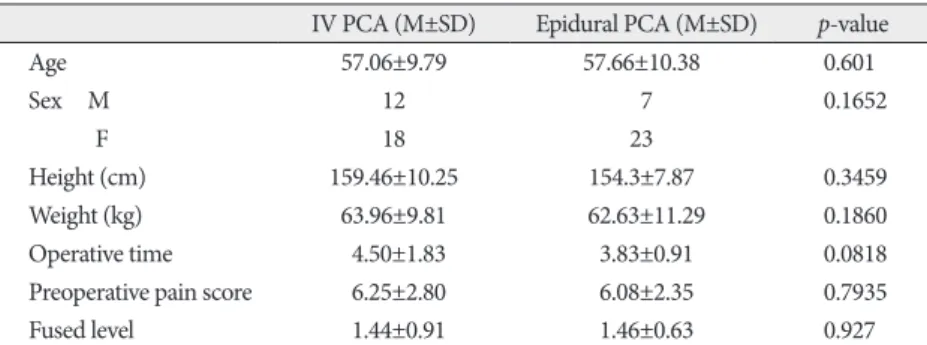
We included consecutive 60 patients who underwent one or two level posterior lumbar instrumented fusion for degenera-tive disc disease, spondylolisthesis, or spinal instability between Sep 2007 and Jan 2008. IV PCA group included 30 patients, 12 male and 18 female and epidural PCA group included 30 pa-tients, 7 male and 23 female. Average age of epidural PCA was 57.66±10.38 and IV PCA was 57.06±9.79 (Table 1).
INTRODUCTION
Traditional posterior lumbar interbody fusion and posterior transpedicular screw fixation is associated with high degree of postoperative pain. Most patients require parenteral adminis-tration of analgesics especially during 2 days after operations or more. High degree of postoperative pain precludes them from early mobilization, which is known to lengthen hospital stay and might result in various complications7,11).
Patient-controlled analgesia (PCA) has long been used for pain control after spinal operations3,5,6,13,14,20). And, there were various methods to administrate the analgesics such as epidural or intravenous route. Excellent pain control and a decrease in
J Korean Neurosurg Soc 50 : 205-208, 2011
http://dx.doi.org/10.3340/jkns.2011.50.3.205
Copyright © 2011 The Korean Neurosurgical Society
Print ISSN 2005-3711 On-line ISSN 1598-7876
A Comparison of the Effect of Epidural
Patient-Controlled Analgesia with Intravenous
Patient-Controlled Analgesia on Pain Control
after Posterior Lumbar Instrumented Fusion
Sang Hoon Lee, M.D., Kyung Hyun Kim, M.D., Seong-Mee Cheong, M.D., Sumi Kim, M.D., Mirang Kooh, M.D., Dong Kyu Chin, M.D., Ph.D. Department of Neurosurgery, The Spine and Spinal Cord Institute, Gangnam Severance Spine Hospital,
Yonsei University College of Medicine, Seoul, Korea
Objective : Retrospective analysis to compare the effect and complication of epidural patient-controlled analgesia (epidural PCA) with intravenous patient-controlled analgesia (IV PCA) for the treatment of the post-operative pain after posterior lumbar instrumented fusion.
Methods : Sixty patients who underwent posterior lumbar instrumented fusion for degenerative lumbar disease at our institution from September 2007 to January 2008 were enrolled in this study. Out of sixty patients, thirty patients received IV PCA group and thirty patients received epidural PCA group. The pain scale was measured by the visual analogue scale (VAS) score.
Results : There were no significant difference between IV PCA group and epidural PCA group on the PCA related complications (p=0.7168). Ten patients in IV PCA group and six patients in epidural PCA group showed PCA related complications. Also, there were no significant differences in re-duction of VAS score between two groups on postoperative 2 hours (p=0.9618) and 6 hours (p=0.0744). However, postoperative 12 hours, 24 hours and 48 hours showed the significant differences as mean of reduction of VAS score (p=0.0069, 0.0165, 0.0058 respectively).
Conclusion : The epidural PCA is more effective method to control the post-operative pain than IV PCA after 12 hours of spinal fusion operation. However, during the first twelve hours after operation, there were no differences between IV PCA and epidural PCA.
Key Words : Patient-controlled analgesia · Postoperative pain · Spinal fusion.
www.jkns.or.kr
Clinical Article
•Received : April 18, 2011 •Revised : June 20, 2011 •Accepted : September 8, 2011
•Address for reprints : Dong Kyu Chin, M.D., Ph.D.
Department of Neurosurgery, The Spine and Spinal Cord Institute, Gangnam Severance Spine Hospital, Yonsei University College of Medicine, 211 Eonju-ro, Gangnam-gu, Seoul 135-720, Korea
Tel : +82-2-2019-3397, Fax : +82-2-3461-9229 E-mail : [email protected]
206
J Korean Neurosurg Soc 50| September 2011 Epidural PCA vs. IV PCA | SH Lee, et al.Epidural PCA vs. IV PCA | SH Lee, et al.
trolled demand.
1) IV PCA medications : total mixture of Ketoracin® (ketorolac tromethamine, Roche, Korea) 120 mg, Fentanyl citrate (Hana Pharm CO LTD, Korea) 1,000 µg and Zofran® (Ondanstron de-hydrate, GlaxoSmithKline) 16 mg with saline (100 mL).
2) Epidural PCA medications : total mixture of Morphine 5 mg and 0.75% Ropivacaine 20 cc with saline (100 mL).
Epidural catheter was inserted into the epidural space 5 cm above laminectomy level under direct visualization and was passed retrograde through the needle in the paraspinal muscles after removal of the stylet by the surgeon before wound closure.
RESULTS
Patient profile and homogeneity
There were a total of 60 patients. Thirty patients were in IV PCA group and 30 patients were in epidural PCA group. There were no statistically significant differences in regards to patients’ demographic data, number of fused level and operative time be-tween two groups (Student’s t-test, chi-square test) (Table 1).
Pain score results
There was no significant difference about preoperative pain score between two groups. Average preoperative pain score of IV PCA group was 6.25±2.80, and epidural PCA was 6.08±2.35 (p= 0.7935). There was also no significant difference between two groups about postoperative pain score at 2 hours and 6 hours (p=0.9618, p=0.0744 respectively). However, epidural PCA group showed significant lower pain score than IV PCA group at 12 hours, 24 hours and 48 hours postoperatively (all p<0.05) (Table 2).
We also reviewed, based on medical records, for the number of injection of additional analgesics (intravenous ke-toracin 30 mg/ample) in patients who did not remove PCA until 48 hours. Al-though there was no significant differ-ence between two groups, epidural PCA group (aver 3.10±2.26) required less ad-ditional analgesics than IV PCA group (aver 1.91±1.69) (p=0.0543) (Table 3).
Adverse effect
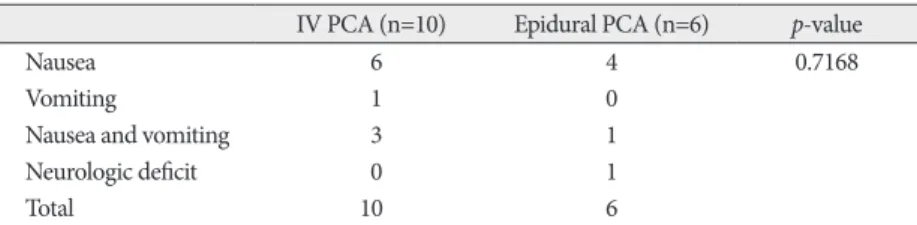
There was no significant difference in regard to adverse effect between two groups.
PCA had to be removed in 10 patients of IV PCA group versus 6 patients of epidural PCA group. Of 10 patients of Pain was assessed using a printed copy of both verbal
numer-ical analogue scale and faced pain scale by researcher and members of this research (nurses) and recorded for time peri-ods of 2, 6, 12, 48 hours after surgery unless PCA was removed before 48 hours (Fig. 1).
All symptoms such as nausea, vomiting, headache, dizziness, chest discomfort, urine retention and neurologic deficit were recorded as adverse effects. Among patients who were not re-moved the PCA until 48 hours after surgery, the number of ad-ditional analgesics injected were counted.
All data were compared statistically using chi-square test and Student’s t-test for homogeneity between two groups, Fisher’s exact test for adverse effect and Student’s t-test for pain scale (SAS 9.1) and significance was defined as p<0.05.
Technique and protocol
Using continuous and bolus infusion kit (continuous and bo-lus ambix anapbo-lus), the PCA medication were dosed in the fol-lowing manners : flow rate was 2mL/hr and additional doses of 0.5 mL/5 min with 20-minute lockout are given by
patient-con-Table 1. Demographics of patients
IV PCA (M±SD) Epidural PCA (M±SD) p-value
Age 57.06±9.79 57.66±10.38 0.601 Sex M 12 7 0.1652 F 18 23 Height (cm) 159.46±10.25 154.3±7.87 0.3459 Weight (kg) 63.96±9.81 62.63±11.29 0.1860 Operative time 4.50±1.83 3.83±0.91 0.0818
Preoperative pain score 6.25±2.80 6.08±2.35 0.7935
Fused level 1.44±0.91 1.46±0.63 0.927
IV : intravenous PCA : patient-controlled analgesia
Fig. 1. VAS score. Pain was assessed using the VAS ranging from “0” (no pain) to “10” (worst imag-inable pain). VAS : visual analogue scale.
0
No pain ever1 Mild pain2 3 4 Moderate pain5 6 7 Severe pain Worst pain 8 9 10
Table 2. Postoperative pain scores
IV PCA (M±SD)
(n=20) Epidural PCA (M±SD) (n=24) p-value
Preop 6.25±2.80 6.08±2.35 0.7935 Postop 2 hrs 6.50±2.23 6.50±2.06 0.9618 postop 6 hrs 6.65±2.08 5.37±1.63 0.0744* postop 12 hrs 5.50±1.67 4.20±1.21 0.0069* postop 24 hrs 5.15±1.78 4.12±1.65 0.0165* postop 48 hrs 4.50±1.23 3.50±1.38 0.0058*
*p<0.05. preop : preoperatively, postop : postoperatively, hrs : hours, IV : intravenous PCA : patient-controlled analgesia
Epidural PCA vs. IV PCA | SH Lee, et al.
207
Epidural PCA vs. IV PCA | SH Lee, et al.
sea and vomititng can be reduced1,10,15,17,19). Nausea and vomiting are the most common and distress side effect of IV PCA, al-though the pain control medication is morphine or fentan-yl14,16,20). Because of small amount of morphine used in epidural PCA, some patients have nausea symptom but patients with vomiting are usually tolerable8,10,15,17,19).
Other side effects associated with epidural PCA include, re-spiratory depression and motor deficit and infection18). Mild re-spiratory depression occurred rarely in patients with epidural PCA, which was unresponsive to naloxone, but needed no ven-tilator support, and the resolved uneventfully16,18,20). In this study, none of patients suffered from respiratory depression.
Although spine surgery causes severe postoperative pain, epi-dural PCA is not commonly used16). The main reason is that it might cause some complications such as motor block16,18,20). The motor block can make difficulty in early detection of surgical related neurologic deficit16,18,20). In our study, one patient in epi-dural PCA group had temporary hypoesthesia of bilateral lower extremities, we assumed that the cause of hypoesthesia might be associated with local analgesics (ropivacane), not epidural procedure, surgery or opioid because it showed bilaterally in-volved whole dermatome of the lower extremities10). Thus, we thought this problem could be resolved by controlling the amount of medication and as soon as we removed the epidural PCA, the symptom had disappeared10,14,18). A small number of pa-tients showed significant postoperative ileus. But it was recov-ered shortly (1 or 2 days) and no adverse sequelae16).
IV PCA has been more commonly accepted postoperative pain control method for several reason2). First, IV PCA needs no additional surgical procedure2,5,18). Second, because fentanyl, the main pain killer of IV PCA, usually does not cause neuro-logic deficit, it is possible to detect surgical procedure related neurologic deficit immediately after operation2,5,10,16).
However, nausea and vomiting are the most common and distress side effect of fentanyl in IV PCA4,5,14,18,20). In our study, PCA had to be removed in 10 patients of IV PCA group. The most common cause to discontinue PCA infusion in IV PCA group was intolerable nausea and vomiting.
The two limitations of this study are as follows. The first, the IV PCA group, 6 patients complained
nausea, 1 patient had vomiting, and 3 patients had both symptoms. Among 6 patients of epidural PCA group, 4 pa-tients complained nausea, 1 patient had both nausea and vomiting, and 1 patient had both leg hypoesthesia. These symp-toms and neurologic deficit were im-proved after removal of PCA (Table 4).
DISCUSSION
In posterior lumbar instrumented fu-sion, appropriate postoperative pain
management is essential for early ambulation, reduced hospital stay, avoidance of additional analgesics, and consequently for improvement of patient outcome. PCA via ether intravenous or epidural route has been considered standard management after major orthopedic or spinal surgery2,8,9) and there have been many comparative studiess on the effectiveness and complica-tion of epidural PCA with intravenous PCA10,15,17,19). Postopera-tive pain score (visual analog scale) were significantly lower in the epidural PCA group when compared with that in the IV PCA group16,20). Epidural PCA group showed superior result in pain control on post-operation day 1 and 2 than on the day of operation20).
Other studies have reported that the capacity of excellent pain control in Epidural PCA were probably due to the higher con-centration of ropivacaine, the higher infusion rate and the use of an epidural opioid lately14,16). But, the total amount of opioid used in epidural PCA was less than IV PCA group14).
In present study, epidural PCA group showed superior postop-erative pain control after 6 hours of operation to IV PCA group (p=0.0744 respectively at 6 hours, all p<0.05 at 12 hours, 24 hours and 48 hours postoperatively). Also, in patients who was not re-moved PCA until 48 hours, epidural PCA group required less additional analgesics than IV PCA group although it was not statistically significant (p=0.0543).
In addition, although we did not investigate in this study, short-er hospital stay and earlishort-er full diet wshort-ere othshort-er positive effects of the epidural PCA20). Van Boerum et al., reported that the patient in the epidural PCA group could start a full diet earlier and were discharged earlier in one and half days on average than the IV PCA group10,15,17,19). Also, patients in the epidural PCA group started ambulation earlier than in the IV PCA group16,20). More-over, patients in the PCEA group were significantly more satis-fied with pain therapy16).
Common side effects associated with epidural administration of local anesthetics or opioids, such as nausea and vomiting or pruritus were not evaluated systematically by all authors14,16,20). Pruritus was described with an incidence between 7% and 43%, nausea and vomiting with an incidence between 14% and 86%16). Because of the amount of opioid used in PCA is small, the
nau-Table 3. Number of additional analgesic injections IV PCA (M±SD)
(n=20) Epidural PCA (M±SD) (n=24) p-value Number 3.10±2.26 1.91±1.69 0.0543 IV : intravenous, PCA : patient-controlled analgesia
Table 4. Adverse effects
IV PCA (n=10) Epidural PCA (n=6) p-value
Nausea 6 4 0.7168
Vomiting 1 0
Nausea and vomiting 3 1
Neurologic deficit 0 1
Total 10 6
208
J Korean Neurosurg Soc 50| September 2011
7. Fountas KN, Kapsalaki EZ, Johnston KW, Smisson HF 3rd, Vogel RL, Robinson JS Jr : Postoperative lumbar microdiscectomy pain. Minimal-ization by irrigation and cooling. Spine (Phila Pa 1976)24 : 1958-1960, 1999
8. Garstka J, Mikolajczak G : [Patient-controlled analgesia (PCA) in post-op pain management in scoliosis surgery]. Chir Narzadow Ruchu Or-top Pol 63 : 281-286, 1998
9. Hecker BR, Albert L : Patient-controlled analgesia : a randomized, pro-spective comparison between two commercially available PCA pumps and conventional analgesic therapy for postoperative pain. Pain 35 : 115-120, 1988
10. Jayr C, Beaussier M, Gustafsson U, Leteurnier Y, Nathan N, Plaud B, et al. : Continuous epidural infusion of ropivacaine for postoperative anal-gesia after major abdominal surgery : comparative study with i.v. PCA morphine. Br J Anaesth 81 : 887-892, 1998
11. Jo DJ, Jun JK, Kim KT, Kim SM : Lumbar interbody fusion outcomes in degenerative lumbar disease : comparison of results between patients over and under 65 years of age. J Korean Neurosurg Soc 48 : 412-418, 2010
12. Lebovits AH, Zenetos P, O’Neill DK, Cox D, Dubois MY, Jansen LA, et al. : Satisfaction with epidural and intravenous patient-controlled anal-gesia. Pain Med 2 : 280-286, 2001
13. Matsui H, Kanamori M, Terahata N, Miaki K, Makiyama N, Satone T, et al. : Significance of patient-controlled analgesia in combination with continuous epidural block for patients who underwent posterior lum-bar surgery. Eur Spine J 7 : 120-124, 1998
14. Reuben SS, Connelly NR, Lurie S, Klatt M, Gibson CS : Dose-response of ketorolac as an adjunct to patient-controlled analgesia morphine in patients after spinal fusion surgery. Anesth Analg 87 : 98-102, 1998 15. Rockemann MG, Seeling W, Goertz AW, Konietzko I, Steffen P,
Geor-gieff M : [Effectiveness, side effects and costs of postoperative pain ther-apy : intravenous and epidural patient-controlled analgesia (PCA)]. An-asthesiol Intensivmed Notfallmed Schmerzther 32 : 414-419, 1997 16. Schenk MR, Putzier M, Kügler B, Tohtz S, Voigt K, Schink T, et al. :
Postoperative analgesia after major spine surgery : patient-controlled epidural analgesia versus patient-controlled intravenous analgesia. Anesth Analg 103 : 1311-1317, 2006
17. Singelyn FJ, Gouverneur JM : Postoperative analgesia after total hip ar-throplasty : i.v. PCA with morphine, patient-controlled epidural analge-sia, or continuous “3-in-1” block? : a prospective evaluation by our acute pain service in more than 1,300 patients. J Clin Anesth 11 : 550-554, 1999
18. Teng YH, Hu JS, Tsai SK, Liew C, Lui PW : Efficacy and adverse effects of patient-controlled epidural or intravenous analgesia after major sur-gery. Chang Gung Med J 27 : 877-886, 2004
19. Toussaint S, Maidl J, Schwagmeier R, Striebel HW : Patient-controlled intranasal analgesia : effective alternative to intravenous PCA for post-operative pain relief. Can J Anaesth 47 : 299-302, 2000
20. Van Boerum DH, Smith JT, Curtin MJ : A comparison of the effects of patient-controlled analgesia with intravenous opioids versus epidural analgesia on recovery after surgery for idiopathic scoliosis. Spine (Phila Pa 1976) 25 : 2355-2357, 2000
main medications of two PCA were different, we used mor-phine in epidural PCA and fentanyl in IV PCA. Fentanyl is the most common medication which used in IV PCA2,4,5,14,16). Be-cause morphine is usually associated with nausea and vomiting symptom (incidence being 10%), morphine is commonly used rather than fentanyl in IV PCA2,4,5,14,18). Secondly, we investigat-ed only pain relief for patient’ outcome in two PCA groups. The future prospective randomized controlled study should be done for patient’s functional outcome, hospital stay, time to ambula-tion and time to start full diet beyond pain control.
CONCLUSION
Epidural PCA group showed significant lower pain score than IV PCA group after 6 hours postoperatively (p<0.05). There was no statistically significant difference in adverse effect of PCA between two groups. The number of additional analgesics injection in epidural PCA group was lower than IV PCA group (p=0.0543). Prospective randomized controlled study should be needed for pain control, functional outcome, duration of hospi-tal stay, time to ambulation, and time to start full diet.
References
1. Bonhomme V, Doll A, Dewandre PY, Brichant JF, Ghassempour K, Hans P : Epidural administration of low-dose morphine combined with clonidine for postoperative analgesia after lumbar disc surgery. J Neuro-surg Anesthesiol 14 : 1-6, 2002
2. Bost P, Commun F, Albuisson E, Guichard C, Mom T, Eschalier A, et al. : [Postoperative pain assessment in head and neck cancer surgery : ben-efit of patient controlled analgesia (PCA)]. Ann Otolaryngol Chir Cer-vicofac 116 : 154-161, 1999
3. Cata JP, Noguera EM, Parke E, Ebrahim Z, Kurz A, Kalfas I, et al. : Pa-tient-controlled epidural analgesia (PCEA) for postoperative pain con-trol after lumbar spine surgery. J Neurosurg Anesthesiol 20 : 256-260, 2008
4. Choi YS, Shim JK, Yoon do H, Jeon DH, Lee JY, Kwak YL : Effect of ra-mosetron on patient-controlled analgesia related nausea and vomiting after spine surgery in highly susceptible patients : comparison with on-dansetron. Spine (Phila Pa 1976) 33 : E602-E606, 2008
5. Cohen BE, Hartman MB, Wade JT, Miller JS, Gilbert R, Chapman TM : Postoperative pain control after lumbar spine fusion. Patient-controlled analgesia versus continuous epidural analgesia. Spine (Phila Pa 1976) 22 : 1892-1896; discussion 1896-1897, 1997
6. Fisher CG, Belanger L, Gofton EG, Umedaly HS, Noonan VK, Abramson C, et al. : Prospective randomized clinical trial comparing patient-controlled intravenous analgesia with patient-controlled epidu-ral analgesia after lumbar spinal fusion. Spine (Phila Pa 1976) 28 : 739-743, 2003