Nonlinear scattering of intense laser pulse with relativistic electron beam
Kitae Lee, Seong-Hee Park, Young Uk Jeong, and Byung Cheol LeeLab. for Quantum Optics, Korea Atomic Energy Research Institute, P.O.Box 105, Yuseong, Daejeon, 305-600, KOREA, [email protected]
1. Introduction
The advent and development of CPA (Chirped-Pulse Amplification) technology [1] has opened the world of femtosecond. Currently an ultra-intense laser pulse, which becomes realized due to the CPA technology, makes it possible to generate an attosecond radiation pulse [2-5].
The nonlinear Thomson scattering exploits relativistic nonlinear oscillatory motion of electron irradiated by an ultra-intense laser pulse. When the strength of laser pulse, represented by the following normalized vector potential,
2 / 1 2 10 [ ] [ / ] 10 5 . 8 m IW cm ao
λ
µ
− × = , (1)gets larger than unity, the motions of electrons become relativistic nonlinear resulting in harmonic radiation, which is called RNTS (Relativistic Nonlinear Thomson Scattered) radiation.
The characteristics of such RNTS have been numerically investigated [6-7] and it has been shown that the radiations from a group of electrons can be coherently superposed with an ultra-thin target of a few 10 nm, resulting in an intense, ultra-short pulse of a few 10 attosecond [8].
An analytic formula to describe the scattered radiation from electrons irradiated by a planewave laser field is obtained including an initial electron distribution. By using it, the condition for the scattered radiation to be coherent was obtained and its dependence on the beam parameters was investigated observing harmonic spectrum.
2. Coherent scattering: Formalism
In the planewave approximation, the dynamics of an electron under a laser pulse can be analytically obtained [9]. Then by using Lienard-Wiechert potential [10], the angular spectral intensity can be obtained as,
( )
, 2 2 2 ω ωd A d I d = ρ Ω (2) where, the radiation field, Aρ( )
ω including all the electrons is approximately written as,( )
( ) ( )
( )
(
ˆ ˆ)
. 2 , ) ( ) ( 2 2∑
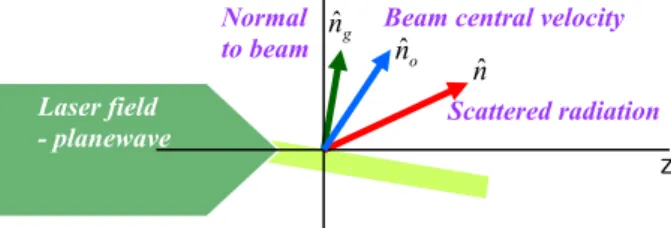
+ = ≈ m m m o o o o e R e R c e A A NF A φ φ θ θ ϕ ω ω π ω ω ω ω ρ ρ ρ (3)Figure 1 Schematic geometry for the scattering process. In above equation, N is the number of electrons,
( )
ωo
Aρ the scattered radiation field from an electron having central velocity [9], and F(k) a coherent factor for an initial distribution of electrons (Fig. 1). For a Gaussian electron beam, F(k)can be written as,
( )
(
)
(
)
(
)
⎥⎥ ⎥ ⎥ ⎥ ⎥ ⎥ ⎦ ⎤ ⎢ ⎢ ⎢ ⎢ ⎢ ⎢ ⎢ ⎣ ⎡ ⎪ ⎪ ⎭ ⎪⎪ ⎬ ⎫ ⎪ ⎪ ⎩ ⎪⎪ ⎨ ⎧ ⎟ ⎟ ⎠ ⎞ ⎜ ⎜ ⎝ ⎛ + + − + + + × + − × + = 2 2 2 2 2 2 2 2 2 2 2 2 2 2 2 2 2 2 2 2 ' 1 2 1 exp ' 1 1 gy gz gz gz gz gz gx gy gx gz N n l n R n N n N l T R k N N R N l l k k l k k F θ θ (4) oz o o oz o o g gy gz o g gx gz o g gz o oy oz o o ox oz o o oz w n p n n N n p n n N n p n n N n n N n p n n N n p n n N β β β β φ θ θ φ θ θ − = − ⋅ − = ⋅ = − ⋅ = − ⋅ = ⋅ = − ⋅ = − ⋅ = 1 , 1 ˆ 1 , ˆ ˆ , ˆ ˆ , ˆ ˆ , ˆ ˆ , ˆ ˆ , ˆ ˆ ρ(
)
(
)
(
2 2 2 2)
2 2 2 2 2 ' 2 2 2 2 2 2 ' 1 gz gz oy ox oz o n R n l T l N N N w T θ β σ γ σ + = ⎟ ⎟ ⎠ ⎞ ⎜ ⎜ ⎝ ⎛ + + − = Γwhere σ , Γ σ ,β' l, and R are beam energy spread in fraction, beam divergence, length, and radius, respectively. In deriving Eq. (4), different directions between beam direction (nˆo) and normal to beam front (nˆg) were used. The coherent factor shows that as the beam parameters get larger, the angular spectral intensity decreases from the high energy part.
The scattered radiations from an electron beam to be coherent, above coherent factor should be almost 1, or the exponent should approach to zero up to a frequency
z Normal
to beam Beam central velocity Scattered radiation Laser field - planewave nˆ o nˆ g nˆ Transactions of the Korean Nuclear Society Autumn Meeting
c
ω . In the x-z plane, Ngy =0, then above requirement leads to the following relations between angles,
(
)
(
)
0, cos 1 cos 1 sin sin = − − − + − = o o o o g g gx N θ β θ θ β θ θ θ (5)and restrictions on the beam parameters as
(
1)
1. ' 1 2 2 2 2 2 2 2 2 2 < + + gz gz c n T R k l k N l k θ (6) The physical meaning of Eqs. (5) and (6) is that time delays between electrons should be less than the pulse width generated by a single electron [8].3. Characteristics of Nonlinear scattered radiation In the case of circularly polarized laser pulse, Fig. 2 shows peak radiation direction (angle) and its intensity (radius) on electron direction (θ ) for o ao =3 and
10 =
o
γ .
Figure 2 For ao =3 and γo =10 , peak radiation directions and its intensities on initial electron direction. The arrows show that how the two peak (see Fig. 3) directions vary as the electron’s direction varies.
When o
o =0
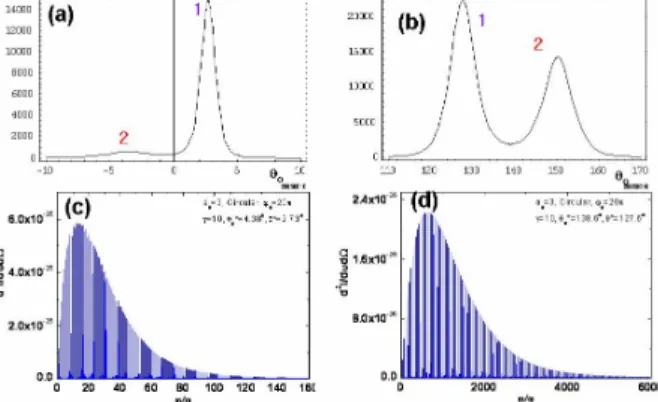
θ , two peak appears symmetric on z-axis. The harmonic spectrum at the peak direction for Figs. 3 (a) and (b) are plotted in (c) and (d), respectively. The spectral range in the case of a forward scattering shows no relativistic Doppler shift, but in the backward direction, due to relativistic Doppler shift, much higher photons are radiated.
Figure 3 Angular distributions of radiation intensity for (a) o
o =4.38
θ and (b) o o =138.6
θ . The (c) and (d) show angular spectra at peak 1 for the conditions of (a) and (b) respectively.
The dependence of peak directions and its peak spectral intensities on the relativistic gamma factor are plotted in Fig. 4. For small γ , forward radiation has higher intensity. But as the electron’s energy increases, backward scattering becomes dominant due to its additional relativistic Doppler effect, which scales as
2
γ . Thus for large γ , the intensity in backward scattering scales to ~γ , while forward scattering to 4
2 ~γ .
Figure 4 For ao =3 and γo =10, the variations of peak angular intensities are plotted in (a) for both forward and backward directions and directions are plotted in (b) and (c) for forward and backward scattering, respectively.
4. Conclusion
Analytical formulas to describe scattered radiation by interaction of a planewave laser pulse with an electron beam was developed, which include electron beam parameters. The nonlinear Thomson scattering was investigated which has very interesting angular distributions. Using the derived formulas, the condition for the coherent nonlinear Thomson scattering was obtained and its dependence on the beam parameters was observed. The effect of Gaussian laser beam was studied by a numerical method. This analysis shows that to make the nonlinear Thomson scattered radiation be coherent with an electron beam, a very small sized electron beam with a large laser beam size are required.
REFERENCES
[1] M.D.Perry and G. Mourou, Science 264, 917 (1004). [2] Pierre Agostini and Louis F DiMauro, Rep. Pro. Phys. 67,
813 (2004).
[3] P. M. Paul et al., Science 292, 1689 (2001). [4] E. Hertz et al., Phys Rev A 64, 051801 (2001).. [5] M. Hentschel et al., Nature 414, 509 (2001). [6] K. Lee et al., Opt. Express 11, 309 (2003). [7] K. Lee et al., Phys. Rev. E 67, 026502 (2003). [8] K. Lee et al., Phys. Plasmas 12, 043107 (2005). [9] E. Esarey et al., Phys. Rev. E 48, 3003 (1993).
[10] J. D. Jackson, Classical Electrodynamics 2nded. Chap. 14 (John Wiley and Sons, New York, 1975).