© Korean Powder Metallurgy Institute 784 -1. Introduction
The amorphous alloy, which has the excellent soft magnetic properties, is mass-produced by the shape of an ultra-thin ribbon, and utilization is progressing to magnetic cores, such as a transformer and a choking coil. However, ribbons usually limit shapes of cores to toroidally wound or stacked types, though substances such as ferrite or dust cores can be produced in various shapes.
We have already reported the Fe-based amorphous powders with good soft-magnetic properties produced by the new atomization process "Spinning Water Atomization Process ( SWAP )", which has rapid super-cooling rate, and industrial mass production was started from 2004 [1-2].
In this study, Co-based Amorphous powder, which substituted partially by chromium, was produced by the SWAP method and it evaluated about the powders characteristic and magnetic properties.
Furthermore, Co-based amorphous powder cores with glass binder were also produced using cold-pressing techniques.
2. Experimental and Result
Co-based ((Co0.95Fe0.05)1-xCrx)75Si15B10 (x = 0, 0.025, 0.05, 0.075) amorphous powders which substituted partially by chromium were prepared utilizing our new atomization process “SWAP”.
The particle size distribution of powder was estimated by sieving, and the morphology and the examination of structure were carried out by using scanning electron microscope (SEM) and X-ray diffractometry (XRD),
respectively. The magnetic property was measured by vibrating sample magnetometer (VSM).
Furthermore, the powder of this experiment, compared as Fe-based amorphous powder, produced by SWAP as comparison material.
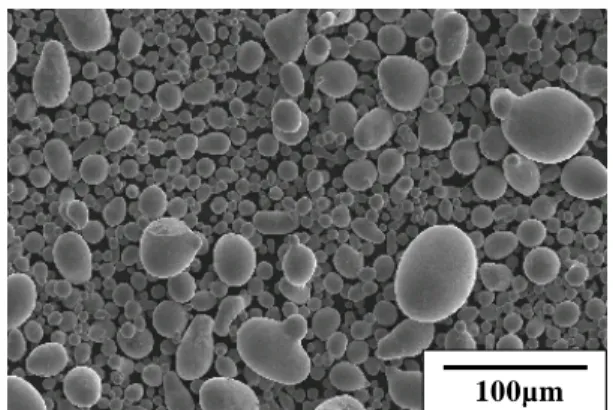
SEM of the powder sieved out to -150 micrometers was shown in Fig. 1.
The mean particle size of the powder evaluated by electromagnetism sieve equipment is about 30 to 35µm, and there was no difference by alloyed composition of the chromium substitution. In the result of XRD, the broad peak which shows single amorphous phase with the powder of the all alloyed composition, which substituted chromium, was observed.
Furthermore, Fig.2 shows the results of XRD of different particle sizes of ((Co0.95Fe0.05)0.95Cr0.05)75Si15B10 amorphous powder. The broad peak was observed at the particle size up to 500µm of the powder, which proved to be single
2006 POWDER METALLURGY World Congress
C09-01-2
Fig. 1. Morphology of the powder (≦150µm) produced by SWAP.
100µm
Soft-magnetic Characteristics of Co-based Amorphous Powder Produced
by Spinning Water Atomization Process (SWAP)
I. Otsuka1,a, K. Wada1,b, A. Watanabe1,c, T. Kadomura1,d, and M. Yagi2,e 1
EPSON ATMIX Corporation, 4-44 Kawaragi, Hachinohe 039-1161,Japan 2
Energy Electronics Lab., Sojo Univ.,4-22-1 Ikeda, Kumamoto 860-0082, Japan a
[email protected] Abstract
Co-based amorphous powder was produced by a new atomization process “Spinning Water Atomization Process (SWAP)”, having rapid super-cooling rate. The composition of the alloys was ((Co0.95Fe0.05)1-xCrx)75Si15B10 (x=0, 0.025, 0.05, 0.075).
The powders became the amorphous state even if particle size was up to about 500 µm. The coercive force of powders was about 0.35 - 0.7 Oe. Furthermore, Co-based amorphous powder cores with glass binders were made by cold-pressing and sintering methods. The initial permeability of the core in the frequency range up to 100 kHz was about 110, and the core loss at 100 kHz for Bm = 0.1 T was 350 kW/m3.
© Korean Powder Metallurgy Institute 785
-amorphous phase. This result suggests that an extremely high cooling rate was attained in SWAP.
Table 1 shows physical and magnetic properties for Co-based amorphous powders, and Fe-Co-based amorphous powder was shown as comparison. In the result of the crystallization temperature (Tx) measured by thermometric analysis equipment, it was observed that crystallization temperature increases from 772K to 816K by the increase in the amount of chromium substitution. The oxygen content which affects soft magnetism showed the low value of 200 ppm or less by adding chromium.
As for the magnetizing properties of powder, the tendency for coercive force (Hc) to decrease was observed as the increase of the amount of chromium substitution, it was a value of the lowest level of Hc = 0.34 Oe at the X = 0.075. The value of coercive force is about 1/2 to 1/4 of Fe-based amorphous powder, and Co-based amorphous powders attained the excellent soft magnetic properties. However, the tendency for magnetic flux density to decrease was observed as the amount of chromium substitution.
Table 1. Physical and magnetic properties of amorphous powders.
To obtain compacted amorphous powder cores, toroidal samples with glass binder were made by cold-pressing and sintering at relatively high temperature below crystallization temperature. The investigation of the state of coagulation in the amorphous core compacted with the
pressure of 2Gpa was carried with in the range from 573K to 783K in the sintering temperature.
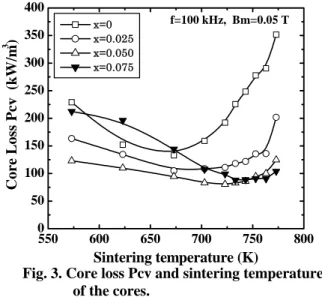
The relation between the core loss (Pcv) of amorphous powder cores and sintering temperature was shown in the Fig.3. The optimal sintering temperature has risen because vitrification temperature Tx rises as for the alloy that adds chromium from the view point of the core loss. The lowest core loss at f= 100 kHz for Bm= 0.05 T was about 80 kW/m3 at 723K.
Frequency dependence of the initial permeability µ’ at 1 kHz – 40 kHz for a driving field Hm = 5 mOe. It is found that the permeability in the frequency rang up to 1 MHz are approximately constant For the chromium substitution at x = 0.075, the permeability up to 1 MHz was 100-110.
3. Summary
We produced Co-base alloyed amorphous magnetic alloy powders by the new process “SWAP”. Even if the particle size was large, it was in amorphous condition and the excellent magnetic property was observed. The amorphous powders obtained have excellent soft magnetism, and their consolidated powder cores exhibited superior magnetic properties compared with Fe-based amorphous powder core.
4. References
1. M. Yagi, H. Nakanishi, I. Otsuka, H. Yamamoto, H. Satake and A. Shintani, J. Magn. Soc. Jpn., 26, 513-517 (2002)
2. M. Yagi, Journal of The Jpn. Soc. Appl. Electromagn. and Mechanics, vol.10, No.3 263 (2002)
30
40
50
60
70
80
In ten sit y (a rb .u n it)2θ
,Deg -45µm -500/+300µm -300/+212µm -212/+150µm -150/+106µm -106/+75µm Particle size: ((Co0.95Fe0.05)0.95Cr0.05)75Si15B10Fig. 2. X-ray diffraction patterns of Co-based amorphous powders. 550 600 650 700 750 800 0 50 100 150 200 250 300 350 400 Core Loss P cv (k W/m 3 ) Sintering temperature (K) x=0 x=0.025 x=0.050 x=0.075
Fig. 3. Core loss Pcv and sintering temperature of the cores. f=100 kHz, Bm=0.05 T 0 0.025 0.050 0.075 Tx K 772 783 796 816 816 O2 ppm 223 177 176 176 300 Hc Oe 0.67 0.54 0.51 0.34 1.2 Ms emu/g 81.1 72.3 58.7 46.0 145 ((Co0.95Fe0.05)1-xCrx)75Si15B10
x value of Cr ratio Fe-based
amorphous powder