2012 년도 한국멀티미디어학회 춘계학술발표대회 논문집 제 15 권 1 호
- 83 -
Step detection using accelerometer sensor on mobile phone
Hoang Minh Thang*, Vo Quang Viet*, Deokjai Choi***ECE, Chonnam National University, Gwangju, South Korea
E-mail : [email protected], [email protected], [email protected] Abstract
Gait analysis through wearable sensors is becoming a key research topic in mobile. In gait analysis, step detection is one of the most important processes that will lay down the foundation for future implementation. In this paper, we will propose a simpler algorithm to determine and analyze the steps using accelerometer sensor built-in mobile phone that physically placed into the trouser pocket. This is the location where most of mobile devices are. With 5 volunteers walking in 160 seconds, the accuracy of this method is approximately 98.5%.
1. Introduction
Gait analysis through wearable sensors is becoming a key research topic in mobile. By using gait analysis, developers could take the advantages of its technology to solve world class issues, including but not limited to identify individuals [1], analyze Parkinson’s diseases [2], or even recognize physical activities [3]. Over years, one can observed that sensors are becoming increasingly ubiquitous in consumer handheld devices. In gait analysis, step detection is one of the most important processes that will lay down the foundation for future implementation. Previous researches have been using accelerometer sensor attached to either foot or hip. However, these positions may not be accurate since they are not the most frequent locations of mobile devices. In this paper, we will propose a simpler algorithm to determine and analyze the steps with the accelerometer sensor physically placed into the trouser pocket of the user
2. Related Work
Previously, accelerometer signals have been known to be one of the most widely used for step detection [4]. In 2007, Ying et al provided three algorithms include Pan-Tompkins method, template matching method, and peak detection method based on 2-axial signal. Gerwin A. L. Meijer [5] also used a unique accelerometer sensor for step detection. In 2010, Tom Mikael Ahola [6] developed a method that counted steps when acceleration signal passed through a threshold. Most of the above methods used dedicated sensors. Therefore, it cannot be applied in a pervasive computing environment. From our best knowledge, no studies have been done on the data collected on mobile devices placed on trouser pocket. We
decided to select Google Nexus One Phone with built-in accelerometer sensor to process and analyze collected data.
3. Method
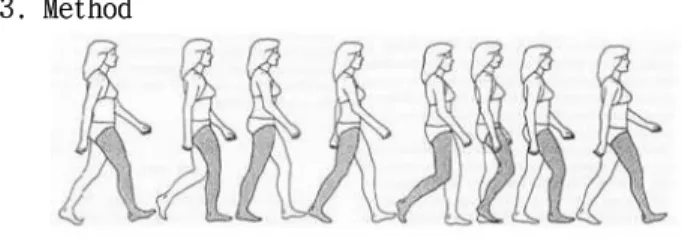
Fig. 1. Cycle of a step
According to figure 1, a step is determined when one foot touches the ground, and ends when that same foot touches the ground again. Raw data in this experiment is collected directly from mobile phone. This device is placed on the trouser pocket vertically as figure 2
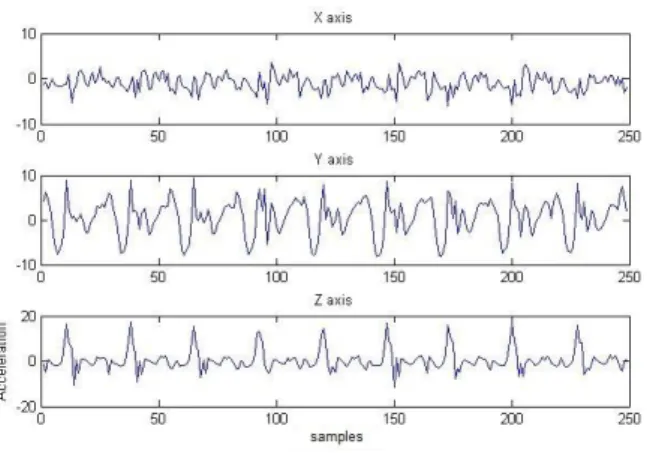
Fig. 2. Mounting position of mobile phone and coordinate system of the accelerometer sensor. When one foot touches the ground, z-axis signal peaks through the graph. These peaks have been recorded vividly in figure 3
2012 년도 한국멀티미디어학회 춘계학술발표대회 논문집 제 15 권 1 호
- 84 - Fig. 3. 3D acceleration signal
A detail description of milestones in step detection will be explained in the following
1. Time Interpolation
Because of the built-in accelerometer on mobile phone is simpler than other wearable sensors, the sampling rate is rather low and time intervals between two consecutive acceleration values will not be equal. Time interpolation is required to ensure that the time-interval between two sample-points will be fixed.
2. Signal filtering
When accelerometer samples movement data, some noises will inevitably get collected. This additional noise could have come from any of a number of sources (e.g., idle orientation shifts, screen taps, bumps on the road while walking) Therefore, a digital filter needs to be designed to eliminate noises. In our experiment, multi-level wavelet decomposition and reconstruction method are adopted to filter signal.
During experiment, we detected that Daubechies wavelet [8] of order 6 at level 2 removes the noise more effectively than others. Therefore, we will choose this wavelet transform for noise reduction in the raw signal.
Fig. 4. Noise filtering on z-axis 3. Step detection
Per observation, steps are displayed clearly on the z-axis signal through the peaks displayed in figure 4. The algorithm to determine those peaks is proposed as follow:
Assumes the signal after applying noise filter is
denoted as D(n). We obtain an array A that contains data points of D(n) in time-series domain. The peak value is determined when its previous one and next one are lower than it. Then, threshold T will be computed to determine the real peaks using the following
T = mean + 1/3sd (1)
Where sd is the standard deviation of all peaks which is computed by
(2)
4. Experiment
Google Nexus One phone is used to collect data. The sampling rate is approximately 28Hz by setting sensor delay function to fastest mode. Gait signal of 5 volunteers is collected to analyze. Each user will be asked to walk with normal speed on 32 seconds in 5 times. The mobile phone is placed vertically on the pocket of volunteers exactly as figure 2. The accuracy is approximately 98.5%
5. Conclusion
Step detection is undoubtedly one of the most important sub-processes in gait analysis. In this paper, we introduced a new lightweight method for a robust and accurate estimation of the step frequency, especially when mobile device was placed on user pocket. Furthermore, we would like to investigate step detection on a more extensive case where the device could be positioned anywhere on the user body. Gait analysis is also the future work to identify individuals based on features extraction on each step.
Acknowledgement
“This research was supported by the MKE (The Ministry of Knowledge Economy), Korea, under the ITRC (Information Technology Research Center) support program supervised by the NIPA (National IT Industry Promotion Agency)” (NIPA-2012-H0301-12-3005).
Reference
[1] Ailisto, Heikki; Lindholm, Mikko; Mäntyjärvi, Jani; Vildjiounaite, Elena; Mäkelä, Satu-Marja; “Identifying people from gait pattern with accelerometers”, Proceedings of SPIE - The International Society for Optical Engineering, 2005, v. 5779, p 7-14.
[2] Jonas Standaert, Wouter Speybrouck, Implementing real-time step detection algorithm
2012 년도 한국멀티미디어학회 춘계학술발표대회 논문집 제 15 권 1 호
- 85 - in EyesWeb environment, Master thesis, June 2011 [3] Narayanan C. Krishnan, Sethuraman Panchanathan, Analysis of low resolution accelerometer data for continuous human activity recognition, ICASSP 2008
[4] H. Ying, C. Silex, A. Schnitzer, S. Leonhardt, M.Schiek, “Automatic Step Detection in the accelerometer Signal,” 4th International Workshop on Wearable and Implantable Body Sensor Networks, Springer Berlin Heidelberg, 2007
[5] Gerwin A. L. Meijer, Klass R. Westerterp, Francois M. H. Verhoeven, Hans B. M. Koper, Foppe ten Hoor, Methods to Assess Physical Activity with Special Reference to Motion Sensors and Accelerometers, IEEE transactions on biomedical engineering, Vol. 38, March 1991
[6] Tom Mikael Ahola, Pedometer for Running Activity Using Accelerometer Sensors on the Wrist, Short Report, Nokia Research Center, 2010
[7] Ingrid Daubechies, The wavelet transform, time-frequency localization and signal analysis, IEEE transaction on information theory, Vol. 36, No. 5, September 1990