An Ecological Approach to an Intelligent Healthscape
for a Medical Service Robot
Jieun Han
1, Hyo-Jin Kang
2, Gyu Hyun Kwon
11
Graduate School of Technology & Innovation Management, Hanyang University, Seoul, Korea
2Department of Service Design Engineering, Sungshin Women's University, Korea
[email protected]
Abstract
Integrated Nursing Care Service has been conducted in Korea since 2013, and there are several suggestions to enhance the medical staff’s efficiency. This research aims to develop a model of intelligent healthscape to delineate ecological constraints of robotic environment. A qualitative study was implemented and video analyses were conducted. To support the main theme, we interpreted environmental elements as smart servicescape we developed. Given that a medical robot service is implemented in complex adaptive systems having diversified contextual and environmental factors of medical services, this ecological approach would be appropriate for understanding medical service experiences. Consequently, the intelligent healthscape from an ecological perspective could be applied to develop a design framework for new medical services.
Keywords: Ecological approach, Intelligent healthscape, Medical staff
Introduction
To reduce the burden of nursing care for patients and to provide high-quality medical services, the Integrated Nursing Care Service started in 2013. With the implementation of this care service, it is important to supplement nurses' workforce or environment to enable nurses to work efficiently in the long-term. This project aims to develop a robotic service system that efficiently supports nursing staff. It aims to provide a Co-Care service that provides cooperative, comprehensive, and connected care for patients and nurses. There are three main parts of this system: a modular robot system (PAR), an IPT based smart room (IPR), and a nursing service control system (tNRS).
Through this study, we attempt to suggest an understanding of the intelligent healthscape for complex and technology-based medical service. With Co-Care service, Gibson and Vicente’s ecological perspective is adapted to interpret the environmental elements in the intelligent healthscape. Through this study, we wish to take a backward glance at the analysis of highly advanced technological environments.
Co-Care service
The Power Assist Robot (PAR) is a combined robotic system to easily support nursing care or patient movement. The basic power support module of PAR, called PAM (the Power Assist Module), connects with nursing carts or patient walkers to provide physical aid. An IoT-based Patient Room (IPR) can monitor the movement of patients and robots in real time using IoT technology. The Total Nursing Robot System (tNRS) team is developing software to construct all the information about nursing work, patient assessment,
patient monitoring, robot status, and more. Thanks to tNRS, nurses can easily search and input patients’ and robots’ information just by carrying a portable pad.
Eight institutions implement this Co-Care system, and our lab has developed a service scenario, a user interface design for tNRS, and a suggested blueprint of the service environment for Co-Care.
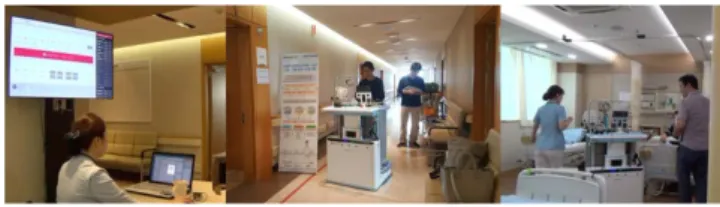
Because this kind of integrated nursing robot service does not exist yet in Korea, we conducted the clinical test in a real general hospital ward. However, we could realize that the current ward environment is highly insufficient to support the Co-Care system. This is not just a matter of certain dimensions or elements; the highly complex and technology-based system’s environment should be approached with different viewpoints from the current ward environment.
Fig 1. clinical testing for Co-care service
Intelligent healthscape for Co-Care service
The appropriate environment for Co-Care service can be explained as intelligent healthscape [1], which is an “environment where intelligent technology is deeply
incorporated in the healthcare service.” Various
interactions between stakeholders, medical service robots, or environmental elements can be generated in this intelligent healthscape. The proposed dimensions to evaluate the intelligent healthscape are advanced
1H3-7
technology, safety, ambience, layout accessibility, and sociality. This definition enables us to recognize the technology-based service environment and complex infrastructure, and to recognize the need for viewpoints that are different from the current medical environment.
Identifying the Requirements for Co-Care
Service
Co-Care is a multidisciplinary and integrated medical service based on PAM robot, therefore we visualized technical flow map as shown in Figure 2.
Flow map starts from PAM (assistive robot), IPR system and Human (patients and nurse). PAM is designed as an autonomous robot which can move and find a way in hospital, and can combine with smart cart or smart walker (PAR). This assistive robot can be only operated by nurse, so patients can rely their body on PAR and get physical assistance to walk or move to other ward or operating room. Through RFID tagging, PAM recognizes one or multi users and provide suitable analytics or data (e.g., moving path, vital sign, medication record)
IPR system means physical ward environment based on IoT system with bluetooth wireless connection. Q-bit system was adapted at the ceiling of each ward and nurse station, so moving path and real-time location of PAM and humans can be detected. Infrared cameras are installed at the ceiling of ward, and lying position and moving speed of high risk patients are monitored. To protect privacy, we collect data of only the silhouette of patients using infrared cameras in the range of smart bed.
All patients and nurses are identified with RFID tagging and additional devices which examine the states
of patients such as falling down and moving to a certain direction. These are adhered to the only high risk patients.
Through these devices and sensors, All the collected and analyzed data are visualized in the additional EMR which called tNRS, a core backbone system of Co-Care service. If the situation needs instant medical treatment by nurses, the warning alarm pops up in the clinical dashboard installed in the hallway of patients’ room. Through this process, we attempted to ensure patient safety and effective job outcomes of nurse.
Understanding Ecological Approach for
integrated robot service
A series of qualitative researches was conducted to identify dominant dimensions of the intelligent servicescape to constraint service encounters in the context of medical services. The previous study based on video analysis highlighted the usability aspect in the same contexts [2,3]. Prior study analyzed a simulated user test of the nurse assistive robot from the servicescape perspective to identify key issues usually not considered in conventional robot-focused research [2]. Subsequent study dealt with situation awareness theory with the series of interviews with 6 nurses to derive significant attributes [3]. In addition, half-day workshop was held to comprehend the integrated points of view for analyzing the service environment. We adapted an ecological approach that originated from Gibson’s ecological psychology theory [4] and considers environmental and social factors as parts of a system. According to this approach, individuals are surrounded by a complex combination of physical and social variables that operate in direct and indirect ways Fig 2. Ecosystem of Co-Care Service
J.Han et al.
to influence human activities [5,6]. Vicente claimed that a work analysis of complex sociotechnical systems needs to start with environmental constraints [7].
Vicente classified the constraints of human works into (1) cognitive constraints relevant to human cognitive systems, such as mental models, and (2) environment constraints that constitute the context in which humans are situated, such as their physical and social realities [7]. The dominant viewpoint in psychology and in HCI has been the cognitivist approach that emphasizes cognitive mental models, such as the sequential flow of an instructional service itinerary. Alternatively, the ecological approach analyzes environmental constraints and enables individuals to understand the real context that may shape actual behaviors (i.e., behavior-shaping constraints) [8] and allows them to deal with unexpected and variable situations [7,9]. Given that medical robot service is a complex adaptive system in which diversified and undefined behavioral patterns can be generated by complex combinations of contextual and environmental factors, the ecological approach is appropriate for understanding service experiences by identifying the intelligent healthscape.
Based on the workshop, we visualized an ecological map of Intelligent Healthscape, which can be generalized the relationship between robot, human and IoT system (Figure 3). The name of attributes and basic categories followed our previous study, Smart Servicescape Wheel [9]. This map is generalized to consider diverse stakeholder in the point of patient (doctors, nurses, and other patients).
Extrinsic factor of servicescape can be described as physical and social layer. Physical layer is composed by human states, environmental cues, and hardware components. Smart and wearable devices not only detect the condition of human body but also monitor ambient states through diverse sensors of IoT system. From these kinds of "Things", abundant data are generalized, collected, processed, and analyzed, so refined valuable data are visualized to human as "information." This continuous and repetitive cycle formed as intelligent healthcare service as Co-Care service. Through these relationships, social interactions between stakeholders are generated or certain service relationships are implemented especially in medical context. Robotics not only perform individual task (e.g., power assisted, moving) but also communicate with other IoT device and environment in real time. Imperceptible environment which is called datascape would be boaden and extensive in the next era. As shown in this Figure 3, we could confirm that the presence of robotics plays a role of mediator in highly advanced medical environment and this tendency will be more noticeable in IoT or IoE environment.
Discussion and conclusion
The study started with a simple question: How can we comprehend and explain the complex technology-based environment in the medical robot service? We attempted to answer this question by suggesting an ecological perspective. In accordance with this viewpoint change, the environment where the medical service robot would be integrated, namely the intelligent healthscape, is highlighted. We examined Fig 3. Ecological map of Intelligent Healthscape (Co-Care Service)
Gibson’s ecological psychology theory and Vicente's interpretation of environmental constraints. This perspective provides a better theoretical framework to identify the possible environmental factors in human-robot relationships. This understanding can also apply to the design of a new highly advanced and complex environment with a diverse system of stakeholders. In the early stage of medical robot service diffusion, we may consider technological innovation and the appropriate environment that can afford expected and unexpected interactions between stakeholders and medical robots [10]. The limitations of this research are that it did not suggest environmental constraints in Co-Care service, and it focuses on single empirical case. We will add the relations with regulations and institutions to more cases in future studies. Further studies should specify and visualize environmental constraints that are adequate for intelligent healthscapes with a medical service robot.
Acknowledgement
This work was supported by the Development of Robot Systems for Total Nursing Service project, Ministry of Trade, Industry and Energy (MOTIE), Republic of Korea (No.10052358).
Contact
More information is available at: http://imagine.hanyang.ac.kr
References
[1] J Han, HJ Kang, GH Kwon (2017). Understanding the servicescape of nurse assistive robot: The perspective of healthcare service experience. Ubiquitous Robots and Ambient Intelligence (URAI), 2017 14th International Conference on: IEEE.
[2] J Han, HJ Kang, GH Kwon (2018). A measurement for evaluating the environmental quality of advanced healthcare facilities: Intelligent healthscape quality for medical staff, Building and Environment, pp. 532-541 [3] JJ Gibson (2014). The Ecological Approach to Visual Perception. New York: Psychology Press. [4] U Bronfenbrenner (1981). The Ecology of Human Development: Experiments By Nature And Design. Cambridge, MA: Harvard University Press.
[5] M Bonnes, G Secchiaroli (1995). Environmental Psychology: A Psycho-Social Introduction. London, UK: SAGE Publications.
[6] KJ Vicente (1999). Cognitive Work Analysis: Toward Safe, Productive, And Healthy Computer-Based Work. Mahwah, NJ: Taylor & Francis, Inc.
[7] J Rasmussen, AM Pejtersen, K Schmidt (1990). Taxonomy for cognitive work analysis. Roskilde, Denmark: Risø National Laboratory.
[8] HJ Kang, J Han, GH Kwon (2018). An Ecological Approach to Smart Homes for Health Care Services: Conceptual Framework of a Smart Servicescape Wheel. JMIR Mhealth Uhealth. 2019;7(2):e12425.
[9] J Han, HJ Kang, GH Kwon (2018). A systematic
underpinning and framing of the servicescape: reflections on future challenges in healthcare services. Int J Environ Res Public Health. [FREE Full text] [doi: 10.3390/ijerph15030509]